ai-powered-markdown-translatorTranslated article from fr to en with gpt-5.4-mini.
August 4, 2026 is marked by six major announcements: Warp is splitting its code agent into a standalone CLI, GitHub is scheduling Spark’s retirement in favor of Copilot, OpenAI is detailing the complete rebuild of ChatGPT’s voice stack, Black Forest Labs is launching FLUX 3 Video, NVIDIA is releasing its open Alpamayo 2 Super model for autonomous vehicles, and Mistral is unveiling Shieldstral, its open-weight safety classifier. Around these releases, Cursor, Amp, DeepSeek, Liquid AI, Google, GitHub Copilot, Pika, and the Open Secure AI Alliance are multiplying updates.
Warp launches Agent CLI, an autonomous code agent for any terminal
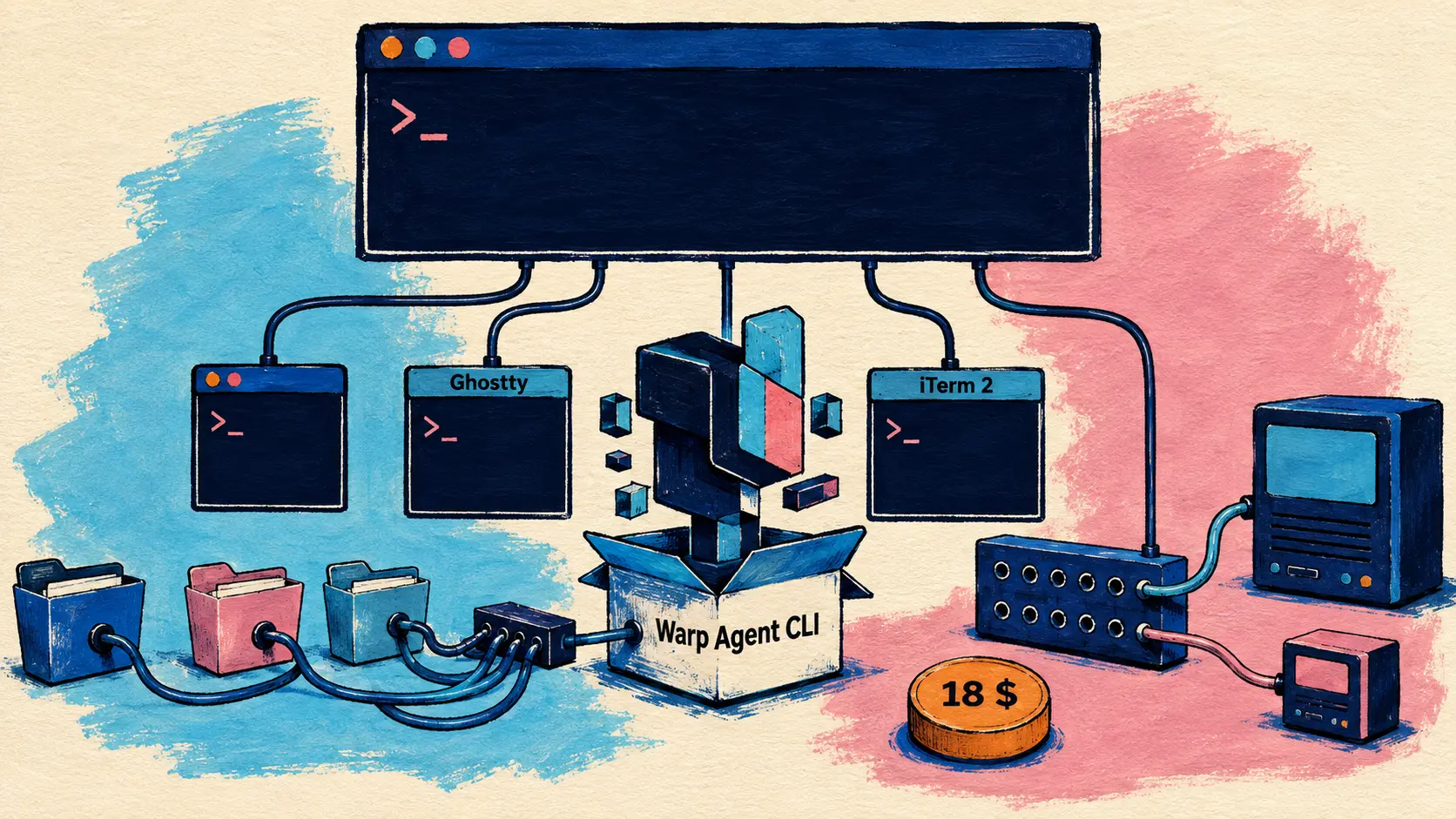
August 4 — Warp is splitting its code agent out of the Warp terminal and offering it as a standalone CLI, installable in any emulator: Ghostty, iTerm 2, VS Code, or native Windows, Mac, and Linux terminals. The architecture relies on a layer that multiplexes PTY connections between the agent and the shell, comparable to tmux, which enables persistent sessions where you can change directories (cd) without losing the agent’s context, remote control without installing a binary on the target machine, and control of full-screen interactive applications such as vim, sqlite, a Python REPL, or htop.
On the features side, the agent automatically distinguishes a shell command from a natural-language prompt, completes arguments and flags, and routes the task to different models depending on complexity — frontier models as well as open-weight models, with YAML-customizable routers. It also handles multi-agent orchestration and cloud handoff.
| Supported environment | Detail |
|---|---|
| Compatible terminals | Ghostty, iTerm 2, VS Code, native Windows/Mac/Linux terminals |
| Monthly subscription | $18/month, $20 of inference credit included |
| Pay-as-you-go credits | starting at $10 |
| Other options | OpenAI-compatible API key, or SuperGrok subscription |
This launch positions Warp against competing CLI agents (Codex CLI, Claude Code, Gemini CLI) by betting on deep shell integration and cloud orchestration rather than a simple model wrapper.
🔗 Warp Blog — Introducing the Warp Agent CLI
GitHub Spark no longer accepts new users, retirement scheduled
August 4 — GitHub is gradually retiring Spark, its natural-language app-building platform launched with a dedicated inference engine (llm()). Since August 4, the creation of new accounts and new applications has been closed.
| Retirement milestone | Date |
|---|---|
| End of new accounts and apps | August 4, 2026 |
| Deadline to export code | August 31, 2026 |
Retirement of GitHub Models (engine llm()) | July 30, 2026 (already effective) |
Existing users have until August 31 to export their app code, via the Spark workbench menu (button … → Create repository). Applications already deployed will continue to work after that date, but those using the llm() feature will have to switch to another inference provider, since GitHub Models — which powered it — was itself retired at the end of July.
GitHub justifies the decision by explaining that AI models and agentic development tools have made significant progress since Spark’s launch, and that creators now prefer integrated workflows — Copilot in VS Code, Copilot CLI, or the GitHub Copilot app — rather than a separate prototyping platform. It is a signal of consolidation: GitHub is closing down a distinct “vibe coding” product to focus its AI offering around Copilot.
🔗 GitHub Changelog — Upcoming deprecation of GitHub Spark
GPT-Live: OpenAI rebuilds ChatGPT’s voice architecture in six months
August 3 — OpenAI details the third generation of its voice system, GPT-Live, and explains why the previous architecture — based on a “turn detector” tasked with guessing when the user had finished speaking — limited the naturalness of the conversation: guessing too early cuts people off, guessing too late makes the response feel sluggish. GPT-Live removes this detector from the audio path: the voice model is full-duplex, capable of listening and speaking at the same time. When deeper reasoning or an tool call is needed, GPT-Live consults frontier models (such as GPT-5.5) asynchronously, without interrupting the conversation.
On the engineering side, OpenAI rewrote the media frontend and inference logic in Go, replacing a Python asyncio implementation, which improved frame delivery consistency to the point that the new system’s p95 matches the old system’s p50. The transport relies on WebRTC, which absorbs packet loss and clock drift by subtly stretching the audio. Concrete result: the start of a voice session has gone from six network round trips to just one. This architecture already powers new ChatGPT Voice capabilities, including computer control from the desktop app.
GPT-Live can listen while it speaks. To make that feel natural at ChatGPT scale, we rebuilt the voice stack from client to model. This new architecture keeps audio flowing continuously, so deeper reasoning and tool use don’t interrupt the conversation. — @OpenAI on X
🔗 How we built a realtime system for responsive voice AI in six months
FLUX 3 Video (Black Forest Labs): official launch, available in API and on Runway
August 4 — Black Forest Labs officially launches FLUX 3 Video after the preview shown on July 30. The model generates clips up to 20 seconds long in native 720p and 1080p, with synchronized native audio (effects, ambience, voice, precise lip-sync) and dialogue in about fifteen languages, including English, Chinese, Spanish, French, German, and Japanese. It handles text-to-video, image-to-video with a start image, end image, or multiple keyframes in sequence, video continuation, and embedded text that blends naturally into the scene.
Draft mode lets users quickly explore creative directions at lower cost, before a final full-quality render that preserves the subjects, composition, and motion from the approved preview:
| Production step | Price |
|---|---|
| Fast preview (Draft mode) | $0.06 per second |
| Full-quality final render | from $0.17 per second |
| Maximum duration | 20 seconds, native 1080p |
The model is available now via the BFL API and from selected partners — Runway integrated it on the very day of launch. Black Forest Labs says the next steps include better controllability, multimodal references (image, video, audio), a FLUX 3 Image model, and an open-weight variant called FLUX 3 Dev.
🔗 @bfl_ai on X (FLUX 3 Video announcement)
NVIDIA Alpamayo 2 Super, open reasoning model for autonomous vehicles
August 4 — NVIDIA launches Alpamayo 2 Super, an open vision-language-action (VLA) reasoning model for robotaxis, autonomous vehicles, trucks, and shuttles. It combines an NVIDIA Cosmos 3 Super reasoner with a diffusion-based action expert, post-trained with reinforcement learning, with 360-degree camera coverage.
| Model component | Size |
|---|---|
| Cosmos 3 Super reasoner | 32 billion parameters |
| Diffusion action expert | 2 billion parameters |
| Alpamayo 2 Super total | 34 billion parameters |
For each driving scenario, the model produces five coupled outputs: planned trajectory, chain-of-causality reasoning trace, meta-action (yield, change lanes, stop), self-labeled reasoning data for training, and answers to visual questions grounded in the camera image. On the LingoQA benchmark, NVIDIA claims first place, beating GPT-4o by 23.2 points. The model is released under the permissive OpenMDW-1.1 license, with weights and inference code available immediately on Hugging Face, for commercial deployment without additional permission.
Today, we’re launching Alpamayo 2 Super, our frontier open reasoning model for autonomous vehicles. Beyond seeing, Alpamayo understands and reasons through the complex world - thinks before it acts. […] We’re releasing it for commercial use under OpenMDW-1.1 so teams can inspect it, fine-tune it and deploy it—open models advance safety and security. The next wave of AI is robotics—and it starts with autonomous vehicles. — @JensenHuang on X
🔗 NVIDIA Blog — Alpamayo 2 Super, open model now available
Shieldstral: Mistral releases a 3B open-weight moderation model
August 4 — Mistral launches Shieldstral, a 3-billion-parameter content moderation model, released as open weights under the Apache 2.0 license. Unlike traditional classifiers with fixed categories, Shieldstral treats moderation as a binary question-answering task: the moderation policy is supplied in natural language at inference time, which makes it adaptable without retraining. The model is multimodal (text and image) and returns a calibrated, continuous safety score rather than a discrete label.
| Covered function | Detail |
|---|---|
| Prompt classification and response moderation | Detects problematic content in both input and output |
| Refusal detection | Identifies when an assistant declines a request |
| Toxicity detection | Text and image |
| Adaptive policy evaluation | Natural-language queries, no retraining |
Mistral says Shieldstral matches or outperforms open guardrail models up to 7 times larger on text safety, refusal detection, policy adaptability, and multimodal evaluation. The model runs on a single 16 GB NVIDIA GPU, making it accessible for standard infrastructure, including local deployment. Shieldstral is also the first member of the Open Secure AI Alliance, the industry alliance whose new SAFE guidelines are detailed later in this article. The weights are available on Hugging Face (mistralai/Shieldstral-1.0-3B).
Code tools: Cursor, Amp, and Warp speed up
Cursor open-sources Mixture-of-Kittens (MoK), its MoE training megakernel
August 4 — Cursor opensources Mixture-of-Kittens (MoK), a training “megakernel” for Mixture-of-Experts architectures designed for NVIDIA NVL72 nodes. The kernel fuses all MoE-related communication and computation into a single deterministic operation. MoK is already powering production training at Cursor, across tens of thousands of GPUs.
We’re open-sourcing Mixture-of-Kittens (MoK), our MoE training megakernel for NVL72s. It fuses all Mixture-of-Experts communication and computation into a single, fully deterministic kernel, and runs up to 2.37x faster than the strongest public baselines. — @cursor_ai on X
Measured gain at Cursor: 1.41x end-to-end training throughput compared with their previous DeepEP-based stack.
Amp lets you attach any file to its orbs
August 4 — Amp’s “orbs,” its cloud agents, now accept any file as an attachment: videos, logs, PDFs, spreadsheets, datasets. The team cites several concrete uses: recording an app’s screen so Amp can fix what it sees, debugging from log files, turning spreadsheets into interactive websites, or transcribing audio and video. The announcement does not specify any file-size limit or exact formats beyond these examples.
Warp gives cloud agents the ability to verify their work through computer control (computer use)
August 3-4 — The fourth installment in Warp’s “cloud software factory” series: a new verify-behavior skill gives cloud agents mouse/keyboard control to reproduce reported bugs ( reproduce mode ) or verify that a feature matches its specification ( verify mode ), with video capture preferred. A Warp engineer confirms the rollout internally, with three cited uses: reproducing bugs with a fix and before/after video, walking through the onboarding flow like a new user, and posting a video demo in Slack or in a pull request to quickly validate an interface.
🔗 Warp Blog — Computer use verification
GitHub Copilot: four new features for developers and teams
Customizable reasoning level for the cloud agent
August 3 — When delegating a task to the Copilot cloud agent, it is now possible to choose the model’s reasoning level, for models that support it. A higher level can improve responses to complex problems, at the cost of higher token usage. Available on all paid Copilot plans: Pro, Pro+, Business, Enterprise, and Max.
🔗 GitHub Changelog — Customize the reasoning level
Trigger Copilot automations from comments
August 3 — Copilot cloud agent automations can now be triggered from an issue or pull request comment, configurable from a repository’s Agents → Automations tab. Three cited use cases: generating documentation from a PR comment, analyzing a stack trace reported in an issue comment, or automatically creating follow-up tasks. Available for Copilot Pro, Pro+, Max, Business, and Enterprise (with admin-side policy activation for enterprise accounts).
🔗 GitHub Changelog — Trigger Copilot automations with comments
How GitHub’s legal team uses Copilot CLI
August 4 — Two internal GitHub lawyers, with no development experience, built tools with Copilot CLI. Ngandu Kasuku (Principal Product Counsel) created terms-ai, a repository centralizing drafting instructions and contract templates, cutting review and drafting time by about half. Jesse Geraci (Online Safety Counsel) developed an application to analyze source code and assess DMCA notices, later expanded to license compliance and NDA risk assessment.
🔗 GitHub Blog — How the GitHub legal team used Copilot CLI
Automatic activation of code coverage, AI-generated
August 4 — In a repository’s Code Quality settings, a new AI agent automatically generates a code coverage workflow: it builds the project, runs the tests, produces a coverage report, and sends it to GitHub, with minimum permissions by default. The user gets a pull request ready to review and merge. Feature in public preview, available on github.com, GitHub Enterprise Cloud, and Team (not yet on Enterprise Server).
🔗 GitHub Changelog — Code coverage automatic enablement
Open models and production availability
DeepSeek V4 Flash available in production on Together AI
August 4 — DeepSeek V4 Flash, DeepSeek’s fast model launched at the end of July, is now available in production on Together AI, with a high-throughput deployment path for coding, tool use, and long-running agents. Together AI highlights stronger coding on terminal and full-stack tasks, three levels of reasoning effort (low, high, maximum), and a speculative decoding method called DSpark to speed up generation.
Liquid AI releases LFM2.5-2.6B, compact model for 100% local agents
August 4 — Liquid AI releases LFM2.5-2.6B, a 2.6 billion-parameter model designed for agents running entirely locally, from laptop to phone, with a 128K-token context window. Compared with models 2 to 4 times larger, it ranks first in instruction following (51.87% on AIME25, 59.41% on LiveCodeBench) and ahead of almost every tested model on tool use. Performance-wise: 220 tokens/second on an Apple M5 Max, 113 tokens/second on an AMD Ryzen, about 30 tokens/second on phone. Available on Hugging Face, compatible with llama.cpp, MLX, vLLM, SGLang, and ONNX.
🔗 Hugging Face Blog — LFM2.5-2.6B
Google and Kaggle share the results of their free AI agents course
August 3 — Google and Kaggle publish the results of their free five-day course “AI Agents Intensive: Vibe Coding,” dedicated to designing and deploying AI agents in production conditions. Reported figures: 353,000 registered participants, 392,000 people active on Kaggle’s Discord during the session, and more than 6,000 final project submissions from more than 12,000 participants. Google recalls that its intensive courses with Kaggle have brought together more than 2 million learners in total since 2024. All content remains available for self-paced learning on Kaggle Learn.
🔗 Google Blog — Inside our 353,000-person vibe coding course
Media generation and agentic ecosystem security
Pika launches API Club, aggregator of more than 100 models
August 4 — Pika Labs launches API Club, a $10-per-month subscription giving access to more than 100 media generation models (video, image, audio, LLM) via a single API, with significant discounts compared with providers like Fal or Runway Dev: up to 87% on Seedance 2.0, up to 50% on MiniMax H3, up to 25% on GPT Image 2. Pika says it negotiated better prices with providers and kept its own margin minimal, in reaction to aggregation platforms it accuses of applying markups up to 3x higher. This launch repositions Pika, known as a consumer video generation tool, as an API aggregator for developers and creators.
HeyGen launches automated video formats for real estate
August 3 — HeyGen unveils “HeyGen for Real Estate,” a series of video formats for real estate agents, each reusing the user’s personal avatar. The format of the day, “Hosted Home Tour,” generates a guided property walkthrough: the user pastes an listing link (Zillow), optionally adds a script, and the tool automatically produces a video where the avatar presents the tour using the listing’s information. Other formats in the series include “Market Update” and “Listing Spotlight.”
The Open Secure AI Alliance presents its SAFE guidelines at Black Hat
August 4 — On the occasion of the Black Hat 2026 conference in Las Vegas, the Open Secure AI Alliance — a coalition led by NVIDIA now bringing together more than 120 organizations (Cisco, CrowdStrike, Hugging Face, Red Hat, Microsoft, Amazon, among others) — announces several contributions. The Linux Foundation is publishing a request for comments on SAFE (Shared AI Findings Exchange), a proposed framework for collecting and analyzing AI security incidents confidentially, identifying recurring control failures, and publishing evidence-based recommendations — a collective defense approach inspired by threat intelligence sharing.
Amazon joins the alliance and contributes its Strands Agents toolkit as well as the Cedar authorization language. Uber open-sources ADR (Agentic AI Detection and Response), a framework that handles more than 200,000 daily agent sessions in production. Mistral contributes Shieldstral, presented earlier in this article and now the alliance’s first model member.
🔗 NVIDIA Blog — Open Secure AI Alliance contributions
OpenAI: response to Apple and new education plugins
Apple is getting this wrong: OpenAI responds to Apple’s lawsuit
August 3 — OpenAI publishes a detailed response to the complaint filed by Apple, addressing each of the three parts of the allegations point by point. On the timeline of contacts, OpenAI says Apple now acknowledges that its outside lawyers wrote to the wrong person, and that an alleged discussion with OpenAI’s General Counsel never took place. In the case of a former employee accused of accessing confidential information after leaving (last day at Apple: January 22, 2026), OpenAI publishes iMessage exchanges showing that Apple employees asked him for help locating files. In the case of a former executive who spent 24 years at Apple and is suspected of having sought to use trade secrets, OpenAI says no confidential Apple information was requested or used. OpenAI describes Apple’s request for a preliminary injunction as “based on false information and completely unnecessary.”
🔗 OpenAI — Apple is getting this wrong
Three new education plugins for ChatGPT Work and Codex
August 4 — For the back-to-school season, OpenAI is launching three plugins for ChatGPT Edu and ChatGPT for Teachers deployments: K-12 Educator (differentiated resources for primary/secondary education), College Educator (course design and LMS export for higher education), and College Student (guided tutoring, study sheets, quizzes based on the sources chosen by the student). The article recalls OpenAI’s partnership with the American Federation of Teachers, a five-year initiative aimed at training 400,000 U.S. K-12 teachers in the use of AI.
🔗 OpenAI — Learn and teach with ChatGPT Work and Codex
Briefs
- Devin Fusion improves intelligence by 4% and costs 27% less — Cognition improves the harness and models of Devin Fusion on the internal FrontierCode 1.1 benchmark, available immediately in Devin Cloud. 🔗 source
- Sakana AI joins AIRoA — The company becomes a member of the Japanese AI robotics association, for collaboration from its RSI Lab on world models and physical AI. 🔗 source
- llama-macos, highlighted by the Hugging Face team — macOS widget (
brew install --cask llama-app) that recommends models based on the machine and launches a llama.cpp server with a web interface. 🔗 source - Finer control over what Copilot can access — GitHub announces increased control over Copilot access, with no detailed changelog attached for now. 🔗 source
- Enhanced documentation on local sandboxing for Copilot CLI — GitHub highlights its documentation on enabling and configuring local sandboxing in the terminal. 🔗 source
- Air editor adds GitHub Copilot as a custom agent via ACP — The third-party Air tool now supports custom agents via Agent Client Protocol, with a guide for configuring Copilot. 🔗 source
- Team specialization for managed settings — Enterprise administrators can target specific teams with dedicated configuration files. 🔗 source
- Custom default code scanning configuration at scale — A new repository property makes it possible to apply a custom CodeQL configuration to the default setup. 🔗 source
- Retirement of the Copilot Billing Preview app — Copilot spending is now managed directly in GitHub billing settings. 🔗 source
- Customizing Dependabot branch names — New options in
dependabot.ymlto define the prefix, length, and separators of branch names created by Dependabot. 🔗 source - CodeQL 2.26.2 adds support for Swift 6.3.3 and Kotlin 2.4.10 — Update to GitHub’s static analysis engine. 🔗 source
- The Triage role can now bypass issue creation restrictions — Users with this role can create issues even when a repository restricts that action to collaborators. 🔗 source
- Wan (Alibaba) — Camera-to-Image — New capability in Wan’s real-time suite: the camera instantly turns the real environment into an anime-style animated scene. 🔗 source
- NVIDIA joins the NSF State and Regional AI Hubs program — Participation in the U.S. National Science Foundation’s regional AI infrastructure hub program, for research and education. 🔗 source
- NVIDIA details SCADA, accelerated storage access for AI — Technology allowing GPUs to access storage directly at near-memory speeds. 🔗 source
- Stability AI and MusicHackspace host a Stable Audio 3.0 hackathon in Montreal — 48-hour hackathon on August 22 and 23, in partnership with the MUTEK festival. 🔗 source
- Qwen-Image-3.0-Pro rises to 5th place worldwide — Alibaba announces a jump for its image generation model on an unspecified ranking. 🔗 source
- Z.ai (GLM) and Tencent Cloud host their first community meetup in Singapore — Presentation of GLM-5.2’s agentic capabilities and its integration into CodeBuddy and WorkBuddy. 🔗 source
- Circles personalizes the telecom experience with the OpenAI API and Codex — Enterprise case study: +22% ARPU, -9% churn, 65% autonomous customer support resolution. 🔗 source
What this means
Code tools continue to move beyond the IDE alone. Warp is splitting out its CLI agent capable of driving any terminal, GitHub Copilot cloud agent gains customizable reasoning levels and comment-based triggers, Amp accepts any kind of file as an attachment, and Warp gives its cloud agents the ability to verify their own work via computer use. The testimony from GitHub’s legal team, which built its own tools with Copilot CLI without any development experience, illustrates a broader shift: these agents are now aimed as much at non-developers as at engineers.
This rise in agent capability is accompanied by platform consolidation rather than proliferation. GitHub is shutting down Spark, its natural-language application prototyping platform, a year and a half after launch, in favor of a single bet on Copilot across its various surfaces (VS Code, CLI, app, cloud agent). It is a signal that the standalone “vibe coding” market is tightening around a few integrated offerings rather than multiplying separate products.
Agentic AI security is organizing itself as a structured ecosystem. Mistral is releasing Shieldstral, an open-weight moderation classifier that runs on a single GPU, and becomes the first model member of the Open Secure AI Alliance — a coalition of more than 120 organizations that now proposes, via the Linux Foundation, a confidential sharing framework for AI security incidents (SAFE) directly inspired by threat intelligence in traditional cybersecurity. Amazon and Uber are also contributing their own open source tools. It is a sign that securing agents is becoming a collective, documented effort rather than an addition of isolated proprietary measures.
Finally, the economics of media generation and real-time compute continue to fall in access cost. FLUX 3 Video introduces a Draft mode at $0.06 per second to explore ideas before a more expensive final render, Pika turns its consumer product into a $10-per-month API aggregator to sidestep the high margins of other platforms, and NVIDIA releases Alpamayo 2 Super in open weights so the autonomous driving industry can have a shared reasoning base rather than starting from scratch. The same movement is reflected on the voice side: OpenAI’s redesign of GPT-Live, which cuts the startup time of a voice session by six, shows that real-time infrastructure is becoming an active area of optimization too, on par with the models themselves.
Sources
- Warp — Introducing the Warp Agent CLI
- GitHub Changelog — Upcoming deprecation of GitHub Spark
- OpenAI — How we built a realtime system for responsive voice AI
- @OpenAI on X — GPT-Live thread
- @bfl_ai on X — FLUX 3 Video
- NVIDIA Blog — Alpamayo 2 Super, open model now available
- @JensenHuang on X — Alpamayo 2 Super
- Mistral — Shieldstral
- @cursor_ai on X — Mixture-of-Kittens
- Amp News — Attach Anything
- Warp Blog — Computer use verification
- GitHub Changelog — Customize the reasoning level for Copilot cloud agent
- GitHub Changelog — Trigger Copilot automations with comments
- GitHub Blog — How the GitHub legal team used Copilot CLI
- GitHub Changelog — Code coverage automatic enablement
- @togethercompute on X — DeepSeek V4 Flash
- Hugging Face Blog — LFM2.5-2.6B
- Google Blog — AI Agents Intensive recap 2026
- @pika_labs on X — API Club
- NVIDIA Blog — Open Secure AI Alliance contributions
- @HeyGen on X — Hosted Home Tour
- OpenAI — Apple is getting this wrong
- OpenAI — Learn and teach with ChatGPT Work and Codex
- @cognition on X — Devin Fusion
- @SakanaAILabs on X — AIRoA
- @mervenoyann on X — llama-macos
- @github on X — Copilot access control
- @github on X — Copilot CLI sandboxing
- @getsome_air on X — Copilot via ACP
- GitHub Changelog — Enterprise team specialization
- GitHub Changelog — Code scanning default setup at scale
- GitHub Changelog — Retiring the Copilot Billing Preview app
- GitHub Changelog — Customize Dependabot pull request branch names
- GitHub Changelog — CodeQL 2.26.2
- GitHub Changelog — Triage role can bypass issue creation restrictions
- @Alibaba_Wan on X — Camera-to-Image
- NVIDIA Blog — NSF State and Regional AI Hub program
- NVIDIA Blog — SCADA, accelerated storage access for AI
- @StabilityAI on X — Stable Audio 3.0 hackathon
- @Alibaba_Qwen on X — Qwen-Image-3.0-Pro
- @tencentcloud on X — Z.ai Singapore meetup
- OpenAI — Circles