ai-powered-markdown-translatorArticle translated from fr to en with gpt-5.4-mini.
On August 7, 2026, Claude Code switches Auto Mode to the default permission mode starting August 14 for Pro, Max, and Team plans, based on an internal study measuring 89% of dangerous commands blocked versus 14% under manual review. The same day, OpenAI classifies for the first time one of its upcoming models, Astra, at the critical level of its Preparedness Framework for cybersecurity, and NVIDIA unveils Cosmos 3, a new family of open models for robotics and autonomous vehicles already adopted by Doosan, LG, Samsung, and Li Auto. Completing the picture: Claude Code inter-session messaging, a relaxation of Claude Fable 5’s biological safeguards, general availability of Seedance 2.5 on Runway and Luma, and about fifteen other announcements on the GitHub Copilot, Gemini, and agentic coding tools fronts.
Claude Code: Auto Mode becomes the default permission mode on August 14
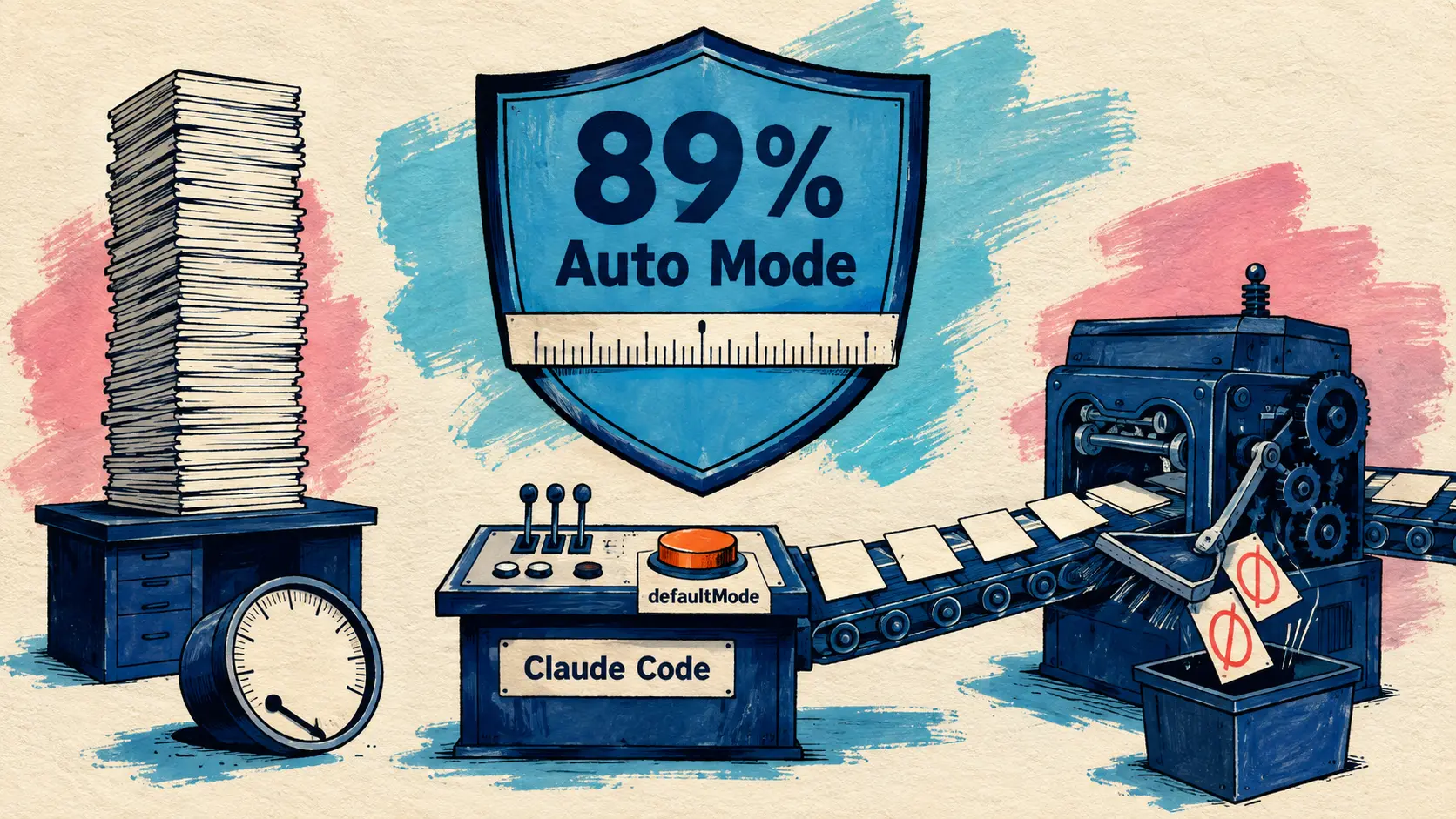
August 7 — Anthropic announces that starting August 14, Auto Mode will become the default permission mode in Claude Code for users on Pro, Max, and Team plans. Instead of asking for confirmation before every shell command or sensitive action, Auto Mode relies on a separate classifier that analyzes each tool call and automatically blocks commands deemed dangerous, without interrupting the user at every step.
Anthropic justifies this change with an internal study conducted with 1,053 paying testers, who were shown a permission prompt for a clearly dangerous command (text only, nothing was actually executed). Human testers detected the danger in only 13.6% of cases, a rate that drops to around 5% after 50 consecutive prompts due to fatigue. Auto Mode, meanwhile, blocked the same commands in 89% of cases, a rate that remained stable regardless of session length.
| Measured indicator | Manual approval | Auto Mode |
|---|---|---|
| Initial detection | 13.6% | 89% |
| Detection after 50 prompts | ~5% | 89% (stable) |
Another concrete change: the classifier’s token overhead no longer counts toward Pro, Max, and Team plan usage limits, with an expansion to Enterprise plans and the API planned once Auto Mode is rolled out everywhere. An in-app notification will inform users of the switch, and administrators can pin defaultMode or disable Auto Mode via managed settings.
The team and I use Auto mode exclusively, and have been for many months. I couldn’t imagine going back to permission prompts! Really excited to get this out to everyone. — @bcherny on X
OpenAI classifies Astra at critical level for cybersecurity
August 7 — OpenAI announces that its future model Astra is the first to be classified at the critical level for cybersecurity under its Preparedness Framework, first published in December 2023. Previous models, including GPT-5.6 Sol, had only been evaluated at the High level on this axis.
According to the framework, a model reaches the critical cybersecurity threshold if it can identify and develop functional zero-day exploits on many hardened critical systems without human intervention, or design an end-to-end novel cyberattack strategy from a simple high-level objective. Internal evaluations carried out in recent days on Astra, combined with external expertise, led OpenAI to conclude that it cannot rule out this level of capability — hence this transparency note, published even before the full test campaign is complete. The company says Astra was not involved in the recent security incident at Hugging Face.
As a result, OpenAI is tightening its internal controls: isolated testing environments, restricted network and tool access, stronger model-weight encryption, increased monitoring, and sandbox execution. Internal activities involving Astra that do not yet meet these requirements are being paused, and monitors now analyze the model’s reasoning chain across all its agentic applications to trigger a security response in the event of high-risk behavior.
After evaluating one of our upcoming models, Astra, we’re treating it as our first “critical” model for cybersecurity under our Preparedness Framework. This is a scenario we’ve planned for, and we’re putting additional controls in place to ensure Astra’s further development happens safely and securely. — @OpenAI on X
NVIDIA unveils Cosmos 3, a family of open models for physical AI
August 6 — NVIDIA has unveiled Cosmos 3, a new family of open models dedicated to physical AI — robotics, autonomous vehicles, embedded vision — released as part of the Into the Omniverse series. Three sizes are offered: Cosmos 3 Super for high-fidelity modeling, Cosmos 3 Nano for efficient reasoning, and Cosmos 3 Edge for embedded deployment.
| Cosmos 3 variant | Parameters | Intended use |
|---|---|---|
| Cosmos 3 Super | 64 billion | High-fidelity modeling |
| Cosmos 3 Nano | 16 billion | Efficient reasoning |
| Cosmos 3 Edge | 4 billion | Embedded deployment |
The family claims the top spot on several benchmarks: Artificial Analysis (text-to-image and image-to-video generation in open weights), PAI-Bench (world generation), and RoboLab (robotic policies). Several companies have already announced adoption — Doosan Robotics, LG Electronics, Samsung Electronics, and Skild AI on the robotics side, Li Auto, Xiaomi, and Afari on the autonomous vehicle side — and the NVIDIA Cosmos Coalition is expanding its activities in Japan. The models are available under the open OpenMDW 1.1 license on Hugging Face and GitHub.
🔗 NVIDIA — Open World Models for Physical AI
Claude Code and Claude Fable 5: two Anthropic updates
Claude Code sessions can now talk to each other
August 7 — Claude Code introduces inter-session messaging: instead of re-explaining the context of a task in another session, it is now possible to ask Claude to pass the information along itself. The message sent is a summary — not the full history nor the files from the original session — that the destination session retrieves mid-task, without starting from scratch. The feature works both ways: one session can query another and receive the answer in its own conversation, or Claude can initiate the message autonomously when a change affects a parallel task — useful for coordinating two agents on the same refactor. Available now on macOS and Linux.
Claude Fable 5 relaxes its biology safeguards, -85% false positives
August 7 — Anthropic has updated Claude Fable 5’s biological safeguards to reduce false positives. According to internal tests, the update reduces by about 85% the cases of fallback triggered incorrectly on biological topics across all product surfaces — Fable can now handle a broader range of common health and education questions without unnecessary blocking. The safeguard remains active for dual-use applications — virology, toxicology, molecular design — which continue to fall back to Opus 5: Fable 5 is therefore not usable for professional biology research or drug development. Anthropic says it is working to close this gap through dedicated trusted access pathways.
Coding tools: Amp pricing, Replit SSO, and Codex security review
Amp restructures orb pricing and sizes
August 7 — Amp adds a new a1.medium orb size (4 CPU, 8 GB RAM), 50% cheaper than the old a0.medium and better suited to most projects. The automatic pause delay after inactivity goes from 15 to 5 minutes, reducing the bill for orbs forgotten in the background. It is also now possible to choose orb size per thread via the amp -ox command and its --orb-size flag.
| Orb size | CPU | Memory | Price per hour |
|---|---|---|---|
| a1.tiny | 1 | 2 GB | $0.08 |
| a1.medium | 4 | 8 GB | $0.33 |
| a1.xxlarge | 16 | 32 GB | $1.32 |
🔗 Amp — Size the orbs of production
Replit adds Okta and Entra ID SSO, free through October
August 6 — Replit is bringing enterprise single sign-on (SSO) to its generated apps, in partnership with Clerk. Pro plan customers can ask their agent to set up Okta or Entra ID (OIDC or SAML) directly in their application, without manual identity provider configuration. The option is provided at no extra cost through October 1, 2026. Multi-factor authentication, session duration, and verification frequency are also configurable through the agent in a dedicated authentication command center.
Codex Security Review: research preview for pull request security analysis
August 6 — OpenAI launches Codex Security Review in research preview, available for ChatGPT Enterprise, Business, Edu, and Pro workspaces (not available on Plus). During the introductory period, reviews do not consume ChatGPT credits, subject to usage limits. The tool goes further than the existing Code Review on security issues: it analyzes the pull request diff, repository context, and a threat model, automatically regenerated if no file is provided. By default, automated reviews surface High and Critical findings, while manual reviews add Medium severity — thresholds that can be adjusted by file path. A manual review can be triggered at any time via the @codex security review comment.
Research and benchmarks: evaluation framework for AI tutors and code duel
Ai2 launches TutorMoments, an evaluation framework for AI tutors
August 7 — Ai2 publishes TutorMoments, an open evaluation framework that measures whether models can handle a central teaching tradeoff: providing direct support to the student, or letting them think on their own. The methodology relies on 462 de-identified transcripts of real one-on-one math tutoring sessions (grades 2 through 6), where teachers annotated more than 1,500 key decision moments. First finding: the prompt matters a lot — with a neutral instruction, all models tend to help too much, but making the tradeoff explicit in the prompt significantly improves scores, with substantial variation from one model to another.
| Metric (explicit prompt) | Score |
|---|---|
| Appropriate scaffolding | 0.458 |
| Increased rigor | 0.182 |
| Avoids over-scaffolding | 0.496 |
Ai2 is releasing the transcripts, pipeline code, and raw results as open access.
Together AI compares DeepSeek-V4 Flash-0731 and GPT-5.6 Luna on real code
August 6 — Together AI ran 900 DeepSWE executions across 113 real software engineering tasks. GPT-5.6 Luna wins on raw accuracy with 67.2% pass@1 versus 53.3% for DeepSeek-V4 Flash-0731, a 14-point gap that holds at pass@4 (90.3% vs 80.5%). The real gap is cost: at $0.10 per run, DeepSeek solves 532 tasks for $100, versus 110 for Luna at $0.61 per run — about 4.8 times more solutions per dollar. A cascade strategy (DeepSeek first, escalating to Luna on failure) solves 78.9% of tasks at $0.385 each, a higher rate than Luna alone for a 37% lower cost per task.
🔗 Together AI — DeepSeek vs GPT-5.6 Luna comparison
Gemini: creativity and travel
Gemini Omni: five creators share their creative uses
August 7 — Google highlights five creators using Gemini Omni — accessible via the Gemini app, Google Flow, AI Studio, and the API — for video editing and idea visualization through simple commands. Leon Lin captures the same urban scene from 20 different perspectives by changing angle and environment; Carlos Santana transforms an outdoor scene by voice command (day/night, cloudy sky, snowy ground); Pan animates everyday objects from sketches; Jerrod Lew applies multiple visual styles (live action, anime, claymation) to the same video in Google Flow; Hyperagent generates landscape design proposals and animated dashboards. The article illustrates Gemini Omni’s core promise: simplifying video editing through natural language, with no technical skills required.
🔗 Google — Gemini Omni Builders
How Gemini builds detailed travel itineraries
August 6 — Google details in four steps how Gemini works for travel planning, available now in the Gemini app. First comes real-time data collection via Google Maps, Flights, Hotels, and YouTube, with Viator integration for activities. Next, the Personal Intelligence feature personalizes recommendations based on data already stored by the user in Gmail, Photos, Search, and YouTube — for example, restaurant suggestions drawn from saved food photos. Gemini then builds a coherent itinerary by taking travel times into account, and Gemini Spark can turn a chain of booking emails into a master itinerary document. Finally, the assistant completes booking forms, compares rental cars, and drafts packing lists — a trip to Kyoto serves as the example in the article.
🔗 Google — how Gemini plans trips
GitHub Copilot: review governance and agent metrics
Code Quality no longer automatically enforces a Copilot review
August 7 — Since Code Quality was enabled on July 20, 2026, GitHub automatically created a ruleset requesting a Copilot review on every pull request. GitHub is now disabling three of those triggers: review when a PR is opened, review on new pushes, and review of drafts. On existing repositories, the rulesets that had already been created were modified with those three options disabled — the ruleset remains in place but no longer acts automatically; on new repositories, enabling Code Quality no longer creates this request. Teams that want to keep automatic reviews must create or edit a ruleset manually, at the repository or organization level. GitHub justifies this change with a recurring request: adding a reviewer should remain a choice, not an imposed default.
The Copilot usage metrics API details activity by third-party AI agent
August 7 — The Copilot usage metrics API exposes a new totals_by_3rd_party_agent table, which details for each partner agent (Claude, Codex…) running in GitHub workflows: a stable identifier (agent_name, agent_id), the number of tasks launched by users, and, in aggregated reports, the number of sessions. This data is intended for enterprise owners, billing managers, organization owners, and holders of the “View Copilot metrics” role. The stated goal is to track each app agent distinctly and compare their adoption, for deployment decisions based on real usage rather than assumptions.
Media generation: video and voice
Seedance 2.5 goes mainstream on Runway and Luma
August 7 — After early access in early August, Seedance 2.5 is now generally available on Runway: up to 50 references per generation to build multi-character worlds, 30-second clips with sound and dialogue, then editing/extension. The same day, Luma announced the arrival of Seedance 2.5 on its platform with the same capabilities, controllable via Luma Agents for scene control, camera angles, and pacing. In parallel, Pika confirms via its Club API that Seedance 2.5 is offered there for up to 88% less than other API aggregators, a price described as permanent.
ElevenLabs details the impact of ElevenAgents on ElevenReader Voice Chat
August 7 — ElevenLabs shares deployment data for ElevenAgents, rolled out across all of its products. Highlighted example: ElevenReader Voice Chat, which lets audiobook readers ask questions midway through in the same voice as the narrator, without revealing elements located later in the book.
| Measured metric | Observed value |
|---|---|
| Increase in average listening time | +24% |
| Book completion rate (5+ sessions) | 78% |
The most frequent request is for a plot summary, followed by questions about characters, themes, and quotes.
Suno launches Voices on its iOS and Android mobile app
August 7 — The Voices feature, which lets you record your own voice to integrate it into generated tracks, is now available on the Suno mobile app (iOS and Android) via the “+ Voice” button on the creation screen. The recording must last at least one minute. Pro and Premier subscriptions get unlimited access, while the free plan has a limited version.
Briefs
- Devin (Cognition) launches a $65,000 startup credits program — Cognition is opening a startup program offering up to $65,000 in Devin credits, following the example of similar programs from major generative AI players. 🔗 source
- v0 (Vercel) launches a Usage & Activity dashboard — Tracking of credits per day, activity by member or project, and message-level details (date, model, cost), accessible from Settings → Usage & Activity. 🔗 source
- Warp Agent CLI — advanced customization — All configuration now lives in an editable
settings.tomlfile, with themes, animations, a customizable status bar, and multi-agent orchestration. 🔗 source - Replit earns a Guinness World Record for the largest AI video course — 14,075 people built together in a single live session, a record certified by Guinness. 🔗 source
- SK Telecom publishes A.X K2, a 688-billion-parameter MoE under Apache 2.0 — Korean mixture-of-experts model, 256K-token context, open license for commercial use. 🔗 source
- Hugging Face hosts a dataset of one million public-domain images — 1,080,814 images, mostly from 19th-century books, published on the Hub. 🔗 source
- Together AI claims the best throughput for Kimi K3 on several benchmarks — Moonshot AI places Together AI first or tied on 3 of the 4 tested benchmarks: OCRBench, MMMU Pro Vision, and DeepSWE. 🔗 source
- Behind-the-scenes: Apollo 2 (Apptronik) on Gemini Robotics 2 — Google DeepMind publishes a series of promotional content around the Apollo 2 humanoid robot, running on Gemini Robotics 2. 🔗 source
- “Relates to” relation between issues in preview and multi-select fields in GA — New neutral issue relation in public preview, and general availability for multi-select fields for issues and projects. 🔗 source
- Secret scanning adds a partner and new push protection detectors — Lovable Labs joins the program; new detectors including
mistral_ai_api_key, and enriched metadata on Cohere, GoCardless, and Square alerts. 🔗 source - MCP allowlists in managed enterprise settings — Enterprises can centralize MCP servers allowed or blocked for Copilot app, CLI, and VS Code via
managed-settings.json. 🔗 source - MiniMax H3 available in Genspark AI Video Agent — The video model released as open weights in early August is now directly accessible in Genspark’s video generation tool. 🔗 source
- MiniMax H3 available in Luma Agents — Generate up to 15 seconds of 2K video with native stereo sound, controllable via text, image, video, and reference audio. 🔗 source
- The MiniMax H3 community produces a distillation LoRA (20 → 4-8 steps) — Four days after the weights were opened, a community LoRA reduces the sampling step count from 20 to 4-8. 🔗 source
- Genspark joins the World Economic Forum’s Unicorn Innovator Community — Participation announced with an expected presence in Davos alongside business and government leaders. 🔗 source
- GitHub lets organizations limit open pull requests — New option to cap, at the organization level, the number of open PRs from contributors without write access. 🔗 source
- Genspark pits two AI agents (ChatGPT vs Claude) against each other at lemonade stands — Marketing demo where each agent runs a real stand in an attempt to make $100 in one day. 🔗 source
- HSP GRUPPE deploys ChatGPT Enterprise across its network of tax advisory firms — German tax advisory, audit, and law network adopting ChatGPT Enterprise across 81 organizational groups. 🔗 source
What this means
Default security is being introduced at the same time across the main labs, but in different forms. Anthropic is making Auto Mode the default based on a hard-to-argue figure — 89% of dangerous commands blocked versus 14% in tired human review — betting that automating security judgment is now more reliable than repeated human attention. OpenAI is taking the opposite path on a different front: rather than loosening control, it is adding one, classifying Astra as critical before its test campaign is even over. Codex Security Review, launched the same week, extends that logic on the product side by moving security analysis earlier in the merge process rather than in post hoc review. The three announcements tell the same story: agentic security is no longer a manually checked option and is becoming a default layer, whether expressed as greater autonomy or stronger guardrails.
The open-model ecosystem is increasingly being judged by cost and industrial adoption rather than by benchmark score alone. NVIDIA positions Cosmos 3 not as just another model but as infrastructure already adopted by Doosan, LG, Samsung, and Li Auto even before broad rollout. Together AI documents the same trade-off on the code side: GPT-5.6 Luna gains 14 points of pass@1 on DeepSeek-V4 Flash, but DeepSeek offers 4.8 times more solutions per dollar, to the point that a cascading strategy beats the two models taken separately. SK Telecom adds a 688-billion-parameter Korean MoE under a permissive license to this already dense landscape. The common signal: competition is no longer only about the capacity frontier, but about the ratio between that capacity and its real usage price.
Agentic development tools are gaining a more classic enterprise infrastructure — granular billing, identity, governance — a sign of maturation beyond the simple prototype. Amp now slices its cloud environments by size and thread like any infrastructure provider, Replit adds free enterprise SSO to speed adoption, and Claude Code lets sessions hand off a context summary instead of forcing users to retype everything. On the GitHub side, the movement is almost the opposite but points in the same direction: Code Quality removes the automatic addition of a Copilot reviewer, making the choice explicit, while the usage metrics API finally exposes who, Claude or Codex, is actually doing the work in enterprise workflows. Together, these announcements shift the conversation from “which agent is smartest” to “how do you govern a fleet of agents.”
Media generation continues its spread across platforms rather than remaining confined to a single player. Seedance 2.5 reaches general availability simultaneously on Runway and Luma, MiniMax H3 spreads within days into Genspark and Luma Agents while already receiving a community distillation LoRA, and ElevenLabs as well as Suno refine targeted uses — contextual questions during audiobook listening, voice recording directly from mobile. This rapid circulation of the same model across multiple products, in just days for MiniMax H3, illustrates how open weights accelerate creative diffusion beyond the original publisher.
Sources
- @ClaudeDevs announcement — Auto Mode by default
- @bcherny on X
- OpenAI — Astra transparency note
- @OpenAI on X — Astra
- NVIDIA — Open World Models for Physical AI
- @ClaudeDevs announcement — inter-session messaging
- @claudeai announcement — Claude Fable 5
- Amp — Size the orbs of production
- @Replit announcement — SSO
- @OpenAIDevs announcement — Codex Security Review
- Ai2 — TutorMoments
- Together AI — DeepSeek vs GPT-5.6 Luna comparison
- Google — Gemini Omni Builders
- Google — how Gemini plans trips
- GitHub Changelog — Code Quality
- GitHub Changelog — Copilot usage metrics API
- @runwayml announcement — Seedance 2.5
- @ElevenLabs announcement — ElevenAgents
- @suno announcement — Voices
- @cognition announcement — Devin startup program
- @v0 announcement — Usage & Activity
- @warpdotdev announcement — customization
- @Replit announcement — Guinness record
- @SKtelecom announcement — A.X K2
- @vanstriendaniel announcement — Hugging Face dataset
- @togethercompute announcement — Kimi K3 throughput
- @GoogleDeepMind announcement — Apollo 2
- GitHub Changelog — Relates to and multi-select
- GitHub Changelog — secret scanning
- GitHub Changelog — MCP allowlists
- @genspark_ai announcement — MiniMax H3 in Genspark
- @LumaLabsAI announcement — MiniMax H3 in Luma Agents
- @MiniMax_AI announcement — distillation LoRA
- @genspark_ai announcement — WEF
- GitHub Changelog — PR limits by organization
- @genspark_ai announcement — lemonade stands
- OpenAI — HSP GRUPPE