ai-powered-markdown-translatorArticle translated from fr to en with gpt-5.4-mini.
July 10 lines up four major announcements that reshape agent-machine interaction: Claude Code Desktop gets a built-in browser and moves to v2.1.206, GPT-5.6 Sol Ultra reaches general availability accompanied by an unprecedented claim of a proof, and Amp replaces all of its named agent modes with a single dial. Eighteen notable updates round out the picture — from Cognition’s growing confidence in Claude Fable 5 to the arrival of Grok 4.5 as an orchestrator at Perplexity — and four short items close out this overview.
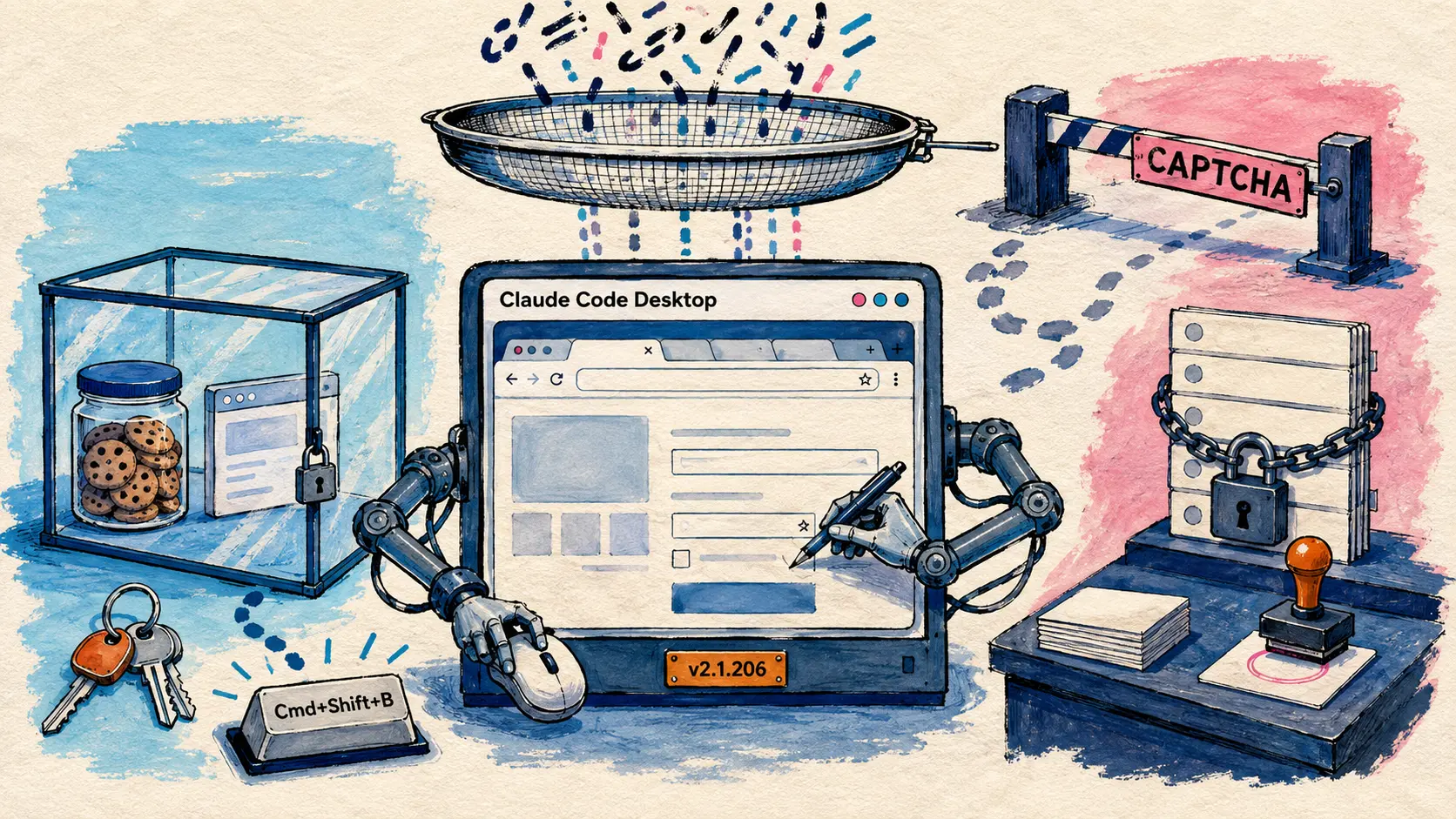
Claude Code Desktop gets a built-in browser
July 10 — Claude Code on desktop gains a new Browser panel: a tabbed browser that Claude drives exactly the same way it already drives local development servers — open documentation, design mockups, or any other site, read content, click, fill out forms. It opens from the keyboard (Cmd+Shift+B on macOS, Ctrl+Shift+B on Windows) or from the Views menu; when Claude encounters an external link in chat, a picker offers to open it in this panel or in the default browser. Signing in to third-party accounts is possible, including through pop-up login flows such as Google OAuth.
The panel is sandboxed: a separate browsing profile, isolated from personal credentials and history, with an option to persist sessions (cookies, local storage) across restarts during development. Two security guardrails are added on top of those already in place for application verification: the same classifiers used by auto mode review every write action Claude takes on an external page — regardless of the active permission mode, a flag triggers a confirmation prompt — and, outside Auto and Bypass modes, a domain allowlist check applies before any navigation. Claude’s first action on a site triggers a permission card (Allow once / Always allow / Deny), and each site must be approved individually, including subdomains. Even on an approved site, Claude cannot buy an item, create an account, or bypass a CAPTCHA without explicit validation — the same security model as the Claude in Chrome extension, whose documentation spells out the difference in use: the Browser panel is suitable for building and testing an app (blank profile, no identity), while the Chrome extension shares the personal browser’s signed-in state.
“Claude Code on desktop now has an in-app browser.” — @ClaudeDevs on X
🔗 Desktop application — Claude Code Docs
GPT-5.6 Sol Ultra reaches general availability, OpenAI claims proof of a 50-year-old conjecture
July 10 — GPT-5.6 Sol with the Ultra setting reaches general availability, after its introduction in multi-agent beta during the July 9 launch (the ultra mode coordinates several agents in parallel by default). To illustrate this move to GA, Ethan Knight, an engineer at OpenAI, says the model produced a proof of the Cycle Double Cover Conjecture, an open problem about 50 years old in graph theory (independently conjectured by Szekeres in 1973 and Seymour in 1979), using 64 sub-agents in just under an hour. OpenAI says it is sharing the prompt used and the proof produced, and invites the community to experiment with Ultra. This is not a new model family, but rather the general-availability rollout of Sol’s ultra setting, introduced the day before in multi-agent beta.
Editorial caution: this is a claim communicated by OpenAI itself (via one of its employees, officially reposted by the @OpenAI account), not a proof verified by an independent third-party source or published in a peer-reviewed journal as of this article’s date. The conjecture itself is genuine and documented in graph theory; the validity of the announced proof has, at this stage, not been independently established — an OpenAI claim to treat as such, not as an established mathematical fact.
“Yesterday, we made GPT-5.6 Sol Ultra generally available. Today, we’re sharing that it produced a proof of the 50-year-old Cycle Double Cover Conjecture using 64 subagents in just under one hour.” — Ethan Knight (OpenAI), reposted by @OpenAI on X
Amp replaces its named agent modes with a single dial (The Dial)
July 9 — Amp releases The Dial, a complete redesign of its agent mode selection system. The four former named modes — smart, deep, rush, large — are deprecated and replaced by a four-level effort dial: low, medium, high, ultra. Guiding idea: the old mode names hid a specific model, prompt, and reasoning effort level that you had to know in order to choose correctly — with model convergence, the only question that still matters according to Amp is the capability/cost tradeoff. The dial is adjusted via Ctrl+S in the CLI or via the web app’s mode selector.
| Dial level | Primary model | Oracle (second opinion) |
|---|---|---|
| ultra | Claude Fable 5 (dedicated system prompt) | GPT-5.6 Sol |
| high | GPT-5.6 Sol, xhigh effort | Claude Fable 5 |
| medium | GPT-5.6 Sol, medium effort | GPT-5.6 Sol, high effort |
| low | GLM-5.2 (Z.ai, open model) | GPT-5.6 Sol |
Notable point: the low level relies by default on GLM-5.2, a third-party open model from Z.ai presented by Amp as “the strongest open model in agentic coding,” rather than a proprietary model — workspace administrators can replace it with GPT-5.6 Terra. Each level now has an “oracle” for a second opinion: at the higher levels, the two frontier models review each other (in high, GPT-5.6 Sol writes and Fable reviews; in ultra, the reverse). For migration, Amp says: “smart, deep → medium” and “rush → low”; users who want to preserve the exact behavior of the old modes can reinstall them as plugins (amp plugins add --auto-update @amp/smart-classic, etc.), with the same system prompts, tools, models, and effort levels as before.
🔗 Amp — The Dial (full article)
Claude Code moves to v2.1.206: path suggestions, CLAUDE.md cleanup, and a dozen-plus fixes
July 10 — Claude Code moves to v2.1.206, a release without a single headline feature but with several noteworthy additions. /cd now suggests directory path completions, on the same principle as /add-dir. /doctor gets a new control that suggests trimming versioned CLAUDE.md files by spotting content that Claude could infer anyway from exploring the repository. On the Git side, /commit-push-pr now automatically authorizes git push to the repo’s configured push remote or to the only available remote in addition to origin, and EnterWorktree asks for confirmation before entering a worktree located outside the project’s .claude/worktrees/ folder. Background agents now update silently right after a Claude Code update, instead of forcing a slow update at the moment the user attaches to them. The agents view (claude agents) is also tweaked: Ctrl+X now permanently deletes a finished session, and the status column uses the terminal’s full width. Anthropic also reports improved result quality for /code-review on claude-opus-4-8, at every effort level.
The rest of the changelog lists a dozen-plus fixes: an expired connection error showing a misleading message instead of prompting to relaunch /login; claude --resume and --continue no longer responding to the keyboard at startup; MCP servers ignoring their own request_timeout_ms and falling back to the default 60 seconds; incorrect prices in the /model selector; and, on Bedrock, a several-minute startup stall when using the awsCredentialExport helper on restricted-egress networks.
🔗 Release v2.1.206 — Claude Code
Anthropic strengthens its enterprise partnerships
Two case studies feature Anthropic Enterprise partners on July 9-10, one on Claude Fable 5’s long-term autonomy, the other on its integration into physical manufacturing pipelines.
Cognition (Devin): Claude Fable 5 runs for 8 hours without supervision
July 10 — A new episode in the “Working at the frontier” series focuses on Cognition, the company behind the autonomous software engineer Devin. Silas Alberti, who leads model training and evaluation at Cognition, describes a qualitative leap on Frontier Code, the company’s in-house anti-slop benchmark: the old Opus model topped out at around 10% on the hardest subset, while Claude Fable 5 reaches around 30%. More importantly, the autonomy horizon changes in kind — an agent left unsupervised makes real progress for 8 straight hours, compared with a few minutes to an hour before Fable 5. Alberti attributes this leap to the model’s ability to use Cognition’s internal debugging tools and to state its invariants before acting; Devin is beginning to proactively monitor Slack and production, an evolution Alberti expects in 90% of sessions within one to two years.
“We trust no eval.” — Silas Alberti, Cognition, quoted on the Claude Blog
UST deploys Claude in physical AI
July 9 — Anthropic announces a partnership with UST, a technology services and engineering company, to deploy Claude across physical manufacturing processes: chips, automotive, connected devices. UST is training 20,000 employees on Claude and becomes a Global Premier Partner of the Claude Partner Network. Core use case: on iDEC, UST’s hardware validation platform, Claude Code reads chip schematics and pinouts, writes regression tests, and compares real equipment with digital twins — a pipeline that is already cutting validation cycles by 50 to 70%. Expansion also covers CarePath (healthcare), IntelliOps (telecom), and FinX (banking), always with human approval for sensitive actions.
🔗 UST is bringing Claude to physical AI
OpenAI, the day after the GPT-5.6 launch
Two announcements dated the day after the GPT-5.6/ChatGPT Work launch: a public acknowledgment of launch issues, and an evolution of the biological safety program.
Post-launch fixes for ChatGPT Work and Codex
July 10 — About 24 hours after the joint launch of GPT-5.6 and ChatGPT Work, Thibault “Tibo” Sottiaux, Codex lead at OpenAI, publicly acknowledges several launch issues, officially reposted by the @OpenAI account: high compute settings too easy to activate, a desktop app reorganization that made chats and projects less accessible, launch framing that incorrectly suggested Codex was going away, regressions on multi-agent workflows, and rough edges in plugins. Day-one fixes: usage limits reset twice, default settings changed, plugin fixes, desktop cleanup. A broader wave is announced for the following week: chats and projects return to the sidebar, usage becomes more visible, and the distinction between ChatGPT Work and Codex is clarified.
“An ambitious direction doesn’t excuse avoidable confusion or regressions in the first version.” — Tibo (Thibault Sottiaux), OpenAI, on X
Bio Bug Bounty evolves into a permanent private program
July 10 — OpenAI is evolving its Bio Bug Bounty into a permanent private program (OpenAI Bio Bug Bounty program), with the reward doubled to $50,000. The program invites researchers in AI red-teaming, security, or biosafety to find a universal jailbreak that defeats the predefined biosafety challenge on OpenAI’s most advanced frontier models. This announcement confirms that it was indeed a transition from the earlier limited-time program spotted the day before — then with a $25,000 reward, and deadlines already past at the time it was observed.
🔗 @OpenAI — OpenAI Bio Bug Bounty program
Gemini grounds its real-time experiences in the real world
Two features linking AI generation to the physical world, one in voice conversation, the other in 360° virtual exploration.
Gemini Live combines image generation and Google Maps in conversation
July 10 — Gemini Live, the Gemini app’s real-time voice-and-camera conversation mode, now integrates Nano Banana image generation and Google Maps grounding directly during a session: show an object or place to the camera to generate images, find local businesses, all while talking by voice. The attached demo shows a painting being turned into a personalized wallpaper. Available free and worldwide to all Gemini users, with no Pro/Ultra restriction.
🔗 @GeminiApp Tweet — Gemini Live in real time
Project Genie grounds its generated worlds in Street View
July 10 — The Project Genie research prototype (Google DeepMind × Google Labs, announced at I/O) adds grounding on Street View data from Google Maps as a real-world geographic foundation for generating interactive 360° virtual environments. This building block solves the “blank space problem” — scene consistency outside the camera’s field of view — by generating the continuation of the world frame by frame according to the user’s actions (swimming, hiking) from a real location or a text prompt. It remains an experimental research prototype, with no broad public availability announced.
🔗 @GoogleAI Tweet — Street View grounding in Project Genie
GitHub beefs up Copilot and the third-party agent ecosystem
Five announcements that strengthen the governance and ergonomics of Copilot and its agent ecosystem, from automatic code review to video game generation.
A rewrite of the instructions reduces the cost of Copilot review by 20%
July 10 — GitHub details how the migration of Copilot code review to the code exploration tools shared with the Copilot CLI harness (grep, glob, view) initially degraded reviews — higher cost, missed issues — even though those tools are better maintained. The cause: instructions tailored for a general-purpose assistant that explores broadly, whereas a reviewer starts from the diff and looks for the minimum evidence needed. After rewriting the instructions around the reviewer’s actual workflow, the regression turned into a gain: about 20% lower average review cost, with equal review quality.
“But the tools weren’t the problem. The instructions were. Once we rewrote them for the way a reviewer actually reads a pull request, the regression flipped into a win: roughly 20% lower average review cost, while maintaining the same review quality.” — The GitHub Blog
The pull requests dashboard reaches general availability
July 9 — The pull requests dashboard (github.com/pulls) reaches general availability after a public preview: a prioritized Inbox that surfaces requested reviews and PRs ready to merge, saved views based on custom queries, and advanced search with new filters. A detail that directly concerns Copilot: the author filter now recognizes PRs created by an agent on the user’s behalf — author:@me also returns pull requests that the user asked Copilot to create for them.
🔗 New pull requests dashboard is now generally available
GitHub Mobile sorts and filters Copilot sessions
July 10 — GitHub Mobile (iOS/Android) adds filters — status, repository, type, agent, active/archived — for the Copilot sessions list, along with sorting options (newest, oldest, active first, those needing attention first), with sorting preserving the current filtering context. A usability improvement that becomes useful as soon as the number of tracked agentic sessions running in parallel increases.
🔗 GitHub Mobile: Improved filters and sorting for Copilot sessions
Manus adds /game-dev and an ElevenLabs connector
July 10 — Manus launches a /game-dev skill: describing a game in natural language is enough to get a functional gameplay experience deployed on a shareable link, with no game-development experience, relying on open source work credited by Manus. On the same day, the ElevenLabs connector arrives on the platform, bringing voice generation and cloning to apps built on Manus — demonstrated by a complete app (retro interface, 4 languages, cloned voice narration) produced from a single prompt.
🔗 Tweet @ManusAI — /game-dev skill 🔗 Tweet @ManusAI — ElevenLabs connector
Perplexity Computer expands its offering, Cohere accelerates inference
Perplexity expands the model and tool offering of Perplexity Computer three times, while Cohere publishes notable research on inference acceleration.
Computer Analytics: track credit spending by model
July 10 — Perplexity launches Computer Analytics, a dashboard for tracking credit usage by model in Perplexity Computer: total credits, active members, average per member, breakdown by model (Claude Opus 4.8 Fast/4.8/4.7, Claude Sonnet 4.6, GPT-5.5, others), and member ranking. Available immediately under Analytics in account settings, for individual users as well as Enterprise organizations.
🔗 Tweet @perplexity_ai — Computer Analytics
Grok 4.5, best WANDR score at half the cost of Opus 4.8
July 10 — Grok 4.5 (xAI) joins the orchestrator models available in Perplexity Computer, for Consumer Pro and Max subscribers. On the WANDR cost/performance benchmark (6 tested configurations), Grok 4.5 achieves the best score of all configurations:
| Evaluated configuration | Cost per run | WANDR score |
|---|---|---|
| GPT-5.6 Terra (medium) | $0.40 | 0.149 |
| GLM 5.2 (high effort) | $1.74 | 0.207 |
| GPT-5.6 Sol (medium) | $2.64 | 0.289 |
| GLM 5.2 + advisor | $4.67 | 0.297 |
| Grok 4.5 | $4.76 | 0.328 |
| Opus 4.8 (thinking, high effort) | $9.46 | 0.254 |
Grok 4.5 thus sits at the top of the cost/performance Pareto frontier: best score, for about half the cost of Opus 4.8.
🔗 Tweet @perplexity_ai — Grok 4.5 orchestrator
Cohere contributes up to 23% inference speed to vLLM
July 10 — Cohere publishes research on Dynamic Speculative Decoding (DSD), which makes the number of draft tokens in speculative decoding adaptive according to the hardware regime (memory vs compute), via a “goodput” metric. On Command A (dense, MT-Bench): DSD is about 23% faster than fixed-K speculative decoding, and 7.5% faster than vanilla inference — where fixed-K SD regresses versus vanilla. More limited gains on Command A+ (MoE architecture). The optimization was contributed as open source to vLLM (merged pull request), with compatibility work for async scheduling and Full CUDA Graph.
🔗 Cohere — Hardware-aware Dynamic Speculative Decoding
Media generation: video research moves to real time
Three announcements illustrating the shift of media generation toward real time and agentic integration.
NVIDIA releases Flex-Forcing, a hybrid diffusion/autoregressive video model
July 9 — NVIDIA Research publishes Flex-Forcing, a method that trains a single video model to master both bidirectional diffusion (processes all frames at once, structure well preserved but slower) and autoregressive generation (frame by frame, fast and streamable, but prone to temporal drift), with the operating point chosen at inference time according to the available compute budget rather than a compromise fixed during training. The work was recognized with a spotlight at ICML 2026.
🔗 Tweet @NVIDIAAI — Flex-Forcing
Wan-Streamer (Alibaba): full-duplex real-time video conversation
July 10 — Alibaba’s Tongyi Lab presents Wan-Streamer, an end-to-end omni-modal model: a single native-streaming Transformer listens, looks, understands, and responds with synchronized voice and video, in full duplex (each party can speak and listen simultaneously), with about 550 ms total latency. The model is not tied to a fixed avatar rig and can embody any character described in natural language. v0.2 brings 640×368 resolution at 25 FPS and model-side latency reduced to about 200 ms.
🔗 Tweet @Alibaba_Wan — Wan-Streamer
HeyGen connects Figma to HyperFrames to generate launch videos
July 10 — New episode in HeyGen’s daily HyperFrames skill series (after Music-to-Video on July 9): the /figma command turns a Figma mockup into a faithful launch video — every color, every font, every framing reproduced exactly — without going through a video editor. The workflow takes three steps: copy the mockup link, hand it to the agent, then invoke /figma. Setup via npx hyperframes@latest skills.
🔗 Tweet @HeyGen — Figma integration
Sakana AI measures the creativity gap between agents and humans
July 10 — Sakana AI publishes “The AI Picbreeder Experiment,” a research paper (GECCO2026, MIT/NYU collaboration, best paper nominee) that recreates Picbreeder — a defunct site where users collectively evolved images with no predefined objective — with vision-language agents (VLMs) instead of humans. Main result: VLM agents explore less broadly than humans, going in circles around similar concepts; but a diverse population of agent “personalities” substantially improves exploration, to the point of approaching the semantic diversity of the human archive in some runs. The persistent gap: humans seem better at turning a “happy accident” into a lasting creative discovery.
🔗 Tweet @SakanaAILabs — announcement 🔗 Interactive blog — pub.sakana.ai/picbreeder-vlm
Briefs
- GitHub — API endpoint for multi-user budgets — new REST API endpoint to retrieve, in a single call, each user’s consumption within a multi-user budget, with filtering by percentage consumed, reserved for enterprise owners and billing managers. 🔗 GitHub Changelog
- GitHub renames its AI secret detector — the “Copilot secret scanning” detector becomes “AI-detected secrets,” with no change in behavior, webhooks, audit logs, or API. 🔗 GitHub Changelog
- Codex CLI 0.144.1 — patch on 0.144.0: standalone installation made more reliable, macOS installations correctly exposing the code-mode host, fallback to embedded runtime if the companion host binary is unavailable. 🔗 Codex CLI 0.144.1
- Cohere Transcribe Arabic runs locally on MacBook — community port via mlx-audio (Apple Silicon), credited to @Prince_Canuma and @lllucas, a sign of ecosystem adoption of the open source model (Apache 2.0). 🔗 Tweet @cohere
What this means
Agents are learning to navigate the web like humans. Claude Code Desktop innovates by giving the agent its own sandboxed browser, with the same site-level permission model as the Claude in Chrome extension — build and test an application without ever sharing the user’s personal credentials. This move aligns with a broader trend: GitHub’s new pull requests dashboard now explicitly recognizes PRs created by an agent on behalf of a human, and Manus adds a /game-dev skill that deploys functional gameplay without intervention. Operating an entire interface, not just producing text or code, is becoming the new frontier for consumer agents.
The model race is shifting toward multi-model orchestration rather than raw size. GPT-5.6 Sol Ultra reaches GA with a spectacular — but not independently verified — demonstration of multi-agent reasoning on a 50-year-old open math problem. Amp abandons its named modes for a single dial that lets Claude Fable 5 and GPT-5.6 Sol converse as each other’s oracles. Perplexity Computer follows the same logic by adding Grok 4.5 as an orchestrator — best WANDR score on the market at half the cost of Opus 4.8 — alongside its own GLM 5.2. The common signal: value no longer comes from a single frontier model, but from the ability to make several models work together according to the available budget, a logic that Cohere’s research on adaptive speculative decoding pushes all the way down to the inference level itself.
Long-duration autonomy is becoming measurable, and companies are demanding it be tracked. Cognition documents a concrete leap — from a few minutes to 8 hours of continuous progress without supervision — to explain why it now trusts Claude Fable 5 on real tasks, while UST deploys Claude on hardware validation chains with 50–70% cycle gains. That same movement is forcing tech companies to publicly acknowledge their own blind spots: OpenAI openly documents the problems with its GPT-5.6/ChatGPT Work launch rather than hiding them, GitHub explains why a tool migration initially degraded Copilot code review before an instruction rewrite fixed it, and Claude Code v2.1.206 stacks up a dozen discreet fixes alongside its integrated browser. Trust is now built as much on transparency about failures as on announcements of capabilities.
Real-time media generation is catching up with batch generation. Alibaba’s Wan-Streamer lets an agent converse in video and voice with 550 ms latency, Gemini Live combines camera, image generation, and mapping in a single voice conversation, and NVIDIA’s Flex-Forcing lets a single video model arbitrate between quality and speed according to the compute budget. This shift toward immediacy and interactivity contrasts with Sakana AI’s reminder about creativity: its vision-language agents explore less freely than humans left to their own devices, a gap that persists even when generation becomes technically instantaneous.
Sources
- Tweet @ClaudeDevs — Claude Code Desktop integrated browser
- Desktop application — Claude Code Docs
- Ethan Knight (
@__eknight__) — GPT-5.6 Sol Ultra GA + mathematical proof - Amp — The Dial (full article)
- Release v2.1.206 — Claude Code
- Working at the frontier: How Cognition trusts Claude Fable 5
- UST is bringing Claude to physical AI
- Tibo (@thsottiaux) — post-launch ChatGPT Work / Codex fixes
- @OpenAI — OpenAI Bio Bug Bounty program
- Tweet @GeminiApp — Gemini Live real time
- Tweet @GoogleAI — Street View grounding in Project Genie
- Better tools made Copilot code review worse
- New pull requests dashboard is now generally available
- GitHub Mobile: Improved filters and sorting for Copilot sessions
- Tweet @ManusAI — /game-dev skill
- Tweet @ManusAI — ElevenLabs connector
- Tweet @perplexity_ai — Computer Analytics
- Tweet @perplexity_ai — Grok 4.5 orchestrator
- Cohere — Hardware-aware Dynamic Speculative Decoding
- Tweet @NVIDIAAI — Flex-Forcing
- Tweet @Alibaba_Wan — Wan-Streamer
- Tweet @HeyGen — Figma integration
- Tweet @SakanaAILabs — announcement
- Interactive blog — pub.sakana.ai/picbreeder-vlm
- Full paper — arXiv:2605.23908
- GitHub Changelog — Per-user states for multi-user budgets
- GitHub Changelog — Clearer names for secret scanning detector types
- Codex CLI 0.144.1 — GitHub Releases
- Tweet @cohere — Transcribe Arabic local via mlx-audio