ai-powered-markdown-translatorArticle translated from fr to en with gpt-5.6-sol.
On July 11, agents moved beyond code and into the real world: Replit partnered its agent with Ramp to incorporate a company and autonomously manage cash flow, invoices, and expenses; GitHub released an open-source dataset covering more than 40 million repositories and the language distribution of code; and HeyGen followed up with two developer announcements—transparent WebM video output and automatically synchronized editing for talking-head videos. Meanwhile, Pika demonstrated advanced video-editing capabilities through a model it calls “Gemini Omni,” an attribution that Google has not confirmed to date. Five briefs round out the picture, from Together AI’s voice call line to Cohere’s infrastructure partnership with NVIDIA and CoreWeave.
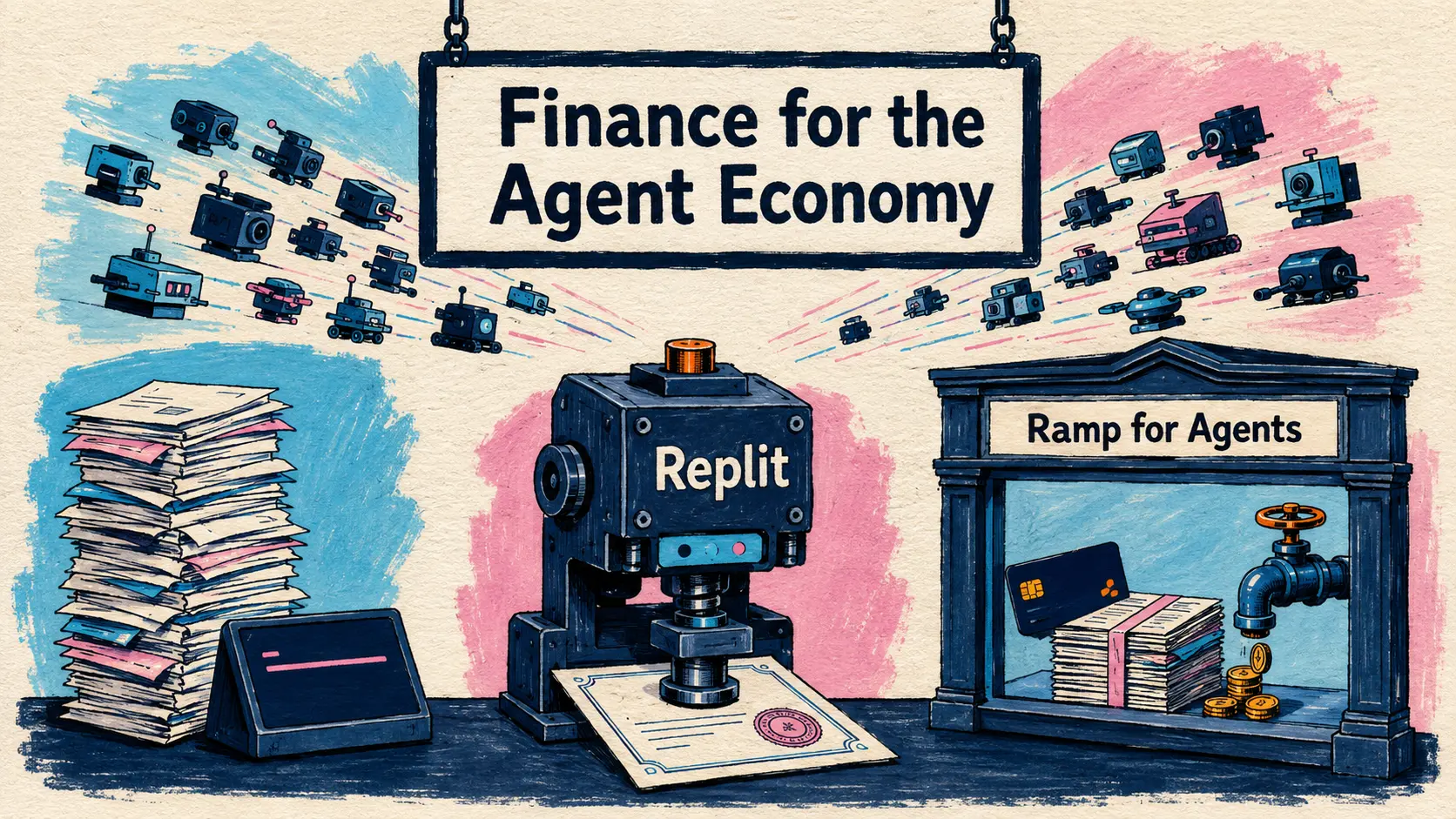
Replit launches Ramp for Agents: its agents can now manage company finances
July 11 — Replit announced a partnership with Ramp, a financial management and corporate card platform, enabling its agent to move beyond code generation and handle real-world financial processes. Specifically, the Replit agent can now assist with forming a company (incorporation), submit an application for a Ramp account for that entity, and then prepare the company to spend money, pay its bills, and manage its cash flow—all through a natural-language conversation.
The launch continues Replit’s strategy of expanding its agent into e-commerce (Shopify integration, June 2026) and discoverability (SEO Agent, June 2026). The product uses a dedicated page operated by Ramp, “Finance for the Agent Economy,” which provides agents with cards, transfers, and bank accounts alongside built-in controls governing every dollar spent.
“Ramp for Agents.
Replit Agent can now incorporate your company, apply for Ramp, and get your business ready to spend, pay bills, and manage money.
Every company used to start with paperwork. The next one starts with a prompt.” — @Replit on X
GitHub releases the Multilingual Repositories Dataset
July 11 — GitHub released the GitHub Multilingual Repositories Dataset, a new open-source dataset for researchers and developers working on multilingual AI. It covers more than 40 million repositories and more than 80 million classification rows, mapping where README files, issues, and pull requests written in languages other than English are found across the platform.
| Metric measured | Measured value |
|---|---|
| Repositories covered | 40M+ |
| Classification rows | 80M+ |
| Repositories with Portuguese README files (leading language) | 3M+ |
| Leading language in issue text | Korean |
The figures highlighted by GitHub reveal concrete language trends: Korean leads in issue text, while Portuguese ranks first for README files, appearing in more than 3 million repositories. This is not strictly a Copilot feature, but rather an open research and data release that continues GitHub’s positioning as an AI-powered development platform.
🔗 Tweet from @github — Multilingual Repositories Dataset
Pika edits videos with a model it calls “Gemini Omni”
July 11 — Pika released a video demonstration showcasing advanced editing features applied to a user-uploaded video: changing the background, camera angle, and outfit, adding visual effects, and even dubbing the voice in French—all presented by Pika as being made possible “with Gemini Omni.”
“Drop in your video and change the background, change the angle, swap the outfit, add visual effects, even make it speak French — all with Gemini Omni” — @pika_labs on X
Editorial caution: the name “Gemini Omni” does not appear in any official Google or DeepMind announcement to date—the dedicated scan of Gemini announcements found no news on July 11. It is the name Pika itself uses for the model underlying this feature; its existence and exact nature have not been independently established. This news should be understood as a feature announced by Pika, not as a Google-confirmed product launch.
Engagement was moderate for the account (15,000 views, 80 likes), well below Pika’s major posts—a sign that this was a feature announcement rather than a flagship product launch.
HeyGen strengthens its developer ecosystem: transparent video and automated editing
HeyGen made two announcements on the same day, one concerning the video output format and the other the automation of editing.
Transparent WebM video output across API, CLI, and MCP
July 11 — HeyGen announced a new video output option for its API, CLI, and MCP server: WebM format with a transparent alpha channel. By setting the output_format: "webm" parameter on the /v3/videos endpoint, generated avatar videos are returned with a genuinely transparent background (native alpha channel), eliminating the need for a green screen that must be keyed out afterward.
This feature targets developers compositing avatar videos into larger productions—editing, overlays, and integration into 3D scenes. The associated thread illustrates a concrete example: an avatar composited directly into a Minecraft-style three.js scene.
🔗 Tweet from @HeyGen — transparent WebM output
The “Talking-Head-Recut Skill” synchronizes graphics with a talking-head video
July 11 — The sixth episode in a series of daily demonstrations focused on HyperFrames, HeyGen’s agent-driven video production environment: the “Talking-Head-Recut Skill” overlays motion graphics (animated titles, counters, cards, and quotes) on a talking-head video, automatically synchronized with the spoken content. The agent reads the transcript, decides which elements deserve a graphic, and then designs each card according to the supplied visual identity.
The demonstration illustrates the complete workflow from a single prompt: researching a news topic (OpenAI’s GPT-5.6 announcement), writing a sourced script, generating an avatar directly through HeyGen’s CLI, reproducing a visual identity live from chatgpt.com, and then creating the final render with subtitles and music—without a video editor or camera. The skill is documented as open source on GitHub.
🔗 Tweet from @HeyGen — Talking-Head-Recut Skill 🔗 GitHub — talking-head-recut skill
Briefs
- Together AI launches a voice call line — a minimalist tweet (“Why type when you can call?”) links to
docs.together.ai/call, which opens a phone dialer (+1 415-723-8167, ext. 676) connecting the caller with a voice assistant powered by Together AI’s inference platform, with no accompanying blog post. 🔗 Tweet from @togethercompute - Pika launches an experimental MCP server —
experiment.pika.art(“Pika MCP – Make Your Agent Creative”) enables AI agents to invoke Pika’s creative video generation and editing capabilities directly from their agentic environment. 🔗 Tweet from @pika_labs - MiniMax and Fireworks AI optimize the M3 kernel on Blackwell — a new “KV-stationary” kernel developed by Fireworks AI for MiniMax’s open M3 model reads each selected block only once, preserving the benefits of sparse attention and reaching approximately 980 TFLOP/s on a B200 GPU. 🔗 Tweet from @MiniMax_AI
- GPT-Live deployed to 100% of users worldwide — OpenAI’s full-duplex voice feature, launched on July 8, has completed its rollout across ChatGPT; OpenAI is temporarily doubling the voice usage limit for the weekend of July 11–12. 🔗 Tweet from @athyuttamre
- Cohere highlights its partnership with NVIDIA and CoreWeave — an institutional post on X focused on infrastructure reliability and protection for large enterprises deploying AI, with no technical details or accompanying article. 🔗 Tweet from @cohere
What it means
Video production is becoming a fully agent-driven pipeline, from editing to distribution. HeyGen eliminates a standard technical step—green-screen keying—by providing a native alpha channel across its API, CLI, and MCP, and automates the synchronization of graphics with talking-head videos through its Talking-Head-Recut Skill: a single prompt is now enough to produce a sourced, branded, and subtitled video without a camera or editor. Pika is extending the same approach to post-production with a model it calls “Gemini Omni,” which can change the background, camera angle, and outfit in an existing video—an attribution that, without official confirmation from Google, also illustrates a trend of giving technical components evocative names to make them sound more powerful and should therefore be treated with appropriate caution.
Agents are moving beyond code and into a company’s administrative and financial operations. Ramp for Agents allows Replit’s agent to incorporate a company, open a Ramp account, and manage cash flow and invoices—an area that, until now, remained strictly human. The same shift appears on a smaller scale in Pika MCP, which opens Pika’s creative capabilities to third-party AI agents through an experimental MCP server: the agent no longer merely produces content; it orchestrates third-party services on the user’s behalf.
The foundations of multilingual AI and large-scale inference continue to open up. GitHub’s Multilingual Repositories Dataset documents, across 40 million repositories, where Korean, Portuguese, and other languages are actually used throughout the world’s code—a resource for any researcher working on multilingual models. The KV-stationary kernel developed by Fireworks AI for MiniMax’s M3 illustrates the same infrastructure work on the inference side, preserving the theoretical benefits of sparse attention on Blackwell. Cohere’s strengthened partnership with NVIDIA and CoreWeave completes the picture: infrastructure reliability is becoming a selling point in its own right for enterprise AI.
Voice is establishing itself as a full-fledged product channel rather than merely an ancillary feature. GPT-Live completed its rollout at OpenAI only three days after launch, with limits doubled to encourage users to try it; meanwhile, Together AI opened a telephone line connecting callers directly to a voice assistant powered by its inference platform. Two different approaches—one integrated into an existing application, the other accessible from a conventional telephone—reflect the same bet: the voice interface is becoming a full-fledged entry point to models, not just one option among many.
Sources
- Tweet from @Replit — Ramp for Agents
- Tweet from @github — Multilingual Repositories Dataset
- Tweet from @pika_labs — video editing with “Gemini Omni”
- Tweet from @HeyGen — transparent WebM output
- Tweet from @HeyGen — Talking-Head-Recut Skill
- GitHub — talking-head-recut skill
- Tweet from @togethercompute — voice call line
- Tweet from @pika_labs — Pika MCP
- Tweet from @MiniMax_AI — M3 kernel on Blackwell
- Tweet from @athyuttamre — GPT-Live deployed to 100%
- Tweet from @cohere — NVIDIA and CoreWeave partnership