ai-powered-markdown-translatorArticle translated from fr to en with gpt-5.4-mini.
June 13, 2026 is marked by an unprecedented U.S. government decision: Anthropic receives an export control directive requiring the immediate suspension of Fable 5 and Mythos 5 for all of its customers. At the same time, NVIDIA publishes the first results from AgentPerf, the first benchmark dedicated to agentic workloads, where Blackwell Ultra shows 20 times more agents per megawatt than Hopper. GitHub opens its Copilot app to all paid plans, and OpenAI Academy launches three new courses to accelerate enterprise AI adoption.
U.S. government directive — Fable 5 and Mythos 5 suspended for all users
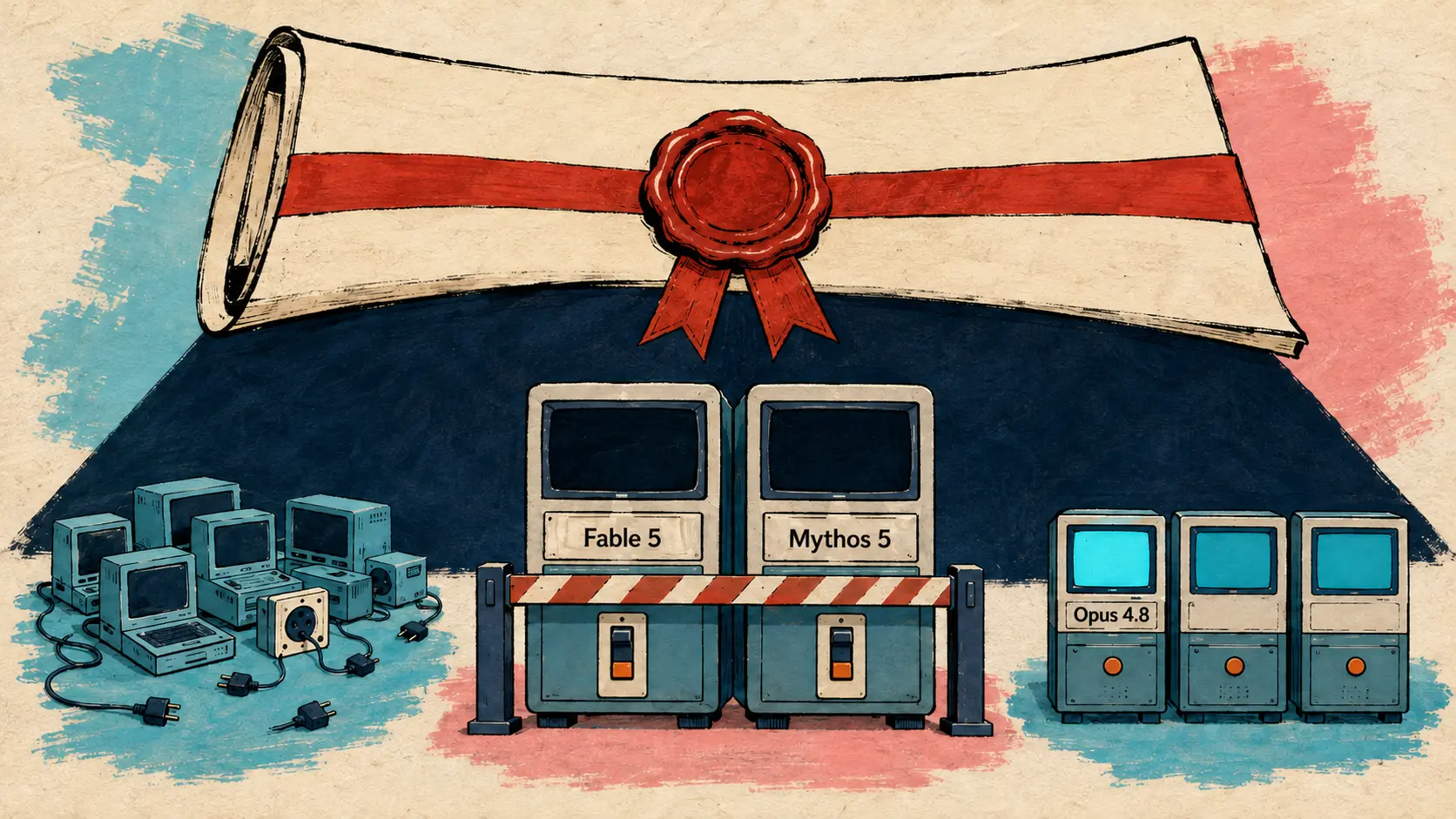
June 12 / June 13 — The U.S. government issued an export control directive requiring Anthropic to immediately disable access to Fable 5 and Mythos 5 for any foreign national, whether based in the United States or abroad, including Anthropic’s foreign employees. The practical result: Anthropic disabled these two models for all of its customers to ensure compliance.
The US government, citing national security authorities, has issued an export control directive to suspend all access to Fable 5 and Mythos 5 by any foreign national, whether inside or outside the United States, including foreign national Anthropic employees. — @AnthropicAI on X
Fact table:
| Item | Detail |
|---|---|
| Directive date | June 12, 2026, 5:21 PM ET |
| Public announcement date | June 13, 2026, 2:50 AM (tweet time) |
| Affected models | Fable 5, Mythos 5 |
| Unaffected models | Opus 4.8, Sonnet 4.6, Haiku 4.5, and all other Claude models |
| Cited reason | Potential Fable 5 jailbreak (national security) |
| Anthropic’s position | Complies with the legal directive but is contesting it |
| Communication deadline | 24 hours to share more details |
The government letter did not specify the exact nature of the national security concern. According to Anthropic’s official statement, the government had become aware of a Fable 5 bypass method (jailbreak). Anthropic reviewed the mentioned technique and concluded that it is only a minor, already known vulnerability available on other public models — the government had provided only verbal evidence of a non-universal, narrow bypass, essentially consisting of asking the model to read a codebase and fix software bugs.
Anthropic states that the capability in question is available on other models (including OpenAI’s GPT-5.5) and that applying this standard across the industry “would effectively halt all new model deployments across all frontier model providers.”
🔗 Anthropic official statement — fable-mythos-access
Rate limit reset — compensatory measure for all users
June 13 — In direct response to the sudden suspension, Anthropic reset the 5-hour and weekly rate limits for all users. The measure aims to soften the impact of losing access to the most powerful models by allowing heavy use of the models still available — notably Opus 4.8 and Sonnet 4.6.
We’ve reset 5-hour and weekly rate limits for all users. — @ClaudeDevs on X
A second message from @ClaudeDevs specifies that the planned Build Day remains on schedule, now using Opus 4.8 rather than Fable 5.
NVIDIA Blackwell — 20x more agents per megawatt on AgentPerf
June 12 — NVIDIA and analytics firm Artificial Analysis published the first results from AgentPerf, the first infrastructure benchmark specifically designed for agentic AI workloads. Unlike classic inference benchmarks that measure a single LLM call, AgentPerf models chains of dozens to hundreds of LLM calls and tool calls in sequence — the reality of production agents.
Comparative results:
| Platform | Architecture | Agents per megawatt (relative) |
|---|---|---|
| NVIDIA GB300 NVL72 (Blackwell Ultra) | 72 GPU rack-scale | 20x vs H200 |
| NVIDIA HGX H200 (Hopper) | Multi-GPU | Baseline (1x) |
The benchmark uses DeepSeek V4 Pro as the reference model — a large mixture-of-experts model (Mixture-of-Experts) representative of today’s frontier agents. The AgentPerf methodology relies on real coding-agent trajectories taken from public repositories: file reading, code writing and editing, command execution, iteration on results — covering more than 12 programming languages.
The GB300 NVL72 architecture is based on a fully rack-scale design: 72 interconnected GPUs, CUDA kernels (CUDA kernels) that overlap communication and compute, and TensorRT LLM that separately optimizes input ingestion and output generation. Inference partners such as Together AI (which powers Cursor) and DeepInfra (which powers Pam.ai for automotive dealerships) are already running agentic workloads on Blackwell in production. NVIDIA also announces full production availability of the Vera Rubin architecture.
🔗 NVIDIA blog — AgentPerf Blackwell
GitHub Copilot code review — organization controls, exclusions, and unlimited instructions
June 12 — GitHub is improving Copilot code review governance with three new settings now available:
| Configuration | Detail |
|---|---|
| Organization-level runners | Set the runner type (standard, self-hosted, or large) for all repositories at once; admins can enforce locking |
| Content exclusion | Respect Copilot exclusion rules (repository, organization, enterprise) — sensitive files and folders excluded from auto review |
| Unlimited instructions | The 4,000-character limit on .github/copilot-instructions.md and *.instructions.md has been removed |
These three additions give teams greater control over the behavior of AI code review, especially useful in Enterprise and Business contexts where security policies and organization-specific conventions are strict.
🔗 GitHub Changelog — New Copilot code review configurations
GitHub Copilot app — open access for all paid plans
June 13 — The GitHub Copilot app, previously in limited technical access since its expanded preview on June 2, is now available to any user with a paid Copilot subscription (Pro, Pro+, Business, Enterprise). The app offers a dedicated native Copilot experience, separate from IDE integration. A video thread published the same day showcases its main features with practical demonstrations.
🔗 @github — Copilot app for all paid plans
NVIDIA Research — MotionBricks, real-time animation at SIGGRAPH 2026
June 12 — NVIDIA Research published MotionBricks, an open model for character animation capable of handling more than 350,000 motion clips at 15,000 frames per second in real time. The announcement accompanies the release of the research paper, demos, and source code on nvlabs.github.io/motionbricks, on the occasion of SIGGRAPH 2026.
🔗 @NVIDIAAI — MotionBricks SIGGRAPH 2026
OpenAI Academy — three courses to master AI at work
June 12 — OpenAI is expanding its training program with three new courses available on OpenAI Academy: AI Foundations, Applied AI Foundations and Agents and Workflows. These practical courses form a progressive path designed to accelerate AI adoption across organizations.
| Course | Main content |
|---|---|
| AI Foundations | Prompting, context, output review, responsible use |
| Applied AI Foundations | Building reproducible AI workflows (inputs, models, checkpoints, human review) |
| Agents and Workflows | Leading agent-assisted workflows, defining outputs and boundaries, human oversight |
The courses were built in partnership with BCG, Accenture and BBVA. At the end of each course, learners receive a shareable completion certificate. Organizations can integrate these courses into their AI onboarding or scale-up adoption programs.
🔗 OpenAI Academy — New courses
Briefs
- Claude Code v2.1.176 — Session titles are now generated in the language of the conversation; added the
footerLinksRegexesparameter for link badges in the footer bar; improved Bedrock ID cache. Fixes:availableModelsenforcement,ifhook conditions, Linux sandbox with symbolic link, Remote Control, background sessions. 🔗 Commit ca9f604 - Manus — Canva connector — Manus publishes a guide on using the Canva connector to turn the agent into a full design tool. Resources article, not a new feature. 🔗 manus.im/blog
What this means
The export control directive imposed on Anthropic over Fable 5 and Mythos 5 marks a turning point in the regulation of frontier AI models. For the first time, a U.S. government agency explicitly invokes national security authorities to block access to a specific commercial model — not to remove it from the market, but to control who can access it based on nationality. The fact that Anthropic complies while publicly challenging the decision reveals the growing tension between national security imperatives and the operational reality of AI companies with a global customer base. Anthropic’s argument — that the accused capability is available on other public models — raises a broader question about the consistency of such a regulatory framework when applied only to certain players.
AgentPerf results confirm that competition in frontier AI is shifting to new ground: no longer simply performance benchmarks on a single call, but the ability to run complex, large-scale agentic pipelines economically. The GB300 NVL72 vs H200’s 20x agents per megawatt means, in practical terms, that infrastructure operators who have moved to Blackwell Ultra can handle the same agentic workloads for a fraction of the energy consumption. The full production announcement for Vera Rubin completes the vision of a hardware acceleration roadmap specifically designed for agents.
GitHub’s announcements this day outline a consolidation of developer tooling around Copilot. The Copilot app moves from preview to general availability for all paid plans, while the organizational controls strengthen Enterprise adoption by addressing real governance constraints faced by large teams — exclusion of sensitive files, organization-configurable runners, unlimited custom instructions.
Finally, the three OpenAI Academy courses, developed with BCG, Accenture and BBVA, illustrate an adoption strategy that goes through large integrators and financial institutions. Training organizations through partners already embedded in their sectors is a scale adoption lever that bypasses the need for direct outreach — an approach parallel to Anthropic’s with TCS, announced the day before.
Sources
- @AnthropicAI — Fable 5 and Mythos 5 government directive
- Anthropic — Official statement fable-mythos-access
- @ClaudeDevs — Rate limit reset
- @ClaudeDevs — Build Day remains on Opus 4.8
- NVIDIA blog — AgentPerf Blackwell Ultra
- @NVIDIAAI — MotionBricks SIGGRAPH 2026
- GitHub Changelog — New Copilot code review configurations
- @github — Copilot app for all paid plans
- OpenAI Academy — New courses
- Claude Code commit ca9f604 — v2.1.176