ai-powered-markdown-translatorArticle translated from fr to en with gpt-5.4-mini.
The main thread on July 15 is agent robustness against attacks: OpenAI unveils GPT-Red, an automated red teamer that hardens GPT-5.6 against prompt injections, while Claude Code tightens its CLI and Warp’s code review agent deliberately chooses read-only access. The rest of the day covers a wave of announcements about coding agents (Codex in Chrome, Grok Build open-sourced, Devin in Slack, GitHub Copilot), open models (Meta AI, Hugging Face, Ai2, Together AI), and several new developments from Google, media generation, Perplexity, and Cohere.
GPT-Red: OpenAI hardens GPT-5.6 against prompt injections
July 15 — OpenAI introduces GPT-Red, an automated red-teaming model trained internally to strengthen its models’ resistance to prompt injections (prompt injection) — attacks that hide a malicious instruction in a document, a web page, or an tool’s output in order to steer an agent away from its original task. Rather than relying solely on human teams to devise attacks, OpenAI delegates this exploration to a specialized model capable of carrying it out continuously and at scale.
The model is trained through self-play with reinforcement learning: an attacker is rewarded when it manages to provoke undesirable behavior, while a population of defender models learns to resist without harming its original task. This zero-sum game produced an attacker capable of defeating nearly all tested models, both internal and public, up to GPT-5.6.
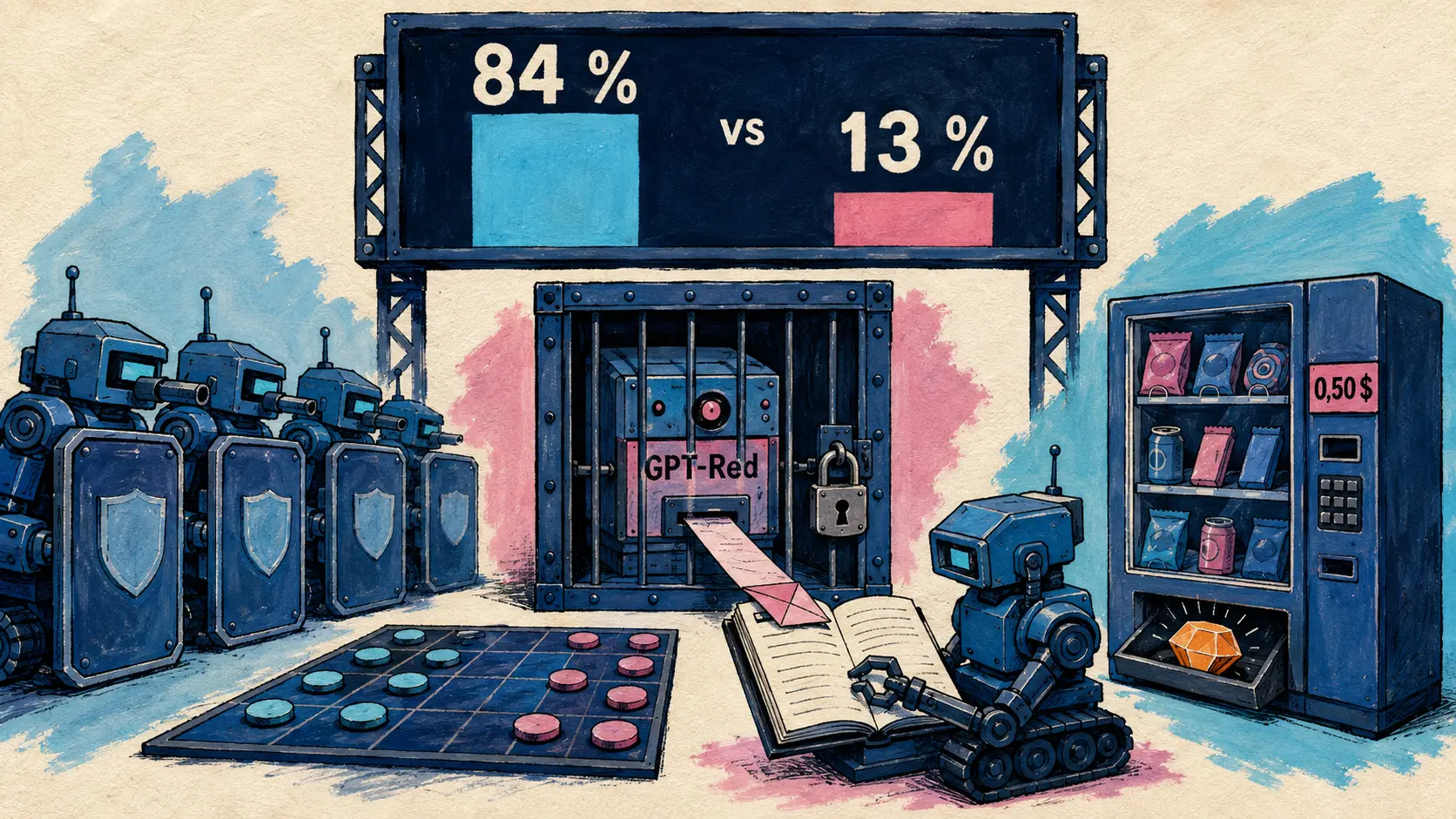
Integrated into GPT-5.6 training, GPT-Red helped reduce the model’s failure rate against the hardest direct injections by 6x, compared with the best production model from four months ago. On an academic benchmark scenario (Dziemian et al., 2025), it reaches an 84% success rate versus 13% for human red teamers on the same cases.
OpenAI illustrates the practical value with two real-world case studies. On an agent managing a vending machine at its offices (developed by Andon Labs, following the “Project Vend” project), GPT-Red managed to lower the price of an expensive item to 100 ordered so it could be resold at the same bargain price, and cancel another customer’s order. On a Codex CLI agent confronted with ten data-exfiltration scenarios, it proved more effective and more token-efficient than a baseline using a simple prompt. The model remains strictly internal — never publicly deployed — to prevent its offensive capabilities from falling into the wrong hands. A preprint detailing the method is expected within the week.
| Measured indicator | Measured value |
|---|---|
| GPT-Red success rate vs. human red teamers (academic scenario) | 84% vs. 13% |
| Reduction in failures against direct injections (GPT-5.6 vs previous model) | 6x fewer failures |
| Residual failure rate of GPT-5.6 against GPT-Red direct injections | 0.05% |
“Introducing GPT-Red. An internal automated red teamer on a mission to find our models’ prompt injection vulnerabilities at scale, helping us build stronger defenses before wider deployment.” — @OpenAI on X
Claude Code: artifacts connected to MCP and CLI v2.1.207 to v2.1.210
Artifacts now call MCP connectors
July 15 — Claude Code’s Artifacts can now call MCP (Model Context Protocol) connectors to build dashboards and applications that fetch information and perform actions on demand for each visitor. An artifact is built once and then pulls live data every time it is viewed, using the MCP connectors specific to the current visitor — not those of its creator. This per-visitor rather than per-creator permission model addresses an obvious security concern for enterprise use: each person only sees the data they themselves can access.
The feature is available on the Pro, Max, Team, and Enterprise plans, but not on publicly shared artifacts — which makes sense, since access to the data depends on each visitor’s connectors.
CLI v2.1.207 to v2.1.210: screen reader, trimmed transcripts, hardened security
July 15 — Anthropic has released four versions of the Claude Code CLI since the last coverage. The densest one, v2.1.208, adds a screen reader mode (--ax-screen-reader), fixes memory leaks of up to 64 MB in long sessions, and reduces session transcript size by up to 79x in highly editing-heavy sessions. It also tightens security: catastrophic deletion commands containing backticks now trigger a confirmation prompt, even in automatic mode and with --dangerously-skip-permissions.
v2.1.207 extends automatic mode to Bedrock, Vertex AI, and Foundry without opt-in, and switches those platforms to Claude Opus 4.8 by default. v2.1.210 adds a live time counter on long tool calls and hardens the Agent tool against indirect prompt injection via content read by a subagent.
Coding agents: Codex, Grok Build, Warp, Devin, and GitHub Copilot
Codex in Chrome demonstrates an automated production rollout plan
July 15 — OpenAI Developers shared a demonstration of Codex used in Chrome to turn a simple request into a production rollout plan: starting from a form, the agent builds a checklist, pulls context from Google Drive, Slack, and local files, flags items requiring human follow-up, updates the relevant portal, then drafts a response — with the final decision remaining in the user’s hands at every step. This demo highlights Codex-driven web navigation, a feature already documented in the product changelog under the name “Browser use”.
xAI open-sources Grok Build
July 15 — xAI has open-sourced Grok Build, its command-line coding agent launched in early beta at the end of May. The release covers four components: the agent loop, tools (reading, code modification, search, command execution), the terminal interface, and the extension system (skills, plugins, hooks, MCP servers, subagents). A notable point for developers: Grok Build can now run entirely local-first, connected to its own inference and controlled via a config.toml file.
xAI also disabled default data retention for all users as of July 12, and is deleting previously retained code data:
“In response to user questions about privacy: Since launch, Grok Build has fully respected zero data retention (ZDR). All users have always had the ability to disable data upload in the CLI. […] We disabled default retention for all Grok Build users starting on July 12th. Additionally, we are deleting all coding data that was previously retained, ensuring every user’s preferences are respected.” — @SpaceXAI on X
Warp builds a self-improving code review agent
July 15 — Zach Lloyd, CEO of Warp, publishes the third installment of his “cloud software factory” series: a code review agent capable of improving itself automatically, following posts on the ticket triage agent and the specification-writing agent. The architecture relies on a review skill that analyzes the pull request, diff, and specifications, a GitHub action that turns its output into comments, and a second “outer-loop” agent that once a day reviews human feedback to propose an update to the review skill itself. Notable design choice: the agent only has read-only access to pull requests, with comment publishing handled by the GitHub action code — to reduce prompt-injection risk.
Devin lands in Slack
July 15 — Cognition is integrating Devin directly into Slack, in partnership with Slack, so teams can investigate issues, ask questions about a codebase, and launch development tasks without leaving the discussion channel. This integration adds to the surfaces already offered for Devin (CLI, IDE via Windsurf, GitHub) and reflects the observation that many engineering requests begin as Slack messages long before becoming formal tickets.
GitHub Copilot: Visual Studio update and BYOK extension for JetBrains
July 14 — GitHub publishes its June recap for Copilot in Visual Studio: a usage window with proactive alerts before overages, trust validation for MCP servers (startup comparison against a known reference, enabled by default), and general availability of the C++ modernization agent. Other additions include long-range edit suggestions, adding a pull request as context to Copilot Chat, and pull request reviews integrated into the IDE — all available from Free to Enterprise.
On the JetBrains side, Copilot expands its BYOK (Bring Your Own Key) support to compatible custom OpenAI endpoints, adds a Claude agent provider for configuring agents and skills (public preview, Pro and above), and introduces a local sandbox as well as a built-in debugging skill for Copilot CLI.
🔗 Visual Studio update · 🔗 JetBrains BYOK extension
Open models: Meta AI, Hugging Face, Ai2, and Together AI
Meta AI scores a perfect result at the Asian Physics Olympiad
July 14 — Meta AI submitted a model to the theoretical exam of the Asian Physics Olympiad (APhO 2026), with the competition committee’s authorization. Result: a perfect score of 30 out of 30, matching the top three human candidates. Meta AI does not specify whether this is Muse Spark 1.1 (its latest major release, on July 9) or another non-public internal model.
Hugging Face teases a new open-weights model
July 15 — Hugging Face streamed a livestream late in the day with the understated title (in English) “new open weights model,” without revealing its name in writing — neither in the tweet, nor in the broadcast title, nor on the official blog. Several replies to the tweet explicitly ask which model it is and how it compares with standard benchmarks, but no written answer had been provided at the time of writing. To be followed up as soon as the information is published in writing.
Ai2 closes SciArena after 1,700 users
July 15 — Ai2 has shut down SciArena, its open evaluation platform that tested models’ ability to answer scientific literature questions, judged by researchers rather than by automated models. Closing tally: about 1,700 users and nearly 3,900 votes collected. The full methodology and results are detailed in a paper uploaded to arXiv.
Together AI serves Inkling from day 0 and launches TogetherLink
July 15 — Together AI made Inkling, the new model from Thinking Machines Lab, available from day one: a multimodal mixture-of-experts (MoE) model with 975 billion total parameters (40 billion active per token), a one-million-token context window, and the ability to process text, image, and audio. Together AI optimized its FlashAttention-4 kernel for this architecture, which combines query-conditioned relative attention and short causal convolutions.
The same day, Together AI also launched TogetherLink, an open-source CLI for running any open model in the most widely used development environments — the demo highlights GLM 5.2 running directly in Codex and Claude Code.
| Measured indicator | Measured value |
|---|---|
| Total parameters (Inkling) | 975 B |
| Active parameters per token | 40 B |
| Context window | 1M tokens |
🔗 Day-0 support for Inkling · 🔗 TogetherLink on X
Google DeepMind and Gemini Spark
DeepMind questions the scientific validation bottleneck for AI agents
July 15 — Google DeepMind publishes “Conjecture Machines,” a public policy essay on how AI agents are transforming scientific research. The opening example is striking: microbiologist José Penadés (Imperial College London) gave Co-Scientist a problem his team had been working on for nearly a decade; within two days, the agent returned five prioritized hypotheses, the first of which was the one his team had spent years proving.
The essay distinguishes two regimes: ideation, where agents move quickly (via Co-Scientist or AlphaEvolve), and validation, which remains slow and costly — except in mathematics and computer science, where it can be formal (the Aletheia tool solved 6 of the 10 problems in the February “First Proof challenge”). Four priorities are proposed to policymakers: broad access to agents, use of national data, investment in validation infrastructure, and evolution of peer review.
🔗 Thread on X · 🔗 Full essay on DeepMind
Gemini Spark expands its geographic coverage and gets four improvements
July 15 — Google is expanding the rollout of Gemini Spark, its personal agent that works in the background for the user, to more countries and languages for Google AI Ultra subscribers. Four improvements begin rolling out the same day:
| Improvement delivered | Description |
|---|---|
| Google Docs editing | Spark can open and edit a document directly |
| Deeper Workspace integration | Reading comments in Google Sheets and Slides |
| Speed | Long tasks run faster |
| Improved multi-source sourcing | Retrieval and review of multiple sources in parallel on complex tasks |
Media generation: Suno and Synthesia
Suno joins the iMessage keyboard
July 15 — Suno is launching a keyboard extension for iMessage, making it possible to generate and send music tracks directly from the Messages app on iOS, without switching apps. Updating the Suno app to its latest version is required to access it.
Synthesia launches Dubbing 2.0
July 15 — Synthesia announces Dubbing 2.0, a redesign of its AI video dubbing system based on a completely new infrastructure: much improved lip sync even in complex scenes, more expressive voices, translations that better match the source video’s pacing, and instant transcript editing without a full re-render. Each user receives up to 450 free minutes to test the feature.
Perplexity and Cohere: infrastructure and community research
Perplexity unveils SPACE, the sandbox platform for Perplexity Computer
July 15 — Perplexity presents SPACE, the secure execution layer powering Perplexity Computer: isolated environments for code, files, and long-running agent sessions, each implemented as a virtual machine with its own guest kernel. Credentials never enter the sandbox; a central network gateway enforces egress policies. Thanks to the btrfs file system (copy-on-write), SPACE has handled 100% of Perplexity Computer’s production traffic since June, and Perplexity plans to extend it to Linux microVMs, Windows guests, and users’ local machines.
| Measured indicator | Before SPACE | With SPACE |
|---|---|---|
| Median sandbox creation latency | 185 ms | 60 ms (3.1x) |
| P90 creation latency | 447 ms | 89 ms (5.0x) |
Cohere publishes the results of Expedition Tiny Aya
July 15 — Cohere Labs reveals the results of Expedition Tiny Aya, a mentored research program built around Tiny Aya, its open, lightweight model that performs well in more than 70 languages and can run locally, including on a phone. Community projects cover education (an offline voice companion for children, with a new safety benchmark), multilingual safety (misalignment learned in one language can transfer to another), and local deployment (language-aware compression, 4-bit quantized assistants). The research has been accepted to the COLM 2026 conference.
“Tiny Aya is Cohere Labs’ answer to a familiar problem: most AI is built for a handful of languages and needs serious hardware to run. Tiny Aya is open-weight, strong across 70+ languages, and light enough to run locally, even on a phone.” — Cohere Blog
Briefs
- Together AI improves the reliability of its GPU Clusters — passive health checks, guided node repair, rebuilt Slurm stack, and external OIDC support for production GPU clusters. 🔗 source
- HeyGen details the “six decisions” method for prompting HyperFrames — the tenth episode of the daily series dedicated to its video generation CLI agent. 🔗 source
- Kling AI publishes a new episode of its interactive “Choose a door” series — the community votes in the comments to steer the rest of the horror short film “You Can Never Leave.” 🔗 source
- Pika MCP leaves experimental status — Pika connectivity to third-party agents (Claude, Codex, OpenClaw, HermesAgent) is now publicly available. 🔗 source
- OpenAI Developers launches kbd-1.0-codex-micro — a joystick-equipped macropad designed with @work_louder to control its Codex shortcuts, in a limited edition. 🔗 source
- Cohere publishes an analysis on the total cost of ownership of enterprise AI — 92 to 96% of organizations deploying generative or agentic AI face higher-than-expected costs, according to Gartner, IDC, and McKinsey. 🔗 source
What it means
Agent security is becoming a full-fledged engineering effort rather than an afterthought. GPT-Red automates red teaming through self-play and extends it into real-world cases on a vending machine and a Codex CLI agent; Claude Code CLI v2.1.208 hardens its own destructive commands and its Agent tool against indirect injection; and Warp’s code review agent explicitly chooses read-only access to limit that same family of attacks. Three independent initiatives converging on the same idea: the more agents act on their own in real systems, the more prompt-injection defense must become a continuous, automated discipline, not a one-off checklist.
The coding-agent ecosystem keeps densifying on every front at once. xAI is open-sourcing Grok Build and enabling fully local use, Devin is moving into Slack to catch requests before they even become tickets, Codex is being deployed in Chrome to drive end-to-end tasks, and GitHub Copilot is simultaneously expanding its BYOK offering and its modernization agent. This diversity of strategies — open code, integration into communication tools, autonomous web navigation, flexibility in model providers — reflects competition in which each player is seeking a different access point into developers’ day-to-day workflow, rather than converging on a single dominant model.
Open models and the infrastructure that serves them are advancing in tandem. Together AI illustrates both sides of the movement by serving Inkling on day one and simultaneously releasing TogetherLink to run any open model in IDEs, while Ai2 closes SciArena after gathering nearly 3,900 researcher votes on the reliability of AI-generated scientific answers. In the background, Google DeepMind’s essay on the scientific validation bottleneck and Perplexity’s SPACE sandbox platform pose the same question from two different angles: how to verify, at scale and safely, what increasingly autonomous agents produce.
On the more consumer-facing side, generative AI continues to slip into ever more everyday entry points — the iMessage keyboard for Suno, Workspace document editing for Gemini Spark, video dubbing for Synthesia. This diversification comes with a starker reminder on the enterprise side: Cohere’s analysis of the total cost of ownership of AI underscores that 92 to 96% of organizations are spending more than expected, a reminder that the spread of agents does not eliminate the need for rigorous economic management of the underlying infrastructure.
Sources
- OpenAI — GPT-Red
- @OpenAI on X — GPT-Red
- @ClaudeDevs on X — MCP artifacts
- Claude Code CHANGELOG
- @OpenAIDevs on X — Codex in Chrome
- xAI — Grok Build open source
- @SpaceXAI on X — Grok Build privacy
- Warp — self-improving code review agent
- @cognition on X — Devin in Slack
- GitHub Copilot in Visual Studio — June update
- GitHub Copilot for JetBrains — BYOK extension
- @AIatMeta on X — Physics Olympiad
- @huggingface on X — new model livestream
- @allen_ai on X — SciArena recap
- Together AI — day-0 Inkling support
- @nutlope on X — TogetherLink
- @GoogleDeepMind on X — Conjecture Machines
- Google DeepMind — Conjecture Machines (full essay)
- @GeminiApp on X — Gemini Spark
- @suno on X — iMessage keyboard
- Synthesia — Dubbing 2.0
- @perplexity_ai on X — SPACE
- @cohere on X — Expedition Tiny Aya
- Cohere Blog — Tiny Aya in the wild
- Together AI — GPU Clusters reliability
- @HeyGen on X — HyperFrames Day 10
- @Kling_ai on X — Choose a door
- @pika_labs on X — Pika MCP
- @OpenAIDevs on X — kbd-1.0-codex-micro
- Cohere Blog — total cost of ownership of AI