ai-powered-markdown-translatorArticle translated from fr to en with gpt-5.4-mini.
June 18, 2026 — Perplexity equips its Computer agent with a self-improving memory (Brain) that learns overnight from past sessions. OpenAI publishes two major results in health: GPT-5.5 Instant reaches frontier performance for ChatGPT’s 230 million free users, and a study published in NEJM AI shows that o3 Deep Research helped produce 18 new diagnoses in 376 unresolved pediatric genetic cases. Genspark launches AgentBase, an internal data management platform without SaaS. On the developer tooling side, Claude Design synchronizes bidirectionally with Claude Code, MAI-Code-1-Flash expands to eight Copilot surfaces, and DeepMind publishes its safety framework for AI agents.
Perplexity Brain — Self-improving memory for Computer
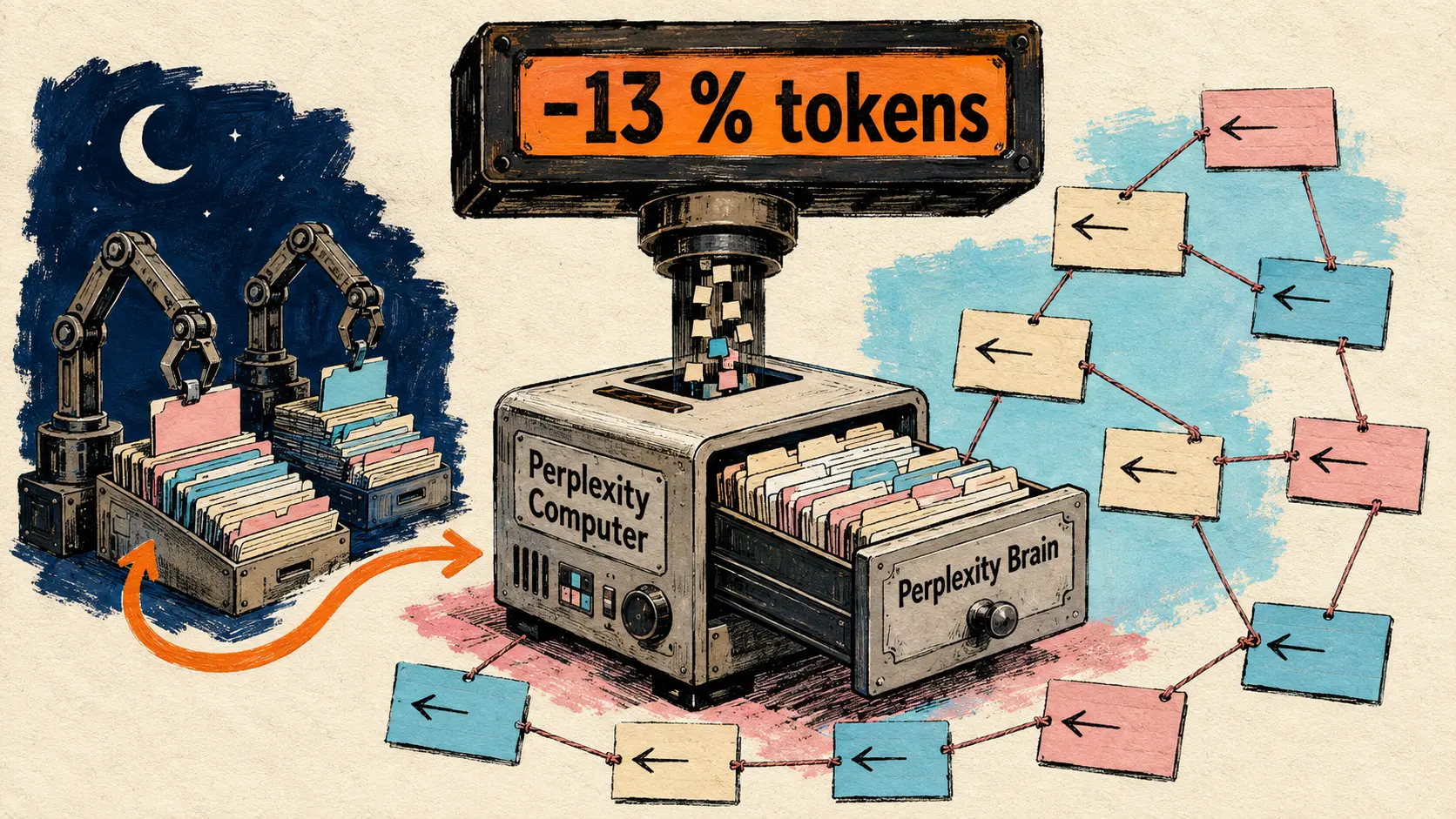
June 18 — Perplexity launches Brain, a self-improving memory system built into its Computer agent. Unlike classic memory systems centered on user preferences, Brain remembers what the agent did: successful tasks, mistakes made, and corrections applied during past sessions.
The system is based on a living context graph (a kind of wiki generated by the language model, automatically loaded into the agent’s sandbox at each session). This graph maps the user’s projects, people, sources, and artifacts. Overnight, the agent analyzes past sessions to extract lessons and adjust its strategies — without human intervention. Every memory entry is traceable back to the originating session, file, or source.
| Parameter | Value |
|---|---|
| Product | Perplexity Computer — Brain |
| Availability | Max and Enterprise Max (Research Preview) |
| Accuracy on seen tasks | +25 % |
| Recall | +16 % |
| Token cost reduction | -13 % |
| Traceability | Each entry linked to its originating session or source |
The -13 % reduction in token costs is particularly notable: by remembering the context of recurring tasks, the agent avoids rebuilding its context for every new session. The improvement is recursive: agents learn from their mistakes and user corrections between sessions, reducing back-and-forth and model calls.
“Brain doesn’t just remember you — it remembers what it did, what worked, what failed, and how to correct course.” — @perplexity_ai
🔗 Perplexity Brain — Official blog
GPT-5.5 Instant — Frontier-level health intelligence for all users
June 18 — OpenAI announces that GPT-5.5 Instant reaches frontier-model performance on the HealthBench and HealthBench Professional benchmarks — and that this level is now available to all 230 million weekly ChatGPT users, including free accounts.
The most striking metric: the rate of health factuality issues fell by 71 % in two months in ChatGPT production responses. This progress is driven by a medical network of 260 doctors in 60 countries, covering 26 specialties and 49 languages, who evaluate and refine the model’s responses.
| Dimension | Value |
|---|---|
| Model | GPT-5.5 Instant |
| Availability | All ChatGPT users (free included) |
| Doctors in the evaluation network | 260+ in 60 countries, 26 specialties, 49 languages |
| Medical evaluations completed | 700,000+ |
| Reduction in health factual errors | -71 % in 2 months (production) |
| Benchmarks reached | HealthBench, HealthBench Professional (frontier level) |
OpenAI says GPT-5.5 Instant outperforms doctor-written answers on several criteria — clarity, completeness, and adaptation to the interlocutor’s level. This announcement is part of the OpenAI for Healthcare strategy and the ChatGPT for Clinicians initiative, whose public scope is explicitly expanded here.
🔗 Health intelligence in ChatGPT — OpenAI
o3 Deep Research — 18 pediatric diagnoses in 376 unresolved cases (NEJM AI)
June 18 — A study published in NEJM AI (New England Journal of Medicine AI) shows that o3 Deep Research, used as a research tool by clinicians at Boston Children’s Hospital and Harvard, helped establish 18 new diagnoses in 376 previously unresolved pediatric genetic cases — an additional diagnostic yield of 4.8 %.
The process was strictly supervised: the researchers submitted anonymized records to o3 Deep Research, retrieved its hypotheses, then validated them with CLIA-certified laboratory tests and multidisciplinary expert review. The model did not diagnose any patient — the physicians made and confirmed the diagnoses.
| Cohort | Cases | Confirmed diagnoses | Yield |
|---|---|---|---|
| Neurodevelopmental disorders | 100 | 10 | 10.0 % |
| Neuromuscular diseases | 61 | 4 | 6.6 % |
| Early-onset psychosis | 15 | 2 | 13.3 % |
| Sudden unexpected pediatric death | 200 | 2 | 1.0 % |
| Total | 376 | 18 | 4.8 % |
One case illustrates the potential of abductive reasoning: o3 inferred a 22q11.2 deletion (DiGeorge syndrome) not explicitly present in the input data, a hypothesis later confirmed in the lab. The model also proposed a potentially new mechanism for vitiligo via the S1PR1 pathway — a testable hypothesis. The OpenAI Foundation will fund the next phase of this research through a grant to the Manton Center for Orphan Disease Research (Boston Children’s Hospital).
🔗 Pediatric rare disease diagnosis — OpenAI
Genspark AgentBase — Data into databases, dashboards, and CRM by prompt
June 17 — Genspark launches AgentBase in public preview: a platform that turns an organization’s existing data into custom databases, dashboards, and operational internal systems — without buying additional SaaS solutions. The announcement drew 213,000 views on X in a few hours.
| Feature | Description |
|---|---|
| Data sources | Mailbox, files, applications, meeting notes |
| Native integrations | Salesforce, HubSpot, and other existing databases |
| Customization | By prompt — the agent builds the dashboard from the description |
| Prebuilt systems | CRM, recruiting, project tracking, internal systems |
| Launch promo | Half-price credits for 2-4 weeks depending on plan; Enterprise free for 4 weeks |
The positioning is explicitly anti-SaaS: instead of deploying a dedicated CRM, a separate recruiting tool, and a project tracking system, the team describes its needs in natural language and AgentBase builds the workflows on its own data.
“AgentBase turns your data into personalized databases, dashboards, and internal systems — without buying multiple SaaS tools.” — @genspark_ai
🔗 Genspark AgentBase — genspark.ai
Claude Design — Bidirectional synchronization with Claude Code
June 17 — Anthropic updates Claude Design with native bidirectional synchronization with Claude Code via the /design-sync command. The flow: import the design system into a code repository to build on real components, or push existing code into Claude Design to continue editing on the canvas.
| Feature | Description |
|---|---|
| Bidirectional sync | /design-sync between Claude Code and Claude Design |
| Canvas editing | Direct changes without leaving the Claude Design interface |
| Cross-project design system | Consistent visual identity (colors, typography, components) across all projects |
| Export | PDF and PowerPoint directly from designs |
“Claude Code and Claude Design now sync both ways. Run /design-sync to pull your design system into your repo and build against your real components, or push what you’ve built back into Claude Design and keep editing on the canvas.” — @ClaudeDevs
Google DeepMind — AI Control Roadmap for agent safety
June 18 — Google DeepMind publishes its AI Control Roadmap, a so-called defense-in-depth safety framework for internal AI agent systems. The approach treats agents as potential insider threats and complements model alignment with an architectural oversight layer.
The framework was calibrated on the analysis of one million trajectories from coding agents. DeepMind simultaneously publishes Three Layers of Agent Security, a technical report for policymakers, structured into three levels: safety of the individual agent, of multi-agent systems, and of the broader ecosystem. A real-time monitor is active on the Gemini Spark agent.
“There is a narrow window to embed structural security protocols before multi-agent systems scale globally.” — @GoogleDeepMind
🔗 Securing the Future of AI Agents — DeepMind
MAI-Code-1-Flash — Available on eight additional Copilot surfaces
June 18 — Microsoft’s MAI-Code-1-Flash model, designed and optimized specifically for GitHub Copilot, is now available on eight additional environments.
| Surface | MAI-Code-1-Flash availability |
|---|---|
| Copilot CLI | ✅ |
| GitHub Copilot app | ✅ |
| Copilot Chat | ✅ |
| Visual Studio | ✅ |
| GitHub Mobile | ✅ |
| JetBrains IDEs | ✅ |
| Eclipse | ✅ |
| Xcode | ✅ |
Plans covered: Free, Student, Pro, Pro+, Max. Progressive rollout underway — Business and Enterprise coming soon.
🔗 MAI-Code-1-Flash — GitHub Changelog
Copilot Code Review — AGENTS.md support and UI improvements
June 18 — Copilot code review now supports AGENTS.md in general availability: repositories can place this file at their root to automatically align Copilot reviews with the project’s conventions. Two interface improvements accompany the update: the Request button is now available directly on draft PRs, and review events are grouped in the conversation timeline.
🔗 Copilot code review AGENTS.md — GitHub Changelog
Grok on Databricks — Available on Agent Bricks at the Data + AI Summit
June 18 — Grok models are now natively available on Databricks Agent Bricks, announced at the Databricks 2026 Data + AI Summit. Agent Bricks connects context from Lakehouse data (Data Lakehouse) with Grok models to help engineering teams build AI agents on large volumes of data. This integration complements the availability on Amazon Bedrock announced on June 17.
Kimi Work — Goal Mode for long-running agents
June 18 — Kimi (Moonshot AI) introduces Goal Mode in its Kimi Work desktop agent. This mode allows the agent to run continuously 24/7 until a task is fully completed, without constant supervision. Designed for long-horizon tasks and complex multi-step workflows.
🔗 Kimi Work Goal Mode — @Kimi_Moonshot
ChatGPT Enterprise — New spending controls and credit analytics
June 18 — OpenAI rolls out new usage analytics tools and spending controls for ChatGPT Enterprise administrators. The Global Admin Console now unifies ChatGPT and Codex credit consumption in a single view. Administrators can set limits by workspace, group, or individual. Employees can view their credit budget and request an increase directly from the interface. A unified Cost API enables data export for external analysis.
🔗 ChatGPT Enterprise spend controls — OpenAI
ElevenLabs — Poland takes an equity stake via Vinci/BGK
June 18 — The Polish government, through Vinci (a subsidiary of BGK, the national development bank), is taking an equity stake in ElevenLabs. This is the first sovereign state investment in the company, alongside Andreessen Horowitz, Sequoia, and ICONIQ. Warsaw’s move fits into the broader European debate on digital sovereignty in AI.
🔗 Poland invests in ElevenLabs
NVIDIA at Cannes Lions — AI Advertising Partners with Blackwell and DGX Vera Rubin
June 18 — Ahead of the Cannes Lions festival (June 22–26, France), NVIDIA shows how its partners are using Blackwell and DGX Vera Rubin NVL72 accelerators to transform advertising and marketing.
| Partner | NVIDIA use |
|---|---|
| Higgsfield AI | Video/image marketing agents on Blackwell (Soul 2.0) + NemoClaw/OpenShell; around 400 Fortune 500 clients |
| Alembic | Causal AI on DGX Vera Rubin NVL72 SuperPODs |
| Criteo | Model training 2× faster on Blackwell (cuEmbed, 17,000 GPU hours/year) |
| KERV.ai | Video understanding 10× faster with Nemotron 3 Nano Omni |
| Taboola | DeeperDive conversational AI on NVIDIA GPUs |
🔗 NVIDIA Cannes Lions — NVIDIA Blog
Briefs
-
Dataland — the world’s first AI art museum: Google and artist Refik Anadol are opening Dataland on June 20 in Los Angeles (25,000 m²), powered by the Gemini Enterprise Agent Platform. An AI artist residency launches at the same time: 4 artists, USD 25,000 each. 🔗 blog.google
-
Grok for Word: Grok extension for Microsoft Word available free on the Microsoft Marketplace. Turns notes into documents, performs web searches, connects to SharePoint and Google Drive. Complements the PowerPoint and Excel extensions already available. 🔗 x.ai
-
GitHub Copilot — developer credit in release notes: when a PR opened by the Copilot agent is merged, the requesting developer is now credited alongside
@copilotin the automatically generated release notes (e.g. “by @monalisa with @copilot”). 🔗 GitHub Changelog -
Cohere North Mini Code 1.0 — first open-source agentic coding model: Cohere launches North Mini Code 1.0 (Apache 2.0), MoE architecture 30B total / 3B active, 256K-token context, 2.8× faster throughput than Devstral Small 2. Available on Hugging Face (bf16, fp8, 4-bit quantization), Ollama, and free OpenRouter. 🔗 cohere.com
-
Cohere — digital sovereignty op-ed at the G7: Aidan Gomez (CEO of Cohere) publishes an op-ed in Fortune warning about nations’ “dangerous” dependence on big tech companies in AI, arguing for digital sovereignty in the G7 context. 🔗 fortune.com
What this means
Medical AI is crossing a threshold of scientific credibility. The publication in NEJM AI of the Boston Children’s Hospital / Harvard / OpenAI study is a strong marker: the 18 laboratory-confirmed diagnoses in 376 unresolved cases show that o3 Deep Research can generate usable medical hypotheses, not just literature summaries. GPT-5.5 Instant reaching frontier level in health for 230 million free users on the same day points to a coherent trajectory: consumer medical AI is becoming normalized, with a network of 260 physicians in 60 countries as an editorial safeguard. These two announcements converge on the same signal — AI in healthcare is leaving the benchmark stage and producing verifiable clinical results.
Agent memory and extended autonomy are becoming differentiating value propositions. Perplexity Brain represents an architectural advance: the agent leverages its operational history (+25% accuracy, -13% token cost on recurring tasks). Kimi Work Goal Mode (24/7 autonomous) and Genspark AgentBase (data in operational systems via prompt) confirm that 2026 is the year agents move from occasional assistance to persistent execution. The convergence of these three products outlines the next-generation agent architecture: inter-session memory, continuous execution, on-demand tool building.
Digital sovereignty is emerging as the geopolitical response to AI concentration. Poland’s investment in ElevenLabs via BGK and Aidan Gomez’s op-ed in Fortune at the G7 converge on the same diagnosis: states are seeking to control their strategic AI infrastructure. The launch of Cohere North Mini Code 1.0 under Apache 2.0 (3 billion active parameters, locally runnable, 2.8× faster than Devstral Small 2) illustrates how open source responds to this demand — sovereignty through local deployability and independence from cloud vendors.
Developer tooling is entering a phase of universal coverage. MAI-Code-1-Flash across eight Copilot surfaces in a single update, standardized AGENTS.md to align reviews with project conventions, Claude Design synchronized with Claude Code via /design-sync : the logic is no longer “which IDE supports my AI assistant” but “is my AI assistant present everywhere I code.” DeepMind, which simultaneously publishes its safety framework for agents (calibrated on one million trajectories), reminds us that this vertical integration raises unresolved control questions — and that the industrial response is beginning to take shape.
Sources
- Perplexity Brain — Official Blog
- Perplexity Brain — Announcement Tweet
- Perplexity Brain — Details Tweet
- GPT-5.5 Instant health — OpenAI
- Rare disease diagnosis — OpenAI
- Genspark AgentBase — X @genspark_ai
- Genspark AgentBase — genspark.ai
- Claude Design sync — @claudeai
- Claude Design sync — @ClaudeDevs
- AI Control Roadmap — DeepMind
- AI Control Roadmap — @GoogleDeepMind
- MAI-Code-1-Flash — GitHub Changelog
- Copilot code review AGENTS.md — GitHub Changelog
- Grok on Databricks — x.ai
- Kimi Work Goal Mode — @Kimi_Moonshot
- ChatGPT Enterprise spend controls — OpenAI
- Poland Invests in ElevenLabs
- NVIDIA Cannes Lions — NVIDIA Blog
- Dataland AI art museum — blog.google
- Grok for Word — x.ai
- Copilot release notes credit — GitHub Changelog
- Cohere North Mini Code 1.0
- Cohere digital sovereignty G7 — Fortune