ai-powered-markdown-translatorTranslated article from fr to en with gpt-5.4-mini.
June 22, 2026 is a packed day: OpenAI extends its Daybreak program to defensive cybersecurity with a new specialized model and an open source initiative; Sakana AI claims, with Fugu Ultra, a step above current frontier models on coding benchmarks; Cursor unveils the recordings of its Compile keynote, including a training partnership with SpaceX; and Google launches Gemini Spark, its personal AI agent in beta for Ultra subscribers in the United States. Claude Code v2.1.186 and Claude’s integration into JetBrains via Copilot round out a particularly busy agentic cycle.
OpenAI extends Daybreak — Codex Security, GPT-5.5-Cyber, and the Cyber Partner Program
June 22 — OpenAI announces a major expansion of Daybreak, its defensive cybersecurity program. The stated goal is to democratize the remediation of software vulnerabilities at machine speed.
Codex Security — integrated plugin for developers
Launched in preview in March 2026, Codex Security has since analyzed more than 30 million commits across more than 30,000 codebases. More than 500,000 fixes have been identified automatically. The plugin now lets developers perform vulnerability analysis directly in Codex: report generation with severity levels, attack-path tracing, threat modeling, and targeted fix generation. CI/CD integration is handled through SARIF files and CodeQL queries.
GPT-5.5-Cyber — performance on security benchmarks
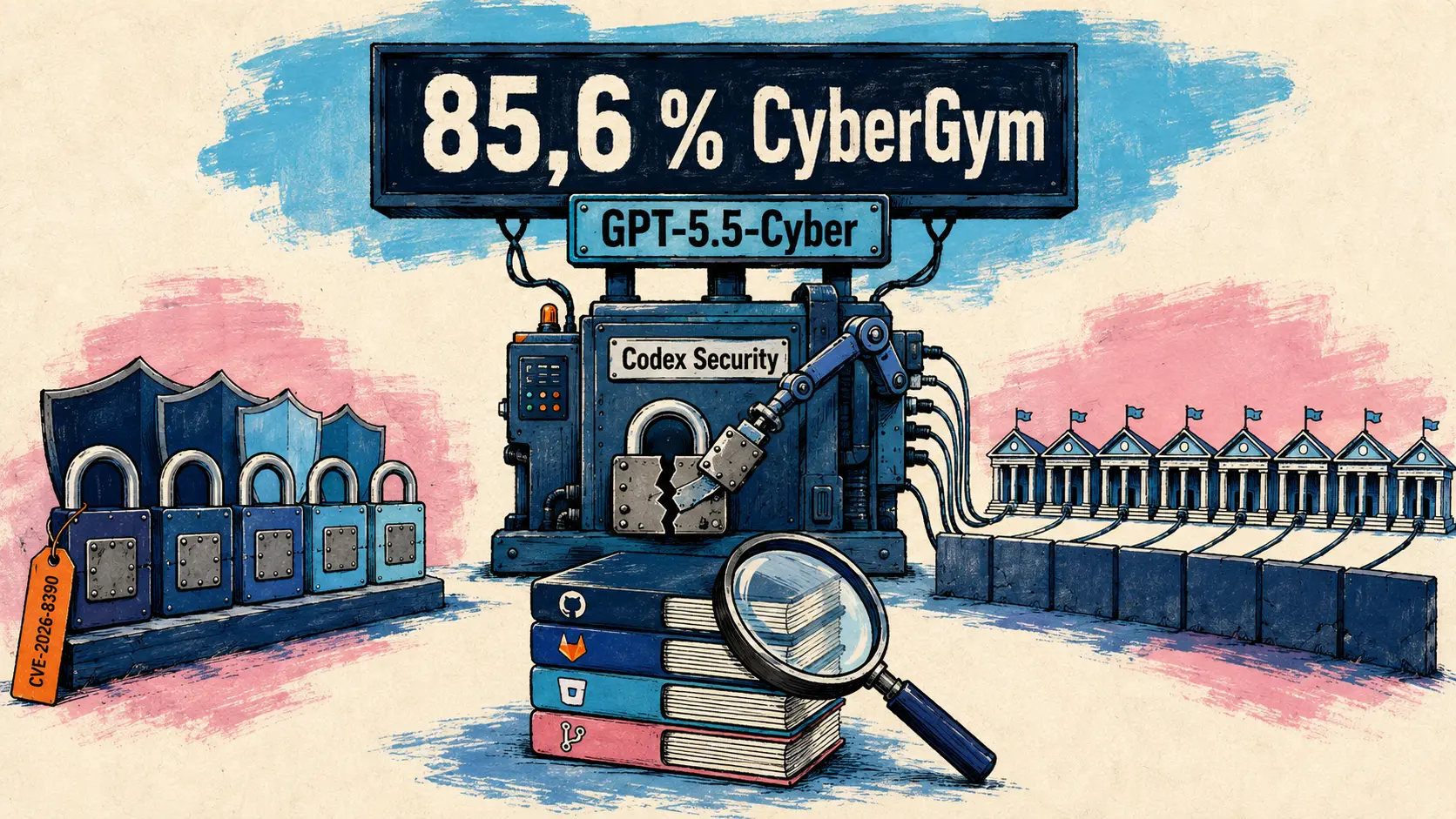
OpenAI launches the full version of GPT-5.5-Cyber after a limited preview. This model is designed for authorized defenders whose work requires advanced cyber capabilities.
| Benchmark | GPT-5.5-Cyber | GPT-5.5 |
|---|---|---|
| CyberGym | 85.6% | 81.8% |
| ExploitGym | 39.5% | 25.95% |
| SEC-bench Pro | 69.8% | 63.1% |
Daybreak Cyber Partner Program and government partnerships
OpenAI is opening a partner program that allows security companies to deploy GPT-5.5 with Trusted Access for Cyber in their products. Government partnerships have been established with Australia, Canada, France, Germany, Japan, South Korea, and European institutions including ENISA.
OpenAI teams discovered and reported real vulnerabilities in Chrome (5 V8 flaws), Safari (more than 10 WebKit flaws), Firefox (CVE-2026-8390, patched two days before Pwn2Own Berlin), the Linux kernel (24 local privilege exploits), OpenBSD (a 23-year-old use-after-free vulnerability), and FreeBSD (34 confirmed vulnerabilities).
🔗 OpenAI — Daybreak Securing the World
Patch the Planet — OpenAI and Trail of Bits for critical open source software
June 22 — As part of Daybreak, OpenAI launches Patch the Planet, an initiative built with Trail of Bits to help open source software maintainers fix vulnerabilities — not just discover them.
The motivation is documented: a study by the Linux Foundation and Harvard shows that 94% of open source projects have fewer than 10 developers responsible for more than 90% of the code added in a year. AI speeds up vulnerability discovery, but maintainers end up overwhelmed by reports without additional resources to handle them.
Participating projects: cURL, NATS Server, pyca/cryptography, Sigstore, aiohttp, Go, freenginx, Python, and python.org. Partners HackerOne and Calif complete the setup for triage and coordinated disclosure.
Results from the first five-day sprint across 19 projects:
- A complete fuzzing lab built in less than a day (estimated to take several weeks manually)
- A reusable pipeline for finding variants of known vulnerabilities from historical CVEs
- Differential testing between implementations of the same protocol, completed in a few days instead of the usual weeks
🔗 Patch the Planet — openai.com
Sakana Fugu — Sakana AI claims a new milestone on SWE-Bench with a multi-agent system
June 22 — Sakana AI (a Japanese lab founded by former Google DeepMind researchers) announces Sakana Fugu, a multi-agent system presented as a single API compatible with OpenAI ChatCompletions. The announcement reached 18.5 million views in a few hours.
The core idea: dynamically orchestrate a set of frontier models behind the scenes, without the user having to manage multiple endpoints. The technology is based on two papers presented at ICLR 2026 (TRINITY and Conductor) that learn to orchestrate models without hard-coded workflows.
Performance claims — presented here as such, according to Sakana:
| Benchmark | Fugu Ultra | Opus 4.8 | Gemini 3.1 Pro | GPT-5.5 |
|---|---|---|---|---|
| SWE-Bench Pro | 73.7% | 69.2% | 54.2% | 58.6% |
| TerminalBench 2.1 | 82.1% | 74.6% | 70.3% | 78.2% |
| LiveCodeBench | 93.2% | 87.8% | 88.5% | 85.3% |
| Humanity’s Last Exam | 50.0% | 49.8% | 44.4% | 41.4% |
| GPQA-D | 95.5% | 92.0% | 94.3% | 93.6% |
Two versions available:
| Version | Input pricing | Output pricing | Cache |
|---|---|---|---|
| Fugu | Underlying model pricing | Underlying model pricing | — |
| Fugu Ultra | $5/M tokens | $30/M tokens | $0.50/M tokens |
| Fugu Ultra (>272K tokens) | $10/M tokens | $45/M tokens | $1.00/M tokens |
Subscriptions: Standard $20/month, Pro $100/month, Max $200/month.
Important limitations: Fugu Ultra is not available in the EU/EEA (GDPR compliance in progress). Vercel AI Gateway already integrates Fugu Ultra. The exact names of all orchestrated underlying models are not fully disclosed by Sakana.
🔗 Sakana Fugu announcement tweet · Product page
Cursor — Compile Keynote: 3 announcements including training a model with SpaceX
June 22 — The Cursor team publishes the recordings of its Compile keynote (Fort Mason, San Francisco, June 16, 2026), an invite-only event organized by Anysphere. Three major announcements are presented, the most significant being: training a new model in partnership with SpaceX.
“Three announcements from our keynote at Compile, including how we’re training a new model with SpaceX.” — @cursor_ai
This training partnership comes in the context of the acquisition of Anysphere (Cursor’s parent company) by SpaceX/xAI, announced around June 16. The other two keynote announcements had not yet been detailed in an official blog post at the time of the scan (the most recent Cursor blog post dated from May 18, 2026). The full keynote video is available on YouTube under the title “Opening Keynote | Compile 26”.
Gemini Spark — 24/7 personal AI agent in beta for Google AI Ultra subscribers
June 22 — Google Gemini announces Gemini Spark in beta, a personal AI agent available 24/7, capable of handling end-to-end tasks under the user’s direction. The beta is available to Google AI Ultra subscribers in the United States.
Unlike the standard conversational features of the Gemini app, Spark is presented as an autonomous operational agent: it handles long-running tasks without supervision at every step.
Internal use cases within the Google team:
| Use case | Description |
|---|---|
| Project tracking auditor | Cross-references meeting notes with project tracking tools to identify outdated items |
| Newsletter aggregator | Scans Gmail, extracts relevant links, and compiles a structured daily summary |
The beta is initially limited to Google AI Ultra subscribers in the United States.
Claude as an agent provider in preview in GitHub Copilot for JetBrains IDEs
June 22 — GitHub publishes a substantial update to the Copilot plugin for JetBrains IDEs. The highlight: Claude (via the Claude Code CLI) is now available in public preview as an agent provider in Copilot Chat.
Requirements:
- Install the Claude Code CLI on the machine
- Configure the CLI path in Settings > Tools > GitHub Copilot > Chat
- Select Claude in the Copilot Chat agent picker
- Reserved for Copilot Business/Enterprise subscribers via the “Editor preview features” policy
- In “bypass permissions” mode for now (all file changes and tool calls are automatically approved; configurable permissions are coming in a future version)
Other improvements included in this update:
| Feature | Description |
|---|---|
| Org/enterprise agent support | Admins publish custom agents available to all members |
| Messages during CLI execution | Three options: Add to Queue, Steer with Message, Stop and Send |
| Agent debug logs view | Debug log summary in a dedicated view |
| /models command | Opens the model picker with a history of recently used models |
| AI credit indicator | Number of credits consumed per turn displayed |
| Cloud agent general availability | The cloud agent exits “Editor Preview” preview |
🔗 GitHub Changelog — Claude as agent provider in JetBrains
Claude Code v2.1.186 — MCP CLI authentication, Skills in /plugin, bash ! auto-reply
June 22 — Claude Code v2.1.186 is released on June 22, 2026. It is one of the densest updates of the recent period.
New commands and features:
| Feature | Description |
|---|---|
claude mcp login/logout <nom> | Authenticate MCP servers directly from the terminal, without opening the interactive menu /mcp |
--no-browser (SSH) | Complete MCP authentication via SSH on remote environments |
”Skills” section in /plugin | New dedicated tab for installed skills in the Installed view |
Status filter in /workflows | Key f to filter by status in the agent detail view |
respondToBashCommands | Bash commands prefixed with ! automatically trigger a Claude response; can be disabled via settings.json |
teammateMode: "iterm2" | New team mode setting with a warning if the it2 CLI is missing |
Important behavior changes:
Background subagents now raise their permission requests in the main session instead of rejecting them automatically. The dialog shows which agent is making the request; Esc only rejects that tool. The /review <pr> command now uses the same engine as /code-review medium. The CLAUDE_CODE_MAX_RETRIES variable is capped at 15; for unattended sessions, CLAUDE_CODE_RETRY_WATCHDOG is recommended.
Notable fixes: resolution of streaming requests failing after the machine wakes up, fix for subagent transcript scrolling overflowing into the main transcript, fix for the dark-theme flash when opening a background session on a light terminal.
Grok Build /goal — long-running autonomous multi-agent execution
June 22 — xAI launches /goal in Grok Build. This command makes it possible to run long-duration tasks autonomously, with multiple rounds of subagents that plan, implement, and verify a single objective. Tasks continue until full verification and validation, without manual intervention at each step.
| Aspect | Detail |
|---|---|
| Availability | Grok Build (terminal), SuperGrok, and X Premium Plus |
| Operating mode | Multiple rounds: planning → implementation → verification |
| Automatic stop | When the objective is verified and tested |
ElevenLabs Ads Engine — ad localization in 50+ languages from ElevenCreative
June 22 — ElevenLabs launches Ads Engine within its ElevenCreative platform. The tool connects Google Ads, Meta, and LinkedIn ad accounts directly from ElevenCreative, localizes existing ad creatives into more than 50 languages using AI voice synthesis, then automatically sends the finalized creatives back to the original platform.
ElevenLabs says localization is the first engine built into ElevenCreative, with more capabilities to come. Available on certain plans. This announcement extends ElevenLabs’ positioning beyond voice generation toward the end-to-end advertising workflow.
Google DeepMind × A24 — Research Partnership for Creative AI Tools
22 June — Google DeepMind announces a research partnership with A24, the American independent film studio (Everything Everywhere All at Once, Midsommar, Hereditary). The stated goal: to ensure that the AI tools of the future are shaped by the creators who use them.
This is a research collaboration (and not a conventional commercial partnership), which suggests that DeepMind wants to gather feedback from professional creators to guide the development of its generative tools. The official blog post had not yet been indexed at the time of the scan.
🔗 Google DeepMind announcement tweet
Impeccable integrated as a native skill in the GitHub Copilot app
22 June — GitHub announces the integration of Impeccable as a native skill in the GitHub Copilot app. Impeccable is an open source tool that has surpassed 40,000+ stars on GitHub, focused on design and code quality. By becoming an integrated skill, it is now available to all Copilot app users without separate installation.
The @github tweet frames the intent like this: “AI raised the floor. We’re here to help raise the ceiling.” — positioning Impeccable as a complement to code generation, aimed at quality and design rather than raw productivity.
🔗 GitHub — Impeccable in Copilot App
NVIDIA ArtiFixer — Open source autoregressive 3D reconstruction (SIGGRAPH 2026)
22 June — NVIDIA Research presents ArtiFixer at SIGGRAPH 2026. This open source autoregressive model fills in missing geometry in reconstructed 3D scenes — areas never captured by a camera usually remain empty with existing methods. ArtiFixer automatically infers the missing geometric structure. The model, code, and a demo are available.
🔗 NVIDIA ArtiFixer tweet · Demo and code
NVIDIA CUDA-X for science at ISC 2026 — DAQIRI, ALCHEMI NIMs, cuPhoton
22 June — NVIDIA introduces three new CUDA-X tools for scientific acceleration at the ISC conference in Hamburg:
| Tool | Domain | Key performance |
|---|---|---|
| DAQIRI | Real-time sensor streaming | Fast detectors → lossless GPU pipeline |
| ALCHEMI NIMs | Chemistry / materials discovery | 50× faster for materials screening (Lila Sciences) |
| cuPhoton | Astronomy, FITS data analysis | 14,900× faster on GB200 NVL72 for the Rubin Observatory |
🔗 NVIDIA Blog — AI for Science Software CUDA
Runway Aleph 2.0 — Aspect ratio expansion and Runway Academy
22 June — Runway publishes a Runway Academy tutorial on Aleph 2.0’s aspect ratio expansion feature. This capability adapts a video from one ratio to another by intelligently reframing the scene — giving the impression that the video was filmed natively in the new format. The feature is available in the web Edit Studio.
🔗 Runway — Aleph 2.0 aspect ratio
HeyGen HyperFrames — Skills week, first pr-to-video skill
22 June — HeyGen announces a launch week of new skills for HyperFrames, its agentic video automation platform. The first skill of the week, pr-to-video, converts pull requests into short explanatory videos. Skills are installed via npx skills add heygen-com/hyperframes. A new skill will be released each day of the week.
🔗 HeyGen — HyperFrames pr-to-video
GLM-5.2 available on AWS Marketplace via Z.ai GLM API
22 June — GLM-5.2 joins AWS Marketplace via the single entry point Z.ai GLM API. The integration allows companies already in the AWS ecosystem to access the model without maintaining their own GPUs. Highlighted capabilities: long-running autonomous workflows, multi-step reasoning, advanced coding.
Note: the announcement comes from the @CarolGLMs account (reposted by @Zai_org), not from the official Z.ai account. The information is factual, but the attribution remains to a third-party account.
Briefs
-
Replit — Vibecon New York (20 June) — Replit wraps up its 2-day Vibecon event in New York, presented as a creative playground. No product announcement attached. 🔗 Recap tweet
-
NotebookLM — customizable flashcards (22 June) — Automatically generated flashcards are now fully editable: questions, answers, new cards can be added manually, and they can be shared. 🔗 NotebookLM announcement
-
NVIDIA at SIGGRAPH 2026 (22 June) — NVIDIA announces its presence at SIGGRAPH 2026 with several research papers and sessions. 🔗 NVIDIA AI tweet
-
Mistral reaches 1,000 employees (22 June) — Mistral AI crosses the milestone of 1,000 team members worldwide and opens hiring across all functions. 🔗 Mistral tweet
-
Grok Imagine — parallel generation on the canvas (22 June) — Grok Imagine now allows multiple image generations to be launched simultaneously on the canvas, without sequential waiting. 🔗 Announcement
-
Codex-Maxxing for Long-Running Work (22 June) — OpenAI publishes a white paper by Jason Liu on using Codex as a persistent workspace for long-duration projects: breaking work into verifiable steps, continuity across workflows, and balancing delegation / human oversight. 🔗 Guide
What this means
Cybersecurity is becoming a differentiator for general-purpose LLMs. OpenAI’s expansion of Daybreak is the first initiative this structured from a frontier provider to mobilize a specialized model (GPT-5.5-Cyber) and a government partnerships infrastructure around software defense. The results already achieved — vulnerabilities in V8, WebKit, the Linux kernel, a 23-year-old OpenBSD flaw — show that these capabilities are not theoretical. Patch the Planet completes the picture by tackling the structural bottleneck: maintainers who do not have the resources to handle vulnerability reports. The alliance with Trail of Bits repositions OpenAI as an actor in the security chain, not just an inference provider.
Multi-agent orchestration as an abstraction layer above frontier models. Sakana Fugu, Grok Build /goal, and Claude Code v2.1.186 illustrate three distinct approaches to the same problem: how to compose multiple models or agents to go beyond the limits of a single model. Sakana exposes orchestration as a transparent API (one endpoint, multiple underlying models). xAI offers a unified /goal command that delegates to sub-agents until full validation. Claude Code improves permission and prompt handling for sub-agents in the background to make orchestration safer. These approaches converge on the same conclusion: the performance limits are no longer in individual models but in coordination.
Claude integration into existing IDEs is accelerating. The pre-release of Claude as an agent provider in JetBrains via Copilot Chat is a sign of maturity: rather than forcing developers to migrate to a dedicated tool, Claude Code CLI slots into the existing environment. The “bypass permissions” approach is a pragmatic concession for launch — configurable permissions are coming in a future version. This adoption vector (integration into IDEs people already use) is different from distribution via claude.ai or the direct API.
The Sakana Fugu theme deserves a critical reading. The claims made for Fugu Ultra (73.7% on SWE-Bench Pro, outperforming Opus 4.8, GPT-5.5, and Gemini 3.1 Pro across all benchmarks) are significant if they are reproduced by independent evaluators. For now, they remain claims from Sakana AI, not verified by third parties. The model is not available in the EU, which limits independent testing from Europe. The lack of disclosure of the underlying models makes reproducibility hard to assess.
Sources
- OpenAI — Daybreak Securing the World
- OpenAI — Patch the Planet
- Sakana AI — Fugu (product page)
- Sakana AI — announcement tweet
- Cursor — Compile keynote tweet
- Cursor — Compile 26
- Gemini Spark — announcement tweet
- GitHub Changelog — Claude agent provider JetBrains
- Claude Code CHANGELOG v2.1.186
- xAI — /goal in Grok Build
- Tweet @grok — /goal
- ElevenLabs — Ads Engine
- Google DeepMind × A24
- GitHub — Impeccable in Copilot App
- NVIDIA ArtiFixer
- NVIDIA Blog — AI for Science Software CUDA
- Runway — Aleph 2.0 aspect ratio
- HeyGen — HyperFrames pr-to-video
- GLM-5.2 on AWS Marketplace
- NotebookLM — flashcards
- Mistral — 1,000 employees
- Grok Imagine — parallel generation
- OpenAI — Codex-Maxxing guide
- Replit — Vibecon recap