ai-powered-markdown-translatorArticle translated from fr to en with gpt-5.4-mini.
June 23, 2026 revolves around two major themes: AI in work environments (Claude Tag in Slack, Copilot CLI generally available, Cursor 3.8) and the quality of multimodal outputs (Mistral OCR 4 on documents, Runway with Seedance 4K, ElevenLabs with The Odyssey). Claude Code v2.1.187, NVIDIA DFlash, Together AI ParallelKernelBench, and Cohere Labs research on cultural awareness round out an announcement cycle spanning seven areas.
Claude Tag — Claude joins Slack as a shared team member
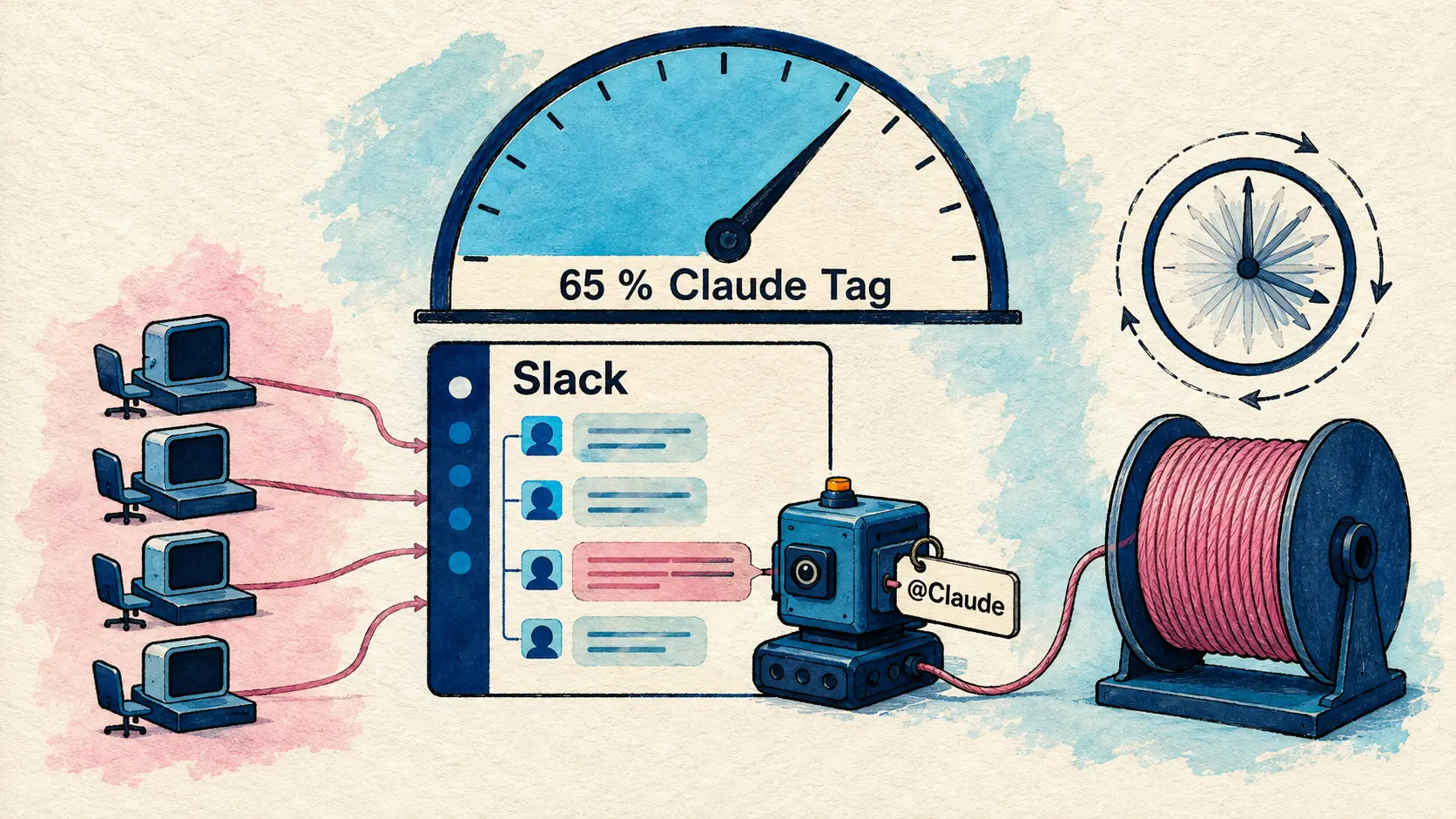
June 23 — Anthropic launches Claude Tag in beta for Enterprise and Team customers. The idea: Claude installs itself in Slack like a regular team member, accessible to the whole channel via @Claude, with persistent memory and asynchronous work capabilities.
How it works
The administrator grants Claude access to selected channels and connects it to the desired tools, data, or codebases. Any member can then mention @Claude to delegate a task: Claude breaks it into steps, executes them, then replies in a thread with the result. Four characteristics distinguish Claude Tag from the old Claude in Slack integration:
| Feature | Description |
|---|---|
| Multiplayer mode | One shared Claude per channel — every member sees what it is working on |
| Persistent memory | Claude accumulates context across conversations, without re-explaining everything each time |
| Ambient mode | Claude actively monitors the channel and takes proactive initiatives if enabled |
| Asynchronous work | Tasks run in the background over several hours or several days |
Governance
Each channel has its own scope of tools, data, and memory — contexts do not mix across channels. A full action log (with the person who initiated each task) is available to administrators, who can set token limits by organization or by channel.
According to Anthropic, 65% of the code produced by the product team is generated by their internal version of Claude Tag. Usage extends to tasks such as metrics tracking, support ticket processing, and bug diagnosis. Claude Tag runs on Opus 4.8 and replaces the old Claude in Slack app — existing administrators have 30 days to migrate.
🔗 Anthropic — Introducing Claude Tag
Cursor 3.8 — Customize Cursor (Marketplace Leaderboard, Plugin Canvases, Team Marketplaces)
June 22-23 — The Cursor 3.8 changelog, published on June 22 and announced on X on June 23, is titled “Customize Cursor”. It introduces a centralized customization page and three team integration features.
New “Customize” page
This single entry point brings together plugins, skills, MCPs, sub-agents, rules, commands, and hooks, at the user, team, and workspace levels. Custom MCPs are also configurable from this page.
Three main features
| Feature | Description |
|---|---|
| Marketplace Leaderboard | Dashboard of the most-used plugins, skills, and MCPs in the team — one-click installation |
| Plugin Canvases | Plugins can include prebuilt canvases; first example: an Atlassian canvas (real-time view of issues, projects, and documents) |
| Expanded Team Marketplaces | Support for GitLab, Bitbucket, and Azure DevOps in addition to local repositories |
The Atlassian canvas is the concrete demonstration of the concept: a plugin can now expose a structured visual interface, not just text commands or tools.
🔗 Cursor — Changelog 3.8 · Marketplace Leaderboard Tweet · Plugin Canvases Tweet · Team Marketplaces Tweet
Copilot CLI — New terminal interface generally available
June 23 — GitHub announces the general availability (GA) of the new terminal interface (TUI) for GitHub Copilot CLI, previewed at Microsoft Build 2026.
Key features
The new TUI introduces a tab system: Session (default), Gists, Issues, and Pull requests — navigable with Tab. From any tab, c references an item in the prompt, o opens it in the browser, / starts a search.
Setup is now fully guided in-session:
/mcp addor/mcp searchto browse the GitHub MCP Registry and install a server without touching a configuration file/skillsto enable or disable skills with the arrow keys/pluginto install plugins from the marketplace, a repository, or a local path/settingsto edit the configuration inline
The interface also handles accessibility: theme colors (default, dim, high-contrast, colorblind via /theme), adaptive components for narrow terminals, and automatic screen reader detection.
Update: copilot update in the terminal.
🔗 GitHub Changelog — Copilot CLI TUI GA
GitHub Copilot app — BYOK support (Bring Your Own Key)
June 23 — The GitHub Copilot app now supports BYOK: users can run agent sessions against their own model providers.
Supported providers
Azure OpenAI, Anthropic, self-hosted Ollama, LM Studio, and any OpenAI-compatible gateway. Configuration is done in Settings → Model Providers (endpoint + API key). Keys are stored in the local OS keychain, never read by the interface.
| Use case | Description |
|---|---|
| Mixed models | Combine a frontier model for complexity and a local model for execution |
| Traffic in your tenant | Route inference through your own cloud account, tenant, or internal gateway |
| Unified selector | Models from the added provider appear alongside models hosted by Copilot |
Note: for Copilot Business and Enterprise plans, the administrator must have enabled “Copilot CLI” in policy settings.
🔗 GitHub Changelog — Copilot App BYOK
Runway integrates Seedance 4K, Seedance Mini, and Kling 3.0 Turbo
June 23 — Runway announces the immediate availability of three third-party video generation models directly in its platform.
The three models added are Seedance 4K (high-resolution 4K generation), Seedance Mini (lighter version for faster use cases), and Kling 3.0 Turbo (the latest turbo version of Kuaishou’s Kling model). Runway thus positions itself as an aggregator of cutting-edge generative video models, alongside its own Gen-4 and Aleph 2.0 models.
This multi-model approach within a single platform lets creators choose the model suited to each use case — resolution, speed, or style — without switching tools.
A 30% promotional code for the first three months is offered to new subscribers (code: 30RUNWAY).
🔗 Runway — Seedance and Kling 3.0
ElevenLabs — Homer’s Odyssey narrated by an AI voice licensed from Michael Caine
June 23 — ElevenLabs launches The Odyssey, an audiobook of Homer’s Odyssey narrated with an AI voice produced in official collaboration with British actor Sir Michael Caine. The work is accompanied by an original score and cinematic sound design.
The audiobook is available free of charge and exclusively on ElevenReader (elevenreader.io), ElevenLabs’ audio reading app. This production illustrates an AI premium-content strategy to promote the ElevenReader platform beyond utilitarian voice synthesis.
The collaboration with Michael Caine is based on an official licensing agreement between ElevenLabs and the actor, allowing his voice to be reproduced in AI form for this specific production.
“Before you see the film, hear the original epic. Today, we’re releasing The Odyssey: an audiobook narrated by the voice of Sir Michael Caine, with original music and cinematic sound design.” — @ElevenLabs
Mistral OCR 4 — SOTA document processing with structured localization
June 23 — Mistral launches Mistral OCR 4, its document processing model presented as SOTA (State Of The Art). On OlmOCRBench, the public reference benchmark for optical character recognition, OCR 4 claims a score of 85.20, ranked first on the benchmark according to Mistral.
Technical features
OCR 4 locates each text block with a bounding box, classifies it (title, table, equation, signature…) and assigns a confidence score by region. This structured localization forms the basis for verified citations, writing, RAG chunking, and human-in-the-loop review.
| Aspect | Detail |
|---|---|
| OlmOCRBench | Score 85.20 — first on the benchmark according to Mistral |
| Multilingual evaluation | First on Mistral’s internal evaluation; largest gains on rare languages |
| Human validation | 600+ real documents blindly labeled by independent annotators across 12+ languages |
Availability
Immediately accessible via the Mistral API, Document AI in Mistral AI Studio, Amazon SageMaker, and Microsoft Foundry. Snowflake Parse Document support is announced for a future update. The model is also self-hostable in a single container.
Claude Code v2.1.187 — Credentials security, organization-level model restrictions
June 23 — Claude Code v2.1.187 introduces two new governance features and several notable fixes.
The new sandbox.credentials setting allows sandboxed commands to be blocked from accessing credentials files and environment variables containing secrets — an added layer of protection for teams using Claude Code in automated mode or in shared environments.
Organizations can now configure model restrictions through their admin console. These restrictions apply to the model selector, --model, /model, and the ANTHROPIC_MODEL variable. An explicit message tells the user that their choice is limited by the organization’s settings.
Among the fixes: remote MCP tool calls that were blocked indefinitely (up to 5 minutes) now fail with an error; pasting Korean or CJK text no longer produces corrupted characters (mojibake) in terminals that transmit the clipboard byte by byte; structured output (--json-schema) is fixed so it no longer recalls StructuredOutput indefinitely after success.
Warp adds GLM 5.2 and experiments with YAML model auto-routers
June 23 — Warp announces official support for GLM 5.2 in its AI terminal, hosted on Fireworks and described as token-efficient for code generation. Warp also supports BYO (Bring Your Own) inference to connect to other providers.
CEO Zach Lloyd also shares an experiment on model auto-routers configurable in YAML: describe in natural language which tasks route to which model — GLM 5.2 for the frontend, GPT 5.5 High for complex architecture decisions. This declarative routing approach helps optimize cost/quality by task type without changing tools.
🔗 Warp — GLM 5.2 · Warp — Auto-router
Together AI — ParallelKernelBench, a multi-GPU benchmark for CUDA kernel generation
June 23 — Together AI publishes ParallelKernelBench (PKB), a benchmark of 87 multi-GPU problems drawn from real production codebases (Megatron-LM, DeepSpeed, TensorRT-LLM, NeMo-RL). The goal: measure LLM ability to generate CUDA kernels that directly exploit NVLink shared memory, replacing PyTorch + NCCL.
Current results show the limits of frontier models on this task:
| Model | Problems solved (zero-shot) | Faster than the baseline |
|---|---|---|
| GPT-5.5 | 28/87 | 22/87 |
| Gemini 3 Pro | 24/87 | 12/87 |
| Claude Opus 4.7 | 20/87 | 12/87 |
| Gemini 3 Pro (agentic) | 35/87 | 26/87 |
The agentic mode (compile/test/review loop) significantly improves Gemini 3 Pro, moving from 24 to 35 correct solutions, but plateaus after about 20 steps. PKB is open source and open to contributions.
🔗 Together AI — ParallelKernelBench · Tweet
NVIDIA DFlash — Speculative decoding up to 15x on Blackwell GPUs
June 23 — NVIDIA publishes DFlash, a lightweight block diffusion model open source designed for speculative decoding. Deployed on NVIDIA Blackwell GPUs, DFlash can increase inference throughput by up to 15x while maintaining the same user-perceived responsiveness.
Speculative decoding consists of generating several tokens in parallel using a lightweight draft model, then validating or correcting the tokens in a single pass of the main model — reducing the number of passes required. DFlash is the draft piece of this architecture, optimized for the Blackwell family.
🔗 NVIDIA — DFlash · Tweet
GPT-5 in immunology — A 3-year experimental mystery solved in one session
June 23 — OpenAI publishes a use case for GPT-5 Pro in immunology: immunologist Derya Unutmaz (Jackson Laboratory / UConn) used GPT-5 Pro to identify the mechanism behind a T-cell experiment that had remained unexplained since 2022.
GPT-5 Pro identified that deoxyglucose interfered with the construction of the IL-2 protein, explaining why the exposed T cells overwhelmingly became Th17 cells (inflammatory response). The model also correctly predicted the result of an unpublished experiment on CD8+ T cells targeting a lymphoma.
Unutmaz now uses GPT-5 Pro, Codex, and GPT-5.2 Deep Research to compile datasets on cancer mutations and accelerate precision immunotherapy research. OpenAI reminds users of the risks of misuse (bio/chemical) and refers to its Preparedness Framework.
🔗 OpenAI — GPT-5 Immunology Mystery
Cohere Labs — Multilingualism is not enough: LLMs lack cultural awareness
June 23 — Cohere Labs publishes a study based on a survey of 81 participants from 22 countries. Main conclusion: multilingual LLMs are not necessarily multicultural.
A few figures from the survey: 89.5% of non-English speakers switch languages to interact with AI and get better answers; 38% believe the AI does not understand their culture (score below 5/10); 63% have seen their cultural norms violated during an interaction (German formality, Korean historical context, Egyptian Arabic); 67% fear increased cultural marginalization. Cohere Labs argues that cultural awareness should be built in as a design requirement from the start, not added later.
🔗 Cohere Labs — Cultural Awareness in Global AI
Briefs
-
Zed — Hidden Gems: Part 4 (June 23) — Blog post in the Zed tips series: configurable centered layout on large screens, multi-worktree keyboard navigation with parallel agents,
EDITOR=zed --waitin the integrated terminal,command_aliasesfor short mnemonics. 🔗 Zed Blog -
NVIDIA Nemotron Office Hours (June 23) — NVIDIA AI streams a live Q&A session dedicated to the Nemotron 3 model family, available on Nemotron Labs. 🔗 NVIDIAAI Tweet
What this means
Agentic AI is becoming embedded in everyday tools. Claude Tag in Slack and Copilot CLI in GA represent two different but complementary adoption vectors. Claude Tag targets integration into the team’s collaborative workflow: a shared agent, with common memory and initiative, visible to everyone. Copilot CLI targets integration into the individual developer’s terminal: a structured interface with tabs, guided MCP management, and native accessibility. In both cases, the goal is to reduce friction between the AI tool and the existing work environment — rather than asking users to change tools.
Customization is becoming a differentiator for coding environments. Cursor 3.8 with its centralized “Customize” page and GitHub Copilot’s BYOK address the same need: letting teams precisely configure which models, tools, and workflows apply to each context. Cursor’s Marketplace Leaderboard introduces a social dimension — what the team uses most rises to the surface. Copilot’s BYOK introduces a sovereignty dimension — traffic stays within the company tenant. These two approaches reflect the growing maturity of development teams with respect to these tools.
Multimodal and document-processing models are reaching a new quality bar. Mistral OCR 4 with a claimed score of 85.20 on OlmOCRBench, Runway with the integration of Seedance 4K and Kling 3.0 Turbo, ElevenLabs with a cinematic audiobook — these three announcements show that high-quality multimodal content generation is no longer an emerging use case. Mistral is particularly positioning itself around structured document intelligence (block-level confidence score, RAG support), not just raw transcription.
GPU kernel benchmarks reveal a blind spot. Together AI’s ParallelKernelBench points to a significant gap between LLM capabilities on classic code benchmarks and their real ability to generate multi-node GPU optimization code. The fact that the best model (GPT-5.5) solves only 28 out of 87 problems in zero-shot — and that only 22 of those solutions beat the existing baseline — shows that this class of problems remains largely out of reach for current models, even frontier ones. The agentic approach improves results but hits a ceiling, suggesting that the limit is not only in context but also in the representation of GPU communication primitives.
The cultural question in LLMs goes beyond multilingualism. The Cohere Labs study confirms a phenomenon already observed in practice: models trained primarily in English tend to project Western cultural perspectives even when responding in other languages. The 89.5% of non-English speakers who switch languages to get better answers reflects a real practical cost. The fact that 67% fear future cultural marginalization suggests that perception of the problem extends beyond technical users alone — these are signals to incorporate into the design of evaluation and training systems.
Sources
- Anthropic — Introducing Claude Tag
- Cursor — Changelog 3.8
- Cursor — Tweet Marketplace Leaderboard
- Cursor — Tweet Plugin Canvases
- Cursor — Tweet Team Marketplaces
- GitHub Changelog — Copilot CLI TUI GA
- GitHub Changelog — Copilot App BYOK
- Runway — Seedance 4K and Kling 3.0
- ElevenLabs — The Odyssey
- ElevenReader — The Odyssey
- Mistral — OCR 4
- Mistral — Thread X OCR 4
- Claude Code CHANGELOG v2.1.187
- Warp — Support GLM 5.2
- Warp — Model auto-router
- Together AI — ParallelKernelBench
- Together AI — Tweet PKB
- NVIDIA — DFlash
- NVIDIA — Tweet DFlash
- OpenAI — GPT-5 Immunology Mystery
- Cohere Labs — Cultural Awareness in Global AI
- Zed — Hidden Gems Part 4
- NVIDIA — Nemotron Office Hours