ai-powered-markdown-translatorArticle translated from fr to en with gpt-6.1-sol.
In the middle of Thanksgiving weekend, the news this Saturday, November 28, is mostly about coding agents. Qwen Code moves to stable v0.29.0: workspace memory now follows task worktrees, and /auth automatically retrieves models from a custom provider; the previous day, the Replit changelog opened the web to its Agent with Agent Browser and added Gemini 4 Carbon to the model selector. The Briefs bring together previews of Copilot CLI, GitHub Agentic Workflows and DeepSeek Harness, GitHub CLI version 2.106.0, released on November 25, which fixes seven vulnerabilities, and several posts published on Hugging Face.
Coding agents: Qwen Code v0.29.0 and the Replit changelog for November 27
A stable Qwen Code release on November 28, the weekly Replit changelog the day before: one focuses on memory and PR checks, the other gives its Agent a browser.
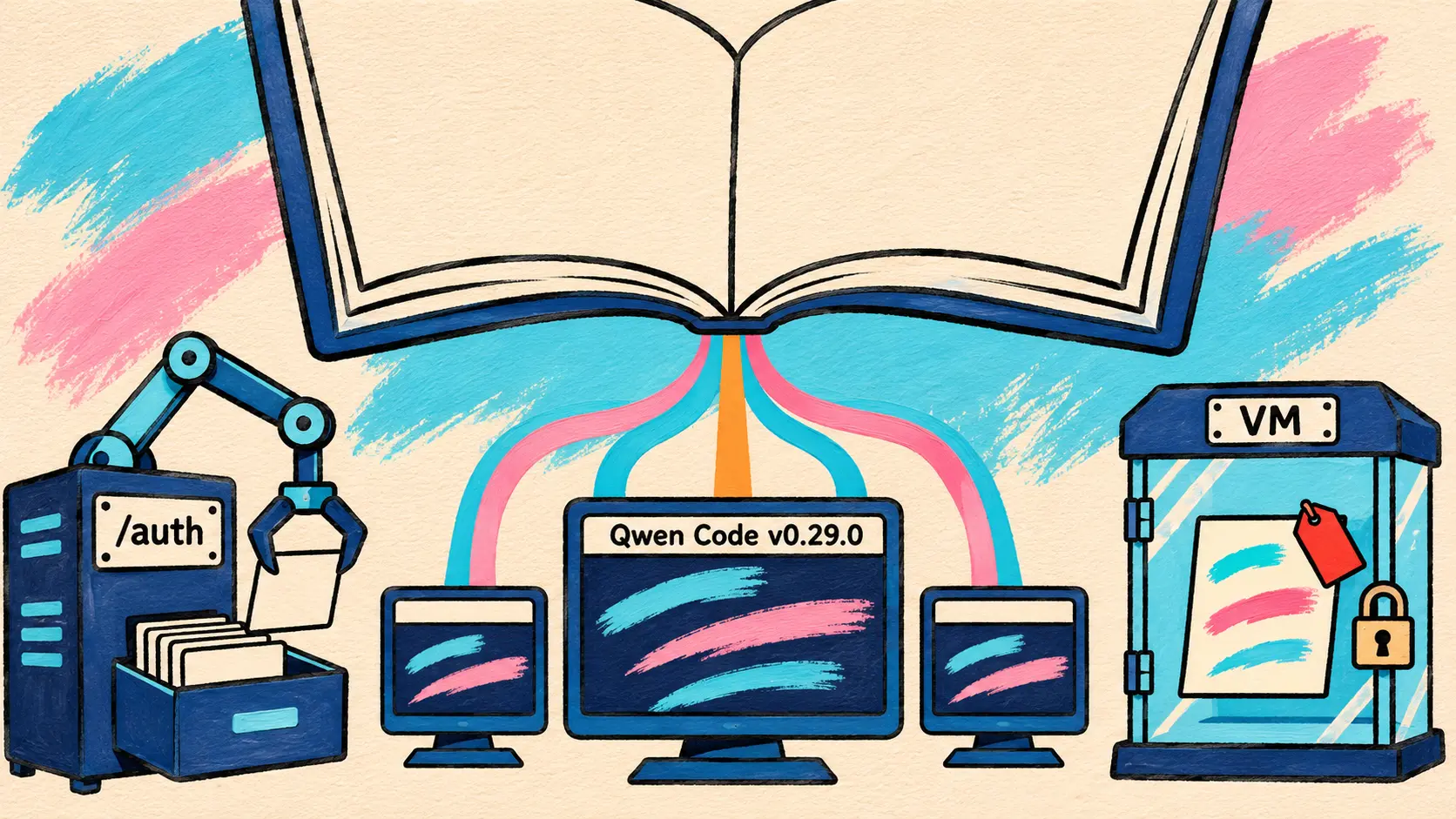
Qwen Code v0.29.0 retains workspace memory across worktrees and automatically retrieves models from a custom provider
November 28 — Qwen Code moves to stable v0.29.0, 1 hour and 18 minutes after the v0.29.0-preview.0 preview and following v0.28.7, covered here on November 26. Its notes contain 67 entries, including 22 features and 25 fixes, and report no known breaking changes. Qwen Code Desktop v0.29.0 and TypeScript SDK v0.1.40, which bundles this CLI, are released the same day.
Two changes affect everyday use. In /auth, custom provider setup now automatically retrieves candidate models from an OpenAI- or Anthropic-compatible endpoint, with search, activation and manual entry. Workspace memory persists across task worktrees: it remains tied to the session’s starting directory or the saved workspace, and a /memory migrate-worktree command is added. The PR review commands /verify-pr and /autofix-pr, already covered here on October 27, gain stronger safeguards.
| Other v0.29.0 additions | What changes |
|---|---|
/verify-pr | Host or VM must be selected, and trust or approval confirmed, before running code from an untrusted PR |
| Host probes | Linux KVM and Apple Silicon, in fail-closed mode; a VM prepared on every turn |
/autofix-pr | --watch option: scheduled in-place fixes, approval on every turn |
| Web Shell | Search archived conversations; control scheduled session tasks (pause, run immediately, stop) |
| Hosted Harness | Resume an interrupted Turn after a Broker failover; pool of two Harness instances in the Helm chart |
🔗 Qwen Code v0.29.0 · Qwen Code Desktop v0.29.0 · TypeScript SDK v0.1.40
Replit: the Agent browses the web with Agent Browser, Gemini 4 Carbon joins the model selector
November 27 — In its weekly changelog, Replit announces that its Agent can now use Agent Browser to browse and interact with websites during a task. Replit cites three uses: exploring an existing product to guide its next build, finding products that meet requirements, and extracting web data for analysis. The browser had already been used for specific purposes: Agentic Commerce purchases, in a Browserbase browser (November 12), and building TernSign through Missions (November 18). Gemini 4 Carbon also arrives in the model selector, for the next conversation.
Technical support for the Core plan moves to AI-assisted troubleshooting instead of routine handoffs to an engineer; direct access to an engineer is available on Pro and Enterprise, and Core billing questions can still be escalated to support. The changelog also mentions the Microsoft 365 Copilot integration, covered here on November 24, and provides no pricing.
| Changelog category | What changes | Intended audience |
|---|---|---|
| Agent Browser | The Agent browses and interacts with websites during a task | Not specified |
| Gemini 4 Carbon | New option in the model selector | Not specified |
| Overview | Chat and project activity brought together: needs a reply, in progress, ready for review, completed | Not specified |
| Technical support | AI-assisted troubleshooting; direct engineer access on Pro and Enterprise | Core plan, billing can still be escalated |
| Get started checklist | First-steps checklist for 7 days, hidden from administrators | Some new Enterprise members |
🔗 Replit changelog for November 27 · Replit support policy
Briefs
Agents and development tools
- Devin, November 27 release notes — The Bots sidebar gains a compact view for everyone, with Pinned and Your bots sections; sharing with a group can enable Bot-to-Bot messaging, and nightly memory refinement now follows Bot-specific rules. PRs opened by Devin use the Review language of the person who started the session. 🔗 source
- Copilot CLI 1.0.118-1 and 1.0.118-2, Copilot SDK 2.0.5-preview.1 and preview.2 — Bug-fix previews: 1.0.118-1 (November 27) preserves changes made to different MCP servers when
copilot mcp enableandcopilot mcp disablerun simultaneously; 1.0.118-2 (November 28) fixes history navigation after Ctrl+R. The SDK incorporates the MCP fix; the stable releases remain CLI 1.0.117 and SDK 2.0.4. 🔗 source · SDK 2.0.5-preview.1 - GitHub Agentic Workflows 1.4.1, in preview —
adaptive-routing: observemode records every routed run without changing the selected model, viewable withgh aw routing status, and therequired-authoroption restricts pull request safe outputs to PRs from the expected author. Two breaking changes: work queue v4, with effects applied at least once, and--dry-runingh aw logsrenamed to--only-dry-run. 🔗 source - DeepSeek Harness 0.2.3-alpha.3 — Third preview of version 0.2.3 of the DeepSeek agent environment: dictation through DeepSeek cloud transcription, an experimental plugin that reads responses aloud, native Office document previews and a Connectors tab that brings together official connectors and custom MCP servers. There is still no stable release. 🔗 source
- GitHub CLI 2.106.0 — Released on November 25, this version fixes seven vulnerabilities, most involving unsanitized terminal control characters, and its notes recommend updating as soon as possible.
gh auth logoutnow revokes the account’s OAuth token before deleting local credentials (--no-revokeretains the previous behavior). 🔗 source
Open models and inference
- Lookers v1.2 from AbstractPowered — Fifteen open vision-language models, built on nine base models including Qwen3.5 and Gemma 4, describe an image in writing (caption, generation prompt, tags, critique), most under two licenses, Apache-2.0 and -nc. According to the post, none now answers an ordinary question in the reading format, compared with 91 times out of 100 for Lucia 4B v1. 🔗 source
- Qwen3.8-27B on two Mac mini M6 machines — ANEMLL distributes the model across two Mac mini machines connected by a Thunderbolt 4 cable: according to its measurements, the pair processes prompts 2.0 to 2.3 times faster than a single Mac (from 8K to 96K context tokens) and generates 1.8 to 2.2 times faster from 2K to 64K (77 to 82 tokens/s versus 35 to 45). RDMA over Thunderbolt 4 requires disabling macOS protections, including SIP. 🔗 source
- Roman Melnyk’s Kafka assistant, version 4.0.0 — His local assistant switches from Qwen3.8-27B to Gemma 4 31B and focuses on better evidence rather than longer reasoning, which failed to meet the goal he had set for it. Across the 60 hidden scenarios in his own evaluation, 7 responses still contain dangerous advice without a warning, against a target threshold of one in 60; the version is released anyway, with this result recorded in its model card. 🔗 source
- New model served by OpenUncensored — This provider of uncensored model APIs, already featured here several times in November, serves an unrestricted version of DeepSeek V4.1 Flash 1017 at $0.28 per million input tokens and $1.12 per million output tokens, according to OpenUncensored, which reports a median throughput of 310 tokens/s based on its own measurements. 🔗 source
Benchmarks and datasets
- An open pressure gauge reader — Denys Cherniavsky combines a frozen 93M vision encoder, an open OCR system and geometric calculations. According to his measurements, across the 546 real photos of single-needle dials in MeasureBench, his reader answers correctly 45.1% of the time, versus 35.3% for Gemini 2.5 Pro and 20.9% for GPT-5; across the 711 dial questions that include a unit, it matches Gemini 2.5 Pro (32.6% versus 31.5%). 🔗 source
- Korean speech recognition, 66 models re-evaluated — Seungwoo (Martin) Hong, of Baryon Labs, evaluates 66 models under the same conditions (one RTX 4090, 457 sentences from the Zeroth test set) and publishes sentence-by-sentence results. Among general-purpose models, whisper-medium-korean-500ksteps leads with a 2.18% character error rate; the best scores (1.53%) come from models fine-tuned on Zeroth itself according to their model cards, now ranked separately as in-domain models. 🔗 source
- KITScenes-LongTail in FiftyOne — On November 27, Harpreet Sahota presents the FiftyOne version, published by Voxel51, of this KIT dataset focused on rare driving scenarios: around 4 seconds of real video, 5 seconds of trajectory to predict and expert reasoning, providing a way to check whether a model chooses the right trajectory for the right reasons. Of the 103 scenes in this version, the 100 test scenes provide neither future trajectories nor reasoning. 🔗 source
What this means
Qwen Code v0.29.0 follows the way a coding agent now works: tasks each running in their own worktree, with workspace memory that is no longer lost between worktrees. The release’s other theme is caution: /verify-pr can run code from an untrusted PR, and v0.29.0 requires an explicit choice between the host and a virtual machine, confirmed trust or approval, and probes that fail closed. The same concern appears on the GitHub side of the Briefs: required-author limits which PRs an agent workflow can modify, and GitHub CLI 2.106.0 fixes a vulnerability through which gh skill update could install a skill from another repository using the same name.
At Replit, the Agent moves beyond the development environment: with Agent Browser, web browsing becomes a tool it can use during a task, following specific uses such as Agentic Commerce purchases or building TernSign. The same changelog shifts support: on the Core plan, a technical question now starts with AI-assisted troubleshooting, and direct access to an engineer requires the Pro or Enterprise plans, while billing issues can still be escalated. AI is used here both to build and to respond to customers, and direct access to an engineer becomes one of the features that distinguish the plans.
Sources
- Qwen Code v0.29.0 (release notes)
- Qwen Code Desktop v0.29.0
- Qwen Code TypeScript SDK v0.1.40
- Replit changelog for November 27
- Replit support policy
- Devin release notes for November 27
- Copilot CLI 1.0.118-2
- Copilot SDK 2.0.5-preview.1
- GitHub Agentic Workflows 1.4.1
- DeepSeek Harness 0.2.3-alpha.3
- GitHub CLI 2.106.0
- Lookers v1.2 (AbstractPhila for AbstractPowered, on Hugging Face)
- Qwen3.8-27B on two Mac mini M6 machines (ANEMLL on Hugging Face)
- Kafka assistant, part 6 (Roman Melnyk on Hugging Face)
- Unrestricted DeepSeek V4.1 Flash (OpenUncensored on Hugging Face)
- Open pressure gauge reader (Denys Cherniavsky on Hugging Face)
- 66 Korean speech recognition models re-evaluated (Seungwoo Hong, Baryon Labs, on Hugging Face)
- KITScenes-LongTail in FiftyOne (Harpreet Sahota on Hugging Face)