ai-powered-markdown-translatorArticle translated from fr to en with gpt-5.4-mini.
On this June 29, 2026, three major announcements dominate: Cursor launches its iOS app to control cloud agents remotely, Cognition releases Devin Fusion — a hybrid harness that maintains frontier-level performance at −35% cost — and Meta files in Nature Neuroscience Brain2Qwerty v2, a non-invasive brain-to-text interface reaching 61% accuracy. On the availability front, Claude Opus 4.8 gains two new integrations: general availability in Microsoft Foundry on Azure and a fast mode preview in GitHub Copilot.
Cursor arrives on iPhone — cloud agents and remote control
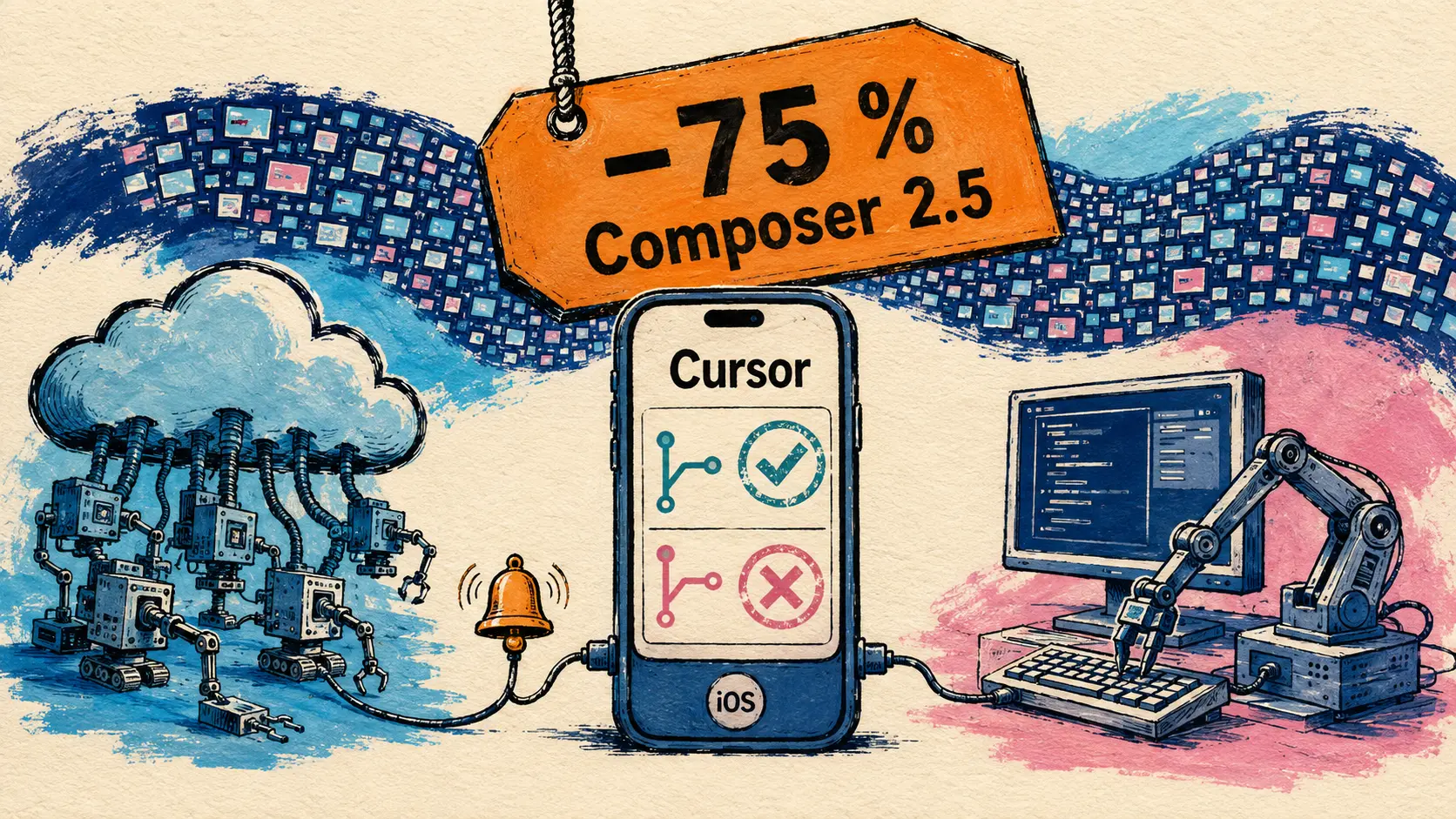
June 29 — Cursor (Anysphere) launches a native iOS app available on the App Store. The app is built around two main modes:
- Always-on cloud agents — launch agents that run in the background and supervise them from the iPhone, wherever you are.
- Remote control — control an agent running on your computer from the mobile app.
Getting started takes advantage of iOS Live Activities: the app sends real-time notifications when an agent finishes a task or requests validation. It is also possible to review demos, inspect diffs, and approve or reject pull requests directly from the phone.
For the launch, Cursor is offering Composer 2.5 at −75% in the app until July 5, 2026.
This release comes as Cursor — developed by Anysphere — is in the process of being acquired by SpaceX/xAI (closing expected in Q3 2026, brand retained). The iOS app marks a shift toward mobile-first development in a context of always-on agents. The launch tweet reached 2.3 million views in a few hours.
Devin Fusion — frontier performance at −35% cost with a hybrid architecture
June 29 — Cognition releases Devin Fusion, a multi-model harness that preserves frontier-level intelligence while reducing costs by 35% compared with Opus 4.8 alone on the FrontierCode Extended benchmark.
| Configuration | Score | Average cost / task |
|---|---|---|
| Fusion + Fable 5 ¹ | 57.6 | $3.00 |
| Fable 5 alone ¹ | 57.0 | $5.12 |
| Opus 4.8 (high) | 48.8 | $3.24 |
| Fusion | 47.9 | $2.38 |
| GPT-5.5 (high) | 44.8 | $3.64 |
| GLM-5.2 | 43.0 | $2.70 |
¹ Fable 5 has been suspended since June 12, 2026 under directive from the U.S. government; these results rely on measurements taken before the suspension.
Architecture: the “Sidekick” approach
Fusion’s originality lies in running two agents in parallel:
- Main agent — frontier model that makes critical decisions (planning, interpreting ambiguities, final review).
- Sidekick agent — more economical model that carries out mechanical and repetitive tasks.
This approach differs from classic model routers in three ways: it preserves real frontier intelligence (not just on benchmark), works on multi-turn tasks, and avoids costly cache misses by letting each agent maintain its own cached context. Dynamic routing is triggered during context compactions — moments when a cache miss would be inevitable anyway — making the switch between agents practically free in terms of cache cost.
In internal use at Cognition, 88% of pull requests were handled entirely by Fusion. Before Fable 5 was suspended, Fusion + Fable 5 reached −41% cost compared with Fable 5 alone.
The preview is available at app.devin.ai.
🔗 Cognition blog — Devin Fusion
Meta Brain2Qwerty v2 — 61% word accuracy without surgery, open-source code
June 29 — Meta AI releases Brain2Qwerty v2, the non-invasive brain-to-text (brain-computer interface) interface achieving the best decoding accuracy ever published without brain surgery. The research paper appeared in Nature Neuroscience.
| Method | Word accuracy |
|---|---|
| Previous non-invasive methods (baseline) | 8% |
| Brain2Qwerty v2 — average, 9 participants | 61% |
| Brain2Qwerty v2 — best participant | 78% |
The system uses a non-invasive MEG (magnetoencephalography) headset paired with an end-to-end deep learning network on raw brain signals, followed by a large language model fine-tuned for semantic context. The model was trained on about 22,000 sentences produced by 9 participants, each wearing the headset for 10 hours. Accuracy improves in a log-linear way with data volume, suggesting future convergence with invasive approaches through data scale alone.
Half of the sentences decoded for the best participant contain no more than one word error.
Open-source resources published:
- Full training code for v1 and v2
- v1 dataset via partner BCBL (Basque Center on Cognition, Brain and Language)
- Associated foundation models: Tribev2, NeuralSet, NeuralBench
This research is part of Meta’s Digital Brain Project, which includes a $5 million fund for open brain datasets. The goal: enable millions of people with motor or neural impairments to write without hands, without surgery.
Claude: Azure Foundry in general availability and fast mode in preview in Copilot
Claude in Microsoft Foundry — general availability
June 29 — Claude Opus 4.8 and Claude Haiku 4.5 are now available in general availability (general availability) in Microsoft Foundry, hosted on Azure. The integration supports prompt caching and extended thinking (extended thinking). Two deployment modes are offered: hosted in the customer’s Azure environment, or hosted by Anthropic on Azure. Inference runs on Azure infrastructure and relies on existing Azure identity, networking, and compliance. Other models and capabilities are announced as coming soon.
Claude Opus 4.8 fast mode — preview in GitHub Copilot
June 29 — Claude Opus 4.8 fast mode is rolling out in progressive preview in GitHub Copilot. This mode offers significantly higher token generation speeds while preserving the capabilities of the standard model, especially suited to interactive coding and agentic workflows where responsiveness is a priority.
Availability: Copilot Pro+, Max, Business and Enterprise — in VS Code, Visual Studio, Copilot CLI, GitHub Copilot cloud agent, github.com, GitHub Mobile (iOS and Android), JetBrains, Xcode and Eclipse. Progressive rollout.
Activation: for Enterprise and Business plans, administrators must enable the dedicated policy in Copilot settings (disabled by default). Billing is done at the provider’s public rate via Usage Based Billing.
Warp: the Spec Agent generates specifications before implementation
June 29 — Zach Lloyd (CEO, Warp) publishes the second article in his “cloud software factory” series. After the Triage Agent (June 25), this post introduces the Spec Agent, designed for complex or ambiguous issues.
When the Triage Agent identifies a complex or roadmap issue, it passes it to the Spec Agent before any implementation. The updated flow is as follows:
Issue → Triage Agent ├── Issue simple → "ready-to-implement" → Implementation Agent ├── Issue complexe → "ready-to-spec" → Spec Agent → Implementation Agent ├── Issue ambiguë → "needs-info" └── Hors scope → "wait-to-implement"The Spec Agent produces two versioned documents under specs/<issue-number>/ in the repository:
- PRODUCT.md — expected product behavior
- TECH.md — technical architecture and code shape
The full demo is published as open-source. A third article on the Verification Agent is announced.
Gemini: free custom images and note-taking in Meet
Free custom images in the United States
June 29 — Google connects Personal Intelligence, Nano Banana, and Google Photos in the Gemini app for deeply personalized image generation. Available free for all eligible users in the United States starting June 29.
The user can enter a simple prompt such as “design my dream house” and Gemini automatically pulls images from Google Photos to personalize the result. Google app connection remains optional (opt-in) and can be configured in settings. Previously, personalization required manually uploading photos and detailing the prompt.
Gemini takes notes in Google Meet
June 29 — Gemini can now take notes automatically in Google Meet for Google AI Pro and Ultra subscribers. The feature is natively integrated into Meet with no manual action needed during the meeting.
Runway × MIXI — strategic enterprise partnership in Japan
June 29 — Runway announces a strategic partnership with MIXI, a leader in Japanese digital entertainment (Monster Strike: 65 million users, FamilyAlbum: 30 million). MIXI is deploying Runway at enterprise scale across its games, sports, and entertainment divisions.
| Task | Before Runway | With Runway |
|---|---|---|
| Monster Strike promo video | 21 days | 3 days |
| Hybrid brand film (live action + generative) | 20 days | 7 days |
| Animation visual proposals | Several days | ~5 minutes |
This partnership is part of Runway’s expansion in Japan: Tokyo office opened, $40 million invested, +300% enterprise growth over 12 months — the third-largest market worldwide behind the United States and Europe. Other Japanese partners mentioned: Yamaha, SoftBank Corp., NHN PlayArt.
Codex — rate-limit banking, 2× faster browser, desktop QOL
June 29 — The Codex changelog brings several updates covering usage-limit management, integrated browser performance, and the desktop experience.
Rate-limit reset banking (Plus and Pro) — OpenAI introduces a banking system for rate-limit resets. One free reset is offered at launch, with a referral program to accumulate more. Business subscribers can invite colleagues to generate shared credits in the workspace.
Browser use 2× faster — The integrated browser is now up to twice as fast thanks to optimizations to the CDP (Chrome DevTools Protocol) protocol and DOM snapshots, reducing the number of back-and-forths with the browser.
Desktop QOL — Customizable macOS Dock icons (light/dark variants), per-application access controls for Computer Use on Windows, an “Unread chats” tab in the command menu with the most recent conversation selected by default, and improved plugin management: support for workspace plugins, reliable state refresh after installation or removal, publishing a new version of a shared plugin without changing its access rights.
Briefs
-
Sakana AI Fugu on Gemini Enterprise Agent Platform (June 29) — Sakana AI publishes an interview article on the Google Cloud Japan blog explaining why the team fully adopted Gemini Enterprise Agent Platform as the service infrastructure for Fugu. Developed since October 2025, Fugu is in production in ~6 months with support from the Google team. 🔗 Tweet @SakanaAILabs
-
Ai2 — DiScoFormer (June 29) — The Allen Institute for AI publishes DiScoFormer, a unified density and score estimator transformer in a single forward pass, generalizable to out-of-distribution distributions without retraining. Generalizes classic KDE in high dimensions. 🔗 Ai2 Research
-
Gemini CLI v0.51.0-nightly (June 28-29) — Nightly builds bring a security fix for the sensitive path blocklist (now case-insensitive) and a fix for vscode hitl behavior. The stable channel remains at v0.49.0. 🔗 GitHub Releases
-
GitHub — restricting issues to collaborators only (June 29) — GitHub now lets you restrict issue creation to collaborators only on a repository, useful for limiting spam and out-of-scope contributions on public repositories. 🔗 GitHub Changelog
-
OpenAI × HP — Frontier partnership (June 28) — OpenAI publishes an article on the enterprise-scale deployment of ChatGPT Enterprise and GPT APIs at HP as part of the Frontier partnership, with use cases in operations and team productivity. 🔗 OpenAI announcement
What it means
Development tooling is becoming mobile and orchestrated. Cursor on iOS shows that agent oversight is no longer confined to the office: developers will be able to steer tasks, approve pull requests, and receive real-time alerts from their phone. Devin Fusion goes further by showing that frontier-level performance no longer requires a monolithic model — a parallel two-agent architecture delivers comparable quality at 35% lower cost. The combination of mobility + multi-model orchestration is shaping the next generation of development environments.
Claude is being deployed across the two infrastructures most used by enterprise engineering teams. General availability in Microsoft Foundry and the fast mode preview in GitHub Copilot illustrate a broad distribution strategy: Opus 4.8 is now available on Azure (with prompt caching and extended thinking for compliance requirements) and in Copilot (with faster generation speed for interactive coding). These two integrations address different needs — sovereign infrastructure for one, responsiveness for the other — and cover most of the enterprise market.
AI is crossing a barrier in neuroscience. Brain2Qwerty v2 moves from 8% to 61% accuracy without brain surgery — a 7.6x improvement on a non-invasive system. The log-linear progress with data suggests a future convergence with invasive approaches without surgery. The open-source release of the code, datasets, and foundation models is a strong signal: Meta is positioning this technology as open infrastructure for brain-computer interface research, with a $5 million fund to accelerate dataset creation. Millions of people with motor or neural impairments are the target of this work.
The creative economy is industrializing in Asia. Runway and MIXI show that shortening production timelines (21 days → 3 days for a promotional video) is restructuring the economics of Japanese creative studios. With +300% enterprise growth in 12 months and $40 million invested in the Japanese market, Runway is betting on geographic expansion where production constraints (high costs, long animation and game cycles) are most pronounced. Japan is becoming Runway’s third-largest global market.
Sources
- Tweet @cursor_ai — Cursor for iOS
- Cognition Blog — Devin Fusion
- Devin Fusion Preview
- Tweet @AIatMeta — Brain2Qwerty v2
- Meta AI Blog — Brain2Qwerty
- Anthropic Announcement — Claude in Microsoft Foundry
- GitHub Changelog — Claude Opus 4.8 fast mode
- Warp Blog — Spec-Driven Development
- Open-source Warp cloud factory demo
- Google Announcement — Personal Intelligence, Nano Banana
- Google Workspace Blog — Gemini in Meet
- Runway × MIXI Announcement
- Codex Changelog — OpenAI
- Tweet @SakanaAILabs — Fugu on Gemini Platform
- Ai2 — DiScoFormer
- Gemini CLI — GitHub Releases
- GitHub Changelog — Collaborator issue restrictions
- OpenAI × HP — Frontier Partnership