ai-powered-markdown-translatorArticle translated from fr to en with gpt-5.4-mini.
July 9 is one of the busiest days of the year for AI news, dominated by a triple OpenAI launch: the new frontier model family GPT-5.6 (Sol, Terra, Luna), the new ChatGPT Work agent powered by Codex, and a deep overhaul of the Codex experience itself. Meta responds with Muse Spark 1.1 and the public opening of its Meta Model API, while Anthropic beefs up Claude Code with the /checkup maintenance command and launches a beta tool to visualize how Claude is used. Eighteen notable updates — from enterprise Copilot governance to media generation joining agents — and seven short items round out this exceptionally packed overview.
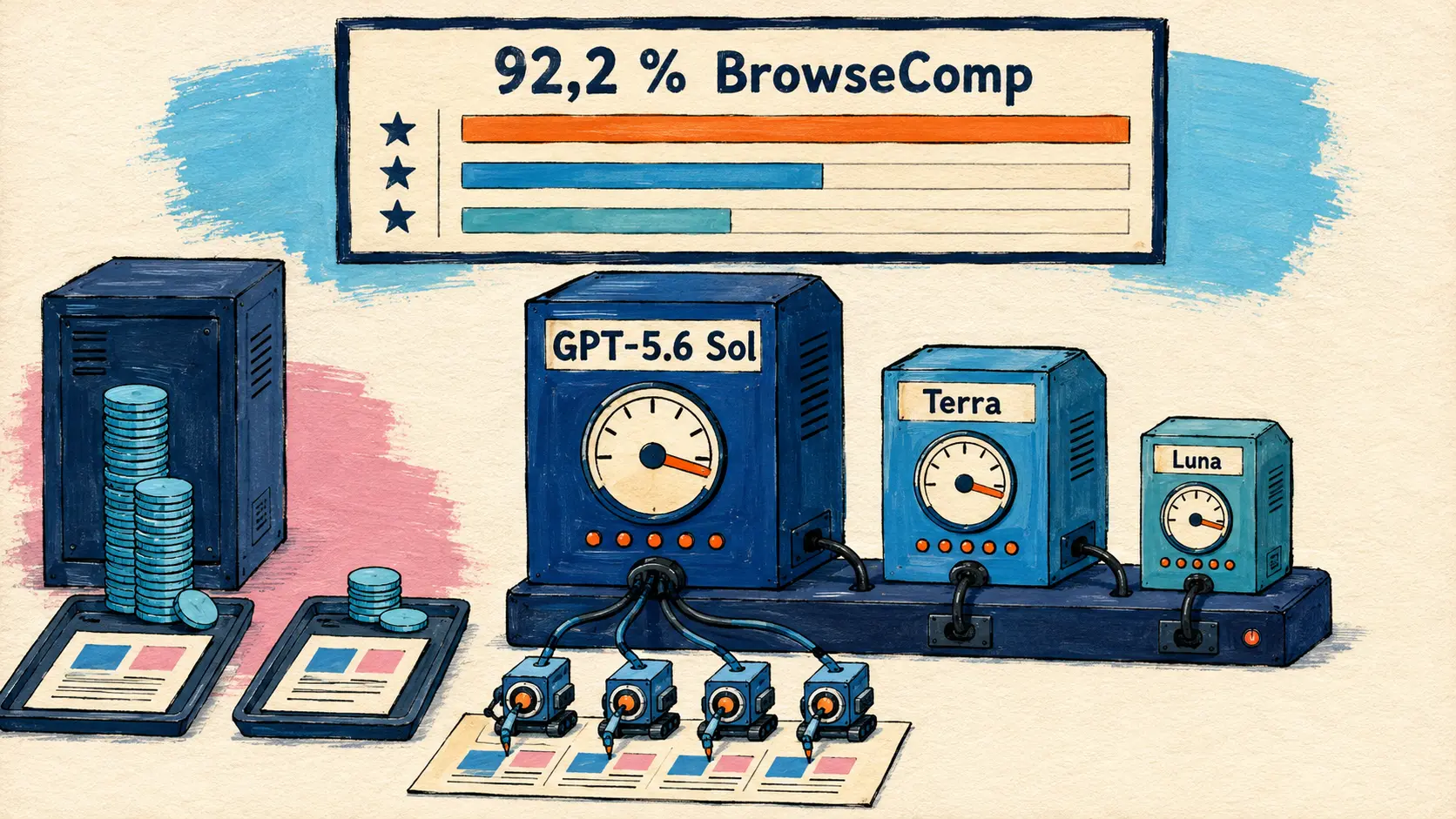
OpenAI launches GPT-5.6, its new frontier model family (Sol, Terra, Luna)
July 9 — OpenAI launches the GPT-5.6 family in general availability: Sol, the new flagship model, Terra, the balanced choice for everyday use, and Luna, the economical variant. Architectural novelty: an ultra effort setting, which by default coordinates four agents in parallel to speed up complex tasks — up to 16 agents tested on some evaluations — accessible via the multi-agent beta of the Responses API.
On benchmarks, Sol sets new state-of-the-art results: 80 on the Artificial Analysis Coding Agent Index (2.8 points ahead of Claude Fable 5 according to OpenAI, with less than half the output tokens), 92.2% on BrowseComp, and 62.6% on OSWorld 2.0 — ahead of Claude Opus 4.8, with 85% fewer tokens. Product novelty: Programmatic Tool Calling in the Responses API lets GPT-5.6 write and execute small programs that orchestrate tools and filter results in memory, reducing back-and-forth. On cybersecurity, GPT-5.6 reaches 73.5% on ExploitBench (versus 47.9% for GPT-5.5); hardware key authentication becomes mandatory on September 1 for the Trusted Access for Cyber program.
| GPT-5.6 Variant | Usage profile | Input price | Output price |
|---|---|---|---|
| Sol | Complex reasoning, long agentic work | $5 | $30 |
| Terra | Everyday agentic coding, balanced choice | $2.50 | $15 |
| Luna | Fast tasks, economical | $1 | $6 |
(Price per million tokens.)
“GPT‑5.6 Sol sets a new standard for both intelligence and efficiency, achieving state-of-the-art results across coding, knowledge work, cybersecurity, and science while outperforming previous and competing frontier models with fewer tokens and at lower estimated cost.” — OpenAI
Deployed today in ChatGPT, Codex, and the API, GPT-5.6 immediately spreads through the developer ecosystem: available in GitHub Copilot (VS Code, JetBrains, Xcode, CLI, cloud agent), now the preferred model of Microsoft 365 Copilot, and adopted the same day by Warp, Cursor, and Devin.
ChatGPT Work: a new agent for ambitious tasks
July 9 — OpenAI introduces ChatGPT Work, an agent capable of acting across the user’s applications and files, staying on a complex project for hours by breaking it into steps, and turning an objective into finished work (spreadsheets, presentations, documents, websites). It relies on Codex technology and GPT-5.6. OpenAI says more than 5 million people use Codex every week, including over 1 million for non-software-development tasks — a figure cited to support this expansion.
| ChatGPT Work feature | What it enables |
|---|---|
| Plugins | Connect to Slack, Microsoft Teams, Google Drive, SharePoint, CRM, via @nom_app |
| Scheduled Tasks | Delegate recurring tasks (monitor Slack, refresh a dashboard every morning) |
| Built-in browser + Computer Use | Act directly on local applications, on desktop |
| Sites (public beta) | Turn work into a shareable website or interactive app by URL |
The launch comes with a redesign of the desktop distribution: the Codex app merges with the new ChatGPT desktop app (Chat, Work, and Codex together, available even on the Free plan), while the old app is renamed ChatGPT Classic. At the same time, OpenAI begins phasing out its standalone Atlas browser, whose capabilities are absorbed by ChatGPT’s built-in browser.
On the enterprise governance side, the system is built on the ChatGPT Enterprise security foundation, with a Compliance API for visibility into actions at scale, and a self-check mechanism that blocked 100% of data exfiltration attempts during internal adversarial tests (red-teaming). Rolling out today on web and mobile for Pro, Enterprise, and Edu plans, with Plus/Business to follow in the coming days; the desktop app is available worldwide today on Mac and Windows.
🔗 ChatGPT is now a partner for your most ambitious work
Codex: dedicated space in ChatGPT, Ultra sub-agents, PR review, and Sites
July 9 — Alongside the launch of ChatGPT Work, Codex gets its own dedicated space in the new ChatGPT desktop app, separate from the Work agent (“Work — for getting work done” / “Codex — for developers” selector). The developer-facing set of updates announced the same day:
| Codex update | Concrete detail |
|---|---|
| GPT-5.6 with Ultra and sub-agents | Multi-agent coordination for the hardest tasks |
| Accelerated Computer Use | Faster and more token-efficient, batch processing, picture-in-picture view for supervision |
| In-line diff editing | Edit code directly in the comparison view (diff) |
| Pull request review | Dedicated side panel, without leaving the app |
| Sites | Rapid deployment of complete (full-stack) apps from Codex |
This evolution is part of the broader merger of the Codex app with the ChatGPT desktop app: existing Codex app users automatically see it become the new ChatGPT app, with Codex available as a configurable default view. The built-in browser in the app gains support for authenticated sites, multiple tabs, and file downloads, rounded out by a new Chrome extension.
Romain Huet from OpenAI announces this set of updates on X, alongside the launch of ChatGPT Work. The whole package is part of the day’s Codex push, set against the backdrop of OpenAI Build Week from July 13 to 21 (see Short items).
🔗 Tweet @romainhuet — Codex in ChatGPT
Meta launches Muse Spark 1.1 and opens its Meta Model API
July 9 — Meta Superintelligence Labs announces Muse Spark 1.1, the second release in the Muse Spark family (the first dated from April 2026): a multimodal reasoning model designed for agentic tasks, with marked gains in tool use, Computer Use, and coding. The launch comes with the public preview of the new Meta Model API — the first external developer access to a Meta model, in a format compatible with OpenAI’s — and the “Thinking” mode now available on the Meta AI app and meta.ai.
| Muse Spark 1.1 feature | Concrete detail |
|---|---|
| Context window | 1 million tokens, actively managed with intelligent compaction |
| Agentic architecture | Planning and delegation to parallel sub-agents |
| Developer access | Public preview of the Meta Model API |
| Safety | Evaluated under the Advanced AI Scaling Framework, safe margins on frontier risks |
The model generates plans and delegates execution, generalizes zero-shot to new tools, MCP servers, and custom skills (skills), and alternates between script writing and direct interaction depending on what is faster. On coding, Meta highlights substantial gains on large and complex codebases (bug diagnosis, migrations, new features on enterprise-grade systems).
“What’s most impressive about Muse Spark is how much it packs into one model: massive million-token context, full multimodal support (images, video, PDFs), built-in search with citations, strong reasoning, top-tier coding abilities (particularly frontend and design), structured output, and parallel tool calling — all in a clean OpenAI-compatible package. A complete agentic foundation.” — Amjad Masad, CEO of Replit
🔗 Introducing Muse Spark 1.1 — AI at Meta Blog
Claude Code v2.1.205: the /checkup command does a full cleanup
July 8-9 — Claude Code moves to v2.1.205, a dense release whose most visible novelty is a full maintenance command: /doctor becomes a true configuration diagnosis-and-repair tool, and /checkup becomes its alias. Boris Cherny, from the Claude Code founding team, explained on X what the command can do in one pass: clean up unused skills, MCP servers, and plugins, deduplicate the local CLAUDE.md compared to the one versioned in the repository, split a root CLAUDE.md that has become too heavy into nested files, disable slow hooks, update Claude Code, enable automatic mode by default, and pre-approve frequently denied read-only commands.
| Issue detected by /checkup | Observed data |
|---|---|
Broken claude command | Detected (launcher overwritten by a test) |
| Never-used project skills | 38, across 2,345 sessions |
| Root CLAUDE.md size | ~10,000 tokens loaded each session |
| Context gain after cleanup | ~5,500 tokens per session |
“/checkup confirms with you before making any changes.” — Boris Cherny, Claude Code team
The rest of the changelog includes around fifteen fixes: an automatic mode rule that now asks for confirmation before a rm -rf on a variable that cannot be resolved from context; automatic-update downloads now stream directly to disk, reducing the tool’s memory peak by about 400 MB; background task notifications explicitly indicate the absence of human intervention, to prevent the exploitation of fake approvals fabricated in a transcript; and several improvements to the agents view (claude agents), including an automatically generated summary and a direct link to the associated pull request.
🔗 Release v2.1.205 — Claude Code
Anthropic launches Reflect with Claude, a tool to visualize your usage (beta)
July 9 — Anthropic launches, in beta, a reflection feature on Claude usage, accessible from Settings on the web or in the desktop app. The tool lets users track their habits over 1, 3, 6, or 12 months — recurring topics, times of day when Claude is most used, types of tasks handled — structured around the 4D AI Fluency Framework (Delegation, Description, Discernment, Diligence), with practical suggestions such as starting a Project rather than re-explaining the context of an ongoing task. The dashboard also lets users set quiet hours or schedule a break reminder, both options that the user can freely ignore.
On privacy, the feature does not rely on incognito-mode conversations or the underlying files of connected tools (an inbox summary may appear, not the source emails), and any health-related conversation is excluded from the insights. Anthropic says it worked with digital well-being experts from MIT Media Lab, the Digital Wellness Lab at Boston Children’s Hospital, and the Family Online Safety Institute to frame the handling of sensitive topics, which are surfaced only at an aggregated level.
The feature is available to Free, Pro, and Max users who have enabled Memory; support for Cowork conversations is planned for later.
🔗 A new way to reflect on how you use Claude
Anthropic — governance and tooling
Four complementary announcements from Anthropic on July 9, spanning operations, governance, and technical education.
Reset of rate limits for all users
July 9 — @ClaudeDevs announces in one sentence the reset of 5-hour and weekly usage limits for all users, without specifying either the cause or the exact scope of the plans affected. No blog post came to provide additional context, but the announcement triggered an immediate and massive community reaction — several million views in a few hours — a sign of its direct impact on regular users of Claude Code and claude.ai.
Inviting hard questions: a new public initiative
July 9 — Anthropic launches “Inviting hard questions,” an initiative inviting the public to submit their toughest questions about AI (jobs, safety, human agency, access to scientific benefits), with a commitment to publicly document the actions taken to address them. The announcement comes with a short film featuring real people interviewed by Anthropic, and highlights work already underway to understand public opinion: the Anthropic Public Record (52,000 Americans surveyed), a survey of 81,000 Claude users across 159 countries, and the Anthropic Institute, dedicated to the societal challenges of AI.
Ben Bernanke joins the Long-Term Benefit Trust
July 9 — Anthropic’s Long-Term Benefit Trust (LTBT) — the independent body responsible for overseeing compliance with its responsible development mission — welcomes Ben Bernanke as a new member. Former chair of the U.S. Federal Reserve (2006–2014) and 2022 Nobel Prize in Economics laureate, Bernanke joins Neil Buddy Shah, Richard Fontaine, and Mariano-Florentino Cuéllar. Daniela Amodei, cofounder and president of Anthropic, says his experience will help the company better anticipate the economic effects of advanced AI on employment and global economies. LTBT trustees hold neither equity stake nor profit-sharing interest in Anthropic.
🔗 Ben Bernanke appointed to Anthropic’s Long-Term Benefit Trust
Model and effort in Claude Code: a deep technical article
July 8 — Lydia Hallie, from the Claude Code team, publishes an article distinguishing two settings that both seem to “improve the response”: the model, which determines which weight set processes the request (and therefore capability and cost per token), and effort, which determines how much work is done — files read, checks performed, autonomy before returning to the user. Proposed rule of thumb: switch to a larger model when the problem is inherently difficult, and increase effort when Claude has not tried hard enough. Practical note: at default effort, Opus 4.8 produces better results than Opus 4.7 for a comparable number of tokens.
🔗 Article @ClaudeDevs — Model and effort in Claude Code
GitHub Copilot enterprise
Four new features that strengthen governance and day-to-day use of Copilot and its ecosystem, including a Manus feature that follows the same agent-enterprise dynamic.
Deploy managed Copilot settings via MDM
July 8 — General availability: Enterprise admins can now deploy managed settings for Copilot CLI and VS Code directly via native MDM (Intune, Jamf, Group Policy) or via a managed-settings.json file (Chef, Puppet, Ansible), in addition to the existing server-managed channel. Priority order in case of conflict: native MDM, then server-managed, then file. Supported settings: permissions.disableBypassPermissionsMode, model, enabledPlugins, extraKnownMarketplaces, telemetry.*.
🔗 Deploy managed Copilot settings via MDM
Enterprise-managed OpenTelemetry export
July 8 — Organizations can now enforce the destination of Copilot’s OpenTelemetry data (endpoint, protocol, whether prompts and responses are captured), without each developer configuring their own variables. Applies to the VS Code Copilot Chat extension and the Copilot CLI agent process, with a managed value that always takes precedence over environment variables and user settings. Notable safeguard: managed authentication headers are never passed through environment variables, to avoid any leakage to subprocesses launched by the agent.
🔗 Enterprise-managed OpenTelemetry export
Copilot summarizes an unknown repository
July 9 — On github.com, when visiting a repository’s home page for the first time, Copilot now offers to generate a high-level overview: project purpose, technologies used, contribution guide. If the repository has no README, Copilot can generate one. Accessible at any time via the Copilot icon in the navigation bar or directly from Copilot Chat, this feature is available on all Copilot plans.
🔗 Ask Copilot for a repository overview
Manus launches Branch, to split a conversation without losing context
July 9 — Manus introduces Branch: any conversation can be split into a parallel session inheriting all accumulated context (files, instructions, history), without altering the original session. The same research can thus become a report, a presentation, and an investor memo, each branch staying focused on its own deliverable, linked to the original by a “Branched from” thread. Available to all users in standard chat sessions; not yet in Web Builder. Branches can themselves be branched again.
🔗 Tweet @ManusAI — Introducing Branch
Code editors
Zed makes multiple announcements on the same day — an ambitious vision and a routine release — while Replit confirms a teaser observed over the past several days.
Zed unveils DeltaDB, a “Google Docs for code”
July 9 — Zed opens sign-ups for early access to DeltaDB, presented as “Google Docs for code”: join a teammate’s discussion thread, have the same agent work together, and review changes on the fly, without “Git ceremony” — no commits or branches to manage in order to collaborate. The concept had already been laid out on June 11 in an article by Nathan Sobo, Zed’s founder, who argued that agents have made conversation the true source of truth for software.
Zed v1.10: llama.cpp support and format-on-save disabled by default
July 8 — Zed releases version 1.10, whose main new feature is support for llama.cpp as a local model provider, developed with Hugging Face — via the built-in llama.cpp server or by connecting to a remote server. Second behavior change: formatting on save (format-on-save) is now disabled by default, except for languages with an official formatter; existing custom configurations are preserved.
🔗 Tweet @zeddotdev — Zed v1.10
Replit launches Community Profiles
July 8 — Replit launches Community Profiles, subtitled “Proof of Work for vibe coders” — a teaser spotted and then set aside during the two previous scans for lack of an official source, now confirmed by this announcement. The feature offers a public profile with an activity graph (agent usage, checkpoints) and a “Replit Power Ranking” reserved for pro users; anyone can claim their profile, select their best projects to showcase, and freely share their usage statistics.
🔗 Tweet @Replit — Community Profiles
Media generation: models join agents
Three announcements that illustrate the same trend: media generation tools are being integrated directly into agentic harnesses rather than remaining standalone interfaces.
Kling AI launches Kling MCP and a CLI interface
July 8 — Kling AI announces the official availability of Kling MCP and a CLI interface, allowing the Kling video model to be called directly from AI agents (Claude and other frameworks), without switching tools or manually moving files. A single sentence is now enough to assign a creative task to an AI assistant. Stated target users: e-commerce sellers, small businesses, and content creators looking to produce at scale at lower cost. 426.9k views on X for this announcement.
ElevenLabs launches ElevenAgents Spotlight
July 9 — ElevenLabs introduces ElevenAgents Spotlight, an observability tool that monitors in real time every conversation — voice and text — handled by its conversational agents, across all channels, in order to improve resolution rate and customer satisfaction score (CSAT). Stated goal: always know what works and how to improve it, without waiting for a post hoc audit. The tool integrates natively with the ElevenAgents platform, with no additional client-side configuration.
HeyGen unveils HyperFrames Music-to-Video (day 4 of 30)
July 9 — The fourth episode in a daily showcase series of HeyGen’s HyperFrames skills: the new /music-to-video command turns a music track into a video synchronized to the beat (BPM, downbeats, musical phrases), from a single prompt and with no visual file provided manually. An audio analyzer builds a single temporal map that every edit cut follows. The code is open source on GitHub (heygen-com/hyperframes), the fourth step in a 30-skill daily rollout.
AlphaEvolve reaches general availability on Google Cloud
July 9 — AlphaEvolve, the evolution-powered agent co-developed with Google DeepMind and driven by Gemini, reaches general availability (GA) on Google Cloud, available to all enterprise customers through the Gemini Enterprise Agent Platform. The agent autonomously designs and discovers highly optimized code to solve complex algorithmic problems, with cited use cases in the financial sector.
| AlphaEvolve item | Confirmed detail |
|---|---|
| Status | General availability on Google Cloud |
| Access platform | Gemini Enterprise Agent Platform |
| Co-development | Google DeepMind |
| History | Internal impact published in May 2026 (Google Spanner optimization) |
AlphaEvolve is not a brand-new project: in May 2026, Google published an article detailing its internal impact, notably the optimization of Google Spanner’s Log-Structured Merge-tree compaction. This announcement marks its move to commercial availability for third-party Google Cloud customers, beyond internal use alone.
🔗 Tweet @googlecloud — AlphaEvolve GA
Mistral Studio adds a system of record for prompts and skills
July 9 — Mistral Studio incorporates a system of record for enterprise AI prompts and skills (skills): immutable versions, a named owner for each asset, rollback in a few minutes, Production/Staging labels, and audit logs. Skills are now exposed as MCP servers directly from Studio, ensuring that what runs in production is the same governed asset that was versioned — not a copy that has drifted. The loop closes with Observability: lineage and telemetry link every production result to the exact version of the asset that generated it.
Mistral’s stated challenge: most companies cannot say which version of a prompt is actually running in their AI. A non-developer domain expert can now iterate and test a prompt without a CI/CD pipeline for every attempt; promotion to production triggers the company’s usual tests and approvals. Available today for Mistral Studio customers.
🔗 Manage Prompts and Skills in Studio
Codex CLI 0.144.0
July 9 — New stable release of Codex CLI, succeeding version 0.143.0. New features: a writes approval mode that automatically authorizes read-only actions while requesting confirmation for writes; MCP tools can now request interactive authentication without enabling an experimental option; detection of global installations via pnpm. Notable point in line with today’s GPT-5.6 launch: selecting the Ultra reasoning mode now triggers a warning when high multi-agent concurrency may quickly drive up usage.
Bug fixes: recovery of ChatGPT threads after compaction referencing a retired model, fixes for crashes on Intel macOS binaries, file deletion in Windows sandbox sessions, and the end of display corruption caused by pasted terminal control sequences. Amazon Bedrock model names now clearly identify the GPT-5.6 family and variant.
🔗 Codex CLI 0.144.0 — GitHub Releases
Perplexity tests a homegrown orchestrator based on GLM 5.2
July 9 — Perplexity publishes a research preview of a new proprietary orchestrator model for Perplexity Computer, its desktop automation agent: a customized GLM 5.2 (Zhipu AI), post-trained for the Computer agentic harness. The model includes an “advisor” tool that natively escalates to a more powerful model when needed, and is hosted in the United States by Perplexity on Nvidia B200 GPUs. Distinct from the July 2 announcement about Claude Fable 5’s return as orchestrator, this is an additional in-house option.
| Evaluated model (WANDR) | Relative cost |
|---|---|
| Opus 4.8 (thinking, high effort) | 6.1x |
| GLM 5.2 + advisor | 2.1x — i.e. 0.344x the cost of Opus |
Perplexity announces iterations and the publication of full benchmarks “in the coming weeks,” across three evaluations in total (Terminal-Bench 2.1, DSQA, WANDR), where the average cost comes out at roughly half that of Opus across all benchmarks combined.
🔗 Thread @perplexity_ai — GLM 5.2 orchestrator
Briefs
- GRAM Research — a “switch” for dual-use knowledge (Anthropic, with AE Studio) — dedicated neuron modules for each category of sensitive knowledge (virology, cybersecurity) can be added to each Transformer layer and then removed individually; the method matches the performance of data filtering without training a separate model per configuration, but remains preliminary research never applied to Claude production models. 🔗 Anthropic Research
- Replit offers a free custom domain until July 17 — any app published on the platform can receive a domain name at no additional cost until that date. 🔗 Tweet @Replit
- GitHub Code Quality: organization-level targeting — administrators can now enable, disable, and lock GitHub Code Quality on a precise subset of repositories; public preview for Enterprise Cloud and Team. 🔗 GitHub Changelog
- Manus extends its Google Drive connector to all of Google Workspace — Docs, Sheets, Slides, and Forms join Drive through a single entry point, with three configurable access levels (none, read-only, read/write). 🔗 Tweet @ManusAI
- NVIDIA Robotics publishes R²D², a digest on World-Action Models — three papers (DreamZero, Cosmos Policy, DreamDojo) that refine pre-trained generative video models into robotic control policies; DreamZero takes the lead in the July 2026 RoboArena ranking. 🔗 Tweet @NVIDIARobotics
- Luma moves to the VEED Fabric 1.0 API for its talking videos — a technical partnership through which VEED Fabric 1.0 becomes the underlying engine for generating talking videos within the Luma ecosystem. 🔗 Tweet @veedstudio
- OpenAI Build Week, from July 13 to 21 — a community event with live sessions and local builder meetups around the world, a call to build with Codex. 🔗 Tweet @OpenAIDevs
What this means
The race for frontier models is intensifying on two fronts at once. GPT-5.6 and Muse Spark 1.1 launch on the same day with a shared goal: combining state-of-the-art intelligence and economic efficiency rather than aiming only for the highest score. OpenAI claims a new state of the art on several major benchmarks while sharply reducing token consumption; Meta is opening its Meta Model API to external developers for the first time, a sign that it now wants to compete with OpenAI and Anthropic on infrastructure, not just open models. Perplexity illustrates a third path: rather than training a full proprietary model, it adapts GLM 5.2 (Zhipu AI) at a cost about three times lower than Opus, with a native escalation tool to a more powerful model when needed — a bet on hybrid architecture rather than brute size.
Agents are moving from occasional assistants to long-running collaborators. ChatGPT Work is explicitly designed to stay on a complex project for hours, Codex gets sub-agents coordinated by GPT-5.6’s Ultra mode, and Muse Spark 1.1 generalizes the multi-agent architecture to the delegation of entire tasks. This growing autonomy shifts the core question: it is no longer “can the model do the task?” but “how long and how much supervision should we give it?” — the question Lydia Hallie’s article on effort tuning in Claude Code is precisely trying to answer, and which the Reflect with Claude tool now proposes to measure objectively for each user.
Enterprise tooling is becoming organized around traceability and control. GitHub is standardizing the rollout of Copilot settings via native MDM and enforcing an approved OpenTelemetry export, Mistral Studio is feeding its prompts and skills into a versioned management system with audit trails, and Anthropic is strengthening its institutional governance with Ben Bernanke’s arrival on the Long-Term Benefit Trust. The common thread: as agents gain autonomy, companies and oversight bodies want the ability to know exactly which version is running, who approved it, and what it is allowed to do — a requirement that Claude’s surprise usage-limit reset, without public explanation, makes even more visible by contrast.
Media generation is completing its shift toward the agentic ecosystem. Kling MCP lets you call a video model directly from a Claude agent without changing tools, HeyGen is publishing an open-source skill that turns an audio track into an automatically edited video, and ElevenLabs is now observing its voice agents in real time rather than after the fact. Manus extends this logic on the general productivity side with Branch, which lets you split a conversation into multiple deliverables without losing the accumulated context — a sign that the value no longer lies in an isolated model, but in its ability to slot natively into a chain of agents working with one another.
Sources
- GPT-5.6: Frontier intelligence that scales with your ambition
- GPT-5.6 System Card
- ChatGPT is now a partner for your most ambitious work
- Tweet @romainhuet — Codex in ChatGPT
- Introducing Muse Spark 1.1 — AI at Meta Blog
- Tweet @AIatMeta — Muse Spark 1.1 announcement
- Release v2.1.205 — Claude Code
- Tweet @bcherny — /checkup announcement
- A new way to reflect on how you use Claude
- Tweet @ClaudeDevs — rate limit reset
- Inviting hard questions
- Ben Bernanke appointed to Anthropic’s Long-Term Benefit Trust
- Article @ClaudeDevs — Model and effort in Claude Code
- Deploy managed Copilot settings via MDM
- Enterprise-managed OpenTelemetry export
- Ask Copilot for a repository overview
- Tweet @ManusAI — Introducing Branch
- Tweet @zeddotdev — DeltaDB
- Tweet @zeddotdev — Zed v1.10
- Tweet @Replit — Community Profiles
- Tweet @Kling_ai
- Tweet @ElevenLabs
- Tweet @HeyGen
- Tweet @googlecloud — AlphaEvolve GA
- Manage Prompts and Skills in Studio
- Codex CLI 0.144.0 — GitHub Releases
- Thread @perplexity_ai — GLM 5.2 orchestrator
- Anthropic Research — An off switch for dual-use knowledge
- Tweet @Replit — free domain
- GitHub Changelog — Organization-level targeting for Code Quality
- Tweet @ManusAI — Google Workspace connector
- Tweet @NVIDIARobotics
- Tweet @veedstudio
- Tweet @OpenAIDevs — OpenAI Build Week