ai-powered-markdown-translatorArticle translated from fr to en with gpt-6.1-sol.
OpenAI details Pando, the Git backend for its monorepo built with Codex in ten weeks, which serves nearly one petabyte (1 Po) of data per day; Claude Code 2.1.317 now asks for consent before sending the account’s email address, and GitHub Copilot arrives in JetBrains Air. Anthropic introduces FlashProve, a prototype for cryptographic proofs of inference, OpenAI more than quadruples its median bug bounties, and Cohere opens Model Vault to open models from other providers. Google releases PLE, an engineering benchmark where no agent exceeds 50 %, and will redirect requests for Gemini 2.5 Pro and 2.5 Flash to newer models on December 1.
Coding agents: OpenAI builds Pando with Codex, Claude Code 2.1.317, GitHub Copilot in JetBrains Air
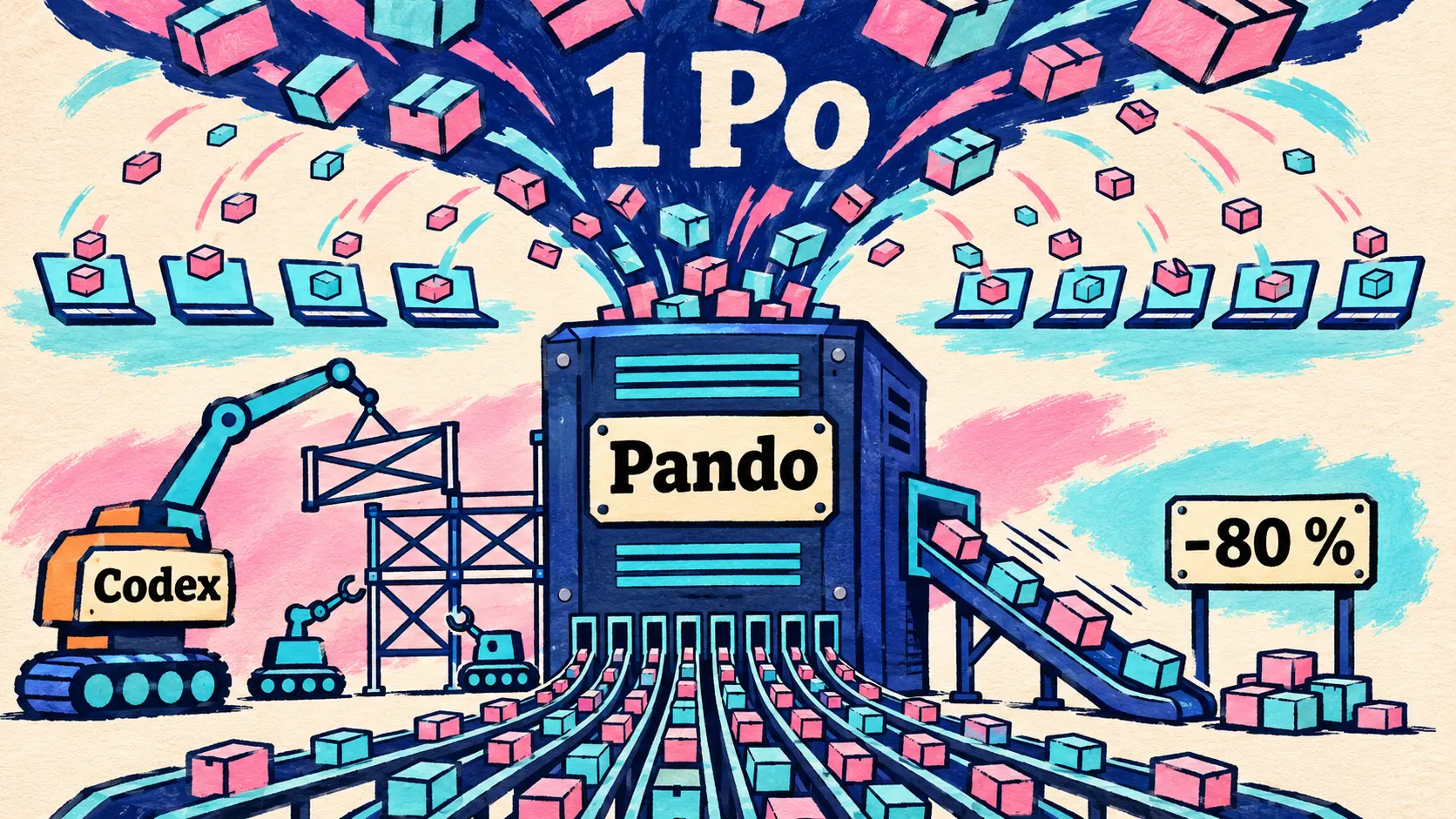
OpenAI replaces its monorepo’s Git backend with Pando, built with Codex in ten weeks
November 2 — OpenAI details Pando, the new Git backend that now supports all development in its monorepository (monorepo), compatible with the Git protocol and client. The driver is Codex: branches, pushes, merges and fetches have multiplied, and by late 2025 the old system’s reliability sometimes fell below 90 %. According to a chart in the post, commits merged into the main branch in the third quarter of 2026 exceed those in the first quarter of 2024 by 1 378 %.
We built Pando, a new Git backend for our monorepo, to handle more pushes and fetches without changing how our engineers and agents use Git. Pando cut push latency by ~80% and now serves nearly a petabyte of Git data a day. We can grow Git capacity alongside agent usage. — @OpenAIDevs on X
To handle the load, Pando gives up a consistent view of all references at any given moment: each branch is updated independently, and incoming pack files are served unchanged to other clients from regional caches.
| Metric measured by OpenAI | Reported value |
|---|---|
| Median push latency | reduced nearly fivefold (approximately -80 %) |
| Git data served | nearly one petabyte (1 Po) per day |
| Hourly peak | more than 57 To in one hour, more than 99 % from the cache |
| Clones and fetches | 10 Gbit/s links saturated on standard VMs |
| Build time | 10 weeks with Codex, in production since April 2026 |
The core was designed by a single engineer and implemented by teams of agents, which also used GPT-6 Astra to write Lean and TLA+ to formalize Pando and uncover bugs. OpenAI has contributed several fixes back to the Git project and says it is exploring ways to share this technology, with no product or date announced.
Claude Code 2.1.317 asks for consent before sending the account email and adds cost reporting to the Claude apps gateway
November 3 — Claude Code 2.1.317 was released on GitHub at 01:25 UTC, following a release on npm the previous evening. Of its 87 entries, 62 are fixes, but the release adds a privacy safeguard: Claude Code now asks for consent before a web or shell tool call sends the account’s email address over the network. Along the same lines, /schedule warns when a new cloud scheduled task receives connectors that were not requested, and explains how to remove them.
| New in 2.1.317 | What changes |
|---|---|
| Claude apps gateway | GET /v1/organizations/analytics/cost cost report: spending by developer, day or IdP group |
| Agent SDK | onFailure: "block": a failed hook callback blocks the action instead of letting it through |
| Subagents and teammates | When using a different model from the conversation, they use the effort setting saved for that model |
| Read tool | Rereading an unchanged file returns its contents, instead of a simple notice |
| OpenTelemetry | New attributes, including anthropic.plan and anthropic.seat_type |
Among the fixes, auto mode no longer gets stuck every turn behind an LLM gateway that returns 403 or 422 to its safety check, Grep and Glob no longer present partial results as complete when a search reaches its time limit, and claude auth status no longer risks logging the user out after a slow token refresh. On npm, the stable channel remains on 2.1.311.
🔗 Claude Code 2.1.317 release notes
GitHub Copilot arrives in JetBrains Air, locally and for cloud tasks through the Copilot subscription
November 3 — GitHub Copilot becomes one of the agents in JetBrains Air, the JetBrains environment designed for development with agents and open to any agent compatible with the Agent Client Protocol (ACP). Users select it in Air’s agent picker with their existing Copilot subscription to delegate a task, guide its execution and review the result alongside the code; Air tracks multiple sessions in parallel. GitHub presents it as an option alongside its Copilot plugin for JetBrains, not as a replacement.
| Execution mode | Requirements | Usage billing |
|---|---|---|
| Local, in the JetBrains IDE | Air installed in the IDE, GitHub Copilot selected, Copilot account connected | Existing Copilot subscription |
| Cloud, via Air Teams | JetBrains business organization with Air Teams, Copilot enabled by the Air administrator | Copilot plan, not JetBrains AI credits |
Each cloud task runs in a Docker container on a fresh virtual machine, behind a proxy through which all traffic passes, with no state retained between tasks. GitHub also lists limitations: subscriptions and credits are checked only when the cloud environment starts, there is no choice between a personal plan and an organization plan for each task, and no Copilot spending cap can be set in Air, where administrators can only disable Copilot.
🔗 The GitHub Changelog announcement
Security: FlashProve at Anthropic, OpenAI bug bounties, CWE-bench v2 and CyberArena
Anthropic introduces FlashProve, an open source prototype for cryptographic proofs of inference for large models
November 2 — Anthropic’s Frontier Red Team releases FlashProve, a research prototype for provable inference (provable inference), announced on X on November 3: it can verify that a response really comes from a given model. The provider first publishes a commitment (commitment) to the weights, then attaches a succinct zero-knowledge cryptographic proof (zkSNARK) to each response, establishing that these weights, applied to this prompt, produce exactly these tokens. The weights remain hidden, but the model architecture does not. According to Anthropic, Claude produced the system improvements and wrote the protocol specification, whose security properties are proved in Lean.
| Published metric (Llama 4 Maverick, 4-bit weights) | Reported value |
|---|---|
| Proof throughput on a single H100 | approximately 110 tokens per second |
| Proof size (1 024-token request) | approximately 19 Mo |
| CPU verification, without a GPU | 17 seconds on 24 threads |
| Overhead compared with vLLM, per GPU | approximately 72 times, 94 times at the highest load |
| VerInf, previous baseline on this model | 14,3 hours for 1 000 tokens, 93,6 Go proof |
The cited uses range from regulators tracking the pace of development to detecting a compromised inference server or a substituted model, as well as text provenance. The limitations are clear: contexts of at most 1 024 tokens, proofs covering a full version of the model using greedy decoding (greedy decoding), and no formal guarantees for the fast code. The code is released under the Apache 2.0 license, in a repository described as unmaintained.
🔗 Anthropic’s post on FlashProve · The FlashProve repository
OpenAI more than quadruples median bug bounty rewards, reaching up to 172 000 dollars with bonuses
November 2 — OpenAI raises the rewards in its vulnerability bounty program (bug bounty), an announcement shared on X on November 3: on average, the midpoint of the reward ranges increases more than fourfold for medium, high and critical severity vulnerabilities. A critical vulnerability in ChatGPT, Codex or the API Platform can earn up to 30 000 dollars, and an exceptional critical finding remains eligible for a base reward of up to 100 000 dollars, or up to 172 000 dollars with the new bonuses: a quality multiplier for a reliable proof of concept, five loyalty tiers and priority campaigns for recently launched features.
| Example vulnerability given by OpenAI | Previous bounty | New bounty |
|---|---|---|
| Medium severity in ChatGPT: file import without write permission | 750 dollars | 2 415 dollars |
| Critical in ChatGPT: zero-click account takeover | 6 500 dollars | 51 577 dollars |
| Exceptional: reading any user’s conversations | 100 000 dollars | 171 925 dollars |
The new ranges apply to pending reports, and OpenAI will pay the difference for bounties awarded in the 30 days before the announcement. The security team will be at PROMPT2PWN in Oakland on November 20 and 21.
🔗 OpenAI’s post on bug bounties
Collinear AI releases CWE-bench v2, where Gemini 4 Argon narrowly leads Claude Opus 5.5 on 100 public vulnerability-fixing tasks
November 3 — Collinear AI publishes the second version of CWE-bench on the Hugging Face blog, measuring an agent’s ability to find and fix a security weakness in a real open source repository without breaking its functionality. The public set contains 100 tasks covering 91 weakness categories (CWE), scored deterministically and reviewed manually; a held-out set remains private to track progress on tasks no model has seen.
| Model evaluated | pass@1 success rate | pass@4 success rate | Cost per run |
|---|---|---|---|
| Gemini 4 Argon | 67,8 % | 81,0 % | 3,92 dollars |
| Claude Opus 5.5 | 67,3 % | 78,0 % | 1,83 dollars |
| DeepSeek V4.1 Flash (1017) | 57,0 % | not reported | 0,04 dollars |
Across the 11 models evaluated, 95 tasks are solved by at least one model, but the leader fails on every attempt on 19 % of the set. Each task is a Harbor environment (Docker container, instructions, deterministic verifier) that can be launched from the Hub and can also be used to train defensive agents through RL. Gemini 4 Carbon is not among the models evaluated.
🔗 CWE-bench v2 on the Hugging Face blog
CyberArena pits twelve agents against each other in live attack-defense matches, and GPT-5.6 Sol leads thanks to its defense
November 3 — 2077AI and UC Berkeley’s RDI center release CyberArena, a benchmark that replaces a cybersecurity exam with a head-to-head contest: two agents each receive a copy of the same vulnerable service and, over three rounds, attack the opposing copy while patching their own. The arena verifies every flag capture and service health check, then converts the matches into rankings.
| Rank | Agent evaluated | Harness used | Ranking score |
|---|---|---|---|
| 1 | GPT-5.6 Sol | OpenAI Codex | 78,6 |
| 2 | Claude Opus 5 | Claude Code | 73,8 |
| 3 | GLM-5.3 | OpenCode | 68,5 |
| 4 | Gemini 3.7 Flash | Gemini CLI | 67,1 |
| 5 | Grok 4.6 | Grok CLI | 65,5 |
Across 466 valid matches involving 12 agents and 40 challenges, defense makes the difference: the top two retain their flags in 83 % and 81 % of rounds, compared with 43 to 61 % for the others. The most frequent errors identified by the audit are claiming a fix without verification (23 % of audited matches) and partial fixes (21 %). The ranking covers models from earlier generations, without GPT-6 Sol or Claude Opus 5.5; the arena code, challenges and match replays are published.
🔗 CyberArena on the Hugging Face blog
Open models in the enterprise: Cohere opens Model Vault, Revolut switches to self-hosted GLM according to Together AI
Cohere opens Model Vault to open models from other providers, from DeepSeek V4.1 Flash to GPT-OSS
November 3 — Cohere is opening Model Vault, its sovereign inference platform launched in January, to open models from other providers. Alongside Cohere models, businesses can run DeepSeek V4.1 Flash, described by Cohere as the most widely used open model on OpenRouter, GLM 5.3 Flash, MiMo V2.6 Pro, Gemma 4, NVIDIA’s Nemotron, Tencent’s Hy3, and the GPT-OSS and Phi families. By default, neither prompts nor responses are retained.
The post distinguishes two tiers. Model Vault runs on infrastructure dedicated to a single customer, in the chosen region. Model Vault Encrypted also encrypts data during processing (confidential computing): according to Cohere, neither Cohere nor the cloud provider can see what goes into or comes out of the model. This second tier does not support every model.
| Model family | Model Vault | Model Vault Encrypted |
|---|---|---|
| Embed, Rerank, Parse, Transcribe, Translate (Cohere) | Yes | Yes |
| Gemma, GPT-OSS, Phi | Yes | Yes |
| Command, DeepSeek, GLM, MiMo, Nemotron, Hy3 | Yes | No |
Model Vault is available in the United States, the European Union and Canada; Model Vault Encrypted is available in the United States, with the European Union and Canada announced as “coming soon.” Billing is based on GPU type, hourly or under a commitment, with no prices listed in the post. Five days after a Series E that outlined a new generation of models over twelve months, Cohere slips this into its thread:
Try out world-class models while you wait for our next one — @cohere on X
🔗 Cohere’s post on Model Vault
Revolut reportedly moved around 2 000 engineers to self-hosted GLM for coding, according to a tweet shared by Together AI
November 3 — Together AI shares a tweet claiming that Revolut has made open models its default choice for coding:
Europe’s largest private company just made open models its default for coding. — @togethercompute on X
The quoted tweet, by Guillermo Flor, draws on comments from David Abitbol, the neobank’s head of AI operations: around 2 000 engineers now work with self-hosted GLM, while Claude Code and Codex move onto an exceptions list.
| Figure reported by the tweet | Stated value |
|---|---|
| Engineers involved | around 2 000 |
| Hardware | 56 NVIDIA B200 GPUs |
| Blended cost | 30 cents per million tokens, around one tenth of Anthropic’s and OpenAI’s prices |
| Engineering lead time (lead time) | improved by 70 % |
According to the same tweet, the gains came when tokens stopped being rationed. Together AI says it is part of the infrastructure running these open models in production, without specifying its role. The information remains secondhand: no Revolut announcement was found, and the GLM version is not specified.
🔗 Guillermo Flor’s tweet quoted by Together AI
Physical-world engineering: GPT-6 Astra designs hardware, Google releases PLE, Antigravity in chemistry, NVIDIA in cities
OpenAI applies GPT-6 Astra and Codex to physical engineering, with Mazda and Chip Ganassi Racing
November 3 — OpenAI presents its work on engineering physical products: mechanical design, electronics and simulation. In the most striking demonstration, two team members used GPT-6 Astra to design a small device for talking to Codex, in less than a week and as a side project: Astra designed its appearance, enclosure, circuit board, interface and firmware, and a contractor manufactured a small batch of prototypes in less than a month. OpenAI acknowledges several review cycles: the model did not always account for manufacturing constraints, tolerances or assembly details.
| Metric published by OpenAI | Stated value |
|---|---|
| BenchCAD 2.0, newer internal model (unnamed) | 0,875 (average score) |
| BenchCAD 2.0, GPT-6 Astra at maximum reasoning | 0,594 |
| Model usage by hardware teams (in tokens) | increased 23-fold since February |
BenchCAD 2.0 tests the reconstruction of 3D parts and assemblies and the identification of circuit board connections. On the industry side, OpenAI is expanding its collaboration with the Chip Ganassi Racing team, which turns 3D scans of existing parts into editable CAD models and 2D manufacturing drawings, and is announcing a research collaboration with Mazda: GPT-6 Astra helps its engineers explore nose shapes that reduce drag, with results promised “in the coming months.” No product or availability is announced.
🔗 OpenAI’s post on physical-world engineering
Google releases Physical-Engineering’s Last Exam, an engineering benchmark where no agent exceeds 50 %
November 3 — The Google AI & Infrastructure team presents Physical-Engineering’s Last Exam (PLE), a benchmark and open competition developed with Mercor to measure agents’ ability to carry out real engineering work. Its 85 long-running tasks (30 in mechanical engineering, 27 in electrical engineering, 18 in civil engineering, 10 in structural engineering) place the agent in a containerized project folder containing an average of 61 files: PDFs, spreadsheets, emails, 2D CAD drawings and 3D BIM models. A deliverable earns points only if it clears every safety gate.
| Leaderboard rank | Model evaluated | Native harness | Average score |
|---|---|---|---|
| 1 | Claude Opus 5.5 | Claude Code | 48,3 % |
| 2 | GPT-6 Astra | Codex | 45,8 % |
| 3 | Claude Sonnet 5.5 | Claude Code | 43,5 % |
| 4 | Gemini 4 Argon | Antigravity | 40,6 % |
| 5 | Claude Opus 5 | Claude Code | 40,0 % |
Of 14 models tested with seven public harnesses, none exceeds 50 % on the private test set. The best configuration satisfies 91 % of constraints individually, but only 41,3 % of its deliverables pass all safety and feasibility checks. The model matters far more than the harness: up to a 50-point gap between models, compared with a median 3-point gap between harnesses for the same model. Google is releasing 29 tasks, the scoring scripts and the evaluation container, and opening submissions on the private set.
🔗 Google Cloud’s post on PLE · The PLE leaderboard
Google DeepMind equips Antigravity with Cheminformatics Skills that cut a drug design cycle to one hour
November 3 — Google DeepMind introduces Cheminformatics Skills for Google Antigravity, turning the agentic environment into a workbench for chemists. The division of roles is explicit: the language model orchestrates the work, navigates databases and reasons, while deterministic chemistry tools, backed by the open source RDKit library and the ChEMBL and PubChem databases, perform the molecular calculations.
The demonstration revisits a classic medicinal chemistry problem: rigidifying crizotinib, a tyrosine kinase inhibitor used against certain lung cancers, to move toward lorlatinib, its cyclized version. In a few minutes, the agent gathers thousands of compounds from the literature, conducts matched molecular pair analysis, trains potency prediction models, then proposes new macrocycles along with their synthesis routes. According to DeepMind, this cycle, which usually takes several days, fits into one hour. The post follows the October 15 post on antimicrobial peptides and links to Antigravity’s Science page, where Google is accepting applications for six months of free access to its highest tier and Gemini 4 Argon for 10 000 scientists, with no access requirements specific to these skills.
NVIDIA showcases in Barcelona the urban services its partners are building with its physical and agentic AI
November 3 — During the Smart City Expo World Congress in Barcelona (November 3–5), NVIDIA publishes an overview of the urban services its partners are building with its physical and agentic AI components: open Nemotron models, Cosmos world models, Omniverse libraries and the Metropolis video search and summarization blueprint.
| Partner mentioned | Deployment location | Announced figure |
|---|---|---|
| 1MillionBot | Spain | more than 150 agent deployments serving residents |
| ITMAX | Malaysia | more than 17 000 cameras covered by 2027 |
| ITMAX with TeraSim | Malaysia | up to 26 % less travel time during rush hour |
| Linker Vision and MVRDV | Taiwan | 15 years of urban canopy evolution simulated in 10 minutes |
1MillionBot combines the open source ALIA models, trained at the Barcelona Supercomputing Center, with Nemotron; K2K uses existing cameras in Wrocław, Honeywell is deploying Nemotron agents at Dangote’s Lekki refinery in Nigeria, and Cires Technologies is expanding a sovereign AI factory at the port of Tanger Med. No new NVIDIA product is announced: this is a showcase of deployments.
Open publications: Mistral Large 4 technical report, pplx-embed-v2-context, StateBench and FineDNA
Mistral publishes the Mistral Large 4 technical report, recounting the building of Le Chonk
November 3 — Mistral publishes the technical report for Mistral Large 4, the model nicknamed Le Chonk whose weights were released on October 29. Posted on Hugging Face on November 2 and then on alphaXiv, the document describes a multimodal mixture of experts (mixture-of-experts) with 52 billion active parameters out of 1 000 billion in total. According to its abstract and introduction, it first sheds light on an architectural choice: KV cache reduction, pushed to the extreme during development to serve the model at lower cost, hurt agentic tasks. The team measured this penalty, then corrected it through model surgery (model surgery): switching to full attention, then to DeepSeek Sparse Attention (DeepSeek Sparse Attention, DSA). On the data side, agents themselves write executable environments, tasks, reference solutions and verifiers, while others repair broken tasks while guarding against reward hacking (reward hacking).
| Metric evaluated | Value according to the report |
|---|---|
| Harvey’s Legal Agent Benchmark (previously unpublished figure) | 15 % |
| Terminal-Bench 4.0 | 41 % |
| FrontierCode 2.0 | 19,7 % |
| Cybersecurity (average across JailbreakBench, StrongREJECT, AgentHarm) | 96,6 % |
| Checkpoint quantized in NVFP4 | 606 Go, served on four GB300 GPUs |
Calibrated NVFP4 quantization matches the FP8 baseline on evaluations, and the three reasoning levels (high, medium, low) come from distillation using several teachers with different levels of verbosity.
🔗 The technical report on alphaXiv · Mistral’s announcement on X
Perplexity releases pplx-embed-v2-context, open contextual embedding models in 9B and 0.6B
November 2 — Perplexity releases pplx-embed-v2-context, open-weight contextual embedding models in two sizes, 9B and 0.6B, one month after the September 30 preview of the 9B model. A contextual embedding represents a passage (chunk) while taking the entire document into account: each model returns either one int8 vector per document or one vector per passage. The innovation lies in training: instead of assuming that a single reference passage (gold chunk) answers the query, Perplexity distills graded relevance scores from its answer engine’s context compression model, so passages that support an answer no longer count as negative examples.
| Metric announced by Perplexity | Published result |
|---|---|
| ConTEB, context-bench and Q2D-Chunk | 9B leads all three benchmarks |
| ViDoRe-V3, visual documents | 9B ahead of Nemotron-3.5-Embed-8B, with an index 4 times smaller |
| ViDoRe-V3 in markdown | 0.6B ranks first among models under 1 billion parameters |
| Q2D-Chunk, new public benchmark | 6 069 real queries, 10 languages, 71 100 documents |
The research paper, written with turbopuffer, is published on arXiv, and Q2D-Chunk is available as a public leaderboard on Hugging Face. The 9B model is published there under the MIT license, while the 0.6B model card lists no license; the thread mentions neither an API nor pricing.
🔗 The thread by @perplexitydevs · The paper on arXiv
Ai2 releases StateBench, a benchmark showing that frontier models struggle with state tracking in long documents
November 3 — Ai2 releases StateBench, a benchmark dedicated to long-context state tracking: a model’s ability to keep track of information that changes throughout a long document, such as a variable reassigned in code. Four difficulty levels, drawn from Krohn–Rhodes theory, range from immutable assignment to assignment by reference.
| Difficulty level | Assignment type | Example given by Ai2 |
|---|---|---|
| r-trivial | immutable | let x = 4 |
| aperiodic | reassignment by value | x = 4 then x = 2 |
| solvable | self-referential update | x = x + 5 |
| general finite | assignment by reference | x = y, variable swapping |
Gemini 3.8 Flash, Claude Opus 5.5, GPT-6 Sol and GPT-6 Luna perform well on the first two levels, but their accuracy drops as length increases on the last two, falling to 13 % or less on the longest general finite problems. Trained on at most 256 assignments and tested on up to 64 000, models with 275M parameters reveal differences between architectures: Gated DeltaNet and hybrid models generalize almost perfectly on the first three levels, while transformers degrade and never learn the last one. The data and code are publicly available.
🔗 StateBench on the Hugging Face blog
Hugging Face releases FineDNA, Carbon-X’s complete training data for teaching DNA to a language model
November 1 — Catch-up: Hugging Face releases FineDNA, the complete dataset used to train Carbon-X, its model capable of reading DNA, built on Qwen3-14B and introduced on October 22. The dataset, licensed under Apache 2.0, covers all three training stages.
| Training stage | Dataset size | Starting point |
|---|---|---|
| Intermediate phase (mid-training), 23 configurations | 514,30 billion tokens, including 302 billion processed | Qwen3-14B |
| SFT, 8 domains | 203 923 conversations | Carbon-X-Base |
| RL | 98 433 prompts | Carbon-X-SFT |
The intermediate phase allocates 55 % of training to DNA, 20 % to English, 15 % to biological text and 10 % to instructions; the sequences, drawn from GENERator and OpenGenome2, are split into multiples of six bases for a tokenizer that reads 6-mers. According to Loubna Ben Allal, who announced the dataset, this phase sets the stage for subsequent training: applied directly to Qwen3-14B, RL remains at chance level on FrontierVEP, whereas the same recipe makes progress on the prepared model.
🔗 FineDNA on the Hugging Face Hub · Loubna Ben Allal’s announcement on X
The Gemini API deprecates Gemini 2.5 Pro and 2.5 Flash and will redirect their requests to Gemini 3.8 Flash and 3.5 Flash-Lite on December 1
November 2 — Google lists the deprecation of Gemini 2.5 Pro and Gemini 2.5 Flash, released in June 2025, in the Gemini API release notes. Both models are no longer offered in Google AI Studio, and API access is restricted to users who have previously used them. On December 1, 2026, instead of returning an error, the API will automatically redirect requests: those addressed to gemini-2.5-pro will go to Gemini 3.8 Flash, and those addressed to gemini-2.5-flash to Gemini 3.5 Flash-Lite, billed at the new models’ rates.
| Affected model | Input price (per million tokens) | Output price (per million tokens) |
|---|---|---|
| gemini-2.5-pro (prompts ≤ 200 000 tokens) | 1,25 dollar | 10 dollars |
| gemini-3.8-flash through December 31, 2026 | 0,75 dollar | 3,75 dollars |
| gemini-3.8-flash from January 1, 2027 | 1,50 dollar | 7,50 dollars |
| gemini-2.5-flash | 0,30 dollar (1 dollar for audio) | 2,50 dollars |
| gemini-3.5-flash-lite | 0,30 dollar, including audio | 2,50 dollars |
Google recommends changing the identifier before that date, because the migration includes breaking changes: validation of function calling and thought_signature, thinking_level replacing thinking_budget, removed sampling parameters and the end of prefilled model turns.
🔗 The Gemini API release notes · The deprecations page
Assistant plugins and integrations: Perplexity Computer adopts Agent Plugins and adds an e-commerce offering, Synthesia details its ChatGPT plugin
Perplexity Computer adopts the open Agent Plugins standard for its connections and skills
November 3 — Perplexity Computer supports Agent Plugins, a format that bundles application connections and skills into a single package. Users can browse Computer’s catalog, organized into at least 13 categories (from Productivity and collaboration to Data and analytics, including HubSpot, IBISWorld and DoorDash Drive), or import their own plugins from GitHub or a .zip file. According to @AskPerplexity, plugins are active in Computer and rolling out to Enterprise accounts.
Agent Plugins is an open standard, independent of vendors, introduced on August 6. Its 1.0.0 specification defines a common format for Agent Skills and MCP servers: a required plugin.json manifest, a skills/ folder and a mcp.json file. Perplexity’s tweet cites maintainers from Amazon, Cursor, GitHub, OpenAI and Vercel; the standard’s website names Microsoft instead of GitHub on its initial steering committee. Its compatible clients page lists Perplexity Computer alongside GitHub Copilot, VS Code, Cursor, Kiro and ChatGPT & Codex. For Computer, this extends September’s Skills Marketplace; neither a blog post nor a changelog accompanies the announcement.
🔗 The announcement from @AskPerplexity · The Agent Plugins standard
Perplexity launches Computer for e-commerce, connecting Shopify, Meta ads and Klaviyo
November 3 — Perplexity introduces Computer for e-commerce, putting its Computer agent to work for online brands: it connects to Shopify for store data and landing pages, Meta for advertising and Klaviyo for email marketing, applying the visual guidelines and tone the brand has saved in skills.
| Connected service | Computer’s role |
|---|---|
| Shopify | Sales analysis, product recommendations, landing page |
| Meta | Static ads, variants of successful videos, campaign setup |
| Klaviyo | Audience drawn from customer data, copy, scheduling or sending after review |
The business sets the goals, budgets and steps requiring approval (publishing pages, sending emails, advertising spending). Perplexity gives this example: a summer collection with a 15 % discount, a two-week Meta campaign capped at 1 000 dollars and a Klaviyo campaign for existing customers, all presented before launch. Shopify was already among Computer’s more than 400 integrations; Perplexity offers help setting up recurring workflows, without specifying pricing or a plan.
🔗 Perplexity’s post on Computer for e-commerce
Synthesia details its ChatGPT plugin, available on all its plans
November 3 — Following the announcement on X the day before, with no accompanying blog post, Synthesia details its plugin in a post by Dan Spooner, the product manager responsible for workflows. The plugin is available in ChatGPT across all Synthesia plans, and users can start for free: it is activated from ChatGPT’s Plugins menu, and a free account can be created along the way. The user describes the desired video or provides a document, presentation or spreadsheet; ChatGPT asks a few questions (visual style, duration), then Synthesia builds the video within the conversation.
By default, videos are produced with Syren, described as the fastest format; the instruction “make it in Studio” switches to Synthesia Studio when an avatar needs to speak a script word for word, or when a brand kit or template is required. The plugin also searches the video library and works with other plugins connected to ChatGPT for one-off or scheduled workflows, such as a 60-second recap of a Zoom call or a daily welcome video based on BambooHR. The post mentions only ChatGPT, not Claude, and specifies neither pricing nor credit usage.
Google launches Guided Learning in Google Classroom, tests it in Search and will disable Gemini by default for K-12 students
November 3 — Google groups its education announcements around Guided Learning, Gemini’s study mode that guides students through questions and step-by-step explanations rather than giving them the answer. According to the main post, it is available now in Google Classroom worldwide: teachers assign an activity grounded in their course materials and see in real time where the class needs help. Google Search will integrate these features for student accounts, with a pilot in selected American schools later in November.
The most substantial change concerns controls: Gemini, Gemini Notebook, Gemini in Classroom and Google Search will be fully disabled for student accounts from kindergarten through high school (K-12) until the school’s administrator enables them. No date is given: Google will share details with schools in the coming months.
| Measure reported by Google | Published value |
|---|---|
| Randomized trial at the University of Tokyo | more than 300 students, half a day of study |
| Improvement with web tools alone | +5,3 percentage points |
| Improvement with Guided Learning | +8,1 points, or gains 1,5 times greater |
| Google.org funding | more than 9,5 million dollars for five organizations |
🔗 Google’s post on AI and learning · The study on Guided Learning
Hugging Face tooling: MOPD in TRL and Model Integration Contracts for Transformers
TRL supports MOPD, multi-teacher distillation that merges RL experts into a single model
November 3 — TRL, Hugging Face’s post-training library, supports Multi-Teacher On-Policy Distillation (MOPD), a technique Xiaomi named in January for MiMo-V2-Flash and since used by DeepSeek, Moonshot, NVIDIA, Liquid AI and Mistral, according to Sergio Paniego’s post. After a shared SFT stage, each domain (math, code, instruction following) gets its own expert trained with RL; a student then responds to prompts from all domains, and the relevant expert scores its response token by token.
In TRL, the still-experimental AsyncDistillationTrainer routes each prompt to its teacher; the synchronous version is in progress (PR 7215), and MOPD does not yet appear in the TRL v1.17 release notes. The example uses Open-MOPD’s experts built around SmolLM3-3B and runs on a single machine with four H200 GPUs via Hugging Face Jobs. The post highlights a pitfall: instruction following can account for 20 % of prompts but only 1 to 2 % of tokens, so the student barely learns from that teacher.
🔗 MOPD in TRL, on the Hugging Face blog
Hugging Face proposes Model Integration Contracts to detect Transformers regressions on CPU before merging
November 3 — In a post by Tarek Ziadé, Hugging Face proposes Model Integration Contracts (MIC) to test Transformers models on a basic CPU before a change reaches the main branch. The starting point: on July 30, enabling SDPA attention for T5 allowed UMT5’s decoder to see future tokens during training, a bug that remained on the main branch for nearly two months. Tested against five months of commits, a small 66 MB UMT5 model, compared with 1 227 MB for the actual checkpoint, detects it at every commit.
A contract combines a scaled-down model that retains all the original’s layer types, an executable usage example and reference values reviewed by a human; Llama 4 Scout thus shrinks from 108,6 billion to 44,7 million parameters. The tmic command-line tool has an LLM write the contract, which a human validates. The weights matter: on Whisper, random weights detect 18 of the 24 injected faults, compared with 24 out of 24 for overfitted weights. As of November 1, the Transformers CI job reports failures without yet blocking PRs.
🔗 Hugging Face’s post on Model Integration Contracts
Briefs
Coding agents and tools
- Claude Code October recap — The @ClaudeDevs thread highlights a variable missing from the release notes:
CLAUDE_CODE_EVEN_MORE_DANGEROUSLY_SKIP_PERMISSIONS=1allows the few riskyrmcommands for which bypass permissions mode still requested confirmation to run without confirmation; reserve it for a disposable container (Claude Code 2.1.311 or later). Cloud sessions also prepare while you type and support comments on individual diff lines. 🔗 source - Copilot CLI 1.0.106-4 to 1.0.106-6 — Three prereleases overnight:
/settingsbecomes a unified dashboard with global search, user-only MCP content is no longer sent to the model, and 67 fixes neutralize new escape sequences, among other issues. The latest stable release remains 1.0.105. 🔗 source - Gemini CLI — The November 3 nightly finally ships the fix for interrupted Whisper downloads, merged the day before, and a new PR merged into main secures extension downloads: atomic moves of temporary files, protection against SSRF and DNS rebinding, and
GITHUB_TOKENrestricted to github.com. Stable and preview remain unchanged. 🔗 source - Gemini API CLI v0.4.5 — Catching up on October 30: transcription now defaults to Gemini 3.5 Transcribe, with a video upscaling parameter and support for resuming long-running tasks using a continuation token; on November 2, Google added a gemini-api-cli skill to its official gemini-skills repository. 🔗 source
- DeepSeek Harness 0.2.2-alpha.3 — The 36th prerelease with no stable release: an experimental feature brings together code review and Git worktrees (local and PR diffs, code quoted to the agent, check tracking), and a
apply_patchtool arrives disabled by default. 🔗 source - Amp Artifacts — Documents attached to the thread (plans, reports, call notes) that the agent, user, and teammates edit together; the agent reads changes before resuming instead of overwriting them. 🔗 source
- Amp Service Accounts — Workspace-owned accounts with their own API keys for team automations: reviewing every pull request, documentation, or a CI job that opens a thread via
amp -ox. No pricing announced. 🔗 source - Replit Agent in Slack — Previously covered on October 27, Replit Agent officially arrives in Slack: mention it in a channel or direct message to query the codebase, work on an existing project, or start one; each teammate links their account, and the agent acts with their permissions. 🔗 source
- Devin release notes — The November 2 notes raise the code scan limit from 500 to 1,000 repositories and add scheduled automatic scans; the October 30 notes, previously missed, introduce hierarchical budgets, self-service OIDC or SAML SSO, and imports of findings from SonarQube, Linear, and Vanta. 🔗 November 2 · 🔗 October 30
- Agent harnesses at IBM Research — Using the same open model, GLM-5.3-flash, on 90 AppWorld tasks, CUGA, IBM’s open source harness, completes 81.1% of tasks, compared with 46.7% for Hermes and 30.0% for Deep Agents; IBM acknowledges the exercise’s limitations (a single benchmark, different configurations). 🔗 source
- Kimi Work 3.2.24 — Markdown files in the preview support note properties, network settings follow the system proxy, and network diagnostics open offline; version 3.2.23, released October 30, already opened HTML previews in a browser tab. 🔗 source
Development platforms and APIs
- GitHub MCP Server 2.1.0 — Two experimental tools,
issue_artifact_readandissue_artifact_write, let agents read and manage artifacts attached to issues; they remain disabled by default, even in Insiders mode, and are enabled with theissue_artifactsflag. 🔗 source - Dependabot and Agent Package Manager — Dependabot version updates now cover agent skills, prompts, and instructions declared in
apm.yml, with regeneration ofapm.lock.yaml; no security updates. Available on github.com for all plans. 🔗 source - Python 3.15 in CodeQL and Dependabot — CodeQL 2.27.3 supports Python 3.15 syntax and adds an opt-in “ai” threat model, with no built-in sources, for data produced by an LLM; Dependabot also tracks projects that have moved to Python 3.15. 🔗 CodeQL 2.27.3 · 🔗 Dependabot
- GitHub Desktop — Following GitHub CLI on October 21, GitHub Desktop 3.6.10 and later switch to short-lived authentication tokens that renew automatically, reducing the window during which a leaked token remains exploitable; gradual rollout, excluding GitHub Enterprise Server. 🔗 source
- Cost centers in GitHub’s REST API — A new endpoint directly retrieves the cost center for a user, organization, repository, or enterprise team, instead of requiring a search through all cost centers. 🔗 source
- OpenAI SDKs — openai-python 3.44.0 and openai-node 7.49.0 add workload identity providers and federation rules, following releases that extend Live Responses delegation tools; the API changelog says nothing about them yet. 🔗 source
- Claude as a trusted issuer — On Team and Enterprise plans, when the identity provider does not support enterprise-managed authentication, Claude can vouch for each member to connect plugins automatically; in beta with 14 plugins, including Atlassian, Figma, Linear, and Notion. 🔗 source
- Claude text watermarking — Following Claude Fable 5.1 and Claude Mythos 5.1, Anthropic’s text watermarking now covers Claude Mythos 5, Claude Opus 4.7, and Claude Sonnet 4.6, without hidden tokens or characters; on Sonnet 4.6, changing
temperature,top_p, ortop_kcan prevent it. 🔗 source
Security
- Isolated cloud agents at Replit — In a security advisory shared by Replit, its CTO Luis Héctor Chávez calls for managed, isolated cloud agents to become the standard, with credentials, networks, and production kept out of the agent’s reach; according to a cited Salt Security survey, 86.4% of respondents have an agent in operation, but only 17.5% know how to stop it automatically. 🔗 source
- Cognition security guide — Jack Cable, cofounder of Corridor, recaps October’s incidents ($6.34 billion stolen from Binance, a malicious Claude Code extension in Cursor) and recommends phishing-resistant MFA, removing secrets from workstations, cloud coding agents, and a minimum age of 7 days for npm or PyPI packages. 🔗 source
- OpenAI security sprint — In the same thread as the bounty increases, OpenAI announces its next internal security sprint, with no date given, alongside Cathedral researchers, who will use its models to test its defenses; the previous sprint involved 25% of its product engineers. 🔗 source
- Cisco and Daybreak — Cisco combines its network telemetry with Daybreak and GPT-6 Astra to find and fix vulnerabilities faster, and is exploring faster exposure triage in Cisco Cloud Control with OpenAI; a case study with no figures. 🔗 source
Google: Workspace, Cloud, and research
- Gemini in Google Slides — Catching up on October 30: Gemini edits multiple slides or an entire presentation in one request (styles, content from Drive, slide merging), in English only, with promotional usage limits until at least December 1. 🔗 source
- Google Vids avatars — Announced on November 2, avatar creation from an uploaded image was suspended the following day, with no new date. 🔗 source
- Google Cloud spending caps — Catching up on October 31: spending caps reach general availability, with an API and a monthly reset; for AI services, they trigger within minutes based on live cost estimates, without ever cutting off provisioned throughput. 🔗 source
- Google in Singapore — Google opens a research hub in Singapore and commits more than $6 million in grants with NUS and NTU, including $1.5 million for Alzheimer’s disease research, plus $3 million from Google.org and Google DeepMind for INSEAD’s Thrive Lab. 🔗 source
Open models and community posts
- Mistral Large 4 on Open Math OS — Mistral announces the arrival of Large 4 (1.05T open weights, 1M context) in SAIR’s mathematics research workspace, available “starting today” for approved teams, although SAIR had said it was available as early as October 27. 🔗 source
- Orbital Trace — A new Mistral demonstration: according to the company, Large 4 built, tested, and optimized real-time 3D tracking of around 19,000 satellites and pieces of orbital debris; the result is shown only in a video, with no link or code. 🔗 source
- Olmo 3 in Nextcloud — Nextcloud, used by organizations including the German federal government and Spain’s CSIC, ships Olmo 3 7B with llm2, its local backend for Assistant and Mail, and awards it a green rating in its ethical AI assessment; the 7B avoids requiring 16 or 32 GB of VRAM. 🔗 source
- Dolci-Think-SFT-Clean-v2 — Without an announcement, Ai2 publishes a filtered version of the reasoning post-training data for its 32B model: 203,303 rows removed out of 2,253,684 (15.6% of tokens), including 148,210 math problems judged contradictory by Kimi K3; ODC-BY license. 🔗 source
- IBM Research’s Palette — An open 20B model, fine-tuned with LoRA as a “designer” and a “coder,” creates presentations following IBM’s brand guidelines; on PresentBench, it ranks second on average, 1.1 points behind NotebookLM (59.7 versus 60.8). No named base model or published weights found. 🔗 source
- Claude Opus and OCR loops — Daniel van Strien had Claude Opus modify 0.0085% of a small OCR model’s weights, without training, in under 3 hours and for about $10 in compute: across 2,165 historical pages, runaway loops dropped from 3 to 1, and errors in the 1881 volume fell by 38%. 🔗 source
- Qwenguard — In a community post, João Galego turns a RISC-V processor compiled into layers ahead of Qwen3.5-4B into a guardrail that rejects tool calls outside an allowlist: in his tests, no prohibited calls got through and no ordinary requests were blocked, but the system makes tampering visible without preventing it. 🔗 source
Image, video, voice
- ElevenAgents at Angle Health — In a pilot spanning eight languages, operating 24/7 with HIPAA safeguards, ElevenLabs agents handled around 80% of calls from healthcare professionals, with more than 90% of those resolved without a transfer, saving nearly 9,000 minutes per day. 🔗 source
- SFX v3 for developers — ElevenLabs’ developer post details calling
eleven_text_to_sound_v3in the Sound Effects API:prompt_influencedefaults to 0.3, duration is unrestricted except forduration_seconds, and looping remains limited to v2; ElevenLabs describes it as an incremental update. 🔗 source - HeyGen Voice and Grok Bot — According to HeyGen alone, phone calls made by Grok Bot, SpaceXSI’s agent, use HeyGen Voice to speak in a voice close to the user’s own; no post, model, or availability details provided. 🔗 source
- HeyGen Insiders — A program that pays creators with at least 1,000 followers for views of short videos published around HeyGen launches, starting at 20,000 views in 7 days, according to an unpublished payment scale adjusted for engagement. 🔗 source
- Luma Expression Sheet — A sheet of six facial expressions for a character, created from images, with three expression sets and an intensity setting; no post or pricing. 🔗 source
- FLUX 3 Image Klein — Black Forest Labs announces more than one million downloads for its model designed for precise editing, without specifying the period or platform. 🔗 source
Compute and infrastructure at NVIDIA
- Semiconductor factories — NVIDIA lists its partners’ gains: cuLitho up to 17 times faster in Siemens Calibre, Applied Materials’ ACE+ up to 35 times faster with PhysicsNeMo, Lam Research plasma predicted in milliseconds instead of days; no new product. 🔗 source
- Dynamo on Kubernetes — Catching up on October 30, shared ahead of KubeCon: AI Cluster Runtime bundles the dynamo-platform 1.4.2 chart in recipes with pinned, verified versions, and Dynamo 1.5 will bring a native endpoint selector written in Rust. 🔗 source
Companies, community, and guides
- Heimstaden — The European property manager cuts the cost of a virtually staged image from around €50 to under €0.10 in the Netherlands, and an analyst with no development experience used Codex to assess environmental risks for 20,112 assets. 🔗 source
- Two OpenAI hires — Jill Hazelbaker, joining from Uber, becomes Chief Corporate Affairs Officer to lead global communications, and Dan Driscoll, former United States Secretary of the Army, becomes senior adviser for national security modernization, a newly created role. 🔗 Jill Hazelbaker · 🔗 Dan Driscoll
- Arnis and GitHub Copilot — The GitHub Blog describes how Louis Erbkamm, the sole maintainer of Arnis (nearly 900,000 downloads, around 70 contributors), triages issues and bugs with Copilot and launches subagents from the GitHub Copilot app to track down regressions. A user account, with no product news. 🔗 source
- Game Off 2026 — Catching up on November 1: GitHub’s 14th game jam, themed SHIFT, allows AI-assisted development, with each participant declaring their AI use upon submission, through December 1 on itch.io. 🔗 source
- Perplexity’s guide to autonomous agents — Five levels of autonomy, four capabilities, and seven best practices, with figures from a Harvard and Perplexity study: 57% of agentic requests concern productivity and learning. No product news. 🔗 source
What this means
Pando shows both sides of coding agents at OpenAI: they drove the surge in load, with a 1,378% increase in commits on the main branch compared with early 2024, and they built the solution in ten weeks around a core designed by a single engineer. The gain comes not from a new protocol but from a deliberate decision to give up a consistent view of all branches at any given moment. For tools, the focus is now on controls: Claude Code asks for consent before sending the account’s email address and tracks spending per developer, while Copilot arrives in JetBrains Air without an adjustable spending cap in Air.
Security is increasingly measured through proof rather than claims. FlashProve can verify that a response actually comes from a given model, at roughly 72 times the cost and with contexts limited to 1,024 tokens: a prototype, not yet a service. CyberArena and CWE-bench v2 point in the same direction for agents: what sets the best apart is defense and fixes that hold up, while claiming a fix without verification remains the most common error (23% of audited matches). OpenAI, meanwhile, now pays up to $172,000 for reports of exceptional vulnerabilities in ChatGPT, Codex, or its API.
Open models are making their way into enterprises through two routes. Cohere hosts them within a controlled environment, including encryption during processing for Gemma, GPT-OSS, and Phi, while Revolut, according to the tweet shared by Together AI, runs GLM on its own GPUs for roughly a tenth of the price paid to Anthropic and OpenAI: a secondhand figure, but one that shows what businesses are now comparing. Closed model providers are also making moves: by redirecting Gemini 2.5 Pro to Gemini 3.8 Flash, Google is lowering the price per token through the end of December, before doubling the price of 3.8 Flash on January 1. The Mistral Large 4 report shows the opposite tradeoff: aggressive KV cache reduction to lower model serving costs hurt agentic tasks and had to be corrected.
The physical world remains the area where demonstrations and measurements diverge most. OpenAI shows a device designed in less than a week with GPT-6 Astra, but acknowledges rounds of review to account for tolerances and manufacturing; on the same day, PLE finds no agent exceeding 50% on real engineering cases, and only 41.3% of the deliverables from the best configuration pass all safety checks. The emerging answer is hybrid: at Google DeepMind, the model orchestrates and deterministic chemistry tools perform the calculations. Finally, StateBench is a reminder that tracking a long document remains difficult: on the hardest problems, frontier models drop to 13% or less.
Sources
- Scaling Git at OpenAI: Pando (OpenAI)
- @OpenAIDevs: Pando
- Claude Code 2.1.317
- GitHub Copilot in JetBrains Air (GitHub Changelog)
- Progress on provable inference for large language models (Anthropic)
- The FlashProve repository
- Rewarding defenders with bigger bug bounties (OpenAI)
- CWE-bench v2 (Collinear AI)
- CyberArena (2077AI and UC Berkeley RDI)
- Leading Open AI Models Now Available in Model Vault (Cohere)
- @cohere: while we wait for our next model
- @togethercompute: Revolut and open models
- @guilleflorvs: Revolut and GLM
- Accelerating engineering for the physical world (OpenAI)
- Introducing Physical-Engineering’s Last Exam for agents (Google Cloud)
- PLE leaderboard
- Agentic cheminformatics with Google Antigravity (Google DeepMind)
- Cities and physical and agentic AI (NVIDIA)
- Mistral Large 4 technical report (alphaXiv)
- @MistralAI: the Le Chonk technical report
- @perplexitydevs: pplx-embed-v2-context
- Contextual Embeddings Beyond the Gold Chunk (arXiv)
- StateBench (Ai2)
- FineDNA on the Hub
- @LoubnaBenAllal1: FineDNA
- Gemini API release notes, November 2
- Gemini API deprecations
- @AskPerplexity: Agent Plugins in Computer
- The Agent Plugins standard
- Computer for e-commerce (Perplexity)
- Designing responsible AI for learning (Google)
- New research shows how Guided Learning supports students (Google)
- MOPD in TRL (Sergio Paniego)
- Transformers Model Integration Contracts (Hugging Face)
- The Synthesia plugin in ChatGPT
- @ClaudeDevs: Claude Code October recap
- Copilot CLI 1.0.106-6
- Gemini CLI v0.67.0-nightly.20261103
- Gemini API CLI v0.4.5
- DeepSeek Harness 0.2.2-alpha.3
- Artifacts (Amp)
- Service Accounts (Amp)
- @Replit: Replit Agent in Slack
- Devin release notes for November 2
- Devin release notes for October 30
- Same Model, Different Harness (IBM Research)
- Kimi Work release notes
- GitHub MCP server 2.1.0
- Dependabot and Agent Package Manager (GitHub Changelog)
- CodeQL 2.27.3 (GitHub Changelog)
- Dependabot and Python 3.15 (GitHub Changelog)
- Short-lived tokens in GitHub Desktop (GitHub Changelog)
- A resource’s cost center in the REST API (GitHub Changelog)
- openai-python 3.44.0
- @ClaudeDevs: Claude as a trusted issuer
- Claude Platform release notes
- @lhchavez: security advisory on cloud agents
- A Practical Guide to Security in November 2026 (Cognition)
- Preparing our next security sprint to harden OpenAI (OpenAI)
- How Cisco defends at machine speed with OpenAI (OpenAI)
- Gemini in Google Slides (Google Workspace Updates)
- Custom avatars in Google Vids (Google Workspace Updates)
- Google Cloud spend caps now generally available
- Advancing research and partnering with universities in Singapore (Google)
- @MistralAI: Mistral Large 4 on Open Math OS
- @MistralAI: Orbital Trace
- How Olmo 3 earned the highest ethical rating from Nextcloud (Ai2)
- Dolci-Think-SFT-Clean-v2 on the Hub
- Palette (IBM Research)
- @vanstriendaniel: Claude Opus and OCR loops
- Qwenguard (João Galego)
- Angle Health and ElevenAgents (ElevenLabs)
- Introducing SFX v3 for developers (ElevenLabs)
- @HeyGen: HeyGen Voice and Grok Bot
- @HeyGen: HeyGen Insiders
- @LumaLabsAI: Expression Sheet
- @bfl_ai: FLUX 3 Image Klein
- AI Is Changing How Semiconductor Fabs Work (NVIDIA)
- Build a Validated Kubernetes Runtime for NVIDIA Dynamo (NVIDIA)
- Heimstaden (OpenAI)
- OpenAI appoints Jill Hazelbaker as Chief Corporate Affairs Officer
- OpenAI appoints Dan Driscoll as Senior Counselor for National Security Modernization
- Arnis and GitHub Copilot (GitHub Blog)
- Game Off 2026 (GitHub Blog)
- Autonomous agents: what they are and how they work (Perplexity)