ai-powered-markdown-translatorArticle translated from fr to en with gpt-5.4-mini.
July 1, 2026 is an especially busy day for the AI ecosystem: DeepSeek launches V4 Preview with two API variants and a scheduled deprecation on July 24, Cognition introduces Security Swarm (72% recall on 50 real CVEs at $90/scan), and Together AI announces an 800 million USD Series C round with +500 MW of compute capacity. In parallel, Anthropic restores Fable 5 globally and publishes a shared sector-wide jailbreak evaluation framework co-developed with Amazon, Microsoft, and Google, while GitHub Copilot rolls out five simultaneous updates and xAI launches its Voice Agent Builder in beta.
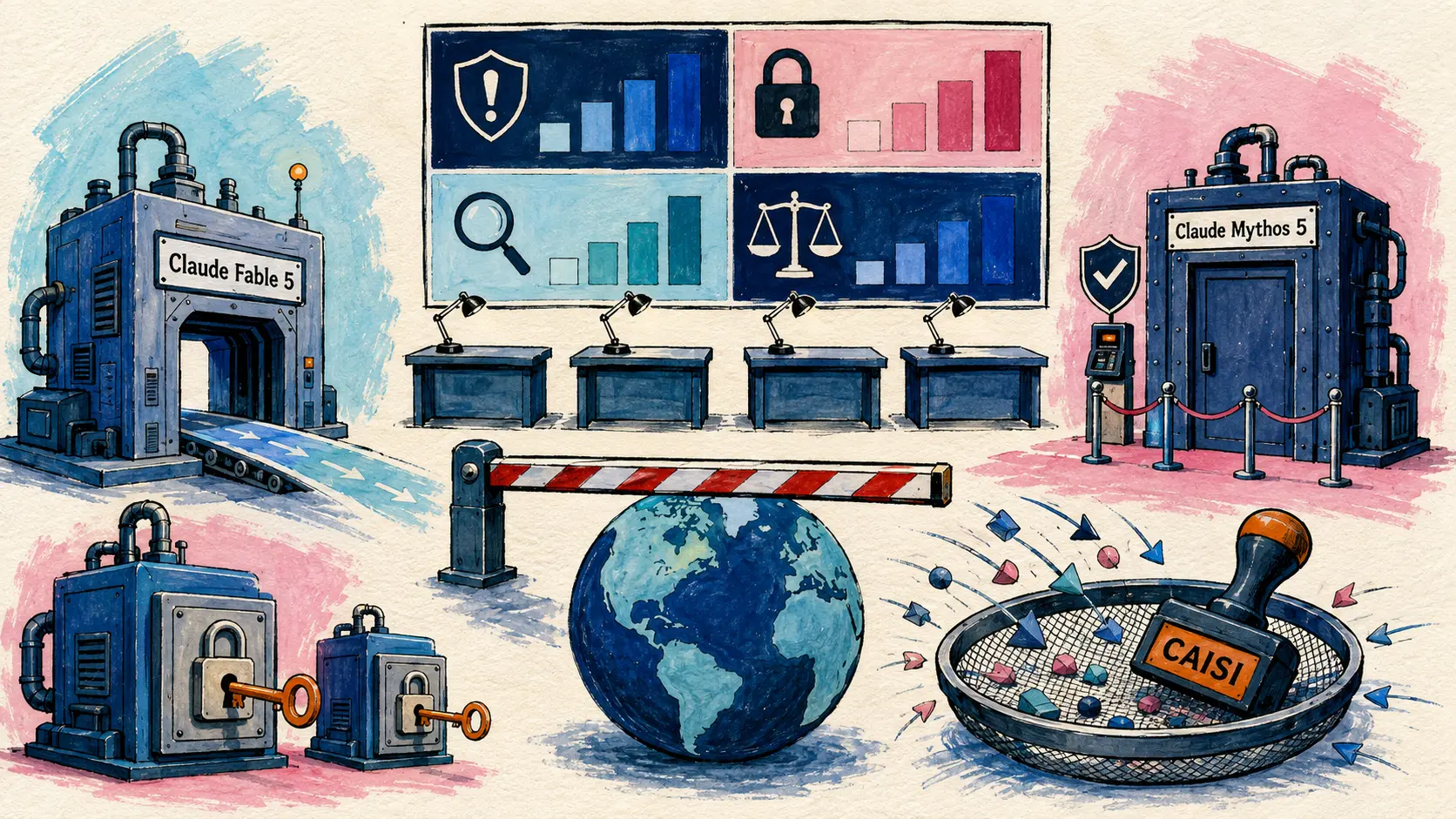
Fable 5 and Mythos 5 restored globally — and a sector-wide framework against jailbreaks
July 1 — Anthropic formally announces the return of Claude Fable 5 and Claude Mythos 5, ending the suspension imposed by U.S. export controls since June 12. This reopening comes with major announcements on AI safety.
Fable 5 availability. The model is available on Claude Platform, Claude.ai, Claude Code, and Claude Cowork. For Pro, Max, Team, and Enterprise premium plans, it is included up to 50% of weekly usage limits until July 7; after that, it switches to usage credits. Reactivation on AWS, Google Cloud, and Microsoft Foundry is underway. Mythos 5 remains for now reserved for approved U.S. organizations since June 26, with an expansion underway to international Glasswing partners.
Why the suspension? Amazon researchers had identified a bypass method for Fable 5’s guardrails, making it possible to generate exploit code for certain software vulnerabilities. After investigation, Anthropic and the U.S. government confirmed that the same behaviors were reproducible with far less powerful models — including Claude Haiku 4.5, Sonnet 4.6, Opus 4.8, and several GPT-5.x variants. No unique Mythos-level offensive capability had therefore been exposed.
Anthropic developed a new safety classifier aimed specifically at this bypass technique, validated by researchers from the Center for AI Standards and Innovation (CAISI) at the U.S. Department of Commerce: it blocks more than 99% of attempts.
Sector-wide jailbreak evaluation framework. The main policy novelty is a proposed common framework co-developed with Amazon, Microsoft, Google, and Glasswing partners, allowing jailbreak severity to be assessed according to four criteria:
| Criterion | Description |
|---|---|
| Capability gain | Does the attacker obtain capabilities that would otherwise be unavailable? |
| Scope | Does the jailbreak cover many distinct offensive tasks? |
| Ease of weaponization | How much human effort is needed to turn the jailbreak into a real attack? |
| Discoverability | Is the technique already widely known and available online? |
This framework is intended to help AI developers sort reports consistently and communicate risk levels in a standardized way to government and industry partners. Other companies in the sector are invited to join the initiative. Anthropic is also launching a HackerOne program dedicated to researchers who want to report jailbreaks in Fable 5.
Expanded commitments to the U.S. government: early access to models before public launch, rapid sharing of jailbreak intelligence and countermeasures, joint research teams with significant compute allocation, and work toward a common voluntary frontier-model evaluation standard.
🔗 Anthropic announcement — Fable 5 and Mythos 5 restored
Devin Security Swarm — an agent swarm for application security
July 1 — Cognition launches Devin Security Swarm, a multi-agent system dedicated to detecting and fixing vulnerabilities across an entire codebase. The architecture is built on an Agentic MapReduce model: parallel agents (Map) inspect code segments, capturing business-logic flaws, chained authentication bypasses, and cross-service attack paths; a central agent (Reduce) combines the individual results into complete attack paths. Each vulnerability is then reproduced in an isolated sandbox to validate exploitability at runtime, after which Devin writes a patch and opens a PR for human review.
Benchmark on 50 real CVEs (with GHSA identifiers):
| Tool | Recall | Cost per scan |
|---|---|---|
| Devin Security Swarm | 36/50 (72%) | $90.23 |
| Claude Security | 34/50 (68%) | $131.87 |
| Codex Security | 24/50 (48%) | $118.20 |
| Cursor Security | 13/50 (26%) | $4.60 |
Devin is the only tool to have found three critical vulnerabilities missed by the others: a PHP sandbox bypass via template injection, argument injection via metadata parsing, and an overly permissive deserialization surface in Spring Kafka. The languages covered in the benchmark include Go, Python, JavaScript, Rust, Ruby, C#, Java, Swift, PHP, Elixir, Erlang, C, Kotlin, and Dart.
Operational mode. No per-repository configuration or CI integration is required. Scan profiles are generated automatically from the existing threat model documentation, with adaptation to specific attacker personas. Scans can be scheduled (daily, weekly, custom): the first scan establishes a complete baseline, and subsequent scans analyze only modified code — reducing costs over time. Batch size is configurable per profile to adjust analysis depth to budget. Devin Security Swarm is 30% cheaper than Claude Security, the closest alternative in recall, and twice as cheap as Codex Security.
Availability: available today for enterprises. A six-week onboarding program (“Devin Security Vulnerability Remediation Program”) is offered with an embedded Cognition engineering team.
🔗 Cognition announcement — Devin Security Swarm
DeepSeek-V4 Preview — two API variants, deprecation on July 24
July 1 — DeepSeek launches the preview (Preview) of DeepSeek-V4, now available on the web, mobile app, and API. The announcement highlights enhanced Agent capabilities and improved reasoning. The API introduces two distinct variants:
| API identifier | Mode | Replaces |
|---|---|---|
deepseek-v4-flash | Non-thinking (non-thinking) | deepseek-chat |
deepseek-v4-pro | Thinking with configurable reasoning_effort | deepseek-reasoner |
The old identifiers deepseek-chat and deepseek-reasoner are deprecated on July 24, 2026 at 15:59 UTC and remain temporary aliases to V4 Flash. Developers using these identifiers must migrate before that date.
Notable V4 Pro parameters:
"thinking": {"type": "enabled"}— enables explicit reasoning"reasoning_effort": "high"— controls reasoning intensity (values:low,medium,high)
Expanded API compatibility. The DeepSeek API now accepts OpenAI and Anthropic formats via two distinct base_url:
- OpenAI format:
https://api.deepseek.com - Anthropic format:
https://api.deepseek.com/anthropic
This dual compatibility simplifies migration from either ecosystem. Announced integrations: Claude Code, GitHub Copilot, and OpenCode can use DeepSeek-V4 as a backend model without code changes. Full parameter documentation is available at api-docs.deepseek.com.
Together AI raises 800 M USD in Series C for open-source AI in production
July 1 — Together AI announces an 800 million USD Series C financing round, along with commitments for more than 500 MW of compute capacity independently capitalized by the new investors.
Cap table:
| Investor | Profile |
|---|---|
| Aramco Ventures | Aramco investment arm |
| NVIDIA | GPU leader (strategic partner) |
| Vista Equity | Tech private equity fund |
| General Catalyst | Major AI/SaaS venture capital |
| Emergence Capital | Enterprise venture capital |
| Schneider Electric | Energy and efficiency |
| Pegatron | Hardware manufacturer |
| Salesforce Ventures | Salesforce venture arm |
| March Capital, DTCP Growth, Lux Capital, Geodesic, PSP Partners | Complementary funds |
Thesis. Together AI’s position is based on a documented observation: the economics of closed proprietary LLMs are becoming unsustainable at large scale in production. Open-weights models — DeepSeek, Nemotron, MiniMax, Kimi, GLM — are closing the quality gap while offering 6x to 20x cost reductions. Documented example: Decagon reduced its inference costs by 6x after migrating to Together AI.
Together AI presents itself as one of the largest producers of AI tokens in the world. Recent achievements highlighted: FlashAttention-4 for NVIDIA Blackwell, Together Megakernel and together.compile for production kernel optimization, and the fastest endpoints for frontier open-source models. The additional 500 MW of capacity is intended to support enterprise migrations from closed proprietary infrastructure to large-scale open-weights deployments.
🔗 Together AI announcement — Series C
Runway × Bertelsmann — AI video models at the scale of a European media conglomerate
July 1 — Runway announces a creative partnership with Bertelsmann, an international media group whose portfolio includes RTL Group, BMG, and Bertelsmann Marketing Services, for a total of 75,000 employees and 19 billion euros in revenue in 2024.
The partnership, initiated in 2024 through the Bertelsmann AI Hub, is moving into an operational integration phase across the group’s creative workflows. Three entities are involved:
- Fremantle (RTL Group’s production studio) — launched Imaginae, its AI studio, and published its first productions using Runway models. RTL Germany uses them to create advertising and marketing assets
- BMG (Bertelsmann Music Group) — creation of visual marketing materials for album releases and artists
- Bertelsmann Marketing Services — deployment across the group’s marketing workflows
“Runway’s models are built to enable creativity at scale. This partnership is a reflection of what we think AI in media actually looks like at scale.” — The Runway models are designed to make creativity possible at scale. This partnership reflects what, in our view, AI concretely means in media at scale.
This partnership is the first documented deployment of Runway AI video models at the scale of a leading European media conglomerate. Bertelsmann also owns Penguin Random House (publishing) and Arvato Group (BPO services), which extends the potential scope of the integration beyond audiovisual creative production alone.
🔗 Runway announcement — Bertelsmann partnership
Grok Voice Agent Builder — production voice agents in under 2 minutes
July 1 — xAI launches the Grok Voice Agent Builder in beta, a no-code platform that makes it possible to create production voice agents in under two minutes. It is built on Grok Voice Think Fast 1.0, a natively integrated speech-to-speech model — without separately assembling transcription, language model, and voice synthesis.
Key features:
- Natural-language call-flow description, with the model reasoning in real time
- Knowledge base: document uploads (text, Markdown, Word, PowerPoint, Excel, HTML, JSON) organized into collections shareable between agents
- Built-in connectors: Google Calendar, Outlook, Google Drive, OneDrive, Linear, Notion, web search, human handoff, real-time notifications
- Telephony: provided toll-free number, direct SIP, WebSocket client
- More than 80 voices built in, or voice cloning from ~2 minutes of audio
- Observability: recording and transcription of every call, auditing of tools used
- Configurable guardrails, support for 25+ languages
Pricing:
| Usage | Price |
|---|---|
| Audio (voices included, no separate platform fees) | $0.05/min |
| Telephony on provisioned free number | +$0.01/min |
τ-voice Bench benchmark (realistic conditions: degraded phone audio, accents, interruptions, multi-tool conversations) — benchmark produced by xAI:
| Model | Ranking |
|---|---|
| Grok Voice Think Fast 1.0 | 1st |
| Gemini 3.1 Flash Live | 2nd |
| GPT Realtime 1.5 | 3rd |
No detailed results or independent methodology are available at this stage for this benchmark.
🔗 xAI announcement — Grok Voice Agent Builder
GitHub Copilot — five updates on July 1
GitHub simultaneously releases five new features for Copilot: multimodal vision, browser control, access to a first open-weight model, and two AI credit control tools.
Copilot Vision Generally Available
July 1 — Copilot Vision is now generally available. Users can attach images (JPEG, PNG, GIF, WebP) and PDFs directly to Copilot chat prompts, available in VS Code, on github.com, and in the CLI. Availability: all plans (Free, Pro, Pro+, Business, Enterprise), with no admin action required. Business and Enterprise plans no longer need the Editor Preview Features policy enabled — Vision is now on by default. GitHub retains attachments for about 24 hours for these plans.
🔗 Changelog — Copilot Vision GA
Browser Tools for Copilot in VS Code Generally Available
July 1 — Copilot agents can now control a real browser in VS Code: navigate, click, type, take screenshots, and read the console. Agent tabs are isolated with no access to user cookies; user tabs remain private until clicking “Share with Agent”. Parallel agents keep their tabs private from one another. For enterprises: new workbench.browser.enableChatTools switch and network allowlists/blocklists (chat.agent.allowedNetworkDomains, chat.agent.deniedNetworkDomains) with wildcard support.
🔗 Changelog — Browser Tools GA
Kimi K2.7 Code — first open-weight model in the Copilot selector
July 1 — Moonshot AI’s Kimi K2.7 Code becomes the first selectable open-weight model in the Copilot model selector, hosted by GitHub on Microsoft Azure. Progressive rollout for Pro, Pro+, and Max plans on VS Code 1.127.0+, Visual Studio 17.14.6+, JetBrains 1.9.1-251+, CLI, github.com, and GitHub Mobile. Business and Enterprise: rollout in the following weeks, disabled by default — manual activation required by the admin, who must verify the open-weight model’s compatibility with their security and data governance requirements.
🔗 Changelog — Kimi K2.7 GA in Copilot
Per-session AI credit limits in Copilot CLI and SDK
July 1 — It is now possible to cap the AI credits consumed by an agent over a session: --max-ai-credits option in non-interactive mode, /limits command in interactive mode (with a suggested adjustment if the limit is reached during the session). The limit is a soft cap (soft cap) — an in-progress response finishes before stopping, and actual usage may slightly exceed it. Available in public preview on Copilot CLI 1.0.66+ and SDK 1.0.5+. Update via copilot update.
🔗 Changelog — Per-session credit limits
Automatic model selection in Copilot CLI
July 1 — Auto mode in Copilot CLI routes to the optimal model based on the task (reasoning, code generation, bug diagnosis, tool orchestration), analyzing availability and reliability in real time. Pricing benefit: −10% on AI credits consumed by Auto (−10% on the multiplier for annual legacy plans). Manual switching available via /model. No configuration required — update Copilot CLI and choose Auto.
🔗 Changelog — Copilot CLI auto model selection
Hugging Face + Cerebras: Gemma 4 for real-time voice
July 1 — Hugging Face and Cerebras are launching HF Realtime Voice, a speech-to-speech conversational voice API powered by Gemma 4 (Google open-weights) on Cerebras hardware (WSE processors). The architecture is based on the WebSocket protocol and targets latency under 100 ms, making voice interactions fluid enough for production conversational assistants.
Target use cases: voice assistants, conversational agents, hands-free interfaces. This partnership extends a prior HF–Cerebras agreement by applying it to low-latency voice scenarios. A demo is available under the label “HF Realtime Voice 🎙”.
🔗 Hugging Face Blog — HF Realtime Voice
Gemini Spark: macOS, connected apps, and real-time tracking
June 30 — Google publishes updates to Gemini Spark, its advanced AI agent integrated into the Gemini app, with four main areas of focus.
macOS (Beta, Google AI Ultra subscribers, United States). Spark can act outside the chat window and automate tasks across the macOS desktop — sort files, generate budget tables from local invoices, schedule updates. Remote execution is announced for the coming weeks: start a task from the phone and have it run on the Mac while away. Download at gemini.google/mac.
New connected apps. In addition to Google Tasks and Google Keep, Spark now integrates with Canva, Dropbox, Instacart, OpenTable, and Zillow Rentals. Gradual rollout on web and mobile within the week, macOS in the following weeks.
Custom MCP servers. Spark now accepts custom Model Context Protocol (MCP) servers to connect any application directly into the agent.
Real-time topic tracking. Spark can continuously monitor events: sports results, stock price thresholds, blogs, social networks, weather, and news — beyond emails alone.
🔗 Google Blog — Gemini Spark June 2026 updates
NVIDIA — American manufacturing and Blackwell inference stack
$485 billion contribution to U.S. GDP in 2026
July 1 — NVIDIA publishes an assessment of its manufacturing footprint in the United States, backed by figures from Public First. NVIDIA and its partners are present in 43 states; NVIDIA-driven AI demand will contribute $485 billion to U.S. GDP in 2026, as part of a cumulative $1 trillion investment over five years in AI infrastructure.
| Partner | Location | Role |
|---|---|---|
| TSMC | Phoenix, Arizona | Blackwell wafer manufacturing at scale |
| Foxconn | Houston, Texas | AI GB300 NVL72 systems |
| Wistron | Fort Worth, Texas | AI systems assembly and testing |
| Coherent | Sherman, Texas | Lasers, optical components, semiconductors |
| Corning | North Carolina + Texas | Advanced optical connectivity |
Article published ahead of July 4 with an explicit political and economic scope.
🔗 NVIDIA Blog — Build in America
Blackwell inference stack: −5× token cost, +20× throughput in one month
June 30 — NVIDIA details how its inference software stack (TensorRT-LLM, Dynamo, SGLang, vLLM) reduces costs on the Blackwell platform:
- Token cost reduction of up to 5× on DeepSeek V4 in one month (via vLLM + SGLang)
- Combination of four optimizations — disaggregated serving, large expert parallelism via NVLink, NVFP4, multi-token prediction (MTP) —: up to 20× throughput
- DFlash speculative decode: up to 15× throughput on existing hardware
- FastVideo: 1080p video generation in under 5 seconds in PyTorch
| Partner | Deployment | Measured gain |
|---|---|---|
| Baseten | DeepSeek V4 Pro (reasoning, coding) | +50% tokens/s via TensorRT-LLM |
| Cognition | RL workloads via Dynamo | Scaling without in-house infra |
| DigitalOcean + Hippocratic AI | Healthcare AI (10M patient calls) | +30% throughput, <0.5 s TTFR |
| Together AI + Cursor | Real-time coding endpoints | Model → production accelerated |
🔗 NVIDIA Blog — Blackwell inference stack
Briefs
- Codex CLI 0.142.5 — trace logs security fix — First Codex CLI release of July: complete WebSocket Responses request payloads are no longer written to trace files (PR fix #30771 by @dylan-hurd-oai). Update:
npm install @openai/codex@0.142.5. 🔗 Codex CLI Changelog
What this means
Open source and the inference economy: a lock is breaking. The combination of DeepSeek-V4 (Anthropic + OpenAI API compatibility), Together AI (USD 800 million and +500 MW for open-weight models), Kimi K2.7 in Copilot (first open-weight model in the Copilot selector), and NVIDIA’s Blackwell stack (−5× token cost in one month) points to a context where the quality/cost ratio of open models is improving structurally faster than that of closed proprietary models. The choice between open and closed is increasingly becoming a matter of governance and compliance, not just performance or price.
Agentic security is becoming a coordinated priority. Devin Security Swarm and Anthropic’s industry framework (Amazon, Microsoft, Google) illustrate two sides of the same problem: as AI agents gain access to real codebases and offensive capabilities, security can no longer be left to each actor separately. Cognition responds with tooling (swarm of parallel agents, sandbox validation, automatic PRs). Anthropic and its partners respond with standardized evaluation (four severity criteria, >99% classifier, HackerOne program). These two approaches are complementary, and their simultaneity on July 1 is probably no coincidence.
Voice and multimodal agents are moving into production. Grok Voice Agent Builder ($0.05/min all-inclusive, 25+ languages, calendar/drive/business-tool connectors) and HF Realtime Voice (Gemma 4 on Cerebras, latency under 100 ms, WebSocket protocol) mark a shift: voice interfaces are no longer conference demos but billable products with latency commitments. The general availability rollout of Copilot Vision and Copilot browser tools completes this picture on the multimodal side — these features had been in preview for months and are now becoming standard for all plans, with no admin action required.
Creative and industrial partnerships are shaping a value chain. Runway × Bertelsmann (EUR 19B in revenue, RTL, BMG, Fremantle/Imaginae already in production) and NVIDIA Build in America ($485B GDP contribution, 43 states, TSMC/Foxconn/Wistron) show that generative AI is being integrated into documented production chains with measurable results. These announcements also carry a political and industrial dimension that goes beyond the technology sector alone.
Sources
- Anthropic — Fable 5 and Mythos 5 restored
- Cognition — Devin Security Swarm
- DeepSeek — V4 Preview
- DeepSeek API Docs
- Together AI — Series C
- Runway — Bertelsmann partnership
- xAI — Grok Voice Agent Builder
- GitHub Changelog — Copilot Vision GA
- GitHub Changelog — Browser Tools GA
- GitHub Changelog — Kimi K2.7 GA in Copilot
- GitHub Changelog — Per-session credit limits
- GitHub Changelog — Copilot CLI auto model selection
- Hugging Face — HF Realtime Voice
- Google — Gemini Spark June 2026 updates
- NVIDIA Blog — Build in America
- NVIDIA Blog — Blackwell inference stack
- Codex CLI Changelog