ai-powered-markdown-translatorArticle translated from fr to en with gpt-5.4-mini.
This week, Meta releases Muse Glimmer, a 30-billion-parameter multimodal agentic model with open weights, immediately accessible via a NVIDIA GPU-accelerated endpoint in addition to Hugging Face. OpenAI restructures its Daybreak cybersecurity program and launches GPT-5.6-Cyber, a model that has already helped uncover an unprecedented flaw in Chrome’s JavaScript engine. Another notable development: an unpublished research version of Claude advanced a mathematical problem related to the Riemann hypothesis, with a formally verified proof. Also on the menu: Anthropic pricing, developer tooling, enterprise voice AI, and AI-native finance.
Meta releases Muse Glimmer, a 30B open-weights agentic model, available via NVIDIA
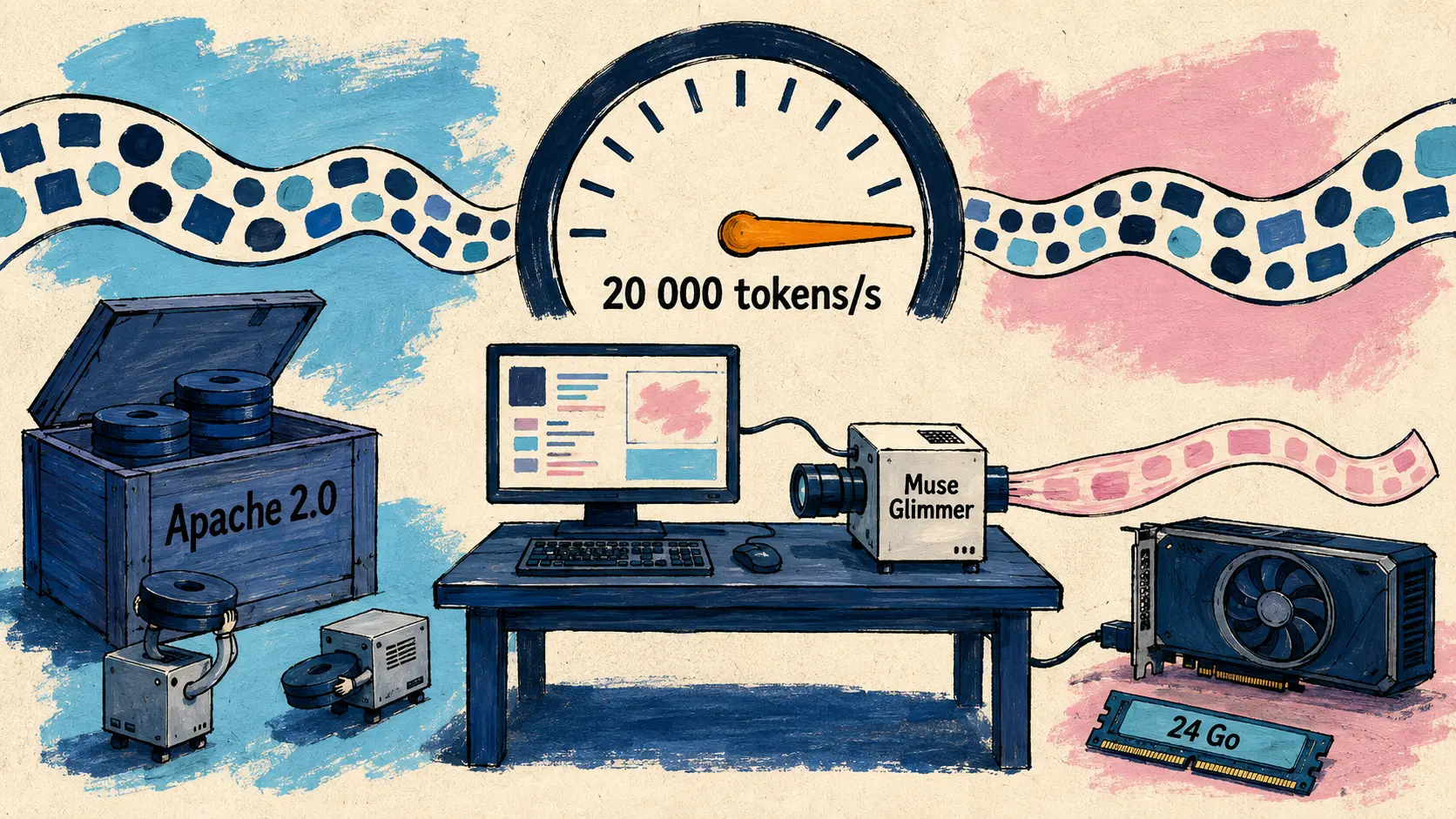
Meta has released Muse Glimmer, a dense multimodal model with 30 billion parameters (2B visual encoder + 28B text decoder) optimized to run locally, continuously, on consumer hardware — a Mac or PC equipped with a powerful GPU. The weights are distributed under the Apache 2.0 license. The model handles a context window of more than 120,000 tokens and, according to NVIDIA, reaches up to 20,000 tokens per second on a single GPU; Alexandr Wang (Meta Superintelligence Labs) specifies that it runs on 24 GB of VRAM without any loss of agentic reliability.
On the technical side, Muse Glimmer combines sliding-window attention and full attention, a Gated Grouped-Query Attention architecture that reduces the memory cache by a factor of 16, and a lightweight DFlash draft model that speeds generation by 2 to 4x. Support is available from day 0 in transformers, llama.cpp, and vLLM, with quantized GGUF weights and deployments via Hugging Face Inference Endpoints.
| Technical characteristic | Measured value |
|---|---|
| Parameters | 30B (2B encoder + 28B decoder) |
| License | Apache 2.0 |
| Context window | 120,000+ tokens |
| Minimum VRAM | 24 GB |
| Throughput (1 GPU) | up to 20,000 tokens/s |
| MCP Atlas (agentic) | 75.5 (vs. 54.2–62.5 for competitors) |
NVIDIA immediately opened a GPU-accelerated access point to test Muse Glimmer, optimized for its edge, desktop, and workstation platforms — concrete availability in addition to downloading the weights.
Introducing Muse Glimmer, an open-weight 30B-parameter model optimized for local, always-on agent workflows. […] we’re releasing model weights under a permissive Apache 2.0 license.
Introducing Muse Glimmer, a 30-billion-parameter open-weights model optimized for local, persistent agent workflows. […] we are releasing the model weights under the permissive Apache 2.0 license. — @AIatMeta on X
🔗 NVIDIA offers a GPU-accelerated endpoint for Muse Glimmer
OpenAI expands Daybreak and launches GPT-5.6-Cyber, an unprecedented CVE discovered in Chrome
OpenAI is restructuring its Daybreak cybersecurity program into two access tiers and launching GPT-5.6-Cyber, a specialized model built on GPT-5.6 Sol. The stated goal: put state-of-the-art intelligence in the hands of trusted defenders before offensive capabilities become widespread among attackers.
| Access tier | Model used | Intended audience |
|---|---|---|
| Daybreak Blue | GPT-5.6 Sol (system safeguards removed) | Recommended entry point for most defenders |
| Daybreak Red | GPT-5.6-Cyber (new) | Experienced security researchers, advanced authorized work |
GPT-5.6-Cyber reduces refusals on certain high-risk dual-use requests (for example pentesting production systems) and outperforms GPT-5.6 Sol as well as the older GPT-5.5 Cyber on ExploitGym 2. In real-world conditions, the model helped discover two previously unknown vulnerabilities in V8, Chrome’s JavaScript engine, making it possible to corrupt memory and escape the heap sandbox; after coordinated disclosure to Google, the flaw was fixed and assigned CVE-2026-15903. It also identified at least five vulnerabilities in a popular mobile operating system, three critical flaws in a popular database, and more than 400 privilege-escalation vulnerabilities in a popular operating system kernel — fixes are underway with Daybreak partners.
OpenAI is requiring hardware security keys for all individual Daybreak accounts starting September 1, 2026, and a Daybreak Cyber Partner program is already bringing together service providers (Accenture, IBM, KPMG) and security vendors (Palo Alto Networks, CrowdStrike, Cisco) to integrate these models into their services.
We’re expanding our cybersecurity initiative Daybreak and introducing GPT-5.6-Cyber, a new model for advanced, authorized cybersecurity work.
We are expanding our Daybreak cybersecurity initiative and launching GPT-5.6-Cyber, a new model for advanced, authorized cybersecurity work. — @OpenAI on X
🔗 Expanding Daybreak as the cyber defense window narrows
Claude advances on the Riemann hypothesis, without solving it
Anthropic asked an unpublished research version of Claude to tackle the Riemann hypothesis, one of the seven Clay Mathematics Institute Millennium Prize Problems ($1 million each). Claude did not solve the problem, but it did advance a related question: it raised the lower bound on the fraction of zeros of the Riemann zeta function that satisfy the hypothesis, increasing it from 41.6% to 67.2%.
The work took place across two sessions totaling 31 million output tokens. The first generated 650 initial ideas, all unsuccessful. For the second attempt, Claude coordinated 60 specialized subagents (mathematical development, idea generation, validation, drafting), executed 2,400 shell commands, and downloaded 54 papers from arXiv to verify its leads. The result was then reviewed by two Anthropic mathematicians, and then examined by external experts Brian Conrey and Dan Goldston. Claude produced a proof formally verified in Lean, which passed standard validation.
This result goes beyond the usual benchmark category: a measurable improvement on a problem open for decades, with independent verification and formal proof, illustrates how Anthropic is now testing its research models on fundamental mathematics problems rather than classic software engineering tasks.
We asked an unreleased research version of Claude to take a stab at the Riemann hypothesis. It didn’t solve it, but it did make strides on a related problem: it increased the lower bound for the fraction of zeros of the Riemann zeta function that satisfy the hypothesis from 41.6% to 67.2%.
We asked an unpublished research version of Claude to take a shot at the Riemann hypothesis. It didn’t solve it, but it did make progress on a related problem: it raised the lower bound on the fraction of zeros of the Riemann zeta function that satisfy the hypothesis from 41.6% to 67.2%. — @AnthropicAI on X
🔗 Full methodological details on the Anthropic research blog
Anthropic: pricing and security
The Sonnet 5 launch price becomes permanent
Anthropic confirms that the launch price of Claude Sonnet 5 — $2 per million input tokens, $10 per million output tokens — is becoming permanent. The model was launched in June with this price presented as promotional, valid until August 31, 2026. Anthropic is thus removing the uncertainty that weighed on teams that had built their cost forecasts around this launch price: no increase is expected for the start of the school year on this model, which strengthens its pricing position against competitors in high-token-volume use cases.
Prompt injection is “largely solved,” according to Anthropic
Boris Cherny, Claude Code product lead at Anthropic, says that prompt injection — the most common attack method against AI users and agents, where a malicious website or document slips in a hidden instruction executed by the model — is now largely solved in practice with Claude models. He specifies that this progress comes mainly from model training, supplemented by several stacked safety classifiers: the model + detector (probe) + auto mode combination would bring the attack success rate down to 0%, a setup that becomes Claude Code’s default permission mode on August 14. This is a public statement on X, not a formal research publication with detailed methodology.
🔗 Tweet
Development tools: Amp switches to OpenAI, Copilot Chat improves
Amp changes its mode system to OpenAI if a ChatGPT subscription is linked
The agentic coding tool Amp is changing the routing logic for its modes (“the Dial”) when an account is linked to a ChatGPT subscription. With a linked subscription, the low, medium, and high modes switch to OpenAI models (GPT-5.6 Terra for low mode and code review, GPT-5.6 Sol for the agent and oracle in high mode) instead of GLM-5.2 or Claude Fable. Without a linked subscription, nothing changes. Amp justifies dropping Claude Fable as the oracle model by pointing to convergence in frontier model performance: its cofounder @sqs considers it unlikely that a future test would justify the 80x price difference between Fable and the OpenAI models used. Ultra mode is not affected and continues to run on Claude Fable.
Copilot Chat on github.com: improved conversation controls
GitHub is updating Copilot Chat on github.com with three improvements, generally available for all plans. Access to recent conversations is easier, the chat window can now be minimized while a response is being generated and then reopened to continue the exchange, and a token usage indicator appears directly in the chat — with details by session and by message. These changes are more about usability than a major feature, but they address a concrete day-to-day need for accounts subject to limited Copilot quotas.
🔗 Copilot on web expands conversation controls
Open source ecosystem and inference
NVIDIA releases Magpie TTS Multilingual, open TTS for voice agents in 12 languages
NVIDIA is releasing Magpie TTS Multilingual, a roughly 357-million-parameter open-weights text-to-speech model under the NVIDIA Open Model License, covering twelve languages (including French) with both male and female voices. Time to first audio reaches 32 ms in single-stream mode on a B200 GPU (239 ms with 64 concurrent streams), 47 ms on H100, and 79 ms on A100, with a real-time factor of up to 320x. Character error rate also drops: from 2.70% to 1.54% for French, from 1.14% to 0.60% for Spanish. Deployment is possible via the open weights on Hugging Face or via NVIDIA NIM in production.
🔗 Build Low-Latency Multilingual Voice Agents
A distillation technique cuts the GPU memory required by up to 15x
Multiverse Computing publishes a knowledge distillation technique combining offline caching of the teacher’s logits and a fused KL loss function that avoids materializing the full vocabulary × sequence-length matrix. Result: GPU memory drops from 85.2 GB to 5.45 GB at 32K context tokens (up to 15.6x reduction), and distillation of a GPT-OSS 20B model went from four GPU nodes to one, with iteration time cut by about 5x. Applied to GPT-OSS 120B and Kimi-K3 (2.8T parameters), the technique retains about 90% of the teacher’s accuracy on BoolQ and HellaSwag. The code is published open source on GitHub.
🔗 Making Knowledge Distillation Cheap Enough to Run at Scale
DeepSeek-V4-Flash available on Ollama Cloud via Together AI
Together AI now provides the inference infrastructure behind DeepSeek-V4-Flash on Ollama Cloud, presented as the best-performing hosting option available for this open-weights model. The offering highlights a zero data-retention policy as well as hosting in the United States and the European Union — a sovereignty argument for companies that want to use DeepSeek-V4-Flash without relying on Chinese infrastructure. This is a new distribution channel added to the already existing availability of DeepSeek-V4-Flash directly on Together AI.
🔗 Tweet
Sakana AI trains its Fugu orchestrator on a Gemma 4 base
Sakana AI is releasing a new version of the chief orchestrator model for its multi-agent orchestration product Fugu, this time trained on the open Gemma 4 model base, in addition to the interchangeable model pool already offered. The two-layer architecture — a small chief orchestrator that distributes tasks, and a model pool that performs the actual processing — builds on the Trinity and Conductor research presented at ICLR 2026. Internal evaluations show orchestration performance equivalent to the previous version, with reduced cost. Sakana AI also aims, in the long term, to build in-house chief orchestrator models to meet digital sovereignty requirements in Japan.
Together AI details its partnership with Cursor for real-time inference
Together AI publishes a co-authored article with Cursor detailing their inference infrastructure partnership: agents integrated into the editor generate code while developers actively edit their file, which imposes strict latency constraints — the model response must fit into the editor feedback loop without breaking the workflow. The article illustrates how Together AI built its infrastructure to meet these goals at scale, a concrete use case for its dedicated inference offerings for AI-assisted development tools.
🔗 Tweet
Generative media: ElevenLabs at Deutsche Telekom, MiniMax details H3
ElevenLabs deploys its AI voice technology at Deutsche Telekom
ElevenLabs announces a partnership with Deutsche Telekom, Europe’s largest telecom operator, to integrate its AI voice technology at three levels: the contact center, the consumer app, and the network itself. The AI call assistant runs on ElevenLabs and is integrated directly into the network, making it available on any mobile device capable of making a call, without a dedicated app — with live assistance during calls, real-time translation, and call transcription/summarization. The partnership began as a set of app features in early 2025 and evolved into an integration at the heart of Deutsche Telekom’s services, with an expansion planned.
🔗 Tweet
MiniMax details the open source roadmap for H3
After an AMA session on Reddit, MiniMax publishes a recap of the open source roadmap for its H3 video model. A move to the Apache-2.0 license is “on the table” once copyright issues are clarified, with a full technical report to come. MiniMax also plans to open-source the weights of H3-Regenerate-2K, a latent-space regeneration model that can take a 768p output back to 2K, a sparse attention implementation, a low-latency 4-NFE/8-NFE variant under study, and a unified image generation/editing model derived from the H3 lineage. The Ref2VA workflow already makes it possible to chain clips together to produce 60-second videos.
🔗 Tweet
Multimodal agents and AI-native finance
Qwen-MM-Plugins: making agents multimodal-native
AlibabaQwen announces Qwen-MM-Plugins, a family of plugins designed to make any agent runtime environment (_agent harness) multimodal-native: image, video, and document reading, video editing, and work on 3D/CAD files. The idea: instead of a standalone multimodal model, a layer of plugins plugs into the environment the developer is already using. The announcement does not detail benchmarks, pricing, or a precise release date — it remains at the product teaser stage, with a video demo to support it. This launch extends Qwen’s 2026 strategy, which now broadens its offering toward multimodal agent tooling rather than toward new raw model weights.
🔗 Tweet
Five lessons for building an AI-native finance function
OpenAI CFO Sarah Friar shares five lessons for building an AI-native finance function, centered on two ambitions: a zero-day close (a real-time, reconciled, and traceable view of the company’s finances) and continuous forecasting. Among the lessons: give everyone access first, then create a reason to use it — illustrated by a finance hackathon that gave rise to IR-GPT, a custom GPT for answering investor due diligence questions; combine bottom-up experimentation with top-down strategy; move beyond static spreadsheets in favor of living tools backed by the full context of the business; build clear accountability into every workflow; and measure the return on investment of AI.
🔗 Building an AI-native finance function
Premium seats are coming to ChatGPT Business
OpenAI is launching Premium seats for ChatGPT Business, giving the most active employees 5x more usage than Standard seats and no five-hour usage cap.
| Seat type | Monthly price | Annual price (monthly billed) |
|---|---|---|
| Standard | $25/user | $20/user |
| Premium | $125/user | $100/user |
Companies can mix Standard and Premium seats within the same workspace. Launch offer: workspace owners who sign up before August 20, 2026 receive $100 in credits per Premium seat added (up to $500 for five seats), with early access available before general availability.
🔗 Premium seats for ChatGPT Business
Briefs
- Claude Code — CPU and memory performance gains: the team says it has seen major improvements in CPU usage and 99th-percentile memory (P99 RSS) over the past few months, without sharing precise figures. 🔗 Tweet
- Replit CEO describes the “self-driving company” in Platformer: Amjad Masad lays out his vision of a company run by an internal bot and agents that use applications in place of humans. 🔗 Tweet
- Sakana AI expands its RSI Lab into physical AI: the company wants to build world models for physical AI and is hiring full-time and intern staff in Tokyo. 🔗 Tweet
- FC Bayern Munich partners with Google Pixel and Gemini: partnership announced without details on its exact nature (sponsorship, product integration). 🔗 Tweet
- Gemini, tips for visiting American agricultural fairs: lifestyle article from the Google blog listing five existing Gemini uses (itineraries, Ask Maps, AI Mode, Gemini Live, photo editing), with no new feature. 🔗 Google Blog
- GitHub billing in India: customers can now enable recurring automatic payment by saved card, via an electronic mandate compliant with the Reserve Bank of India. 🔗 Changelog
- GitHub deprecates custom thread subscriptions: only the Subscribed/Not subscribed states will remain available, with existing custom subscriptions automatically switching to Subscribed. 🔗 Changelog
- NVIDIA optimizes vLLM for Qwen 3.5 on GB200: the optimizations reach 25,000 tokens per second per GPU, in preparation for the launch of Qwen 3.8. 🔗 Tweet
- Codex Build Week — projects and winners to come: OpenAI says participants turned their ideas into real projects with Codex; the winners announcement is still to come. 🔗 Tweet
- OpenAI letter to the governor of Texas: the company details its commitment to responsible development of AI infrastructure in the state. 🔗 OpenAI
- Model ML speeds up finance work with GPT-5.6 Sol: the firm automates the production of traceable PowerPoint decks and Excel workbooks, with 36% fewer tokens than Opus 5 on an Excel workflow. 🔗 OpenAI
What it means
The race for open weights is accelerating and diversifying: Meta (Muse Glimmer), Alibaba (Qwen-MM-Plugins), MiniMax (H3 roadmap), and Sakana AI (Fugu on Gemma 4) all released, in the same week, reusable building blocks rather than simple closed models. The trend goes beyond text alone: NVIDIA is opening a multilingual TTS model with 357M parameters, and Sakana AI explicitly justifies its choice with digital sovereignty — an argument that also comes up at Together AI for hosting DeepSeek-V4-Flash in the EU and the United States.
AI safety is moving from the lab into concrete production. OpenAI’s GPT-5.6-Cyber is not just about a benchmark score: it helped fix a real CVE in V8 and hundreds of other vulnerabilities, while coming with a reinforced access regime (hardware keys required starting in September). In parallel, Anthropic says it has neutralized prompt injection on the defense side through model + classifier stacking — two complementary approaches (tooling-assisted attack on one side, hardened defense on the other) that show safety is becoming a product differentiator in its own right, not a secondary topic.
On the infrastructure side, inference economics keep tightening: Multiverse Computing’s distillation technique divides the required GPU memory by 15, Together AI is strengthening its partnership with Cursor to meet strict latency constraints in code editing, and Anthropic is permanently stabilizing Sonnet 5 pricing. Taken together, these moves point to continued pressure on inference costs as agentic and interactive uses become widespread.
Finally, AI is settling into enterprise support functions as much as into fundamental research. OpenAI documents how its own finance function is becoming AI-native and launches enhanced-capacity ChatGPT Business seats, while Model ML reports concrete token savings on Excel workflows. At the other end of the spectrum, Claude’s result on the Riemann conjecture — formally verified and reviewed by external mathematicians — is a reminder that these same models are also being used on fundamental research problems, far from product use cases.
Sources
- Meta launches Muse Glimmer
- NVIDIA — GPU-accelerated Muse Glimmer endpoint
- OpenAI — Expanding Daybreak as the cyber defense window narrows
- OpenAI — Daybreak/GPT-5.6-Cyber announcement on X
- Anthropic — Riemann announcement on X
- Anthropic — Riemann research post
- Anthropic — permanent Sonnet 5 pricing
- Anthropic — prompt injection largely solved
- Amp — We changed the Dial
- GitHub — Copilot on web expands conversation controls
- NVIDIA — Magpie TTS Multilingual
- Multiverse Computing — knowledge distillation
- Together AI — DeepSeek-V4-Flash on Ollama
- Sakana AI — Fugu × Gemma 4
- Together AI — Cursor partnership
- ElevenLabs — Deutsche Telekom partnership
- MiniMax — H3 roadmap
- Alibaba_Qwen — Qwen-MM-Plugins
- OpenAI — Building an AI-native finance function
- OpenAI — Premium seats for ChatGPT Business
- Claude Code — CPU/memory performance gains
- Replit — self-driving company
- Sakana AI — physical AI RSI Lab
- FC Bayern Munich × Google Pixel × Gemini
- Google Blog — Gemini and agricultural fairs
- GitHub — billing in India
- GitHub — thread subscription deprecation
- vLLM/NVIDIA — Qwen 3.5 optimizations
- OpenAIDevs — Codex Build Week
- OpenAI — letter to the governor of Texas
- OpenAI — Model ML