March 10, 2026 is marked by three major announcements: Anthropic launches Code Review for Claude Code, an automated team of agents on every pull request now available in preview for Team and Enterprise plans; OpenAI acquires Promptfoo, the open-source AI security platform used by 25% of the Fortune 500; and Runway opens its Characters API, enabling real-time conversational avatars based on the GWM-1 world model. Meanwhile, GitHub, Google, NVIDIA and Perplexity rolled out several notable updates.
Code Review for Claude Code — a team of agents on every PR
Anthropic announced on March 9 a new feature for Claude Code: Code Review. Available in preview (research preview) for Team and Enterprise plans, it automatically deploys a team of agents on each pull request to identify bugs that slip past individual reviews.
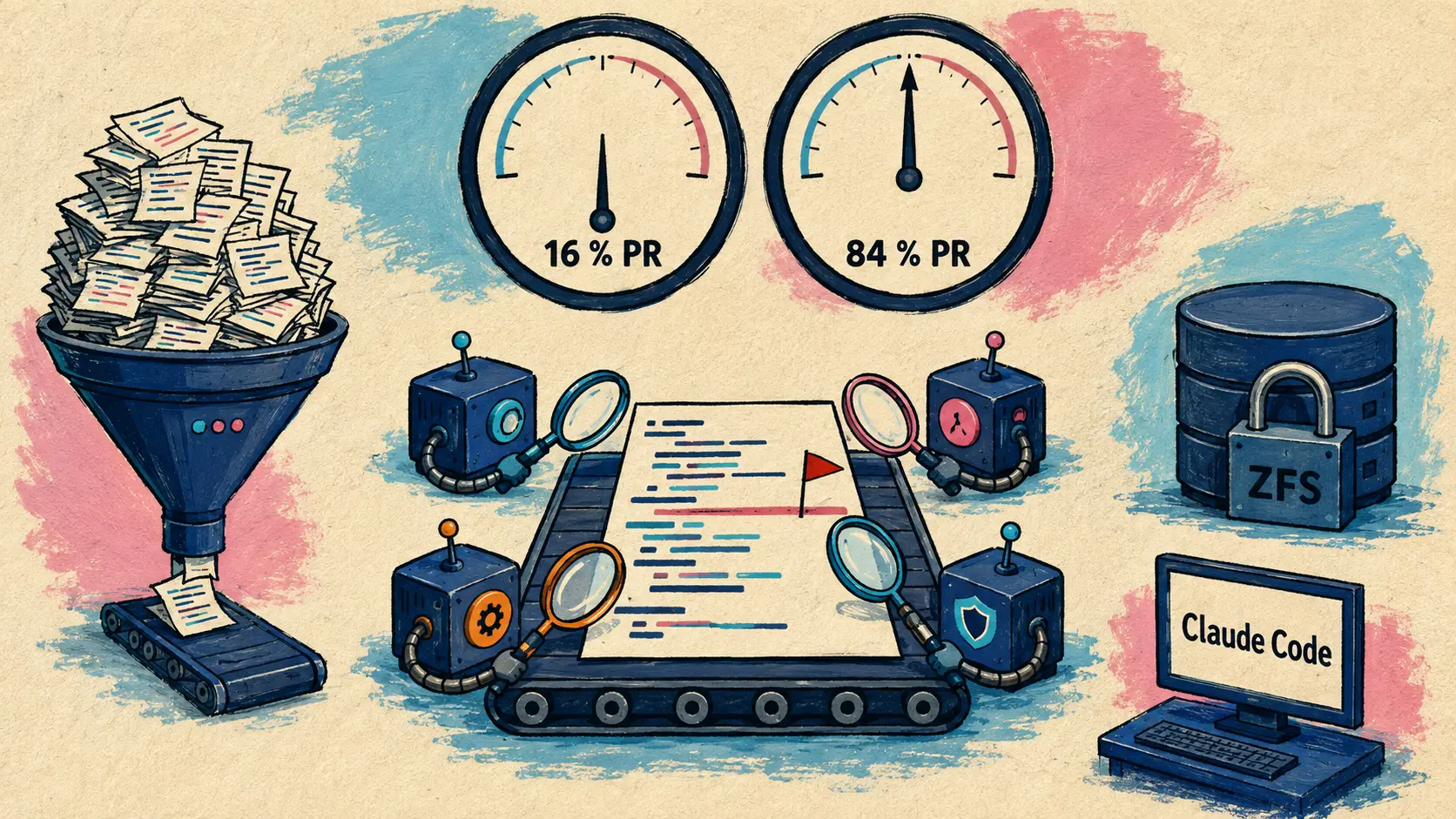
The system is directly inspired by what Anthropic uses internally. The company reports that code output per engineer increased by 200% in one year, turning code review into a bottleneck. Before Code Review, only 16% of internal PRs received substantive comments. With Code Review enabled, that rate rises to 84% on large PRs (more than 1,000 lines changed).
Agents run in parallel and adapt their depth of analysis to the size of the change: a trivial PR receives a light review, while a complex refactor mobilizes more agents. A concrete example: a one-line change in a production service, seemingly innocuous, revealed a critical security vulnerability. At customer TrueNAS, Code Review found a preexisting bug in a ZFS encryption refactor.
The feature is explicitly positioned as more expensive than the existing open-source GitHub Action, due to its depth of analysis. Control tools are provided to administrators:
| Control | Description |
|---|---|
| Monthly organization cap | Total limit on all reviews for the month |
| Repository-level control | Enable reviews only on selected repositories |
| Analytics dashboard | Track reviewed PRs, acceptance rates, total costs |
To enable Code Review: Claude Code settings → install the GitHub App → select repositories. Developers have nothing to configure — reviews start automatically on each new PR.
“When a PR opens, Claude dispatches a team of agents to catch the bugs that slip past individual reviewers.” — @claudeai on X
🔗 Blog: Bringing Code Review to Claude Code
OpenAI acquires Promptfoo
March 9 — OpenAI announced the acquisition of Promptfoo, an AI security platform co-founded by Ian Webster and Michael D’Angelo. The tool is used by more than 25% of Fortune 500 companies to identify and remediate vulnerabilities in AI systems under development.
Once the acquisition closes, Promptfoo’s technology will be integrated directly into OpenAI Frontier, OpenAI’s enterprise platform for deploying AI coworkers. Three capabilities will be added to Frontier:
| Capability | Description |
|---|---|
| Built-in security tests | Detection of prompt injections, jailbreaks, data leaks and out-of-policy behavior |
| Integration into development workflows | Identify and remediate agent risks upstream of deployment |
| Compliance and traceability | Reports and history for governance (compliance) requirements |
Promptfoo will remain open source under its current license, and OpenAI will continue to support existing customers. The deal is subject to customary closing conditions.
Runway Characters — real-time video agents API
March 9 — Runway launched Characters, an API for creating real-time conversational characters. Based on their GWM-1 world model, it generates expressive avatars from a single image, with no fine-tuning required.
Characters support full conversational expressiveness — facial expressions, eye movements, lip-sync, gestures — without degradation over long conversations. Every aspect is customizable via the API: voice, personality, knowledge base, available actions.
The platform targets customer support, training and marketing experiences. Early partners include BBC and Silverside. The API is available now at dev.runwayml.com, with 30 free credits on account creation.
🔗 Introducing Runway Characters
Interactive math and science visualizations in ChatGPT
March 10 — OpenAI launched dynamic interactive visualizations for learning math and science in ChatGPT. Available to all signed-in users, they cover over 70 fundamental concepts.
For each concept, ChatGPT can now explain with a dynamic visualization, let the user modify variables in real time and show the immediate effect on graphs and equations. Covered concepts include: the Pythagorean theorem, Coulomb’s law, kinetic energy, trigonometric identities, compound interest, the ideal gas equation.
OpenAI cites a figure: 140 million people use ChatGPT each week to learn math and science. The feature is part of the NextGenAI and OpenAI Learning Lab initiatives.
🔗 New ways to learn math and science in ChatGPT
Skills Codex for maintaining Agents SDKs — +45% PRs merged
March 9 — OpenAI published a postmortem on using Codex and a skills system to automate maintenance of its Agents SDKs (Python and TypeScript). Between December 2025 and February 2026, this approach merged 457 PRs, versus 316 in the previous period, an increase of +45%.
The team uses local skills (.agents/skills/) and a AGENTS.md file to automate recurring workflows. Deployed skills include:
| Skill | Function |
|---|---|
code-change-verification | Format, lint, types, tests — mandatory checks |
docs-sync | Documentation audit vs code |
pr-draft-summary | Automatic generation of PR title and description |
integration-tests | Tests on Node.js, Bun, Deno, Cloudflare Workers |
Both SDKs have significant adoption: ~14.7 million PyPI downloads over 30 days for Python, ~1.5 million for TypeScript on npm.
🔗 Using skills to accelerate OSS maintenance
Perplexity Computer integrates Claude Code and GitHub CLI
March 9 — Perplexity announced integration of Claude Code and the GitHub Command Line Interface (CLI) directly into Perplexity Computer, its agentic environment launched in late February.
Users can now run Claude Code — Anthropic’s CLI tool for interacting with complex codebases — without leaving Perplexity Computer. GitHub CLI enables repository operations directly from the interface. In the shared demo, the team challenged Perplexity Computer with a real open-source project to showcase its capabilities. This positions Perplexity Computer as an AI-driven integrated development environment.
Dependabot now supports pre-commit hooks
March 10 — GitHub Dependabot now supports automatic updates for pre-commit hooks. Simply add pre-commit as an ecosystem in dependabot.yml so Dependabot scans .pre-commit-config.yaml, detects new versions and opens update pull requests.
Grouped updates, changelogs included in PRs, and preserved YAML formatting are supported. The feature works with hooks hosted on GitHub, GitLab, Bitbucket and other Git platforms. It supports hooks pinned to Git tags or commit SHAs.
🔗 Dependabot now supports pre-commit hooks
Genspark named launch partner for Microsoft Agent 365
March 10 — Genspark was announced as a launch partner for Microsoft Agent 365. The platform can now run in Teams, Word and other Microsoft 365 apps, inside the enterprise secure environment. CEO Eric Jing is quoted in Microsoft’s official announcement.
Gemini in Google Workspace — deeper integration
March 10 — Google announced optimizations of Gemini specifically tailored to each Workspace product. In Google Drive, the new “Ask Gemini” feature lets users query the content of their files directly from the Drive interface. Similar optimizations were rolled out to Docs, Sheets and Slides.
NVIDIA × Thinky Machines — 1 gigawatt of Vera Rubin systems
March 10 — NVIDIA announced a partnership with Thinky Machines to deploy at least 1 gigawatt of NVIDIA Vera Rubin systems for training frontier AI models. This deployment represents large-scale compute infrastructure dedicated to frontier models.
NVIDIA Nemotron 3 Nano 30B — available for free on OpenRouter
March 9 — NVIDIA Nemotron 3 Nano 30B is available for free on OpenRouter. The model has become the most used by OpenClaw on the platform, mainly for building agentic systems. A free version is accessible at openrouter.ai/nvidia/nemotron-3-nano-30b-a3b:free.
🔗 Nemotron 3 Nano 30B on OpenRouter
Briefs
Claude Code v2.1.72 (March 10) — Maintenance update with several useful additions. /plan now accepts a direct argument (e.g. /plan fix the auth bug), allowing entry into plan mode and immediate start without an intermediate step. ExitWorktree lets agents cleanly exit an isolated worktree session. /copy writes the selection directly to a file without going through the system clipboard — useful in remote environments (SSH, containers). The CLAUDE_CODE_DISABLE_CRON variable allows disabling in-session cron jobs /loop. Reasoning effort levels are simplified: low (○), medium (◐) and high (●); the max level is removed. Fixes: prompt caching in SDK calls is corrected, reducing input tokens up to 12× on some workflows — a direct impact on API costs. Bundle size decreased by ~510 KB, and several voice-mode bugs (latency, false “No speech detected” errors) were resolved.
IH-Challenge — dataset for instruction hierarchy (March 10, OpenAI) — OpenAI open-sourced IH-Challenge, a reinforcement learning training dataset to improve LLM robustness against instruction conflicts and prompt injection. The internal GPT-5 Mini-R model trained on these data rose from 0.83 to 0.95 on the Developer/User Conflict benchmark, with no notable regression on general capabilities.
Codex Security extended to ChatGPT Pro accounts (March 7, OpenAI) — The application security agent Codex Security, launched in preview (research preview) on March 6, is now available to ChatGPT Pro subscribers.
Grok: images in voice mode (March 8, xAI) — Grok now allows attaching an image during a voice-mode session for real-time visual analysis without leaving the conversation. Available in the mobile app.
Antigravity v1.20.5 (March 9, Google) — Stability update. The Google CLI now reads rules from AGENTS.md in addition to GEMINI.md. Auto-continue enabled by default. Fixed a token-counting bug that could prematurely end a conversation.
NotebookLM — 100% custom infographic styles (March 10, Google) — The Custom Infographic styles feature is now rolled out to all NotebookLM users.
Gemini on Pixel — automatic background tasks (March 10, Google) — Gemini on Pixel can handle everyday background tasks (shopping, ride bookings, restocking) while the user stays in control.
ElevenLabs “11 Voices” (March 9) — World premiere of the docuseries “11 Voices” at SXSW, Friday March 13 at 2:30 PM. The series features people who have lost their voices narrating their own stories using ElevenLabs’ AI voice technology.
What this means
Code Review for Claude Code represents a structural change in how development teams can integrate AI into their workflows. The most significant metric — 16% → 84% coverage on large PRs — illustrates that agentic AI is beginning to solve real organizational problems, not just technical ones. The pricing positioning (more expensive than the light GitHub Action) signals that Anthropic is targeting teams willing to pay for depth rather than volume.
OpenAI’s acquisition of Promptfoo accelerates consolidation in the AI security market. By integrating red-teaming tools directly into Frontier, OpenAI aims to make application-level AI security as embedded as testing is in current CI/CD pipelines.
Runway Characters marks a step in commercializing video agents: a standard API, no fine-tuning, 30 free credits — the entry barrier for real-time conversational avatars is significantly lowered.
Sources - Blog : Bringing Code Review to Claude Code
- Tweet @claudeai — Code Review
- Tweet @bcherny — Code Review
- OpenAI to acquire Promptfoo
- Tweet @OpenAI — Promptfoo
- Introducing Runway Characters
- Tweet @runwayml — Characters
- New ways to learn math and science in ChatGPT
- Using skills to accelerate OSS maintenance
- Tweet @AskPerplexity — Claude Code + GitHub CLI
- Dependabot now supports pre-commit hooks
- Tweet @genspark_ai — Microsoft Agent 365
- Tweet @GoogleAI — Workspace
- Tweet @NVIDIAAI — Thinky Machines
- Nemotron 3 Nano 30B on OpenRouter
- Tweet @grok — voice mode for images
- Tweet @OpenAIDevs — Codex Security Pro
- IH-Challenge dataset
- Changelog Claude Code
- Tweet @NotebookLM — Infographic styles
- Tweet @madebygoogle — Gemini Pixel
This document was translated from the fr version into the en language using the gpt-5-mini model. For more information on the translation process, see https://gitlab.com/jls42/ai-powered-markdown-translator