ai-powered-markdown-translatorArticle translated from fr to en with gpt-5.4-mini.
On August 11, 2026, the Gemini app surpasses one billion monthly users, becoming the fastest-growing product in Google’s history. NVIDIA releases Nemotron 3.5 Lightning and its NeMo Switchyard routing library, Mistral opens its platform to third-party models and forges a European compute coalition, and Alibaba unveils Wan-Animate-2, a major upgrade to its open-source animation model. Also on the menu: ChatGPT ads expand to five new markets, new tools for developers, and a long list of announcements in media generation.
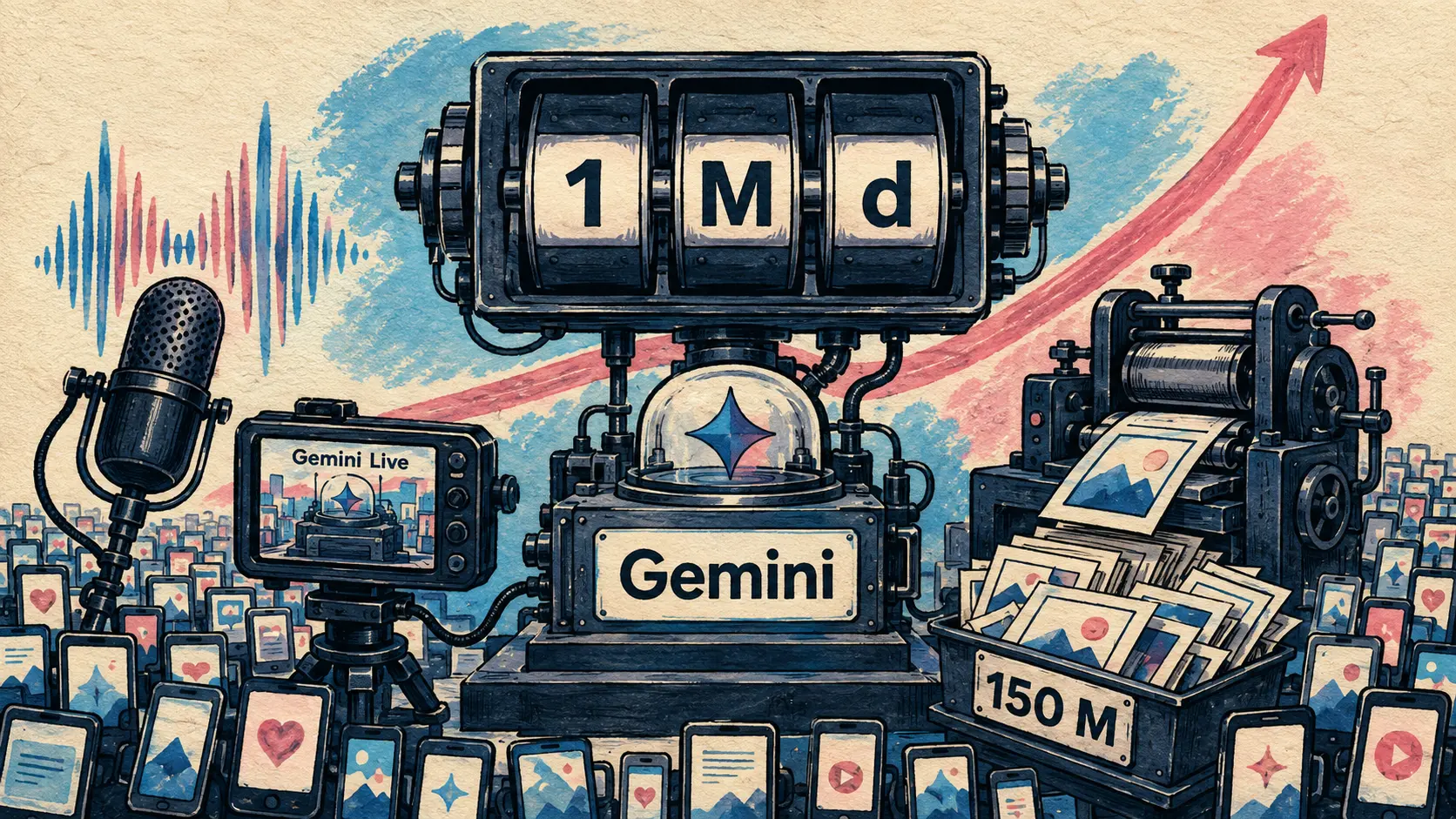
Gemini crosses one billion monthly users
The Gemini app has officially surpassed one billion monthly active users, making it, according to Google, the fastest-growing product in the company’s entire history. The announcement was shared both by the official @GeminiApp account and by Josh Woodward, who leads the Gemini and Labs teams at Google.
Google accompanies the announcement with a set of usage figures that helped drive this growth:
| Measured usage | Data |
|---|---|
| Voice interactions | 63% of users use voice |
| Gemini Live sessions | 1 in 5 uses the live camera or screen sharing |
| School-related prompts | 38% include an attachment (file) |
| Image generation | More than 150 million images produced every day |
| Android automation | Automated actions in more than 40 applications |
| iOS users | More than 100 million active users on Apple devices |
These figures illustrate a diversification of use cases beyond simple text chat: voice, camera, screen sharing, multimedia generation, and cross-app automation (restaurant booking, ride-hailing orders) are emerging as important drivers of adoption.
🚀One billion for Gemini! Our goal remains to make it the most personal, proactive, and powerful assistant. — @GeminiApp on X
🔗 Official announcement on the Google blog
NVIDIA launches Nemotron 3.5 Lightning and NeMo Switchyard for high-volume agents
NVIDIA is expanding its Nemotron 3 open model family with Nemotron 3.5 Lightning, a 30-billion-parameter hybrid MoE model (3 billion active) designed for high-volume agentic task execution — tool calls, result validation, task delegation — rather than complex reasoning. Available in NVFP4 and BF16 with a context window of up to 1 million tokens, the model claims up to 4x the output throughput of comparable models and a 30% gain in task completion time. On PinchBench, it reaches 86% accuracy while completing 10,000 tasks 35% faster than Qwen3.6 35B at equivalent accuracy.
The model is distributed with weights, training data, and recipes, and is available on Hugging Face, ModelScope, OpenRouter, and build.nvidia.com. Together AI is a day-0 launch partner, with reserved capacity through its Dedicated Model Inference offering for high-volume agentic workloads.
In parallel, NVIDIA releases NeMo Switchyard, an open-source library that routes each request to the most appropriate model (quality, latency, cost) without rewriting the application — reserving frontier models for complex reasoning and Lightning for specialized execution. NVIDIA claims the cost of task completion is reduced to nearly one-third of Opus 4.8 alone. Concrete partners are cited: Boomi routes 59% of its traffic to a faster fine-tuned model, Cognition cuts its average cost by 28%, and Ramp combines model and routing for 59% lower cost and 32% less execution time.
🔗 Official NVIDIA post · Model announcement on X
Alibaba unveils Wan-Animate-2, a major upgrade to its open-source character animation model
Alibaba (Wan team) releases Wan-Animate-2, described as a major upgrade to its open-source character animation model. Four capabilities are highlighted: high-fidelity animation that conveys motion and micro-expressions across humans, cartoons, robots, and animals; multi-character animation, where each character keeps its own identity and motion in the same scene; text-driven camera control (for example, “top view”), decoupled from the source video; and real-time streaming generation, producing sequences of arbitrary length chunk by chunk without observable error accumulation.
On the technical side, Alibaba abandons explicit pose skeletons in favor of the reference video itself as a motion prior, with a Dual-Branch DiT (Diffusion Transformer) architecture, Time-Align RoPE temporal encoding, and Sparse-Ref Attention to reduce computation without quality loss. Camera control relies on a LoRA trained on roughly 50,000 multi-view Unreal Engine samples.
The model is open source, available now on ModelScope, Hugging Face, and GitHub, with an online demo. According to NVIDIA’s August “Local AI” campaign, its 14 billion parameters generate 16 to 26 times faster on RTX systems than alternatives — confirming its optimization for local deployment on consumer hardware.
🔗 Technical details and NVIDIA figures · Announcement on X
Mistral launches regional inference, opens its platform to GLM-5.2, and builds a European compute coalition
Mistral is positioning itself as the only European AI lab combining regional inference choice and service guarantees. The company, already engaged in a pricing and technical race against OpenAI, Google, and Chinese players, is betting here on a distinct positioning: sovereignty and service predictability, rather than a pure race on benchmarks. Two platform updates:
| Feature | Status | Description |
|---|---|---|
| Mistral Regional Endpoints | Available | Europe or United States selection for inference runtime |
| Mistral Priority Tier | Public preview | Availability SLA and customized throughput limits |
Another notable development: the Mistral platform is opening up to third-party models, starting with GLM-5.2 from Z.ai, which will benefit from the same regional controls and service commitments as Mistral models — a first convergence between the two players, until now direct competitors in the affordable open-model segment.
Finally, Mistral is launching European Compute Units (ECU), a mechanism that converts multi-year corporate commitments into access to its compute infrastructure, with the goal of 1 GW of capacity by 2030 — equivalent to the power consumed by a large city. The announced founding partners are ASML (Christophe Fouquet, CEO), CMA CGM (Rodolphe Saadé, Chairman and CEO), Amadeus (Luis Maroto, CEO), and Caisse des Dépôts (Olivier Sichel, CEO) — a mix of industrial, transport, and public finance players that illustrates the ambition to build a European compute industry independent of American hyperscalers.
🔗 Official Mistral announcement
OpenAI launches ChatGPT ads in the United Kingdom, Mexico, Brazil, Japan, and South Korea
OpenAI is taking another step in rolling out advertising inside ChatGPT. Launched in test in the United States in February 2026 for the Free and Go plans, then expanded to Canada, Australia, and New Zealand in March, the ad program is now officially launching in five new markets: the United Kingdom, Mexico, Brazil, Japan, and South Korea. The Plus, Pro, Business, Enterprise, and Education plans remain ad-free, and additional markets are targeted by year-end.
The principle remains unchanged: ads never influence ChatGPT’s answers, they remain clearly labeled as sponsored and visually separated from the organic response. Targeting is based on the topic of the current conversation and the history of past ad interactions, without ever giving advertisers access to conversations or personal data — they receive only aggregated statistics (views, clicks).
On the user-control side, ChatGPT lets users hide an ad, see why it was shown, delete their ad data in one step, and manage personalization at any time. No ads are shown to identified or presumed underage accounts, nor near sensitive topics (health, mental health, politics). According to OpenAI, the pilot showed no measured impact on user trust, which motivated this gradual expansion.
🔗 Official OpenAI announcement
Open-source ecosystem and inference
webAI Intelligence Lab releases TwiL-LM3, a 3B reasoning model that beats GPT-OSS-120B
webAI Intelligence Lab (Austin) releases TwiL-LM3, its first open-source formal reasoning model. With only 3 billion parameters, it claims to outperform OpenAI’s GPT-OSS-120B on 4 of the 5 formal reasoning benchmarks tested — about 40 times fewer parameters for inference that is 2.6 times faster. Trained on verified, proprietary data rather than automatically scraped web content, the model targets edge computing: it is said to run from a Raspberry Pi to an iPhone, without relying on the cloud.
Meta prepares an open-weights version of Muse Spark 1.2
In the thread announcing Muse Glimmer, Alexandr Wang (Meta Superintelligence Labs) says Meta will soon release an open-weights version of Muse Spark 1.2 — until now the proprietary model powering the terminal coding agent Muse Code. No exact date is given, but the announcement confirms Meta’s shift toward more open weights across its Muse lineup, following the immediate release of Muse Glimmer weights under the Apache 2.0 license.
Zuckerberg publishes a piece on Meta’s AI philosophy
On the same day, Mark Zuckerberg publishes a piece stating that “everyone should have access to superintelligence,” laying out Meta’s philosophy and values for building a positive AI future. The message accompanies the launch of Muse Glimmer, framing open weights as a foundational choice rather than a mere marketing argument, and fits into Meta’s broader communication about its open-weights strategy that week.
Lightricks unveils LTX-2.5, a major update to its open world model
Lightricks releases LTX-2.5, a new version of its “world model” already used for film, robotics, and real-time workflows. The update promises higher pixel fidelity, multi-shot scenes that remain consistent from one cut to the next, and a pre-trained base designed to be fine-tuned across different domains via a new rendering approach called Diffusion Fidelity Rendering. The team presents LTX-2.5 as an open foundation rather than a rented tool.
IBM Research releases ALTK-Evolve, an agent memory system that uses fewer tokens than ACE
IBM Research releases ALTK-Evolve, a system that lets AI agents learn from past failures without retraining, by adjusting how much guidance is re-injected based on the capacity of the model in use — unlike ACE (Agentic Context Engineering), which sends its full “playbook” at every step. On the AppWorld benchmark with DeepSeek-V3.2, ALTK-Evolve reaches 89.3% task completion for 263K tokens per task, versus 80.4% and 634K tokens for ACE. With gpt-oss-120b, it achieves equal or better accuracy for roughly 40% of ACE’s inference cost.
Together AI, IBM, and NVIDIA team up for enterprise inference on IBM Cloud
Together AI announces a partnership with IBM and NVIDIA to bring enterprise-grade AI inference to IBM Cloud, via a dedicated NVIDIA B300 GPU cluster with Spectrum-X networking — a first of its kind on this platform, powered by Together AI’s production inference platform. The offering targets enterprises already using IBM Cloud that want to deploy AI workloads without moving to another cloud provider.
Developer tooling: Amp, Replit, GitHub Copilot, and Manus
Amp launches global plugins and skills for orbs
Amp (Sourcegraph) introduces a centralized system of Amp-hosted plugins and skills, available wherever Amp runs, especially in orbs. Two tiers coexist: a personal tier, an experimental sandbox with live reloading in the same conversation thread, and a workspace tier, managed by administrators and loaded by default for the whole team. Personal items can be shared to the workspace, and versioning is handled natively (update to the latest version, detect outdated skills).
Replit MCP beta: create, load, search, and publish an app via MCP
Replit is strengthening its MCP (Model Context Protocol) beta with new capabilities: create, load, search, and publish an application directly through MCP, without going through the web interface. The stated goal is to make it possible to build real software on Replit from any compatible MCP client — editor, autonomous agent, or third-party tool — rather than being confined to Replit’s own interface. This extension confirms Replit’s strategy of exposing its platform as a programmable building block for agentic workflows.
MAI-Code-1.1-Flash arrives in GitHub Copilot, MAI-Code-1-Flash deprecated
Microsoft’s latest compact code model, MAI-Code-1.1-Flash, is rolling out in GitHub Copilot with native vision support, along with improvements in code quality, instruction following, and tool use. It costs 73% less than MAI-Code-1-Flash, with a premium request multiplier of 0.25× for annual subscribers. Automatically selected on Free and Student, manually selectable on Pro, Pro+, Max, Business, and Enterprise. At the same time, GitHub announces the deprecation of MAI-Code-1-Flash on September 10, 2026.
Manus is going back to being an independent company
Manus announces that it is becoming an independent company again. To comply with regulatory requirements in certain jurisdictions, some users will need to save their data before August 23, 2026 (7:59 AM, Singapore time), then initiate a restore starting August 25, 2026 (8:00 AM, Singapore time). Affected users will be notified by email and in-app notification; no billing is planned during the transition, with welcome bonuses included.
Media generation: Wan CLI, Motif 3, Luma Scenes, and 800 VDC power
Wan CLI: Alibaba lets agents drive Wan directly
Alibaba is releasing Wan CLI, a new command-line tool that lets you call the Wan platform directly from agents to generate images and videos programmatically. The credits consumed remain fully synchronized with the user’s Wan Video account, avoiding double billing management between the web interface and automated use. Installation is done by retrieving a command from the Wan panel and pasting it into your agent, with a video tutorial provided to get started.
Motif 3: first Korean frontier model trained on NVIDIA B200 GPUs
Korean startup Motif Technologies is launching Motif 3 Base and Motif 3, its first models targeting the frontier LLM race, developed with support from the Korean Ministry of Science and trained on NVIDIA B200 GPUs. Motif 3 is built on Motif 3 Base through post-training using NVIDIA NeMo-RL. In collaboration with NVIDIA, the team is also releasing an NVFP4 version (optimized reduced precision from NVIDIA). The whole set will be available on Hugging Face with a technical report, and NVIDIA praised the launch as an example of the momentum in Korea’s AI ecosystem.
Luma Scenes: scene-by-scene video production, powered by Uni-1
Luma AI is launching Luma Scenes, a tool that lets you refine, time, and validate each scene individually before final rendering — addressing the classic problem of producing many variants to keep only one usable one, at the risk that a failed scene ruins an entire production. The tool extends Luma Layers (layer-based editing, late July), confirming Luma’s shift toward granular control rather than one-click generation, with a workflow closer to traditional editing.
Ideogram Ad Resizer: one design, all ad formats
Ideogram is launching Ad Resizer: from a single design and the targeted ad placements, the tool automatically generates a full set of campaign-ready formats (Instagram, Facebook, YouTube, connected TV, display, print), including extreme ratios that are hard to crop manually. Available immediately in the app and via the API, for integration into automated ad production pipelines — a concrete marketing use case for multichannel creative teams.
HeyGen for Real Estate: official launch with three video formats for real estate agents
HeyGen officially launches HeyGen for Real Estate, with three video formats designed for real estate agents who appear on screen themselves without camera or editing — the goal: let them publish several times a day without sacrificing the visual presence this sector requires. Incentive offer: those who sign up for the Creator plan within 12 hours of the announcement receive free White Glove access for 30 days (United States only). HeyGen mentions a possible expansion to other small businesses beyond real estate.
NVIDIA details the 800 VDC power architecture for future “AI factories”
NVIDIA, with Google and Microsoft, details via the Open Compute Project an 800-volt direct current power architecture, which reduces the number of electrical conversion steps between the grid and GPUs to support the compute density of future generations of accelerators. More than 80 manufacturers are already working on compliant products. Deployment in several stages: hybrid “Power Rack” architecture starting in the second half of 2026, “Row Power Center” in 2027, then native 800 VDC installations in the coming decade.
Qwen, Z.ai, and OpenAI: new models and agent synchronization
Qwen3.8-27B: open weights announced for this week
Alibaba Qwen confirms that the open weights for Qwen3.8-27B will be released this week, a new size in the Qwen3.8 family after the flagship Qwen3.8-Max already covered in early August. The team presents this new model as superior to Qwen3.6-27B in agentic coding, a performance already well received by the developer community that had been waiting for this intermediate size for several weeks.
Z.ai: ZCode reaches 1 million users, GLM Coding Plan limits reset
Z.ai announces that ZCode, its coding tool based on GLM models, has surpassed one million users. As thanks, the company is resetting the usage limits of all GLM Coding Plan subscribers, and rolling out an update meant to better turn long-horizon reasoning capabilities into actually completed work, with a 98% cache success rate, offering about 1.8× more usage for subscribers.
ChatGPT desktop app available in preview on Linux, with Codex
OpenAI is extending its desktop app to Linux, previously limited to macOS and Windows. The preview covers four major distributions — Ubuntu 24.04/26.04 LTS, Debian 13, and Fedora 43/44 — with .deb/.rpm packages in x64 and ARM64. The app brings together ChatGPT, ChatGPT Work, and Codex in a single native interface, with access to supported browser projects and workflows, without changing your work environment.
Codex and ChatGPT Work import work from other AI agents
A new feature for ChatGPT Work and Codex: keep existing work done with other AI agents synchronized with the OpenAI ecosystem. Concretely, users can import projects, conversations, skills, and plugins, view an import history, and enable automatic synchronization in settings. Available now in the ChatGPT desktop app, to reduce the friction of switching tools rather than starting over with a completely new setup.
Briefs
- Fable billing bug fixed, 196 refunds — Anthropic confirms the complete resolution of a configuration cache bug that falsely showed overruns; 196 users refunded and credited as compensation. 🔗 Tweet
- v0 (Vercel) redesigns its sidebar — conversations grouped by project, real-time status indicators, hover preview cards. 🔗 Tweet
- Amp increases orb disk size to 60 GB — up from 40 GB before, at no extra cost for new orbs. 🔗 Tweet
- DeepSeek V4 Flash 0731 available for fine-tuning on Together AI — specialization via SFT or DPO then production deployment. 🔗 Tweet
- Together AI details a second part on autoscaling its dedicated inference — three policies tested under the same load, only one truly adapted. 🔗 Tweet
- Hugging Face launches the Open Model Series — a new educational video series on open models and their local use. 🔗 Tweet
- FC Barcelona joins the Google Pixel / Gemini partnership — new official partners of the club, following a similar partnership with Bayern Munich. 🔗 Tweet
- Copilot usage report: token breakdown by model — input, output, and cache tokens now visible behind the AI credits consumed. 🔗 Changelog
- GitHub highlights Copilot’s Rubber Duck agent — in a careers article about junior developer skills; the agent uses a second model to critique generated code. 🔗 Tweet
- Perplexity Computer: GitHub, the most used connector — mostly by non-developers (4 out of 5). 🔗 Tweet
- Suno Studio 2.0 (teaser) — a new version of Suno’s music production environment, with no additional details. 🔗 Tweet
- ElevenLabs Summit in New York on November 11 — a conference day bringing together tech and business leaders; applications open. 🔗 Tweet
- FLUX 3 Video confirms the #2 global ranking — Black Forest Labs extends free access to the playground until August 16 and teases 4K and video editing. 🔗 Tweet
- Seedance 2.5 on Runway adds 50 character references — and synchronized clips on a music track. 🔗 Tweet
- P-Image-Ideogram available on Runway — generates an image in as little as 0.6 seconds, with four quality modes. 🔗 Tweet
- Kimi K3 available on Databricks — a new distribution channel for Moonshot AI’s model. 🔗 Tweet
- Zapier transforms its marketing with ChatGPT Work — reduced drop-off in the leads funnel, automated reporting. 🔗 OpenAI
- Virgin Atlantic optimizes customer journeys with ChatGPT Work — faster research and product planning. 🔗 OpenAI
- Cohere — Aidan Gomez details the open source and sovereign strategy — customizable, affordable, and secure models as the guiding thread. 🔗 Tweet
What this means
The scale of consumer AI usage is changing gears: with one billion monthly users, Gemini joins the very small group of Google products at massive scale, driven by uses that go far beyond text chat (voice, camera, automation). In parallel, OpenAI is expanding its ChatGPT ads to five new markets — a sign that large-scale monetization of conversational assistants is becoming a strategic priority once the user base is large and loyal enough.
On the infrastructure side, the day illustrates a shift toward specialized agentic execution rather than frontier reasoning alone. With Nemotron 3.5 Lightning and NeMo Switchyard, NVIDIA is proposing an explicit economic model: reserve expensive models for complex planning and delegate high-volume execution to lighter, cheaper models, with cost savings measured at several partners. IBM Research (ALTK-Evolve) and Together AI (autoscaling, IBM Cloud partnership) are pushing along the same economic path for inference, while Mistral is structuring its own sovereignty effort with European Compute Units and regional inference.
The opening of weights continues to spread to new players and new modalities: Alibaba’s Wan-Animate-2, webAI’s TwiL-LM3, the upcoming Qwen3.8-27B, Meta’s promise about Muse Spark 1.2, and even a first Korean frontier model (Motif 3) built on NVIDIA’s technical stack. This geographic and modal diversification — text, animation, embedded reasoning — confirms that open source is no longer the preserve of a small number of Western labs.
Finally, agentic developer tooling continues to professionalize: Amp and Replit are adding management layers (global plugins, expanded MCP), GitHub is strengthening its low-cost model offering, and OpenAI is building explicit bridges between competing ecosystems by allowing Codex and ChatGPT Work to import work done elsewhere — a bet on portability rather than lock-in, at a time when developers are juggling multiple AI agents in parallel.
Sources
- Gemini — one billion users
- Gemini — announcement on X
- NVIDIA — Nemotron 3.5 Lightning and NeMo Switchyard
- Alibaba Wan — Wan-Animate-2
- NVIDIA — Local AI figures (Wan-Animate-2)
- Mistral — regional inference, GLM-5.2, compute coalition
- OpenAI — ChatGPT ads
- webAI — TwiL-LM3
- Meta — Muse Spark 1.2 (Alexandr Wang)
- Zuckerberg — Meta’s AI philosophy
- IBM Research — ALTK-Evolve
- Together AI, IBM, NVIDIA — IBM Cloud inference
- Amp — global plugins and skills
- Replit — MCP beta
- GitHub — MAI-Code-1.1-Flash
- Manus — independent company
- Alibaba Wan — Wan CLI
- Motif Technologies — Motif 3
- Luma AI — Luma Scenes
- Ideogram — Ad Resizer
- HeyGen — for Real Estate
- NVIDIA — 800 VDC architecture
- Alibaba Qwen — Qwen3.8-27B
- Z.ai — ZCode 1 million users
- OpenAI — ChatGPT desktop app Linux
- OpenAI — importing agents into Codex/ChatGPT Work
- Anthropic — Fable billing bug fixed
- v0 — sidebar redesign
- Amp — orbs at 60 GB
- Together AI — DeepSeek V4 Flash 0731 fine-tuning
- Together AI — dedicated inference autoscaling
- Hugging Face — Open Model Series
- FC Barcelona — Google Pixel / Gemini partnership
- GitHub — Copilot usage report by model
- GitHub — Rubber Duck agent
- Perplexity Computer — GitHub connector
- Suno — Suno Studio 2.0
- ElevenLabs — New York Summit
- Black Forest Labs — FLUX 3 Video
- Runway — Seedance 2.5
- Runway — P-Image-Ideogram
- Kimi Moonshot — K3 on Databricks
- OpenAI — Zapier
- OpenAI — Virgin Atlantic
- Cohere — open source and sovereign strategy