ai-powered-markdown-translatorArticle translated from fr to en with gpt-5.4-mini.
OpenAI is bringing ChatGPT back to WhatsApp in Europe and extending it to two new messaging apps, GitHub is improving the reliability of Copilot CLI, and Amp is changing the way its agents commit code. On the research side, Anthropic is publishing a study on the values expressed by Claude across languages, while Ai2 and Sakana AI are detailing respectively a maritime surveillance agent in production and an experiment in physical collective intelligence.
ChatGPT back on WhatsApp in the EEA, extended to Kakao and Viber
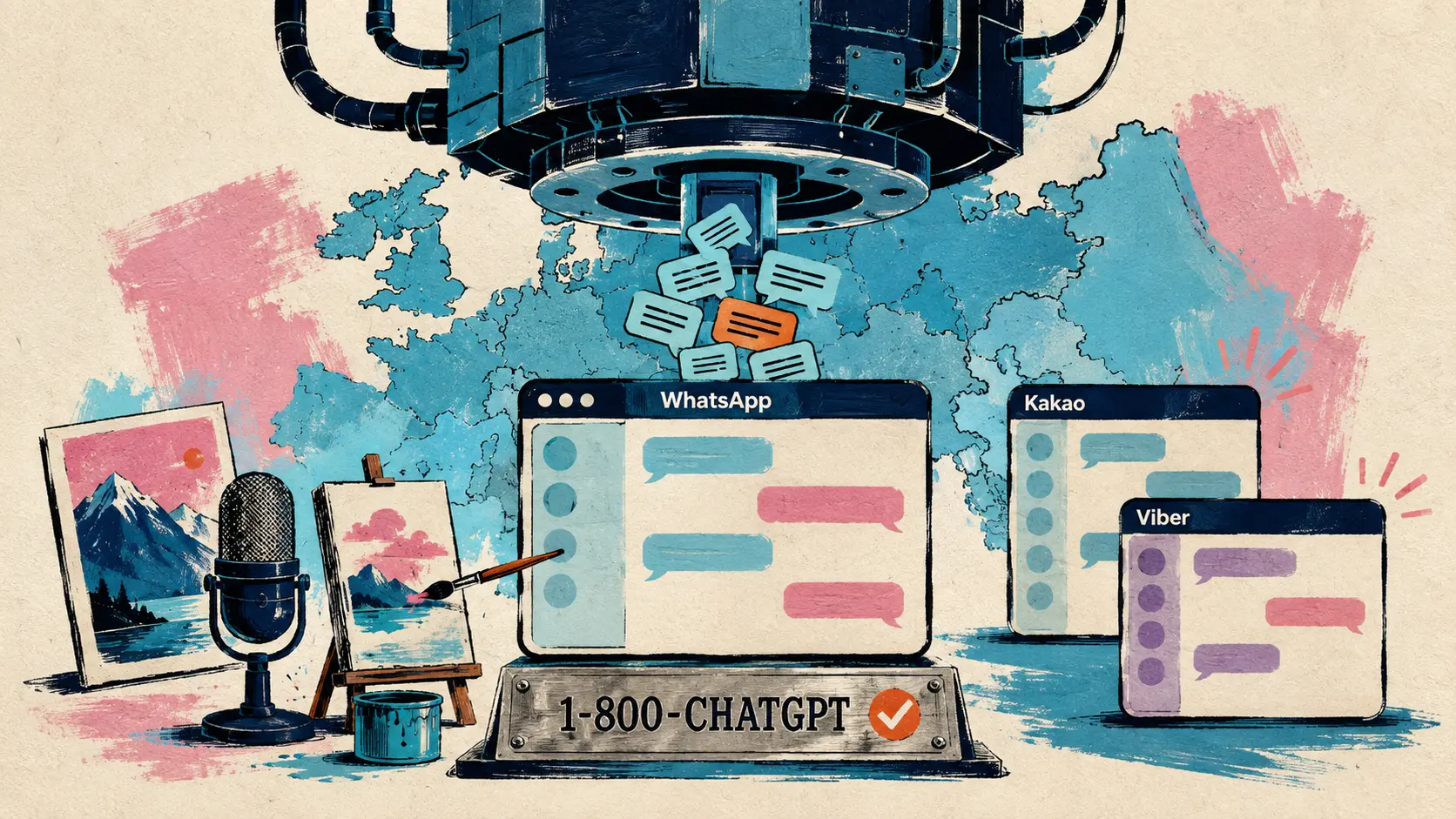
July 13 — ChatGPT is once again available on WhatsApp in the European Economic Area (EEA), after a period of unavailability in the region. Access is via the verified contact 1-800-CHATGPT, which lets users ask questions, send images, send voice notes, generate images, and use ChatGPT in many languages directly inside the messaging app.
In parallel, OpenAI is extending ChatGPT availability to two new apps: Kakao in South Korea and Viber in supported markets. The strategy is clear: make the assistant available in messaging apps people already use every day, rather than forcing them through the dedicated ChatGPT app or website.
GitHub Copilot CLI v1.0.42: more reliable subagent delegation
July 13 — GitHub is releasing version 1.0.42+ of Copilot CLI, installable via the command /update. This update introduces smarter subagent delegation, designed to make coding sessions faster and more reliable, without technical detail on the measurement method.
| Type of failure measured | Reported reduction |
|---|---|
| Tool failures | -23% |
| Search failures | -27% |
| Edit failures | -18% |
GitHub says no quality regressions were observed despite these changes.
Amp orbs can now commit on the user’s behalf
July 11 — Amp is adding, in its project settings, an option allowing orbs (the machines that run agents remotely) to commit under the user’s identity rather than Amp’s, with a co-authored-by mention attached to the commit.
You can now make Amp orbs commit as you, not Amp (+ co-authored-by you). It’s in project settings. Useful for, e.g., pushing to a repo where Vercel only deploys for known committers. — @sqs on X
Anthropic studies the values expressed by Claude across models and languages
July 13 — Anthropic is extending its work on the values expressed by Claude in conversation (more than 3,000 identified values, such as honesty or human warmth) by analyzing how they vary depending on the model used and the language. The study is based on more than 300,000 anonymized conversations, grouped into four axes.
| Axis (French / original) | What it measures |
|---|---|
| Deference vs Prudence (Deference vs. Caution) | Tendency to follow the user or temper them |
| Warmth vs Rigor (Warmth vs. Rigor) | Warm tone or demand for evidence |
| Depth vs Brevity (Depth vs. Brevity) | Detailed or concise answers |
| Candor vs Execution (Candor vs. Execution) | Direct critique or simple execution |
The differences between models remain modest (Sonnet 4.6 more cheerful and validating, Opus 4.7 more inclined toward frank criticism), but the most pronounced differences appear by language: Claude leans toward warmth in Hindi and Arabic, and toward rigor in Russian, where it more often asks for evidence supporting the user’s claims.
Ai2 details the inner workings of Shippy, its maritime surveillance agent
July 13 — Ai2 (AllenAI) publishes a retrospective on Shippy, the agent built by its Skylight team for maritime domain monitoring: detection of fishing events, vessel tracking, protected areas. The agent now serves more than 300 partners in over 70 countries.
The real work wasn’t the model. It was building a system we could trust to be correct, to stay within appropriate boundaries. — Ai2 Blog
Technically, Shippy is built on OpenClaw (an open source agent framework) with Claude Opus 4.6 as the model, structured into three components — an “soul” (the system prompt and its guardrails), “skills” and a “config” (parameters and model choices). Isolation between customer agencies goes through Mothership, an in-house platform that provisions one Kubernetes deployment per user session, and evaluation through the Harbor framework, where an LLM judge scores the responses with written reasoning.
Sakana AI gets nearly 200 physical blocks to collaborate and recognize their own shape
July 12 — Sakana AI, with the IT University of Copenhagen and Autodesk, publishes research on physical collective intelligence: “cellular bricks” — cubic hardware modules locally running the same neural network (Neural Cellular Automata) — collectively infer the overall shape they compose, without a central controller.
At Sakana AI, a recurring theme in our research is collective intelligence: the observation that sophisticated, robust behavior can arise from many simple parts following local rules, with no central controller, as it does in a colony, a tissue, or a brain. — Sakana AI Blog
Tested on nearly 200 bricks and four assembled shapes (airplane, guitar, boat, table), the system reaches 100% classification accuracy in 60 cycles (about 3 minutes), remains robust up to 5% failing modules, detects structural damage with 94.8% accuracy, and scales in simulation to grids of more than 18,000 cubes.
Google DeepMind introduces the “Predicting the Past” Skill in Google Antigravity
July 13 — Google DeepMind details a Skill called “Predicting the Past”, run in Google Antigravity with no programming expertise required, which analyzes ancient texts and artifacts. Three use cases are documented: the dating and localization of an 1,800-year-old Roman curse tablet (curse tablet) using the Aeneas model, mapping the cult of the Aufaniae across Europe (all the way to an isolated altar in Spain erected by a Roman veteran), and reconstructing the network of visitors to the oracle of Dodona from ancient lead tablets.
Each time, the Skill generates an explanation of its prediction, like an epigraphic commentary intended for domain experts.
🔗 Announcement — @GoogleDeepMind
Briefs
- Amp is preparing multi-user collaborative threads — an Amp thread can already be followed from many clients simultaneously, but only under its creator’s account; the team is working on multi-account collaboration on the same thread. 🔗 @sqs on X
- A native macOS version of Amp is in development — with no expected functional difference compared with the current web app and no announced release date. 🔗 @sqs on X
- GitHub separates the SSO and Organizations pages — the combined user settings page is split into two separate pages for clarity. 🔗 GitHub Changelog
- HeyGen CLI: music and sound effects from the command line — free search and download of the HeyGen music/SFX catalog from the terminal, with a demo of an agent syncing sounds to the beat of a video. 🔗 @HeyGen on X
What it means
Distribution is becoming a battlefield again for consumer assistants. ChatGPT’s return to WhatsApp in the EEA and its extension to Kakao and Viber show that OpenAI is betting on presence inside already installed apps rather than on drawing users to its own interfaces. This is more a distribution-channel logic than a feature logic: the assistant goes where the users already are, even if that means returning to regulated markets like Europe after an interruption.
Agent reliability is becoming a full engineering track, not a by-product of the model. GitHub is precisely quantifying the gains from its new subagent delegation (-23% tool failures, -27% search, -18% editing), and Ai2 is drawing the same lesson in reverse with Shippy: production reliability comes from deterministic tools, explicit guardrails, and isolated infrastructure, not just from the chosen model. Amp orbs now committing on the user’s behalf address the same operational concern — fitting cleanly into existing deployment pipelines.
Research into model behavior is expanding beyond text. Anthropic’s study on the values expressed by Claude across languages shows that cultural differences (warmth in Hindi and Arabic, rigor in Russian) matter more than differences between model versions. Sakana AI’s cellular bricks pose a related but distinct question: can intelligent, robust behavior emerge without a central model, from identical local rules repeated at scale — a path toward physical systems capable of self-diagnosis.
No-code AI is moving toward highly specialized expert uses. Google DeepMind’s “Predicting the Past” Skill, applied to epigraphy and archaeology, illustrates how complex workflows become accessible to researchers without programming expertise, opening niche fields to users who would not have been able to build these tools themselves.
Sources
- ChatGPT — back on WhatsApp, Kakao/Viber expansion (@ChatGPTapp)
- GitHub Copilot CLI v1.0.42 (@github)
- Amp — orbs: commits in your name (@sqs)
- Anthropic — study on Claude values (@AnthropicAI)
- Ai2 — Shippy deep dive
- Sakana AI — smart cellular bricks
- Google DeepMind — Predicting the Past (@GoogleDeepMind)
- Amp — collaborative threads (@sqs)
- Amp — native macOS version (@sqs)
- GitHub — separate SSO and Organizations pages
- HeyGen CLI — music and SFX (@HeyGen)