ai-powered-markdown-translatorArticle translated from fr to en with gpt-6.1-sol.
SpaceXSI launches Grok Voice 3.0, which takes the lead in Artificial Analysis’s Speech-to-Speech Index at the same price of $0.08 per minute. The day after its general availability, Google shows Gemini 4 Argon at work in quantum computing, robotics, and across 205,000 lines of Python, while Anthropic reorganizes the Claude Code desktop app around parallel sessions and releases two versions of its tool in one day. Meta publishes ten medical manuscripts produced with its Muse models, NVIDIA commits $250 million in compute to British research on agent safety, and OpenAI says it discovered a hidden recording device in one of its offices.
Grok Voice 3.0: SpaceXSI takes the lead in the Speech-to-Speech Index, at an unchanged price of $0.08 per minute
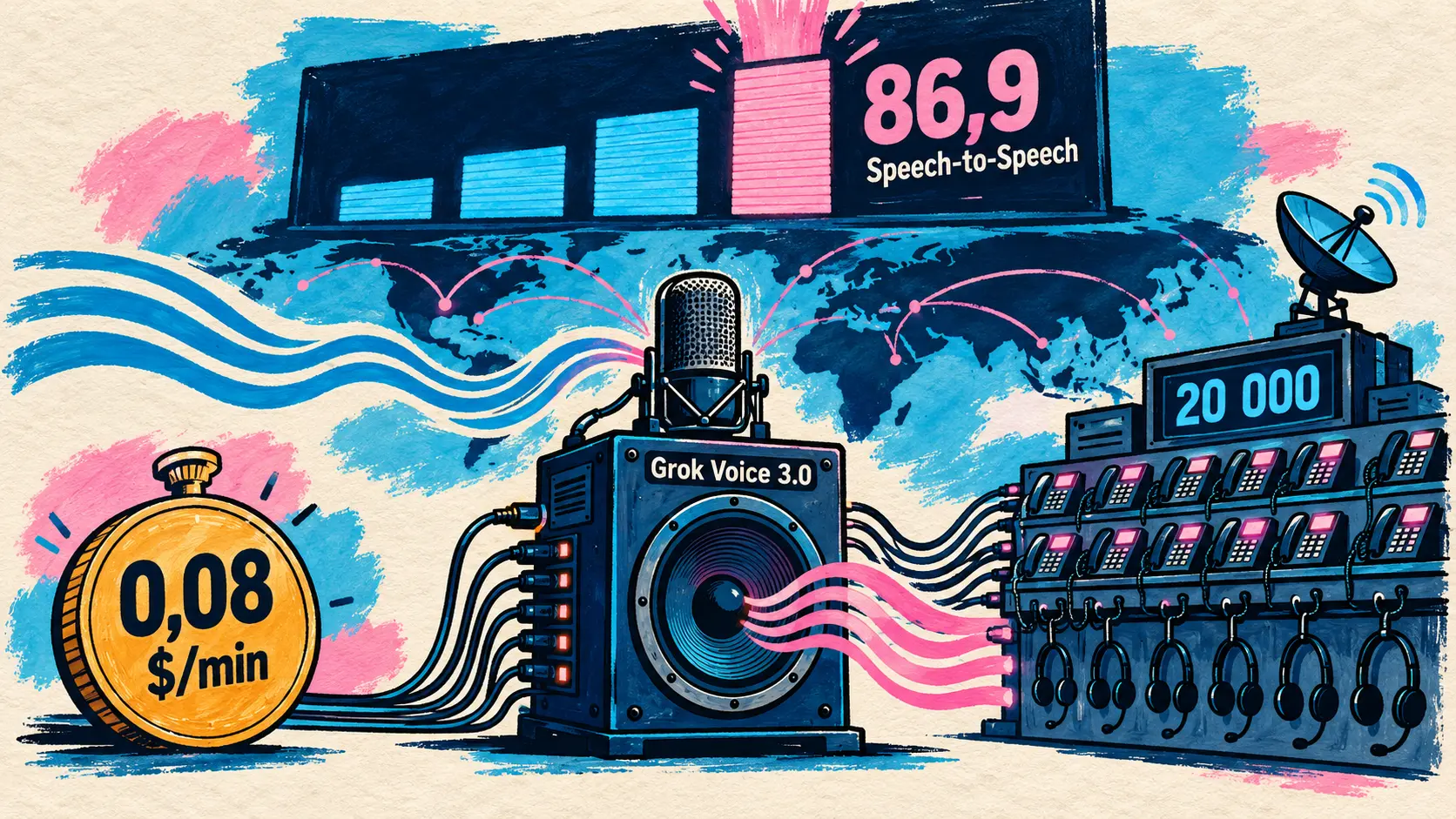
October 14 — SpaceXSI, formerly xAI, launches Grok Voice 3.0, an end-to-end voice model (speech-to-speech) that it describes as the most intelligent on the market. The grok-voice-3.0 model is available the same day in the Voice Agent API and Voice Agent Builder, at the same price as Grok Voice 2.0: $0.08 per minute, or $4.80 per hour. Agents calling the grok-voice-latest alias switched over without changes, using the same endpoint and session parameters. Grok Voice 2.0 is deprecated the same day, with no end-of-life date.
| Benchmark evaluated (Artificial Analysis, October 13) | Grok Voice 3.0 | Grok Voice 2.0 | GPT-Live-1 (Astra, Medium) | Gemini 3.8 Live (Ext. Thinking, High) |
|---|---|---|---|---|
| Speech-to-Speech Index | 86,9 | 81,3 | 83,2 | 82,6 |
| Big Bench Audio (voice reasoning) | 98,5 % | 97,2 % | 90,1 % | 97,7 % |
| Speech Agent Arena (Elo, human preference) | 1 070 | 1 011 | 1 048 | 990 |
| Task success rate | 94,8 % | 94,6 % | 87,4 % | 89,1 % |
| Full Duplex Bench (pauses, turn-taking) | 97,0 % | 95,1 % | 94,9 % | 91,9 % |
| τ-Voice (support calls) | 71,6 % | 56,5 % | 74,5 % | 68,6 % |
These Artificial Analysis measurements, dated October 13, are the ones cited by SpaceXSI. The Speech-to-Speech Index combines voice reasoning, τ-Voice, human preference, and task success in blind call comparisons. Grok Voice 3.0 takes the lead, but it does not win everywhere: on τ-Voice, which involves support calls with varied accents, background noise, and interruptions, its 71.6% remains below GPT-Live-1’s 74.5%, a level SpaceXSI considers comparable, with 40% lower latency. On EVA-Bench, ServiceNow’s open source benchmark for enterprise voice agents (more than 200 scenarios), it achieves the highest accuracy, 74%, according to SpaceXSI. The pricing argument follows: on Big Bench Audio, a task costs an average of $0.025 with Grok Voice 3.0, compared with $0.030 for GPT-Live-1 and $0.055 for OpenAI’s GPT-Realtime-2.1.
The model is already running at scale at Tesla and SpaceX: it processes millions of conversations per day in Tesla vehicles and powers Grok Bot’s voice mode. In Starlink call centers, it answers 20,000 calls per day in multiple languages: around 70% are resolved without human intervention, and one in four sales calls ends in a purchase before the call is over. On August 24, Grok Voice Think Fast 2.0 was already leading this index, handling 15,000 Starlink calls per day at the time.
🔗 Grok Voice 3.0 (SpaceXSI blog post) · Announcement from @SpaceXSI · API release notes
Gemini 4 Argon put to the test: first scientific results, robotics, and code optimization
The day after its general availability, Google documents Gemini 4 Argon in three areas: scientific research, robotics, and optimization of a large Python repository. The two developer blog posts date from launch day; the researchers’ thread was compiled on October 14 by Google DeepMind.
First scientific results: quantum computing, fusion, and enzyme design
October 14 — Google DeepMind brings together in a thread the first results its researchers obtained with Argon, each detailed the previous day by its author.
| Research area | Claimed result with Argon |
|---|---|
| Quantum error correction | AlphaQubit decoder inference throughput nearly doubled |
| Quantum algorithms | Arcsin subroutine more than 100 times less costly than quantum CORDIC, verified in Lean |
| Plasma physics | 2 new families of counterexamples to Grad’s conjecture |
| Enzyme design | 5 novel serine esterases (59 to 81 % identity), activity confirmed in the lab |
| Rare diseases (Gamow Labs) | 57 % on RareBench and 52,2 % on LabBench, two private evaluations |
In quantum computing, Ben Jaderberg and his team, working with Google Quantum AI, had Argon translate an internal version of AlphaQubit, Google’s error-correction decoder, into a single optimized hardware kernel (megakernel) that nearly doubles its inference throughput, a useful gain for a decoder that must keep up with quantum processor measurements in real time.
Second, we used Argon to discover a quantum arcsin subroutine that cuts spacetime cost by more than 100x compared to the published quantum CORDIC baseline. — @benjaderberg on X
This cost is the product of the number of qubits and the execution time, and the circuit was formally verified in Lean. In plasma physics, Opal Issan announces two families of counterexamples to Grad’s conjecture, which had assumed since 1967 that certain three-dimensional magnetic equilibria could not exist; her thread says they were found with Argon, but the abstract of the arXiv paper, submitted on October 5, does not mention the model. In biology, Ryan Krueger describes serine esterases designed over a few prompting sessions: Argon assembled the data, fine-tuned a protein language model, and built its own active-site filters. The launch post adds the case of Gamow Labs, where Argon identified a chromosomal rearrangement in a newborn’s genome that conventional software had missed for years.
🔗 The Google DeepMind thread · The paper on Grad’s conjecture (arXiv) · The Argon launch post
Robotics: from cornhole with the Apollo humanoid to a real-world success rate increased from 56% to 75%
October 13 — On launch day, Google’s developer blog devotes a long post to Argon in robotics, written by Kanishka Rao, with the prompts for each demonstration. The launch post highlights the most striking one, an internal test that started with a simple video of a human playing cornhole, the game of tossing beanbags onto a board with a hole: Argon mapped the environment, calculated whole-body movements, and coded its own simulation; transferred to Apptronik’s Apollo humanoid, the robot made seven successful throws in a row under real-world conditions. Google sums up this progression from video to simulation and then to reality (Video-to-Sim-to-Real): weeks of manual modeling reduced to a few hours.
Kanishka Rao’s post presents other demonstrations: a Boston Dynamics Spot training in a MuJoCo digital twin before pressing the pedal of a real trash can, simulations reconstructed from an eye-level video or a sketch on paper, and the 12-ball puzzle solved in three weighings by two robotic arms guided solely by stereo vision. The most measurable result concerns training: from a single photo of a real table, Argon builds a MuJoCo twin, generates more than 4,500 episodes, and raises a vision-language-action (VLA) model’s success rate on the real robot from 56% to 75%, while reducing execution time from 35 to 24 seconds. An SO-101 arm also improves on its own, from 58.9 to 22.9 and then 17.4 seconds.
🔗 Gemini 4 Argon for robotics (Google Developers)
ADK: eleven hours of overnight work on 205,000 lines of Python, two optimizations accepted out of six
October 13 — Google Cloud engineers gave Argon a more demanding exercise than building an application from scratch: finding and fixing performance bottlenecks in the Python repository for the Agent Development Kit (ADK), Google’s open source framework for building agents, with around 205,000 lines, nearly 800 files, and nearly 17,000 unit tests.
| ADK run metric | Published result |
|---|---|
| Duration of unattended overnight work | 11 hours |
| Unit tests rerun | 16 892 |
| Optimizations proposed and then accepted | 6 proposed, 2 accepted |
| Preparation of long sessions in memory | Around 40 % less |
| Importing the google.adk package | 21 % faster |
| Full execution of 158 turns | From 65,6 s to 56,1 s |
An initial two-hour attempt, without repository-specific instructions, found real bottlenecks but ignored the maintainers’ conventions, going so far as to modify a public JSON schema. For the second attempt, the team placed its review rules in the .agents/skills folder and enabled Google Antigravity’s /goal mode, which maintains the objective through context compactions. Human review retained only two of the six optimizations: filtering session history before copying it and loading heavy packages on first use; the others relied on fragile state, a private OpenTelemetry attribute, or gains limited to synthetic benchmarks. The improvement applies only to the in-memory session service, not external storage. The team sums up the division of roles: the agent explores, the maintainer pares back.
🔗 Optimizing ADK overnight with Gemini 4 Argon (Google Developers)
Coding agents: the desktop app and two Claude Code releases, VS Code 1.142, HydraFusion Max
Anthropic reorganizes the Claude Code desktop app around parallel sessions and releases two versions of its command-line tool in one day; VS Code makes the Copilot harness its default choice, and GitHub adds a Max option to its multi-model orchestration.
Claude Code: the desktop app is organized around parallel sessions
October 14 — Anthropic updates the Claude Code desktop app, the Code tab in Claude Desktop, to better run multiple sessions side by side: according to @ClaudeDevs, starting a session is faster, splitting work across several is easier, and users can see what each one is doing at any time.
| Announced feature | What it offers |
|---|---|
| Session screen | Recent folders one click away; saved environments (a few folders, an SSH host, or the cloud), optional worktree per folder |
| Nested sessions | One session per parallel task, returning its result to the main session |
| Follow-up tasks | Suggested by Claude as it works and launched in one click as a separate session; /btw opens side questions in a tab |
| Sidebar and rail | Active or waiting sessions, live task list, recap card, execution location, context, and changes |
When you ask Claude to run tasks in parallel, it starts a nested session for each one. Each reports its result back into your main session when it’s done, so the main thread stays readable. — @ClaudeDevs on X
The recap card (recap card) summarizes the turn when Claude needs the user, and the side rail shows where the session is running, its context, and its changes. To use it, simply update the app and open a new session; Anthropic provides neither a version number nor a rollout schedule. The getting-started page notes that Claude Code requires a Pro, Max, Team, or Enterprise subscription, with Local, Cloud, SSH, and WSL environments. The update builds on the app redesign for parallel agents introduced in April.
🔗 Thread from @ClaudeDevs · Getting started with the desktop app
Claude Code 2.1.299: compaction of idle conversations before cache expiration, 131 fixes
October 14 — Released at 2:49 UTC, Claude Code 2.1.299 is a major release with 190 entries, including 18 additions, 131 fixes, 16 improvements and 25 changes; versions 2.1.297 and 2.1.298 were skipped. The most visible new feature targets the cost of long sessions, idle compaction (idle compaction): in the terminal, a conversation exceeding 200 000 tokens that has been left idle for about 54 minutes is compacted before its one-hour prompt cache expires, so the next message does not have to reprocess everything. The threshold is configured with CLAUDE_CODE_IDLE_COMPACT_MIN_TOKENS, and "idleCompaction": false in settings.json disables the feature. With CLAUDE_CODE_DISABLE_FILE_MENTIONS, Claude receives the paths of files referenced with @, which it reads itself using its tools, rather than their contents. The /usage command now warns about maximum effort, workflows, context that is always loaded and large tool results, and never displays more than 100 %.
The release also tightens permissions: an MCP allow rule now applies only to the server it names (mcp__a no longer authorizes a a__b server), requests to the claude.ai connector proxy and to MCP servers hosted by Anthropic no longer follow HTTP redirects, and UserPromptSubmit hooks run before a skill or command is expanded, which also blocks their embedded shell commands. Among the security fixes, a command running in the sandbox could write to an --plugin-dir folder whose code is reloaded outside the sandbox, plan mode could perform a write authorized by an PreToolUse hook, and a denied path remained accessible through a symbolic link in the macOS sandbox. Tool descriptions from Anthropic’s MCP servers are no longer truncated at 4 096 characters, and Claude Tag, Claude in Slack, can delete a canvas it created.
🔗 Claude Code 2.1.299 release notes
Claude Code 2.1.300: /advisor on Claude Platform on AWS, OpenTelemetry GenAI traces, Claude Tag in Slack Connect
October 14 — The second release of the day, Claude Code 2.1.300 (18:24 UTC, 88 entries including 59 fixes), extends /advisor to Claude Platform on AWS: no advisor model runs there until the user has selected one with /advisor, advisorModel or --advisor, and CLAUDE_CODE_DISABLE_ADVISOR_TOOL=1 disables the tool. Telemetry aligns with OpenTelemetry’s GenAI semantic conventions (gen_ai.provider.name, gen_ai.conversation.id, gen_ai.tool.name and error.type on spans), and the api_request event separates 5-minute and 1-hour cache writes.
On security, modified input (updatedInput) returned by an PreToolUse or PermissionRequest hook is now validated in the same way as Claude’s input: unknown keys are removed, and input rejected by the tool causes the call to be rejected. Agent-type hooks finally respect their model field and, if that model is unavailable, use the caller’s model instead of allowing the action through. Local transcripts also record the system prompt, tools and parameters for every request, and the --sandbox and --no-sandbox options of claude remote-control, which had no effect, have been removed. Claude Tag can now respond in Slack Connect channels shared with another organization (disabled by default, enableable by an Owner or a Claude Tag admin) and requests approval for a connector action through a private Allow once / Deny card instead of denying it.
| Claude Code version | Release (UTC) | Published entries | Including fixes | Main new feature |
|---|---|---|---|---|
| 2.1.299 | October 14, 2 h 49 | 190 | 131 | Idle compaction of conversations exceeding 200 000 tokens |
| 2.1.300 | October 14, 18 h 24 | 88 | 59 | /advisor on Claude Platform on AWS, OpenTelemetry GenAI attributes |
🔗 Claude Code 2.1.300 release notes
VS Code 1.142: the Copilot harness by default and canvases in preview
October 14 — VS Code 1.142 continues the transition to the Copilot harness, based on the Copilot SDK, whose sessions run through the Agent Host so they can continue in the background. Previously available in the harness selector, it is gradually becoming the default harness for new sessions, following “overwhelmingly positive” feedback according to the team; Ask returns as a built-in read-only agent, and the chat title indicates the active harness, Copilot or Codex. Another new feature is canvases (Canvases), in preview: interactive interfaces opened alongside the chat, where the user and agent edit the same artifact, such as a Kanban board whose tasks the agent updates. Each canvas comes from an extension, which the agent can generate with the /create-canvas command. In the Agents window, a chat can also switch folders or move into a new Git worktree without losing its history, currently with the Codex harness.
For enterprises, a permissions or sandbox policy now enforces the Copilot harness in the Agent Host: existing local chats migrate there automatically, without sending anything, and Claude, Codex and terminal chat become unavailable while these policies apply. Administrators can temporarily retain the Local harness, which does not enforce these execution rules, and this harness’s Windows sandbox is deprecated in favor of Agent Host sessions.
HydraFusion Max: GitHub adds a frontier option to its multi-model orchestration
October 14 — GitHub is evolving HydraFusion, its orchestration system that combines several models to produce a single response, without requiring a model to be chosen for each task. The model pool now includes Claude Opus 5.5, GPT-6 Astra, GPT-6.1 Sol and GPT-6 Luna, and reasoning effort can be configured for each stage: medium for initial drafts, high for review, whereas HydraFusion previously used each model’s default effort. The Cascade workflow can insert a judgment stage that inspects the initial work and requests a repair only when needed, while Critique runs several critic models in parallel, equipped with tools to inspect the workspace directly.
| Available option | Positioning according to GitHub |
|---|---|
| HydraFusion | Balance between speed, cost and performance, with moderate token savings |
| HydraFusion Max | Frontier capability and the most advanced reasoning, with token efficiency managed by orchestration |
Both options remain in research preview in VS Code, the GitHub Copilot app and Copilot CLI, for Pro, Pro+, Business and Enterprise plans with experimental or preview features enabled. GitHub publishes neither benchmarks nor pricing for this release; at its Copilot CLI launch on September 4, it claimed a 4.9-point increase in quality and 67 % lower cost compared with Opus 5 on TerminalBench 2.1.
🔗 HydraFusion updates and new Max option (GitHub changelog)
Security and integrity: Anthropic’s election safeguards, scam detection on phones, a hidden recorder at OpenAI
Three topics concerning trust: Anthropic is preparing Claude for the US midterm elections, Google DeepMind and GovTech Singapore detect scams without leaving the phone, and OpenAI says it has discovered a hidden recording device in one of its offices.
Midterm elections: Anthropic strengthens its safeguards and will integrate voting information from Democracy Works
October 14 — With the US midterm elections approaching, Anthropic details the election safeguards strengthened since its April update. An analysis of 250 000 consumer conversations on Claude.ai in the United States, from September 21 to 27, first measures the share devoted to politics.
| Conversation type (Claude.ai, United States) | Share of conversations |
|---|---|
| Politics, public policy, social issues | Approximately 5,75 % |
| Elections or voting | Approximately 0,51 % |
| Who or what to vote for | Approximately 0,01 % |
| Violations of election integrity rules (separate analysis) | Approximately 0,002 % |
The banner linking to TurboVote (Democracy Works) remains in place, and later this month Claude.ai will integrate official voting information from Democracy Works into its responses to US users (where to vote, what ID to bring, with a response specific to each state), then display official results on election night and in the following days. According to Anthropic, Claude Opus 5.5, Sonnet 5.5 and Haiku 5.5 score 99 % on its political impartiality evaluation. Of three independent evaluations, two (The Future of Free Speech and the Collective Intelligence Project) report few refusals, but unsolicited warnings and counterarguments; the third, by the Foundation for American Innovation, found that Claude Sonnet 4.5 did not always add qualifications in a balanced way and more readily softened arguments in favor of right-wing positions. Tests conducted with the Institute for Strategic Dialogue and the McCain Institute in the United States, Israel and Brazil showed that Claude reliably refused an isolated harmful request, but could miss a campaign broken down into small, seemingly harmless tasks. Anthropic has added classifiers to counter these multi-stage abuses, and banned the accounts of foreign-based operators of a fake news website who were using Claude to produce election coverage favorable to Russian, Iranian and North Korean narratives.
🔗 Preparing for the 2026 US midterms (Anthropic)
Scams: Google DeepMind and GovTech Singapore fine-tune Gemma for detection on phones
October 14 — Google DeepMind and the government agency GovTech Singapore have fine-tuned a lightweight Gemma model, whose generation the post does not specify, to detect scams directly on the user’s phone. The starting point is quantified: in Singapore, scams account for more than half of reported crimes and more than 4 billion Singapore dollars in losses since 2019, while sophisticated social engineering scams account for up to 80 % of losses. The model was fine-tuned on local scam conversations: impersonation of public institutions, banks or public figures, and current regional scams. Everything runs on the device, in two stages to conserve battery life: a lightweight classifier filters incoming messages, then the fine-tuned Gemma reviews a broader excerpt of the conversation to confirm the threat or dismiss the false alarm, before displaying a real-time warning.
The model accesses conversations only with the user’s consent, and neither the Singaporean government nor Google can read them; fine-tuning took place in the Google Cloud environment managed by GovTech, using anonymized data, with no citizen data. Presented at Singapore International Cyber Week, the project has neither a date nor a named application yet: its rollout will be “carefully phased” (carefully phased) with the government, and Google DeepMind is considering other countries.
🔗 Google DeepMind and GovTech Singapore tackle scams
OpenAI discovers a hidden recording device in one of its offices
October 13 — According to a statement published by its press account, OpenAI discovered a sophisticated recording device hidden in one of its offices. The company says it used its own models to understand the device and its origin, ultimately identifying the employee who had placed it there a few days earlier. The matter was referred to the FBI, and OpenAI thanks the agents and prosecutors who acted quickly to make an arrest; the federal investigation continues, and the employee has been fired.
At this time, we have no indications of this individual inappropriately accessing or exfiltrating model weights, source code, or customer data. — @OpenAINewsroom on X
According to OpenAI, its security program addresses a broad range of threats, from insider risks to cybercriminals and nation-states, and this case shows how AI can help counter them. The statement does not specify the employee’s identity, the office involved, the exact nature of the device or the date of the arrest.
AI for science: ten medical manuscripts from Meta using its Muse models, extreme weather at 3 km with HiRO-ACEv2
Two scientific uses of models: Meta accelerates epidemiological studies using health records, while Ai2 produces high-resolution climate data at low cost.
Meta releases ten medical research manuscripts produced with Muse Spark 1.3 and Muse Wonder
October 14 — Meta built an internal coding scaffold (coding scaffold), powered by Muse Spark 1.3 and Muse Wonder, that accesses public data and a licensed retrospective database of five million de-identified electronic health records. A cohort of medical researchers (cardiology, epidemiology, infectious diseases, internal medicine) used it for four weeks to formulate hypotheses, write and execute all analysis code, and co-author the manuscripts; the experts retain authority over scientific decisions. The effort produced ten manuscripts, reviewed by peers within the cohort, by a biostatistician, and then by commissioned independent experts, whose assessments are published beneath each paper.
| Example study cited | Reported result |
|---|---|
| Arrhythmias after infective endocarditis | +73 % new arrhythmias and conduction disorders compared with bacteremia without endocarditis; one-year risk of 7 % versus 4 % |
| Emergency department, behavioral health patients who left without being seen | Relative risks of 1,86 (return visit), 4,41 (hospitalization), and 2,15 (short-term mortality) |
| Time from first prompt to manuscript | Less than two weeks, sometimes seven days |
Participants report productivity gains of up to tenfold in the best cases, a self-reported measure. The limitations are acknowledged: the analyses are exclusively retrospective, and an external reviewer considers the arrhythmia study to generate hypotheses rather than warrant changes to clinical practice, with surveillance bias remaining possible. This health initiative follows the six mathematics papers written with Muse Spark and published on October 2.
HiRO-ACEv2: Ai2 simulates global extreme weather at 3 km, at around 300 times lower cost than X-SHiELD
October 14 — Ai2 releases HiRO-ACEv2, a new version of its high-resolution climate emulator. The system combines ACE, an AI model that simulates the climate at 100 km resolution, with HiRO, which refines those outputs down to 3 km. While the first version of HiRO only produced precipitation, HiROv2 predicts rainfall, near-surface winds, and sea-level pressure. Fed coarsened data from X-SHiELD, a global atmospheric model that explicitly simulates storms, it reproduces its high-resolution statistics to within 3 %, even for events occurring at one in a million data points, and correctly estimates tropical cyclone energy, including for storms never seen during training.
| Metric reported by Ai2 | Reported value |
|---|---|
| Resolution | 3 km output, starting from ACE at 100 km |
| Deviation from X-SHiELD statistics | Within 3 %, including for one-in-a-million events |
| Cost compared with X-SHiELD | Around 300 times lower for global data |
| Simulations produced | 10 years (ACE); one full year of global data at 3 km |
| Model license | Apache-2.0, on Hugging Face |
The limitation is acknowledged: because HiRO was trained on X-SHiELD, it only works with the version of ACE calibrated to that model and cannot yet generate data for a warmer climate or for the ERA5 historical record. Ai2 plans to train it on a world that is 4 °C warmer, then add near-surface temperature, snow, and ice. The models are released with a technical report (arXiv 2610.17693), tutorial notebooks, and a demo.
🔗 Ai2’s blog post · The models on Hugging Face
Expansion and investments: Anthropic in Singapore, 250 million dollars from NVIDIA for British research, Mistral acquires New Material
Anthropic establishes a presence in Singapore with a government agreement, NVIDIA commits compute and investments in the United Kingdom, and Mistral expands through an acquisition in product design.
Anthropic opens its fifth Asia-Pacific office in Singapore and signs a memorandum of understanding with the government
October 14 — Anthropic opens an office in Singapore, its fifth in Asia-Pacific, and signs a memorandum of understanding (Memorandum of Understanding) with Singapore’s Ministry of Digital Development and Information. The document was signed by the ministry’s Permanent Secretary, Kai Fong Chng, and Anthropic co-founder Ben Mann, on the sidelines of Singapore International Cyber Week. It provides for cooperation on model safety, security, and evaluation, technical exchanges on testing standards and incident response, and the sharing of Anthropic Economic Index data.
| Singaporean organization | Use of Claude cited by Anthropic |
|---|---|
| GovTech Singapore | More than 1 500 engineers and technical staff using Claude Code |
| Grab | BriX sales assistant, around 40 000 hours saved per quarter |
| DBS and GIC | Use or deployment of Claude at the bank and the sovereign wealth fund |
| Sea (Shopee, Garena, Monee) | Shopee customer service chatbot, thousands of employees coding with Claude |
According to the Economic Index, Singapore ranks second among 121 countries for Claude.ai usage relative to population, nearly six times what its size would suggest. A Builder Summit brought together more than 300 developers on opening day. Anthropic has disclosed neither an investment amount nor a headcount for the office, which is hiring.
🔗 Singapore office opening (Anthropic)
NVIDIA offers 250 million dollars in compute for British research on agent security
October 13 — NVIDIA announces a compute donation worth 250 million dollars over five years, equivalent to 50 million dollars in compute access per year, for British research on agent safety and security (agentic safety and security). Most will go to the broader British AI safety and security research community; a portion is reserved for BOLD (University of Oxford), SOFAIR (UCL), and Imperial College London, which will work on safety engineering and robotics. Compute will be provided through NVIDIA Cloud Partners based in the United Kingdom, using infrastructure hosted in the country; providers, technical architecture, and commercial terms remain to be agreed. The targeted work covers secure agents, open model security, and mitigation of real-world threats, with sandboxes, reproducible research, and safety evaluation benchmarks, including work on NVIDIA OpenShell and the NVIDIA Sentry reference design.
The accompanying blog post adds planned investments, without amounts, in five British startups: Boltz (biomolecular models), Foresight (management of major construction projects), Hiverge (algorithm discovery), Prima Mente (biological foundation models for Alzheimer’s, Parkinson’s, and ALS), and Riverlane (quantum error correction). These announcements precede Jensen Huang’s GTC Berlin keynote on October 21.
🔗 NVIDIA press release · NVIDIA blog post on the British ecosystem
Mistral acquires design studio New Material and creates a Solutions Design team
October 14 — Mistral acquires New Material, an AI product design studio founded six years ago. The announcement comes from New Material’s blog post, which describes an acquisition; Mistral shared it on X to welcome the team, without a post on its own website or a disclosed amount. The studio says it has delivered AI-native tools, products, and businesses across automotive, retail, legal services, and healthcare, with partners including Ford, Rafael Nadal, the Wellcome Trust, and AmLaw 50 law firms. At Mistral, it forms a new team, Solutions Design, combining design, engineering, and AI, which will co-develop projects with customers to tighten the feedback loop between real-world deployments and Mistral’s products for critical AI applications in businesses and governments. In May, Mistral had already acquired Emmi AI, an Austrian specialist in Physics AI.
🔗 New Material’s blog post · Post by @MistralAI
OpenAI measures the agentic shift among EU businesses: users up 8,1-fold at SMEs
October 14 — OpenAI publishes an economic research report on agentic AI usage among European Union businesses, accompanied by a PDF and explorable data. In the European sample of ChatGPT Enterprise customers, Codex and ChatGPT Work now account for more than half of output tokens: users are entrusting agents with entire tasks, from planning to execution.
| Indicator measured by OpenAI | Recorded value |
|---|---|
| Share of output tokens through Codex and ChatGPT Work (EU, ChatGPT Enterprise) | More than half |
| Weekly active users of agentic tools at EU SMEs | ×8,1 compared with the week of May 1 to 7 |
| Agentic share of output tokens by country | From 22 % (Slovenia) to 85 % (Lithuania) |
| Output tokens over 28 days, relative to typical firms in May | Non-EU frontier firms 12,9x; EU frontier firms 6,1x; typical non-EU firms 1,6x; typical EU firms 1,5x |
| EU share of global frontier firms | 10 % |
SMEs are defined here as businesses with at most 200 associated users, and their growth extends to every member state. The report primarily measures a gap in usage intensity: in September, EU frontier firms (frontier firms, the 10 % generating the most output tokens per active user) produced more than four times as many as typical EU firms, but frontier firms outside the EU still produced more than twice as many as their EU counterparts. For OpenAI, the challenge is to turn broad adoption into deeper usage by helping businesses move beyond experimentation and training employees. The report follows the September 30 report on American small businesses.
🔗 The next chapter of AI in the EU will be agentic (OpenAI)
Agent infrastructure: OpenTelemetry traces on Claude Platform, sandbox routing at Perplexity
Two components of the tooling used to run and observe agents in production: observability at Anthropic, and routing requests to the correct execution at Perplexity.
Claude Platform exports OpenTelemetry traces from the Messages API, Managed Agents, and SDKs in public beta
October 14 — Claude Platform can now send OpenTelemetry traces, in public beta, from the Messages API, Claude Managed Agents, and Claude SDKs to any observability tool that accepts a standard OTLP endpoint. Each agent turn, model call, and tool call arrives as a standard trace, with latency, tokens, and identifiers. For the Messages API and Managed Agents, a destination must be added in the Claude Console; the SDKs automatically export their spans, in Python, TypeScript, C#, Go, Java, PHP, and Ruby according to the release notes. The spans follow OpenTelemetry’s GenAI semantic conventions and carry metadata by default (duration, status, token count, model, tool names); a destination set to full content (full content) also exports prompts, responses, tool inputs, and tool results. On the same day, Claude Code 2.1.300 aligns its own spans with these conventions.
| Highlighted use case | Tools cited by Anthropic |
|---|---|
| Debug alongside the rest of the stack | Grafana Cloud, Honeycomb, Sentry, Splunk |
| Turn real traces into evaluations | Arize AI, Braintrust, Datadog, Langfuse, LangSmith, New Relic, PostHog |
| Track token usage by team | Databricks Unity Gateway |
Among the testimonials, Ramp explains that Reflect, its system for scoring its agents’ Langfuse traces, has already reduced token usage by 10 to 20 % and sped up sessions by 30 % for some agents. Anthropic announces neither pricing nor a general availability timeline.
🔗 Agent observability on the Claude Platform · Claude Platform release notes
SPACE: Perplexity binds each request to the correct sandbox execution
October 14 — Perplexity publishes an engineering blog post about SPACE, the sandbox platform where Perplexity Computer agents run. According to Perplexity, SPACE has handled millions of executions per day for months, with an error rate below 0,0002 % and no dropped connections. The problem addressed is a stale route: a sandbox resumed on another machine keeps its identifier but starts a new execution, and a delayed request can reach the old one under the correct name. A simple file read passes through the control plane, node-api, sbx-manager, a Unix socket, and the host bridge, then through VSOCK to the Firecracker microVM.
The solution separates the sandbox’s stable identity from its execution identity, which identifies an incarnation and its placement. After authorization, each request carries an Ed25519-signed capability, valid for 120 seconds, which the receiving component compares against its own record before forwarding; terminals and file watches are disconnected as soon as a new execution takes over. The threat model excludes root compromise of an execution machine (worker), and verification remains local, without remote hardware attestation. Finally, the post compares SPACE with OpenShell, which offers comparable guarantees, and with E2B and CubeSandbox, which forward requests without an expected execution identity: Perplexity specifies that these findings are limited to the implementations inspected.
🔗 Perplexity’s blog post on SPACE
General-purpose agents: Ultrafast versions in Perplexity Computer, Manus for Business for teams
Agents that carry out long tasks for users are working along two lines: model speed at Perplexity and teamwork at Manus.
Perplexity Computer opens Ultrafast versions of GPT-6 Astra and GPT-6.1 Sol to Max subscribers
October 14 — Perplexity is opening Ultrafast versions of two OpenAI models to Max subscribers in Perplexity Computer, its agent for multi-step tasks: GPT-6 Astra and GPT-6.1 Sol, written as “SOL 6.1” in the announcement. Both models generate tokens faster, so long Computer tasks finish sooner. The selection is manual: choose Astra or SOL 6.1 in the Custom menu, then switch the speed to Ultrafast. The announcement quantifies neither the speed increase nor credit consumption, and says nothing about other plans; the product changelog has no entry more recent than October 5. This is Perplexity’s implementation of a tier that OpenAI launched for GPT-6 Astra on September 29, then for GPT-6.1 Sol on October 8, offering up to 8 times the speed according to OpenAI.
Manus for Business: a Team Plan starting at 20 dollars per seat and an Enterprise offering
October 13 — Manus is launching Manus for Business, an offering for teams that brings together the Manus Team Plan and an Enterprise Plan.
| Manus plan | Features according to Manus |
|---|---|
| Manus Team Plan | From 20 dollars per paid seat per month or 200 dollars per year, for 4 000 credits; free guest seats |
| Manus Enterprise | Contact sales: managed accounts, legal hold, SIEM integration, agent network controls, per-user usage limits |
The Team Plan, available now, provides projects that retain context (instructions, files, Skills and connectors shared across related tasks, including scheduled tasks), shared Skills that administrators can enforce, team-only access to tasks, files and internal sites, and pooled credits tracked in a dashboard. Guests review and comment without taking up a paid seat. Roles, audit logs, SSO and SCIM round out the offering; Manus says it prohibits model providers from training on Team customers’ data and holds SOC 2 Type II, ISO 27001 and ISO 27701 certifications.
🔗 Introducing Manus for Business
Agent research: HybridAgent reasons in latent space, Cohere Labs measures coding agent teams
Two studies seek to make agents less costly: one by having them reason without producing tokens, the other by organizing their teams more effectively.
HybridAgent: agents that think in latent space and act through text
October 13 — Researchers from Stanford, Together AI, UIUC and Meta, according to the arXiv submission whose authors include Jiaru Zou and James Zou, introduce HybridAgent, hybrid reasoning agents that alternate between latent-space reasoning and text-based actions within a single generation. A lightweight module, HybridLink, maps the last layer’s hidden states back into the input embedding space: the model reasons without producing tokens, then returns to text to call its tools, a Python interpreter and web search. Each latent step remains readable as pseudo-text. Training takes place in two stages: HybridSFT learns coordination with HybridLink, then HybridRL learns when to think in latent space and when to act through text.
| Published metric (according to the authors) | Reported value |
|---|---|
| Performance gain across 11 benchmarks and 3 sizes | +10,4 % |
| Token reduction | 35,5 % to 54,7 % |
| Inference speed | 1,8 to 2,6 times faster |
| Cost savings | 2,7 to 3,7 times |
The HybridAgent-8B-Agentic and 14B-Agentic models are released under the MIT license along with the code; no Together AI announcement accompanies the paper.
Cohere Labs: a strong lead agent surrounded by inexpensive agents approaches the top score at 70 % lower cost
October 14 — Cohere Labs publishes a study on the organization of coding agent teams, authored by Keenan Samway, Daniel D’souza and Nouha Dziri. In a deliberately minimal harness, a lead agent (lead) assigns subtasks to secondary agents (workers), and only one parameter changes at a time: delegated stages, blocking or asynchronous waiting, the model for each role, team size, direct messaging. The main benchmark, ProgramBench, requires reconstructing 200 programs from their executable and documentation alone, ranging from jq and ripgrep to SQLite or FFmpeg.
| Evaluated configuration (ProgramBench, GPT-5.6) | Average reward | Total cost of the 200 tasks |
|---|---|---|
| Sol alone, three-stage prompt | 57,7 % | Not quantified in the text |
| Asynchronous Sol team, three delegated stages | 63,2 % | 510 dollars |
| Asynchronous Sol team, planning alone delegated | 63,6 % | 249 dollars |
| Sol lead agent and 16 Luna agents, planning | 61,8 % | 155 dollars |
Delegating planning alone therefore performs as well as delegating everything, at half the cost, and a Sol lead agent supported by 16 GPT-5.6 Luna agents reaches 61,8 % for 155 dollars, 70 % less than the all-Sol team that delegates everything. A weak lead agent cannot make up the gap: with Luna agents, a Terra lead agent (51,6 %) remains below Sol working alone (57,7 %). On a subset of 30 tasks, with a single run per model, Claude Opus 4.8 gains 5,9 points in a team while Claude Opus 4.7 barely delegates; a Claude Opus 5 trial was stopped after eight tasks, all of which reached the eight-hour timeout, at around 500 dollars each. The study evaluates no Cohere model.
Generative media: cheaper FLUX 3 Video, Runway on Baseten, HeyGen’s voice adapted to the setting
Generative video is lowering its prices and moving into dedicated enterprise infrastructure, while HeyGen documents voice cloning for its videos.
FLUX 3 Video up to twice as fast and up to half the price in 2K and 4K
October 14 — Black Forest Labs announces that FLUX 3 Video is now up to twice as fast and costs 50 % less to generate in native 2K and 4K. The lab explains that it has optimized the service to use less compute, passing those gains on through both price and speed. In a second message, it claims better 4K quality than Kling o3 at comparable price and latency, without a benchmark published in the thread.
| FLUX 3 Video resolution | Text or image to video (per second) | Video to video (per second) |
|---|---|---|
| HD | 0,17 → 0,15 dollar | 0,41 → 0,21 dollar |
| FHD | 0,29 → 0,24 dollar | 0,53 → 0,27 dollar |
| QHD (2K) | 0,40 → 0,28 dollar | 0,65 → 0,31 dollar |
| UHD (4K) | 0,80 → 0,41 dollar | 0,95 → 0,45 dollar |
The pricing table on bfl.ai qualifies the “50 %” claim: in 2K and 4K, the reduction ranges from 30 % (2K from text or an image) to 53 % (video to video), and HD and FHD prices also fall; draft mode (Draft) remains at 0,06 dollar per second, in HD only. FLUX 3 Video launched on August 4.
🔗 Black Forest Labs announcement · FLUX 3 Video page · FLUX 3 Video pricing table
Runway partners with Baseten to deploy Gen-4.5 and Aleph 2.0 in dedicated environments
October 14 — Runway and Baseten are partnering to offer Runway’s video models to enterprises in dedicated environments. Gen-4.5 and Aleph 2.0, which edits multi-scene sequences up to 30 seconds long in 1080p, can now be deployed, including fine-tuned versions, in a single-tenant environment (single-tenant) through Baseten Dedicated Inference. The enterprise licenses the weights directly from Runway, then deploys them at Baseten, where each deployment runs in an isolated execution plane with dedicated GPUs, with Baseten managing the control plane. The infrastructure falls under Baseten’s SOC 2 Type II and HIPAA programs, availability is guaranteed at 99,99 %, and customers can fine-tune the models on their data and reserve GPU capacity. No pricing is disclosed. The offering extends Runway Model Licensing, launched on September 11 to license its closed weights to enterprises.
🔗 Runway announcement · Baseten post
HeyGen Voice: the technical report on voice cloning that adapts the voice to the setting
October 14 — Five days after launching HeyGen Voice, HeyGen publishes the technical report for its voice model, presented as the first designed for video. The voice reference establishes who is speaking, while the target image and scene description guide how the voice should sound: a language model derives two captions from them, one for the speaker (tone, pace, emphasis, expressiveness), the other for the background (the space and its acoustics). The video is rendered by a separate avatar model.
| Blind evaluation (conducted by HeyGen) | HeyGen Voice preferred |
|---|---|
| Fit with the setting, against Cartesia | 73 % |
| Fit with the setting, against ElevenLabs v4 | 70 % |
| Fit with the setting, against Seedance 2.5 | 65 % |
| User choice, against ElevenLabs v4 | 62,2 % |
| User choice, against Cartesia Sonic 3.6 | 54,1 % |
In the first test, the same voice is placed in 50 settings, from a cathedral to the front seat of a car; in the second, thousands of users recorded their voices and then chose the version to adopt without labels, with 41,7 % choosing HeyGen Voice in the three-way comparison. These figures come from HeyGen.
🔗 HeyGen thread · HeyGen Voice research page
Chips: NVIDIA launches cuPotential and extends CUDA-X to AI-driven semiconductor fabs
October 14 — NVIDIA introduces cuPotential, a new CUDA-X library for building agents that can simulate interactions between atoms and molecules, a computation central to modeling semiconductor materials and processes. In early-access testing, it delivered an additional 2 to 3 times speedup for workflows already optimized for GPUs; Synopsys is among the early users. The announcement is part of the move toward AI-driven semiconductor fabs (AI-defined fabs), where agents help engineers optimize processes, resolve production incidents and improve yield.
| Partner or tool | Reported result (according to NVIDIA) |
|---|---|
| NVIDIA cuPotential | An additional 2 to 3 times speedup on workflows already optimized for GPUs (early access) |
| Lam Research (NanoVDB, SEMulator3D) | Up to 30 times on certain etching simulations, by the end of 2026 |
| KLA (NPP) | 50 times faster than previous CPU versions |
| Applied Materials | Chamber simulations up to 35 times faster |
| Synopsys | Potential for 30 times (cuEST, QuantumATK) and 12 times (cuDSS, S-Device) |
On the same day, a technical post illustrates the agent component: using the open NeMo Gym library, the Siemens Fuse team evaluated its standard cell characterization agent by comparing its Liberty files with verified references. Over around 25 runs, keeping Claude Opus 4.8 as the model and Claude Code as the harness, the team refined its skills and MCP tool descriptions: the composite score rises from around 55 % to around 95 %, agent turns fall from 155 to 53, and output tokens fall from around 81 000 to 29 000.
🔗 NVIDIA press release · NeMo Gym and Siemens Fuse technical post
Open models and environments: UltraBERT encoders, multilingual RL environments at Hugging Face
Two open releases on the Hub: a family of encoders for classification and retrieval, and reinforcement learning environments in more than a hundred languages.
UltraBERT: DMIS Lab releases 150M and 380M English encoders with a 32K context
October 14 — DMIS (Data Mining and Information Systems Lab) releases UltraBERT, a family of English encoders with 150M and 380M parameters and a native context of 32K tokens, and UltraBERT-Embed-150M, a ready-to-use embedding model, all under Apache 2.0 with a paper (arXiv 2610.15028). Ablations totaling more than 70 trillion tokens reveal two findings: encoders stop improving after 1 to 2 trillion tokens even as the loss continues to fall, and the masking rate determines their specialization, with a low rate favoring classification and a high rate favoring retrieval. UltraBERT therefore mixes 5 % and 50 % masking in each batch, with a language modeling head for each rate.
| Released UltraBERT model | Result reported by the authors |
|---|---|
| UltraBERT-380M | 91,0 on GLUE, 47,7 on BEIR |
| UltraBERT-150M and 380M | Top score on 9 out of 10 benchmarks; 99 % on the hidden-key test up to 32K tokens |
| UltraBERT-Embed-150M | 67,24 on MTEB (eng, v2), best dense embedding model under 200M parameters |
Hugging Face releases RL environments for OCR in 22 languages and speech recognition in 102 languages
October 14 — Adithya S K, who works on reinforcement learning environments at Hugging Face, presents what he describes as the largest open source multilingual and multimodal RL environments. Two OpenEnv environments with verifiable rewards have been released: one for document recognition (OCR), covering more than a million pages in 22 languages drawn from Cognitive Lab’s Nayana corpus, and the other for speech recognition (ASR), covering speech in 102 languages from Google’s FLEURS, for more than 12 million tasks in total. The principle: reuse existing open datasets by adding verifiable rewards. To demonstrate their use for training, the author fine-tuned Gemma 4 E4B with GRPO in Kannada on a single A100: 16% fewer character errors on Sarvam AI’s held-out OCR benchmark, and 45% fewer on 838 held-out speech clips. The RL Environment Explorer presented on October 7 already listed more than 12 million tasks; the new development is the official presentation and the first training results.
GitHub Actions: lockfiles for workflow dependencies, in public preview
October 14 — Outside AI, GitHub Actions introduces lockfiles (lockfiles) for workflow dependencies in public preview on GitHub Enterprise Cloud (with or without data residency), Team and Free. The risk being addressed is familiar: a tag or branch can be moved after a workflow review, and a compromised action can inject malicious code without any change to the repository. The gh actions-lock extension for GitHub CLI generates .github/workflows/actions.lock with the commits for actions, their transitive dependencies and reusable workflows; Actions then executes the locked commit even if the tag moves. Adoption happens one workflow at a time, a Require lockfile policy can enforce it, and Dependabot updates the locked entry in the same pull request as an action’s new version. GitHub reminds users that locking says nothing about a dependency’s safety, and that it should be reviewed before being locked.
🔗 GitHub Actions workflow lockfiles in public preview (GitHub changelog)
Briefs
Coding agents and tools
- Copilot CLI 1.0.98 — Released as stable the day after 1.0.97, it supports Gemini 4 Argon and makes /ask responses easier to handle: Ctrl+E expands them, Ctrl+Y copies them in full, and /ask or /btw reopens the last full response; Copilot SDK 1.0.22 simply bundles the CLI. 🔗 source
- Zed 1.24 and preview 1.25.0 — Version 1.24 becomes stable (1.24.2) with just one additional fix compared with its preview; 1.25.0-pre adds Gemini 4 Argon to the Google AI provider, GPT-6 Astra, Claude Fable 5.1 and Claude Opus 5.5 to Bedrock, context compaction for ACP agents, and prevents secrets from external agents and MCP servers from appearing in the local process list. 🔗 source
- Antigravity 1.8.0 extension for VS Code — Catching up on October 11: without automatic acceptance, diff reviews remain open and accumulate across agent turns, changes made on disk are detected in under a second, and the VSIX package is about 70% smaller. 🔗 source
- DeepSeek Harness 0.2.1-alpha.3 — The 27th preview, still with no stable release: keys and tokens are masked by default in outgoing messages, agent presets (Agent Presets) are specific to subagents, session resumption is available in the SDKs, and there are ten fixes; the Azure provider, renamed azure, requires configuration migration. 🔗 source
- GPT-5.5 leaves Codex — As announced on September 15, GPT-5.5 left Codex on October 14 at 19:00 UTC for accounts signed in with ChatGPT, replaced by GPT-6.1 Sol (Plus, Pro, Business, Enterprise, Edu) or GPT-6 Luna in the desktop app (Free and Go); the API and sessions using API keys are unaffected. 🔗 source
- Amp and OpenAI’s models — In an OpenAI case study, Amp says these models account for most of the tokens consumed, with some users spending 10 billion per week; Calling Puck enables real-time conversations with its meta-agent through GPT-Live-1, and the team is testing GPT-6 Astra’s Ultrafast mode. 🔗 source
- cuDF skills for Apache Spark — NVIDIA releases agent skills that rewrite Spark UDFs into GPU-accelerated equivalents; at an unnamed large company, more than 30 production UDFs have been converted, including one that went from 274.55 to 12.78 hours on 600 billion rows. 🔗 source
- Built with Claude: Japan 2026 — Anthropic and Cerebral Valley are organizing a fully online Claude Code hackathon for residents of Japan from November 2 to 10: 250 selected participants receive a Max 5x plan and 500 dollars in API credits, 50,000 dollars in credits are up for grabs, and applications are open until October 26. 🔗 source
- Astra Commons meetups — In September, Codex Ambassadors brought together around 2,500 developers in 52 cities, in cafés, galleries and universities, for the launch of GPT-6 Astra, according to Rhiannon Payne from OpenAI’s community team. 🔗 source
Assistants, enterprise tools and guides
- Genspark — Meta’s Muse Wonder, followed by Gemini 4 Argon, arrives within hours in AI Chat, Code Agent and Claw, accompanied by their vendors’ pitches and with no plan or pricing specified. 🔗 source · 🔗 Argon
- My Fish in Sakana Chat — Sakana AI makes its assistant’s memory visible: a heatmap of reads and writes, a category view, a map of connections between memories, which fade after 30 days without use, and a history, all under Settings → My Fish, on both web and mobile. 🔗 source
- Gloss — Together AI highlights a free, open source app for saving articles, PDFs and X bookmarks and asking AI about a highlighted passage, built with DeepSeek V4.1 Flash on its platform. 🔗 source
- MCP in Apigee hybrid — Since version 1.17.0, an OpenAPI specification is enough to expose each API operation as an MCP tool, with a data plane that stays in the customer’s Kubernetes cluster: no tool call passes through Google Cloud. 🔗 source
- The cost of AI tools according to Perplexity — A guide details pricing models and hidden costs (a hypothetical team of 10 people spending 350 dollars in some months, plus 18 hours of internal work) and summarizes Perplexity’s pricing tiers, from Free to Enterprise Max; no new developments are announced. 🔗 source
- MCP tools according to Perplexity — A second guide explains what an MCP tool is and outlines the two ways to use MCP with Perplexity: connect MCP servers on Pro, Max and Enterprise, or call the four tools of its own MCP server from Claude Code, for example. 🔗 source
Case studies and deployments
- Third Moment Research — In an OpenAI case study, this lab runs 10,000 simultaneous agents in sessions lasting 36 to 48 hours, consumed 1 trillion tokens in one day, and reduced the duration of a retrospective test (backtest) by 97% with Codex; GPT-6.1 Sol is its most-used model. 🔗 source
- SentinelOne and Daybreak — According to its AI director, Gregor Stewart, OpenAI Daybreak produces human-level malware reverse engineering in about eight hours, a task that took a top researcher four to six weeks. 🔗 source
- Circa and Manus — Manus publishes a testimonial from Circa, a Boston startup that reuses demolition materials and uses the agent for its website, grants and an estimation tool; nearly 100,000 dollars in cumulative revenue reported in September, with no new product developments. 🔗 source
- European cities and NVIDIA — In Côte-d’Or, agents from Akila and ThinkDeep deployed across more than 500 public buildings reduce operating costs by 10%, with a target of 30%; NVIDIA also cites projects in Milan, Antwerp-Bruges, Gothenburg and Liverpool, with no new product. 🔗 source
- MiniMax H3 IP Edition — In the recap of its September 11 conference in Tokyo, MiniMax claims more than 60 interested companies; the Captain Tsubasa × PixVerse pilot brought together 126,360 creators and 329,314 pieces of licensed content in 45 days. 🔗 source
Open models and community research
- Cohere mentions Rerank 5 — Cohere publishes a video of Rerank playing Mario and invites viewers to see whether Rerank 5 beats Rerank 4’s score; nothing has launched, and the documentation still lists only Rerank 4 and versions 3.x. 🔗 source
- Lumma-Fev-27B — FrontiersMind fully fine-tunes Qwen3.8-27B on around 100,000 decision examples (English, Hindi, Tamil, Kannada): 90.7% correct answers versus 83.9% for Jev 1.13 on 4,454 held-out decisions, but Jev remains ahead on BBH and WinoGrande; measurements from the authors, weights under Apache 2.0. 🔗 source
- TranscribePsy — Tether AI Research releases a speech recognition model with 254M parameters for 25 European languages, in GGUF and Core ML versions: an 8.02% word error rate on the Open ASR Leaderboard versus 12.34% for Whisper-small, and 2.6 times faster than the next-fastest model on six phones, according to Tether. 🔗 source
- VKORE-46M-NPU — VIDRAFT trains a small decoder with 46M parameters from scratch, using actual backpropagation, on a 32-chip inference NPU; its loss curve has a 0.99 correlation with that of the same training run on GPU. 🔗 source
- Quantization and agent capabilities — Across 19,200 paired results, Patrick Hill (PBH Applied Systems) shows that Mistral-Nemo in Q4_K_M suffers significant losses in 5 out of 8 agent capabilities, reaching −28.0 points on structured output with prose, while Q5_K_M (8.73 GB versus 7.48) and Q8_0 make no difference. 🔗 source
- A gate on Gated DeltaNet — Avi Fenesh adds a small gate on the beta of Gated DeltaNet layers to a LoRA trained with GRPO: Qwen3.5-4B’s reasoning becomes 48% shorter on MATH-500, and anytime accuracy rises from 0.786 to 0.852. 🔗 source
- pico-165m — Fausto Saporito trains a 165M model that takes notes on a single TPU chip: 0.81 on memory checks over conversations of around 47 turns, versus 0.31 for SmolLM2-360M-Instruct reading the entire conversation. 🔗 source
Inference and compute kernels
- DeepGEMM-Ascend, DeepGEMM 2.8.2 and TileKernels 2.1.0 — Without an announcement, DeepSeek adds sparse MQA logits kernels and a C term or bias to BF16, FP8 and FP4 GEMMs in its library for Ascend NPUs, updates DeepGEMM to 2.8.2 and releases TileKernels 2.1.0 without release notes. 🔗 source
- TokenSpeed and Qwen3.8-Flash-Next — LightSeek’s open source engine serves the model at 685.9 tokens/s per user with a single conversation on four NVIDIA GB300 GPUs in NVFP4, and at 95.7 tokens/s with 32 conversations; Qwen praised the result. 🔗 source
- Qwen3.8-Flash-Next on AMD MI350P — Florian Zimmermeister increases aggregate throughput under vLLM from 1,168.2 to 2,256.6 tokens/s with 32 streams (+93.2%) on a single GPU, starting from a setup that already had custom MXFP4. 🔗 source
- GLM 5.3 Flash on Microsoft Foundry — Hugging Face adds Z.ai’s model to its Foundry catalog, optimized for AMD MI300X in three configurations with 512K context; on ShareGPT, the 8-GPU version using TP4 + DP2 delivers around 1.8 times the throughput and reduces time to first token from 11.3 to 5.2 s. 🔗 source
- Qwen3.8-27B on the Neural Engine — The ANEMLL project quantizes all of the model’s MLP matrices into 3-bit vectors: on an M6 chip, KL divergence of 0.0518 compared with BF16 and an average of 37.5 tokens/s, with 9.74 GiB of weights; accuracy on standard tasks remains to be measured. 🔗 source
- Hub tensor viewer — Hugging Face returns the headers of all shards in a single request: DeepSeek-V3.2 opens in 0.45 s instead of 9.2 s, and GLM-5.3 in 0.57 s instead of 4.0 s. 🔗 source
GitHub, outside AI
- GitHub Apps permissions — Two fine-grained permissions allow creating a repository or managing an installation’s repositories without admin rights, and a repository administrator can connect their repository to an already approved app; the stated goal is to move away from classic PATs. 🔗 source
- GitHub availability report — As of October 7, 120 of the 160 production services were running in Central US and 13 of the 51 primary MySQL databases had migrated; GitHub missed its September 30 target and revisits the September 13 incident, which affected around 96% of issue creation on the web. 🔗 source
- Star history — The new API endpoint returns up to 30 weeks of daily counts per request, without identities: around 24 requests suffice for react/react instead of around 2,511. 🔗 source
What this means
Voice is becoming an arena for quantitative comparisons, where cost matters as much as ranking. Grok Voice 3.0 improves its scores without changing the per-minute price, and SpaceXSI highlights the cost per task, $0.025 versus $0.030 for GPT-Live-1. These Artificial Analysis metrics, cited by the vendor, do not settle everything: on τ-Voice, GPT-Live-1 remains ahead, while Grok Voice 3.0 makes up ground with 40% lower latency. Deployment matters too: 20,000 calls per day at Starlink, around 70% of them resolved without human intervention, show that voice agents already handle a real share of customer support. In video, FLUX 3 Video cuts its 2K and 4K prices by 30 to 53% through a service that requires less compute, while HeyGen focuses on a voice tuned to the acoustics of the setting.
Frontier models are also judged on research results. Google showcases Argon through a quantum decoder, a plasma physics conjecture, and enzymes tested in the lab; Meta through ten medical manuscripts; and Ai2 through climate data at 3 km resolution produced about 300 times more cheaply. The limitations remain spelled out in black and white: the abstract of the paper on Grad’s conjecture does not mention Argon, Meta’s studies are retrospective and one is considered hypothesis-generating, and human reviewers kept only two of six optimizations in the ADK repository. Everywhere, humans have the final say: in Meta’s experiment, medical researchers decide on the scientific conclusions, and ADK maintainers trim back the agent’s proposals.
The cost of agents’ work is becoming a central issue in tooling. Claude Code compacts long conversations before the cache expires to avoid reprocessing everything, HydraFusion adjusts reasoning effort step by step, and the Cohere Labs study shows that a strong lead agent supported by inexpensive agents approaches the best score at 70% lower cost. HybridAgent tackles the same problem through architecture, reasoning without producing tokens. To manage these costs, they need to be visible: traces from Claude Platform and Claude Code 2.1.300 now follow the same OpenTelemetry GenAI conventions, and Ramp reports a 10 to 20% reduction in tokens for some agents by grading its own traces. OpenAI’s EU report underscores what is at stake: Codex and ChatGPT Work already account for more than half of the output tokens among the Enterprise customers studied.
AI security is also taking on a public dimension. In Singapore, the same Cyber Week sees Anthropic sign a memorandum of understanding on model evaluation and incident response, and Google DeepMind present scam detection with GovTech that runs entirely on the phone. In the United Kingdom, NVIDIA funds research on agent safety through compute; in the United States, Anthropic is preparing Claude for the midterm elections with classifiers targeting campaigns broken down into small tasks. In businesses, OpenAI says it used its own models to identify the employee who had hidden a recording device, GitHub locks workflow dependencies so that a moved tag can no longer cause code other than what was reviewed to run, and VS Code enforces the Copilot harness and its execution rules under enterprise policy.
Sources
- Grok Voice 3.0 (SpaceXSI post)
- Grok Voice 3.0 announcement (@SpaceXSI)
- SpaceXSI API release notes
- First scientific results from Gemini 4 Argon (@GoogleDeepMind)
- The arcsin subroutine found with Argon (@benjaderberg)
- Analytic non-axisymmetric 3D MHD equilibria without stellarator symmetry (arXiv)
- The Gemini 4 Argon launch post (Google blog)
- Gemini 4 Argon for robotics (Google Developers)
- Optimizing ADK overnight with Gemini 4 Argon (Google Developers)
- The Claude Code desktop app (@ClaudeDevs)
- Claude Code nested sessions (@ClaudeDevs)
- Getting started with the desktop app (Claude Code documentation)
- Claude Code 2.1.299 release notes (GitHub)
- Claude Code 2.1.300 release notes (GitHub)
- VS Code 1.142 release notes
- HydraFusion updates and new Max option (GitHub changelog)
- Preparing for the 2026 US midterms (Anthropic)
- On-device scam detection with GovTech Singapore (Google DeepMind)
- OpenAI’s statement on the recording device (@OpenAINewsroom)
- Health data science research with Muse models (Meta)
- HiRO-ACEv2 (Ai2 blog)
- HiRO-ACEv2 on Hugging Face
- Singapore office opening and memorandum of understanding (Anthropic)
- NVIDIA’s $250 million for UK research (NVIDIA press release)
- The UK ecosystem and NVIDIA (NVIDIA blog)
- New Material joins Mistral (New Material post)
- Welcome to New Material (@MistralAI)
- The next chapter of AI in the EU will be agentic (OpenAI)
- Agent observability on the Claude Platform
- Claude Platform release notes
- How SPACE routes requests to the right sandbox execution (Perplexity)
- Ultrafast versions in Perplexity Computer (@perplexity_ai)
- Introducing Manus for Business (Manus blog)
- HybridAgent (arXiv)
- Lessons from scaling teams of frontier coding agents (Cohere Labs)
- Faster and cheaper FLUX 3 Video (@bfl_ai)
- FLUX 3 Video page (Black Forest Labs)
- FLUX 3 Video pricing (Black Forest Labs)
- Runway and Baseten (@runwayml)
- Deploying Runway video models with dedicated inference (Baseten blog)
- The HeyGen Voice technical report (@HeyGen)
- HeyGen Voice: Scene-Aware Voice Cloning (HeyGen research)
- cuPotential and CUDA-X for semiconductor factories (NVIDIA press release)
- NeMo Gym and Siemens Fuse (NVIDIA technical blog)
- UltraBERT (DMIS Lab Hugging Face blog)
- Multilingual and multimodal RL environments (@adithya_s_k)
- GitHub Actions workflow lockfiles in public preview (GitHub changelog)
- Copilot CLI 1.0.98 (GitHub)
- Zed 1.25.0-pre (GitHub)
- Antigravity changelog
- DeepSeek Harness 0.2.1-alpha.3 (GitHub)
- GPT-5.5 retirement in Codex (ChatGPT and Codex changelog)
- Amp case study (OpenAI)
- cuDF skills for Apache Spark (NVIDIA technical blog)
- Built with Claude: Japan 2026 (Cerebral Valley)
- The Astra Commons meetup recap (@rhiannon_io)
- Muse Wonder in Genspark (@genspark_ai)
- Gemini 4 Argon in Genspark (@genspark_ai)
- My Fish (Sakana AI)
- Gloss (@togethercompute)
- MCP in Apigee hybrid (Google Developers)
- The cost of AI tools (Perplexity guide)
- MCP tools (Perplexity guide)
- Third Moment Research case study (OpenAI)
- SentinelOne case study (OpenAI)
- Circa’s testimonial (Manus blog)
- European cities and their agents (NVIDIA blog)
- Tokyo conference recap (MiniMax)
- Rerank plays Mario (@cohere)
- Lumma-Fev-27B (FrontiersMind Hugging Face blog)
- TranscribePsy (QVAC Hugging Face blog)
- VKORE-46M-NPU (VIDRAFT Hugging Face blog)
- Q4_K_M versus Q5_K_M for agents (Hugging Face blog)
- A gate on Gated DeltaNet’s beta (Hugging Face blog)
- pico-165m (Hugging Face blog)
- DeepGEMM-Ascend October release (GitHub)
- TokenSpeed and Qwen3.8-Flash-Next (LightSeek)
- Qwen3.8-Flash-Next on AMD MI350P (Hugging Face blog)
- GLM 5.3 Flash on Microsoft Foundry (Hugging Face blog)
- 3-bit quantization on the Neural Engine (ANEMLL Hugging Face blog)
- Faster tensor viewer (Hugging Face changelog)
- GitHub App improvements for least privilege and management (GitHub changelog)
- GitHub availability report: September 2026 (GitHub Blog)
- From 2,500 requests to 24 (GitHub Blog)