Busy day on April 15: Anthropic launches a full redesign of the Claude Code desktop app focused on parallel agents, OpenAI releases Agents SDK v0.14.0 with a native sandbox and standardized agentic primitives, and Google simultaneously announces Gemini 3.1 Flash TTS (Elo 1 211) and a free macOS desktop app. At the same time, Mistral opens MCP Connectors in Studio, Anthropic publishes two notable alignment studies, and there is a first in automotive advertising: the first Mazda spot entirely produced by AI.
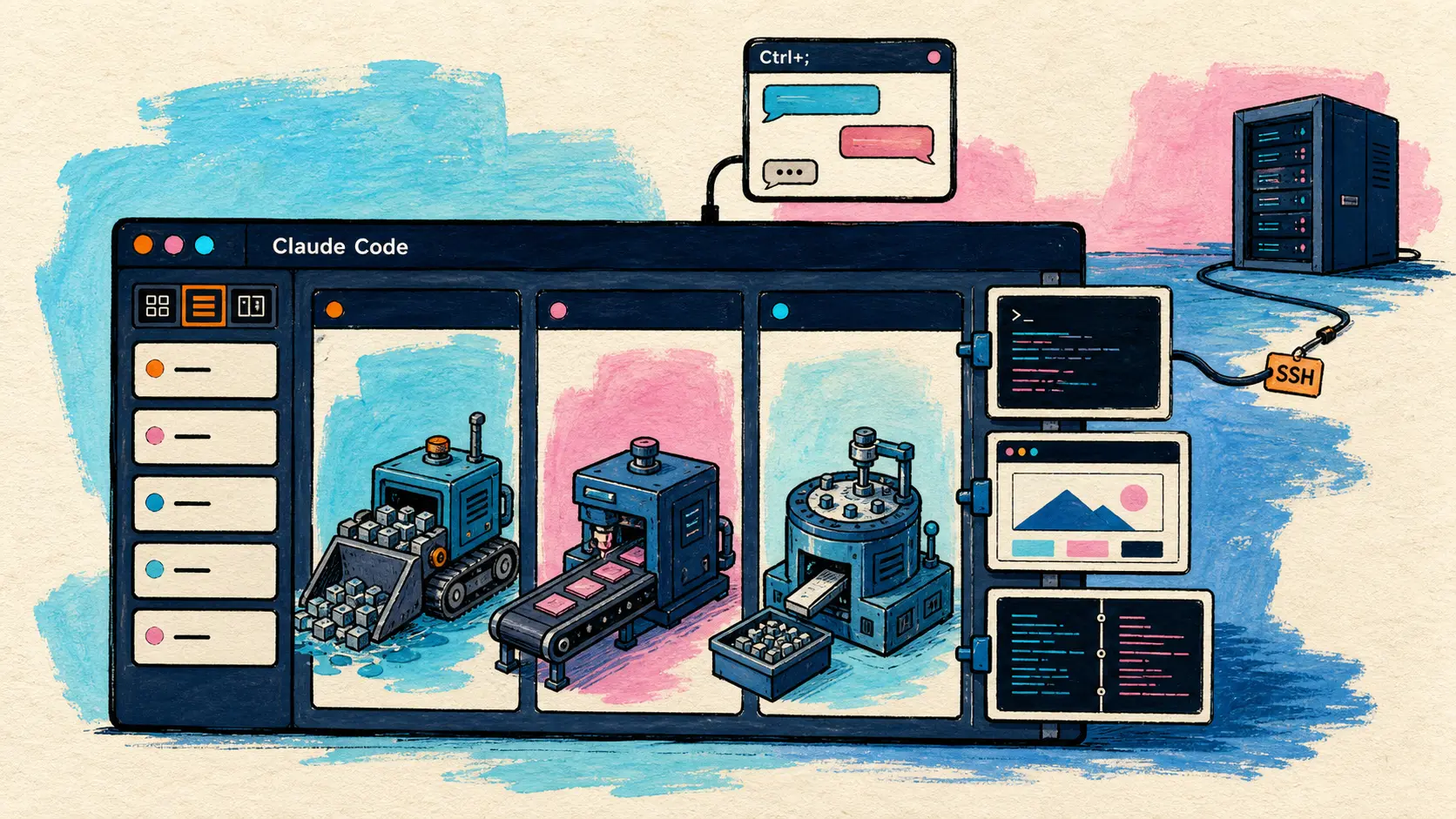
Claude Code Desktop: redesign for parallel agents
April 14 — Anthropic launches a full redesign of the Claude Code desktop app, designed for running multiple sessions in parallel.
“We’ve redesigned Claude Code on desktop. You can now run multiple Claude sessions side by side from the same app.” — @claudeai on X
| Feature | Description |
|---|---|
| Session sidebar | All active and recent sessions, filterable by status, project, or environment |
| Side chat (⌘+; / Ctrl+;) | Branch a conversation from the main session without polluting it |
| Integrated terminal | Run tests or builds without leaving the app |
| In-app file editor | Open, edit, and save files directly |
| Rebuilt diff viewer | Improved performance on large changesets |
| Extended preview | HTML, PDF, local servers in the preview panel |
| Drag-and-drop layout | Arrange terminal, preview, diff viewer, and chat freely |
| CLI plugin parity | Plugins work identically in the desktop app |
| SSH extended to Mac | In addition to Linux, sessions can point to remote machines |
| 3 view modes | Verbose, Normal, Summary — from full detail to results only |
The session sidebar is the most structural change: it centralizes all active sessions in one place, fundamentally changing the way you work with multiple agents in parallel. Side chat (⌘+; on Mac, Ctrl+; on Linux/Windows) makes it possible to start an extra conversation without polluting the context of the main session — useful for asking a quick question or testing a hypothesis.
The SSH extension to macOS closes a notable gap with Linux: sessions can now point to remote machines from the Mac, opening the door to workflows where code runs on a remote server while still being driven from the local interface.
Available now for all Claude Code users on Pro, Max, Team, Enterprise plans and via the Claude API.
🔗 Claude Blog — Redesigning Claude Code on desktop 🔗 Download the app
OpenAI Agents SDK v0.14.0: native sandbox and agentic primitives
April 15 — OpenAI releases a significant evolution of its Agents SDK (openai-agents>=0.14.0). The announcement positions this SDK as the standard infrastructure for building agents in production.
Enriched native harness
The SDK now integrates a set of primitives that align with what other leading agentic runtimes do:
| Primitive | Description |
|---|---|
| MCP (tool use) | Tool calling via the MCP protocol |
| AGENTS.md | Custom instructions via configuration file |
shell tool | Command execution (code execution) |
apply patch tool | File editing via patch |
| Skills | Progressive disclosure of capabilities |
| Configurable memory | Long-term agent state management |
Sandboxed runtime environment
Agents can now run in controlled environments (sandboxes) with their own file system, dependencies, and tools. The separation between the orchestrator (harness) and compute is designed for three goals: protect credentials in environments where generated code runs, enable durable execution via checkpoint and rehydration if the container dies, and allow scaling with multiple sandboxes in parallel.
Native sandbox providers supported: Blaxel, Cloudflare, Daytona, E2B, Modal, Runloop, Vercel.
Storage via the Manifest abstraction: AWS S3, Google Cloud Storage, Azure Blob Storage, Cloudflare R2.
Availability
Python first, TypeScript planned in a future release. Companies that tested it early include Oscar Health, LexisNexis, Thomson Reuters, Zoom.
🔗 Official OpenAI announcement
Gemini 3.1 Flash TTS: audio tags and Elo 1 211
April 15 — Google launches Gemini 3.1 Flash TTS, its most expressive and controllable text-to-speech model to date.
The headline feature is the introduction of audio tags: natural-language commands embedded directly in the input text to control vocal style, pace, and tone. A passage surrounded by [excitement] will be spoken enthusiastically, a [explanatory] passage will adopt an instructional tone. This approach places the developer in the role of a “director” to compose precise audio experiences.
| Feature | Detail |
|---|---|
| Audio tags | Natural-language commands in the text |
| Supported languages | 70+ (including 24 high-quality evaluated) |
| Multi-speaker dialogue | Native |
| Watermarking | SynthID integrated across all generated audio |
| Elo score | 1 211 (Artificial Analysis TTS Leaderboard) |
With an Elo score of 1 211 on the reference Artificial Analysis TTS ranking — which measures thousands of human preferences in blind testing — the model is positioned in the “most attractive quadrant” for its quality/cost balance.
In Google AI Studio, three advanced controls are available: Scene direction (define environment and acting instructions), Speaker-level specificity (unique audio profiles per character), and Seamless export (export settings as API code to keep vocal consistency across projects).
All generated audio is imperceptibly marked by SynthID, Google’s digital watermark.
Availability:
- Developers: preview via the Gemini API and Google AI Studio
- Enterprises: preview on Vertex AI
- Workspace users: via Google Vids
🔗 blog.google article — Gemini 3.1 Flash TTS
Gemini App for Mac: native desktop client
April 15 — Google launches the Gemini app for macOS, available free for all users on macOS 15 and later.
| Feature | Detail |
|---|---|
| Global shortcut | Option + Space from any application |
| Window sharing | Context on local documents, code, data |
| Image generation | Nano Banana integration |
| Video generation | Veo integration |
| Availability | Free, macOS 15+, worldwide |
The app is accessible from any screen via Option + Space, allowing you to query Gemini without leaving your workflow. It can share the active window to provide instant context on local files, spreadsheets, charts, or code blocks.
Google presents this version as an “initial release” that lays the foundation for a personal, proactive desktop assistant, with more announcements expected in the coming months.
🔗 blog.google article — Gemini App for macOS
Claude Code v2.1.108 and v2.1.109: session recap, 1h caching, thinking
April 14-15 — Two new Claude Code releases in two days.
v2.1.108 brings several functional improvements:
| Feature | Description |
|---|---|
| Session recap | /recap or /config, automatically triggered after an absence. Can be forced via CLAUDE_CODE_ENABLE_AWAY_SUMMARY |
| Prompt caching 1h | Variable ENABLE_PROMPT_CACHING_1H for 1h TTL (API key, Bedrock, Vertex, Foundry). FORCE_PROMPT_CACHING_5M forces 5 min TTL |
| Slash commands via Skill tool | The model can invoke built-in commands (/init, /review, /security-review) via the Skill tool |
/undo alias | /undo is now an alias for /rewind |
/model improvements | Warning before model change (the next response rereads the full history without cache) |
/resume improvements | Defaults to sessions in the current directory; Ctrl+A to see all projects |
The /recap feature is particularly useful in a parallel-agents context: when you return to a session left in the background, Claude summarizes what happened since the last interaction.
v2.1.109 brings an interface improvement for extended thinking mode: the progress indicator spins with a rotating hint to make it easier to see that the model is in a thinking phase.
Anthropic: automated alignment researchers (PGR 0.97)
April 14 — As part of the Anthropic Fellows program, an original experiment: can Claude Opus 4.6 be used to accelerate alignment research?
The “weak-to-strong supervision” problem is a proxy for the challenge ahead: how do we supervise models smarter than us? The experiment uses a strong model (Qwen 3-4B-Base) and a weak model as the “teacher” (Qwen 1.5-0.5B-Chat). The performance gap recovered (PGR) metric measures how much the strong model surpasses the weak teacher’s limits.
Setup: 9 copies of Claude Opus 4.6 equipped with tools (sandbox, shared forum, storage, score server) work in parallel for 5 days. Each instance receives a slightly different starting point to encourage diversity of approaches.
| Indicator | Value |
|---|---|
| Human baseline (7 days, 4 methods) | PGR 0.23 |
| Automated researchers after 5 days (800h cumulative) | PGR 0.97 |
| Total cost | |
| Math generalization | PGR 0.94 |
| Code generalization | PGR 0.47 (double the baseline) |
| Production test (Claude Sonnet 4) | No significant improvement |
The researchers specify that this result does not mean Claude is a “generalist alignment scientist” — the chosen problem is exceptionally well suited to automation (single objective measure). But the experiment shows that Claude can increase the pace of alignment experimentation, and that diversity of starting points is key. The code and data are open source.
🔗 Anthropic blog — Automated Alignment Researchers
Subliminal learning in LLMs published in Nature
April 15 — A research paper co-authored by Anthropic and Owain Evans was published in Nature on the phenomenon of subliminal learning in LLMs.
“Research we co-authored on subliminal learning—how LLMs can pass on traits like preferences or misalignment through hidden signals in data—was published today in Nature.” — @AnthropicAI on X
The paper shows that LLMs can transmit traits (such as “liking owls”) through seemingly neutral data (for example, sequences of numbers unrelated to the trait). This hidden transmission phenomenon raises important safety questions: a model could spread preferences or misalignment through training data without this being detectable by direct inspection. A preprint was published in July 2025.
🔗 Nature article — Subliminal Learning
GPT-5.4-Cyber and expansion of the TAC program
April 14 — OpenAI announces the expansion of its Trusted Access for Cyber (TAC) program to thousands of verified individual defenders and hundreds of teams responsible for protecting critical software.
A new model, GPT-5.4-Cyber, is now available to users at the highest tiers of the program. It is a GPT-5.4 variant optimized for defensive cybersecurity, with a lowered refusal threshold for legitimate uses and an exclusive binary reverse engineering capability (analysis of compiled software without access to source code).
The TAC program operates on three levels:
- Individual users: Identity verification on chatgpt.com/cyber
- Businesses: Team access via OpenAI representative
- Higher tiers (access to GPT-5.4-Cyber): Strong authentication + expression of interest
Codex Security, launched in early 2026, has already helped fix more than 3,000 critical and high-severity vulnerabilities.
🔗 Official OpenAI announcement
Gemini Personal Intelligence: global rollout
April 15 — The Personal Intelligence feature in the Gemini app is expanding internationally. Previously limited to the United States, it is now available to Google AI Ultra, Pro, and Plus subscribers worldwide, with a rollout to free users planned soon.
Personal Intelligence lets Gemini provide personalized and contextual answers by connecting to the user’s Google apps: Search, Gmail, Google Photos, and YouTube. Google also announced the arrival of Personal Intelligence in Google Chrome later this week.
Mistral Connectors MCP in Studio (Public Preview)
April 15 — Mistral AI launches Connectors in Mistral Studio in Public Preview, allowing enterprise data sources to be connected via the MCP protocol.
A connector encapsulates an integration into a reusable entity based on MCP. Once registered, it is governed and monitored in Studio, and becomes a native tool for any conversation, agent, or workflow.
| Feature | Detail | | ---------------------------- | ------------------------------------------------------------- | ------------------------------------------------------------------------------------- | | Integrated and custom MCPs | Available for all model and agent queries | | Direct tool calling | Fine-grained control over when and how tools are invoked | | Human-in-the-loop validation | Configurable approval flow before tool execution | | Programmatic access | Create, edit, list, and delete connectors via the API | | Centralized registry | Available in all Mistral apps (Le Chat, AI Studio, Vibe soon) | Supported integrations: CRM, knowledge bases, productivity tools, GitHub, web search. |
🔗 Mistral Announcement — Connectors
First fully AI-produced automotive ad spot
April 15 — Luma Agents powered Mazda’s first fully AI-produced ad spot. Independent creative agency Boundless (Johannesburg) used Luma to create a campaign bringing together several generations of the MX-5 and decades of brand storytelling. Total turnaround from concept to final approval: less than two weeks.
Luma cites this case as an example of AI-native creative workflows: faster production, without compromising the creative vision.
🔗 Luma Labs — Boundless × Mazda
Minor announcements
Kling AI Skill (April 15) — Kling is launching a one-stop wrapper for its APIs for direct integration into AI agents. Agents can access Text/Image-to-Video generation, 4K image generation, and cross-scene consistency, without complex setup. Compatible with Claude Code, Cursor, Codex, Copilot. 🔗 Kling AI Skill documentation
Qwen in OpenCode (April 15) — Qwen3.6-Plus and Qwen3.5-Plus are now available in the OpenCode coding tool. Qwen3.5-Plus is 3x cheaper than Qwen3.6-Plus, both models support images and offer zero data retention. 🔗 Tweet @Alibaba_Qwen
Copilot Cloud Agent — selective activation (April 15) — GitHub Enterprise admins can now selectively enable Copilot Cloud Agent by organization via custom properties. Three new REST endpoints make it possible to manage this policy via API. 🔗 GitHub Changelog
What this means
April 15 shows a convergence: major players are equipping their development environments with standardized agentic infrastructure. Claude Code Desktop, OpenAI’s Agents SDK, and Mistral Connectors share the same logic — orchestrating multiple agents in parallel, giving them primitives (MCP, AGENTS.md, shell, files), and providing them with an isolated execution environment.
The most significant announcement remains the Claude Code Desktop redesign: the sessions sidebar and side chat change the way people work with multiple agents simultaneously, a use case that is gradually becoming the norm for developers who rely on AI.
On the research side, the Nature publication on subliminal learning and the automated alignment researchers experiment (PGR 0.97 for $18,000) indicate that Anthropic is also investing in understanding long-term risks — a balance between immediate productivity and structural safety.
Sources
- Claude Blog — Redesigning Claude Code on desktop
- Claude Code CHANGELOG (GitHub)
- Anthropic — Automated Alignment Researchers
- Nature — Subliminal Learning in LLMs
- OpenAI — The Next Evolution of the Agents SDK
- OpenAI — Scaling Trusted Access for Cyber Defense
- blog.google — Gemini 3.1 Flash TTS
- blog.google — Gemini App for macOS
- Mistral — Connectors MCP
- Luma Labs — Boundless × Mazda
- Kling AI Skill documentation
- GitHub Changelog — Copilot Cloud Agent custom properties
This document was translated from the fr version to the en language using the gpt-5.4-mini model. For more information about the translation process, see https://gitlab.com/jls42/ai-powered-markdown-translator