ai-powered-markdown-translatorArticle translated from fr to en with gpt-5.4-mini.
Between August 14 and 16, 2026, Cursor officially joined SpaceX, Z.ai launched GLM-5.3 with a strong cyber defense focus, and Pika Labs unveiled its first generation of audio models. At the same time, Anthropic detailed an internal experiment in which Claude Code routines autonomously maintain its iOS, Android, Desktop, and web applications, with 388 open pull requests and 180 merged. Also on the menu: watermarking at Anthropic and Gemini, Copilot, Zed, and Replit updates, and the arrival of the open weights of Qwen3.8-27B.
Cursor joins SpaceX — acquisition officially completed
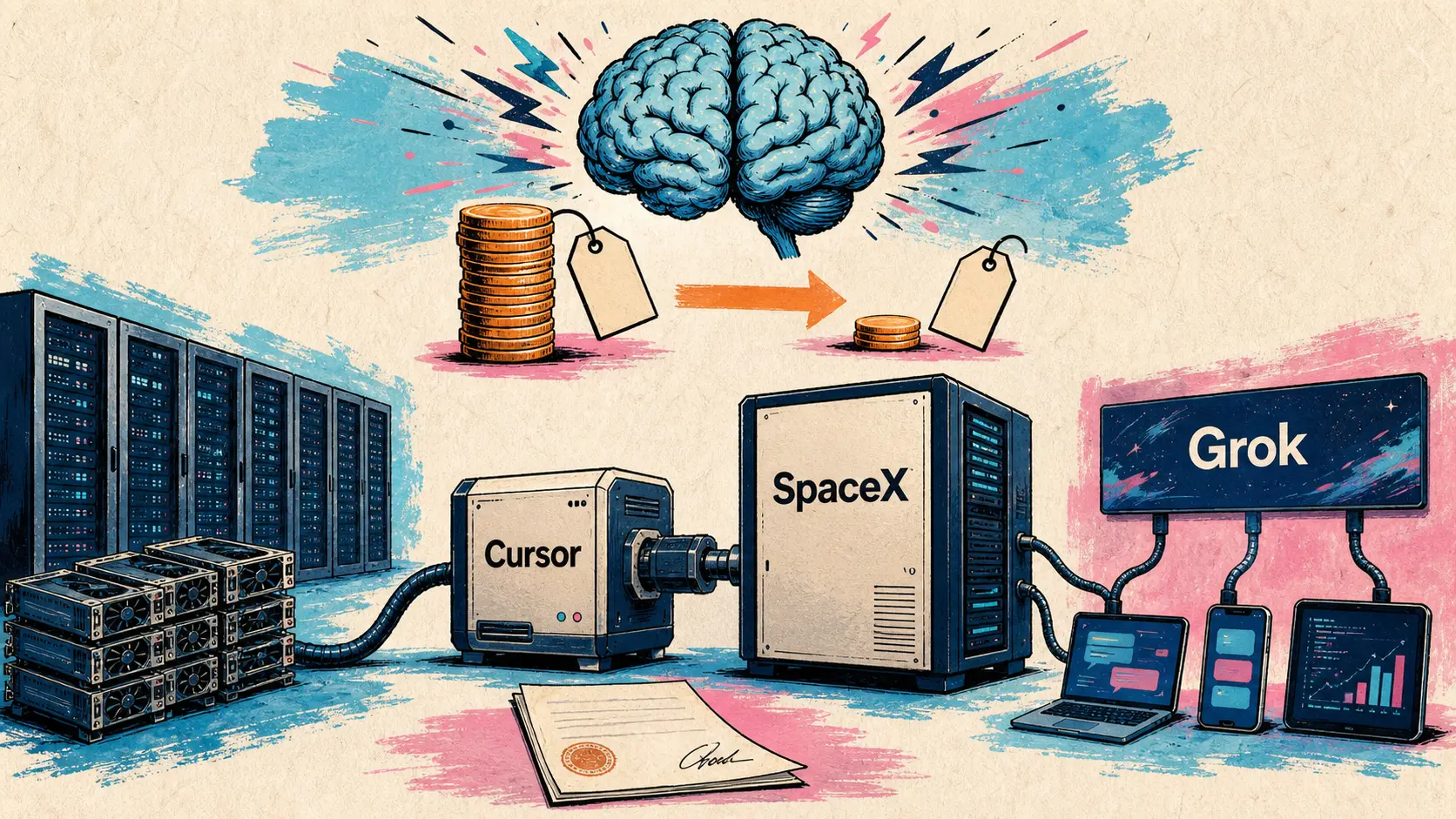
August 14 — Cursor announces that its acquisition by SpaceX is officially closed. The editor joins the SpaceXAI team to, in its own words, help make Grok the most useful AI in the world and improve a set of products: Grok Build, Grok Bot, Grok API, and Cursor itself.
The process was not a total surprise: a partnership between the two companies had been announced in April 2026, and this August step marks the culmination of it.
From a strategic standpoint, Cursor justifies the move by gaining access to SpaceX’s massive GPU infrastructure, which should make it possible to train and serve more capable models at lower cost. The company says it wants to keep its product direction — helping developers spend less time writing code and more time solving complex problems — with more powerful AI teammates (AI teammates) and lower pricing, announced as a direct consequence of this compute pooling.
This is a notable move in the AI development tools landscape: Cursor, one of the most widely used agentic IDEs, changes ownership to integrate the xAI/SpaceX ecosystem alongside Grok, in a context of rapid sector consolidation. The post does not detail any immediate change in the user experience beyond the promise of more powerful and cheaper models.
Cursor is now part of @SpaceX. Today, we have officially closed our acquisition. We will join the @SpaceXAI team to help make Grok the world’s most useful AI and improve Grok Build, Grok Bot, Grok API, Cursor, and more. — @cursor_ai on X
🔗 Official Cursor post — “Cursor is now a part of SpaceX”
Z.ai launches GLM-5.3, built for agentic coding and cyber defense
August 14 — Z.ai (Zhipu AI) introduces GLM-5.3, successor to GLM-5.2, with two priority areas: agentic coding and cyber defense. The model results from post-training on a 743-billion-parameter base, with better performance in agentic coding while consuming fewer output tokens than GLM-5.2.
On the security side, Z.ai integrated vulnerability discovery data and authorized security environments during post-training:
| Evaluated benchmark | GLM-5.2 | GLM-5.3 |
|---|---|---|
| CyberGym (vulnerability identification) | 77.2 % | 84.5 % |
| ExploitBench (exploit reasoning) | 24.4 % | 54.4 % |
| ExploitGym (successful tasks in 2h) | 29 | 105 |
| ExploitGym (successful tasks in 6h) | 39 | 130 |
According to Z.ai, the GLM series as a whole has made it possible to identify 2,436 vulnerabilities across 269 projects (including 1,097 of medium to high severity), as part of authorized research conducted with universities and professional security teams.
Faced with the obvious dual-use risks of a more capable model in offensive cybersecurity, Z.ai is adopting a phased rollout: selected security partners first evaluate the model in a controlled setting, before broader API access and then the release of open weights once security evaluations are complete. For now, GLM-5.3 is available via the GLM Coding Plan and ZCode, with a “Weekend Build” event (August 16–17) offering 100 million free tokens to new ZCode users.
Claude Code keeps Anthropic’s applications running autonomously: 388 PRs open, 180 merged
August 13 — Boris Cherny (Claude Code team at Anthropic) details an internal experiment conducted over several weeks: entrusting Claude with the daily maintenance of Anthropic’s applications (iOS, Android, Desktop, web, CLI, and Agent SDK). The setup relies on a dedicated Slack channel in which “Claude Tag” runs a series of automated daily routines:
| Routine | Role |
|---|---|
| Crash fuzzer | Opens the app in a simulator, triggers crashes, identifies the cause, and proposes a fix |
| Dup unifier | Finds similar but divergent abstractions, opens PRs to unify them |
| Dead-code remover | Removes statically unreachable code after logging confirmation |
| Abstraction police | Fixes leaky abstractions |
The results are presented as surprisingly positive: over the past few weeks, these routines have opened 388 pull requests across Anthropic’s repositories, 180 of which were merged after a Claude Code Review followed by a human review. If something fails, the team asks Claude to adjust its own routine to improve the next day. Anthropic now says it is considering ways to streamline the merge process for this kind of mechanical change, and invites anyone interested to reproduce a similar workflow.
Over the last few weeks, these routines have opened 388 PRs across our repos, 180 of which we merged after Claude Code Review + human review. Claude generally gets these PRs right on the first shot, and if it doesn’t, we ask Claude to tune its routines so it’s better the next day. — @bcherny on X
🔗 Crash fuzzing routine prompt
Pika Labs launches Pika Audio Models, four foundation models for generated sound
August 14 — Pika Labs, previously focused on video generation, enters the generated audio market with four foundation models grouped under the name Pika Audio Models: Pika Soundtrack (background music for video), Pika Music (music generation), Pika SFX (sound effects), and Pika Speech (synthetic voice).
The central argument in the announcement is price:
| Model | Claimed comparison |
|---|---|
| Pika Soundtrack | $0.617 per second — 2x more efficient than Hunyuan Foley |
| Pika SFX | up to 20x more efficient than alternatives |
| Pika Speech | 9x more efficient than ElevenLabs v3, 4.5x more efficient than Cartesia |
| Pika Music | up to 10x more efficient than comparable music models |
The four models are available exclusively through the Pika API Club, with no public access announced for now — a choice aimed at developers and integrators rather than direct creation inside the Pika app. For the media generation landscape, this launch positions Pika Labs as a direct competitor to ElevenLabs on voice and to music-generation players, betting on price rather than on any claimed qualitative superiority.
Sound on! Today, we’re introducing Pika Audio models: 4 frontier foundation models that cover the full spectrum of generative sound. And we’ve made them less expensive than every audio model on the market—up to 20x times cheaper. — @pika_labs on X
Anthropic: watermarking, Risk Report, and Auto Mode by default
Anthropic publishes three back-to-back announcements on August 13 and 14, spanning regulatory transparency and the evolution of its flagship product Claude Code.
Watermarking FAQ: compliance with the AI Act without affecting quality
August 14 — Anthropic publishes an FAQ to answer questions received about watermarking (invisible marking) of texts generated by Claude. This measure aims to comply with the European AI Act, as part of the same Code of Practice signed by other major model developers. The company states that the method has no practical impact on answer quality, that marked and unmarked text remain indistinguishable when read, that no hidden characters are inserted, that watermarking does not consume extra tokens and will not cost more, and that the watermarks cannot be traced back to a specific person or conversation.
Second Risk Report: transparency on risks
August 14 — As part of its Responsible Scaling Policy, Anthropic regularly publishes Risk Reports detailing the risks posed by its systems and the company’s level of readiness to address them. The second report of this kind has just been published online, following the first one already released. The announcement tweet does not detail the document’s specific content beyond its existence and transparency goal — the practice nonetheless fits into a broader movement of voluntary risk governance at major AI labs, alongside regulatory obligations such as the European AI Act.
Auto Mode becomes the default mode, new /auto-mode-setup command
August 14 — The rollout announced on August 7 is now in effect: Auto Mode becomes the default permission mode in Claude Code, for Pro, Max, and Team accounts. If a default mode had already been configured manually, Claude asks for confirmation before changing it. Two mechanisms keep control in place: switch modes at any time via Shift+Tab, or pin a fixed mode with the “defaultMode” parameter in settings. Anthropic also introduces a new command, /auto-mode-setup, which analyzes the project repository and suggests a list of trusted repositories and domains for the user to validate.
Code tools: Amp hosts Git, Zed 1.15, Replit updates
Three agentic editors and development environments publish notable updates between August 14 and 16.
Amp now hosts Git repositories — “Step 1”
August 15 — Amp (Sourcegraph) adds Git repository hosting directly into its ecosystem, presented by founder @sqs as the first step (“Step 1”) of a broader ambition: reducing users’ and agents’ dependence on GitHub. In a follow-up message, he clarifies that this is only an initial milestone, not a rejection of GitHub. On pull requests, Amp takes a firmer position: they remain a good reason to stay on GitHub, but the company believes they are becoming less and less important in an agent-dominated workflow — a statement consistent with the fact that the Amp team is already pushing directly to main without PRs.
Zed v1.15: branch diff, drag-and-drop, JSX/TSX custom elements
August 14 — Zed releases version 1.15, the same day as the launch of Delta’s private beta. The most notable feature lets users compare their current branch with the repository’s default branch directly in the editor gutters, via the “Diff Against Default Branch” option. Zed also adds drag-and-drop support for files into external applications (macOS and Linux Wayland), and linked JSX/TSX tag editing now works with custom elements (custom elements) — renaming one tag automatically updates its corresponding closing tag. Emmet completions are also available in return and arrow functions.
Replit: MCP servers, beta Admin API, inline charts, Clerk migration
August 14 — In its weekly recap, Replit details several updates: three new MCP servers can be added to the Agent, including Airtable and Rootly Docs; a beta Admin API lets Enterprise administrators extract account data and track usage and spending; inline charts let users ask the Agent for data and get a chart displayed directly in the conversation; and apps using Replit Auth can be more easily migrated to Clerk Auth, with the agent first migrating account data so existing users keep access.
🔗 “This Week in Replit” thread
GitHub Copilot: Grok 4.6, agent apps, and open source security
Four GitHub announcements shape the week, spanning new models, CLI tooling, and security initiatives.
Grok 4.6 available in GitHub Copilot
August 14 — xAI’s reasoning model gradually arrives in Copilot (VS Code, Visual Studio, CLI, JetBrains, Xcode, Eclipse, app, and cloud agent) for Pro to Enterprise plans, with usage-based billing. For Business and Enterprise, administrators must explicitly enable the Grok 4.6 policy, which is disabled by default. This integration comes during a busy week for Copilot: Grok 4.6 also arrived the same day at Devin, Warp, and Genspark.
Weekly updates: Agent Plugins 1.0, /tasks, /rewind, Kimi K3
August 14 — Copilot’s weekly recap details several updates: Agent Plugins 1.0 reaches general availability in VS Code, the CLI, the SDK, and the Copilot app; Kimi K3 rolls out to all subscription plans; and MAI-Code-1.1-Flash introduces native image understanding. In the Copilot CLI, a /tasks command manages subagents, a /rewind command discards changes without going through git, and --plan now works together with --mode autopilot in headless mode. Copilot JetBrains memory preserves context between sessions, and Ollama becomes available as a BYOK provider. VS Code 1.133 adds model switching between Claude in BYOK and built-in models.
Agent apps: scoping, securing, and deploying without leaving GitHub
August 14 — GitHub details how four mentionable agent apps (“@mention”) make it possible to cover the software lifecycle without switching tools: Amplitude analyzes the impact of a feature on user behavior, Endor Labs performs dependency security reviews, LaunchDarkly creates and wires up feature flags for progressive deployments, and PagerDuty assesses deployment risk by checking active incidents before recommending a production release. Other agent apps are available at launch: Packfiles, Miro, Bright Security, SonarQube, and Octopus Deploy.
Secure Open Source Fund: Session 4 recap
August 13 — GitHub publishes the recap of the fourth session of its Secure Open Source Fund program: 50 open source projects improved their security posture by combining AI-assisted workflows, maintainer expertise, GitHub security tools, and direct funding. The post emphasizes the central role of maintainers in protecting the open source ecosystem, at a time when AI is fundamentally changing how software is built, reviewed, and secured.
Gemini: configurable watermark and Pixel 11 roundup
Configurable SynthID: detect and customize the watermark
August 14 — Gemini now lets you check whether content (image, video, music) was generated by AI by asking it directly: “Is this AI-generated?”. In addition, Google is rolling out over several days the ability to choose whether creations made with Gemini display a visible watermark or not. Invisible SynthID watermarks as well as C2PA metadata, meanwhile, always remain embedded in the background regardless of this setting — only the visible display becomes optional, via a “Show watermark” button in the account settings.
🔗 Configurable SynthID announcement
Pixel 11, Gemini Intelligence, and WeatherNext 2 open source
August 14 — In its weekly roundup, Google AI looks back at the Pixel 11 lineup (Pixel 11, Pixel Watch 5, Pixel Tag), which includes Magic Capture, Rambler, and an extension of Live Transcribe for real-time American Sign Language translation — all overseen by Gemini Intelligence, a new proactive, agentic AI layer. The same roundup confirms the open source release of WeatherNext 2, Google DeepMind’s weather forecasting tool, which provides one extra day of lead time on a cyclone’s path and intensity. Finally, the new Gemini Notebook experience is now fully rolled out for Pro users.
Media generation: Wan Agent Skills, HeyGen Avatar V, NVIDIA x Runway
Wan launches Agent Skills, a marketplace for community workflows
August 14 — Alibaba is opening a new feature on Wan Video, Agent Skills, which allows users to create and share reusable creative workflows built around Wan models — from a “short drama” generator to a music clip generator. The launch comes with an incentive program: each Skill published successfully earns 150 Inspiration points, capped at 450 points per account, until August 31, 2026. This announcement continues the recent releases in the Wan ecosystem (Wan3.0, Wan-Animate-2, Wan CLI): Alibaba is structuring the platform beyond a simple standalone video generation tool.
🔗 Wan Agent Skills announcement
HeyGen unveils Avatar V, a new generation of its avatar engine
August 13 — HeyGen presents Avatar V, a new version of its video avatar generation engine. Rather than compressing the user’s reference video into a single image, as “most avatar systems” would according to the company, Avatar V would read the entire reference video at each model layer. This approach would better preserve fine details that are usually lost — skin texture, teeth, micro-expressions — as well as the speaking rhythm specific to the person being filmed. No benchmark figures or general availability date are provided.
NVIDIA details the Vera Rubin partnership with Runway, behind Gen-4.5
August 13 — At the Runway AI Summit 2026, NVIDIA highlighted, through its media and entertainment lead Richard Kerris, the role of its Vera Rubin infrastructure in the deployment of Runway’s Gen-4.5 model. The headline figure: thanks to this infrastructure, Runway would have been able to deploy Gen-4.5 on its platform in a single day. NVIDIA positions real-time generative AI as a new computing model for media and entertainment, capable of turning creative production into a live, artist-driven process rather than a classic delayed rendering pipeline.
Open source ecosystem: Hugging Face recap and AI Factory in India
State of Open Models Summer 2026: China dominates the frontier, Qwen leads derivatives
August 14 — Hugging Face publishes its semiannual overview of the open model ecosystem. Chinese labs dominated frontier releases in 2026, with models ranging from 754 billion to 2.78 trillion parameters, compared with less than 130 billion parameters for most U.S. releases. Qwen (Alibaba) stands out as the community’s foundational model with 151,448 derivatives on the Hub, or 2.6 times Meta’s footprint. In real-world usage, models under 1B parameters capture 83% of all historical downloads. Finally, AI agents are emerging as a new traffic category: Claude Code accounted for 44.4% of tagged “agent” traffic in July.
Together AI and Larsen & Toubro are building India’s largest AI Factory
August 13 — Together AI announces a partnership with Indian group Larsen & Toubro to build what would become the country’s largest GPU cluster: 10,000 NVIDIA B300 GPUs, presented as “India’s largest AI Factory”. The infrastructure is explicitly positioned to serve the open-source ecosystem — inference, fine-tuning, and large-scale training — for India’s AI-native ecosystem. The announcement confirms the rise of regional AI factories based on NVIDIA’s latest-generation hardware.
Qwen3.8-27B: open weights and rapid ecosystem adoption
August 14 — Alibaba publishes the open weights for Qwen3.8-27B, a dense natively multimodal model under Apache 2.0. According to Qwen, it outperforms Qwen3.7-Plus overall and stands out on coding and office tasks, with a native context window of 262K tokens, expandable up to 1M via YaRN.
| Provider / tool | Detail |
|---|---|
| Unsloth | Runs with only 17 GB of RAM |
| SGLang | 206 tokens/second on a single RTX 5090 |
| vLLM | Day-0 support with full 1M-token context window |
| Ollama, LM Studio, MediaTek, RTX Spark | Integration in the following days |
On August 16, Qwen3.8-27B became the most trending model on Hugging Face, and Alibaba said it had passed 3 billion cumulative downloads for its Qwen family on the platform.
OpenAI launches Computer History in ChatGPT desktop
August 13 — OpenAI launches Computer History, a feature in the ChatGPT desktop app that lets ChatGPT and Codex remember the user’s recent activity across their apps and websites, reducing the need to re-explain context at every interaction. The feature builds on the previously published Chronicle preview, with a new chronological view that makes it possible to create “skills” from frequent tasks. On the privacy side, the user can clear their history, exclude certain apps, and activation is done via explicit opt-in. Rollout starts for ChatGPT desktop Pro, Business, and Enterprise users on Mac; EEA, the UK, and Switzerland will follow in the coming weeks.
🔗 Computer History announcement
Perplexity migrates Sonar to the Agent API
August 13 — Perplexity is evolving its Sonar API into a new Agent API, which keeps grounded web search while adding multi-step search, code execution, built-in tools, and access to multiple models through a single entry point. On the BrowseComp and WideSearch benchmarks, the team says the Agent API more than doubles Sonar’s best-ever score. For developers already integrated with Sonar, the migration still bears watching: the announcement does not specify a deprecation timeline or backward compatibility.
Briefs
- Claude Code desktop — auto-continue after usage limit — a new checkbox lets Claude Code desktop automatically resume a session as soon as the usage limit resets. 🔗 Tweet
- Claude Cowork — office hours open to non-tech teams — the Cowork team opens 15-minute slots to gather feedback from users in marketing, sales, finance, legal, and ops. 🔗 Tweet
- Gemini 3.7 Flash available in Devin, -50% for two weeks — at Claude Sonnet 5 level on FrontierCode 1.1 for less than half the cost, offered at -50% until August 27, 2026. 🔗 Tweet
- Gemini 3.7 Flash available on Genspark — integrated into AI Chat, Code Agent, and Genspark Claw, three weeks after 3.6 Flash, at half price. 🔗 Tweet
- Amp improves Portal URL sharing — OpenGraph previews, shorter URLs, and the Portal tab feels more like a shareable browser. 🔗 Tweet
- Copilot CLI and a Namecheap skill automate a GitHub Pages site — go from an empty repo to a GitHub Pages site on HTTPS with a custom domain in about 14 minutes. 🔗 Tweet
- GitHub details the stacked pull request workflow with AI agents — break agent-generated work into a stack of targeted PRs, managed via the
gh stackCLI. 🔗 Tweet - GitHub Copilot Dev Days — call for community events — GitHub invites developers to organize or join Copilot Dev Days events in their city. 🔗 Tweet
- Blocking users from comments (personal repositories) — PR and issue comments in personal repositories can now be used to block or unblock a user from the More menu. 🔗 GitHub changelog
- OAuth Apps — multiple redirect URIs and token refresh — up to 10 redirect URIs and short-lived tokens with refresh, shipped with GitHub Enterprise Server 3.23. 🔗 GitHub changelog
- Ideogram updates its AI image editor — object removal and targeted retouching, judged superior to GPT-2 and Nano Banana Pro in certain comparison tests according to a third-party account. 🔗 Tweet
- NVIDIA and Indosat open Indonesia’s first university AI center — three initial student projects: tuberculosis screening, precision agriculture, and disaster alerts. 🔗 NVIDIA article
- Runway opens early access to Seedance 2.5 in 1080p — an update affecting only output resolution, with no other new feature announced. 🔗 Tweet
- Cohere — North Mini Code passes 150k downloads — the open source model remains available via Model Vault, OpenRouter, or locally following the end of the free OpenCode offer. 🔗 Tweet
What this means
Consolidation around GPU infrastructure is accelerating and redrawing the balance of power. SpaceX’s acquisition of Cursor anchors an agentic IDE editor in a massive computing ecosystem rather than leaving it dependent on third-party providers, much like Together AI building with Larsen & Toubro India’s largest GPU cluster to power regional open-source inference, or NVIDIA staging its Vera Rubin chip as the condition for Runway’s one-day deployment of Gen-4.5. In all three cases, compute capacity becomes as much of the selling point as the model itself.
Agents are no longer just assisting: they are starting to operate. The Claude Code routines that maintain Anthropic’s applications on their own (388 PRs, 180 merged) are the clearest illustration, but the movement is broader — Auto Mode becomes Claude Code’s default setting, GitHub is structuring agent apps capable of scoping and deploying a feature end to end, its Copilot CLI gains /tasks and /rewind commands to manage sub-agents, and Amp is beginning to move beyond GitHub by hosting its own Git repositories. Development infrastructure is reorganizing around agent autonomy rather than mere code assistance.
Governance of generated content is becoming a shared concern, driven by the same regulatory deadline. Anthropic details its watermarking method and publishes its second Risk Report the same week Gemini makes the visible watermark configurable while keeping SynthID active in the background — two distinct responses to the same European AI Act Code of Practice. The phased rollout of GLM-5.3, stronger in offensive as well as defensive cybersecurity, illustrates the same tension: release a more capable model while controlling its dual-use potential before opening the weights.
Finally, the economics of open models are increasingly being decided by adoption speed and price rather than raw performance alone. Qwen3.8-27B becomes the most trending model on Hugging Face in just two days, helped by day-0 support in Ollama, vLLM, and SGLang, while the Hugging Face recap confirms that Qwen already dominates community derivatives with 2.6 times Meta’s footprint. Pika Labs applies the same logic to generated audio, betting on a price argument that can go as much as 20 times cheaper rather than on claimed qualitative superiority — a sign that the battle for open and low-cost models is now being fought as much on distribution as on benchmarks.
Sources
- Cursor — announcement on X
- Cursor — official post
- Z.ai — GLM-5.3 announcement on X
- Boris Cherny — Claude Code routines on X
- Boris Cherny — prompt crash fuzzing on X
- Pika Labs — Pika Audio Models announcement on X
- Pika Labs — price comparisons
- Anthropic — watermarking FAQ on X
- Anthropic — second Risk Report on X
- Anthropic — Auto Mode by default on X
- Amp — Git hosting on X
- Zed — v1.15 changelog
- Replit — weekly thread on X
- GitHub — Grok 4.6 in Copilot
- GitHub — Copilot weekly releases
- GitHub — agent apps
- GitHub — Secure Open Source Fund Session 4 on X
- Gemini — configurable SynthID on X
- Google AI — Pixel 11 recap on X
- Wan — Agent Skills on X
- HeyGen — Avatar V on X
- NVIDIA — Vera Rubin x Runway partnership on X
- Hugging Face — State of Open Models Summer 2026
- Together AI — AI Factory in India on X
- Alibaba Qwen — Qwen3.8-27B announcement on X
- OpenAI — Computer History on X
- Perplexity — Agent API on X
- Claude Code desktop — auto-continue on X
- Claude Cowork — office hours on X
- Devin — Gemini 3.7 Flash on X
- Genspark — Gemini 3.7 Flash on X
- Amp — sharing Portal URLs on X
- GitHub — Copilot CLI + Namecheap skill on X
- GitHub — stacked pull requests on X
- GitHub — Copilot Dev Days on X
- GitHub — blocking users from comments
- GitHub — OAuth Apps redirect URIs and refresh tokens
- Curious Refuge — Ideogram editor on X
- NVIDIA — Indonesia AI center
- Runway — Seedance 2.5 1080p on X
- Cohere — North Mini Code