ai-powered-markdown-translatorArticle translated from fr to en with gpt-5.6-sol.
June 16, 2026 — Z.ai releases the open-source MIT weights of GLM-5.2 (1M-token window, two reasoning levels), Alibaba Qwen unveils the Qwen-Robot Suite, comprising three foundation models for robotics, and NVIDIA Blackwell dominates all MLPerf Training 6.0 benchmarks—including DeepSeek-V3 671B trained in 2.02 minutes on 8,192 GPUs. GitHub announces the paid general availability of Code Quality on July 20 at $10 per active developer per month, the June Pixel Drop brings Gemini Omni video and music generation to Pixel devices, and Anthropic’s economic research quantifies the impact of domain expertise on Claude Code for the first time.
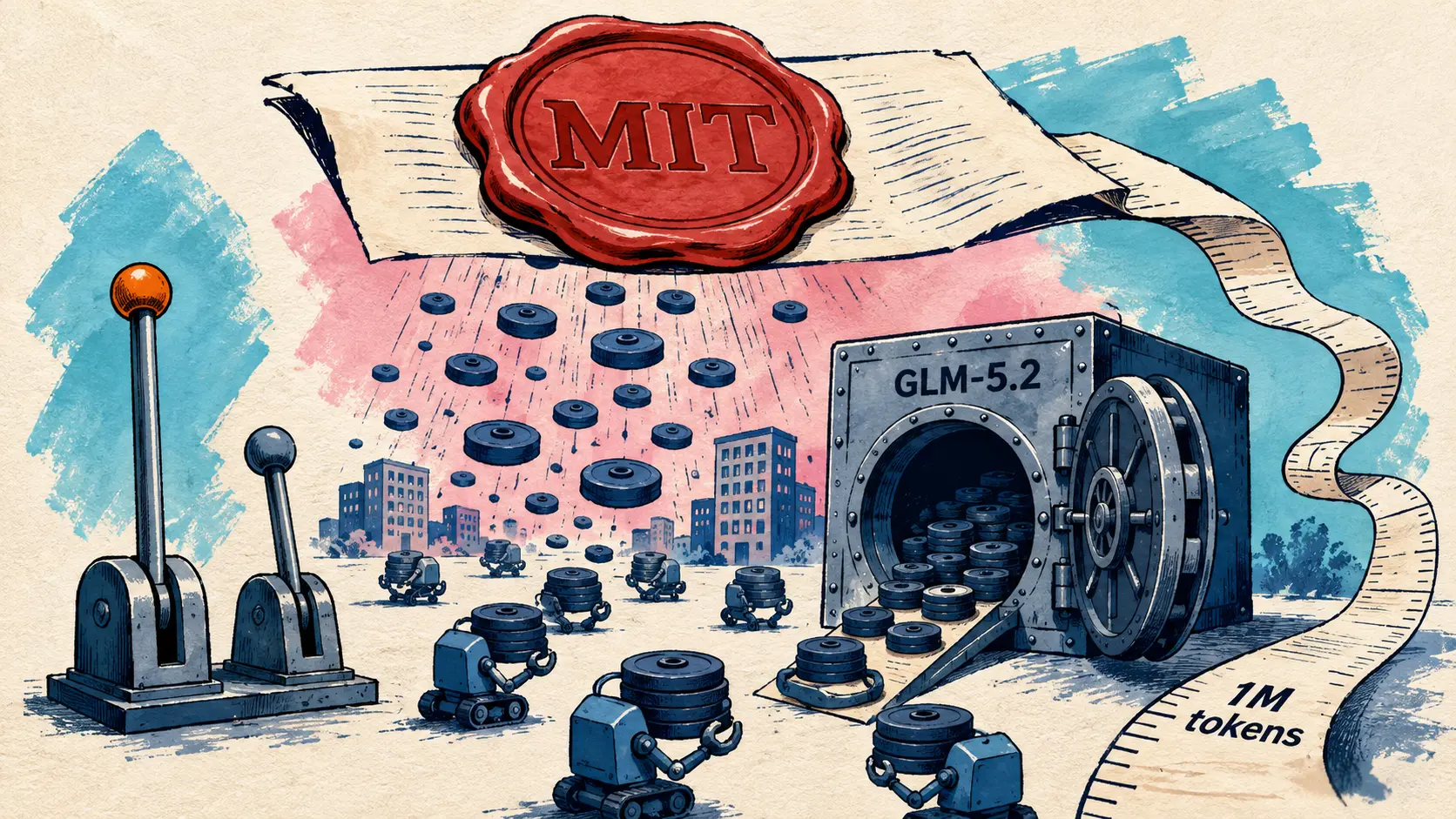
Z.ai GLM-5.2 — open-source MIT weights available
June 16 — Z.ai (formerly Zhipu AI) officially releases the open-source weights of GLM-5.2 under the MIT license, delivering on its June 13 announcement. The weights are now available for download on the company’s platform.
“Introducing GLM-5.2: Frontier Intelligence, Open Weights
- Significant improvements in coding and agentic tasks
- Strong long-horizon capabilities with a 1M context window
- Two levels of reasoning effort: GLM-5.2 (max) pushes the limits, while GLM-5.2 (high) strikes a strong balance” — @Zai_org on X
Key features of GLM-5.2:
- Significant improvements on coding and agentic tasks
- 1-million-token context window—useful for large-scale coding agents and long-document processing
- Two complementary reasoning-effort levels
- Outperforms GLM-5.1 in coding, tool use, and reasoning
- Available via chat.z.ai
| Variant | Reasoning | Context | License |
|---|---|---|---|
| GLM-5.2 (max) | Maximum performance | 1M tokens | MIT open-source |
| GLM-5.2 (high) | Strong performance/speed balance | 1M tokens | MIT open-source |
The MIT license is the most important marker: it permits unrestricted commercial use, making GLM-5.2 directly usable by companies that cannot or do not wish to depend on proprietary American models. The tweet reached 515,000 views within a few hours—a strong signal of the community’s interest in open-source frontier models with large context windows.
Qwen-Robot Suite — three foundation models for embodied robotics
June 16 — Alibaba Qwen announces the Qwen-Robot Suite, a complete stack for embodied intelligence comprising three distinct and complementary foundation models: navigation, manipulation, and a world model.
Qwen-RobotNav — mobile navigation specialist:
- Unifies 5 tasks in a single model: instruction following, point-goal navigation, object-goal navigation, object tracking, and autonomous driving
- Controllable observation protocol
- Tool interface for agentic systems
Qwen-RobotManip — manipulation specialist:
- Unified state-action space for heterogeneous robots
- Camera-frame delta poses for consistent learning across different robotic bodies (cross-embodiment)
- Pretrained on an open-source corpus of more than 38,100 hours
Qwen-RobotWorld — physical world model:
- A single model covering more than 20 types of robotic bodies
- Natural-language action interface
- Predicts physically grounded futures for manipulation, driving, and navigation
Each model can be used independently and composed as a physical-world tool. Together, they form the low-level toolkit for general-purpose agentic systems.
| Model | Specialty | Key data item |
|---|---|---|
| Qwen-RobotNav | Multi-task navigation (5 unified tasks) | Tool interface for agentic systems |
| Qwen-RobotManip | Cross-embodiment robotic manipulation | 38,100+ hour open-source corpus |
| Qwen-RobotWorld | Physical world model | 20+ robotic body types |
🔗 Qwen-Robot Suite — announcement
NVIDIA Blackwell dominates MLPerf Training 6.0 — clean sweep
June 16 — NVIDIA won every MLPerf Training 6.0 benchmark, the industry standard for AI training established by the MLCommons consortium. It is the only platform to have submitted results for every test, including the two new benchmarks introduced in this edition: DeepSeek-V3 (671 billion parameters, MoE architecture) and GPT-OSS-20B.
The performance of the GB300 NVL72 system (72 interconnected Blackwell Ultra GPUs) is remarkable:
| Model | Platform | GPUs | Time |
|---|---|---|---|
| DeepSeek-V3 671B (MoE) | GB300 NVL72 | 8,192 | 2.02 min |
| GPT-OSS 20B (MoE) | GB300 NVL72 | 512 | 7.43 min |
| Llama 3.1 405B | GB200 NVL72 | 8,192 | 7.07 min |
| Llama 3.1 8B | GB200 NVL72 | 1,024 | 4.46 min |
| Llama 2 70B LoRA | GB300 NVL72 | 512 | 0.40 min |
| FLUX.1 (image generation) | GB300 NVL72 | 512 | 17.1 min |
| DLRM-dcnv2 | GB300 NVL72 | 64 | 0.67 min |
The inclusion of FLUX.1 (Black Forest Labs’ image-generation model) in the official benchmarks is notable: it confirms that Blackwell infrastructure is the benchmark standard for training the most advanced image-generation models.
On the software side, NVIDIA deployed several innovations in the NeMo 26.06 stack: full-iteration CUDA graphs for MoEs, kernel fusion via CuTe DSL, MXFP8 precision for the attention block, and MoE router optimizations (5× kernel acceleration). These software improvements delivered a 1.3× increase in DeepSeek-V3 throughput in three months without any hardware changes, rising from 1,298 to 1,648 TFLOPS/GPU—a reminder that hardware performance is only part of the equation.
🔗 NVIDIA — MLPerf Training 6.0
June Pixel Drop 2026 — Gemini Omni video, music generation, Daily Brief
June 16 — The June Pixel Drop 2026 introduces several major features that integrate Gemini directly into Pixel devices, with a gradual rollout beginning in the coming weeks.
Gemini Omni — AI video creation and editing: users can simply converse naturally with Gemini to combine text, images, and videos. They can start from scratch, remix camera-roll content, use preset templates, or even create a personalized AI avatar with the user’s appearance and voice.
Music generation in Gemini: the user describes an idea or imports a photo, which is transformed into an original audio track with lyrics. Style, voice, and tempo can be customized from Tools → “Create music” in the Gemini app.
Daily Brief — AI morning agent: available to all Google AI Plus, Pro, and Ultra subscribers (18+, United States only for now). This agent organizes the user’s day before they even wake up. Voice Translate, which translates calls in real time, is expanding to the Pixel 10a (7 languages, including French).
| Feature | Availability | Notes |
|---|---|---|
| Gemini Omni video | Pixel (gradual rollout) | Conversational creation/remixing |
| Music generation | Pixel (Gemini app) | Audio + lyrics, customizable |
| Daily Brief | Google AI Plus/Pro/Ultra, 18+, United States | AI morning agent |
| Voice Translate | Pixel 10a | 7 languages + Hindi in preview |
| Edit with Ask Photos | UK, Germany, France, Spain, Italy | Conversational photo editing |
🔗 June Pixel Drop 2026 — official Google blog
GitHub Code Quality — general availability on July 20, $10 per active developer
June 16 — GitHub announces that GitHub Code Quality will move from public preview to general availability on July 20, 2026, as a paid product. More than 10,000 companies participated in the preview.
Pricing as of July 20:
| Component | Pricing |
|---|---|
| License per active developer (committer) | $10 / active developer / month |
| AI features (Copilot code review, AI detection, Copilot Autofix) | Usage-based billing |
| Deterministic CodeQL analysis | GitHub Actions minutes |
New features available at GA:
- Organization-wide deployment (a single admin toggle)
- Organization-level quality dashboards
- Code-coverage enforcement through rulesets
- Quality score by repository and organization
- API for activation and result management
Availability: GitHub Enterprise Cloud and GitHub Team only. Not available on GitHub Enterprise Server. Customers wishing to opt out before billing begins can disable Code Quality on their repositories before July 20.
🔗 GitHub Code Quality — GA announcement
Anthropic economic research — domain expertise matters more than coding proficiency
June 16 — Anthropic publishes an economic study on Claude Code usage, based on a confidential analysis of approximately 400,000 sessions between October 2025 and April 2026. These are the first quantified findings on how expertise determines success with an AI coding agent.
Key study findings (authors: Zoe Hitzig, Maxim Massenkoff, Eva Lyubich, Ryan Heller, Peter McCrory):
| Metric | Value |
|---|---|
| Sessions analyzed | ~400,000 |
| Distinct users | ~235,000 |
| Period covered | Oct 2025 – Apr 2026 |
| Planning decisions (user) | ~70% |
| Execution decisions (Claude) | ~80% |
| Average increase in tasks’ economic value | +25% |
| Verified success rate (domain expert) | 28–33% |
| Verified success rate (novice) | 15% |
| Share of debugging sessions, Oct → Apr | 33% → 19% |
Central conclusion: in a typical session, the user makes ~70% of the planning decisions (what to do), while Claude makes ~80% of the execution decisions (how to do it). Domain experts—not necessarily developers—guide Claude through action chains twice as long, with five times more content per instruction. The success rate of non-technical professionals (lawyers, managers, scientists) is within 7 percentage points of that of software engineers. Understanding the domain problem, rather than mastering code, is what determines success.
🔗 Anthropic economic research — Claude Code
Anthropic and OpenAI — agents in production and European rollout
Claude Managed Agents — production deployment guide
June 16 — Anthropic’s Applied AI team publishes a practical guide to deploying agents in production with Claude Managed Agents. The post explains the evolution of interaction surfaces: from classic chatbots to scheduled, persistent autonomous agents with access to stateful runtime environments. Two features have been available since June 9: running agents on a defined schedule and storing environment variables in vaults.
🔗 Building with Claude Managed Agents
Claude Code v2.1.178 — granular permissions and nested skills
June 15 — Claude Code v2.1.178 introduces the Tool(param:value) syntax for permission rules—for example, Agent(model:opus) to block Opus sub-agents. Skills in nested .claude/skills/ directories now load automatically when working in those folders. Auto mode now evaluates sub-agent launches through the classifier before startup, closing a loophole where a sub-agent could request a blocked action without prior review.
Codex app in the EEA, UK, and Switzerland — Computer Use, Memories, Chronicle
June 16 — OpenAI rolls out four advanced Codex features in the European Economic Area (EEA), the United Kingdom, and Switzerland: Computer Use (macOS + Windows), the Codex Chrome extension, Memories, and Chronicle.
Computer Use enables Codex to interact with desktop applications—seeing, clicking, and entering text. The Chrome extension can perform tasks requiring connected browser context, working across multiple tabs in the background. Memories retains recurring repository preferences and conventions, but is disabled by default in all three regions for regulatory compliance. Chronicle, an opt-in preview limited to Pro subscribers on macOS, helps Codex build memories from recent on-screen context. These features were already available to Enterprise users outside the EEA/UK/CH.
🔗 OpenAI — Codex rollout in the EEA/UK/Switzerland
OpenAI Deployment Simulation — predicting behavior before release
June 16 — OpenAI publishes its Deployment Simulation method: replaying real anonymized conversations from previous deployments with a candidate model to detect undesirable behaviors before production release. Tested on GPT-5-series Thinking deployments (~1.3 million conversations), the median prediction error is 1.5×, significantly better than synthetic evaluations. The method detected “calculator hacking” (a form of reward hacking) before the release of GPT-5.1.
🔗 Deployment Simulation — OpenAI
Codex CLI 0.140.0 — /usage, /import from Claude Code, Bedrock auth
June 15 — Version 0.140.0 of the Codex CLI introduces several substantial features. /usage displays the account’s daily, weekly, and cumulative token activity. /import allows users to selectively import configuration, project settings, and recent conversations from Claude Code — direct interoperability between two competing tools. codex delete permanently deletes a session with safety confirmation and cleanup of associated sub-agents. Managed Amazon Bedrock authentication stores API keys locally in encrypted form and also covers MCP OAuth credentials. In parallel, the release includes MCP reliability fixes (retries after transient startup failures) and automatic recovery of corrupted SQLite databases.
🔗 Codex CLI 0.140.0 — GitHub release
Meta AI — AI Mode on Facebook with Muse Spark
June 16 — Meta is rolling out new artificial intelligence tools on Facebook. AI Mode is a new search mode powered by Meta AI (using Muse Spark) that grounds its answers in what users say publicly across Meta apps — Groups, Reels — providing contextualized perspectives rather than generic results. It is accessible from the Feed or search.
New creative tools include sharing suggestions from the camera roll with collage models (cutout templates), video transition effects, photo presets (photo presets) for virtually changing clothes and hairstyles, and the “Wear It” option for virtually wearing a sports jersey in Stories. All these features are opt-in and can be disabled.
🔗 Meta — new AI tools on Facebook
🔗 Meta Newsroom — announcement on X
NVIDIA SpatialClaw — training-free spatial reasoning agent
June 16 — NVIDIA Research is releasing SpatialClaw, a training-free visual spatial reasoning agent (without additional training). Rather than calling a fixed set of predefined tools, the agent writes Python directly in a persistent kernel, dynamically composing perception modules and revising its strategy throughout the process. Outputs become reusable Python variables with NumPy and SciPy.
Results: +11.2 points across 20 visual spatial reasoning benchmarks compared with a recent previous agent, consistently across 6 different model architectures, without benchmark-specific tuning.
🔗 SpatialClaw — @NVIDIAAI on X
Cohere — influx of inquiries following US restriction on Anthropic
June 15 — Cohere, a Canadian generative AI company, reports receiving a high number of inbound inquiries (inbounds) from companies seeking alternatives following the US directive restricting access to Anthropic (covered on June 13). The company responded humorously by quoting Polymarket’s tweet: “The world needs more Canada 🇨🇦”. The tweet reached 56,000 views and 797 likes. This positioning confirms that the US directive is creating a direct commercial opportunity for sovereign non-US providers.
GitHub Models retired for new customers
June 16 — GitHub announces the gradual retirement of GitHub Models. Starting June 16, new customers (organizations and enterprises without prior usage) no longer have access to the service, on either free or paid plans. Existing customers with active usage are not affected for now and can continue using the playground (playground), API, and available models. GitHub says it will communicate a detailed timeline for the complete shutdown at a later date. For new projects requiring access to AI models, GitHub is directing users to Azure AI Foundry, which offers an extensive model catalog.
In Brief
-
Claude Code v2.1.179 — 9 stability fixes (June 16): work is now preserved during mid-stream connection interruptions (mid-stream), mouse-wheel scrolling has been fixed in WSL2 under Windows Terminal and VS Code (a regression since v2.1.172), and the Linux sandbox has been fixed for large directory trees. 🔗 v2.1.179
-
Gemini Trusted Tester Program — applications open: Google is opening a limited number of spots for power users who want to test unreleased Gemini features before their public launch. 🔗 Apply
-
Gemini — New multilingual microphone supporting 70+ languages (Android and iOS): via @joshwoodward.
-
GitHub Code Quality — one-click organization-wide enablement (June 16): organization admins can enable or disable Code Quality across all their repositories with a single toggle in the security settings. 🔗 Changelog
-
Copilot usage metrics — enhanced with server-side telemetry (June 15): Copilot Enterprise usage reports now include active users detected server-side (in addition to client telemetry), improving DAU coverage in daily and 28-day reports. 🔗 Changelog
-
Manus — message queue during execution (June 16): Manus now allows users to queue messages to be sent to the agent while a task is running. Messages are processed in order as soon as the current task finishes. 🔗 Announcement
-
ChatGPT for iOS 1.2026.160 — workspace file browser, MCP approval, LaTeX (June 15).
What This Means
The release of GLM-5.2’s weights under the MIT license and the three Qwen-Robot Suite robotics models illustrate the accelerating Chinese open-source offering in areas where US players remain largely proprietary. GLM-5.2, with its 1M-token context window under the MIT license, directly competes with commercial models for companies seeking a sovereign alternative — precisely the segment that the US directive restricting Anthropic has made strategically visible, as confirmed by the influx of inquiries reported by Cohere. Robotics is the next battleground in this competition: Qwen-Robot Suite offers a complete navigation-manipulation-world model stack, while NVIDIA Research’s SpatialClaw demonstrates that advanced spatial reasoning can be achieved without fine-tuning — two complementary approaches that outline the architecture of next-generation agentic robotic systems.
On the hardware front, the MLPerf Training 6.0 results confirm the dominance of the Blackwell architecture at industrial scale: training DeepSeek-V3 (671 billion parameters) in 2 minutes on 8,192 GPUs is not an academic achievement; it is a real production capability deployed in cloud data centers. The 1.3× software gain in DeepSeek-V3 throughput over three months without any hardware changes is a reminder that the race for AI performance is as much a competition between software stacks (NeMo, CuTe DSL, MXFP8) as it is between chips — a dynamic that reinforces already dominant positions.
Anthropic’s economic research on Claude Code provides an important counterintuitive insight: expertise in the business domain (law, management, science) determines success with a coding agent almost as much as coding proficiency itself. Verified success rates show a gap of only 7 points between engineers and non-developers who are experts in their domain. This is foundational information for product teams: AI coding tools are no longer intended solely for developers, and interface design must take this into account.
On the developer tooling front, June 16 brings together several converging signals: the paid GA release of GitHub Code Quality ($10/active developer), the availability of Codex with Computer Use in the EEA/UK/Switzerland, the granular permissions in Claude Code v2.1.178, and OpenAI’s Deployment Simulation method. Code quality and deployment security are shifting from research topics to paid products — a normalization that reflects the growing maturity of the AI tooling market for development teams.
Sources
- Z.ai GLM-5.2 — @Zai_org on X
- Z.ai GLM-5.2 — official blog
- Qwen-Robot Suite — @Alibaba_Qwen on X
- Qwen-Robot Suite — official blog
- NVIDIA Blackwell MLPerf Training 6.0
- June Pixel Drop 2026 — official Google blog
- June Pixel Drop — @GeminiApp on X
- GitHub Code Quality GA — changelog
- Anthropic economic research — Claude Code
- Anthropic — @AnthropicAI on X
- Claude Managed Agents — blog
- Claude Code v2.1.178
- Claude Code v2.1.179
- Codex app EEA/UK/Switzerland — @OpenAIDevs on X
- Deployment Simulation — OpenAI
- Codex CLI 0.140.0 — GitHub release
- ChatGPT for iOS — Codex changelog
- Meta AI — new Facebook tools
- Meta AI — @MetaNewsroom on X
- NVIDIA SpatialClaw — @NVIDIAAI on X
- Cohere — @cohere on X
- GitHub Models retirement
- GitHub Code Quality — organization-wide enablement
- Copilot usage metrics — changelog
- Manus — message queue
- Gemini Trusted Tester Program