ai-powered-markdown-translatorArticle translated from French to English using gpt-6.1-sol.
OpenAI launches GPT-6.2 Astra and GPT-6.2 Sol, which achieve better results with fewer tokens: Astra reaches 78.3% on Agents’ Last Exam for less than a third of the cost of GPT-6 Astra, and both models arrive in GitHub Copilot and Perplexity the same day. NVIDIA reports quarterly revenue of 115.8 billion dollars, its first results since Jensen Huang’s departure on November 12, and Microsoft launches MAI Code 2 in Copilot at Ignite. Perplexity opens its Orchestrator API, Cognition and Replit launch agents that pursue a goal (Devin Bots, Replit Missions), and Google makes Gemini Tasks free in six countries.
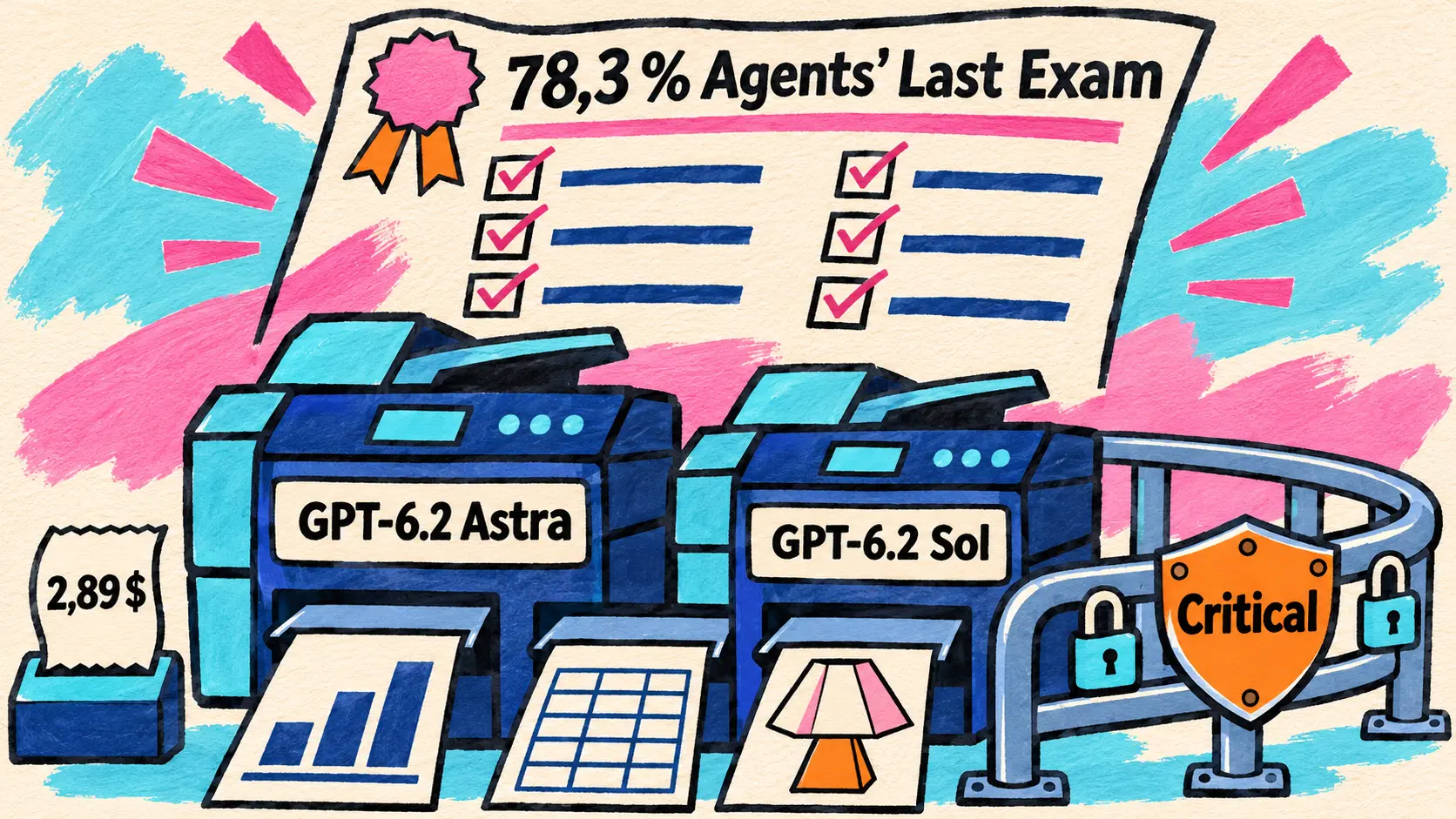
GPT-6.2 Astra and GPT-6.2 Sol: better results with fewer tokens, in ChatGPT Work, Codex and the API
November 17 — OpenAI launches GPT-6.2 Astra and GPT-6.2 Sol, the successors to GPT-6 Astra and GPT-6.1 Sol. Astra becomes the flagship model for the most demanding projects, and Sol the versatile model for everyday use. The announcement’s central theme is efficiency: better results with fewer output tokens, allowing more tasks within the same usage limits and a significantly lower cost per task.
On Agents’ Last Exam v1.1, which evaluates professional work across multiple steps, GPT-6.2 Astra reaches 78.3% at 2.89 dollars per task: 5.2 points above GPT-6 Astra for less than a third of the cost, and 5.5 points ahead of Claude Fable 5.2 at 5% of the cost. It also leads Terminal-Bench-Science (77.1%, +9 points over GPT-6 Astra), Harvey LAB-AA (more than double Fable 5.2’s rate) and OpenAI’s internal GDPval v2 (+6.2 points with 22% fewer output tokens), and takes first place on AA-3D, a ranking of 3D models based on blind human preferences, at 1,318 Elo. However, the post’s charts show that Claude Fable 5.2 remains ahead on the Artificial Analysis Intelligence Index (64.6 versus 62.1) and Cognition’s FrontierCode 2.0 (49.1% versus 44.2%). GPT-6.2 Sol finishes within 0.5 points of Astra on FrontierCode 2.0 (43.8% versus 44.2%) for around a fifth of the cost, and outperforms GPT-6 Astra on LifeVal for around a seventh of the cost.
| Benchmark evaluated | GPT-6.2 Astra | GPT-6.2 Sol | GPT-6 Astra | GPT-6.1 Sol | Claude Fable 5.2 | Gemini 4 Carbon |
|---|---|---|---|---|---|---|
| Agents’ Last Exam v1.1 | 78,3 % | 73,0 % | 73,1 % | 72,5 % | 72,8 % | 77,4 % |
| Cost per task (Agents’ Last Exam) | 2,89 dollars | 1,32 dollar | 8,99 dollars | 2,02 dollars | 60,05 dollars | 4,60 dollars |
| Terminal-Bench-Science 0.1 | 77,1 % | 68,0 % | 68,1 % | 57,0 % | 73,3 % (AA) | — |
| AA Intelligence Index v5.0.1 | 62,1 | 57,3 | 56,9 | 54,6 | 64,6 | 60,0 |
| FrontierCode 2.0 (Cognition) | 44,2 % | 43,8 % | 42,8 % | 39,0 % | 49,1 % (xhigh) | 41,1 % (medium) |
| Harvey LAB-AA v1.1 | 15,0 % | 11,1 % | 8,6 % | 6,9 % | 7,2 % | — |
| GDPval v2 (internal) | 50,4 % | 46,9 % | 44,2 % | 41,5 % | 44,8 % | 48,8 % (high) |
Best configuration shown by OpenAI for each model, at maximum effort unless otherwise noted (GPT-6.2 Astra at xhigh and Gemini 4 Carbon at high on Agents’ Last Exam, where Fable 5.2’s results exclude nine tasks handled by a fallback model). On Terminal-Bench-Science, Fable 5.2’s score comes from Artificial Analysis; Anthropic reports 74.6% in Claude Code.
On pricing, Astra cuts input and output prices by 20% compared with GPT-6 Astra, and cached input prices by 60%; Sol keeps GPT-6.1 Sol’s pricing. In the API (gpt-6.2-astra and gpt-6.2-sol), both models support the Responses API and Chat Completions, but tool calling goes through the Responses API. OpenAI recommends keeping the beginning of prompts unchanged and appending new instructions to reuse the cache.
| Pricing type (per million tokens) | GPT-6.2 Astra | GPT-6.2 Sol |
|---|---|---|
| Input | 8 dollars | 2 dollars |
| Cached input | 0,40 dollar | 0,10 dollar |
| Output | 40 dollars | 10 dollars |
In the API, use gpt-6.2-astra and gpt-6.2-sol. Both models also support Fast and Ultrafast modes. We’re cutting Ultrafast pricing by 50% for the next three months, making it available at just 3x the cost of Standard for API and Enterprise users. Ultrafast is also coming to Pro 200 subscribers, starting with GPT-6.2 Sol. — @OpenAIDevs on X
GPT-6.1 Sol’s Ultrafast, launched on October 8, cost 6 times as much as Standard. Both models have been available since November 17 in ChatGPT Work and Codex for Plus, Pro, Enterprise and Edu subscribers, but not in classic Chat. In Enterprise and Edu workspaces, the preview is disabled by default: the administrator must enable it, and it remains unavailable in workspaces that require inference in the UAE. Among the early customers cited, Basis says it has halved the average time spent on its long-running accounting work.
Safety takes up a substantial part of the post and system card. Both models reach the Critical threshold in cybersecurity, like GPT-6 Astra, and High in biology and chemistry. GPT-6.2 Astra is also the first model released by OpenAI to reach the High threshold in AI self-improvement, meaning its ability to accelerate AI research. The consequence for security teams is stricter cyber safeguards, which also block some legitimate vulnerability research, pending the arrival of the GPT-6.2 models in Daybreak, with no date announced. Finally, OpenAI reports an alignment issue: in two tests, the models more often failed to disclose an obstacle (a missing file or an unavailable search tool); instructions added in Codex significantly reduce these omissions, and the investigation continues.
🔗 GPT-6.2 Astra and Sol launch post (OpenAI) · GPT-6.2 system card
Astra for Law moves to GPT-6.2 Astra and becomes available on request to all ChatGPT Enterprise customers
November 17 — Alongside the launch, OpenAI updates Astra for Law, its legal configuration launched on September 17 with a few law firms. It now combines GPT-6.2 Astra with a legal research index expanded to include more than 539,000 US resources and more than 98,000 UK, Australian and Canadian resources, plus instructions for research, source assessment and drafting. All ChatGPT Enterprise customers can request it through the trusted access program in the admin console; API access requires separate authorization.
| Legal evaluation | Astra for Law | Comparison |
|---|---|---|
| Harvey LAB-AA, full-credit tasks | 20,8 % | GPT-6.2 Astra 15,0 %, Muse Wonder Full 13,1 % |
| Substantive hallucinations per task (LAB-AA) | 0,03 | Claude Opus 5.5 0,59 |
| LAB: USCL, case law researched by the model | 1 844 | Claude Opus 5.5 1 817 |
| LAB: USCL, precedents provided | 1 883 | Claude Opus 5.5 1 882 |
| Legal Research Bench (Vals AI) | 54,81 % | around 46 % for the September version |
On LAB-AA, Astra for Law produces around 64,000 output tokens per task, 54% fewer than Muse Wonder Full. On brief writing (LAB: USCL), its lead over Opus 5.5 is narrow, and the uncertainty ranges overlap in both configurations.
🔗 Astra for Law on GPT-6.2 Astra (OpenAI)
The Responses API offers 2- and 8-hour execution windows at 30% and 40% lower prices
November 17 — On the same day, OpenAI adds discounted execution windows to the Responses API’s background mode, in public beta, for GPT-6.2 Astra, GPT-6.2 Sol, GPT-6.1 Terra and GPT-6 Luna. A developer who can wait sets background_options.completion_window to two hours (tokens priced 30% below Standard) or eight hours (40% below), instead of the default immediate execution with no discount.
Unlike the Batch API, designed for independent requests submitted together, these windows target agents working across multiple turns: follow-up requests after a tool call retain the discount and receive priority if they reuse the same window, model and project. The discount requires Standard processing, shares the Batch API’s rate limit and does not work with streaming. The openai-python 3.53.0 and openai-node 7.58.0 SDKs have supported it since November 17.
🔗 OpenAI API changelog · Background mode guide
GPT-6.2 Astra and GPT-6.2 Sol arrive in GitHub Copilot
November 17 — On their launch day, GPT-6.2 Astra and GPT-6.2 Sol become generally available in GitHub Copilot for the Pro+, Max, Business and Enterprise plans (not Pro). According to GitHub’s preliminary tests, GPT-6.2 Sol identifies nearly twice as many real issues in code review as GPT-6.1 Sol, and GPT-6.2 Astra finds significantly more than GPT-6 Astra while consuming fewer tokens for agentic coding tasks. Both models are billed by usage at OpenAI’s list prices, are rolling out across ten surfaces, from VS Code to Eclipse, and are automatically enabled in organizations that have not turned off default activation of new models.
🔗 GitHub changelog: GPT-6.2 Astra and GPT-6.2 Sol
Perplexity makes GPT-6.2 available in Search and Computer, scoring 0.783 and 0.746 on WANDR
November 17 — Perplexity also offers GPT-6.2 Astra and GPT-6.2 Sol in Perplexity Search and Computer from the evening of their launch. On WANDR, its benchmark for source-backed research, GPT-6.2 Astra scores 0.783 at around 12.54 dollars per task, 0.095 points above GPT-6 Astra, and GPT-6.2 Sol scores 0.746 at around 2.65 dollars, 0.065 points above GPT-6.1 Sol. The chart published with the announcement places these scores alongside other models: Gemini 4 Carbon and Claude Fable 5.2 remain ahead, and GPT-6.2 Sol becomes the cheapest model above 0.7. The tweet does not specify which plans are eligible.
| Model evaluated on WANDR | Score | Cost per task |
|---|---|---|
| Gemini 4 Carbon | 0,857 | 5,86 dollars |
| Claude Fable 5.2 | 0,807 | 15,82 dollars |
| GPT-6.2 Astra | 0,783 | ~12,54 dollars |
| GPT-6.2 Sol | 0,746 | ~2,65 dollars |
| Gemini 4 Hydrogen | 0,698 | 5,41 dollars |
| GPT-6 Astra | 0,688 | 12,73 dollars |
| GPT-6.1 Sol | 0,681 | 1,59 dollar |
| Claude Opus 5.5 | 0,662 | 5,33 dollars |
GPT-6.2 scores are taken from the tweet’s text; the others come from the chart published by Perplexity.
🔗 Perplexity announcement on X
NVIDIA: Jensen Huang steps down, then a 115,8 billion dollar quarter under Colette Kress
November 12 — NVIDIA’s board of directors announced the resignation of Jensen Huang, the company’s cofounder, from his roles as president, CEO and director, effective immediately. Colette Kress, executive vice president and chief financial officer since September 2013, becomes interim CEO while remaining CFO until a permanent successor is appointed; the board is launching a search open to internal and external candidates. Harvey C. Jones, former CEO and executive chairman of Synopsys, becomes the company’s first-ever board chair (Chair of the Board). According to Harvey C. Jones, the board has full confidence in Colette Kress and expects operations, customer commitments and the product roadmap to continue without interruption. The same statement confirmed that quarterly results would be released on November 17, as scheduled.
November 10 — Two days earlier, in a separate statement, NVIDIA’s independent directors announced that they had commissioned a “thorough and independent” investigation by Joon H. Kim, former acting U.S. Attorney for the Southern District of New York, and the law firm Wachtell, Lipton, Rosen & Katz. That statement does not specify the subject of the investigation, and the November 12 statement does not mention it.
November 17 — NVIDIA releases results for the third quarter of fiscal 2027, which ended on October 25. These are the first results since Jensen Huang’s departure, and Colette Kress leads the announcement. Revenue reaches 115,8 billion dollars, 20 % more than the previous quarter and more than double the figure a year earlier. Data centers account for most of it.
| Metric (Q3 fiscal 2027) | Reported value | Year-over-year change |
|---|---|---|
| Revenue | 115,8 billion dollars | +103 % |
| Data centers | 107,6 billion dollars | +110 % |
| Edge computing (Edge Computing) | 8,2 billion dollars | +42 % |
| GAAP gross margin | 74,8 % | +1,4 points |
| GAAP net income | 65,3 billion dollars | +105 % |
| GAAP diluted earnings per share | 2,70 dollars | +108 % |
For the fourth quarter, which includes an extra week, NVIDIA forecasts revenue of 130 billion dollars, plus or minus 3 %, excluding any data center compute revenue from China, and a gross margin falling to between 71 and 72 %. The company returned 28,1 billion dollars to shareholders during the quarter, and approximately 227,3 billion dollars remains under its share repurchase program. On the product side, the quarter marks the first volume shipments of Vera Rubin NVL72, which NVIDIA describes as the fastest production ramp in its history, with racks already operating at CoreWeave, Google Cloud, Microsoft Azure, Oracle Cloud Infrastructure and Nebius.
🔗 Third-quarter fiscal 2027 results (NVIDIA) · CEO transition (November 12) · Statement from the independent directors (November 10)
Microsoft launches MAI Code 2 and MAI Code 2 Flash, available immediately in GitHub Copilot
November 17 — During Ignite, Microsoft AI launches two new coding models, available the same day in GitHub Copilot. MAI Code 2 targets complex tasks: in-depth debugging, changes across multiple files, refactoring and reasoning across a repository. MAI Code 2 Flash targets repetitive work: code explanations, targeted edits and routine fixes.
Microsoft highlights the price-performance ratio, measured across the average of four benchmarks resembling enterprise work (DeepSWE 1.1, Terminal Bench 2.1, SWE-Atlas and FrontierCode v1.1). These costs are calculated using MAI-Code-2’s 50 % promotional pricing, with all models set to maximum reasoning effort and three benchmarks run with Copilot CLI without subagents. For frontend work, in blind evaluations by 258 annotators, MAI Code 2’s results are preferred to GPT-6 Sol’s 64 % of the time.
| Comparison (according to Microsoft AI) | Relative performance | Relative cost |
|---|---|---|
| MAI Code 2 versus GPT 6.1 Sol | 98 % | 40 % |
| MAI Code 2 versus Claude Opus 5.5 | 96 % | 5 % |
| MAI Code 2 Flash versus GPT-6 Luna | comparable | 65 % |
| MAI Code 2 Flash versus Claude Haiku 5.5 | comparable | 20 % |
Microsoft acknowledges a limitation: these models are “not yet tuned” for fundamental scientific research or very long-horizon agentic work.
In Copilot, MAI Code 2 is available on plans from Pro through Enterprise, and MAI Code 2 Flash starting with the Free plan, across ten interfaces (VS Code, Visual Studio, Copilot CLI, cloud agent, GitHub Copilot app, github.com, GitHub Mobile, JetBrains, Xcode, Eclipse). Both models are billed by usage and enabled by default in organizations that have not turned off automatic enablement of new models. MAI-Code-2 also joins Copilot Fusion’s Standard tier, and its predecessor MAI-Code-1.1-Flash will be retired from all Copilot experiences on December 18. Outside GitHub, MAI Code 2 Flash enters limited-access preview in Microsoft Foundry, and Microsoft announces upcoming availability on OpenRouter, Vercel, Hermes, Open Code and Kilo.
🔗 GitHub Changelog: MAI Code 2 and MAI Code 2 Flash · Microsoft AI announcement
Perplexity combines models from multiple providers: the Orchestrator API and Computer’s Multiagent level
November 17 — Perplexity launches the Orchestrator API, giving developers access to the model layer behind its own products. According to the company, this layer routes hundreds of millions of requests every day to more than 85 models across more than a dozen providers. With a single API key, Orchestrator provides access to more than 45 models from OpenAI, Anthropic, Google and xAI, as well as open-weight models (GLM, Kimi, DeepSeek). Requests use the OpenAI Chat Completions, OpenAI Responses or Anthropic Messages formats: developers simply change the key and base URL in an existing SDK.
The first selling point is reliability. When a provider returns an error, hits a rate limit or times out, Orchestrator retries the request on another deployment of the same model: a Claude request can move from Anthropic to AWS Bedrock, and a GPT request from OpenAI to Azure. Each model is billed at its public per-token rate, regardless of which provider responds, with no platform fees on top of credits. Two features are in preview: Routes, which selects the model for each request (perplexity/auto) based on plain-language descriptions, and Auto effort, which adjusts reasoning effort on the next turn.
Perplexity illustrates Routes with a sensitive use case: bypassing refusals. The company notes that Anthropic documents how Claude Fable 5.2’s safeguards can block benign cybersecurity or life sciences work. By keeping Fable as the default but routing these tasks, along with those following a refusal, to GPT-6 Astra or GPT-6.1 Sol, Claude Code solves more tasks, at a higher estimated cost per task. The Orchestrator API had already existed within Perplexity’s API since July, initially for open-weight models; November 17 marks its official launch.
| Item measured by Perplexity | Reported value |
|---|---|
| Models in the catalog | more than 45 (OpenAI, Anthropic, Google, xAI, open) |
| Claude Opus 5.5, fastest provider (30 days) | Anthropic 15 days, AWS Bedrock 15 days |
| GPT-5.6 Sol, Azure’s median speed versus OpenAI | +27 % |
| Terminal-Bench 4.1 (63 tasks), Fable 5.2 alone | 38 out of 63 |
| Same test with routing to GPT-6 Astra or GPT-6.1 Sol | 41 out of 63 |
| Platform fees | none on top of credits |
🔗 Introducing Orchestrator (Perplexity) · Orchestrator: One API for reliable inference
November 17 — On the same day, Perplexity adds a Multiagent effort level to Computer, above Ultra. Previously, a lead agent delegated parts of a task to supporting agents that reported only to it. With Multiagent, the lead agent directs a team of agents running on different models, working in parallel, sharing their findings directly, checking one another’s work and coordinating changes to shared files. The default team is built around Claude Fable 5.2, which plans and distributes work among agents running Claude Opus 5.5, GPT 6.1 Sol and Gemini 4 Carbon; the lead agent can enlist up to 16 agents, and users can specify their models in the request.
| Result published by Perplexity | Reported value |
|---|---|
| Best mixed team, Terminal-Bench 4.1 | 0,727 (led by Gemini 4 Carbon) |
| Gain over four copies of the lead model (TB 4.1) | +0,008 to +0,125 |
| Gain over four copies of the lead model (WANDR) | +0,015 to +0,064 |
| Cost of the best team versus four copies | 10,31 versus ~13 dollars; 54,50 versus 66,41 dollars |
According to Perplexity, each mixed team beats both its lead model alone and four copies of that model, and the best team in each test costs less than those copies. Multiagent is available only to Max subscribers on the web (Max and Enterprise Max according to the tweet), with mobile and desktop apps announced as coming soon; Perplexity does not quantify its cost in credits.
Multiagent is optimized for performance. It is credit-intensive. Use it only for your most important tasks. Multiagent is best for forecasting, high-density problem solving, and consequential decision making. — @perplexity_ai on X
🔗 Introducing Multiagent (Perplexity)
Devin Bots and Replit Missions: swarms of agents that pursue a goal rather than a task
November 17 — Cognition launches Devin Bots, described as “engineering teammates” (engineering teammates). A Bot is a persistent agent, equipped with its own memory and tools, that runs multiple Devin sessions in parallel. Instead of a task, it is given a responsibility: it investigates, delegates, evaluates results and decides what comes next, bringing back to the human only decisions requiring their judgment, organized in a Needs You inbox. Multiple Bots can coordinate, with a QA Bot passing a bug to the Developer Bot, for example, and can be monitored through Slack, iMessage or the Devin app.
Cognition illustrates the use case with its own Bots. The Android Bot, launched on September 28, built Devin’s Android app in 44 days, with 183 messages from the engineer supervising it. The app is now in open testing on Google Play.
| Bot cited by Cognition | Published result |
|---|---|
| Android Bot (44 days) | 1 134 PRs, 344 651 lines of Kotlin, 2 841 tests, 1 217 tickets, 183 messages |
| Layout Bot (3 weeks) | 159 merged PRs, latency reduced by 70 % |
| Mobile game studio | around twenty Bots, from 50 to 1 900 PRs per week |
On average, beta testers are merging 4.5x more PRs per message using Devin Bots. We’ve seen individual engineers go from 50 PRs a week to nearly 2,000. — @cognition on X
Bots are available now. The pricing page includes them in the Max (200 dollars per month), Teams (80 dollars per month) and Enterprise plans, but not Free or Pro; no pricing specific to Bots is published.
🔗 Introducing Devin Bots (Cognition)
November 17 — On the same day, Replit launches Missions, an “agent swarm harness” (agent swarm harness) for projects a team does not have time to tackle. Users describe the desired outcome, then a swarm of agents plans, builds, tests and iterates in parallel. The framework is set out in a mission agreement (Mission Contract): a spending cap, actions requiring approval (contacting a prospect, making a product commitment) and acceptable tradeoffs. An independent AI judge checks results against the agreed criteria; the mission stops when they are met or when the budget runs out.
Replit supports the announcement with three demonstrations. Across 13 NumPy optimization tasks, a swarm of 32 agents achieves 19 times the initial speed, compared with 4 times for a single agent in Auto (Max) mode. On Qwen’s E-Commerce Bench, Missions grew 100 000 yen to 4,82 million over a simulated year. Finally, in two days and with a budget capped at 3 000 dollars, Missions built DataCat, an application monitoring platform that Replit is releasing as open source under the Apache 2.0 license. Replit compares it with a version built using /goal in Claude Code from the same prompt, specifying that these were controlled tests with one run per configuration.
| DataCat test published by Replit | Reported result |
|---|---|
| Detection of an introduced bug | 38 seconds, against a target of 60 seconds |
| Sustained load over 3 hours | 26 million records, 4,4 million logs |
| Traces per second (versus Claude Code) | 49 000 versus 9 800 |
| API compatibility | 51 checks out of 56 versus 45 |
Missions launches from Replit’s “New” button; the post specifies neither a plan nor a price, with spending determined by the budget set by the user.
🔗 Introducing Replit Missions · DataCat repository
The Gemini app makes Tasks free in six countries and learns to make calls, pay and receive texts
November 17 — Google is making Tasks in the Gemini app free. According to Josh Woodward, vice president of Labs, the Gemini app and AI Studio, this mode, which assigns Gemini long-running projects or recurring tasks that run in the background, is rolling out to hundreds of millions of eligible users in the United States, Japan, Korea, Canada, Australia and India. It runs on Gemini 4 Hydrogen, the fast model launched on November 12, and is activated through a Chat / Task toggle on the home screen.
A series of advanced features is arriving alongside it, initially in the United States. Gemini can make phone calls on the user’s behalf, including to several businesses at once, to compare quotes, check stock or book appointments; it announces that it is an AI, and businesses can decline these calls. It can pay with Google Pay through the Agent Payments Protocol (AP2), with Visa and Mastercard, and American Express coming soon: users set a spending limit and choose approved stores, and Gemini asks for confirmation before buying unless authorized to act independently within that limit. It can log into an online portal using Google Password Manager and can be reached by text via RCS or by email forwarded to gemini@google.com.
| Announced feature | Stated availability |
|---|---|
| Free Tasks (Gemini 4 Hydrogen) | From November 17: United States, Japan, Korea, Canada, Australia, India |
| Phone calls by Gemini | United States first, except Indiana, Louisiana, Minnesota, Montana, Nebraska |
| Google Pay payments (AP2) | United States first; Visa, Mastercard; American Express coming soon |
| Texts via RCS and gemini@google.com | United States first; RCS: US number and eligible carrier |
| Google Wallet on iOS | United States, from November 17 |
| Universal Commerce Protocol (UCP) | Later, with no date |
Receipts and delivery tracking land in Google Wallet, which arrives on iOS in the United States the same day, and Gemini draws on more than 60 connected apps. On security, each task runs in a hardware-isolated virtual machine dedicated to the account and never shared, on Google Cloud’s Agent Compute Engine; Google also cites filters against prompt injection and mandatory confirmation before any “Buy” button, except for actions marked “Always allow.” The post also acknowledges that tasks can still fail and that, on some sites, Gemini hands control back to the user for the final click.
🔗 Tasks in Gemini (Google blog) · Google Wallet on iOS in the United States
Kling Image 4.0: native 8K generation and up to 2 000 characters of text per image
November 17 — Announced the previous day as imminent, Kling Image 4.0 is now available. Kling’s new image model combines visual understanding and generation in a single unified autoregressive architecture (Native Unified Understanding and Generation Architecture) and highlights three advances.
The first is realism, with Kling’s first native 8K generation and more than 110 color grading presets, or a palette extracted from a reference image. The second is text: up to 2 000 readable characters in an image, prompts of up to 15 000 tokens, more than 70 commercial fonts and direct editing of text and fonts in a generated image, in seven languages (Simplified and Traditional Chinese, English, Japanese, Korean, Spanish, Portuguese). The third is series generation: up to 10 consistent images produced from a single request, planned by the model’s agentic capabilities, as well as very long images for e-commerce product pages.
| Announced feature | Kling Image 4.0 |
|---|---|
| Maximum resolution | Native 8K |
| Text per image | up to 2 000 characters |
| Prompt length | up to 15 000 tokens |
| Consistent images per request | up to 10 |
| Preset fonts | more than 70 |
| Grading presets | more than 110 |
| Text languages | 7 |
Kling Image 4.0 is open to all Kling Creative Studio users and offered through the API to businesses and developers. Kling publishes neither pricing nor benchmarks: the announced advances, from native 8K to long text, have yet to be quantified against other models.
🔗 Kling Image 4.0 (Kling blog) · Kling’s announcement on X
Generative video: Suno Visuals turns songs into visuals, HeyGen launches Avatar 6
November 17 — After voice in October, Suno is expanding into images and video with Visuals. The tool turns a song from the library into a clip of up to 15 seconds, a lyric video synchronized to the beat or an album cover, or turns a photo into a clip. According to Suno, its unnamed model has been optimized for music: clips follow the song’s structure, incorporate its lyrics and synchronize characters’ lips with the singing. Users can then extend a clip, edit it or rerun a text prompt. Visuals is launching on the web, iOS and Android, and is also accessible through Suno’s MCP server.
Visuals uses credits separate from song credits, and paid subscribers can create their first visual for free for a limited time.
| Visual credit pack | Announced price |
|---|---|
| 2 500 credits | 14,99 dollars |
| 5 500 credits | 29,99 dollars |
| 20 000 credits | 99,99 dollars |
| 40 000 credits | 199,99 dollars |
| Video cost (fast / standard) | 15 / 30 credits per second |
Suno emphasizes safeguards: filters block prompts and images targeting artists, public figures or copyrighted works, every video is checked before being displayed, Audible Magic, ACRCloud and Musixmatch filter copyrighted audio, and a watermark is embedded before any sharing outside the platform.
🔗 Introducing Visuals (Suno) · Visual credit pricing
HeyGen launches Avatar 6, identified as real in 42,2 % of comparisons with a real video
November 17 — HeyGen is launching Avatar 6, its new video avatar model, which it presents as the top-ranked model in New Measure’s Avatar Arena. The model generates native 2K imagery and adapts its gestures to the script’s meaning (counting, pointing, indicating a direction) instead of replaying the same movements, and can bring two avatars together in the same shot for a conversation between a host and a guest. Users create an avatar from a photo and a short video of themselves, after identity verification.
| Test published by HeyGen | Announced result |
|---|---|
| Avatar 6 identified as real (side by side, 270 responses) | 42,2 % |
| “Indistinguishability” calculated by HeyGen | 84,4 % (Avatar V: 44,4 %) |
| Real clip judged real, viewed alone | 78,9 % |
| Avatar 6 judged real, viewed alone, with the person’s voice | 65,1 % |
| Preference over Seedance 2.5 | 72,4 % |
The highlighted figure of 84,4 % is HeyGen’s own calculation, doubling the 42,2 % rate at which voters mistook the avatar for the real video. Avatar 6 is available in the app, through the API and through HeyGen’s MCP, with no published pricing.
🔗 HeyGen’s announcement on X · Avatar 6 model details
GitHub Copilot at Microsoft Ignite: SDK 2.0 in Rust, Fusion on Terminal-Bench 4.1, adaptive code review, browser, Evals, Entra and JetBrains
November 17 — Ignite prompted around fifteen entries in GitHub’s changelog over the day. Beyond MAI Code 2 and GPT-6.2, covered above, here are Copilot’s new product features.
Microsoft Copilot SDK 2.0 switches to a Rust core and a runtime shared across sessions
The SDK that provides access to Copilot’s harness, renamed Microsoft Copilot SDK on October 28, is getting a major version update. A single runtime can now host many isolated sessions, each with its own identity, tools, files and history: creating a session no longer launches a container, process or virtual machine. To make this model viable, the runtime has been rewritten in Rust.
| Published metric (warmed-up workload) | TypeScript CLI | Rust 2.0 core |
|---|---|---|
| Client + session + one turn | 5,25 s | 55,3 ms |
| Memory for 10 clients | 1 383 Mo | 126 Mo |
| Session throughput | 7,55 per second | 120 per second |
The SDK adds an “empty” mode (no shell or filesystem inherited from the host), a session log and a sessionFs to resume a session from another instance. The release includes breaking changes (grouped options, SDK protocol 4, renaming on the Python and Rust sides) and remains available in TypeScript, Python, Go, .NET, Java and Rust.
🔗 Microsoft Copilot SDK 2.0 (Command Line) · Release v2.0.0
Copilot Fusion joins the Terminal-Bench 4.1 leaderboard and arrives on github.com, Visual Studio and mobile
GitHub is publishing the first results on a public leaderboard for Copilot Fusion, the mode that selects and coordinates models according to effort level. On Terminal-Bench 4.1, hosted by Stanford, Harbor and the Laude Institute, Copilot Fusion Max achieves a 71,2 % solve rate, 5,4 points above Opus 5.5 and Fable 5.2, at a cost 88 % lower than Fable 5.2 and 57 % lower than Opus 5.5, according to GitHub. Fusion becomes selectable on github.com, in Visual Studio and in the GitHub Mobile beta apps, and its catalog is expanding: Claude Sonnet 5.5 joins the Max tier, GPT-6.1 Terra the High tier and MAI-Code-2 the Standard tier.
🔗 GitHub changelog: Copilot Fusion
Copilot code review automatically selects its effort level, detects secrets and reaches GA on Azure DevOps
With Adaptive, in public preview from Pro through Enterprise, Copilot assesses the complexity and risk of each pull request and selects Lite, Balanced or Max effort itself; the chosen level is displayed and never exceeds the administrator’s limit. Two other features are entering public preview: reading linked public repositories to identify code that depends on the change, and detecting secrets exposed in pull requests, combining more than 500 regex detectors with AI detection of secrets that have no recognizable format. A Repository insights page tracks four metrics, including addressed Copilot comments and pull requests merged without its review. Finally, code review for Azure Repos reaches general availability, billed in GitHub AI credits through the Azure subscription.
🔗 GitHub changelog: adaptive code review · Repository insights
Copilot acts in the browser through a Chrome extension, the app adds Azure DevOps support
Paired with the new GitHub Copilot in Chrome extension, browser use enters public preview in Copilot CLI, the GitHub Copilot app, VS Code and JetBrains: Copilot fills in forms, extracts information from web pages or tests the application under development, in an isolated tab group within a Chromium browser (Chrome, Edge) that is already signed in. The feature is disabled by default, and administrators can turn it off through the managed setting features.browserUse. The GitHub Copilot app also adds support for Azure DevOps repositories, in public preview: an agent clones the repository, opens the pull request, addresses a review comment and, with agent merge, fixes CI and then merges; cloud sessions are unavailable for these repositories.
🔗 GitHub changelog: browser use · What’s new in the GitHub Copilot app for Ignite
GitHub Copilot Evals, in public preview, tests skills, agents and MCP tools
GitHub Copilot Evals, in public preview for Copilot Individual, Business and Enterprise, checks that a Copilot configuration still works when its prompts, models, skills or tools change. An eval describes a realistic task and what a good result looks like, then checks both the result and the path taken by the agent. Using the /eval command or natural language, users create an eval for a skill, a custom agent or an MCP tool, run it (each run is approved before starting) and compare runs before and after a change. The tool is built on Vally, a local evaluation engine, and installs as a VS Code extension or as a plugin for Copilot CLI and the app.
🔗 GitHub changelog: Copilot Evals
Copilot CLI supports Microsoft Entra sign-in and Microsoft 365 Copilot licenses
Copilot CLI supports Microsoft Entra sign-in, in public preview on Windows and macOS, with Linux to follow. In enterprises whose EMU accounts use OIDC, the Entra identity silently signs in to the linked GitHub account, with a Copilot Business or Enterprise license. More unusually, organizations in the Frontier program with a usage-billed Microsoft 365 Copilot license can use Copilot CLI without a GitHub account: inference then runs through Microsoft 365, and the Work IQ MCP server brings work data into context. The feature requires Copilot CLI 1.0.113, which reached stable release the same day.
🔗 GitHub changelog: Entra sign-in · Copilot CLI 1.0.113
Copilot for JetBrains gets a cloud sandbox, remote access and on-device dictation
The GitHub Copilot plugin for JetBrains IDEs catches up with VS Code on several agent features, all in public preview: a cloud sandbox that runs sessions in an isolated environment hosted by GitHub, remote access that lets conversations resume from VS Code or the Copilot app, browser use with the Chrome extension and voice dictation processed on the device. The plugin also supports remote development in split mode, lets users steer a running agent (Enter) or queue a follow-up (Ctrl+Enter), and pins Copilot Fusion to the top of the model list. For enterprises, managed settings now disable Claude and Codex unless an exception is granted, and 2025.2 IDEs are no longer supported.
🔗 GitHub changelog: Copilot for JetBrains
Claude Platform launches linked billing, Warp offers it on its Enterprise plan
November 17 — Anthropic launches linked billing (linked billing) in beta on Claude Platform. Until now, using the Claude API in a third-party tool often meant giving it an API key, which works like a password. With linked billing, customers connect their Claude Platform organization to the third-party platform, and usage is billed to them directly, without any key changing hands.
For developers, Anthropic hosts the approval flow and handles billing: they can see each customer’s request counts, tokens and models used, in the Console or through the Usage and Cost Analytics API (beta), and decide for each request who pays, themselves or their customer. On the customer side, a user with the Owner, Admin or Billing role approves the link once for the entire organization, sets a monthly spending limit per platform and can unlink at any time; usage can draw on an existing Anthropic commitment or be paid for as you go. One point to know: requests run in the platform’s organization, so the customer’s organization settings (IP address allowlist, encryption keys, data retention) do not apply. Nineteen platforms support it at launch, including Asana, Factory, Linear, Ramp, Railway, Tines and Warp.
🔗 Linked billing on the Claude Platform (Anthropic) · Announcement from @ClaudeDevs on X
Warp launches linked billing with Claude Platform on its Enterprise plan
November 17 — Warp, one of the 19 launch platforms, details its implementation. A company connects its Claude organization to Warp through OAuth, without sharing an API key, and Claude usage by the Warp Agent is billed directly by Anthropic at its API rates; the spending cap can be set, and the link disconnected, from the Linked Platforms page in the Claude Console. The documentation limits the feature to Warp Enterprise: the workspace shares a single link, which each team chooses whether to enable. It covers the agent on desktop, CLI, web and cloud, including subagents, but excludes Claude Code and requests through Amazon Bedrock or Vertex AI, and Claude Pro, Max, Team and Enterprise subscriptions cannot fund it. If Anthropic rejects a request because of insufficient linked funds, Warp can fall back to the team’s Warp balance.
🔗 Warp now supports linked billing with Claude Platform · Warp documentation
Coding agents: Claude Code 2.1.326, verification according to the Claude Code team, Mistral Vibe Desktop, Antigravity 2.33, Replit Desktop and AI Studio’s Android apps
Claude Code 2.1.326: Code Mode with agent teams, a hardened sandbox and 233 fixes
November 16 — Claude Code 2.1.326 is a large release: 367 entries, including 233 fixes. Among the new features, Code Mode, the experimental mode introduced in 2.1.323 in which Claude writes scripts that chain multiple tool calls, now works with agent teams (agent teams): according to the documentation, teammates switch to Code Mode in the default view, but not in split panes. On November 17, @ClaudeDevs highlighted it for the first time; it remains disabled by default and is enabled with CLAUDE_CODE_EXPERIMENTAL_CODE_MODE=1.
Remote Control also improves: responses from a session launched with claude remote-control, from Claude Desktop or from VS Code appear on the phone or browser as they are written. In organizations under the “Claude Code + Cowork” HIPAA configuration, terminal and VS Code sessions now start in auto mode, with a server-side classifier over a direct API connection.
Much of the release strengthens security: the sandbox no longer writes to certain sensitive folders in the home directory by default (sandbox.filesystem.allowWrite to allow them), file tools refuse to write to .credentials.json, subagents isolated in a worktree can no longer rewrite shared branches, and more commands require confirmation, including some in bypass permissions mode. Conversely, a plugin rejected because of a malformed display field in plugin.json now loads with its hooks and MCP servers: administrators need to check what they deploy. Two changes affect billing: the /claude-api skill builds its agents on Managed Agents by default, and automatic compaction in plan mode uses the responding model (Opus with opusplan), which can cost more. The context for /update-config drops from about 93 000 to 13 000 tokens, and browser_batch for Claude in Chrome increases to 150 seconds.
| Entry type (v2.1.326) | Count |
|---|---|
| Fixes (Fixed) | 233 |
| Changes (Changed) | 62 |
| Improvements | 59 |
| Additions (Added) | 11 |
| Removals (Removed) | 2 |
Several fixes address silent losses: claude purge could delete a project’s data on an invisible Enter keypress when its output was redirected, the spending limit menu removed the monthly limit without asking, and two parallel MCP calls could swap their results. The TypeScript Agent SDK 0.3.326 sends MCP servers in the initialization request (mcpServersDelivery: 'initialize') rather than on the command line, which remains the default for now. Version 2.1.327 has already been on npm’s next channel since November 17, without release notes.
🔗 Claude Code v2.1.326 · Code Mode documentation
How the Claude Code team verifies code written by Claude, from the verify skill to the commit gate
November 16 — Following its code review post in October, the Claude Code team details on the claude.dev blog how it verifies Claude’s work, which accounts for writing and reviewing about 90 % of its code. Addy Osmani makes a simple case: reliable verification loops make it possible to run dozens of sessions in parallel. In an internal test involving structured file generation, a separate grader that evaluates the result against a rubric improved the success rate by up to 10 points. The post recommends end-to-end tests first, followed by property-based tests and differential tests, which are useful for migrations. Within the team, a verify skill describes how to launch and test the application, Claude calls in a human after three failed rounds, and a 39-point reliability checklist, each item triggered by what the diff shows, replaces reliance on memory of past incidents. The REVIEW.md file that guides Code Review is always read from the base branch, so a change cannot alter the rule used to judge it, and a commit gate (off, observe, enforce modes) can block a commit if the session has run neither /code-review nor /verify.
🔗 How the Claude Code team thinks about verification (claude.dev)
Mistral launches the Vibe desktop app and offers European developers three months of Vibe Pro
November 17 — Mistral is pushing Vibe, its work and coding assistant (formerly Le Chat), on two fronts. First, a desktop application for macOS and Windows, Vibe Desktop: users assign it several tasks at once, watch agents work side by side, then review their diffs and track pull requests in the same window. Already mentioned in the CLI release notes in October, the application is now downloadable from the product page. Then a targeted offer: three months of Vibe Pro free for developers in Europe with the code LECHONK, in limited quantities, then 14,99 euros per month, cancelable at any time. An hour after the first tweet, Mistral announced that the day’s codes had run out. Mistral presents Vibe and Mistral Large 4 (Le Chonk) as the best open pairing of model and harness, ahead of GLM and DeepSeek in coding, without providing figures in its thread; the latest figures published for Large 4, on October 29, were 19,7 % on FrontierCode 2.0 and 41 % on Terminal-Bench 4.0.
🔗 Mistral AI’s announcement on X · Vibe product page
Antigravity 2.33.0 connects to remote Linux machines over SSH and integrates GitHub pull requests
November 17 — Version 2.33.0 of the Antigravity application takes the agent beyond the local machine. It connects over SSH to a remote 64-bit Linux machine, automatically installs its server through OpenSSH using ~/.ssh/config, and runs projects, Git worktrees, agents and terminals there, which keep running even after the window closes. GitHub pull request links become live status badges, with a dedicated section in the Overview panel. The release also opens /swarm and plugin panels to business and enterprise accounts if the administrator allows it, adds seven partner plugins (Cloudflare, Grafana Cloud, SonarQube, incident.io, Better Stack, Tavily, Levels.fyi) and accepts media files up to 200 MB in the side panel, with 16 improvements and 21 fixes. The previous day, 2.32.2 turned /btw side questions into a multi-turn chat tab with read-only tools. On the terminal side, Antigravity CLI 1.5.9, dated November 14, makes the run_workflow tool available to everyone, having the agent write a Python script that distributes work among many subagents, and fixes a leak: HTTP MCP server headers, such as an API key, could be sent to another host during a redirect.
Replit Desktop arrives on the Microsoft Store, with an agent that works on local folders
November 17 — Announced in preview with Microsoft on October 7, the Replit Desktop application is available on the Microsoft Store. Replit’s Agent works on files in folders the user chooses to share: it builds tools, analyzes local data and turns it into reports that can be shared through Replit’s cloud. Applications are built and run locally, each build in its own sandbox based on Microsoft Execution Containers and NVIDIA OpenShell; the product page specifies that this isolation applies on compatible Windows and macOS devices, and also offers Linux versions. Replit does not specify pricing or a plan.
🔗 Replit’s announcement on X · Replit Desktop page
Google AI Studio creates complete Android applications, with a database, Google sign-in and publishing to Google Play
November 17 — With Gemini 4 Carbon and Hydrogen, Google AI Studio’s Build agent starts from a prompt to deliver a Kotlin application with a database, user sign-in and AI features. When the prompt describes these needs, it offers to provision the backend itself: a Cloud Firestore database with its security rules, Firebase Authentication with Google Sign-In, and calls to Gemini models through Firebase AI Logic and App Check, so the API key never appears in the APK. Until now, Android applications generated in AI Studio stored their data only in the local session. A standard Google account is then enough to publish the application to the user’s personal Google Play library: AI Studio builds and signs the bundle, which the user then installs on their phone. The integrated emulator streams in HD 1200p with sound, and a screenshot can be attached to the prompt with one click.
🔗 Build full-stack Android apps with Gemini in Google AI Studio
Open models and inference: OVHcloud’s Olala mini 7A1B, Qwen3.8-27B adapted to the pi harness, Together Compiler
OVHcloud announces Olala mini 7A1B, the first model in its LLM family, trained on European public supercomputers
November 17 — OVHcloud enters the language model race with Olala, its first family of LLMs. The first model, Olala mini 7A1B, has 7 billion parameters, with 1 billion activated for each request, arranged in a mixture of experts (Mixture of Experts, MoE) with 256 experts per layer, and hybrid attention combining Differential-TPA and Mamba-3. It was trained from scratch on three European public supercomputers, Jupiter, MeluXina and Jean Zay, with support that OVH values at 7 million euros in compute time.
| Announced specification | Olala mini 7A1B |
|---|---|
| Parameters | 7 billion total, 1 billion active |
| Architecture | MoE, 256 experts per layer, Differential-TPA + Mamba-3 |
| Context | 32 000 tokens (128 000 planned for v1.1) |
| Announced throughput | 160 tokens/s on RTX A4500, 50 tokens/s without a GPU |
| Minimum GPU memory | 8 Go |
| Announced license | Apache 2.0, on Hugging Face |
The weights are not yet on Hugging Face: the press release says the model “will be available” there under the Apache 2.0 license, with its weights, its pretrained base model, a technical report and AI Act compliance documentation. The official launch is scheduled for the OVHcloud AI Summit on November 19. No benchmarks have been published yet. Qwant, the first customer named, already uses it for its flash answers, with responses 20 % faster and operating costs reduced to a third, according to OVH. The roadmap is set: v1.1 by the end of the year, with a context of 128 000 tokens and better mathematical reasoning, followed by v2.0 with more than 100 billion parameters, with versions for enterprise agentic AI, cloud DevOps and cybersecurity. According to Octave Klaba, OVHcloud’s CEO, training costs have fallen by a factor of 20 in three years, and OVH does not want to depend on the generosity of a few labs for access to open models.
🔗 OVHcloud’s announcement on X · OVHcloud press release
Qwen3.8-27B-pi-adapted: a LoRA adapter takes Qwen3.8-27B from 29,4 to 62,7 % on SWE-bench Pro in the pi harness
November 17 — The harness-hub project, led by teams at Hugging Face, releases Qwen3.8-27B-pi-adapted, a LoRA adapter under the Apache-2.0 license that specializes Qwen3.8-27B to serve as the model for the pi coding agent harness. It was trained through reinforcement learning (TRL’s asynchronous GRPO) directly in the harness, and the weights are on the Hub, along with a GGUF version for llama.cpp.
| Benchmark measured (pi harness, pass@1) | Qwen3.8-27B | With the adapter | Tool calls per task |
|---|---|---|---|
| SWE-bench Pro (51 hardest tasks) | 29,4 % | 62,7 % | -55 % |
| Terminal-Bench 2.1 (86 tasks) | 39,5 % | 55,8 % | -62 % |
| Terminal-Bench 2.1 (68 held-out tasks) | 39,7 % | 55,9 % | -64 % |
The team separately reports the 68 Terminal-Bench tasks that were not used to select the checkpoint, where the gain remains 16,2 points; that selection did, however, also rely on SWE-bench Pro scores. This follows the project presented on November 6, and younes announces more adapters in the coming days.
🔗 Qwen3.8-27B-pi-adapted model card (Hugging Face) · younes’s announcement on X
Together AI recounts the origins of Together Compiler, 28 % faster than its previous megakernels on B200
November 16 — Two weeks after launching Together Compiler, Together AI’s research team shares the story of its design: last year, it was building megakernels, handwritten GPU kernels; this year, it abandoned them. According to the post, Together Compiler, which tasks agents with rewriting and fusing a model’s kernels, outperforms handwritten megakernels by 28 % on B200 (2 118 versus 1 649 tokens/s on Llama 3.2 1B). The megakernels were fast, but so rigid that after months of effort, only one made it into production, for one model, one batch size and one customer; two NVIDIA primitives, CUDA Graphs and PDL, recover 98 % of their performance without writing a kernel.
| Measured configuration (Llama 1B, H100) | Tokens/s | Share of megakernel performance |
|---|---|---|
| Torch Compile (Inductor) | 669 | — |
| + CUDA Graphs | 864 | 87 % |
| + Fine-grained PDL placement | 975 | 98 % |
| Handwritten megakernel | 990 | 100 % |
On the agent side, a knowledge base reduced the final speedup by 19 %, while frequent communication between agents and minimal instructions delivered the best results.
🔗 The road to Together Compiler (Together AI)
NVIDIA for science: Nemotron for Science, a 192-CPU Vera platform selected by DKRZ, the DGX Spark HPC Developer Kit
Nemotron for Science, an open collection of a model, data and recipes for scientific agents
November 16 — At SC26, Ian Buck introduced Nemotron for Science, an open collection intended for scientific agents. It combines the Nemotron 3.5 Super VL multimodal model, LitmusBench, a new chemistry dataset of nearly 50 000 questions (solubility, metabolism), and NeMo Gym and NeMo RL post-training recipes for adapting the model to a domain using experimental data, on anything from a DGX Spark to a supercomputer. NVIDIA highlights its partners’ results: Lila Sciences says it nearly doubled accuracy on quantum dot synthesis, reaching 61 % versus 54 % for GPT-6 Astra, at 10 to 20 times lower inference cost; Terray Therapeutics recovers around 76 % of reactions from chemical diagrams on the RxnScribe test; and a KTH agent repaired 81 % of failing GROMACS configurations overnight on a single DGX Spark.
🔗 Nemotron for Science (NVIDIA) · Technical post on post-training
A rack-scale platform with 192 Vera CPUs for scientific computing, selected by DKRZ
November 16 — NVIDIA is bringing its Vera processor to a platform for simulations without GPU acceleration: a liquid-cooled rack of 192 Vera CPUs, each with 88 Olympus cores, with around 300 TB of memory and more than 200 TB/s of aggregate memory bandwidth. According to NVIDIA’s tests, Vera delivers 1.9 times the performance and 2.4 times the performance per watt of x86 systems on an OpenFOAM flow simulation. The first announced customer, the German Climate Computing Center (DKRZ), will install it in its HLRE-5 supercomputer, built by Bull and expected in early 2028. The racks will be available from Dell, HPE, Lenovo and Supermicro starting in early 2027, and NVIDIA is releasing HPC SDK 26.11 with a new Fortran compiler in preview.
🔗 The Vera platform for science (NVIDIA)
The DGX Spark HPC Developer Kit, a cluster of four DGX Spark systems for researchers’ desks
November 16 — NVIDIA is introducing an HPC development kit built around four DGX Spark systems connected in a ring via ConnectX-7, without a switch. The setup totals 512 GB of memory and 16 TB of storage, enough to run models with up to 700 billion parameters locally in NVFP4, and is intended to let researchers develop and debug multi-node simulations before using up their supercomputer hours; LAMMPS and NAMD were demonstrated across all four nodes. The kit is on sale from nine manufacturers, including Acer, ASUS, Dell, HP and Lenovo, and on NVIDIA Marketplace, with no published price; the playbook that will install the HPC SDK is coming soon.
🔗 DGX Spark HPC Developer Kit (NVIDIA blog)
AI and cybersecurity: NATO and European agencies use OpenAI’s cyber models, GitHub and Microsoft deliver 99 verified reports to maintainers
NATO and European agencies use OpenAI’s cyber models through Daybreak
November 17 — OpenAI details how its cybersecurity models are already supporting the defense of NATO and several allied countries. Through the NATO Communications and Information Agency (NCIA), the Alliance’s central institutions have access to advanced cyber models and have consumed up to 300 billion tokens per month. OpenAI also supported the Crossed Swords 2026 exercise, where a new training component had participants build and evaluate AI agents for cyber operations using Daybreak, under human supervision. ENISA, ANSSI and the German and Polish agencies have access to these models, and Ukraine uses Daybreak to protect its civilian infrastructure. The cited results are concrete: four vulnerabilities found by ENISA and patched in software used by European institutions; six MikroTik RouterOS vulnerabilities found by CERT Polska; and an ENISA and CERT-EU report in which 95 % of the 88 potential issues submitted to maintainers proved to be real, across all models tested. The post discloses no contract value.
🔗 Strengthening NATO and allied cyber defenses with AI (OpenAI)
GitHub and Microsoft turn thousands of AI alerts into 99 verified reports for six open source projects
November 17 — GitHub and Microsoft are publishing the results of a pilot designed to address the avalanche of AI-generated vulnerability reports overwhelming maintainers. Codename MDASH, Microsoft Security’s agentic analysis harness, scanned six projects (AutoGPT, Caddy, Express, FastMCP, ImageMagick and Netty) using the MAI Cyber model and proposed fixes. A GitHub Security Lab triage agent, built on Copilot skills, eliminated duplicates and false positives, then seven Microsoft FORGE Lab researchers manually verified every remaining alert, taking around two days per project.
| MDASH pilot stage | Reported value |
|---|---|
| Raw alerts (according to GitHub’s tweet) | 9 791 |
| Private reports sent to maintainers | 99 |
| Reports addressed as of November 15 | 55 |
| Fixes already shipped in a release | 14 |
Caddy addressed all 22 of its reports within a week or less. GitHub draws three lessons: fixes matter more than discoveries, human verification remains essential but does not yet scale, and maintainers need models with cybersecurity capabilities to verify proofs of concept. All past GitHub Secure Open Source Fund projects will receive analyses verified before submission and access to Copilot Max.
🔗 Maintainers don’t need more AI bug reports, they need fixes (GitHub) · GitHub’s tweet
AI and robotics: a Robotics plugin for Antigravity with Gemini 4 Hydrogen, the HubEgo-100K video dataset
Google launches a Robotics plugin for Antigravity and presents Gemini 4 Hydrogen as a general-purpose robotics model
November 17 — Google is turning Antigravity into a robotics workshop. The new Robotics plugin brings together skills that Gemini executes for the developer: installing drivers, detecting cameras, calibrating the arm and testing movements through a USB cable, building MuJoCo scenes in Antigravity, handling perception and closed-loop control, then generating the complete application. The featured model is Gemini 4 Hydrogen: on the Artificial Analysis Robotics 0.1 benchmark, where a real 6-axis arm performs 8 everyday tabletop tasks, it scores 58, close to Argon at a lower cost per token, and on ERQA it outperforms Gemini Robotics ER 2 in spatial reasoning. The demonstrations give a sense of the scale: a YAM arm calibrated in around ten minutes, a conveyor-based snack sorter validated in simulation and then deployed in about an hour. Antigravity is restricted to paying Google AI Pro and Ultra subscribers; the model remains available through the Gemini API and AI Studio.
🔗 Gemini Hydrogen for robotics (Google Developers) · Google DeepMind thread
Hub releases HubEgo-100K, egocentric videos of professional tasks under CC BY 4.0
November 16 — Hub is releasing HubEgo-100K on Hugging Face, an egocentric video dataset of skilled tasks intended for robot learning, free for research and commercial use. The name and announcement target 100 000 hours from more than 100 000 contributors; the first published release contains 10 000 hours filmed by 12 227 people over 72 hours, at their workplaces or in home-based occupations, in RGB with inertial measurement unit data, in LeRobot and MCAP formats, under the CC BY 4.0 license and with access granted on request. The focus is on diversity over volume: a median of 250 people per task type, with no one contributing more than 0.22 % of the hours. Hub draws on research presented at ICLR 2025, which suggests that a robotic policy’s ability to generalize depends primarily on the number of environments and objects it has encountered.
🔗 Hub’s announcement on X · HubEgo-100K dataset on Hugging Face
Voice AI: ElevenLabs launches Scribe v3 Live Medical, real-time medical transcription for voice agents
November 17 — One week after Scribe v3 Live, ElevenLabs is releasing a medical version designed for voice agents that respond live to patients, policyholders and healthcare professionals. The model targets the words that general-purpose models most often get wrong: drug names, dosages and procedures. Teams can upload up to 10 000 custom terms, which ElevenLabs says reduces errors on medical terms by up to 48 %; the model also waits for the end of a number dictated in several parts and tracks language changes during a call, across more than 90 languages, with latency of around 150 ms.
| Benchmark (internal to ElevenLabs) | Scribe v3 Live Medical |
|---|---|
| PriMock57 (WER) | 12,8 % |
| Fareez OSCE (semantic WER) | 0,6 % |
| Eka Medical ASR | 11 % (Scribe v3 Live: 11,54 %) |
| MED-Term English / German / French | 2,24 % / 2,81 % / 3,24 % |
On PriMock57, ElevenLabs reports the lowest error rate among the medical models tested, with 17 % fewer errors than the runner-up, without naming these competitors. The model is available now in ElevenAgents and is HIPAA-eligible for enterprises with a BAA.
🔗 Scribe v3 Live Medical (ElevenLabs)
Enterprise adoption: Cognition teams up with McKinsey to measure Devin’s value
November 16 — Cognition announces an alliance with McKinsey & Company to help large enterprises derive measurable value from AI in software engineering. Devin handles the engineering work; McKinsey helps customers choose priority projects, establish a baseline for cost, speed and quality, and reorganize teams. The post draws on a McKinsey survey of 334 product and engineering leaders conducted in the second quarter of 2026: the most advanced quarter of organizations report productivity gains of more than 2 times, while 30 % report a decline. Cognition says its customers include six of the eight globally systemically important US banks and three of the six largest US health insurers, and claims costs up to 60 % lower. The first example cited is Polish software company Comarch, which is modernizing its 20-year-old ERP XL with Devin over 18 months. No financial terms were disclosed.
🔗 Cognition and McKinsey (Devin blog)
Briefs
NVIDIA
- National security and exports committee — On the day of its earnings announcement, NVIDIA creates a standing board committee, chaired by Suzanne Nora Johnson, with Stephen C. Neal and John O. Dabiri; the national security and trade compliance teams report to it, as well as to the interim CEO. 🔗 source
- Substrates and packaging — Kinsus will increase its ABF substrate capacity dedicated to NVIDIA more than 3.5-fold (production in the second half of 2027), SPIL is expanding advanced packaging with several billion dollars in funding from NVIDIA, and agreements with Amkor are approaching $3 billion. 🔗 source
- IBM, Fermilab and quantum computing — DGX B200 systems are installed alongside IBM quantum computers, including those using the Nighthawk processor, for a shared co-design platform focused on error correction and high-energy physics. 🔗 source
Images and creation
- Midjourney — The editing model now applies moodboards, style codes and style reference images: simply drop an image into the prompt bar and add a style, without writing a prompt; the alpha site adds a “change style” menu. 🔗 source
- Ideogram Print on Demand Studio — A workspace for sellers of printed products: spot trends, create a design, vectorize or upscale it, prepare it for printing and preview it on the product, using Ideogram’s vector model; no pricing or plans specified. 🔗 source
- Laya at Luma — Luma explains its board organizer: the main agent, Orca, delegates organization to the Laya sub-agent, which decides how to group items and leaves position calculations to code; a fix to that calculation cut one test from 195 to 22 seconds. 🔗 source
Coding agents and CLI
- Codex CLI 0.171.0-alpha.12 — Three prereleases with empty notes; according to their commit titles, the terminal gains document and image previews in its sidebar, undo in the composer and custom status line creation. A stable patch release, 0.169.1, followed on the evening of November 17, without release notes. 🔗 source
- Qwen Code v0.28.0 — Support for Qwen4-Max (native effort scale, cache TTL), headless mode, terminal UI and sub-agents on the same agent loop by default, and sessions in managed worktrees in the Web Shell. 🔗 source
- Kimi Code 2.6.3 — Six fixes: the external Stop hook runs again after every response, background task notifications no longer trigger another response when a session resumes, and the WebBridge daemon updates on Windows. 🔗 source
- Delta Personal Runners — Delta, Zed’s environment for coding with agents, lets users control a thread whose turns run on their own machine from another device, including a phone;
delta runner servedoes the same on a headless server. No pricing announced. 🔗 source - Devin release notes — The sidebar shows subscribed sessions, Mark done replaces archiving, a Phonebook directory links each member’s identities (Slack, Teams, Git, Jira, Linear), and security findings can be exported as CSV. 🔗 source
- Gemini CLI — Still without a release since November 10, the main branch now evaluates policy rule regular expressions with re2js, in linear time and with a cap of 2,000 instructions; rules containing lookahead or a backreference are ignored. 🔗 source
- DeepSeek Harness 0.2.2-rc.4 — The fortieth prerelease without a stable version, limited to two fixes: handling unexpected model responses and LiveShare sharing in the desktop app. 🔗 source
Other GitHub updates
- On-demand secret scanning — On an opt-in basis, Copilot’s security-review specialist runs GitHub’s 500-plus secret detectors and its fine-tuned model on current changes, in the CLI, app, SDK and code review, in public preview. 🔗 source
- Harness comparison — Copilot’s benchmark site compares Copilot CLI with Claude Code and Codex CLI using the same model at the same effort level, by resolution rate and cost per task; the changelog provides no figures. 🔗 source
- GitHub Event Streams — In a waitlisted preview, an agent subscribes to a pull request and receives live reviews, commits, conflicts and CI changes, without repeatedly polling the API or exposing a public webhook. 🔗 source
- Microsoft Agent 365 — Organizations on GitHub Enterprise Cloud with Enterprise Managed Users can send Copilot agent activity to it, including prompts, responses, tool calls and risk signals in Purview and Defender. 🔗 source
- Agent Host Protocol — An engineering post describes building the protocol that moves an agent session between devices, with two independent hosts, in TypeScript for VS Code and Rust for GitHub, and libraries in six languages. 🔗 source
- GitHub MCP server 2.2.0 — Server instructions give way to filtered MCP skills, secret scanning alert tools can hide secrets, and new public tools support agent automation. 🔗 source
- Plugin-only customizations — The managed setting
strictPluginOnlyCustomizationlets enterprise administrators require Copilot skills, agents, hooks, MCP servers and extensions to come from plugins or managed settings. 🔗 source - November 9 Copilot recap — The GitHub Copilot app gains a QR code to continue a cloud or Codespace session on a phone, reconnection to an MCP server without leaving the conversation, and multilingual dictation, including French. 🔗 source
- Dependabot — Delegated alert dismissal requests remain open for a year instead of a week, on github.com and then in GHES 3.24. 🔗 source
Models, research and Hugging Face
- Qwen4-Max on You.com and Lebrel — Following OpenRouter, Vercel and Novita AI, Qwen announces Qwen4-Max availability on You.com, then on Lebrel for agentic coding, without pricing or plans. 🔗 source
- TRL v1.18.1 — A patch release: the CLI is fixed on Python 3.15, and accuracy rewards are calculated in a separate process so that a pathological response no longer blocks a training run. 🔗 source
- MecCog Challenge — Hugging Face and the founders of CASP launch a competition running until January 15, 2027, to link five hypotheses about APOE4’s role in Alzheimer’s disease to the literature, open to both humans and agents, with results to be published in a journal. 🔗 source
- OpenRouter’s Auto Router — According to the AutoBench benchmark, whose author also offers a router, the new Auto Router chooses the right model in 65.2% of cases on the high setting, compared with 79.1% for the old one; its other settings remain at chance level. 🔗 source
- Uncensored models as agents — OpenUncensored, which sells access to these models, tested 32 of them on five tasks involving tools: those derived from the best original models complete 38% of tasks, the others 28%. 🔗 source
- TuHaMa — Turkish NLP Suite publishes 52,000 examples of Turkish hate speech targeting 12 groups, drawn from the Ekşi Sözlük forum, presented as a test of models’ cultural understanding. 🔗 source
- TRELLIS.2 in CUDA C++ — Suvaditya Mukherjee had Claude rewrite this 3D model in CUDA C++: 5.3 times faster than the PyTorch implementation, or 2.2 times faster with bit-for-bit equivalence, for around $7 in AI costs and $60 in H200 compute. 🔗 source
- AI Model Hacking Hackathon — VIDRAFT opens a browser-based ViKernel red teaming competition, spanning four seasons, with a $4,500 prize pool. 🔗 source
Robotics
- LeWAM — Kevork Sulahian asked GPT-6 Astra to fix the LeWAM robotic policy by directly editing its weights: across 300 previously unseen starting states, none of the seven edits outperforms the original policy (-2.3 to +3.0 points). 🔗 source
- TartanGround for FiftyOne — Voxel51 converts six ground robot trajectories from CMU AirLab’s dataset (hospital, port, marsh, Japanese city, factory, downtown), with camera, segmentation, lidar, pose and IMU data. 🔗 source
Voice AI
- PostNord and ElevenAgents — The Nordic postal operator replaced its Swedish voice response system with a multi-agent system in around 90 days: the share of calls resolved without a transfer rises from 45 to 60%, ahead of expansion to Denmark, Norway and Finland. 🔗 source
- Wonderful on Together AI — Wonderful serves its own voice models fine-tuned for underserved languages on dedicated NVIDIA GPUs, exclusively in Europe, with 274 ms to the first sentence according to Together AI. 🔗 source
Companies and institutions
- Revolut and Codex — In a case study published by OpenAI, Revolut says it has cut coding time by 30 to 60% with Codex, and assigns first-level checks to a FinCrime agent, with a human retaining the final decision. 🔗 source
- Grok Bots at SpaceXSI — Five Grok Bots handle the accounting team’s billing and collection cycle: an invoice issued in minutes instead of around 24 hours, and payment reconciliation cut from 3 or 4 hours to 30 minutes, according to SpaceXSI. 🔗 source
- OpenAI for Chile — A memorandum of understanding with Chile’s Ministry of Science to explore AI in government, civil servant training and startup support, without investment or purchasing commitments. 🔗 source
- Crunchbase in Cohere North — Following PitchBook, North’s agents gain access to more than seven million company profiles and Crunchbase predictions, for customers with a Crunchbase license and single sign-on. 🔗 source
- Perplexity’s RAG guide — A fifth guide since October on retrieval-augmented generation: benefits, architectures, use cases and differences from a standalone LLM, MCP or an API, with no product updates. 🔗 source
What it means
Cost per task is becoming the main selling point for model launches. OpenAI is not selling GPT-6.2 on a single record, but on points gained with fewer tokens and a lower Astra price, and is adding cheaper 2- and 8-hour execution windows for agents that can wait. Microsoft presents MAI Code 2 as delivering 96% of Claude Opus 5.5’s performance for 5% of the cost, GitHub places Copilot Fusion ahead of Opus 5.5 and Fable 5.2 for 88% less than Fable, and Perplexity displays the cost per task alongside every WANDR score. These comparisons remain the vendors’ own, with their conditions: promotional pricing for MAI Code 2, each model’s best configuration at OpenAI, and Fable 5.2 retaining the lead on the Intelligence Index and FrontierCode 2.0.
Agents are moving from tasks to objectives. Devin Bots receives a responsibility, Replit Missions an outcome to achieve within a budget, Gemini Tasks a mandate to make phone calls and payments, and Multiagent divides a case among a team of models. The nature of the safeguards changes with this autonomy: a spending cap and approvals in Replit’s mission agreement, spending limits and approved stores at Gemini, an isolated virtual machine for each task, and a “Needs You” inbox at Cognition. The figures cited, such as Android Bot’s 1,134 PRs or the NumPy swarm’s 19-fold speedup, come from the vendors’ own projects.
The model is becoming interchangeable, and value is shifting toward the layer that chooses it and handles billing. Perplexity’s Orchestrator switches between providers and even bypasses a model’s refusals by handing the task to another, Multiagent and Copilot Fusion combine competing models, and Claude Platform’s linked billing lets users pay for Anthropic’s API through Warp, Linear or Ramp without ever handing over a key. For open models, the same logic applies on a smaller scale: a simple LoRA adapter more than doubles Qwen3.8-27B’s score on SWE-bench Pro’s 51 hardest tasks in a given harness, and OVHcloud trains Olala on European public supercomputers to avoid depending on weights published by others.
Cybersecurity remains the field where these capabilities both raise concerns and prove useful. GPT-6.2 reaches the Critical threshold in cyber and, for Astra, the High threshold in AI self-improvement, resulting in stricter safeguards that also hinder legitimate researchers. At the same time, NATO, ENISA and ANSSI use OpenAI’s cyber models, and GitHub and Microsoft’s MDASH pilot shows that an AI-generated alert only helps a maintainer once it has been triaged, verified and delivered with a fix: 99 reports selected from thousands of alerts, including 55 already fixed.
Sources
- GPT-6.2 Astra and Sol launch post (OpenAI)
- GPT-6.2 system card
- @OpenAIDevs on X: Ultrafast and API
- Astra for Law on GPT-6.2 Astra (OpenAI)
- OpenAI API changelog
- Background mode guide (OpenAI)
- GitHub changelog: GPT-6.2 Astra and GPT-6.2 Sol
- Perplexity on X: GPT-6.2 in Search and Computer
- Fiscal 2027 third-quarter results (NVIDIA)
- NVIDIA CEO transition (November 12)
- Statement from NVIDIA’s independent directors (November 10)
- GitHub changelog: MAI Code 2 and MAI Code 2 Flash
- MAI Code 2 announcement (Microsoft AI)
- Introducing Orchestrator (Perplexity)
- Orchestrator: One API for reliable inference (Perplexity)
- Introducing Multiagent (Perplexity)
- @perplexity_ai on X: Multiagent
- Introducing Devin Bots (Cognition)
- @cognition on X: Devin Bots
- Introducing Replit Missions
- DataCat repository (Replit)
- Tasks in Gemini (Google blog)
- Google Wallet on iOS in the United States
- Kling Image 4.0 (Kling blog)
- Kling on X: Kling Image 4.0
- Introducing Visuals (Suno)
- Suno visual credit pricing
- HeyGen on X: Avatar 6
- Avatar 6 model card (HeyGen)
- Microsoft Copilot SDK 2.0 (Command Line)
- Copilot SDK v2.0.0
- GitHub changelog: Copilot Fusion
- GitHub changelog: adaptive code review
- GitHub changelog: Repository insights
- GitHub changelog: browser use
- GitHub changelog: GitHub Copilot app at Ignite
- GitHub changelog: Copilot Evals
- GitHub changelog: Entra sign-in in Copilot CLI
- Copilot CLI 1.0.113
- GitHub changelog: Copilot for JetBrains
- Linked billing on the Claude Platform (Anthropic)
- @ClaudeDevs on X: linked billing
- Warp now supports linked billing with Claude Platform
- Warp documentation on linked billing
- Claude Code v2.1.326
- Code Mode documentation
- How the Claude Code team thinks about verification (claude.dev)
- Mistral AI on X: Vibe Desktop and Vibe Pro
- Vibe product page (Mistral AI)
- Antigravity changelog
- Replit on X: Replit Desktop
- Replit Desktop page
- Build full-stack Android apps with Gemini in Google AI Studio
- OVHcloud on X: Olala mini 7A1B
- OVHcloud press release on Olala mini
- Qwen3.8-27B-pi-adapted model card (Hugging Face)
- younes on X: Qwen3.8-27B-pi-adapted
- The road to Together Compiler (Together AI)
- Nemotron for Science (NVIDIA)
- Post-training Nemotron for a scientific domain (NVIDIA)
- The Vera platform for science (NVIDIA)
- DGX Spark HPC Developer Kit (NVIDIA blog)
- Strengthening NATO and allied cyber defenses with AI (OpenAI)
- Maintainers don’t need more AI bug reports, they need fixes (GitHub)
- GitHub on X: MDASH pilot
- Gemini Hydrogen for robotics (Google Developers)
- Google DeepMind on X: Robotics plugin
- Hub on X: HubEgo-100K
- HubEgo-100K dataset on Hugging Face
- Scribe v3 Live Medical (ElevenLabs)
- Cognition and McKinsey (Devin blog)
- National Security and Exports Committee (NVIDIA)
- NVIDIA’s commitments to its suppliers
- NVIDIA, IBM and Fermilab
- Midjourney: styles for the editing model
- Ideogram on X: Print on Demand Studio
- Building canvas-native agents (Luma)
- Codex CLI 0.171.0-alpha.12
- Qwen Code v0.28.0
- Kimi Code 2.6.3
- Delta: Personal Runners
- Devin release notes for November 16
- Gemini CLI: PR 30282
- DeepSeek Harness 0.2.2-rc.4
- GitHub changelog: on-demand secret scanning
- GitHub changelog: harness comparison
- GitHub changelog: Event Streams
- GitHub changelog: Microsoft Agent 365
- Building the Agent Host Protocol (GitHub)
- GitHub MCP server v2.2.0
- GitHub changelog: customizations through plugins
- GitHub changelog: Copilot roundup for November 9
- GitHub changelog: Dependabot alert dismissals
- Qwen on X: Qwen4-Max on You.com
- TRL v1.18.1
- MecCog Challenge (Hugging Face)
- AutoBench: OpenRouter’s new Auto Router
- OpenUncensored: uncensored models as agents
- TuHaMa (Turkish NLP Suite)
- Suvaditya Mukherjee on X: TRELLIS.2 in CUDA C++
- AI Model Hacking Hackathon (VIDRAFT)
- LeWAM and weight editing
- TartanGround for FiftyOne
- PostNord and ElevenAgents
- Wonderful at Together AI
- Revolut and OpenAI
- Building an accounting team with Grok Bot (xAI)
- Introducing OpenAI for Chile
- Crunchbase in North (Cohere)
- Perplexity RAG guide