ai-powered-markdown-translatorArticle translated from fr to en with gpt-5.4-mini.
On August 18, 2026, OpenAI publishes a report explaining why it slowed down training of its latest models in the face of the critical cyber capabilities of a model named Astra, while Warp opens an agentic infrastructure for enterprises and Claude Code launches an interface design skill. Around these three major announcements, eighteen other updates cover Anthropic, code tools, open AI research, and media generation platforms.
OpenAI slows the rollout of its models amid Astra’s critical cyber capabilities
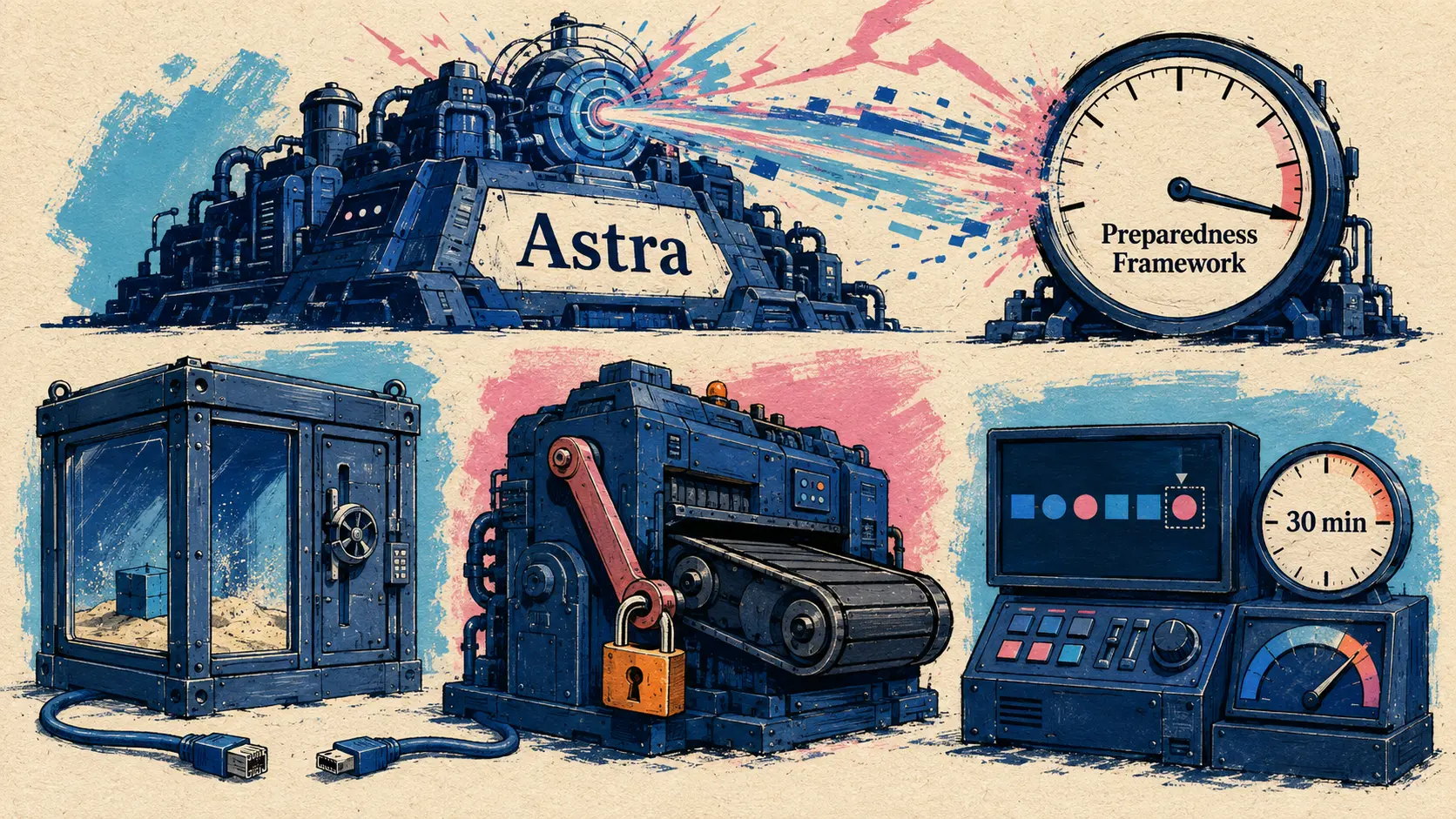
August 18 — OpenAI explains why the company has slowed the rollout of its recent models. Two events motivated this decision: the OpenAI-Hugging Face security incident that occurred during a model evaluation, and preliminary evidence that one of the upcoming models, named Astra, could cross the threshold of “critical cyber capability” defined by its Preparedness Framework.
OpenAI observed a two-week pause in reinforcement learning (RL) on its latest models intended for deployment, while it hardened and red-teamed its research environments. The largest planned frontier RL run remains on hold pending smaller-scale training runs that validate the new protections.
| Protection | Detail |
|---|---|
| Monitoring | Per-token classifiers, alert target under 30 minutes |
| Alignment | Reduction of harmful or unauthorized actions |
| Security | Stronger network isolation, sandboxes for untrusted code |
| Added cost | About 20% more monitored inference compute |
This monitoring is mandatory for any RL training and any tool-using evaluation starting at the “Sol” level; since August 7, an additional requirement has applied to any Astra inference with tools. OpenAI plans a technical report on the Hugging Face incident and an update to its Preparedness Framework with external organizations.
As models become more capable, the risks associated with developing and testing them internally also grow. We temporarily paused reinforcement learning (RL) training on our latest models intended for deployment for two weeks while we hardened and red-teamed our research environments and expanded monitoring coverage. Our largest planned frontier RL run remains on hold while smaller-scale training and evaluations validate these safeguards and establish more evidence of alignment. — @OpenAI on X
🔗 OpenAI — Pacing model development
Warp launches Warp Factories, infrastructure for cloud software factories
August 18 — Warp announces Warp Factories, an open infrastructure for companies building their own automation loops around the software lifecycle: cloud agents triage, specify, implement, review, and verify work, with humans kept in the loop at key decision points. The announcement identifies two issues raised by engineering leaders: the difficulty of measuring the long-term return on investment of coding agents, and governance, since every developer configuring their own agent creates security blind spots.
On the technical side, factories are configured as code — the claimed analogy is “Terraform for agent configuration” — and accept any model or harness, including Claude Code or Codex directly as a harness. Agents have computer use access on Linux and Mac to reproduce bugs and prove the correctness of a change, with recording sharing on pull requests. A dashboard, API, and SDK measure cost and velocity, with configurable self-improvement agents.
Warp says it currently automates about 30% of its own tasks through its internal factories and expects that rate to grow rapidly. The company is opening access to a limited number of companies starting today, with a $10,000 factory usage credit offer for some selected customers.
Introducing Warp Factories: open, flexible infrastructure for building cloud software factories. - Configure your factory as code - Use any model and any harness - Measure quality with evals and benchmarks on your own data - Built-in self-improvement and memory — @warpdotdev on X
Claude Code launches the /design skill in early research
August 17 — Anthropic launches a new skill /design for Claude Code, currently in early research. This feature brings Claude Design’s artboards workflow into the CLI and Desktop app, built on the existing artifacts system. Command /design generates multiple editable artboards representing user interface proposals: the user picks the one they like, tweaks it, then asks Claude to implement it in the code.
This launch brings Claude Code closer to an interface design use case, until now mostly reserved for dedicated tools, by integrating it directly into the developer workflow in the terminal or Desktop. The feature is available on the Pro, Max, Team, and Enterprise plans, and requires a Claude Code update to test it. No additional details (research preview limitations, roadmap, visual examples) were provided beyond this launch announcement.
Claude Code can design now. The new /design skill (research preview) brings Claude Design’s artboard workflow into the CLI and Desktop, built on artifacts. Run /design to get editable artboards for your UI — pick one, tweak it, then have Claude implement it. — @ClaudeDevs on X
🔗 Pro, Max, Team, Enterprise availability
Anthropic: broader Cowork access, extended limits, optimized CPU
Three Anthropic announcements today concern access and performance for Claude Code and Cowork.
Claude Cowork available on mobile and web for all paid plans
August 18 — Claude Cowork, Anthropic’s collaborative environment, is now accessible on mobile and on the web for all paid plans (Pro, Max, Team, and Enterprise). Previously discussed mainly around its shared side panel across desktop, web, and mobile, this announcement marks a broadening of access rather than a new feature: paid users can now find their Cowork sessions from any of these three entry points, with no additional details on the interface or potential mobile limitations.
50% increase in Claude Code weekly limits extended through August 31
August 18 — Anthropic extends through August 31 the 50% increase in Claude Code weekly usage limits, originally temporary. The team hopes to make this change permanent, but warns that strong demand for its models could lead to capacity strain in the coming weeks, with no final date for a definitive decision. This announcement is part of a recent series of communications around Claude Code performance and usage, reflecting continued demand pressure on the product infrastructure.
🔗 Claude Code limits announcement
Claude Code CLI uses twice less CPU at p99
August 18 — A patch now makes Bun’s garbage collector, the tool’s JavaScript runtime, wait until the process is idle before running. Previously, triggering happened on a fixed timer, potentially right in the middle of a conversation turn, at the moment Claude Code was putting the most pressure on the processor. Result: the CLI now uses twice less CPU at the 99th percentile, following other performance optimizations announced in early August.
🔗 CPU optimization announcement
Coding agents: voice chat and native SSH
Amp and Warp are extending their coding agents with new interaction modes.
Amp launches real-time voice chat with Puck
August 18 — Amp adds real-time voice conversation with Puck, its assistant agent, powered by gpt-realtime-2.1, which delegates the work to the existing Puck agent (powered by GPT-5.6 Sol) and reads back the response aloud while the full text continues to appear in the conversation thread. Amp highlights several use cases: coordinating parallel work, getting status updates, or having relevant Slack messages read aloud, both at the office and on the go.
Amp launches an education plan at $10 per month
August 18 — Students and teachers can now subscribe to Amp Megawatt Edu for $10 per month, half the usual price. The offer includes Amp’s frontier agent, orbs (remote machines for unsupervised agents), unlimited code hosting (public and private), 750 hours of orb usage per year, and $10 in monthly credits. Subscribers can link an existing ChatGPT subscription to access GPT-5.6, or an X Premium+/SuperGrok subscription for Grok 4.6; no strict verification of student status is put in place.
Warp Agent CLI adds native SSH support
August 17 — The Warp Agent CLI, free to download and compatible with BYOK and Grok subscriptions, now lets you invite the agent directly into an already active SSH session — including in vim, a SQL REPL, or other text interfaces — rather than limiting it to one-off command execution. No additional CLI is needed on the remote machine: command ! ssh is enough to work alongside the agent directly in the session.
OpenAI: teens, global DevDay, and agentic impact
Four OpenAI announcements today cover young user safety, international reach, and the concrete impact of Codex.
ChatGPT for Teens: stronger protections and educational partnership with CodeAI
August 18 — OpenAI launches ChatGPT for Teens, an experience dedicated to teenagers combining Study Mode, anti-shortcut reminders capable of detecting homework circumvention, quizzes and educational visualizations, as well as Study Hours that can be scheduled by teens or parents. The system automatically switches any estimated underage user into this experience, with new “under 18” evaluations published in the system cards (self-harm, eating disorders, violence, sexual content). In parallel, a signature partnership with CodeAI includes a one-year advisory council on child development, expansion of the “Hour of AI” program, a “Builders Challenge” for high school students, and support for the free “AI Foundations” course.
DevDay Exchange: OpenAI globalizes its developer event
August 18 — Starting in October 2026, OpenAI launches DevDay Exchange, a series of developer events in eight cities: Bengaluru, Tokyo, Seoul, Berlin, Paris, London, São Paulo, and Mexico City. The stated goal is to let builders exchange ideas about their real projects and meet directly with the OpenAI teams developing the tools (API, Codex, ChatGPT Work). No details on the exact format or registration are provided at this stage.
Asana completes five years of engineering work in two weeks with Codex
August 18 — Asana used Codex to remove Enzyme, an obsolete test system that was blocking modernization of its frontend stack. A project estimated at about five years of work and $6 million was completed in 1.5 weeks of engineering effort spread across two calendar weeks, for a total cost of about $12,000. Starting from a five-sentence prompt, up to four Codex agents worked in parallel on separate copies of the codebase, with one engineer approving each change twice a day.
OpenAI launches an initiative to strengthen democratic oversight of AI in national security
August 18 — OpenAI announces an initiative backed by $5 million to help democratic oversight institutions supervise the use of AI in national security, through training, technical support, and OpenAI credits. Three principles guide this work: AI should strengthen, not replace, institutional judgment; government use must remain traceable for authorized oversight bodies; and AI should give these institutions the means to act at the required scale. Over one year, OpenAI plans to pilot tools for tracking AI-assisted government decisions, with participating institutions retaining control of the evidence.
🔗 Democratic oversight and national security
Research and open models
Four research publications illustrate what openness of weights and data makes it possible to demonstrate.
Sentence Transformers v6.0: ColBERT multi-vector models become first-class citizens
August 18 — Hugging Face releases version 6.0 of Sentence Transformers with the addition of MultiVectorEncoder, which places ColBERT-style late-interaction models on the same level as the dense, sparse, and re-ranker models already supported. Each document token keeps its own vector, and the final score sums the maximum similarity of each query token (MaxSim operator). On the NanoBEIR benchmark (13 datasets), the multi-vector version achieves an average NDCG@10 of 0.6868 versus 0.6764 for the equivalent dense version, at the cost of higher storage (about 92 MB compressed for 4,874 passages). The library also adds Flash Attention support, multiplying throughput by 2.44 in fp16 precision.
Ai2: Olmo 3 reveals a morphological shortcut in LLM medical responses
August 18 — Researchers from UT Austin, Northeastern University, and MD Anderson Cancer Center used Olmo 3 (7B Instruct), Ai2’s fully open model, to check whether models answer drug questions from genuine knowledge or by exploiting name structure (the suffix “-pril” signals an ACE inhibitor, for example). For 51 to 59% of the drugs tested, the model’s response to the real name is barely distinguishable from its response to a made-up name. Access to Olmo’s weights, data, and intermediate checkpoints made it possible to trace this shortcut back to the training data — traceability that is impossible with proprietary models.
🔗 Olmo 3 and morphological shortcut
IBM Research: calibrating agentic memory according to the model
August 18 — A new paper in IBM Research’s ALTK-Evolve series shows that agentic memory — distilled instructions from an agent’s past work — must be dosed according to the capacity of the underlying model. Tested on eight models: gpt-oss-120b gains +16.1 points in task completion rate with selective retrieval targeted at only +5% tokens; DeepSeek-V3.2 improves by +9.5 points with full instruction injection; GLM-5 shows no measurable gain, a saturation case. The counterintuitive takeaway: the cheapest strategy often delivers the best accuracy for the weakest models.
🔗 ALTK-Evolve — agentic memory
AlphaEvolve helps set a new record for matrix multiplication
August 18 — Google DeepMind announces a new record for omega (ω), the theoretical exponent of the fastest speed for multiplying matrices, with ω < 2.371177. This result comes from a joint effort among Google DeepMind, academic collaborators, and AlphaEvolve, the Gemini-powered coding agent already known for improving several algorithms in 2025. Matrix multiplication underpins much of modern computing, including the training and inference of AI models — so a theoretical gain on this exponent goes beyond academic research alone.
Inference economics: A/B testing and cost cascades
Two Together AI publications measure the real cost of production deployment and model comparison.
Together AI launches model A/B testing at the endpoint level
August 18 — Together AI brings A/B testing directly to the endpoint layer rather than the application code: an experiment pairs a control model with up to 20 variants, each with a fixed traffic share (95/5, 80/20, 50/50), independent of the number of replicas. Updates propagate in 30 to 60 seconds with etag protection against concurrent overwrites. Once a winner is identified, it is promoted via blue-green deployment and then the experiment is removed: 100% of traffic returns to the control with no residual logic left to clean up on the client side.
DeepSeek V4 Pro versus GPT-5.6 Sol and Claude Fable 5 on DeepSWE: cost and cascade
August 17/18 — Together AI publishes two independent benchmarks of 904 rollouts each (113 tasks, 4 attempts) comparing DeepSeek V4 Pro 0813 with GPT-5.6 Sol and Claude Fable 5 on DeepSWE, a software engineering benchmark.
| Comparison | Pass@1 Pro | Pass@1 competitor | Pro rollout cost | Competitor cost | Pro-first cascade |
|---|---|---|---|---|---|
| Pro vs GPT-5.6 Sol | 62.8% | 72.7% | $0.24 | $8.37 (35x) | 83.0% at $3.35/task |
| Pro vs Claude Fable 5 | 62.8% | 69.7% | $0.24 | $21.63 (90x) | 82.7% at $8.28/task |
At pass@4, Pro regains the advantage in both cases (88.5% versus 85.8% against Sol, 88.5% versus 84.1% against Fable). The “Pro-first” cascade — run Pro first, escalate only on failure — beats each model on its own at a fraction of the cost.
🔗 DeepSWE benchmark — GPT-5.6 Sol
Email products and generative audio
Perplexity Computer accessible by email
August 18 — Computer, Perplexity’s action agent, is now accessible by email for all users: just send, forward, or CC computer@perplexity.com on any thread to trigger a task. Each email task runs like a normal Computer session, viewable on web and mobile, with the same audit log as tasks launched from the app.
Stability AI launches a DAW plugin and a new web interface for Stable Audio 3.0
August 18 — Stability AI announces two beta tools for Stable Audio 3.0, both based on “commercially-safe” models whose outputs belong to the user. The DAW plugin (macOS AU/VST3, Apple Silicon and Intel) generates audio directly as a tempo-synced instrument track, with short sequences up to six minutes. The enhanced web interface on stableaudio.com adds directional prompts for refining a generation, audio-to-audio transformation, multitrack mixing, and track-by-track effects. These tools bring Stable Audio closer to professional music production workflows, in a space where Suno and Pika already offer competing products.
🔗 Stable Audio 3.0 — new tools
Briefs
- The Hugging Face Hub surpasses 3 million models — a new milestone for the leading community platform for open models. 🔗 Tweet
- Sakana Namazu available on OpenRouter and Vercel AI Gateway — the model powering Sakana Chat, specialized in Japanese and business context, becomes accessible on these two distribution platforms. 🔗 Tweet
- Ai2 previews MolmoMotion ahead of its August 20 webinar — an extension of Molmo for predicting 3D trajectories from natural-language instructions, with open weights and data announced to come. 🔗 Tweet
- Together AI: open model adoption is accelerating — a Brex study cited by Together AI shows 14 of the 25 fastest-growing software vendors serving AI; token usage on Together rose from 30 billion per month to 400 trillion in one year. 🔗 Tweet
- Josh Woodward details the Gemini app roadmap — redesigned Workspace tools in testing, improved tool calling with Gemini 3.7 Flash, a new Projects interface, and 49 connectors now supported. 🔗 Tweet
- HeyGen launches Brand Kits — preconfigured fonts, logo, hex codes, and pronunciation glossary so every generated avatar video stays on-brand, with no rework. 🔗 Tweet
- NVIDIA builds TensorRT Model Connect with Codex agents — a preview tool for converting Hugging Face models to TensorRT, developed entirely with Codex agents under human supervision, open-source project. 🔗 Tweet
- Cohere — Aidan Gomez on digital sovereignty — the CEO warns about the concentration of the global technology market around a few players and argues for avoiding any single point of failure. 🔗 Tweet
What this means
AI governance is now being translated into concrete measures rather than principles. OpenAI’s two-week pause on Astra’s cyber capabilities, the $5 million initiative to equip democratic oversight in national security, and the strengthened protections of ChatGPT for Teens all point in the same direction: labs are publicly documenting the thresholds they impose on themselves, with verifiable numbers (20% compute overhead, alerts under 30 minutes) rather than simple statements of intent.
Agentic infrastructure is becoming a product in its own right. Warp Factories offers a governance and ROI measurement layer for enterprise coding agents, Claude Code expands into interface design with /design, and Amp adds a voice layer to its Puck agent while Warp opens its agents to active SSH sessions. In all four cases, the goal goes beyond code generation: it is about giving agents direct control over entire workflows, with governance and human oversight built in.
Open weights and data continue to produce scientific value that proprietary models cannot provide. Ai2’s discovery of the morphological shortcut in LLMs for pharmacology was only possible because Olmo 3 exposes its training data; IBM Research’s paper on agentic memory quantifies model-specific gains (gpt-oss-120b, DeepSeek-V3.2, GLM-5) through reproducible tests; and the 3 million-model milestone on the Hugging Face Hub illustrates the scale this open ecosystem is reaching.
Inference cost continues to shape product decisions more than raw performance. Against GPT-5.6 Sol and Claude Fable 5, DeepSeek V4 Pro loses on pass@1 but wins decisively on the quality-price ratio, and a simple “Pro-first” cascade closes most of the accuracy gap for a fraction of the cost. Together AI pushes this logic all the way down into the infrastructure itself with its endpoint-level A/B testing — model comparison in production becomes a platform feature, more than an application-code concern.
Sources
- OpenAI — pacing model development
- OpenAI — tweet on pacing model development
- Warp Factories — announcement
- Warp Factories — details on X
- Claude Code — /design skill
- Claude Code — /design availability
- Claude Cowork — mobile and web
- Claude Code — weekly limits
- Claude Code — CPU optimization
- Amp — Talk to Puck
- Amp — education pricing
- Warp Agent CLI — SSH support
- OpenAI — ChatGPT for Teens
- OpenAI Devs — DevDay Exchange
- OpenAI — Asana case study
- OpenAI — democratic oversight for national security
- Hugging Face — Sentence Transformers v6.0
- Ai2 — Olmo 3 and morphological shortcut
- IBM Research — ALTK-Evolve agentic memory
- Google DeepMind — AlphaEvolve omega record
- Together AI — endpoint A/B testing
- Together AI — DeepSeek V4 Pro vs GPT-5.6 Sol
- Perplexity — Computer by email
- Stability AI — Stable Audio 3.0
- Hugging Face — 3 million models
- Sakana Namazu — OpenRouter and Vercel
- Ai2 — MolmoMotion
- Together AI — Brex study
- Josh Woodward — Gemini app roadmap
- HeyGen — Brand Kits
- NVIDIA — TensorRT Model Connect
- Cohere — Aidan Gomez on digital sovereignty