ai-powered-markdown-translatorArticle translated from French to English using gpt-6.1-sol.
Google launches Gemini 4 Neon, a model positioned between Carbon and Hydrogen, priced at 3 and 15 dollars per million tokens, ranked 1st on the Artificial Analysis Coding Agent Index and the new default model in Antigravity. OpenAI says it holds back models such as GPT-6.1 Astra when it needs more time to meet its safety standards, and shows that its models found PPA improvements of up to 14 % on AMD’s flagship GPU IP. Genie 4 arrives in Project Genie for Google AI Ultra subscribers, Claude Code 2.1.327 fixes 100 issues, and Perplexity launches a Context API at 1 dollar per 1 000 URLs.
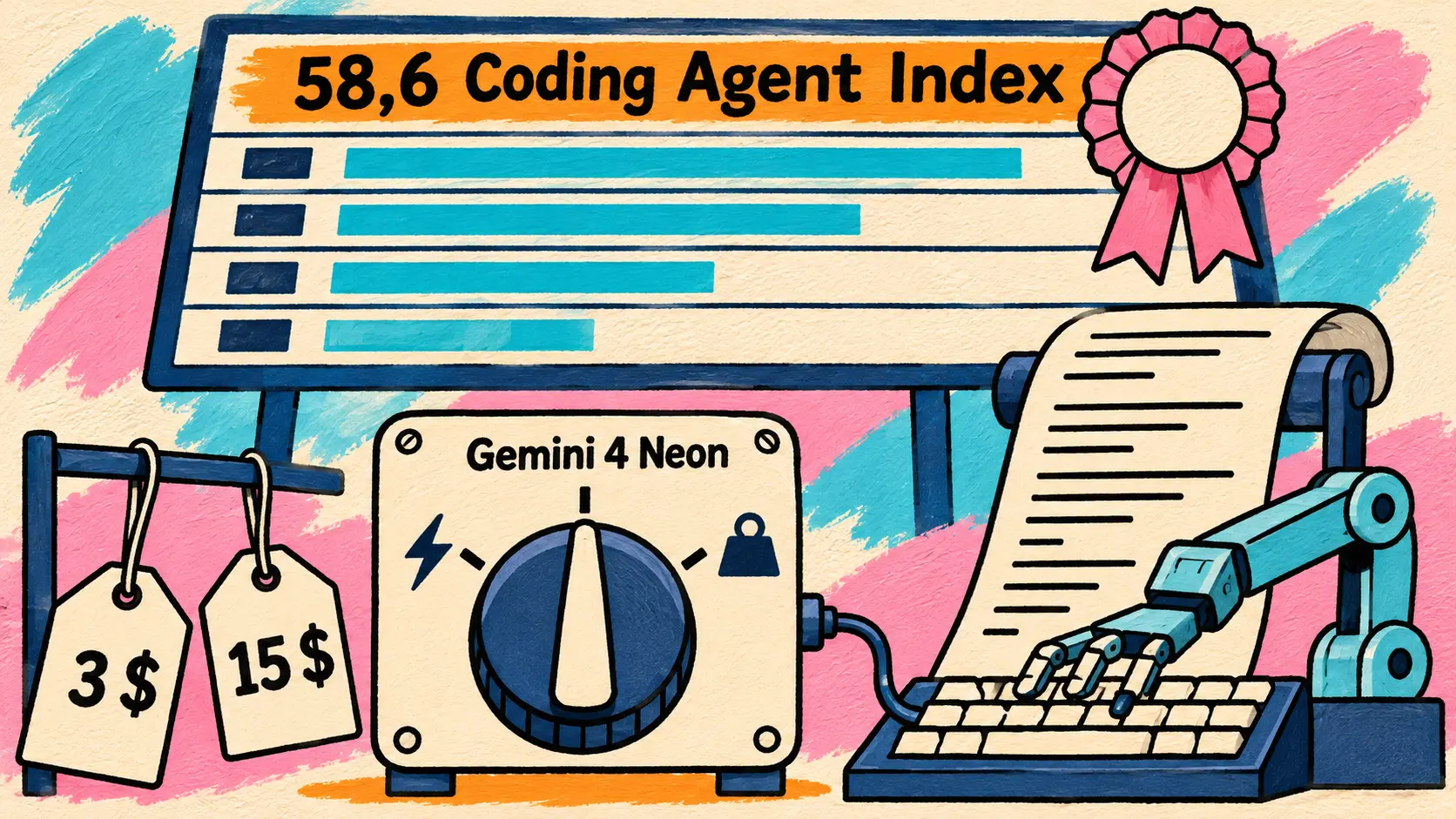
Gemini 4 Neon: Google’s mid-tier model, at 3 and 15 dollars per million tokens
November 18 — Google DeepMind launches Gemini 4 Neon, a new model in the Gemini 4 family following Argon, Carbon and Hydrogen, positioned between Carbon, for the longest and most difficult projects, and Hydrogen, for fast everyday execution. The gemini-4-neon model is generally available through the paid API: 3 dollars per million input tokens (0.15 dollars for cached tokens), 15 dollars for output, a context of 1 million tokens and four thinking levels, from low to xhigh.
| Index or benchmark cited by Google | Gemini 4 Neon result |
|---|---|
| Artificial Analysis Intelligence Index | 61 in xhigh, 3rd overall |
| Artificial Analysis Coding Agent Index | 58,6, 1st place |
| Vals Index | 70,9 %, 2nd place |
| Agent Arena Index (Arena) | 1336, 2nd place |
| Terminal-Bench 4.1 | 65,2 % |
| SWE-sweep (mini-SWE harness, then Antigravity) | 12,8 %, then 39,0 % |
Google primarily highlights the cost per task: on high, 32 % less than Carbon, and 50 to 80 % less than the best competing models on Vals and Agent Arena. Glean says it measured quality equal to or better than Carbon, three times faster and at 60 % of the cost. Per token, however, Neon remains more expensive than Carbon, which retains its launch price of 2 and 10 dollars until November 30 before moving to 4 and 20 dollars. A “Gemini 4 Neon for cyber” variant will reach defenders in the Fairwind Program in the coming days.
The rollout begins the same day: the paid API (AI Studio, Android Studio), Gemini for business, the Gemini app for Google AI Pro and Ultra subscribers, where Tasks can now run on Neon, and Antigravity for paying Pro and Ultra subscribers. There, Neon becomes the default model for new conversations when no model has been selected, with a context of 512K tokens, and the Orchestrator (Neon) option assigns it planning while leaving execution to Hydrogen.
Gemini 4 Neon is rolling out now. Sitting between Carbon and Hydrogen, it brings frontier intelligence and fast task completion for complex software engineering, knowledge work, and science. — @GoogleDeepMind on X
🔗 Google’s post on Gemini 4 Neon · Models available in Antigravity
Frontier model safety: OpenAI details its risk management and says it is holding back GPT-6.1 Astra
November 18 — OpenAI’s post on frontier model risk management opens with a model being held back:
We are pacing the development and release of our models, including pausing internal training or holding back models like GPT‑6.1 Astra when we need more time to meet our safety standards. — OpenAI, post on frontier model risk management
The post says nothing more about this model. The framework combines four layers of protection across three stages. During research, frontier training takes place without access to the real Internet following the Hugging Face incident in July; all frontier inference is monitored, with an automatic pause if a model reaches the Internet. During internal deployment, where models access the Internet, Slack and OpenAI’s code, Auto-Review is generally required for employees using Codex. External deployment adds third-party testing and offline review by agentic and human investigators. Any employee can report an incident for public disclosure.
Chip design: OpenAI’s models improve PPA by up to 14 % on an AMD flagship GPU and improve the Jalapeño chip
November 18 — Working with AMD, OpenAI’s models found PPA (power, performance and area) improvements of up to 14 % on AMD’s flagship GPU IP against already highly optimized baselines, by rewriting the code that describes the circuits (RTL SystemVerilog). AMD has already incorporated some of these changes into a design sent for manufacturing, with each rewrite verified using Synopsys tools.
| Chip or testbench concerned | Result announced by OpenAI |
|---|---|
| AMD flagship GPU IP | up to 14 % better PPA, in less than 5 months |
| Future AMD flagship CPU | single-digit gains on key blocks |
| Jalapeño, vector unit | approximately 13 % less cell area |
| Jalapeño, matrix unit | approximately 10 % less cell area |
On Jalapeño, OpenAI’s inference chip, the gains estimated by the team were confirmed in silicon. Next up: GPT-Synopsys, a model trained with Synopsys for its electronic design tools.
🔗 OpenAI’s post on chip design
Interactive worlds and video: Genie 4 in Project Genie, Pika Enact
Genie 4 arrives in Project Genie for Google AI Ultra subscribers
November 18 — Genie 4, the world model unveiled on October 27 as a research preview, becomes available in a new version of Project Genie for eligible Google AI Ultra subscribers; Google AI Pro members can join a waitlist. You can change the world while moving through it by typing a new prompt (weather, character), with native real-time audio. An agent builds a world from a simple description, then Gemini suggests and triggers events during exploration. A community gallery lets users discover, remix and publish worlds. Genie 3 remains available, with sessions of 3 minutes per generation instead of 60 seconds and starting points based on a 360-degree panoramic image. All generated content carries the SynthID watermark.
🔗 Google’s post on Genie 4 in Project Genie
Pika Enact: directing actors, staging and camera in a video that keeps playing
November 18 — Pika introduces Enact, a research preview built on Pika H3 Flex, which generates visuals and audio in chunks of less than a second while the scene keeps playing.
| Interaction mode | Performance announced by Pika |
|---|---|
| Live staging (Live Staging) | subjects moved with the mouse, visual response in under 0,4 s on H100 |
| Actor direction (Live Actor Direction) | agents with memory, video and audio at 1,75x playback speed |
| Camera control (Live Camera Control) | 8 B300 GPUs, 640x480 at 24 i/s, 1,50x real time |
You speak to the actors, who respond in their own voices, then at the word “Action,” the rehearsal is rewritten as a continuous take starting again from the first frame. Distillation reduces sampling from twenty denoising steps to just a few. Enact is not open to the public: trials and integrations go through Pika’s enterprise team, with no pricing or date announced.
Consumer assistants: live dictation in ChatGPT, Perplexity on mobile and skills written by Brain, Gemini on Android Go
ChatGPT displays dictation as you speak and removes the 10-minute limit
November 18 — ChatGPT’s voice dictation goes live with Live Dictation: speech appears as text while you speak, instead of appearing once the message transcription is complete. Tapping or clicking the waveform shows or hides the text in progress. OpenAI is also removing the 10-minute recording limit. The feature is rolling out worldwide for all ChatGPT plans, on iOS, Android, the web and the desktop app. The December 11 retirement of Advanced and Standard Voice was covered here on November 11.
Perplexity brings Teammates and Multiagent to iOS and Android, with voice
November 18 — Teammates, personal agents that handle ongoing work in Computer (launched on November 5 on the web, then on November 13 on Mac), and Multiagent, the effort level where several agents from different models work as a team (made available the day before on the web), arrive in the Perplexity app on iOS and Android. Mobile brings a feature of its own: Teammates can be controlled by voice. According to Perplexity, about a third of the most demanding Computer work already starts on iPhone. Everything is available from November 18 for Max subscribers; the tweet specifies neither the credit cost nor availability for Enterprise plans.
🔗 Perplexity’s announcement on X
Perplexity Brain writes and fixes personal skills itself
November 18 — Perplexity details how Brain, Computer’s memory, writes and improves skills, reusable instructions for recurring tasks. Using a user’s memory and history, a daily pass creates or fixes personal skills, without access to the internet or connectors, with a limit of 10 automatically created skills per user. Built-in skills, shared by everyone, go through a comparative replay of both versions followed by human review. More than 80 000 personal skills were written for more than 20 000 users between August 1 and November 14. In an eight-week randomized test, tool call failures fell by 11 % and dissatisfaction by 7.6 %, with no measurable effect on cost; on SkillLearnBench, the success rate rose from 43.8 to 62.5 %. The feature is available to all Max subscribers in the United States, enabled by default and can be disabled.
🔗 Perplexity’s post on self-improving skills
The Gemini app comes to low-memory Android phones
November 18 — Google has rebuilt the Gemini app’s architecture to run on low-memory Android phones, including eligible Android (Go edition) devices, which had previously been limited to basic voice commands. For hundreds of millions of people, Google points out, this type of phone is their everyday connection to the internet, education and commerce. The highlighted features: Gemini Live in more than 45 languages, pointing the camera at notes or a form to learn or translate, and image creation with Nano Banana. The app can be downloaded from Google Play or opened by long-pressing the power button, and will be preinstalled on future devices from partners such as Transsion. The post specifies neither a memory threshold nor a list of countries.
🔗 Google’s post on Gemini for low-memory phones
Coding agents: Claude Code 2.1.327, the Claude Docs chaos loop, the Codex sandbox, Vibe CLI 3.1.3, VS Code 1.147 and Replit at Ignite
Claude Code 2.1.327 reads MCP configuration from stdin and turns /status into a diagnostic tool
November 17 — Claude Code 2.1.327 has 173 entries, including 100 fixes. claude mcp add-json <nom> - reads an MCP server’s configuration from standard input, keeping tokens off the command line. /status now lists broken agent, skill, command and output style files, ignored permission settings and hooks whose filter (matcher) never matches anything. Several fixes prevent data loss: Remote Control in worktree mode could delete files ignored by git, such as .env, claude mcp add and remove deleted other keys from .mcp.json, and /export overwrote a file without asking. Note: to speed up the first Bash command, shell startup files may run before that command is approved, even if it is rejected (CLAUDE_CODE_DISABLE_SHELL_HEAD_START=1 disables this). Auto mode announces that a future release will remove the fallback to the billed classifier. On npm, the stable version remains 2.1.311.
How Claude Code tested Claude Docs in a chaos loop before launch
November 17 — On the claude.dev blog, Vivek Nair describes the chaos loop (chaos loop) assigned to Claude Code before the September 16 launch of Claude Docs. For about two weeks, a coordinating session, with up to 30 subagents, deliberately broke a preproduction environment (staging) modeled on production, read telemetry through the Datadog MCP, then deployed a fix and reran the test. Decisions that were difficult to undo remained with the human.
| Claude Docs launch metric | Published figure |
|---|---|
| Memory for a large document | approximately 3 Go, then approximately 180 Mo |
| Pods planned for launch | approximately 50 instead of more than 500 |
| Server errors | 60 out of 2 billion requests |
| Inference cost (Fable 5.2 list price) | approximately 125 000 dollars |
The author used an internal research model close to Claude Fable 5.2 and estimates, without having tested it, 3 000 to 10 000 dollars for a small team over two weeks.
🔗 claude.dev’s post on the chaos loop
OpenAI details Codex’s sandbox, permission profiles and network proxy
November 18 — In a post by Michael Bolin, OpenAI explains why Codex uses neither a virtual machine nor a container: it constrains each command using the operating system’s native protections to preserve the developer’s environment (a Docker container would deprive it of the iPhone simulator). The default :workspace profile allows writes to the repository, keeps .git and .codex read-only and disables network access. The post acknowledges its limitations: sensitive files outside the repository remain readable, and an agent could slip code into node_modules/prettier, which the editor would execute outside the sandbox. Permission profiles are defined in config.toml, the codex-network-proxy proxy filters by domain and only resolves DNS after authorization, and codex sandbox confines other tools, such as an MCP server.
| Operating system | Mechanism used by Codex |
|---|---|
| macOS | Seatbelt (sandbox-exec) |
| Linux | bubblewrap and seccomp-bpf |
| Windows | Microsoft’s MXC library, adoption underway |
🔗 OpenAI’s post on the Codex sandbox
Vibe CLI 3.1.3 makes Mistral Large 4 the default model and adds /goal
November 18 — Eight days after 3.1.2, Mistral releases Vibe CLI 3.1.3 (78 entries: 13 additions, 20 changes, 44 fixes, 1 removal). Mistral Large 4 becomes the default model, replacing Mistral Medium 3.5; active_model = "mistral-medium-3.5" lets users keep the previous model. The /goal command sets a goal that Vibe pursues across turns until it is achieved, with an optional token budget cap (max_goal_token_budget). Two hooks run around each model call: pre_llm can stop the turn, and post_llm can request another attempt, within a limit of three attempts per turn shared with post_agent. As for safeguards, a shell command that reads protected files requires approval, project configuration can no longer re-enable telemetry, and an installation connected to a self-hosted server no longer sends crash reports to Mistral.
🔗 Vibe CLI 3.1.3 release notes
VS Code 1.147 adds model routers and lets enterprises authorize the Claude and Codex harnesses
November 18 — VS Code 1.147 introduces experimental model routers (model routers) for Copilot harness sessions: a YAML file placed in ~/.agents/model-routers/ describes which model to use for which type of work, and the decision model gpt-6-luna-decisions directs each request to the appropriate route. The example in the release notes assigns long coding tasks to Opus and quick questions to GPT-6 Luna. For enterprises, a restriction is lifted: until now, any managed Copilot setting disabled the Claude and Codex harnesses, which do not enforce those settings. Administrators can now authorize one or both through vscode.allowedHarnesses, in settings managed through files or MDM. Managed shell rules also accept regular expressions, and the Agents window gains scheduled sending (Send Later) and multiple parallel drafts. VS Code desktop is becoming deprecated on macOS Ventura and Sonoma and on 32-bit Linux ARM.
Replit at Microsoft Ignite: local access and Teams generally available, Azure publishing in early access
November 18 — Replit uses Microsoft Ignite to expand its partnership with Microsoft and says it has been named 2026 Microsoft Partner of the Year for Startups.
| Microsoft integration | Status as of November 18 |
|---|---|
| Replit Desktop local access (Windows, Mac, Linux) | generally available |
| Replit in Microsoft Teams | generally available |
| Publishing to the Azure tenant, through Microsoft Marketplace | early access |
| Full BYOC on Azure | announced, no date |
Local access lets the Agent work on folders selected by the user, in a sandbox based on Microsoft Execution Containers; local applications can use Microsoft Foundry Local models running on the device. In Teams, users can ask Replit questions and start work from a team conversation. On Azure, Replit manages hosting, and published applications can connect to private databases through the corporate network or a VPN. No pricing is disclosed.
🔗 Replit’s post on Microsoft Ignite
Open models and inference: Rumble-2-Flash, Nemotron-Labs-Sigma, Qwen3.8-27B’s OpenCode adapter and a 180B MoE on a 32 GB Mac
Reson8 releases Rumble-2-Flash, a 0,5B speech recognition model for more than 40 languages
November 18 — Reson8 releases Rumble-2-Flash under the Apache 2.0 license, a speech recognition model with 0,5 billion parameters for more than 40 languages. Built on the Qwen3-ASR architecture, it runs as-is in Transformers and vLLM. It is obtained through on-policy distillation (on-policy distillation) of Rumble-2, Reson8’s production model.
| Benchmark | Model compared | Measured error rate |
|---|---|---|
| Open ASR Leaderboard, multilingual | Rumble-2-Flash (0,5B) | 6,96 % on average |
| AppTek, call center (302 h) | Rumble-2-Flash (0,5B) | 7,86 % WER |
| AppTek, call center (302 h) | Nemotron 3.5 Transcribe (30B) | 7,78 % WER |
| AppTek, call center (302 h) | Qwen3-ASR 1.7B | 7,4 % WER |
On the multilingual track, it outperforms Meta’s omniASR-LLM 7B, which is fifteen times larger, and Whisper large-v3. It exceeds 7 000 RTFx with full batches, equivalent to roughly one hour of audio transcribed in half a second.
🔗 Hugging Face post on Rumble-2-Flash
NVIDIA releases Nemotron-Labs-Sigma, 14 continuous diffusion language models with open weights
November 18 — NVIDIA highlights Nemotron-Labs-Sigma, whose weights, published on Hugging Face, were announced on November 16. These models generate text in parallel blocks rather than token by token: each block starts as Gaussian noise and is refined through denoising.
| Released item | Announced value |
|---|---|
| Sizes and checkpoints | 3B and 8B, 14 repositories (base, instruct, distilled variants) |
| Diffusion space | 16-dimensional continuous embeddings |
| Speedup after distillation | roughly 8x in mathematics, 4x in code |
| Context and language | 8 192 tokens, English |
| License | NVIDIA Nemotron Open Model License |
According to the research paper, these models outperform discrete diffusion models and autoregressive baselines on GSM8K, Minerva, HumanEval and MBPP, with the clearest gains in code. Once distilled, they produce 8 tokens per pass in mathematics and 4 in code, with a loss of accuracy that the authors consider negligible.
🔗 @NVIDIAAI’s announcement on X · arXiv paper 2610.02665
harness-hub releases Qwen3.8-27B’s OpenCode adapter and reevaluates the pi adapter at 64,7 %
November 18 — The harness-hub project releases Qwen3.8-27B-opencode-adapted, an Apache 2.0 LoRA adapter trained through reinforcement learning in the OpenCode coding agent harness.
| Evaluated configuration (OpenCode harness) | SWE-bench Pro (hard 51) | Terminal-Bench 2.1 (83 tasks) |
|---|---|---|
| Qwen3.8-27B | 35,3 % | 47,0 % |
| Qwen3.8-27B, xhigh reasoning | 47,1 % | 55,4 % |
| Qwen3.8-27B-opencode-adapted | 51,0 % | 53,0 % |
Without reasoning, the adapter matches the base model set to its maximum effort while writing 6 to 8 times fewer tokens per task. On Terminal-Bench 2.1, the model card reports an overall gain of 6,0 points (p = 0,38), and an increase from 45,5 to 59,1 % on the 66 tasks that were not used to select the checkpoint. The team also reevaluated the pi adapter: from 39,2 to 64,7 % on SWE-bench Pro, compared with the 29,4 to 62,7 % announced the previous day and covered here on November 17.
🔗 Qwen3.8-27B-opencode-adapted model card · pi adapter model card
A 180B MoE on a 32 GB MacBook with Transformers, within 6 % of Strata
November 18 — Tarek Ziadé of Hugging Face runs Qwen3.8-Flash-Next, a mixture-of-experts model with 180 billion parameters, on a 32 GB MacBook M5 using Transformers alone. The approach: keep a 12 GiB expert cache in memory and, for each token, read only the experts selected by the router from the SSD, quantized to 3 bits (49 GB on disk).
| Measurement on MacBook M5 (32 Go) | Transformers (streaming) | Strata 0.1.60 |
|---|---|---|
| Decoding, 200 tokens | 13,9 tokens/s | 14,8 tokens/s |
| Prefill, 4K prompt | 228 tokens/s | 220 tokens/s |
| Decoding after a 6K document | 12,4 tokens/s | 13,7 tokens/s |
The code is in a Transformers pull request (PR 50717) that is still open: this is not a shipped feature. The author states that all the code was written with AI and that the result remains too slow for his coding agents.
🔗 Hugging Face post on expert streaming
Ranking: Meta’s Muse Ember ahead of GPT-6 Luna and Claude Haiku 5.5 on Agent Arena, at 27 seconds and 1,9 cents per task
November 18 — Arena publishes results for Muse Ember, launched by Meta on November 9, on Agent Arena, its benchmark based on real user sessions, against two other efficient models designed for real work. Meta shared the thread.
| Agent Arena metric | Muse Ember (Max) | GPT-6 Luna (Max) | Claude Haiku 5.5 (High) |
|---|---|---|---|
| Time per task | 27 s | 5,8 min | 1,9 min |
| Net improvement | +2,3 % | +1,4 % | +0,4 % |
| Cost per task | 1,9 cent | 7,0 cents | 6,9 cents |
| Steering score (overall work) | +11,2 % | +3,9 % | +3,8 % |
According to Arena, Muse Ember is roughly 13 times faster than GPT-6 Luna and costs less than a third as much as either model. The steering score (steering score), measured across thousands of sessions, rises as the user needs to correct the model less often. These measurements come from Arena, a third-party evaluator.
APIs for agents: Perplexity launches the Context API, which reads up to 10 URLs per call
November 17 — Perplexity adds the Context API to its developer platform, made available on November 18 according to the @perplexitydevs thread. It reads up to 10 URLs per call and returns clean Markdown, HTML, links and excerpts selected according to a query for each page. The excerpts reproduce the original text rather than a summary, and a model separates the main content from menus and advertisements. By default, the API uses the copy in Perplexity’s index if it is less than two days old; otherwise, it reads the live page. Setting max_age_seconds to 0 forces a live fetch, while cache_only prohibits it.
| Criterion measured by Perplexity | Context API result |
|---|---|
| URLs with usable content | 92,3 % |
| Recall of key facts | 87,9 % |
| Content precision | 80,3 % |
| Pricing | 1 dollar per 1 000 URLs retrieved |
Perplexity compared itself with Firecrawl, Exa, Parallel, Keenable and Context.dev across 715 sites, using a blinded model judge, but provides their scores only in a chart. Failed requests are not billed.
🔗 Perplexity’s post on the Context API · @perplexitydevs’ thread on X
Business agents: ChatGPT for Sales and ElevenAgents for Healthcare
OpenAI launches ChatGPT for Sales, with a Sales plugin and more than 30 partner plugins
November 17 — OpenAI launches ChatGPT for Sales for sales teams: a new Sales plugin with ready-to-use workflows (choosing accounts to prospect, preparing for a call, drafting a follow-up), and more than 30 new or improved partner plugins. They cover the entire sales cycle: CRM (Salesforce, HubSpot, Close, monday CRM, Attio), prospecting (Apollo, Clay, Common Room, ZoomInfo), call notes (Gong, Otter.ai, Granola), presentations (Gamma, Figma, Canva) and contracts (Docusign, Ironclad, PandaDoc, ServiceNow CPQ). Dots, ChatGPT’s persistent agents, can use them to prepare meeting briefings or track deals; with Rox, a dot can check a deal every morning. ChatGPT Business and Enterprise administrators enable these plugins from the Admin Console, with the option to install them by default, and availability varies by plan and region. OpenAI provides no pricing.
🔗 OpenAI’s post on ChatGPT for Sales
ElevenLabs launches ElevenAgents for Healthcare, voice agents for healthcare
November 18 — The day after Scribe v3 Live Medical, ElevenLabs brings its healthcare components together in ElevenAgents for Healthcare: voice agents that schedule, reschedule or cancel appointments in the provider’s medical record system, check reimbursements and prior authorizations, and respond to patients around the clock. A question about a symptom is routed to a healthcare professional with the call’s context, and deployments are HIPAA-eligible for Enterprise customers who sign a BAA and enable Zero Retention Mode.
| Metric cited by ElevenLabs | Announced result |
|---|---|
| Cadence, median time to reach a patient | from nearly 2 hours to 3,5 minutes |
| Angle Health, provider calls without a transfer | more than 90 % |
| Scribe v3 Live Medical on PriMock57 (internal tests) | 17 % fewer errors than the next-best model |
Banner Health, Pfizer and AstraZeneca are also among the teams cited. A Healthcare Receptionist template helps users get started, and no pricing is published.
🔗 ElevenLabs’ post on ElevenAgents for Healthcare
Press: Groupe Figaro brings its journalism to ChatGPT
November 18 — Two days after LVMH’s media division, Groupe Figaro signs a strategic partnership with OpenAI. Recent articles and archives from Le Figaro and its associated publications (news, economics, culture, lifestyle) will appear in ChatGPT as summaries and excerpts, with links to the articles. The newspaper retains its editorial independence. Marc Feuillée, the group’s CEO, highlights a newsroom of more than 600 journalists. Le Figaro also plans to deploy ChatGPT Enterprise across several teams and explore other uses under its AI charter. Neither the financial terms nor the duration have been disclosed.
🔗 OpenAI’s partnership announcement
Briefs
- Antigravity CLI 1.5.10 and 1.5.11 — Version 1.5.10 adds an accept-edits mode for remote agents (
--remote-agent): in the default mode, the remote agent now requests approval before each file modification. It also opens Orchestrator (planning by Carbon, execution by Hydrogen) to Gemini Enterprise accounts. 🔗 source - Gemini CLI — Five fixes merged into the main branch, still without a new release since November 10: a shell command with an unresolved expansion retains the confirmation prompt, and the
commandPrefixandcommandRegexrules now apply only to the top-level command. 🔗 source - Gemini 4 Carbon showcase — Google shares five community creations made with Carbon, including a meadow of 52,000 flowers coded in CUDA, 1,048,576 particles simulated in WebGPU, and a 19th-century optics laboratory with 92 instruments recreated from a single image. 🔗 source
- EmbeddingGemma 2 — A post introduces the embedding model’s technical report, available on arXiv since October 27, with a five-minute video; according to the authors, the model outperforms models 2 to 12 times its size. 🔗 source
Coding agents and development tools
- Zed 1.29 and 1.30 — Version 1.29 becomes stable with branch mode in the Git Panel and Claude Fable 5.2 via BYOK; the 1.30 preview adds GPT-6.1 Terra, Gemini 4 Hydrogen’s Extra High effort level, and the full context of Copilot models when no surcharge applies. 🔗 source
- Codex CLI 0.170.0 — Real-time voice calls in the terminal negotiate their connection over WebRTC, OpenTelemetry headers refresh automatically, and several lapses in sandbox restrictions are fixed; according to the November 17 Codex changelog, Pro 500 subscribers can use Ultrafast with GPT-6.2 Sol and Astra. 🔗 source · 🔗 Codex changelog
- Copilot SDK 2.0.1 and Copilot CLI 1.0.114 — The SDK once again accepts
@github/copilot-sdkimports and legacy option formats for existing extensions, and adds selection of GPT-6.2 Sol and Astra; Copilot CLI 1.0.114 ships with release notes containing only a generic mention of fixes and changes. 🔗 source - Copilot plugins by team — Generally available on Copilot Business and Enterprise, team maintainers and organization owners select approved Agent Plugins, enabled by default for direct members in VS Code, the GitHub Copilot app, and Copilot CLI. 🔗 source
- GitHub Agentic Workflows 1.3.1 — This preview removes direct model API hosts from default network access (Claude requires allowing
api.anthropic.com), removes the experimental Atomic engine, and spreads recurring schedules over time. 🔗 source - DeepSeek Harness 0.2.2-rc.5 — With DeepSeek models, the coding agent uses DeepSeek’s server-side web search, with no per-search charge; other models use the DeepSeek Search API. 🔗 source
- Replit Missions at work — According to Replit, Missions explored more than 1,000 workflows on the leading enterprise electronic signature platform, then rebuilt them in TernSign, released as a free preview; on Replit Slides, 6 iterations improved the design score by 20% for less than 500 dollars. 🔗 source · 🔗 Replit Slides
APIs and platforms
- OpenAI API usage dashboard — The Analytics tab shows usage and spending, rate limits and rate-limited requests, as well as errors by model, project, or API key. 🔗 source
- OpenAI API data residency — Owners of eligible organizations choose their data region when creating a project, without a separate zero-retention request; according to the guide, the region cannot be changed afterward, and regional endpoints cost 10% more for eligible models released since March 5, 2026. 🔗 source · 🔗 guide
- Agents SDK Python 0.25.0 — The first stable release since mid-October: the Runloop sandbox provider is removed, the Pydantic checkpoint format changes, and Responses session compaction defaults to GPT-6 Luna. 🔗 source
- Perplexity API — The pplx-embed-v2-context models arrive in the Embeddings API (0.12 dollars per million text tokens for 9b, 0.02 dollars for 0.6b), and the Agent API adds GPT-6.2 Sol (2 and 10 dollars per million tokens) and GPT-6.2 Astra (8 and 40 dollars), with up to 272,000 input tokens. 🔗 source
- Together AI — DeepSeek-V4.1-Flash-1017 joins Together Post-Training: SFT or reinforcement learning with your own data, rewards, and environments, with the training loop remaining in the customer’s Python code. 🔗 source
- Qwen4-Max — Qwen shares the model’s arrival at TokenHarbor and Runware, which serves it with a context of 1 million tokens and up to 128,000 output tokens. 🔗 source · 🔗 Runware
- GPT-6.2 at Genspark — GPT-6.2 Sol comes to AI Chat and the Code Agent, while GPT-6.2 Astra comes to the Code Agent only. 🔗 source
Assistants and applications
- Claude Desktop — A Latest update channel, enabled in Settings > Desktop app on Windows and Mac, delivers more frequent but sometimes less reliable releases; Stable remains the default channel. 🔗 source
- Grok Bot — SpaceXSI’s agent can now book flights, hotels, and rental cars by searching for the best deal; the tweet names no countries, plans, or booking partners. 🔗 source
- Kimi Work 3.2.28 — Project instructions in a project-specific AGENTS.md, enterprise SSO login, a conversation summary panel, and presentations delivered in PPTX by default. 🔗 source
- Context degradation — Perplexity publishes a guide on the loss of agent accuracy as its context fills up (context rot), and explains how Computer limits it: subagents, working files, and context compression based on the request. 🔗 source
Image, video, and audio
- Kling Image 4.0 on third-party platforms — The day after its launch, the model arrives at fal, Runware, and eachlabs, as well as in Genspark’s AI Media Studio and AI Image Agent (native 8K, 2,000 text characters per image). 🔗 source · 🔗 Runware · 🔗 eachlabs · 🔗 Genspark
- MAI-Image-2.7 at Genspark — Microsoft AI’s MAI-Image-2.7 and MAI-Image-2.7-Flash image models arrive in Genspark, with improved rendering of text within images. 🔗 source
- Suno MCP for everyone — Suno’s MCP server, in a registration-based beta since October 28, opens to everyone: songs and now visuals can be created from ChatGPT, Claude, Gemini, Claude Code, or Cursor, without an API key, using Suno credits. 🔗 source
- Synthesia in Claude — Synthesia details its connector: the Syren agent creates videos from the conversation, for Starter, Pro, and Enterprise plans, using Synthesia credits; according to the company, Syren is built on Opus 5.5. 🔗 source
- Runway AI Festival 2027 — Submissions are open until April 5, 2027, in five categories (film, advertising, fashion, video games, design), with gala screenings in New York, Los Angeles, and Tokyo. 🔗 source
Open models, data, and research
- NVIDIA Cosmos Data Factory — NVIDIA puts the compute cost of its physical AI data blueprints at around 2.66 dollars per driving clip on a server with eight RTX PRO 6000 GPUs, and says Cosmos Dataset Search is now open source under Apache 2.0. 🔗 source
- ANEMLL — A research version splits Qwen3.8-27B between the Neural Engine and GPU of a Mac M6: a 64K prompt takes about two and a half minutes instead of five minutes on the Neural Engine alone; it requires disabling SIP. 🔗 source
- Samdei Type — Two small models under Apache 2.0 (7.1M and 18.2M parameters) convert Khmer typed in Latin letters into Khmer script, with a character error rate of 0.052 compared with 0.066 for the best existing open model, according to the author. 🔗 source
- ViKernel Scanner — VIDRAFT releases an open-source scanner that gives models mock tools: all 20 open models tested receive an F grade, with the median model attempting a dangerous action in 40 out of 100 tests. 🔗 source
- Uncensored Kimi K3.1 Pro — Provider OpenUncensored serves an unrestricted version that handles 97% of the legitimate but borderline requests in its test set, compared with 83% for the original, with an acknowledged weakness in agent loops. 🔗 source
- olmOCR-Bench — Ai2 shares Unsiloed’s reported score of 88.0 on its benchmark for reading complex documents, ahead of GPT-5.5 at 84.6. 🔗 source
- RoboTwin Unified — Harpreet Sahota releases a FiftyOne import of 27,500 episodes and more than 6 million images of dual-arm manipulation across 50 tasks. 🔗 source
- Recapture — Nutrient releases an open-source tool that turns an annotated page into realistic phone photos or scans while preserving the annotations, to train document-reading models. 🔗 source
- Local Kafka assistant — In the third part of his series, Roman Melnyk replaces fine-tuning with document retrieval using unmodified Qwen3.8-27B: +1.48 across 40 questions, compared with +0.08 and -0.18 for his fine-tuned adapters. 🔗 source
- Ai2 and Taylor Geospatial — A partnership for open geospatial benchmarks, models (OlmoEarth), and data, including Fields of The World expanded to cover crop type and yield, published for free on Source Cooperative and GitHub. 🔗 source
Ecosystem
- Replit & Co. — Replit launches a creator program aimed at professional audiences, starting with 45 creators who receive benefits on their Replit accounts. 🔗 source
- Manus and Godot — Manus becomes a Platinum sponsor of the Godot Foundation, which funds the open-source game engine; no amount is disclosed. 🔗 source
- GitHub Team — Beyond AI: security risk assessments (exposed credentials, code vulnerabilities) run automatically for GitHub Team organizations. 🔗 source
What this means
The midrange is becoming the most contested segment. Google slots Gemini 4 Neon between Carbon and Hydrogen and pitches it on cost per task rather than price per token, which remains higher than Carbon’s until November 30. Arena evaluates Meta’s Muse Ember against GPT-6 Luna and Claude Haiku 5.5, three efficient models designed for real work, and Muse Ember completes a task in 27 seconds for 1.9 cents. The same logic plays out at a smaller scale among open models: Rumble-2-Flash, with 0.5 billion parameters, matches a 30-billion-parameter model on real call-center recordings, and a simple LoRA adapter allows Qwen3.8-27B to match its own maximum thinking mode with 6 to 8 times fewer tokens. These figures remain those reported by the vendors or the evaluators they cite.
Safety depends as much on tooling as on laboratories. OpenAI says it is holding back GPT-6.1 Astra and training its frontier models without access to the real Internet; on the same day, its Codex post acknowledges that the sandbox leaves blind spots that model training must help address. Coding tools are making these tradeoffs in public: Claude Code speeds up its first Bash command at the cost of startup files running before approval and announces the end of a billed fallback in its auto mode, VS Code lets enterprises reauthorize the Claude and Codex harnesses that do not apply its managed settings, and Vibe prevents a project from re-enabling telemetry.
Models are increasingly being used to improve what surrounds them. At AMD, they rewrite already highly optimized circuits and find up to 14% more PPA. At Anthropic, a Claude Code session reduced memory usage for a large document from 3 GB to 180 MB; the entire effort, from late August to the launch of Claude Docs, cost around 125,000 dollars in inference at list price. Perplexity lets Brain write its users’ skills, and Replit has Missions rebuild more than 1,000 workflows from an electronic signature platform. Humans retain control over irreversible actions: rewrites verified with Synopsys tools, schema decisions left to the engineer directing the Claude Docs loop, and human review of Perplexity’s built-in skills.
AI is finally settling into the places where people already are. Google is rebuilding the Gemini app for low-memory phones that it says connect hundreds of millions of people to the internet every day, Perplexity is bringing its agents to mobile, and ChatGPT displays dictation as people speak, without the 10-minute limit. In the enterprise, agents are entering existing business tools: CRM and sales tools for ChatGPT for Sales, medical records for ElevenAgents, Teams and Azure for Replit. The press is following suit: after LVMH’s media division, Groupe Figaro is bringing its archives into ChatGPT while retaining its editorial independence.
Sources
- Google’s post on Gemini 4 Neon
- Models available in Antigravity
- @GoogleDeepMind on X: Gemini 4 Neon
- Managing frontier model risk (OpenAI)
- @OpenAI on X: risk management
- Chip design with OpenAI’s models (OpenAI)
- Genie 4 in Project Genie (Google)
- Research Preview: Pika Enact
- ChatGPT release notes
- @perplexity_ai on X: Teammates and Multiagent on mobile
- Self-improving skills (Perplexity)
- Gemini on low-memory phones (Google)
- Claude Code v2.1.327
- Chaos loop before the Claude Docs launch (claude.dev)
- The Codex sandbox (OpenAI)
- Vibe CLI 3.1.3
- VS Code 1.147 release notes
- Replit at Microsoft Ignite
- Rumble-2-Flash (Hugging Face)
- @NVIDIAAI on X: Nemotron-Labs-Sigma
- arXiv paper 2610.02665
- Qwen3.8-27B-opencode-adapted (harness-hub)
- Qwen3.8-27B-pi-adapted (harness-hub)
- MoE expert streaming with Transformers (Hugging Face)
- @arena on X: Muse Ember on Agent Arena
- Context API (Perplexity)
- @perplexitydevs on X: Context API
- ChatGPT for Sales launch (OpenAI)
- ElevenAgents for Healthcare (ElevenLabs)
- Groupe Figaro and OpenAI (OpenAI)
- Antigravity changelog
- Gemini CLI, PR 30338
- Community creations with Gemini 4 Carbon (Google)
- EmbeddingGemma 2 technical report (Google)
- Zed v1.29.1
- Codex CLI 0.170.0
- Codex changelog
- Copilot SDK v2.0.1
- Customize GitHub Copilot for your team (GitHub)
- GitHub Agentic Workflows v1.3.1
- DeepSeek Harness 0.2.2-rc.5
- @Replit on X: Missions and TernSign
- @Replit on X: Missions and Replit Slides
- @OpenAIDevs on X: usage dashboard
- ChatGPT Enterprise and Edu release notes (OpenAI)
- Data residency guide (OpenAI)
- OpenAI Agents SDK Python v0.25.0
- Perplexity API changelog
- @togethercompute on X: DeepSeek-V4.1-Flash-1017
- @Alibaba_Qwen on X: Qwen4-Max on TokenHarbor
- @Alibaba_Qwen on X: Qwen4-Max on Runware
- @genspark_ai on X: GPT-6.2
- @ClaudeDevs on X: Claude Desktop’s Latest channel
- @bot on X: Grok Bot bookings
- Kimi Work release notes
- Perplexity’s guide to context degradation
- @Kling_ai on X: Kling Image 4.0 on fal
- @Kling_ai on X: Kling Image 4.0 on Runware
- @Kling_ai on X: Kling Image 4.0 on eachlabs
- @genspark_ai on X: Kling Image 4.0
- @genspark_ai on X: MAI-Image-2.7
- @suno on X: Suno MCP
- Synthesia in Claude (Synthesia)
- @runwayml on X: AI Festival 2027
- Cosmos Data Factory (NVIDIA)
- Hybrid ANEMLL using Neural Engine and GPU (Hugging Face)
- Samdei Type (Hugging Face)
- ViKernel Scanner (Hugging Face)
- Uncensored Kimi K3.1 Pro (Hugging Face)
- @allen_ai on X: olmOCR-Bench
- RoboTwin Unified in FiftyOne (Hugging Face)
- Recapture (Hugging Face)
- Local Kafka SRE assistant, part 3 (Hugging Face)
- Ai2 and Taylor Geospatial (Ai2)
- Replit & Co. (PR Newswire)
- Manus joins the Godot Foundation (Manus)
- Security risk assessments on GitHub Team (GitHub)