ai-powered-markdown-translatorArticle translated from fr to en with gpt-5.4-mini.
The weekend of June 21, 2026 brings together two distinct trends: on one side, Perplexity Computer gains depth with the integration of Deep Research and new navigation tools in work threads; on the other, Together AI makes GLM-5.2 freely available while positioning itself as the fastest inference provider for this model on OpenRouter. On the coding-tools side, Amp significantly improves its Librarian sub-agent and introduces Custom Agents, while v0 simplifies user feedback with its Annotations mode.
Perplexity Computer — Integrated Deep Research, command panel, and forking
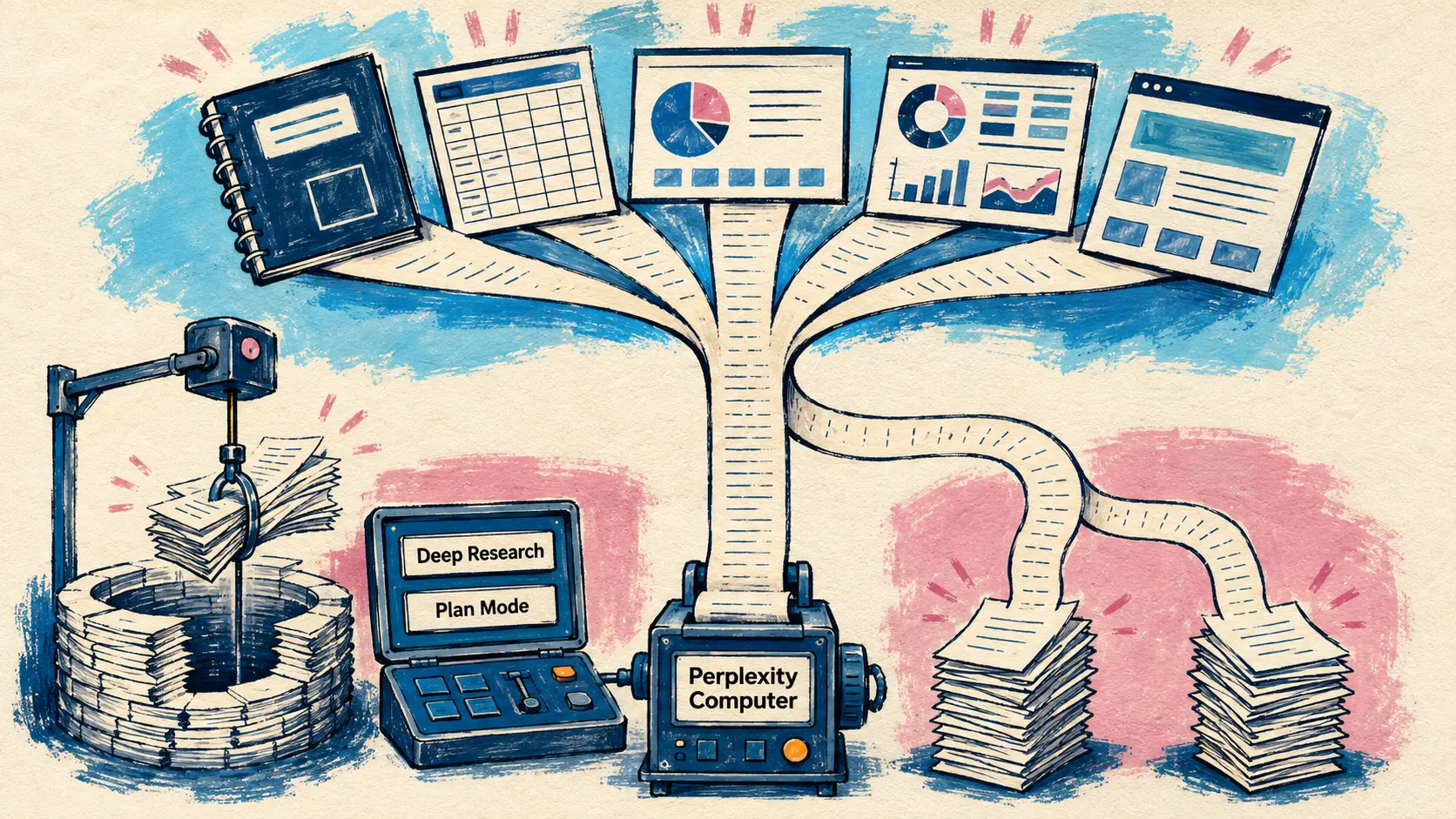
June 19 — Perplexity releases a substantial update to Computer, its research-agent platform. The main new feature: Deep Research is now directly available in Computer work threads. The results of a deep search can be turned into a report, spreadsheet, presentation, dashboard, website, or workflow — without leaving the environment. Perplexity says Deep Research in Computer outperforms competitors on the latest benchmarks thanks to an infrastructure called “Search as Code”.
| Feature | Description |
|---|---|
| Deep Research in Computer | Deep search convertible into a report, spreadsheet, dashboard, or workflow in the same thread |
| Command panel | Quick access to all modes and skills via / in the search box |
| Forking | Branching a thread into a new question while keeping the full context |
| Inline actions | Confirmations, clarifications, and connections surfaced directly in the search box |
| Computer Analytics API | Retrieval of usage data (credits, artifacts, workflows, durations) in time series — Enterprise |
| Custom credit limits | Credit limits by member or team that admins can define — Enterprise |
The command panel accessible via / brings together all available modes and skills (Deep Research, Plan Mode, custom skills, organization skills) in one place. Forking makes it possible to explore a follow-up question in a separate thread while retaining access to the context and artifacts from the original thread — a non-regression mechanism that is useful when iterating on complex projects.
The Analytics API and custom credit limits features are aimed at organizations: admins can now monitor Computer usage via API (compatible with Snowflake, Hex, Metabase, or spreadsheets) and define credit quotas by role or team.
🔗 Perplexity changelog — Deep Research, command panel, forking
Together AI rolls out GLM-5.2 for free and takes the lead on OpenRouter
June 21 — Together AI announces the deployment of GLM-5.2 (an open-source model released under the MIT license by Z.ai / Zhipu) on its platform, available for free via Together Chat without any API setup. The model runs on secure North American infrastructure.
| Model | Publisher | License | Together AI access |
|---|---|---|---|
| GLM-5.2 | Z.ai (Zhipu) | MIT (open-source) | Free — Together Chat, no API setup |
At the same time, Together AI says it is the fastest inference provider for GLM-5.2 on OpenRouter, with focused work on long-context workloads (coding, agents) to maximize tokens per GPU while keeping latency low.
“Everyone’s trying to find where to test GLM-5.2. You can try it free on Together Chat (link below). No API setup. Just pick GLM-5.2 and start prompting. Served by Together AI on secure North American infrastructure.” — @togethercompute
🔗 Together AI — fastest GLM-5.2 server on OpenRouter
AI coding tools — Amp speeds up its Librarian and launches Custom Agents, v0 introduces Annotations
Amp — Librarian 3× faster and 43% cheaper
June 18 — Amp improves its Librarian sub-agent, specialized in code search on GitHub. The new version is about 3× faster and 43% cheaper than the previous version.
| Metric | Change |
|---|---|
| Speed | ~3× faster |
| Cost | −43% |
Librarian is Amp’s internal agent responsible for scanning large codebases to locate symbols, functions, or patterns. This performance improvement directly benefits workflows where code search is a frequent step.
Amp — Custom Agents: plugins create and control agents
June 19 — Amp expands its plugin system with Custom Agents: plugins can now create agents, run them, and continue interacting with their conversation threads. This feature makes it possible to compose specialized agents directly from a plugin, without additional infrastructure.
The practical value is the composition of agentic pipelines: a plugin can trigger an agent dedicated to a task (code review, test generation, dependency analysis) and retrieve the results in the same thread. The separation between the orchestrating plugin and the executing agent remains explicit.
v0 — Annotations mode, questions in the form, Apple/Google Pay
June 19 — v0 (Vercel’s UI generation platform) releases several new features.
| Feature | Description |
|---|---|
| Annotations mode | Click elements in the preview to leave numbered comments, sent in batch to the agent |
| In-form questions | v0’s clarification questions appear in the prompt form (single choice, multiple choice, or skip) |
| Apple Pay / Google Pay | Available in v0 checkout |
| Unlimited favorites | Removal of the 5-favorites limit |
| ZIP download | Read-only members can download a chat’s code as a ZIP |
Annotations mode is the most notable new feature: instead of describing a visual problem in prose, the user clicks directly on the element in the preview and leaves a numbered comment — all comments are sent in batch to the agent. This approach reduces ambiguity between textual description and actual intent.
Briefs
- Claude Code v2.1.185 (June 20) — The waiting message shown during a network slowdown is reworded: “Waiting for API response · will retry in …” replaces “No response from API · Retrying in …”. The trigger delay changes from 10 to 20 seconds. 🔗 CHANGELOG
What this means
Agentic tooling for developers is becoming more composable. Amp’s Custom Agents illustrate a broader trend: AI development environments no longer just embed an LLM in an editor, they expose primitives that let plugins orchestrate specialized agents. The orchestrator/executor split offered by Custom Agents matches the multi-agent architecture now taking hold in production pipelines — but made accessible at the plugin level, without infrastructure to deploy. The Librarian update (3×, −43%) shows that this layer of specialized agents can be optimized independently from the main model.
The inference race for open-source models is intensifying. The fact that Together AI is actively communicating its position as the fastest server for GLM-5.2 on OpenRouter signals that inference performance is becoming a differentiating commercial argument for ML cloud providers. Making GLM-5.2 freely available through Together Chat without setup is an acquisition strategy: once developers become familiar with the model through chat, conversion to the paid API is more direct. This is a model HuggingFace and Replicate successfully used with previous open-source models.
Research-agent platforms are adding enterprise control layers. Perplexity Computer’s new features (Analytics API, per-member credit limits, forking) reveal a maturity in organizational adoption of these tools: companies need cost control, usage traceability, and non-regression during iterations. Forking is especially interesting — it is a context-management primitive that was absent from the first AI research tools, and it brings these platforms closer to collaborative work environments (Git branches, separate discussion threads).