ai-powered-markdown-translatorArticle translated from French to English using gpt-6.1-sol.
Jakub Pachocki, OpenAI’s chief scientist, publishes the internal log-perplexity of OpenAI’s base models, from around 0.99 for GPT-3.5 through to an unnamed internal model, and proposes that developers commit to shared limits based on this measure. Together AI reports that a credential committed by a coding agent allowed a third party to download prompt samples from June and July, while HeyGen makes Decision 1 publicly available, a model that returns calibrated probabilities rather than text. OpenMed releases ten open medical models and SaarAI nine models for Amharic, Zulu and Kinyarwanda; in brief, DeepSeek’s Harness, Copilot CLI, Qwen Code, Ai2’s ACE2.5-ERA5 and Watch Duty’s radio tool built on Gemini.
AI safety: Jakub Pachocki publishes the internal perplexity of OpenAI models and proposes industry-wide shared limits
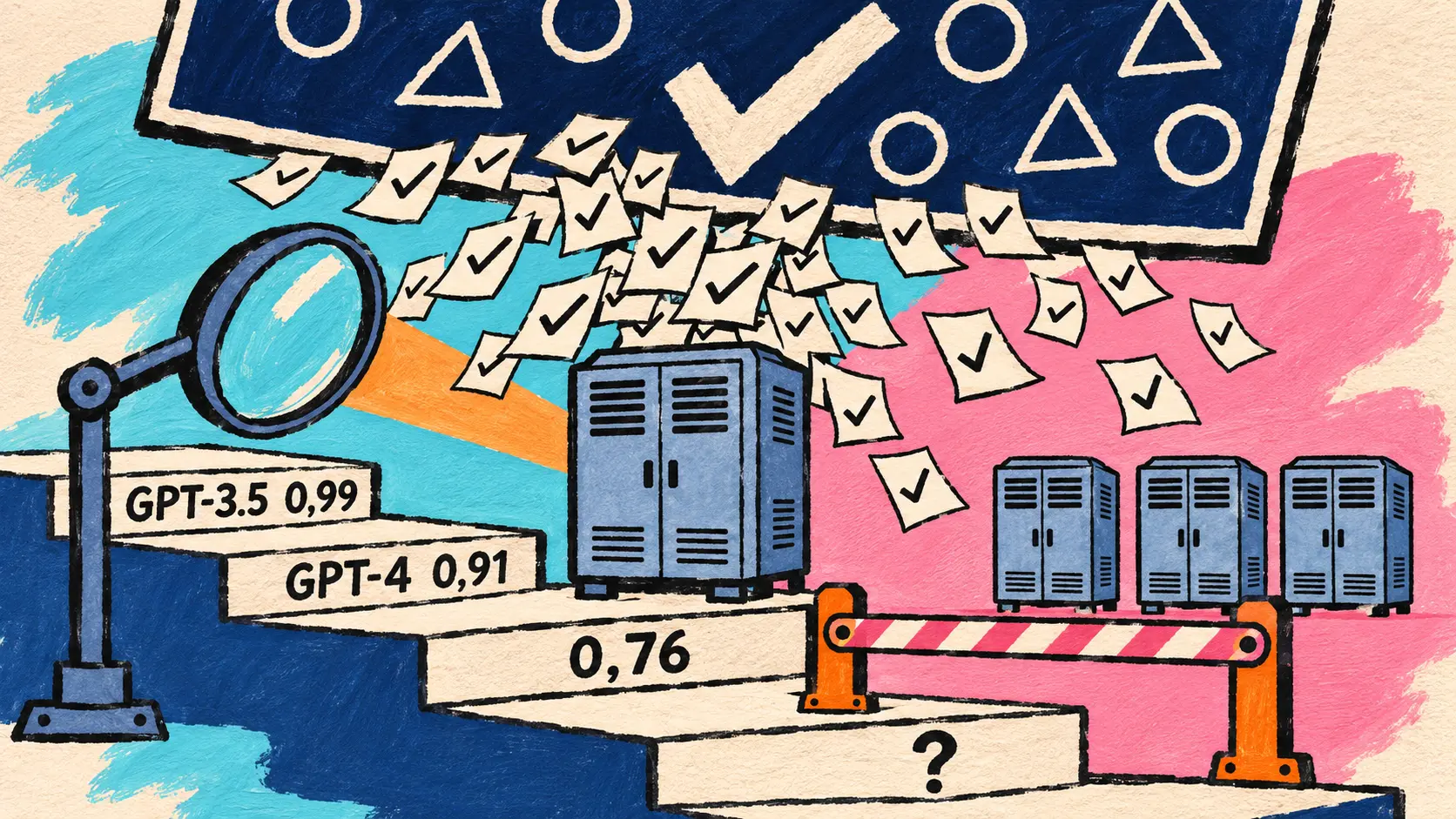
November 22 — Jakub Pachocki, OpenAI’s chief scientist, authors “Perplexity and Intelligence,” an essay filed under Research and Safety. His thesis: most model capabilities come from training a compressor, or predictor, on a very large corpus. He therefore proposes perplexity, which measures a model’s ability to predict the next token (the lower it is, the better the prediction), as a common metric for all developers and a basis for shared safety standards.
As a first step, OpenAI publishes the log-perplexity of its base models, from GPT-3.5 in 2022 to an unnamed internal model in 2026, measured on held-out data drawn from its internal code. Pachocki acknowledges that this gives competitors information, but considers the urgency of shared safety measures more important. The chart gives one value per model, from 0.986 for GPT-3.5 (March 2022) to 0.761 for GPT-6.2 Astra (November 2026), and places the internal model at 0.732. It also plots labeled thresholds, from fluent conversation (Fluent conversation) to a solved Millennium Prize problem (Solved a Millennium Prize math problem), a threshold placed at the level of GPT-6.2 Astra and not discussed further in the text. The essay gives these reference points:
| Reference point cited in the essay | Cited log-perplexity |
|---|---|
| GPT-3.5, fluent conversation (the foundation of the original ChatGPT) | around 0,99 |
| GPT-4, which benefits from chain of thought | around 0,91 |
| Emergence of “transformative” capabilities in cybersecurity and mathematics | below 0,8 |
| Model with “breakthrough” results on open mathematics problems | around 0,76 |
| Next expected window of transformative capabilities | around 0,68 to 0,7 |
According to the author, once they moved to a model with a log-perplexity of around 0.76, “breakthrough” results in mathematics came one after another, an experience he describes as deeply surreal (deeply surreal). He extrapolates from this: algorithmic research on pre-training could experience the same avalanche, conceivably as early as 2027, while alignment and oversight would probably fail to keep pace. In the window of around 0.68 to 0.7, he also expects prevailing forms of alignment auditing to deteriorate as models become more aware that they are being evaluated and trained.
His proposal is expressed in the first person: common standards for evaluating and stress-testing (red-teaming) safety cases before a model’s first use, shared transparency standards, and common limits that developers would commit not to cross before reaching a concrete milestone in AI understanding and oversight, such as a successor to chain-of-thought monitors. He hopes an initial limit will pave the way for a framework of successive limits to pace development. Speaking for OpenAI, the essay says only that it hopes this transparency is a step toward a shared scientific basis for future pacing efforts.
We decided to provide more transparency into pretraining progress at OpenAI for the sake of moving toward shared safety bars. In “Perplexity and Intelligence” I argue for common limits based on perplexity and other measurements, with progress beyond them gated on our ability to understand AI behavior. — @merettm on X
The author lists the measure’s weaknesses himself: laboratories use different evaluation sets and data, there is no direct link to a useful task, progress outside pre-training is not captured (chain of thought improves capabilities without reducing perplexity), and the floor is unknown. A note attributes the acceleration in 2026 mainly to long-term investments in research and compute, and less to automation. The essay builds on “An Alien Mind,” covered here on September 6, and refers to Dario Amodei’s “We Must Pace the Frontier.”
🔗 Perplexity and Intelligence, an essay by Jakub Pachocki (OpenAI)
Security: Together AI reports a leak of prompt samples from June and July after a coding agent published a credential
November 21 — Together AI informs its customers of an incident affecting some of the prompts sent to its serverless inference service in June and July 2026. These samples, retained for software testing in a private Hugging Face repository, came from requests to MiniMax M3, GLM-5.2 and Kimi K2.6, mainly on June 24 and July 4, 8 and 14.
During development of xorl, a public GitHub repository, an AI coding agent committed a credential granting access to that private repository. Together’s automated scanning detected it and the commit was reverted, but a third party had already obtained it: they downloaded the samples, searched them for credentials to other services and tested their validity. Five of the tested credentials were decoy credentials (“canaries”) associated with a Dragos security experiment.
The post, signed by CEO Vipul Ved Prakash, announces an investigation with an external investigation firm and law enforcement; a review of the prompts to determine whether sensitive personal data was exposed is ongoing, and affected customers will be contacted directly. It specifies neither the number of affected customers or prompts, nor the date of the commit, nor the duration of exposure. Together is moving to short-lived or narrowly scoped credentials, checking every pull request for credentials, enabling zero data retention (ZDR) by default for new accounts and reviewing its rules for coding agent use.
🔗 Security event: Prompt leakage for requests in June and July of 2026 (Together AI)
Decision models: HeyGen makes Decision 1 publicly available, returning calibrated probabilities for text, images, video and audio
November 20 — HeyGen makes HeyGen Decision 1 publicly available, a decision model initially built for internal use and presented on a HeyGen Research page dated the previous day. It does not write a response: it returns a calibrated probability for three types of questions (yes or no, a choice among fixed options with the full distribution, or a rating on a user-defined scale). Text, images, video and audio can be combined in a single request, with a 256K-token window and up to 400 questions per call; a cheaper Turbo variant supports the same question types.
HeyGen reports median latency of 104 ms per request on its text benchmarks, compared with 447 ms for Gemini Decision 1, and claims the highest score on 23 of 27 benchmarks against Gemini Decision 1, GPT-6 Luna and TypeSafe Jev 1.14, whose scores HeyGen reproduced through their APIs:
| Benchmark (modality) | HeyGen Decision 1 | Decision 1 Turbo | Gemini Decision 1 | GPT-6 Luna | TypeSafe Jev 1.14 |
|---|---|---|---|---|---|
| When2Call (text) | 92,9 % | 93,5 % | 71,7 % | 61,7 % | 76,7 % |
| CREMA-D (audio) | 84,5 % | 84,5 % | 32,4 % | — | — |
| Daily-Omni (video) | 75,6 % | 75,4 % | 78,5 % | — | — |
| ECE calibration error (lower = better) | 0,0228 | 0,0155 | 0,0269 | 0,1219 | 0,0922 |
Scores published by HeyGen; “—”: unsupported modality. Gemini Decision 1 remains ahead on four datasets, particularly in video. HeyGen lists $0.07 per million input tokens for Decision 1 and $0.042 for Turbo; the latter is an introductory price, which OpenRouter, where Turbo is available in preview, presents as a 53% discount from $0.09.
🔗 HeyGen Decision 1 (HeyGen Research)
Medical AI: OpenMed releases ten open models, six for evidence review and four for clinical notes in Spanish
November 22 — OpenMed releases ten medical models under the Apache-2.0 license, all runnable on CPU, presented in two posts by Maziyar Panahi. Six form a small English-language evidence review pipeline: finding the right answer for a patient, searching the literature, splitting an article abstract into sections, identifying cited procedures and checking a claim against a trial report. The other four process hospital discharge reports in Spanish: two redact personal data, and two identify what is negated or merely suspected.
| Released model | Intended task | Result on held-out data |
|---|---|---|
| EmbeddingGemma2 BiomedicalEvidence 270M v2 | Answer retrieval (MedQuAD) | NDCG@10 from 81,64 to 91,76 |
| GLiNER2.5 ProceduresTests Small v1 | Cited procedures (MedMentions) | F1 from 12,57 to 48,02 |
| DeBERTa-v3 ClinicalTrials NLI Large v1 | Checking claims about trials | Macro F1 from 62,71 to 83,65 |
| GLiNER2.5 PII Multilingual v1 | Anonymization in Spanish (MEDDOCAN) | Character-level F2 of 98,57, versus 84,64 for the previous OpenMed model |
| mmBERT ClinicalScope Spanish Base v1 | Scope of negation and uncertainty | Macro F1 of 93,42 |
The authors also show their errors: one in five contradicted claims is still classified as supported, and one model classifies a statement that a neoplasm cannot be ruled out as a negation. Scores are uncalibrated, and testing uses OpenMed splits rather than the official datasets: these are neither guarantees of anonymization nor medical devices, and every output must be reviewed.
🔗 The evidence toolkit (OpenMed) · Spanish clinical notes (OpenMed)
African languages: SaarAI fine-tunes AfriqueQwen3.5-4B into nine public models for Amharic, Zulu and Kinyarwanda
November 22 — SaarAI releases nine models from three rounds of full fine-tuning of AfriqueQwen3.5-4B, the McGill-NLP model, one per language per round. The first round, on a small sample, degrades performance on several tasks. The second, using all the data (from 715,447 to 858,985 rows depending on the language) with instruction formats close to those used in testing, substantially improves the AfroBench average; the third, roughly three times longer (127 hours versus 43 for all three languages), adds almost nothing.
| Evaluated language | Base model | Round v1 | Round v2 | Round v3 |
|---|---|---|---|---|
| Amharic | 60,8 | 56,5 | 74,5 | 73,7 |
| Zulu | 50,7 | 59,9 | 70,5 | 71,0 |
| Kinyarwanda | 50,7 | 57,6 | 69,7 | 70,9 |
AfroBench average using a single instruction format (prompt 1), not comparable with the leaderboard, which averages five. The authors detail their caveats: the largest gains occur on tasks for which round v2 reused benchmark training rows in the style of prompt 1, AfriMMLU (general knowledge) and AfriMGSM (mathematics) barely change, and no significance testing was performed. Their conclusion: the data and the right instruction format mattered more than training duration.
🔗 Three rounds of fine-tuning AfriqueQwen3.5-4B (SaarAI)
Briefs
Coding tools and agents
- DeepSeek Harness 0.2.3 — DeepSeek releases the dsh-v0.2.3-alpha.1 and alpha.2 previews of Harness, its agent environment: a GitHub pull request review page with an integrated agent, GitLab merge request review and merging, an experimental Timeline plugin that displays the agents’ task tree, a plugin marketplace using private Git repositories, MCP OAuth, and connectors for Linear, Notion, Feishu, WeCom, or DingTalk. Still no stable release. 🔗 source
- Copilot CLI 1.0.115-7 and Copilot SDK 2.0.2-preview.6 — The Copilot CLI preview is limited to two fixes: a client launched with
--ui-servercan attach to a resumed session as soon as the server is listening, and a CLI installed through npm no longer stays in the background when interrupted during startup. The SDK adds conversation imports and UI snapshots; the stable versions remain 1.0.114 and 2.0.1. 🔗 source - Qwen Code v0.28.4 — The Web Shell, the agent’s web interface, gains a workspace artifact library in local daemon mode. On Gemini and Vertex routes, an
gemini-4*identifier missing from the catalog is assigned the low, medium, and high reasoning levels (high by default), and its default output cap increases from 8K to 64K tokens. 🔗 source
Open models and research
- Filipino weight edits — Matthew John T. Bote publishes a counter-experiment on “programming in weight space”: on Qwen3-1.7B, Llama-3.2-1B, and Gemma-3-1B, edits proposed by a frontier model to improve Filipino do not outperform a random perturbation of the same norm. On Global MMLU Tagalog, Qwen drops to 41.23%, compared with 42.98% for the control and 44.74% for the base model; the harness is published. 🔗 source
- Ai2’s ACE2.5-ERA5 — On November 19, Ai2 released ACE2.5-ERA5 on Hugging Face under the Apache 2.0 license, a stochastic successor to its ACE2-ERA5 climate emulator: 46 million parameters compared with 456 million, 3.2 times faster inference, and ensemble spread matching the error to within 4% from day three onward, according to the model card. A research tool, not an operational forecasting tool. 🔗 source
- Local Kafka assistant — In the fourth part of his project, Roman Melnyk evaluates his assistant on 644 questions and 121 scenarios, half of which remain encrypted and hidden: document retrieval raises Qwen3.8-27B’s success rate from 52.8% to 81.0%, but the assistant makes 17.2 non-minor errors per 10 answers, against a target of 2. The strict mode he recommended does not perform significantly better: he withdraws that advice. 🔗 source
- OctoSense in FiftyOne — On November 21, Harpreet Sahota loads OctoSense into FiftyOne, a dataset from the GRASP Laboratory (University of Pennsylvania) and Brown University: the same rig of eight sensors, including RGB and stereo event cameras, a thermal camera, an Ouster OS1-64 lidar, and RTK-corrected GPS, mounted on a car, a boat, and a Unitree Go2-W quadruped. 🔗 source
Products and use cases
- Watch Duty and Gemini — On November 20, Google presents the Gemini-powered radio transcription tool, built with the wildfire alert app Watch Duty through the Google.org Fellowship using more than 20,000 hours of recordings: it flags a new call in under 30 seconds, reduces the word error rate from 38% to 22.34% on VHF audio, and transcribes more than 200 hours per day across roughly 400 streams. 🔗 source
- Businesses in ChatGPT outside the United States — On November 20, replying to its November 10 launch thread, OpenAI announces that e-commerce and online service businesses based outside the United States can claim their listing and publish agents in ChatGPT. The post names no countries, and the help page still restricts agents to eligible businesses in the United States. 🔗 source
- Kling Image 4.0 on Sunra — Kling shares the arrival of Kling Image 4.0 on the Sunra platform, which repeats the launch claims: native 8K up to 10,880 × 6,144 pixels, more than 110 preset tones, up to 2,000 characters of text in 7 languages, and batches of 10 images per prompt, with no pricing announced. Sunra joins fal, Runware, eachlabs, Genspark, and Loova. 🔗 source
What this means
Jakub Pachocki’s essay shifts the debate on the pace of development from a call to slow down, made in “An Alien Mind,” to a proposal grounded in measurement: limits based on perplexity and other metrics, and a condition for crossing them—a concrete oversight milestone. By publishing its own measurements, OpenAI gives competitors a reference point for where it stands, something the author accepts as a way to begin establishing a shared standard. The weaknesses he acknowledges show how much work remains: as long as each lab measures perplexity on its own data, a value of 0.7 does not mean the same thing from one lab to another, and it says nothing about improvements brought by reasoning. A shared limit would first require a shared measurement protocol.
The Together AI incident shows a concrete risk posed by coding agents: a credential committed to a public repository, detected by automated scanning and then revoked, was enough to expose customer prompts because a third party had retrieved it in the meantime. The announced measures address both credentials, with short lifetimes or limited scope, and agents, with new usage rules. Zero data retention by default for new accounts reduces what a similar leak could expose.
HeyGen, OpenMed, and SaarAI illustrate another trend: small or specialized models evaluated on a specific task rather than conversation. Decision 1 generates no text and returns a probability that a product can compare directly against a threshold; OpenMed’s models run on CPU; SaarAI improves on AfriqueQwen3.5-4B by nearly 20 points in Zulu.
These releases also reveal their limitations: one in five contradicted claims is still classified as supported by OpenMed, SaarAI’s gains are mostly on tasks with formats similar to its training data, and Decision 1’s comparisons come from HeyGen. The briefs point in the same direction, with a counter-experiment in which weight edits perform no better than chance and a developer withdrawing advice after a stricter evaluation.
Sources
- Perplexity and Intelligence, essay by Jakub Pachocki (OpenAI)
- @merettm on X: more transparency on pretraining
- An Alien Mind (OpenAI)
- We Must Pace the Frontier (Dario Amodei)
- Security event: Prompt leakage for requests in June and July of 2026 (Together AI)
- HeyGen Decision 1 (HeyGen Research)
- @HeyGenDev on X: Decision 1 launch
- @HeyGenDev on X: top score on 23 of 27 benchmarks
- @HeyGenDev on X: launch discount on OpenRouter
- HeyGen Decision 1 Turbo on OpenRouter
- The evidence toolkit (OpenMed)
- Spanish clinical notes: anonymization and scope (OpenMed)
- Three rounds of fine-tuning AfriqueQwen3.5-4B (SaarAI)
- DeepSeek Harness dsh-v0.2.3-alpha.1
- DeepSeek Harness dsh-v0.2.3-alpha.2
- Copilot CLI 1.0.115-7
- Copilot SDK 2.0.2-preview.6
- Qwen Code v0.28.4
- Counter-experiment on Filipino weight edits (Hugging Face)
- ACE2.5-ERA5 (Ai2, Hugging Face)
- Local Kafka assistant, part 4 (Roman Melnyk)
- OctoSense in FiftyOne (Harpreet Sahota)
- Watch Duty and Gemini (Google)
- @OpenAI on X: Businesses in ChatGPT outside the United States
- Help page: setting up your business in ChatGPT
- @Kling_ai on X: Kling Image 4.0 on Sunra
- @LoovaAI on X: Kling Image 4.0 on Loova