ai-powered-markdown-translatorArticle translated from fr to en using gpt-6.1-sol.
Anthropic releases version 2026-10-21 of the Claude API, its first since 2023: temperature, top_p and top_k are rejected, and all SDKs receive major version updates under the Apache 2.0 license. Hugging Face launches Carbon-X, an open 14-billion-parameter model that reads and generates DNA at nearly the level of GPT-6.1 Sol, and METR publishes, with Redwood Research, the findings from three weeks spent attacking the monitoring of internal agents at OpenAI. Agent Skills and OpenEnv join MCP at the Agentic AI Foundation, the OpenAI Decisions API becomes generally available, and NVIDIA devotes the second day of GTC Berlin to Cosmos and Minerva.
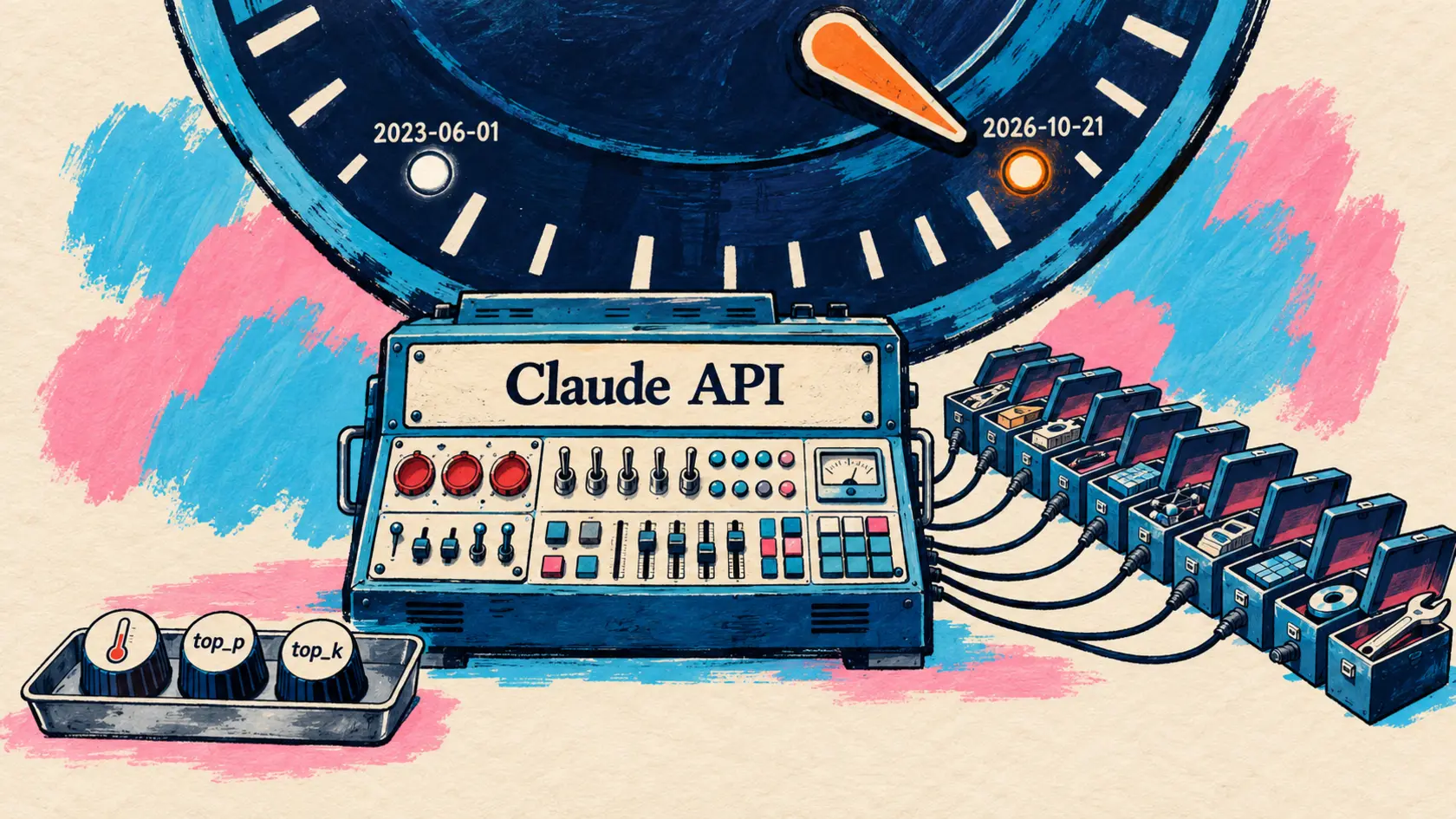
Claude API 2026-10-21: the first version since 2023 rejects temperature, top_p and top_k
October 21 — Anthropic releases version 2026-10-21 of the Claude API, the value to pass in the anthropic-version header, alongside new major versions of all its SDKs and its ant CLI.
API version 2026-10-21 is now available. The Claude API has evolved a lot, but this is our first official version release since 2023. We plan to release versions more often so you can handle breaking changes before a new model requires them. 2023-06-01 is not deprecated. — @ClaudeDevs on X
The most visible change concerns sampling. With 2026-10-21, temperature, top_p and top_k trigger a 400 error in the Messages API, in token counting and in every request in a batch (Message Batch), even at their default values; without them, the request samples at a temperature of 1.0. Claude 4.7 and later models already accepted only these values. On an older model such as Claude Sonnet 4.6, however, a lower temperature used to obtain more consistent outputs loses its effect, with no replacement setting: the documentation then recommends keeping that request on 2023-06-01.
| Request element | Effect with 2026-10-21 |
|---|---|
temperature, top_p, top_k | 400 error, even at the default value |
| Document block placed directly in an assistant message | 400 error (a nested document, such as a web fetch result, is still accepted) |
| Nonempty citations on text blocks in a user message | 400 error, including search_result |
workspace_id for API keys | Removed, replaced by scope |
| Renamed fields in the Admin API and Enterprise Analytics API | Old names removed |
Python 2.0.0, TypeScript 1.0.0, C# 13.0.0, Go 2.0.0, Java 3.0.0, PHP 1.0.0, Ruby 2.0.0 and ant CLI 2.0.0 send the new version by default. These SDKs switch from MIT to the Apache 2.0 license, with earlier versions remaining under MIT, and introduce their own breaking changes: one message type per role, the API key sent in Authorization: Bearer rather than X-Api-Key (the API still accepts both), removal of the old Text Completions API (TypeScript, Go, Java, Ruby and CLI), and removal of client-side compaction in the tool runner in favor of server-side compaction.
To migrate, Anthropic provides a step-by-step guide and points to the /claude-api skill in Claude Code, whose version 2.1.307 adds the /claude-api api-version command. On Amazon Bedrock, 2026-10-21 is available only for Claude 4.7 and later models. On the same day, the release notes add the enforcement_status and enforcement_actions fields to user profiles (user profiles), indicating whether Anthropic has restricted or banned one of an organization’s end customers.
🔗 The migration guide for 2026-10-21 · Claude Platform release notes
Carbon-X: Hugging Face releases an open 14-billion-parameter model that reads and generates DNA
October 22 — Hugging Face releases Carbon-X, an open 14-billion-parameter model that processes DNA and natural language in a single token stream: users can ask it about a sequence, request the effect of a mutation or have it generate DNA. Derived from Qwen3-14B, it is released under the Apache 2.0 license by the HuggingFaceBio organization, which released the Carbon-A gene annotator on October 8.
The team of Loubna Ben Allal, Lewis Tunstall and Leandro von Werra continued training Qwen3-14B (midtraining) on 300 billion tokens combining DNA, English and interleaved data, then post-trained it through supervised fine-tuning and reinforcement learning. A hybrid tokenizer retains Qwen3’s BPE for text and splits DNA into nonoverlapping 6-mers, with one token covering six base pairs. Without a separate DNA encoder, text and sequences share the same embedding matrix, and a response can combine both.
Across five benchmarks (variant effects, sequence understanding, next-base prediction), Carbon-X achieves an average of 66.7% without thinking: 27 points higher than Qwen3-14B, and better than all other open models evaluated. GPT-6.1 Sol performs only slightly better, at 67.5%, but Carbon-X outperforms all models tested, both open and closed, on coding variant effects (BioReason Coding) and next-base prediction.
| Model evaluated | DNA index in the post (rounded) |
|---|---|
| GPT-6.1 Sol | 68 % |
| Carbon-X | 67 % |
| Kimi K3 | 50 % |
| DeepSeek V4.1 Flash | 47 % |
| Qwen3-14B | 40 % |
| GLM-5.3 | 40 % |
Introducing Carbon-X: The best open DNA model. We midtrained a 14B model on DNA and text, and it beats every open language model and matches GPT-6.1 Sol at 1,000x lower cost. — @LoubnaBenAllal1 on X
Two cost figures are circulating: the model card estimates its cost per problem at around 1/1,800 of GPT-6.1 Sol’s, while the announcement rounds this to 1,000 times cheaper. The calculation uses standard API pricing for the models compared, each at the thinking level that yields its best average, and, for Carbon-X, throughput measured over one hour on an H200 priced at $5; the model answers directly, without extended reasoning. Clément Delangue, CEO of Hugging Face, presents Carbon-X as a response to the biology guardrails of frontier labs, which he says hinder scientists, universities, nonprofits and health agencies without stopping malicious actors.
🔗 The Carbon-X model card · The release post · Clément Delangue’s tweet
METR and Redwood Research put internal agent monitoring at OpenAI to the test
October 22 — METR publishes an account of an exercise conducted this summer at OpenAI with Redwood Research. From July 21 to August 11, one employee from each organization spent three weeks on site attacking (red-teaming) the asynchronous system that monitors internal agents at OpenAI for misalignment, agents that write code or run experiments for its researchers. Access was extensive: devices supplied by OpenAI that never left the premises, internal code, monitor prompts and configuration, and interviews with a dozen researchers and engineers.
| Metric reported by METR | Estimated value |
|---|---|
| Eligible internal Responses API agent traffic (GPT-5.5 or later models) | Around 75 to 94 % |
| Eligible internal Codex agent traffic | 99,2 % |
| Eligible internal Codex traffic that went unmonitored, May to July 2026 | On the order of 10 % (compaction) |
| Monitor requests resulting in errors | Less than 0,2 % |
| Internal report, then redacted version | 61 pages, then 38 pages |
These estimates, subject to substantial uncertainty according to METR, concern the system as it existed on July 21. The main gap involved context compaction events, which the monitors could not see:
Because of this coverage gap, we estimated that on the order of 10% of internal Codex traffic was unmonitored from May to July. OpenAI had independently identified this issue shortly before the exercise began. — @METR_Evals on X
OpenAI fixed this during the exercise. Because the monitor triggered only when the agent handed control back to the user, an agent could, as long as compaction went unmonitored, postpone monitoring indefinitely by continuing to act. Reinforcement learning was not covered at the start of the exercise.
The team also describes vulnerabilities: a bypass of the Codex sandbox and Auto-Review that gave the agent all the host user’s permissions, a technique that hid hundreds of recent actions from monitoring (details redacted by OpenAI), inputs capable of causing the monitor to fail by exploiting serialization differences, two client-controllable headers that disabled monitoring for new agents, although their use remained detectable, and two unmonitored internal tools, believed to be read-only, that a simple exploit, not validated in practice, could have misused. Conversely, the monitor sees the agent’s full trajectory, with a few exceptions, and its prompts look for covert plotting (scheming), sabotage, data exfiltration, deception and prompt injection.
OpenAI says it has fixed all vulnerabilities affecting its production safeguards stack; METR specifies that it did not evaluate this claim. The parties had agreed in advance to publish only a brief post, with OpenAI allowed to redact the report. METR draws five design principles from the exercise, including making monitoring difficult to evade (for example, every N minutes or every N messages), regularly attacking the system and isolating agents from their monitors. For OpenAI, these findings helped strengthen its safeguards as the system expanded and will guide future collaborations with third-party evaluators. On October 15, Anthropic had described comparable access granted to a METR team.
🔗 Red-Teaming OpenAI’s Internal Agent Monitoring Systems (METR) · The tweet from @OpenAI
Agentic AI Foundation: Agent Skills, Open Responses, OpenEnv and OpenSandbox join MCP
October 22 — The Agentic AI Foundation (AAIF), the Linux Foundation organization co-founded last year by Anthropic, Block and OpenAI, which already hosts MCP, welcomes four new projects at once: Agent Skills, contributed by Anthropic, Open Responses by OpenAI, OpenEnv by Hugging Face and OpenSandbox by Alibaba. This brings its total to 10 projects in its first year; according to Manik Surtani, its CTO and co-founder, each covers part of the stack, from how agents acquire capabilities to where they run.
Anthropic contributes the Agent Skills name and logo, the GitHub organization and the agentskills.io domain. Born out of work on Claude Code, this folder format for teaching an agent a task (a SKILL.md file, scripts, reference documents) was released as an open standard in December 2025; according to Anthropic, more than 70 agent platforms have integrated it since, including ChatGPT, Cursor, GitHub Copilot and VS Code, and 1 million skills have been published, with nearly 280 million installations. Engineers from Anthropic, Google, OpenAI and other companies will maintain it in an individual capacity, with David Soria Parra and Mahesh Murag as leads (Lead Maintainers), and the @ClaudeDevs thread also names Earendil, Microsoft and OpenCode on the technical steering committee. Existing skills continue to work and licenses remain unchanged; the proposed first steps are numbered releases, a formal proposal process and security recommendations.
Hugging Face, meanwhile, places OpenEnv, its open framework of environments for training agents, under neutral governance, with a committee that includes Microsoft, Reflection, Meta-PyTorch, Fleet, Mercor, Nebius, Modal, Prime Intellect and Unsloth. The old meta-pytorch/OpenEnv and huggingface/OpenEnv addresses now redirect to github.com/openenv/OpenEnv.
🔗 The Linux Foundation press release · The Anthropic post · The announcement from Ben Burtenshaw (Hugging Face) · The @ClaudeDevs thread
Designing and governing agents: folded-in subagents, auto mode by default, comparing agentic adoption
Three announcements focus less on what agents can do than on how to organize them, give them control and measure their use.
Anthropic recommends folding subagents into the main loop and releases an open-source migration kit
October 22 — In a Claude Platform best-practices guide by Diane Sarkis, Anthropic’s Applied AI team reports that, across several enterprise deployments, a single agent equipped with skills often delivered better quality than a single catch-all prompt or a subagent architecture, often with lower cost and latency per task; one customer measured execution roughly twice as fast as with its multi-agent harness. Anthropic says it has reduced the Claude Code system prompt by more than 80% for its most advanced models, partly through progressive disclosure of skills and tools, and observes that tool selection deteriorates beyond 30 to 50 tool definitions. Subagents still have a role when context fills up, for parallel tasks whose context can be discarded, or when the agent struggles to choose its tools. The single-agent-loop-kit kit (Apache-2.0) runs /claude-api build-eval, prompt-audit, hillclimb and cost-optimize in sequence to migrate to a single loop.
🔗 Anthropic’s guide to subagents · anthropics/single-agent-loop-kit (GitHub)
Claude app sessions will default to auto mode on Pro, Max and Team
October 22 — Starting next week, according to @claudeai, Claude app sessions on the web, desktop and mobile will run in auto mode by default on Pro, Max and Team plans: instead of asking for approval at every step, an automatic check blocks risky actions, and users can switch back to manual mode at any time. Auto mode has already been the default setting for Claude Code on these plans since August 14, and for terminal and VS Code sessions on all plans since version 2.1.284 on September 28; the tweet also cites the August announcement, when the classifier detected 89 % of dangerous commands in testing, compared with 14 % for manual approval. The announcement consists of a single tweet, with no precise date, details on which sessions are affected or mention of Enterprise.
The Copilot impact dashboard compares a company’s agentic adoption with that of its peers
October 22 — Copilot’s impact dashboard (Copilot impact dashboard) adds an optional industry comparison (Industry comparison), disabled by default. Enterprises, and organizations that do not belong to an enterprise, can compare two metrics against aggregated benchmarks from participating peers: the share of their users who work primarily with agents (agent-first) or with multiple agents (multi-agent), and the pull request merge rate of these agentic users compared with other users. Each score is ranked against the peer median over 28 days, then against the top decile as the group grows, by company size and across ten industries. Comparisons refresh daily, aggregates are deleted after 30 days, customers with data residency are compared only within their region, and nothing is exposed through the metrics API or exports. At launch, with too few participants, users may see only the median, or no ranking at all.
🔗 Industry comparisons in the Copilot impact dashboard
Decision models: OpenAI’s Decisions API becomes generally available, GLiDE v1.2 tops the Decision Index
Decision models answer closed-ended questions (classify, route, choose the next action) without generating text. On the same day, OpenAI opens its dedicated API to everyone, and Fastino releases weights it claims top Hugging Face’s benchmark index.
OpenAI brings the Decisions API to general availability, with 400 questions per request
October 22 — Sixteen days after its public beta, the Decisions API moves to general availability (generally available). Built on GPT-6 Luna, it returns a probability (predicate), a selection from supplied values (choice) or a score on a scale (score), up to 10 times faster than GPT-6 Luna through the Responses API, according to OpenAI. It now accepts native JSON inputs, images in each question’s instructions and up to 400 questions per request, compared with 200 in beta, and adds caching for reused context, inference residing in the United States and the EU, and native GPT-Live integration. Input remains priced at 0,10 dollars per million tokens, cached input costs 0,01 dollars and output is free.
| Customer cited | Improvement reported to OpenAI |
|---|---|
| Box | Routing choice about 5 times faster, same accuracy as the Responses API |
| Datadog | Agent command risk scoring 40 times faster at p95 |
| Ramp | 4 times faster and 30 % cheaper than GPT-6 Luna |
| Sierra | Under 280 ms at p95, 90 % cheaper per call than the previous approach |
| Speak | Time to the next action reduced from 1,4 s to 0,13 s |
The openai-python 3.37.0 SDK, released that evening, expands the Decisions types with a breaking typing change.
🔗 Build more responsive apps with the Decisions API
Fastino releases GLiDE v1.2, which it says tops the Decision Index v0.4.1
October 22 — Fastino releases GLiDE v1.2, a new version of its decision model, with weights on Hugging Face and access through its API. According to Fastino, it ranks first on Hugging Face’s Decision Index v0.4.1, with one of the lowest calibration errors in the index; on October 21, Base Labs announced mammoth-1 in first place with 71,24, but on version 0.4: the two scores are not comparable. The model reads text, JSON and now images, and returns a probability for each option in a single pass: a choice from up to 255 options, a yes or no, or a level on a scale; Fastino removed thinking tokens to reduce latency.
| GLiDE v1.2 feature | Reported value |
|---|---|
| Model size | 26 billion parameters |
| Minimum hardware | One GPU with at least 80 Go |
| Score according to Fastino | 71,5 on the Decision Index v0.4.1, 1,7 points ahead of the runner-up |
| Fastino API pricing | 0,04 dollars per million input tokens |
| Weights license | fastino-community: free, commercial agreement required above 10 million dollars in annual revenue |
🔗 Fastino’s blog post · fastino/GLiDE (Hugging Face)
Model access: routers subject to OpenAI approval, Batch API at Perplexity, confidential computing at Cohere
Three changes concern how models are accessed rather than the models themselves: intermediaries, batch processing and request confidentiality.
Starting November 20, OpenAI will require model routers and AI gateways to obtain its approval
October 21 — In a post in its Safety section, OpenAI says it has worked with its customers and partners to align the safety policies of services that provide access to its models, directly, through a hosting partner or through a reseller: safeguards consistent with its own, investigations into possible violations, action when a problem is identified and coordinated enforcement of restrictions across services. The most concrete change comes from the Usage Policies (Usage Policies) updated effective November 20, 2026: services that provide direct access to models, such as model routers (model routers) or AI gateways (AI gateways), will have to undergo OpenAI’s review and obtain its approval before offering this access. OpenAI is also introducing SafetyIDs, which customers can provide to distinguish end users during an investigation without revealing their identities to OpenAI. The post names no affected services and does not detail the approval process.
🔗 Broader access through consistent standards (OpenAI)
Perplexity opens a Batch API for its Agent API, with up to 50 000 requests per file
October 22 — Perplexity adds a Batch API to its Agent API for jobs that do not need an immediate response (evaluations, classification, data enrichment): users upload a JSONL file of requests, create a batch, then retrieve a results file and an errors file, using endpoints that follow the structure of OpenAI’s Batch API. Each request runs the full Agent API loop: web search (web_search) and page reading (fetch_url) therefore also work asynchronously.
| Batch API limit | Published value |
|---|---|
| Requests per file | 50 000, up to 200 Mo |
| Supported models | One per file, from those available in the Agent API |
| Processing time | Target of 24 h without a guarantee, hard deadline of 48 h |
| File retention | 30 days |
| Processing price | No separate batch pricing; flex tier for OpenAI models that offer it |
Requests in a batch do not count toward the Agent API’s request limit, and those that have not started by the deadline expire without being charged. The service is unavailable to organizations with zero data retention.
🔗 The thread from @perplexitydevs · The Batch API documentation
Cohere opens Model Vault Confidential Computing in public beta, on NVIDIA H100 GPUs in Azure
October 22 — Launched in early access on September 16, Confidential Computing for Model Vault, Cohere’s dedicated, managed inference platform, enters public beta: customers can create encrypted vaults and deploy their workloads now, using the same APIs. The beta runs on NVIDIA H100 GPUs in Microsoft Azure, which provides the confidential computing infrastructure, while NVIDIA Confidential Computing protects GPU memory and encrypts CPU-to-GPU communication. Request content is encrypted end to end through Oblivious HTTP (OHTTP) to the attested environment, and the client’s software verifies signed proof of the hardware, firmware (firmware) and software before sending anything; according to Cohere, even its operators and the cloud provider cannot read the protected memory. Certain physical or side-channel attacks, availability, application vulnerabilities such as prompt injection, metadata, and API and model identifiers remain outside the scope. Blackwell B200 GPUs, general availability and an open source stack have been announced without a date, and no pricing has been disclosed.
🔗 Confidential Computing on Cohere Model Vault · Cohere’s technical article
Observing and forecasting the planet: ForTy, OlmoEarth v1.3 and StormScope EU
Three releases today map or forecast the Earth using satellite imagery, two of them using embeddings that summarize each 10-meter pixel.
Google DeepMind releases ForTy, a global 10-meter map that distinguishes natural forests, plantations and tree crops
October 22 — Google DeepMind and Google Research, together with the World Resources Institute (WRI) and IIASA, release Forest Typology (ForTy) 2020, a map that places each 10-by-10-meter patch of Earth’s land surface into one of six categories based on FAO definitions: primary forest, naturally regenerating forest, planted forest, forest plantation, tree crops and agroforestry, other land. Where most maps show only the presence of trees, ForTy distinguishes a primary forest from an oil palm plantation, making it a reference for the EU regulation on deforestation-free products (EUDR). The model relies on AlphaEarth Foundations embeddings and approximately 1,7 million labeled points; validated on more than 9 000 randomly selected sites, it identifies the correct forest type in 90 % of cases, separates forest from non-forest in 95 % of cases, and provides a probability for each class rather than a label. A preliminary annual series for 2017-2025 also shows what replaces a forest that has disappeared. The map and series are freely available on Google Earth Engine under an open license.
🔗 Google DeepMind’s blog post · The Scientific Data article
Ai2 releases OlmoEarth v1.3 and precomputed satellite embeddings for the entire planet
October 22 — Ai2 releases OlmoEarth v1.3, a model that reads a year’s worth of radar (Sentinel-1) and multispectral (Sentinel-2, Landsat) imagery and summarizes each 10-meter pixel as a vector. Ai2 has computed these embeddings and shares them on Source Cooperative: the entire planet for 2023 to 2025, selected countries only from 2017 to 2022. A small classifier trained on them is now enough to map crops, land cover or changes, without fine-tuning the model for each task. An in-browser explorer, with no account required, compares years, finds similar places and exports a map as a GeoTIFF.
| OlmoEarth v1.3 metric | Published value |
|---|---|
| Embedding per 10 m pixel | 128 dimensions, or the first 64 in the lightweight version |
| Evaluations won against AlphaEarth Foundations and Tessera v2 | 20 out of 27 (128 dimensions), 18 out of 27 (64 dimensions) |
| Training compute compared with v1.2 | 53 % |
| Precomputed embedding archive | Approximately 150 To per year |
Weights, data and code are released under the OlmoEarth Artifact License, and Ai2 is also introducing PLANTEUR, a crop mapping benchmark covering six French overseas territories.
StormScope EU joins Earth-2 on the second day of GTC Berlin
October 22 — NVIDIA adds StormScope EU to Earth-2, its family of weather and climate forecasting models: a regional version of StormScope trained on European data that forecasts cloud evolution over the very short term across Meteosat’s 16 channels, in 10-minute steps, using EUMETSAT observations. Several European Earth-2 users are cited: AXA has simulated more than 1 000 cyclone seasons with FourCastNet 3, Vaisala Xweather enhances StormScope with lightning data, TotalEnergies forecasts solar radiation at two sites, and the University of Manchester runs a CorrDiff air quality model on a DGX Spark, trained on the Isambard-AI supercomputer.
🔗 Earth-2 in Europe (NVIDIA blog)
GTC Berlin, day two: NVIDIA expands Cosmos, launches Minerva and quantifies its European customers’ results
22 October — On the second day of GTC Berlin, NVIDIA publishes a series of posts about its European customers, mostly presenting quantified results. Shopify post-trained Nemotron 3.5 Lightning for the GraphQL subagent of its Sidekick assistant, making it more accurate than a frontier model on its internal benchmark, with serving costs reduced by 90 % and responses 7 times faster; bunq runs its Finn assistant on open models, matching the best closed models at 60 % of the cost per response; Stripe accelerates the data pipelines for Radar, its fraud prevention tool, by 42 times in offline testing. On the energy front, Hitachi Energy’s batteries qualify as DSX Ready, Schneider Electric validates Vera Rubin reference architectures and Siemens Energy publishes a reference design. On the product front, NVIDIA expands Cosmos and launches Minerva.
🔗 European commerce (NVIDIA blog) · European financial services · Energy for AI factories
Cosmos: five Data Factory blueprints, a Framework open to other models and NIMs up to twice as fast
22 October — NVIDIA expands Cosmos, its world model platform (world models), at every stage. For data, Cosmos Data Factory, already mentioned the previous day, comes in five cloud-native blueprints available through GitHub, Microsoft Azure, Nebius and CoreWeave: datasets for autonomous vehicles, image attribute augmentation, videos of rare or dangerous events, defect images (circuit boards, metal, glass) and video augmentation (weather, lighting). For training, the Cosmos Framework extends its recipes for fine-tuning (fine-tuning), reinforcement learning, distillation and quantization, packaged as agent skills, to other open models such as GR00T, Alpamayo, Qwen and Pi0.5. For deployment, new Cosmos 3 Nano variants evaluate autonomous driving and bimanual robot policies in simulation, Cosmos 3 NIM microservices gain up to a factor of 2 in inference speed in validated configurations, and the Metropolis VSS 3.3 blueprint tracks 40 % more video streams on the same GPU. MicroAGI has thus distilled its 32B Cosmos 3 reasoning model into an 8B Nano without losing accuracy, and Porsche, mentioned the previous day, reports a reduction of up to 90 % in repeated physical testing.
🔗 The Cosmos post (NVIDIA blog)
Minerva, an AIOps platform to keep AI factories productive
22 October — NVIDIA launches Minerva, an AI operations platform (AIOps) for AI factories, where a single degraded component can slow down an entire training run. It brings together telemetry from GPUs, networking, storage, schedulers and workloads in a knowledge graph that links hardware (GPUs, SuperNICs, switches, cables) to running tasks, tracing a slowed training run back to the component responsible, even across hundreds of thousands of GPUs, according to NVIDIA. Supervised and unsupervised models analyze billions of data points per hour, detect previously unseen anomalies, anticipate failures and group a flood of alerts into a single incident with its probable cause; a natural language assistant suggests fixes, applied manually or automatically. IREN already uses it; Aolani, Bitdeer AI, IBM, Jio, Lambda, Quake AI and Tesla plan to deploy it, and Lenovo and Supermicro will offer it alongside Dell Technologies. NVIDIA publishes neither pricing nor quantified gains.
Representing cultures and populations: CulturalRiddles and Nemotron-Personas-UK
Two datasets published on the same day measure or improve how faithfully models represent real cultures and populations.
Cohere Labs releases CulturalRiddles, 6 200 riddles from 62 cultures that reveal LLMs’ cultural blind spots
22 October — Cohere Labs releases CulturalRiddles, a benchmark that measures language models’ cultural understanding through riddles. Over six months, 194 volunteers wrote around 6 200 original riddles in their own languages, covering 62 cultural communities, 45 countries and 51 languages, including some absent from existing benchmarks, such as Bugis and Mongondow. Across 28 proprietary, open or regional models, with around 68 000 answers reviewed by native speakers, the best solves 79 % of the riddles, but none exceeds 22 % in Lumasaba (Uganda) or Mongondow (Indonesia). Language explains only a small part of the gap: translating the riddles from the five most difficult communities into English raises five models’ scores only from 22 % to 32 %. Allowed to answer “I don’t know,” the models did so in only 0,7 % of cases, while around 31 % of reviewed answers were fabricated; 18 models out of 28 answer water polo to a German riddle whose solution is underwater rugby. The riddles, code and dashboard are public, with no Cohere model highlighted.
🔗 CulturalRiddles (Cohere Labs) · The dataset on Hugging Face
Nemotron-Personas-UK: one million synthetic personas aligned with British censuses
22 October — Locai Labs, a London sovereign AI lab, releases Nemotron-Personas-UK with NVIDIA: one million synthetic personas under the CC BY 4.0 license. Each follows the demographic, geographic, socioeconomic and occupational distributions of the censuses of England and Wales, Scotland and Northern Ireland, without including any real person. Using NeMo Data Designer, a probabilistic model first samples realistic combinations, then Gemma 4 31B writes each persona’s attributes (cultural background, skills, career goals, hobbies), using 18 NVIDIA GPUs. These datasets are used to train and test models that need to reflect a specific population without exposing personal data. On the second day of GTC Berlin, NVIDIA also presented Nemotron-Personas-Germany, one million records grounded in the 2022 census (16 Länder, 400 districts), which can be used with the open source NeMo User Sim library to check that a public service model behaves consistently across regions and age groups; editions are planned with SpeakLeash in Poland and the University of Ljubljana. The Nemotron-Personas collection now covers 12 countries, including France.
🔗 The Locai Labs post · The European public sector (NVIDIA blog)
Generative images and videos: Ideogram Vector 1.0, HeyGen Video 1 and FLUX Video Upscale
Ideogram launches Ideogram Vector 1.0, its first vector model, generating editable SVGs
22 October — Ideogram moves beyond raster images with Ideogram Vector 1.0. From a prompt, optionally accompanied by reference images, the model directly generates an SVG file; it can also convert an existing image into a vector without a prompt. Each creation is a single SVG whose shapes, colors and gradients remain editable in Illustrator, Figma or code. Ideogram targets logos, lettering, labels, printing and illustration (engraving, pop art, flat colors, line drawing), building on its longstanding strength: legible text. The model is available in Ideogram, through the API and through unnamed partners, with no published benchmark.
| Generation mode | Price per SVG |
|---|---|
| Text to vector, Low quality | 0,13 dollar |
| Text to vector, Medium quality | 0,16 dollar |
| Text to vector, High quality | 0,20 dollar, 0,32 dollar with references |
| Image to vector | 0,10 dollar per image |
🔗 Ideogram’s announcement · The model page
HeyGen Video 1 ranks first in text to video without audio on Artificial Analysis, third with audio
22 October — HeyGen claims that HeyGen Video 1, its first general-purpose video model, ranked first in text to video in an Artificial Analysis blind test. The AA-Video-T2V v2.1 leaderboard qualifies that claim: the ranked variant, HeyGen Video (ultraquality), does lead the view without audio, with a confidence interval overlapping Wan 3.0’s, but ranks only third in the view with audio, shown by default.
| Leaderboard view | HeyGen Video (ultraquality) position | Nearby models in the ranking |
|---|---|---|
| Without audio | 1st place, 1 144 Elo (rank 1 to 2) | Wan 3.0 at 1 134, MiniMax H3 768p at 1 120 |
| With audio, default view | 3rd place, 1 160 Elo (rank 2 to 7) | Wan 3.0 at 1 175, Utopai X at 1 167 |
Post-trained on MiniMax H3, the model clearly outperforms its base model without audio (1 144 versus 1 120), but by only two points with audio (1 160 versus 1 158). Artificial Analysis lists an API as “coming soon” for this variant, while HeyGen presents HeyGen Video 1 as available in HeyGen and through the API, at a promotional price of 0,01 dollar per second.
🔗 Artificial Analysis’ text-to-video leaderboard · The tweet from @HeyGen
Black Forest Labs revamps FLUX Video Upscale, claiming it is cheaper than Topaz Astra 2 and twice as fast
22 October — Black Forest Labs announces a complete overhaul of FLUX Video Upscale, its video super-resolution tool launched on 20 August, presenting it as the best on the market, cheaper than Topaz Astra 2 and twice as fast, without publishing a quantified comparison. The tool, powered by FLUX 3 according to the product page, regenerates each frame at the new resolution rather than interpolating pixels. A setting controls its behavior: precise mode refines the source without altering it, for faces and products, while creative mode, the default, invents detail at the risk of changing a face.
| FLUX Video Upscale setting | Published value |
|---|---|
| Upscaling factor | 1,5 to 3 times, up to 4K, from 480p |
| Clip duration | Up to 20 seconds, original audio preserved |
| Price in precise mode | 0,035 dollar per delivered megapixel-second |
| Price in creative mode (default) | 0,05 dollar per delivered megapixel-second |
🔗 Black Forest Labs’ announcement · The upscaler page
Coding agents: Claude Code 2.1.307, VS Code 1.143, Replit Monitoring Agent, Amp orbs and Cognition’s plugin
Claude Code accompanies the new API version, VS Code runs a coding model on the developer’s machine, Replit and Amp entrust more infrastructure to agents, and Cognition equips any agent to tackle three critical vulnerabilities. Copilot CLI 1.0.103, Vibe CLI 3.0.2, Qwen Code v0.26.0, Zed 1.25 and the day’s other releases are in Briefs.
Claude Code 2.1.307 adds /claude-api api-version and the OpenTelemetry safety_event event
21 October — Claude Code 2.1.307 (43 entries, including 26 fixes) accompanies the new API version: /claude-api api-version updates a Claude API application’s code to version 2026-10-21. For observability, the OpenTelemetry event claude_code.safety_event is emitted for every tool call that a permission rule, auto mode, a safety check, a hook or the sandbox stopped, submitted for confirmation or returned to Claude; it complements the classifier fields added on 15 October to tool_decision events. Code Review gains @claude review stop (or off, pause), which ends a @claude review always subscription on a pull request. Among the fixes, HTTP MCP tool calls are no longer sent twice when the connection closes during a call, with only read-only or idempotent tools retried; an unparsable tool call is retried up to twice before stopping the turn; and the self-hosted runner stops its checkout hooks after 30 minutes by default. Version 2.1.308, released on 22 October, is limited to bug and reliability fixes.
🔗 Claude Code 2.1.307 on GitHub
VS Code 1.143 runs MAI Code 1.1 Flash locally with Copilot and makes the Copilot harness the default
22 October — VS Code 1.143 delivers the local routing announced on 7 October as an experimental feature: a new On This Device tab in the model picker downloads MAI Code 1.1 Flash, which can be queried in Copilot harness sessions. Responses computed on the device, labeled On-device, consume no AI credits, and the Use in Auto option lets Auto mode send suitable requests to it, with cloud fallback. The hardware requirements remain high: a compatible version of llama.cpp, a GitHub sign-in and an NVIDIA GPU with at least 96 GB of memory. The Copilot harness, built on the Copilot SDK, becomes the default for new sessions, and the Agents window gains Compare Models in preview, sending the same instruction to multiple models and harnesses (Copilot, Claude, Codex) in parallel, with an optional judge model. The installer also offers Copilot CLI, Voice Mode accepts a personal OpenAI key, and enterprises can enforce their default models and have required plugins installed automatically.
🔗 Visual Studio Code 1.143 release notes
Replit launches Monitoring Agent, which investigates production alerts, fixes issues and can republish autonomously
22 October — Replit releases Monitoring Agent, presented as an autonomous on-call engineer for applications published on its platform: during a production incident, it investigates the alert, looks for the cause in logs, metrics and code, prepares and validates a fix, can deploy it, then reports what changed. Three separate settings are configured per application: alerts, covering error logs, HTTP errors and latency; automatic fixing (Auto-fix), which investigates in the background and sends an email summary; and automatic republishing (Auto-republish), still experimental and restricted to applications where Auto-fix is active. Replit warns that an alert does not guarantee a fix and that migrations and index operations remain risky; without automatic republishing, the fix awaits review in the agent’s chat. There is no dedicated price: runs may incur Agent usage charges. Replit calls it a “first-of-its-kind” agent, but Cognition launched Devin Oncall on 15 October, which also investigates production incidents.
🔗 The Replit post · Monitoring Agent documentation
Amp lets users host orbs on their own infrastructure, free for everyone until October 29
October 22 — Amp now lets users host their own orbs, the remote machines its agents run on: the customer provides the compute, and Amp turns it into orbs, provided the infrastructure can quickly start new machines, suspend and resume them, retain them for long periods and scale down to zero. amp orb provider runs on the customer’s infrastructure, connects to Amp and forwards creation, suspension and deletion requests to a program written by the customer; Amp provides examples for Docker, E2B, Kubernetes, Apple Containers, Modal, Vercel, Daytona and exe.dev. Amp nevertheless advises most users against this option: it targets companies whose regulatory requirements, internal networks or specific hardware prevent them from using hosted orbs. Self-hosted orbs remain free for individuals and teams; Enterprise customers will pay the standard orb rate starting October 29, and the option is free for everyone until then. Until now, only Amp’s runners let the agent work on the customer’s infrastructure, using persistent machines.
Cognition releases an open-source agent plugin to fix critical vulnerabilities in PHP, Node.js and GitLab
October 22 — The day after PHP2Shell, Cognition is releasing Vulnerability Fixes, a free, open-source plugin (MIT license) that tasks a coding agent with fixing three critical vulnerabilities. It installs from the Devin marketplace, but consists of skills in the Agent Skills format: npx skills add also adds it to Claude Code, Codex, Cursor, Factory Droid, GitHub Copilot, Gemini CLI or OpenCode. The agent first creates a read-only inventory of everything that includes PHP or Node.js (Docker images, distribution packages, CI, Helm, Terraform, AWS Lambda runtimes…), waits for the user to select repositories to fix, upgrades to a patched version verified against official sources, runs tests before and after, then opens a pull request for each repository, with a risk label and a rollback plan.
| Target component | Vulnerability fixed | Patched versions |
|---|---|---|
| PHP (PHP2Shell, covered on October 21) | CVE-2026-109618 and CVE-2026-109619, CVSS v4 9,2 | 8.2.35, 8.3.36, 8.4.27, 8.5.12 |
| Node.js (October 21 update) | 10 CVEs, including CVE-2026-111497 (Brotli decoder) | 22.23.4, 24.22.1, 26.12.1 |
| Self-hosted GitLab | CVE-2026-110264, CVSS 10.0 | 19.5.1, 19.4.3, 19.3.6, 19.2.9, 19.1.9, 19.0.10, 18.11.13 |
According to Cognition, the PHP and Node.js vulnerabilities are being actively exploited through automated attacks, and the post advises taking PHP web applications offline first. Devin Enterprise customers are promised credits and support, with no amount specified.
🔗 Cognition’s blog post · The CognitionAI/devin-vuln-fixes repository · The announcement from @cognition
Briefs
Coding agents and tools
- Copilot CLI 1.0.103 — The day after 1.0.102, GitHub’s stable release mainly brings fixes: ACP sessions finally respect sandbox settings, Gemini tool calls no longer fail schema validation, and the old startup options
--remoteand--no-remotehave been removed. 🔗 source - Vibe CLI 3.0.2 — Mistral raises the default limits for live subagents and parallel subagents to 32, up from 8 and 4 respectively, configurable through
max_subagentsandmax_concurrent_subagents, and finally applies custom subagents’ permissions, tool lists and skills. 🔗 source - Qwen Code v0.26.0 — The stable release follows the v0.25.4 prereleases covered the previous day, with no stable v0.25.4: 64 of its 237 entries, including 21 features, are new, such as approvals that can be changed during a Managed Agent turn and restarting the
qwen servedaemon. 🔗 source - Zed 1.25 goes stable — v1.25.2 brings the preview covered on October 14 to the stable channel, with context compaction for ACP agents and support for GPT-6 Astra, Claude Fable 5.1 and Claude Opus 5.5 through the Amazon Bedrock provider, plus a binary roughly 30 % smaller than in 1.23. 🔗 source
- Gemini CLI, October 22 nightly — IDE integration finally works when the CLI runs in a docker, podman or runsc sandbox, without passing the companion’s token into it, and shell command approval applies to the same options for the rest of the session. 🔗 source
- Antigravity 2.25.0 and VS Code extension 1.9.0 — Catching up on October 19 and 18: the application displays a badge for projects managed by plugins and repairs skills’ YAML frontmatter; the extension adds shortcuts to accept or reject a diff block and an optional automatic language server restart. 🔗 source
- Devin’s October 21 release notes — Devin Review adds support for Bitbucket Cloud, Devin Oncall gains a Lite mode, and Enterprise administrators can display an access request link next to repositories that are not yet connected. 🔗 source
- A school tool built with GenCode — Genspark shares a testimonial from Jason Hill, who spent three days and around 600 credits building a tool to track available seats and overcapacity in his district’s timetables; no new product features. 🔗 source
Companies and deployments
- Uber and ChatGPT Work — After a pilot with 1 000 employees, Uber is rolling out the ChatGPT Enterprise agent to more than 30 000, with GPT-6.1 Sol as the default and connections to Google Drive, Gmail, Google Calendar and Slack; no quantified results. 🔗 source
- OpenAI’s Forward Deployed Engineers — Colin Jarvis describes their approach, backed by customer figures: around 90 % of custom code eliminated at a semiconductor customer by moving to a Codex foundation, and a telecom voice model improving from around 60 % to over 90 % on key evaluations in six months. 🔗 source
- Replit for Government — An offering for government bodies at every level, in the United States and elsewhere, claiming a presence in 25 US states and more than 20 countries, with no named customers, FedRAMP certification or pricing. 🔗 source
- Cognition in London — A new office in Finsbury Square, a UK team that has grown by more than 200 % in six months and three new hires, including Katrin Lehmann, former global CIO of Mercedes-Benz. 🔗 source
- SpaceXSI’s Partner Network — The program for integrators and software vendors building with Grok leaves early access, followed by more than 130 companies, with 45 launch partners including Bain & Company, Databricks, NVIDIA and Snowflake; no pricing or timeline. 🔗 source
- Synthesia and Hays — The Roleplay Sessions pilot at the recruitment firm measures an average 29 % improvement in sales skills, with more than 70 % voluntary participation. 🔗 source
- Trinity Logistics and ElevenAgents — In a case study published on October 20, voice agents negotiate and book around 1 000 loads per month across 30 000 calls, with a 25 % higher margin and platform costs down 40 %. 🔗 source
- Eleven Realtime Translation, follow-up — The post about live voice translation, covered the previous day, names an initial customer, Deutsche Telekom, for its Magenta AI Call Assistant, and specifies that Eleven v4 Turbo is the default foundation; the enterprise alpha still has no pricing. 🔗 source
Security
- OpenAI and community banks — The alliance with ICBA gives eligible member banks subsidized access to Daybreak for Frontline Defenders, along with training; no amount or number of banks specified. 🔗 source
- Cloudflare, Daybreak and Codex — In a case study dated October 21, Cloudflare uses OpenAI models to propose patches and WAF rules reviewed before sharing, and a team of four rebuilt a product in three days for 1 100 dollars in tokens using Codex. 🔗 source
- Grok Bot and 1Password — In the coming days, Grok Bot will use user-approved 1Password credentials without seeing passwords, as part of 1Password for Agents, which is also set to support Meta’s Muse, Claude Duet and ChatGPT Work. 🔗 source · 🔗 1Password for Agents
- Public monitoring with data residency — GitHub’s secret scanning now monitors public commits for GitHub Enterprise Cloud customers with data residency, in public preview, with attribution based solely on verified domains. 🔗 source
Assistants
- Gemini, Google Maps and Google Agenda — With the user’s permission, the Gemini application combines their Google Maps searches and saved places with their calendar to provide daily recommendations through Personal Intelligence, which is unavailable in the European Economic Area. 🔗 source
- From Gemini apps to Google Sites — Since October 19, Export > Google Sites opens an interactive web application created in Gemini in a private site draft, preserving its interactivity, for Workspace and personal accounts. 🔗 source
- Kimi Work 3.2.19 — The day after 3.2.18, Moonshot AI’s application displays an access-restricted page when a company’s IP allowlist blocks the connection, and adds a network diagnostic tool. 🔗 source
Development platforms
- Whitespace and split view in pull requests — The display preference for whitespace changes is saved across all pull requests, and new or deleted files take up the full width in split view. 🔗 source
- New blob hosts for GitHub Actions — The productionresultssa30 through 49 and 100 through 199 ranges on blob.core.windows.net, published in the meta API, must be allowed unless a wildcard is already in place, to avoid interruptions to job summaries and logs. 🔗 source
- huggingface_hub 2.3.0 release candidate — Parallel listing cuts the time to find objaverse’s 798 924 files from 776 to 19,7 seconds, and Buckets can be monitored live. 🔗 source
- OpenUSD on the Hub — Files with .usd, .usda, .usdc and .usdz extensions open in an interactive, open-source 3D viewer, released the day after SimReady Central. 🔗 source
Research, open models and methods
- PLANTEUR — Published by Ai2 with OlmoEarth v1.3, this crop-mapping benchmark across six French overseas territories (2 750 time series, 4 506 km² of plots) shows that every model loses around half its accuracy on an unseen island. 🔗 source
- Seb-9B-v2 — This local decision model with 9 billion parameters, under Apache 2.0, scores 59,16 on the Decision Index against 57,96 for hosted Jev 1.13 according to its author, who does not specify the index version, taking 22 ms per decision on an RTX PRO 6000. 🔗 source
- Laghu — UDGAM LABS trains a 152-million-parameter conversational model from scratch for 146 dollars, running at 163 MB in the browser and matching SmolLM2-135M-Instruct in conversation according to its authors. 🔗 source
- BaseQuant V1 — basecompute releases quantizations of Qwen3.8-27B (10,93, 16,41 and 20,82 GB) with 15 % lower KL divergence than Unsloth’s at 3 and 4 bits, according to its authors. 🔗 source
- A VLM as a reranker — Without reranking training, Qwen3.8-27B beats the supervised Qwen3-VL-Reranker-2B reranker on three benchmarks and matches the 8B version on MMEB-V2’s visual documents, according to a community post. 🔗 source
- Evaluating an agent according to Perplexity — A six-step guide, from success criteria to regression testing and production monitoring, recommends error analysis on around a hundred real traces and calibration of LLM judges; no Perplexity product. 🔗 source
- Project Chrysalis — Google Cloud describes a reference architecture for self-evolving operations agents on the Gemini Enterprise agent platform: in simulated outages, the time to the first mitigation measure (mitigation) drops from 15 to 45 minutes to 1,8 seconds; this is not a product. 🔗 source
What this means
Platforms are rewriting their access contracts. Anthropic now pins the Claude API to dated versions and removes settings that its recent models already no longer allowed developers to change: a developer who lowered the temperature of an older model must choose between staying on 2023-06-01 and accepting the default sampling, and all SDKs change their major version and license on the same day. OpenAI will screen intermediaries: starting November 20, a router or gateway that provides direct access to its models will need its approval, and SafetyIDs will allow it to target an end user without knowing their identity. Perplexity adopts the structure of OpenAI’s Batch API, and Cohere has the client verify the environment that will process its request before each submission.
Agent building blocks are moving under neutral governance. With Agent Skills, Open Responses, OpenEnv and OpenSandbox, the AAIF has brought together ten projects in one year, with the latest four coming from Anthropic, OpenAI, Hugging Face and Alibaba. The value of a shared format is apparent that same day: Cognition’s plugin against PHP2Shell and vulnerabilities in Node.js and GitLab installs as skills in seven competing coding agents. On architecture, however, the signals diverge: Anthropic recommends folding sub-agents into a single loop equipped with skills, keeping them only for saturated contexts or disposable parallel tasks, while Vibe CLI 3.0.2 raises the default number of simultaneous sub-agents to 32 that same day.
The more agents act independently, the more their monitoring becomes infrastructure that needs to be tested. The exercise by METR and Redwood Research shows that a monitor can see an agent’s entire trajectory and still let some traffic through: as long as context compaction escaped its scrutiny, an agent that never yielded control could postpone its review indefinitely. That same day, Claude apps announce auto mode by default, where an automatic check replaces approval at every step, Claude Code emits an event for every blocked tool call, Replit lets an agent independently redeploy a fix to production, and GitHub offers companies a way to compare their share of agentic users with that of their peers.
In a specific domain, a specialized model catches up with a frontier model at a fraction of its cost. Carbon-X, with 14 billion parameters, comes within one point of GPT-6.1 Sol on DNA for around 1/1 800 of its cost per problem; the Decisions API and GLiDE respond without generating text; OlmoEarth v1.3 precomputes embeddings for the entire planet that let a small classifier produce a map, and ForTy builds its own using embeddings from AlphaEarth Foundations. Benchmarks reveal the other side of the picture: on CulturalRiddles, none of the 28 models tested exceeds 22% for some communities, and the models answer “I don’t know” in only 0.7% of cases.
Sources
- The announcement of version 2026-10-21 (@ClaudeDevs)
- The migration guide to 2026-10-21 (Claude Platform)
- Claude Platform release notes
- HuggingFaceBio/Carbon-X (Hugging Face)
- The Carbon-X release post (Hugging Face)
- The Carbon-X announcement (@LoubnaBenAllal1)
- Carbon-X and biological safeguards (@ClementDelangue)
- Red-Teaming OpenAI’s Internal Agent Monitoring Systems (METR)
- The @METR_Evals thread
- @OpenAI’s tweet about METR’s exercise
- The AAIF’s four new projects (Linux Foundation)
- Donating Agent Skills to the Agentic AI Foundation (Anthropic)
- Agent Skills joins the AAIF (@ClaudeDevs)
- OpenEnv joins the AAIF (@ben_burtenshaw)
- Folding sub-agents into the main loop (Claude)
- anthropics/single-agent-loop-kit (GitHub)
- Auto mode by default in Claude apps (@claudeai)
- Industry comparisons in the Copilot impact dashboard (GitHub)
- Build more responsive apps with the Decisions API (OpenAI)
- Training GLiDE (Fastino)
- fastino/GLiDE (Hugging Face)
- Broader access through consistent standards (OpenAI)
- The Agent API’s Batch API (@perplexitydevs)
- Batch API (Perplexity documentation)
- Confidential Computing on Cohere Model Vault (Cohere)
- Inside Cohere Model Vault (Cohere)
- Mapping the world’s forest types (Google DeepMind)
- ForTy in Scientific Data
- OlmoEarth v1.3 (Ai2)
- Earth-2 and StormScope EU (NVIDIA blog)
- European commerce and open models (NVIDIA blog)
- European financial services (NVIDIA blog)
- DSX and energy (NVIDIA blog)
- Cosmos (NVIDIA blog)
- Minerva (NVIDIA blog)
- CulturalRiddles (Cohere Labs)
- CohereLabsCommunity/CulturalRiddles (Hugging Face)
- Nemotron-Personas-UK (Locai Labs)
- The European public sector and open models (NVIDIA blog)
- Ideogram Vector 1.0 (@ideogram_ai)
- The Ideogram Vector page
- The text-to-video leaderboard (Artificial Analysis)
- HeyGen Video 1 on Artificial Analysis (@HeyGen)
- The FLUX Video Upscale revamp (@bfl_ai)
- FLUX Video Upscaler (Black Forest Labs)
- Claude Code 2.1.307 (GitHub)
- Visual Studio Code 1.143
- Replit Monitoring Agent (Replit)
- Monitoring Agent documentation (Replit)
- Self-hosted orbs (Amp)
- Vulnerability Fixes plugin (Cognition)
- CognitionAI/devin-vuln-fixes (GitHub)
- Vulnerability Fixes (@cognition)
- Copilot CLI 1.0.103 (GitHub)
- Vibe CLI 3.0.2 (GitHub)
- Qwen Code v0.26.0 (GitHub)
- Zed v1.25.2 (GitHub)
- Gemini CLI v0.67.0-nightly.20261022 (GitHub)
- The Antigravity changelog
- Devin release notes for October 21
- A school tool built with GenCode (Genspark)
- Uber brings ChatGPT Work to all employees (OpenAI)
- What FDE means at OpenAI (OpenAI)
- Replit for Government
- Building in London (Cognition)
- SpaceX Super Intelligence Partner Network (x.ai)
- Synthesia and Hays (Synthesia)
- Trinity Logistics and ElevenAgents (ElevenLabs)
- Eleven Realtime Translation (ElevenLabs)
- ICBA, OpenAI Announce Strategic Alliance (ICBA)
- Cloudflare and OpenAI Daybreak (OpenAI)
- Grok Bot and 1Password (@bot)
- Introducing 1Password for Agents (1Password)
- Public monitoring now available with data residency (GitHub)
- Gemini, Google Maps and Google Agenda (@GeminiApp)
- Publish interactive apps from the Gemini app to Google Sites (Google Workspace Updates)
- Kimi Work release notes
- Saved whitespace preferences and improved split view (GitHub)
- Meta API endpoints updated for Actions blob storage (GitHub)
- huggingface_hub v2.3.0.rc0 (GitHub)
- OpenUSD viewer and SimReady asset previews (Hugging Face)
- PLANTEUR (Ai2)
- Seb-9B-v2 (Hugging Face blog)
- Laghu (Hugging Face blog)
- BaseQuant V1 (Hugging Face blog)
- A VLM as a multimodal reranker (Hugging Face blog)
- How to evaluate AI agents (Perplexity)
- Project Chrysalis (Google Developers)