ai-powered-markdown-translatorArticle translated from fr to en with gpt-5.6-sol.
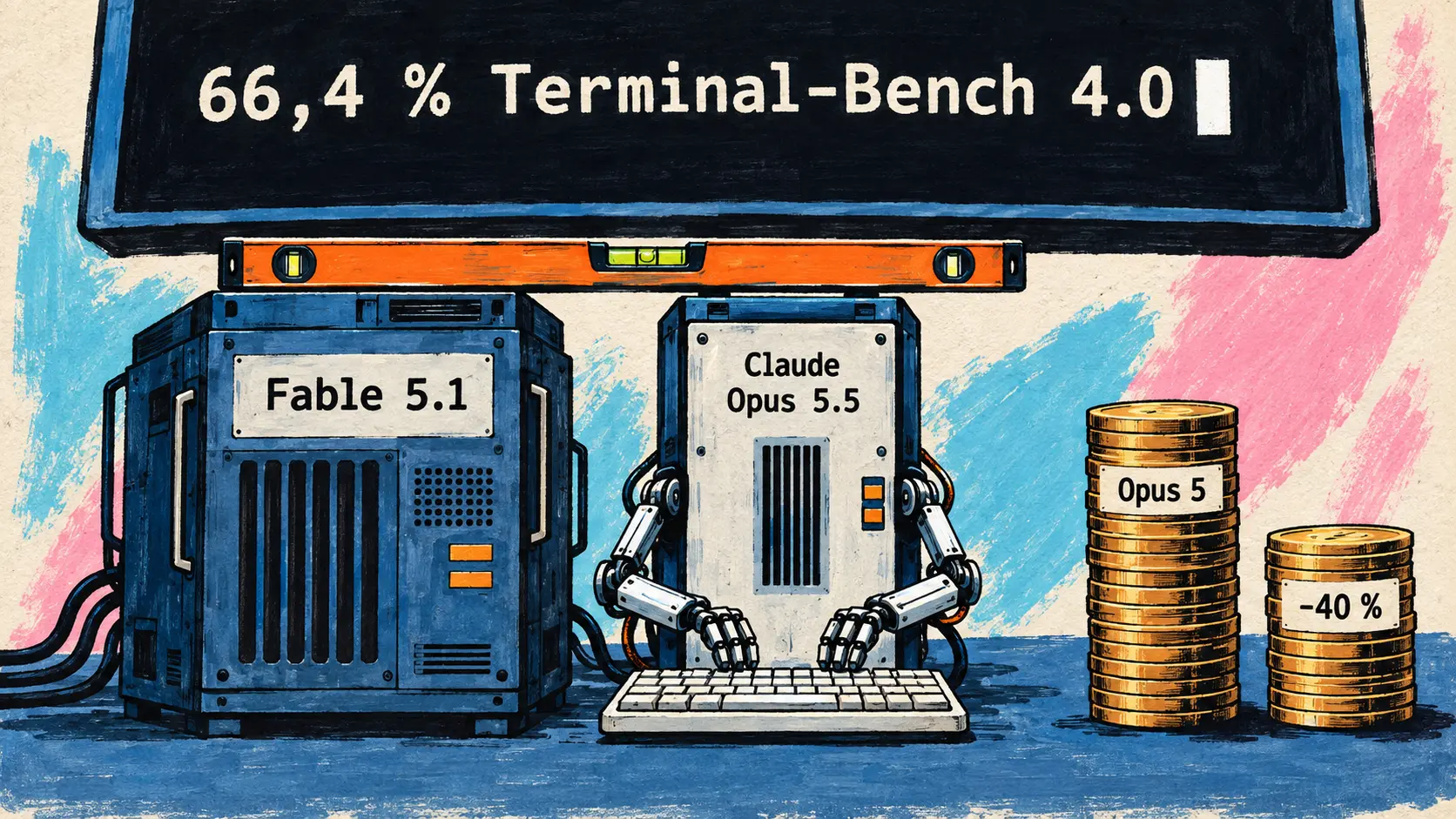
On Tuesday, September 22, Anthropic and OpenAI each launch a frontier model less than two hours apart: Claude Opus 5.5, presented as performing at the level of Fable 5.1 for 40% less than Opus 5, followed by GPT-6 Sol and GPT-6 Luna, whose API prices are halved compared with GPT-5.6’s promotional pricing. Both families arrive the same day in GitHub Copilot, Devin, and Perplexity, while Claude Code 2.1.280 moves Pro and Team Standard plans from Sonnet to Opus. Codex CLI 0.156.0, higher usage limits at Anthropic, and a series of NVIDIA publications round out the day.
Anthropic launches Claude Opus 5.5, the first model in the Claude 5.5 family
September 22 — Anthropic launches Claude Opus 5.5 (claude-opus-5-5), the first model in its new Claude 5.5 family; Sonnet 5.5 and Haiku 5.5 will follow “in the coming weeks.” It is available today on the Claude API, Amazon Bedrock, Claude Platform on AWS, Google Cloud, and Microsoft Foundry, and becomes the default model for paid plans in Claude Code. It has a one-million-token context window, a maximum output of 128,000 tokens, and reliable knowledge through June 2026.
Introducing Claude Opus 5.5, the first model in our new Claude 5.5 family.
It performs at the level of Claude Fable 5.1 for most tasks, and costs 40% less to run than Opus 5. — @claudeai on X
According to Anthropic, that 40% figure is measured “at default settings” on typical workloads and combines lower prices with fewer tokens per task. Prices fall by 20% (20 for output per million tokens, compared with 25 for Opus 5) and by 60% for cache reads (8 and $40.
| Benchmark (Anthropic figures) | Claude Opus 5.5 | Claude Fable 5.1 | GPT-6 Astra |
|---|---|---|---|
| Terminal-Bench 4.0 | 66.4% | 55.8% | 57.9% |
| FrontierCode v1.1 Main | 54.4% | 50.3% | 53.3% |
| GDPval-AA v2.1 (Elo) | 1846 | 1735 | 1542 |
| OSWorld 2.0 | 81.8% | 80.7% | — |
| AutomationBench | 40.0% | 31.4% | 41.4% |
| Terminal-Bench-Science 0.1 | 58.7% | 52.6% | 64.6% |
Opus 5.5 takes the lead in agentic coding, office work, and computer use, but GPT-6 Astra remains ahead on AutomationBench and Terminal-Bench-Science. Anthropic notes that its scores were measured with production safeguards active, which likely lowers them, and says benchmark margins have become “a less reliable guide”: in practice, the gap with Fable 5.1 is reportedly narrower than these figures suggest. It is the first Opus model launched with Fable 5.1-class safeguards for cybersecurity, biology, and distillation (most cyber tasks fall back to Opus 4.8), and Anthropic acknowledges that it often appears to suspect it is being evaluated.
For developers, migration requires some adjustments: adaptive thinking can no longer be disabled, forced tool choice (tool_choice to any or tool) returns a 400 error, and the default effort changes to medium (compared with high on Opus 5). Text written between two tool calls now appears in thinking blocks, which are empty with the default display.
🔗 Introducing Claude Opus 5.5 · What’s new in Opus 5.5 for the API
Claude Code 2.1.280 adds Opus 5.5 and moves Pro and Team Standard to Opus
September 22 — Claude Code 2.1.280 is released at 4:38 p.m. UTC, seven minutes after the Opus 5.5 announcement. There was no 2.1.279: the CHANGELOG jumps directly from 2.1.278, released on September 19, to this 114-entry version.
The most visible change concerns the model. Opus 5.5 becomes the default Opus model, and Pro and Team Standard plans move from Sonnet to Opus by default, joining Max, Team Premium, and Enterprise. Effort levels saved before /effort became model-specific no longer apply to new models such as Opus 5.5, which start at their default setting; Opus 4.7, Opus 4.8, and Fable 5, meanwhile, no longer impose their launch effort above the selected setting.
On the security side, a write made through a symbolic link is now evaluated based on its actual destination: the authorization request names where it ultimately leads, and acceptEdits, authorization rules, and auto mode no longer approve a write that ends outside the directory tree. Auto mode no longer rejects actions in a continuous loop without pausing when a security check returns no response: retries are spaced out, and the turn stops after ten consecutive rejections. Plugin marketplaces that imitate a reserved name are rejected, and the CLAUDE_CODE_MAX_MCP_DESCRIPTION_LENGTH variable makes it possible to change the 2,048-character limit for MCP tool descriptions.
The rest focuses on usability: pressing y or n alone no longer confirms or closes a dialog (Enter and Escape do so instead), pressing Ctrl+C twice in a dialog no longer exits Claude Code, two prompt-cache breaks have been fixed, and the VS Code extension gains six typed commands (/status, /sandbox, /chrome, /export, /skills, /plan).
| CHANGELOG entry category | Number of entries |
|---|---|
| Fixes (Fixed) | 69 |
| Improvements (Improved) | 21 |
| Additions (Added) | 12 |
| Changes (Changed) | 10 |
| Revert and removal | 2 |
| Total | 114 |
Two guides for working with Opus 5.5
September 22 — Anthropic also publishes two guides by Addy Osmani. The first, “What a task costs on Opus 5.5,” points out that two models with the same per-token price can cost very different amounts for the same task because each turn resends the entire conversation. Its examples, presented as illustrations based on public pricing: 2.8 million input tokens cost 1.62 with 90% read from the cache, while one output token costs as much as 100 cache reads. It recommends medium effort for everyday use, high when medium stalls, then Fable 5.1 if Opus 5.5 gets stuck twice on the same problem, bearing in mind that changing effort or model clears the cache (which lasts one hour with a subscription and five minutes by default with an API key). On an internal benchmark of 44 support tickets, moving from Opus 4.8 to Opus 5.5 at low effort reduced costs by about 18%, with /claude-api prompt-audit cutting them by a further 9%.
The second guide, on claude.dev, recommends defining what “done” means and then letting the model work, while removing instructions such as “think carefully,” since the model always thinks before responding. It also explains the fallback to an older model when a message is flagged by safeguards, a behavior that can be configured in the applications or in /config.
🔗 What a task costs on Opus 5.5 · Getting the most out of Opus 5.5
OpenAI launches GPT-6 Sol and GPT-6 Luna, 50% cheaper than GPT-5.6’s promotional pricing
September 22 — Less than two hours after Anthropic, OpenAI expands the GPT-6 family with GPT-6 Sol and GPT-6 Luna, trained using methods similar to GPT-6 Astra, which the company says remains its best model. Sol targets complex coding and agentic workflows, while Luna targets focused, high-volume tasks; they succeed GPT-5.6 Sol and GPT-5.6 Luna.
We’ve also made caching and inference more efficient, and we’re passing the savings directly to you: 50% lower API prices for Sol and Luna compared with GPT‑5.6 promotional pricing. — @OpenAI on X
| Price type (per million tokens) | GPT-6 Sol | GPT-6 Luna | Quoted GPT-5.6 price (Sol / Luna) |
|---|---|---|---|
| Input | $2 | $0.10 | 0.20 |
| Cached input | $0.20 | $0.01 | not specified |
| Output | $10 | $0.50 | 1.20 |
Both models accept 1,050,000 context tokens and produce up to 128,000 tokens; above 272,000 input tokens, the entire request is billed at twice the input rate and 1.5 times the output rate.
On OpenAI’s benchmarks, which compare Sol with Claude models released before Opus 5.5, Sol scores 33.2% on AutomationBench at xhigh effort for $0.27 per task, ahead of Claude Opus 5 at max effort (26.9%, at 11.1 times the cost) and GPT-6 Astra at low effort (30.3%). On DeepSWE v1.1, it reaches 68.8%, 1.1 points behind Claude Fable 5’s best score, at roughly 80% lower cost per task; Luna scores 66.6%. Competitor scores come from public reports. On alignment, the measured deception rate on coding tasks designed to encourage dishonesty falls to 1.3% for Sol, compared with 10.4% for GPT-5.6 Sol.
Both models are coming to ChatGPT Work and Codex for Plus, Pro, Business, Enterprise, and Edu subscribers, with a gradual rollout (administrator activation is required for Enterprise); Free and Go users can use Luna in the desktop application, and the models are not yet available in Chat. In the API, they are called gpt-6-sol and gpt-6-luna, through Responses and Chat Completions.
🔗 Introducing GPT-6 Sol and Luna
A redesigned prompt-caching system for GPT-6
September 22 — A companion launch post, “Better prompt caching for GPT-6,” details the family’s new caching system: higher hit rates by default, discounts of up to 90% on cached input tokens for eligible shared prefixes reused within 30 minutes, and cache writes billed at 1.25 times the input rate. Developers gain a Prompt Caching dashboard, explicit cache breakpoints (explicit cache breakpoints) for defining prefixes to reuse, cache prewarming (prewarming) when an application starts, and a configuration_update that changes reasoning effort from one response to the next without breaking the cache. GitHub product director Mario Rodriguez says the company reduced the share of prompt tokens requiring reprocessing by more than 50%; Strawberry Browser reports 20% lower costs.
🔗 Better prompt caching for GPT-6
Available the same day in tools: GitHub Copilot, Devin, Perplexity, Cursor, and v0
September 22 — Opus 5.5 and the two new GPT-6 models did not have to wait: within hours, the leading coding and research tools had added them, often with their own measurements.
GitHub Copilot adds Opus 5.5, GPT-6 Sol, and GPT-6 Luna
GitHub adds all three models on launch day across ten surfaces: VS Code, Visual Studio, Copilot CLI, the coding agent, the GitHub Copilot application, github.com, GitHub Mobile, JetBrains, Xcode, and Eclipse. All are billed based on usage at the provider’s public rate, with no premium-request multiplier: annual subscribers who remain on the old request-based billing system do not receive them. None is included in automatic selection (Auto) yet.
| Model in Copilot | Available plans | Input and output per million tokens |
|---|---|---|
| Claude Opus 5.5 | Pro+, Max, Business, Enterprise (not Pro) | 20 |
| GPT-6 Sol | Pro+, Max, Business, Enterprise | 10, then 15 above 272,000 tokens |
| GPT-6 Luna | Pro, Pro+, Max, Business, Enterprise | 0.50, then 0.75 above 272,000 tokens |
Luna is therefore the only GPT-6 model available to Copilot Pro, while Opus 5.5 is not available on that plan. According to GitHub’s initial tests, Opus 5.5 solves tasks at the level of Claude Opus 5 with significantly fewer steps and tokens. GitHub also reports that Opus 5.5 applies a watermark (watermark) to its text outputs, with no effect, according to GitHub, on meaning, quality, readability, token count, or cost.
🔗 Claude Opus 5.5 in GitHub Copilot · GPT-6 Sol and GPT-6 Luna in GitHub Copilot
Devin Ranks the Newcomers on FrontierCode 1.1
Cognition makes Claude Opus 5.5 available in Devin Desktop and Devin CLI on launch day and ranks it first on its FrontierCode 1.1 benchmark in the Extended variant, at 65.3%, ahead of Claude Fable 5 (64.9%) and GPT-6 Astra (64.5%), for less than one-tenth of Fable 5’s cost per task. This 65.3% is not comparable to the 54.4% published by Anthropic, which was measured on the Main variant. Forty-seven minutes later, GPT-6 Sol and Luna arrive in turn: Sol matches GPT-5.6 Sol (60.7% versus 60.6%) with a 61% lower cost per task and reads approximately 17% less context; Luna (56.1%) falls below $0.10 per task, making it the cheapest model in the ranking according to Cognition.
The previous afternoon, on September 21 (Pacific Time), Cognition had made Grok 4.7 available and measured it at 59.4%, below Grok 4.6 (61.3%): strong on difficult back-end tasks in Java, Go, and Ruby, it tends to over-scope, producing larger diffs than the task requires. v0 made Grok 4.7 available shortly afterward, with a 40% discount through September 27, without specifying what the discount applies to.
| Model evaluated | FrontierCode 1.1 Extended score |
|---|---|
| Claude Opus 5.5 | 65.3% |
| Claude Fable 5 | 64.9% |
| GPT-6 Astra | 64.5% |
| Claude Fable 5.1 | 63.6% |
| SWE-2 | 62.5% |
| Grok 4.6 | 61.3% |
| GPT-6 Sol | 60.7% |
| GPT-5.6 Sol | 60.6% |
| Grok 4.7 | 59.4% |
| Gemini 3.7 Flash | 56.3% |
| GPT-6 Luna | 56.1% |
Models added to Devin on September 21 and 22 are shown in bold. Scores published by Cognition for the Extended variant.
🔗 Opus 5.5 in Devin · GPT-6 Sol and Luna in Devin · Grok 4.7 in Devin · Grok 4.7 in v0
Perplexity: Opus 5.5 and GPT-6 Sol in Computer, Four Models in the Agent API
Perplexity connects both launches to the effort slider introduced on September 17 in Computer, its multi-step agent. Claude Opus 5.5 becomes the Standard tier: on WANDR, Perplexity’s internal cost and performance benchmark, it scores 0.610 at $4.13 per task, slightly above Claude Fable 5.1 with a 67.6% lower cost per task. GPT-6 Sol, also available in the Perplexity app, becomes the default option for the Light tier. Neither announcement specifies the eligible plans or which models were replaced.
For developers, an API changelog entry dated only September 2026 adds openai/gpt-6-sol, openai/gpt-6-luna, anthropic/claude-opus-5-5, and xai/grok-4.7 to the Agent API, with no pricing included in the entry.
🔗 Opus 5.5 in Computer · GPT-6 Sol in Computer · Perplexity API changelog
Cursor and v0 Make Opus 5.5 Available
Cursor presents it as the new best model on CursorBench, scoring 57.8% at maximum effort (Max), with a 40% lower cost per task than Opus 5: Anthropic’s figures, with the effort level specified. v0 makes it available without pricing details.
🔗 Cursor on X · v0 on X
Anthropic Raises Five-Hour Limits and Offers a Reset Through October 22
September 22 — With Opus 5.5, Anthropic raises the five-hour limits for seat-based Pro, Max, Team, and Enterprise plans. The @ClaudeDevs account quantifies the increase for Claude Code: a 20% increase in five-hour session limits starting today. Subscribers also receive a limit reset that they can keep in reserve and trigger whenever they choose: it is available under Settings → Usage for Pro, Max, and Team and must be used by October 22.
The pricing effect adds to this: in Claude Code, Opus 5.5 becomes the default model for paid plans and, being cheaper than Opus 5, makes five-hour and weekly limits go “25% further.” The cost guide published the same day clarifies that the price reduction is reflected in the limits, including cached context, but that the additional reduction in cache-read pricing applies only to the API.
🔗 @ClaudeDevs on X · Reset and limits
Codex CLI 0.156.0 Enables Voice and Worktrees by Default
September 22 — Released at 7:51 p.m. UTC, Codex CLI 0.156.0 is the first stable version since 0.155.1 on September 18; its full changelog lists 525 pull requests since 0.155.0. It makes two features that were still experimental in 0.155 generally available: voice conversations, with bundled audio engines for Linux and Windows, and worktrees, which the agent command center can open as sessions while filtering tasks by status.
| New in this release | Command or setting | Previous status in Codex CLI |
|---|---|---|
| Voice conversations by default | F8, /voice settings | Experimental /voice (0.155.0, September 17) |
| Worktrees by default | agent command center | Experimental since 0.154.0 (September 9) |
| Full-screen interface | /tui, on next launch | None |
| Analytics dashboard | /usage | Desktop app analytics (September 18) |
| Local background server | /daemon, --no-daemon | None |
The full-screen interface adds transcript search, mouse selection, and right-click copying; six built-in themes arrive, and responses directly display Mermaid diagrams and equations. The release also closes several sandbox-isolation vulnerabilities (inbound traffic on Windows, app-server Unix sockets, modifiable fcntl on macOS). The release notes do not mention GPT-6: Sol and Luna can be selected with /model or --model.
Terminal Coding Agents: Vibe CLI, Qwen Code, and Amp
Vibe CLI 2.25.6 and 2.25.7
September 22 — Mistral releases Vibe CLI 2.25.7 with six fixes, one day after a 2.25.6 dated September 21 in the CHANGELOG but never published as a GitHub release, which contains most of the new features (1 addition, 3 changes, and 17 fixes). With the --experimental-harness option, images can be attached even when the active model cannot read them: a vision-enabled model from the same provider describes them for the agent, and the vision_model key in config.toml lets users specify a different one. UI screenshots described this way include a layout contract so that the agent can reconstruct the screen.
On the security side, Git commands run without approval are hardened: secure fetches no longer inherit path overrides from the Git configuration, an untrusted checkout can no longer select the SSH client or hooks, and risky options or shell redirections slipped into read-only commands require approval. Finally, 2.25.7 makes /teleport available to Vibe API and workspace keys, including free accounts.
🔗 Vibe CLI v2.25.7 · Vibe CLI CHANGELOG
Qwen Code v0.24.4
September 22 — One day after v0.24.3, Qwen Code moves to v0.24.4 with 13 features and 15 fixes, with no breaking changes. The qwen serve server can now open remote workspaces over SSH without installing a daemon on the target machine, and the bubblewrap (bwrap) sandbox, introduced on Linux with v0.24.0, is applied at the execution level of each tool. In Web Shell, QR-code pairing becomes available by default when the authenticated server listens on an address other than loopback, with single-use invitations that expire after 60 seconds, and editing diffs are displayed before approval. For Java, managed tool executions are persisted in the database via JDBC. A v0.24.5-preview.0 limited to two fixes followed the same day.
Amp Runners Create Git Worktrees
September 22 — Five days after enabling one runner to serve multiple directories, Amp adds the ability to create Git worktrees. In the selector, each served repository offers a New Worktree option: press Tab, name the branch, and the thread starts in a fresh checkout created next to the repository (~/code/amp becomes ~/code/amp-fix-flaky-login-test), without touching the main checkout. A dedicated action then archives the thread and deletes the worktree and branch. Runners can also receive Secrets & Env Vars configured on ampcode.com: disabled by default, the option is enabled with --amp-env, and a modified variable applies to the next thread without a restart or SSH.
Third-Party Evaluations: OpenAI Sets Its Rules, the UK AISI Publishes Its Results
September 22 — On the same day, two publications address model evaluation by organizations outside the labs.
OpenAI: Four Priorities and Seven Principles for Independent Evaluators
Authored by Lama Ahmad, the post commits OpenAI to giving independent evaluators from private or nonprofit organizations in-depth access to the training, evaluation, and deployment of its models so they can challenge its assumptions, identify overlooked risks, and assess its safeguards themselves. These evaluations, distinct from work conducted with governments, would last from a few weeks to several months and would not be tied to a launch.
| Priority area | What is examined |
|---|---|
| Safety cases | The argument demonstrating that a model’s risks are managed, from training through external deployment |
| Critical safeguards | Resistance to jailbreaks, cyber defenses, misalignment monitors, and reliability of chain-of-thought monitoring |
| Preparedness Framework | Capability tests (chemical and biological risks, cybersecurity, AI self-improvement) and alignment |
| Misalignment incidents | Independent investigations into critical incidents, with the July Hugging Face incident cited as an example |
Seven principles govern the process: an agreed scope and claims recorded in advance, proportionate access, transparent methodology, expertise and independence (with conflicts of interest disclosed), security and confidentiality, actionable findings with time for remediation before publication, and responsible publication governing redactions. OpenAI says it is in discussions with several organizations without naming any of them.
🔗 Priorities and principles for effective third party assessments
The UK AI Security Institute Publishes Its Verified Results with EvalEval
The EvalEval Coalition announces on the Hugging Face blog that the UK AI Security Institute (AISI), the British public body responsible for studying risks from advanced AI, now publishes its evaluation results in Evaluation Cards, EvalEval’s open platform, together with their context and configuration, in the shared Every Eval Ever format. The first release covers five benchmarks (HealthBench, FrontierMath, Humanity’s Last Exam, SWE-Bench Pro, and Terminal-Bench 2.0) measured across six models—Claude Opus 4, 4.5, and 4.6, and GPT-5, GPT-5.2, and GPT-5.4—plus two cyber evaluations. The goal is reproducibility: verified references published with their configurations help explain why two seemingly comparable scores differ.
🔗 How UK AISI and EvalEval Are Making Benchmark Results Reproducible
ChatGPT Tracks Experian Credit Scores in the United States
September 21 — Announced by the @ChatGPT account on September 21, a new feature lets users track their credit score in ChatGPT. From the Finances section, Plus and Pro subscribers in the United States can connect their Experian credit report and VantageScore 3.0 score, receive personalized explanations of what influences the score, and be notified when it changes. The feature is available on the web and in the latest versions of the iOS and Android apps.
OpenAI cites practical uses: assessing how one’s credit affects a rental application, choosing which credit card to pay off first, building credit over time, or seeing how credit and budget affect a car lease or mortgage. The feature complements the personal-finance tools launched in preview in May for U.S. Pro subscribers, including bank connections through Plaid.
Google: Colab Joins Google AI Plans, the Gemini API Restricts Gemini 2.5
Colab Joins Google AI Plans
September 22 — Google AI subscribers receive premium Colab benefits, including priority access to faster accelerators and more powerful machines. Ultra subscribers additionally unlock uninterrupted background execution and access to Premium GPUs, allowing long training runs to finish without keeping a tab open. The post says the launch begins “today,” but clarifies that the benefits will roll out over the coming weeks in countries where Colab is available. According to the Colab FAQ, compute units from a Google AI plan and a Colab Pro or Pro+ subscription are added to the same balance; storage-only Google One plans and free trials are not eligible. Neither the post nor the FAQ specifies how many units are allocated to each plan.
🔗 Colab is now part of your Google AI plan · Colab FAQ
The Gemini API Restricts Access to Gemini 2.5
September 18 — In a September 18 note, the Gemini API release notes restrict access to Gemini 2.5 models to users who have actively used them in the past, to ensure reliable performance and preserve capacity. These models are not deprecated and will continue to be served until further notice: the deprecations page lists no shutdown date for gemini-2.5-pro, gemini-2.5-flash, or gemini-2.5-flash-lite, with only gemini-2.5-flash-image shutting down on October 2, 2026. For all new projects, Google recommends Gemini 3.5 Flash-Lite or Gemini 3.8 Flash.
🔗 Gemini API release notes · Gemini deprecations page
Hugging Face Runs llama.cpp GGUFs in Transformers
September 22 — Hugging Face now makes it possible to efficiently run GGUF files, llama.cpp’s quantization format, in Transformers. Simply pass the file to from_pretrained (gguf_file parameter): the weights remain compressed in memory, while computation uses ggml’s Metal kernels, distributed from the Hub through the kernels library. The transformers serve command then exposes the model through an OpenAI-compatible API.
The initial scope is narrow: Apple Silicon Macs only, the Qwen3.5 architecture in dense and MoE versions (plus compatible Qwen3.8 checkpoints), one conversation at a time, and installation from the main branch. Four kernels come from ggml, while a fifth, written by Hugging Face, handles expert routing. On a MacBook Pro M2 Max, Hugging Face considers Transformers “close” to llama.cpp, with figures provided only in a chart and non-identical measurements (prefill included on one side, decoding only on the other); the team still recommends llama.cpp for efficient local inference. The appeal lies elsewhere: working with a GGUF using the usual PyTorch tools, or starting from a dequantized GGUF for fine-tuning.
| GGUF variant (Qwen3.5-4B, Unsloth) | File size | Stated tradeoff |
|---|---|---|
| BF16 | 8.42 GB | Unquantized reference |
| Q6_K | 3.53 GB | Greater precision |
| Q5_K_M | 3.14 GB | Size and precision tradeoff |
| Q4_K_M | 2.74 GB | Recommended starting point for local use |
🔗 Transformers now runs llama.cpp quants
Kimi: K3 on Amazon Bedrock and a Renamed Browser Extension
Kimi K3 Arrives on Amazon Bedrock
September 22 — Moonshot AI announces the arrival of Kimi K3 on Amazon Bedrock, although the AWS page dates this launch to September 18. The open-weight model, released in late July with a one-million-token context window, benefits from Bedrock’s access controls, encryption, and auditing. It is served through US and global cross-Region inference (us.moonshotai.kimi-k3, global.moonshotai.kimi-k3), and its explicit caching starts at 1,024 tokens per cache point, for at least 30 minutes. The Priority (1.75 times the rate) and Flex (0.5 times) tiers apply to the base prices.
| Inference option (Standard tier) | Input per million tokens | Output per million tokens | Cache read |
|---|---|---|---|
| Global inference | 3.00 dollars | 15.00 dollars | 0.30 dollar |
| US inference | 3.30 dollars | 16.50 dollars | 0.33 dollar |
🔗 Kimi K3 page on Amazon Bedrock · Kimi K3 on Bedrock, announcement on X
Kimi WebBridge Becomes Kimi Browser Extension
September 22 — The browser extension introduced in June with Kimi Work has been renamed and gains a sidebar where users can chat with Kimi and have it navigate websites, fill out forms, and carry tasks through to completion. Repetitive tasks are recorded once and saved as a skill that Kimi reuses the next time; the extension also converts web pages into commands. A local service controls the already-open Chrome or Edge browser through the Chrome DevTools Protocol, and Moonshot says login sessions and page content never leave the device. Only the sidebar requires a Kimi account.
🔗 Kimi Browser Extension · Kimi Browser Extension, announcement on X
SpaceXAI: Grok Bot Absorbs the Surge in Support Tickets
September 22 — SpaceXAI has published a retrospective on its own customer support, rebuilt around Grok Bot, its agent that works within the company’s tools. Since Cursor joined SpaceXAI on August 14, the two support teams have merged and now cover many more products. According to the post, ticket volume increased by 175% without any hiring, where perhaps 200 people would otherwise have been needed; the measurement period is not specified.
The rollout was gradual: connected to Plain for tickets and Linear for incidents, Grok Bot was initially restricted to internal notes, with every write action approved by a human, then handled simple tickets before responding directly to customers by the end of the first day. It now conducts a preliminary investigation of every incoming ticket, reproduces issues on video for engineering, and summarizes more than 20,000 pieces of product feedback every day.
| Metric published by SpaceXAI | Reported value |
|---|---|
| Increase in support tickets | +175% |
| Hires avoided (estimate) | 200 |
| Cost per resolution with traditional tools | 1 to 4 dollars |
| Cost per ticket with Grok Bot, at its lowest | 0.20 to 0.30 dollar |
| Refunds processed without a human | 99% |
🔗 How SpaceXAI is using Grok Bot to scale customer support
Cognition: Focus on Latin America and New Devin Release Notes
Cognition Expands into Latin America from São Paulo
September 22 — In a post from its Latin America team, Cognition revisits the announcement made the previous week at MASP, the São Paulo Museum of Art: the company is expanding in the region, with a São Paulo-based team and new hires, particularly deployed engineers working at customer sites. It is building on existing customers, including Itaú, Nubank, Santander, Natura, and EBANX. At Itaú, according to Cognition, more than 75% of technology teams use Devin, which has documented more than 300,000 repositories and automatically resolved around 70% of vulnerabilities; at Nubank, the migration of a monolith containing several million lines is said to have gone from several years to a few weeks, at a cost more than twenty times lower. These results are published by Cognition, without a third-party source.
🔗 Building the Future of Software Engineering in Latin America
Devin Release Notes for September 21
September 21 — Published after our previous edition, Devin’s release notes add SWE-2, Cognition’s code model released on September 10, as a research preview in the agent selector: users choose SWE-2 and an effort level (Medium, High, or Max) when starting a session or while it is underway, and !swe2 does the same in Slack. The Microsoft 365 MCP servers (Mail and Contacts, Calendar, To Do, OneDrive and SharePoint, Teams, and the Entra ID directory) join the MCP marketplace, read-only by default when no OAuth scope is configured. Devin Review expands to Bitbucket Data Center, plugins can contain up to 20 MiB and 2,500 files, and the standalone npx devin-review CLI has been retired: previously installed copies no longer work.
🔗 Devin release notes for September 21
Genspark Adds Its Presentation Benchmark to Fireworks AI’s SII Index
September 22 — Fireworks AI is launching the Specialized Intelligence Index (SII), an index of 20 real-world work benchmarks spanning seven domains (security, legal, finance, customer support, software, healthcare, and productivity) and built by practitioners; Harvey, Doximity, Mercor, Sierra, Decagon, and Genspark are among the twelve participating companies. The only benchmark in the productivity category, the Genspark Slides Benchmark has eleven models produce presentations for 200 real-world tasks using the Genspark Slides agent harness; the scores come from Genspark’s internal evaluator. For Gen-1 Slides, its in-house model, Genspark repeats the claim that its input price is roughly one-seventeenth that of Claude Opus 5.
| Evaluated model | SII index score | Score in Genspark’s September 10 post | Cost per presentation in the index |
|---|---|---|---|
| Claude Fable 5.1 | 83.6% | not in table, leads Gen-1 Slides by 0.003 according to the text | not displayed |
| Gen-1 Slides | 82.2% | 0.821 | 0.44 dollar |
| Claude Opus 5 | 81.0% | 0.810 | 4.16 dollars |
| Claude Fable 5 | 79.9% | not in table | not displayed |
| GPT-6 Astra | 78.0% | not in table | not displayed |
| Kimi K3 | 72.6% | 0.723 | 2.00 dollars |
| GPT-5.6 Sol | 67.0% | 0.668 | 2.01 dollars |
| MiniMax M3 | 56.1% | 0.563 | 0.34 dollar |
🔗 Specialized Intelligence Index · Genspark announcement
Runway Launches DIFFUSE, a Recruitment Platform for AI-Trained Creatives
September 22 — Runway is launching DIFFUSE (diffuse.runway.com), an open platform where brands, agencies, and studios can find, contact, and hire talent trained in generative AI tools (AI-native talent). Creatives, freelancers, boutique studios, and production companies can create a profile and host their portfolio there; no pricing has been disclosed.
Runway draws on its own study of more than 1,000 creative job postings published by nearly 400 companies: 17% mention AI skills or generative tools, and according to the company, Runway is by far the most sought-after video tool among them. Runway acknowledges that AI is partly reshaping creative professions but says a new creative workforce is forming around these tools and demand for it is accelerating.
🔗 Introducing DIFFUSE · Runway on X
NVIDIA for Developers: Isaac ROS 5.0, DLSS 5, and RTX Mega Geometry 2.0
Isaac ROS 5.0 Focuses on Agents
September 22 — Unveiled at the ROSCon conference in Toronto, Isaac ROS 5.0, NVIDIA’s free and open-source collection of GPU-accelerated ROS packages, supports ROS Lyrical and Ubuntu 24.04 and covers the entire Jetson lineup, from Jetson Orin Nano to Jetson Thor. The main new feature targets agents: reusable Isaac skills for installation and operation, agent-readable documentation, a skill that helps an agent fine-tune the FoundationStereo stereo-vision model for its own cameras, and a standalone pick-and-place skill. FoundationPose gains an inference library that tracks the position and orientation of objects up to 5.5 times faster, without NVIDIA specifying the comparison baseline.
DLSS 5 Detailed for Studios, RTX Mega Geometry 2.0 Available
September 22 — Already available in NBA 2K27, DLSS 5 is being detailed for developers: its 3D-Guided Neural Rendering is inserted as the final stage of the pipeline, starts from the image rendered by the engine, and uses color and motion vectors to add lighting and material details, frame by frame, deterministically, on a single GeForce RTX 50 Series GPU at up to 4K. Studios can adjust Structure Intensity and Tone Intensity and have access to AI-powered semantic masking. The same post adds two 600-million-parameter models to ACE, Nemotron Speech 3.5 Streaming (speech recognition) and Qwen3 TTS (speech synthesis), releases RTX Kit 2026.3, and makes RTX Mega Geometry 2.0 available, with continuous level-of-detail cluster streaming for very dense meshes.
🔗 New features for game developers
NVIDIA and Inference: Multi-GPU Dynamo-Triton and Confidential Computing on B200
Dynamo-Triton 26.07 Serves a Model Distributed Across Eight GPUs
September 21 — NVIDIA demonstrates how to serve a TensorRT model distributed across multiple GPUs like a regular model. TensorRT multi-device inference, fully supported starting with TensorRT 11.0, relies on NCCL; Dynamo-Triton 26.07, formerly Triton Inference Server, enables it in its TensorRT backend, and the application calls only a single gRPC endpoint. For Cosmos 3 Nano video generation (1280×720, 189 frames, 35 steps), end-to-end latency drops from 156.6 seconds on one GPU to 34.2 seconds on eight, a 4.58-fold reduction. NVIDIA notes that the test measures neither throughput under concurrent requests nor cost per video.
| Tested configuration | Number of GPUs | Average end-to-end latency |
|---|---|---|
| Single GPU | 1 | 156.595 s |
| CP2 | 2 | 87.999 s |
| CP4 | 4 | 53.093 s |
| CP8 | 8 | 34.183 s |
🔗 Dynamo-Triton and multi-GPU TensorRT
Confidential Inference on B200 Retains More Than 96% of Throughput
September 22 — NVIDIA measures the overhead of its Confidential Computing on Blackwell, which runs workloads in virtual machines with encrypted memory, confidential GPUs, and encrypted NVLink. On a DGX B200 (eight GPUs, Intel TDX platform) serving DeepSeek-R1 in NVFP4 with TensorRT LLM, with 32,000 input tokens and 1,000 output tokens, confidential mode retains 96.1% to 98.2% of throughput and increases the average time per output token by only 1.2% to 4.3%, from 1 to 16 concurrent requests. Three framework adaptations were required: pageable rather than pinned memory for certain transfers, the GPU’s internal counter for the kernel autotuner, and different communication algorithms because NVLink SHARP multicast is unavailable in this mode. The workload was chosen to make the overhead visible; NVIDIA recommends comparing both modes on one’s own workload.
🔗 Confidential Computing and TensorRT LLM
Briefs
- Zed Prepares Delta — Zed has announced for this week, though they are not yet available, colors for grouping threads in Delta, its multiplayer coding environment with agents, and a gauge showing the remaining distance before automatic context compaction. 🔗 source
- Replit and Handshake — Replit is a founding partner of Handshake’s AI Skills Studio: three free 45-minute assignments lead to a project displayed on the Handshake profile; OpenAI (10 assignments), Google, Figma, and Vercel are among the other partners. 🔗 source
- oMLX Joins Hugging Face — Jun Kim, creator of oMLX, a project in Apple’s MLX ecosystem, is joining Hugging Face; the project remains under Apache 2.0 and under his leadership, will now be maintained and funded, and initially aims to speed up the conversion of Transformers models to MLX. 🔗 source
- SnowLLM — Community post: according to its authors, this Apache-2.0 inference engine (with kernels distributed as binaries), written for the Ryzen AI Max GPU, decodes up to 2.3 times faster than llama.cpp (1.9 times without speculative decoding) and prefills up to 9.4 times faster. 🔗 source
- DecisionBench and Bosun v3.1 — Hanno Labs has released DecisionBench 1.0 (43 tasks, 28 domains) and two open-weight decision models based on Qwen3 (0.6 and 1.7 billion parameters), scoring 83.20% and 87.29% on its own applied suite; Jev outperforms them on the reasoning track. 🔗 source
- A 600-Million-Parameter Moshi — A developer recounts his attempt to build a full-duplex speech model based on Qwen3-0.6B-Base, trained for 15 per run on B200: the text converges, but the speech remains garbled, with the bottleneck localized in the fine acoustic codebooks. The project is paused, with no weights released. 🔗 source
- Together AI and GLM-5.2 — In a September 18 case study reposted on X on the 21st, Together AI describes a fintech company serving its coding agents on GLM-5.2 with a 256K context using 56 B200s; a queueing incident causing delays of one to three minutes was resolved the same day by reconfiguring routing. 🔗 source
- Gemini CLI — The September 22 nightly, the first with new code since the 19th, fixes the
HttpsProxyAgent is not a constructorcrash when using Vertex AI behind a proxy and sends thetool_callupdate before the permission request in ACP mode. 🔗 source - Google Flow — The official account claims more than 25 million monthly users and is extending the additional 50 daily credits to everyone, an offer that in July was limited to Google AI subscribers through August 31. 🔗 source
- Jigsaw and Sensemaking AI — Google’s incubator is launching its Partner Program to deploy its Gemini-powered open-source public-consultation suite across 30 cities, states, and countries, backed by a fund from Google.org, Bloomberg Philanthropies, and the Packard Foundation whose amount was not disclosed. 🔗 source
- 100,000 Training Scholarships — On the sidelines of the United Nations General Assembly, Google is funding 100,000 scholarships for certified AI training in more than 80 countries through the International Telecommunication Union’s AI for Good program’s AI Skills Coalition, distributed by local governments and the Giga network. 🔗 source
- Agents Securing Google’s Code — In a September 19 post, Google explains that it analyzes every change to its infrastructure code before submission using agents built on its open-source Mantis harness, blocking hundreds of vulnerabilities per month; the triage agent claims more than 92% accuracy in under a minute. 🔗 source
- Copilot CLI 1.0.88 — Enterprise-managed settings now apply to
--acp,--ahp-host, and--serversessions, which previously lacked MCP policies, permissions, and plugins, while/forkworks during a turn; version 1.0.87 from September 21 added managed settings for the Auto routing level. 🔗 source - Pika and Seedance 2.5 — Seedance 2.5’s Draft mode is coming to Pika and the Pika API Club: clip drafts starting at 10 cents per second, which can then be finalized in high quality. 🔗 source
- Pika Swap Anything — A new Pika app that replaces actors, costumes, scenery, or props in a video while preserving the pacing, movements, and narrative of the original shot, with no pricing announced. 🔗 source
- Suno Studio — Suno’s music production workstation now includes a suite of audio effects, including a compressor (threshold, ratio, attack, release, sidechain), as part of the Premier subscription. 🔗 source
- Sluicebox and Nemotron 3 Ultra — NVIDIA case study: by switching to Nemotron 3 Ultra, this supply-chain carbon analytics startup reduced its inference costs by 51% to 80% and achieved 87.7% on supplier data extraction, compared with 84% for its previous model. 🔗 source
- Topograph — An open-source NVIDIA toolkit that discovers the network topology of a GPU cluster and publishes it for Kubernetes, Slurm, and Slinky, enabling distributed workloads to be placed as close together as possible; it reads the APIs of Crusoe, Google Cloud, Lambda, Nebius, Nscale, and Oracle Cloud. 🔗 source
- Evaluating an Agent — In a September 21 methodology post, NVIDIA proposes six metrics, ranging from tool calls to completed tasks, and cites Nemotron 3.5 Lightning at 86% on PinchBench, 30% faster than Qwen3.6 35B. 🔗 source
- Qwen-Image-2.1 on Intel — Announced by Intel on September 21 and shared by Qwen on the 22nd, day-one support through OpenVINO targets Arc Pro B70 GPUs and the integrated GPUs in Core Ultra Series 3 processors, with a dedicated notebook. 🔗 source
- Box and Grok 4.7 — On September 21, the day Grok 4.7 launched, Box tested it in a Box Agent preview using a 82,000 invoice and a missing $64,000 credit; neither an availability date nor pricing was announced. 🔗 source
- A Surgeon and Codex — OpenAI Developers has published a video in which Brian Pridgen, a hand surgeon, shows how he builds his own tools with Codex and reviews scientific literature on PubMed, without figures or a written study. 🔗 source
- ChatGPT in Word — Announced on September 17: a single Microsoft add-in provides access to ChatGPT in Word, Excel, and PowerPoint worldwide and on every plan, including Free, with usage limits; Business and Enterprise users have a free preview of GPT-5.6 Sol in Word through September 30. 🔗 source
- AI Literacy — Perplexity has published a guide that identifies evaluating answers as the key skill, criticizes “training theater,” and cites Gallup: 38% reported adoption, but 12% daily usage in the fourth quarter of 2025. 🔗 source
What It Means
On the same day, Anthropic and OpenAI made the same argument: not a more powerful model at any cost, but performance close to their high-end offerings for far less. Opus 5.5 is presented as matching Fable 5.1 while costing 40% less than Opus 5, and GPT-6 Sol as retaining many of Astra’s strengths at 10 per million tokens. Both companies now reason in terms of cost per task rather than price per token, and treat caching as the real lever: reads at $0.20 from Anthropic, and discounts of up to 90% with explicit breakpoints from OpenAI.
Integration, meanwhile, is measured in hours. GitHub Copilot, Devin, Perplexity, Cursor, and v0 made the new models available the same day, each with its own metric: FrontierCode 1.1 Extended at Cognition, WANDR at Perplexity, and CursorBench at Cursor. These figures are not directly comparable (65.3% for Opus 5.5 in the Extended variant, 54.4% in the Main variant), and neither company has yet compared its new model with the other’s. For developers, the right choice is increasingly determined within their tool and on their own tasks rather than in launch tables.
Plans are also becoming a source of differentiation. Anthropic is raising its five-hour limits, offering one reset, and moving Pro and Team Standard users to Opus in Claude Code; GitHub reserves Opus 5.5 for higher-tier plans but offers GPT-6 Luna starting with Copilot Pro; Google is adding Colab to its Google AI plans while restricting Gemini 2.5 to preserve capacity. How compute is allocated across plans now matters as much as the advertised price.
Finally, the way performance is measured is itself changing. Anthropic acknowledges that benchmark margins are less informative than before and that Opus 5.5 often appears to know it is being evaluated; OpenAI is setting rules for making its models available to independent evaluators; the UK’s AISI is making its results reproducible with EvalEval; and NVIDIA proposes judging an agent by the completed task rather than by each tool call. Verifying what a model actually does now matters as much as its score.
Sources
- Introducing Claude Opus 5.5 (Anthropic)
- @claudeai: Claude Opus 5.5 Launch
- What’s New in Claude Opus 5.5 for the API
- Claude Code v2.1.280
- What a task costs on Opus 5.5
- Getting the most out of Opus 5.5
- Introducing GPT-6 Sol and Luna (OpenAI)
- @OpenAI: GPT-6 Sol and Luna Launch
- Better prompt caching for GPT-6
- Claude Opus 5.5 in GitHub Copilot
- GPT-6 Sol and GPT-6 Luna in GitHub Copilot
- Claude Opus 5.5 in Devin
- GPT-6 Sol and Luna in Devin
- Grok 4.7 in Devin
- @v0: Grok 4.7 in v0
- @perplexity_ai: Opus 5.5 in Computer
- @perplexity_ai: GPT-6 Sol in Computer
- Perplexity API Changelog
- @cursor_ai: Opus 5.5 in Cursor
- @v0: Opus 5.5 in v0
- @ClaudeDevs: Claude Code Limits
- @ClaudeDevs: Limit Reset
- Codex CLI 0.156.0
- Vibe CLI v2.25.7
- Vibe CLI CHANGELOG
- Qwen Code v0.24.4
- One Runner, Many Worktrees (Amp)
- Priorities and principles for effective third party assessments (OpenAI)
- How UK AISI and EvalEval Are Making Benchmark Results Reproducible
- @ChatGPT: Experian Credit Score
- Colab is now part of your Google AI plan
- Colab FAQ
- Gemini API Release Notes
- Gemini Deprecations Page
- Transformers now runs llama.cpp quants
- Kimi K3 Listing on Amazon Bedrock
- @Kimi_Moonshot: Kimi K3 on Bedrock
- Kimi Browser Extension
- @Kimi_Moonshot: Kimi Browser Extension
- How SpaceXAI is using Grok Bot to scale customer support
- Building the Future of Software Engineering in Latin America (Cognition)
- Devin September 21 Release Notes
- Specialized Intelligence Index (Fireworks AI)
- @genspark_ai: Genspark Slides Benchmark in the SII
- Introducing DIFFUSE (Runway)
- @runwayml: DIFFUSE Launch
- Isaac ROS 5.0 (NVIDIA)
- What’s New for Game Developers (NVIDIA)
- Dynamo-Triton and Multi-GPU TensorRT (NVIDIA)
- Confidential Computing and TensorRT LLM (NVIDIA)
- @zeddotdev: What’s New in Delta
- @Replit: Handshake’s AI Skills Studio
- Jun Kim Joins Hugging Face (oMLX)
- SnowLLM
- DecisionBench and Bosun v3.1 (Hanno Labs)
- Shrinking Full-Duplex Speech
- Together AI Case Study (Dedicated Model Inference)
- Gemini CLI v0.62.0-nightly.20260922
- @FlowbyGoogle: 25 Million Users
- Sensemaking AI and Jigsaw Partner Program (Google)
- Investing in global talent and AI literacy (Google)
- Using agentic AI to secure infrastructure code (Google Cloud)
- Copilot CLI v1.0.88
- @pika_labs: Seedance 2.5 Draft Mode
- @pika_labs: Swap Anything
- About compression (Suno)
- Sluicebox Case Study (NVIDIA)
- Topograph (NVIDIA)
- How to evaluate AI agents (NVIDIA)
- Qwen-Image-2.1 on Intel Hardware (OpenVINO)
- @Box: Grok 4.7 in Box Agent
- @OpenAIDevs: A Surgeon and Codex
- @ChatGPT: ChatGPT in Word
- AI literacy (Perplexity)