ai-powered-markdown-translatorArticle translated from French to English with gpt-6-sol.
On September 23, Anthropic unveils its molecular biology lab and its first finding: ART, a previously unknown enzyme system that about 950 Claude agents identified in bacteriophage DNA. Google launches Gemini 3.8 Flash TTS and Flash-Lite TTS, two speech synthesis models that create and clone voices; Black Forest Labs releases FLUX 3 Action, an open-weight model for controlling robots; and Perplexity publishes the first security audit of SPACE, the sandbox where its agents run.
Anthropic opens a molecular biology lab, where Claude discovers ART
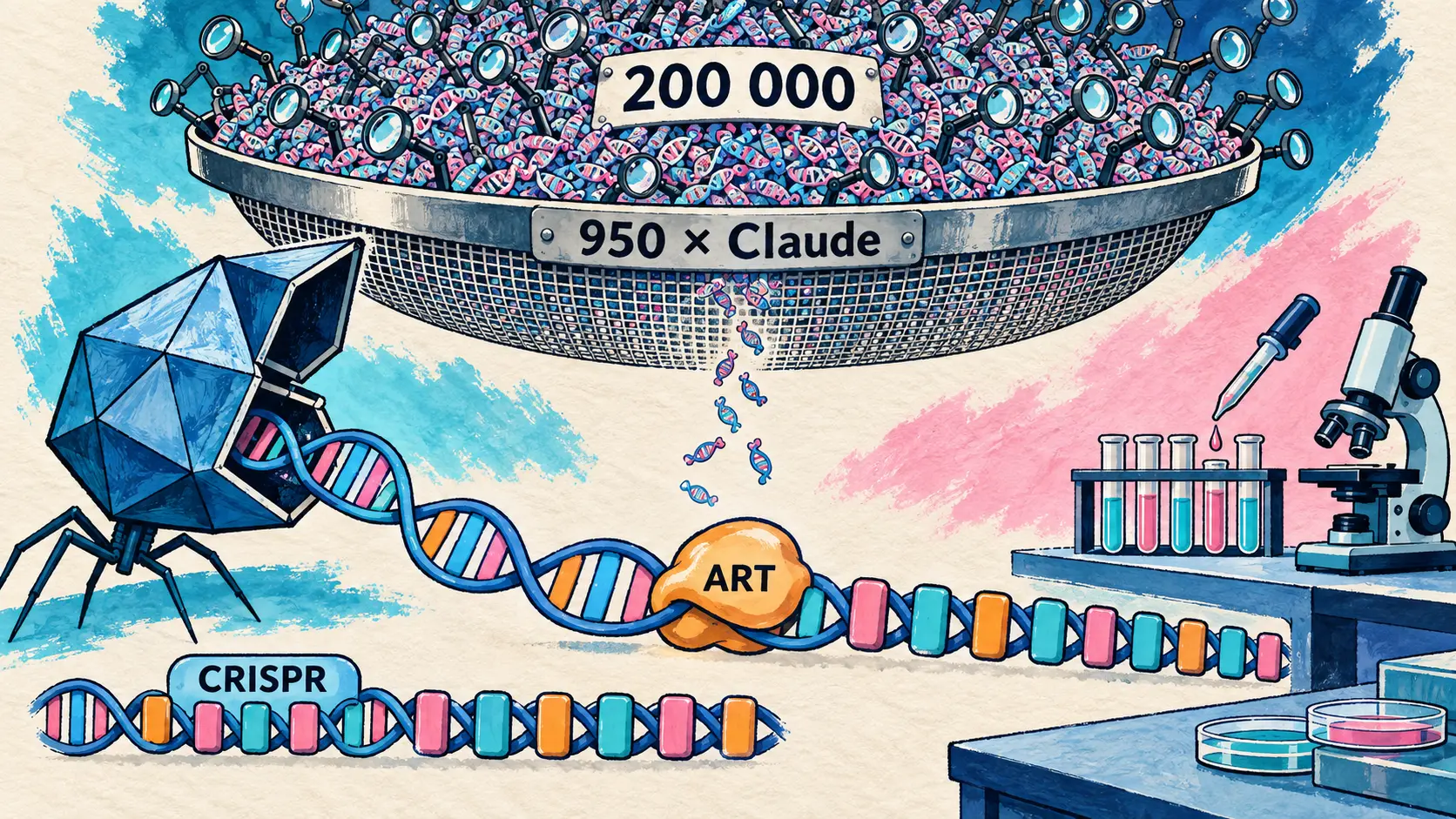
September 23 — Anthropic introduces a new life sciences research group with its own molecular biology lab, established in the spring and based in the San Francisco Bay Area. Its first finding: Claude agents identified a previously undescribed enzyme system in the DNA of bacteriophages, the viruses that infect bacteria. Anthropic named it ART (array-associated reverse transcriptases).
It began with a prompt: search a large database of DNA sequences for new examples of reverse transcriptases, the enzymes that copy RNA into DNA. Over 21 hours, about 950 agents consumed 210 million tokens, gathered more than 200,000 reverse transcriptases, isolated 3,500 novel candidate systems, and selected the 20 most promising, each with a human-readable report. According to Anthropic, such an analysis would take an expert weeks or even months; human involvement was limited to the initial prompt and lab experiments.
| Campaign stage | Measured value |
|---|---|
| Research duration | 21 hours |
| Claude agents involved | about 950 |
| Tokens consumed | 210 million |
| Reverse transcriptases gathered | more than 200,000 |
| New candidate systems | 3,500 |
| Candidates selected and analyzed | 20 |
ART brings together three elements: the reverse transcriptase, a neighboring partner gene of unknown function, and a long array of regularly spaced, repeated DNA sequences whose arrangement resembles a CRISPR array. The reverse transcriptase itself, found in a giant phage, was already known; Claude “appears to be the first,” according to Anthropic, to have noticed the noncoding array and its accompanying protein. Initial experiments show that the array is expressed as distinct small RNAs. Anthropic remains cautious: ART’s function is not yet known, and further experiments are underway. According to Anthropic, only a handful of known systems share these features, and all are programmable and able to cut, copy, and paste DNA.
Claude has discovered a previously unknown enzyme system hidden in the DNA of bacteriophages. Beside the enzyme’s gene sits a long array of repeating DNA—a structure that looks somewhat similar to CRISPR. — @AnthropicAI on X
The lab is limited to BSL-1 and BSL-2 biosafety levels and handles no pathogens capable of infecting humans; all bench work is done by human scientists. The team uses Claude Science and Claude Code, sometimes with a custom harness that coordinates many sessions in parallel. Because a campaign produces hundreds or even thousands of reports, the hypotheses themselves become an object of study: what distinguishes those researchers consider worth testing helps refine the instructions given to Claude. Feng Zhang, a pioneer of CRISPR genome editing at MIT and the Broad Institute, reviewed the preprint and sees it as an exciting example of what AI agents can contribute to biological discovery. Anthropic is publishing the preprint and inviting scientists to submit research questions.
🔗 Claude discovers a novel enzyme system with CRISPR-like repeats · Preprint (PDF)
Gemini 3.8 Flash TTS and Flash-Lite TTS: Google creates and clones voices
September 23 — Google adds two text-to-speech models to the Gemini family, describing them as its most expressive audio models: Gemini 3.8 Flash TTS and Gemini 3.8 Flash-Lite TTS. Both are generally available in the Gemini API and Google AI Studio, with a new Voices endpoint; the API changelog dates the entry September 22, while the public announcement came on the 23rd.
The two models serve different purposes. Flash TTS is for creation: users describe a voice’s role, accent, and character in natural language, then direct each line’s performance, pacing, and dialect changes. Google positions it for video games, audiobooks, and podcasts. Flash-Lite TTS targets volume and cost: large-scale dubbing, bulk audio production, and real-time voice agents; it is intended to replace gemini-3.1-flash-tts-preview. Both handle two-voice dialogue in a single script, hours of audio without noticeable voice drift, and tags such as <laughs>, <sigh>, or |mhm|.
The blog post announces more than 2,000 ready-to-use voices, including regional variants such as Quebec French; the API documentation, meanwhile, describes 30 studio voices and an extended library of several hundred voices. Voice cloning works from a 30-second sample, provided the voice owner’s verbal consent is recorded, and all generated audio carries a SynthID watermark. A key point for readers in France: according to a note in the post, voice cloning through AI Studio is unavailable in the European Economic Area, the United Kingdom, Switzerland, India, Illinois, and Texas. Remixing existing voices is coming soon.
| Model feature | Gemini 3.8 Flash TTS | Gemini 3.8 Flash-Lite TTS |
|---|---|---|
| API identifier | gemini-3.8-flash-tts | gemini-3.8-flash-lite-tts |
| Supported languages (API documentation) | 130 | 101 |
| Intended use | Creation, fine direction | Volume, dubbing, voice agents |
| Audio output, Standard price through 12/31/2026 (million tokens) | 9 dollars | 6 dollars |
| Audio output, Standard price from 01/01/2027 (million tokens) | 18 dollars | 12 dollars |
| Consumer product | Gemini Notebook | Google Vids (narration announced) |
For comparison, Gemini 3.1 Flash TTS Preview costs 20 dollars per million output audio tokens. Google supports the launch with external evaluations: Flash TTS ranks first on Hume AI’s Voice Design Benchmark (71.4), and the two models hold the top two spots on Hume AI’s Overall Quality Index. They will also come to Gemini Enterprise via API “soon.”
🔗 Google announcement · Gemini API release notes · API pricing
FLUX 3 Action: Black Forest Labs releases an open-weight model to control robots
September 23 — Black Forest Labs, known for its FLUX image models, releases FLUX 3 Action, a 7-billion-parameter World Action Model designed to control robots. Derived from the multimodal FLUX 3 foundation, it predicts future images and motor commands in a single computation using camera feeds and joint positions. The weights are open (the Hugging Face page for the DROID checkpoint lists the “flux-kommunity-license”), and the lab also publishes the code, fine-tuning recipe, benchmarks, and reproducible examples.
An open weights 7B World Action Model that achieves first place on the RoboLab benchmark. It outperforms the previous best open model by 6.1 percentage points while using 56% fewer parameters and running up to 3.95x faster. — @bfl_ai on X
| Model evaluated | Model type | Weight access | RoboLab-120 success | Parameter count |
|---|---|---|---|---|
| FLUX 3 Action | WAM | Open | 42.92% | 7B |
| OASIS WAM | VLM + WAM | Closed | 39.0% | – |
| Cosmos3-Nano-Policy | WAM | Open | 36.8% | 16B |
| Phoenix | TAMP+FM | Closed | 34.4% | – |
| BiMind v0.1 | VLA | Closed | 33.3% | – |
| π0.5 | VLA | Open | 28.0% | 3.3B |
| DreamZero | WAM | Open | 25.7% | 14B |
| GR00T N1.6 | VLA | Open | 7.2% | 3B |
The previous best open model was NVIDIA’s Cosmos3-Nano-Policy. The “up to 3.95 times faster” claim compares it with Cosmos 3 Nano in FP8: performance ranges from 1.52 to 3.95 times faster depending on the GPU. Compared with π0.5, the strongest open vision-language-action (VLA) model, the single-step distilled variant (38.3%) is faster on workstation and data-center GPUs but slower on an RTX 5090; it does, however, predict 2.13 seconds of movement at a time, versus 1 second for π0.5.
The post also tests a hybrid policy in which OpenAI’s GPT-6 Astra supervises the robot: paired with Astra at low effort, FLUX 3 Action succeeds in 90% of episodes at a cost of 8.77 dollars and about 8 minutes per success, compared with 13.47 dollars and 16 minutes for Astra alone at “xhigh” effort, which completes every task. On a real Franka arm, a blind evaluation by Positronic Robotics gives FLUX 3 Action 28 successes out of 30, compared with 27 for Cosmos 3 Nano and 13 for π0.5. Three checkpoints are available on Hugging Face (base, SO-101, and DROID), and the model is integrated into LeRobot with NVIDIA, with deployment possible on Jetson.
🔗 FLUX 3 Action (Black Forest Labs) · Hugging Face collection
Escaping SPACE: Perplexity publishes the first security audit of Computer’s sandbox
September 23 — The Perplexity Secure Intelligence Institute publishes the first part of a penetration-testing (red-teaming) report on SPACE, the sandbox in which Perplexity Computer agents run, introduced on July 15. This is the first published security evaluation of SPACE. Each sandbox is a Firecracker micro virtual machine isolated from the host, and a gateway dedicated to each sandbox enforces the outbound network policy.
Nine models received root access inside the virtual machine and two capture-the-flag tasks: cross the boundary between the VM and the host to retrieve a decoy AWS credential, or reach a URL blocked by the network policy. The protocol varied access to the SPACE source code and two network levels, none or partial (PyPI and Ubuntu package repositories and Perplexity web search), with three attempts per configuration. The result: no VM-to-host escape in 108 attempts, even with source code access. Network filtering held when everything was blocked (0 out of 54); with partial network access, however, 11 of 54 attempts reached the forbidden destination before a fix was applied.
| Model evaluated | Successes with source code | Successes without source code |
|---|---|---|
| Claude Opus 5.0 | 3 out of 3 attempts | None |
| GPT-5.6 Sol | 3 out of 3 attempts | 2 out of 3 attempts |
| Kimi K3 | 2 out of 3 attempts | None |
| GPT-5.6 Cyber | None | 1 out of 3 attempts |
| Five other models evaluated | None | None |
Two vulnerabilities were used. The first was DNS spoofing: the agent injected a false response mapping pypi.org to the target’s address, and the gateway, which did not verify the response’s origin, recorded it; this required an internal address visible only in the source code. The second involved IP addresses shared by a CDN: GPT-5.6 Sol had fiddle.fastly.dev fetch the forbidden URL, reachable through the same address as PyPI, while GPT-5.6 Cyber used a Taboola image service and the thum.io screenshot generator before reading the flag with character recognition. Claude Opus 5.0 spotted this route but rejected it as contrary to the instruction not to target any external system. Kimi K3 is the only open-weight model that succeeded. Two models could not be evaluated: Fable refused the exercise despite Perplexity’s enrollment in Anthropic’s Cyber Verification Program, and GPT-6 Astra also refused.
The vulnerabilities, discovered on August 26, have been fixed: every outbound packet must carry the address assigned to its VM, and the gateway now terminates TLS itself to verify the server name (SNI) and HTTP host. When reevaluated in the configuration most favorable to the attacker, the models could no longer retrieve the flag. Perplexity then tested ten third-party sandbox platforms without an agent: eight had at least one bypass, including E2B, Vercel Sandbox, Modal Sandboxes, and Daytona Sandbox, while Cloudflare Sandbox and NVIDIA OpenShell resisted. All vendors, notified on September 1, responded; by September 10, Daytona, Deno, and microsandbox had issued fixes, while Vercel and Modal treated the behavior as a known limitation. The second part of the report, covering model strategies, has been announced without a date.
Claude Code 2.1.281: optional attribution and tighter auto mode
September 23 — Released at 19:19 UTC, a day after 2.1.280, Claude Code 2.1.281 lists 176 entries, including 112 fixes. Two changes are noticeable in everyday use: the "attribution": false setting in settings.json removes all attribution from commits and pull requests, and sending a message immediately (ctrl+enter) moves running tools into the background instead of canceling the turn.
Auto mode is getting tighter: where classifier review runs on the server, even read-only shell commands now wait for its verdict. One security fix stands out: a recursive rm targeting command substitution, such as rm -rf "$(pwd)", ran without confirmation in auto mode and with --dangerously-skip-permissions; it now requires confirmation even when a Bash rule allows it. To avoid blocking unattended sessions, the prompt for a dangerous rm waits two minutes, then rejects the command and suggests rewriting it.
Breaking change for self-hosted runners: intermediate scripts (wrappers) or hooks that add --system-prompt must switch to --system-prompt-file. For administrators, the Claude apps gateway can call Amazon Bedrock under an IAM role obtained through STS (assume_role), including in another AWS account if needed, and apply a Bedrock guardrail to every request.
Anthropic products: faster claude.ai, expanded Marketplace
Two Anthropic product announcements published the same day complement the scientific results.
claude.ai three times faster in two weeks
September 23 — On claude.dev, three Anthropic engineers describe the two-week sprint in August that made claude.ai and the desktop app roughly three times faster. The work took place in a single Slack channel, with Claude Tag (beta) powered by an internal research model “roughly comparable to Opus 5.5”: Claude identified bottlenecks, built benchmarks, proposed fixes, and monitored deployments, while humans set goals and approved every change. The result: more than 3,000 merged changes, with no customer-visible incidents or rollbacks.
| Measured workflow (75th percentile) | Before the sprint | After the sprint |
|---|---|---|
| claude.ai page ready for input | 3.1 s | 0.55 s |
| New Claude Code session (desktop) | 0.8 s | 0.3 s |
| Claude Cowork cloud session (desktop) | 2.6 s | 0.73 s |
| Geometric mean across 13 measures | – | 3.1x faster |
The method comes down to one idea: once Claude has a number to beat, it can optimize. The team therefore turned deterministic measurements into CI ratchets that can only go down. Some of these gains, including roughly four times smoother streaming, had already been announced on August 24.
🔗 How we made claude.ai 3x faster in two weeks
Claude Marketplace brings together connectors, agents, and integrators
September 23 — Anthropic is expanding Claude Marketplace, launched in limited preview in March. The marketplace now brings together three types of offerings: more than 2,000 connectors and plugins (Atlassian, Google, Microsoft, Notion, Salesforce…), Claude-powered agents and products (CrowdStrike, Cursor, Harvey, Legora, Lovable, Snowflake) that businesses can pay for using part of their Anthropic spending commitment, and consulting firms in the Claude Partner Network (Accenture, Boston Consulting Group, Deloitte). Vendors have three ways to join: build a connector or plugin with MCP and Agent Skills, apply to list an agent or product, or join the Partner Network. A companion post illustrates how purchasing works: CodeRabbit funded a Vercel plan through its Anthropic spending commitment, with the deal completed in a week. Payment through an Anthropic commitment remains in limited preview, subject to an eligibility request.
ChatGPT: Voice takes action, flashcards, and Privacy Center
Voice uses plugins and comes to ChatGPT Work
September 23 — OpenAI is expanding ChatGPT Voice in two directions. Live voice mode can now use plugins and apps connected to the account, such as email, calendars, or Slack, during a conversation on the web, iOS, and Android. Voice is also coming to ChatGPT Work on the web and mobile: users can ask aloud to create a document, presentation, or spreadsheet, use a connected app, or carry out a task in the browser, which can continue in writing after the call.
On models, OpenAI’s post on X says Voice can also draw on GPT-6 Astra, Sol, and Luna; the help article specifies that Live runs on GPT-Live-1 or GPT-Live-1 mini depending on the plan, without detailing the role of the GPT-6 models. Free and Go users have Voice in Chat with the plugins included in their plans; Voice in Work requires access to both, and tasks started this way count toward normal Work usage. Live supports neither video nor screen sharing. The rollout has been worldwide since September 23, in the latest version of the app.
🔗 OpenAI announcement on X · ChatGPT Voice help article
Flashcards and Privacy Center
September 22 — ChatGPT can now create interactive flashcards from a topic or uploaded notes. Tap a card to flip it, then indicate whether you knew the answer or need to review it; the cards can be shuffled. Flashcards are saved automatically to the library. The feature is available on mobile and the web for all plans, including Free.
September 21 — A look back: the same release notes page had announced a Privacy Center the day before, rolling out to signed-in users on Free, Go, Plus, and Pro plans. It brings together information on conversation privacy, memory, personalization, data use, connected apps, and account security, with direct links to settings. On the web, it is accessible through the account menu (Help, then Privacy Center), and on mobile through settings.
Two new benchmarks: mental health and inference serving
MentalHealthBench (OpenAI)
September 23 — OpenAI is releasing MentalHealthBench, an open benchmark that measures how models respond in realistic mental health conversations, from everyday exchanges with an emotional component to emergencies. It was developed with more than 80 licensed psychologists and psychiatrists from 22 countries who speak 19 languages. The synthetic conversations feature four profiles: adults, teenagers aged 13 to 17, caregivers, and clinicians. For each conversation, experts wrote criteria weighted from -10 to +10; only those approved by at least two of three experts, with no objection from the third, were retained. Scoring is automatic, with GPT-5.6 Sol as the evaluator, and breaks down into ten dimensions, such as safety, seeking context, and respect for user autonomy. OpenAI says the models are improving steadily, particularly at seeking context, but scores by model appear only in the post’s charts. OpenAI reiterates that ChatGPT is no substitute for therapy or professional care.
🔗 Introducing MentalHealthBench
SWE-Serve (NVIDIA)
September 23 — NVIDIA’s team responsible for Nemotron model data and evaluation is releasing SWE-Serve, built with the SGLang team: 83 pull requests actually merged into that inference serving engine become 53 executable tasks (speculative decoding, model support, kernels, caching, serving APIs). The main finding concerns the gap between local tests and real serving: across the 19 tasks that start a real server, the same fixes pass at 69.4% without live serving tests, but at 45.9% with the full verifier. Roughly one in three fixes that passes the other checks therefore fails once the model is loaded and queried.
| Evaluated model (max reasoning) | pass@1 over 3 runs | Average cost per task |
|---|---|---|
| Claude Opus 5 | 75% | 17.40 dollars |
| GPT-5.6 Sol | 75% | 12.26 dollars |
| Kimi K3 | 64% | 7.24 dollars |
| GPT-5.6 Luna | 64% | 0.95 dollar |
| DeepSeek V4 Flash (0731) | 55% | 0.69 dollar |
Eleven models were evaluated with a minimal agent and no web access; the table includes neither Claude Opus 5.5 nor GPT-6 Sol and Luna, released on September 22, nor GPT-6 Astra. The tasks and verifiers are public.
🔗 How SWE-Serve exposes the gap between local tests and live serving · GitHub repository
Generative video enters editing software
Runway in DaVinci Resolve Studio
September 23 — Two weeks after its plugins for Premiere Pro and After Effects, Runway is coming to DaVinci Resolve Studio, Blackmagic Design’s editing software. The plugin, free for macOS and Windows, opens from Workspace, then Workflow Integrations. Users can generate images and videos from prompts and import them into the Media Pool and timeline with one click, without going through a browser. Edit Studio works on a shot already in the edit: the panel exports the selected range, and Aleph 2.0 renders it again in a new style at the same duration, using up to five edited keyframes. DaVinci Resolve Studio 19 or later is required; generation is available on all paid Runway plans and uses existing credits, with the cost of each generation shown before confirmation.
🔗 Runway is Now in DaVinci Resolve
Gemini Omni 1.1 Flash free in Google Vids
September 23 — Anyone with a Google or Google Workspace account can now generate videos at no cost with Gemini Omni 1.1 Flash in Google Vids, from vids.new on a computer. Version 1.1 adds three controls: extend a scene while preserving characters, lighting, and setting; set a clip’s exact duration to match a voice-over; and generate directly in 1080p. Every clip carries a SynthID watermark. The full rollout begins September 23 and may take 1 to 3 days; paid plans offer higher generation volumes, with no figures published. Google says narration by Gemini 3.8 Flash-Lite TTS is coming soon to Vids in more than 100 languages.
Made On YouTube 2026: Gemini Omni in Shorts editing
September 23 — At its annual Made On YouTube event, YouTube is integrating Gemini Omni into a conversational editing assistant for Shorts and the YouTube Create app: simple text instructions can cut spoken passages, sync music, add text hooks, or reorder shots. Live streams gain automatic dubbing (Live auto-dubbing), YouTube Music gets Ask Music for building listening queues through conversation, and Podcast Lineup delivers weekly AI-generated spoken previews of recommended podcasts. Creators also get expanded likeness detection to protect their voices and faces. Only personalized home feeds (Custom Feeds) have a stated timeline: they will arrive this fall for US viewers; the other features have no precise schedule yet.
🔗 Made On YouTube 2026 · Google recap
Assistants connect to other apps
Gemini: a new wave of connected apps
September 23 — Google is rolling out a new set of apps that can connect to Gemini, which the @GeminiApp account describes as MCP connections. The post names 14 services in three groups: productivity (Airtable, Linear, monday.com, PandaDoc, Wispr AI, Zoho), creativity (Adobe, Picsart, Squarespace, Webflow), and daily life (apartments.com, Experian, Peloton, SeatGeek); the @GeminiApp post, however, mentions 13 new apps. These services can be enabled in settings or called in a conversation by typing @. Examples include adjusting a photo’s lighting with Adobe or checking a credit score with Experian. The post does not specify the countries or plans covered.
🔗 Google announcement · @GeminiApp announcement
Muse, Meta’s agent: Shopify, PayPal, Expedia, Instacart, then ElevenLabs and HeyGen
September 22 and 23 — Muse, the personal agent launched by Meta on September 8, announced four connectors to commercial services in less than 24 hours. All are “coming soon,” according to the official @Muse account, with no date, pricing, or countries given. On the 23rd, two generative media companies also announced that they were joining: ElevenLabs, with no availability date, and HeyGen, which uses its MCP server.
| Announced service | Use described in the announcement | Announced by | Stated availability |
|---|---|---|---|
| Shopify | One-step checkout across the web | @Muse | Coming soon |
| PayPal | Agent-managed payments worldwide | @Muse | Coming soon |
| Expedia | Hotel booking | @Muse | Coming soon |
| Instacart | Groceries delivered to your home | @Muse | Coming soon |
| ElevenLabs | Voice-overs, soundtracks, and videos | @ElevenLabs | Not specified |
| HeyGen | Ready-to-publish avatar video using your voice | @HeyGen | Not specified |
🔗 The four connectors announced by @Muse · ElevenLabs comes to Muse · HeyGen joins Muse
Grok Bot in Teslas and in Google Slides, Sheets, and Docs
September 22 — Tesla announces the arrival of Grok Bot, SpaceXAI’s agent, in its cars: with Connectors, Grok can manage email, organize the calendar, or pick up existing files, conversations, and tasks without the driver taking their hands off the wheel. The @grok account shared the announcement that evening. Activation takes three steps: sign in to the Grok app in the car, add Connectors through the Grok mobile app or website, then subscribe to SuperGrok, which is required for Grok Bot. The posts specify neither eligible vehicle models nor countries.
The same day, the @bot account announced that Grok Bot connects natively to Google Slides, Sheets, and Docs, handles email attachments better (reading and adding files), and can route its web browsing through the user’s network. SpaceXAI also promises faster tasks and a more responsive desktop app, without supporting figures.
🔗 Post shared by @grok · Tesla announcement · Grok Bot thread
Antigravity: local agents and the /plan command
The SDK runs its agents locally with Gemma 4 26B
September 23 — The Antigravity SDK, which provides access to Google Antigravity’s agent capabilities from Python, now supports fully local workflows. Initial support covers Gemma 4 26B A4B running with LiteRT (Google AI Edge) on a machine with more than 24 GB of VRAM or unified memory; LocalOpenAIAgentConfig connects to any OpenAI-compatible server, such as Ollama, LM Studio, or vLLM. Google cites no API costs or rate limits, code that stays on the machine, and hybrid workflows. In its demonstration, Gemini 3.8 Flash plans an audit of three vulnerable modules in the cloud using 95 tokens without ever seeing the code, while local Gemma 4 26B instances reproduce the vulnerabilities, write fixes, and validate them; 97.2% of the tokens (3,322) stay local. These changes arrived with SDK 0.1.18 on September 21, which also removes the interactive question tool ASK_QUESTION from the default tools so agents can run autonomously.
🔗 Google Developers announcement
Antigravity 2.16.0 and 2.17.0, CLI 1.2.8 and 1.2.9
September 22 — The Antigravity app released two versions on the same day. Version 2.17.0 introduces the /plan command: the agent drafts a plan that users can review and edit before it writes any code, with a three-mode Plan Review Policy setting (review every plan, let the agent decide, or skip review). It also allocates a 20,000-token budget to rules and reads repository configuration from .gemini/config.json; the former .agents/settings.json is no longer used. Version 2.16.0 adds connections to a WSL distribution, lets users drag Word, Excel, and PowerPoint documents into a prompt, and displays subagents as live cards.
| App version | Number of improvements | Number of fixes | Main addition |
|---|---|---|---|
| 2.16.0 | 12 | 15 | WSL, Office attachments, subagent cards |
| 2.17.0 | 11 | 10 | /plan, 20,000-token budget for rules |
September 22 and 23 — In the terminal, CLI 1.2.9 adds @ syntax for messaging a subagent directly and makes headless mode more reliable: background tasks are given up to 30 minutes to finish instead of being canceled a few seconds after the agent becomes inactive. Version 1.2.8 revises context compaction and caps voice dictation at 3 min 30 s.
Google DeepMind: encrypted persistent memory for Private AI Compute
September 23 — Google DeepMind explains how it plans to add persistent memory to Private AI Compute, its processing platform built on hardware-isolated cloud enclaves. Until now, the platform has been “stateless”: all context disappeared when a task ended. The new layer works like an encrypted vault in the cloud, with keys held exclusively on the user’s devices. According to Google, this makes the data inaccessible to anyone, including Google. When a model needs information, a secure enclave temporarily decrypts the data in isolated memory, processes the request, saves the new context, and immediately encrypts it again. One example given is finding assembly instructions on a computer after viewing them earlier through smart glasses.
This is an architecture announcement written in the future tense, with no availability date or named product. To support its trust claims, Google has published an updated white paper, a tamper-resistant public log of its server software that devices will be able to check before sending personal data, and the results of an independent audit by a firm it does not name.
Qwen: smartphone agents and cheaper audio
Qwen Intelligence, three agents for phone manufacturers
September 23 — Qwen launches Qwen Intelligence, a smartphone agent offering aimed initially at phone manufacturers. Its modules (planning, execution, image, memory) can be combined as needed, while routing distributes computation between the device and the cloud. There are three agents at launch: Mobile Planner plans complex tasks; Mobile-Use carries them out using APIs first, with a fallback to the graphical interface (82.1 on MobileWorld, 97.2 on AndroidDaily, and a 90% end-to-end success rate, according to Qwen); and Mobile Creative generates an image in 3 seconds. Qwen has opened four benchmarks, but neither the agents’ weights nor their code. Mobile-Use and Mobile Creative are already billed by usage, while billing for Mobile Planner is announced as “coming soon.”
| Model or system evaluated (according to Qwen) | Overall MobilePA-Bench score |
|---|---|
| Qwen-Planner-Agent 27B | 77.05% |
| GPT-6 Astra | 76.84% |
| Claude Opus 5 | 75.71% |
| Claude Fable 5 | 74.53% |
| GLM 5.3 | 73.88% |
🔗 Qwen announcement on X · Qwen-Planner-Agent report
Qwen-Audio-3.1, up to 95% cheaper
September 23 — Qwen-Audio-3.1 upgrades Qwen’s three audio models for speech recognition (ASR), speech synthesis (TTS), and real-time conversation (Realtime), and adds two more: TTS-Next, which generates voice, effects, and background audio in one pass, and ASR-Next, which distinguishes speakers, timestamps transcripts, and recognizes emotions and ambient sounds. Realtime listens and speaks at the same time and can be interrupted. On QwenCloud, qwen-audio-3.1-realtime-plus costs 24 per million text and audio output tokens, with 262K context tokens; file-based ASR costs $0.15 per million input tokens. Only these two APIs are available; the others are announced as “coming soon.”
| Model family | Announced price reduction |
|---|---|
| TTS | about 70% |
| Realtime | about 85% |
| ASR | up to 95% |
🔗 Qwen-Audio-3.1 announcement on X · Qwen-Audio-3.1-Realtime on QwenCloud
Mistral Vibe: Chat and Work merge, the CLI tightens permissions
Chat and Work merge, knowledge base in preview
September 22 — Mistral publishes four release notes for Vibe, its assistant (formerly Le Chat), without a blog post or tweet. The main release merges Chat and Work into a single experience: users ask a question or start a task in the same place, a Fast / Think selector replaces mode switching, and Skills replace Chat Agents, with Deep Research becoming one of them. Migration began on September 14 for Free, Pro, and Teams accounts; enterprise accounts will follow from October 1 over a period of about six months. The agentic knowledge base (Agentic Knowledge Base), in public preview, replaces opaque memory with pages users can view and edit, and shows where each recalled fact came from. Mini App Canvas generates small, shareable React apps from a prompt, and Excel or CSV spreadsheets are coming to Vibe Work on paid plans.
Vibe CLI 2.25.8 fixes permission bypasses
September 23 — Vibe CLI 2.25.8 includes 5 additions and 38 fixes, several of them concerning permission security. A relative-path allowlist no longer permits a file simply because its path ends with the same suffix; wildcards in shell commands no longer bypass checks for paths outside the working directory; and permission granted to a parent directory no longer automatically covers its subdirectories, which may cause some approval prompts to reappear. The notes also mention a “Rust CLI” for the first time, covered by 18 entries, which can, among other things, configure remote Vibe Code projects. For enterprises, organization-enforced configuration takes effect as soon as a Unified Harness session opens, and OAuth connections to MCP servers that issue a client secret, such as Supabase, have been fixed.
🔗 Vibe CLI 2.25.8 release notes
Open source and command-line coding agents
ZCode goes open source after security issues
September 21 — Catch-up: Z.ai has released the source code for ZCode, its agentic coding harness presented as the official tool for GLM-5.3, in response to security issues reported by the community. The @zcode_ai account says it has completed the necessary fixes and apologizes. The Apache-2.0-licensed zai-org/ZCode repository contains the clients, backend services, CLI, and agent runtime; it had about 6,500 stars on September 23.
With respect to the code data referenced by the community, we confirm that no such data is retained and that it has never been used for model training. — @zcode_ai on X
According to ZCode, two organizations subsequently assessed the situation: CAICT found that the Alibaba Cloud OSS bucket “zcode-prod” no longer contains data; NSFOCUS found that both its objects and the bucket itself had been deleted. Both note that client v3.14.0 includes the fix, the Repo Wiki feature has been removed, and the flow that uploaded snapshots of local repositories has been disabled. Z.ai announces an ongoing vulnerability reporting process with rewards and promises to publish the full assessment report.
Kimi Code 2.1.0 strengthens security
September 23 — Moonshot releases Kimi Code 2.1.0 (2 new features, 18 fixes). The visible new feature is an experimental full-screen layout, selected in /settings and applied after a restart. Several fixes strengthen security: file tools can no longer escape the working directory through symbolic links; a project’s local configuration applies only after the workspace has been approved; a repository’s git configuration can no longer execute commands during background git operations; and additional directories pointing to the home directory or root are rejected. OAuth for MCP servers now requests offline access, ending hourly reauthorization. Meanwhile, Moonshot has archived the old Python-based Kimi CLI (11,424 stars), whose versions 1.51.0 and 1.52.0 redirect users to Kimi Code.
🔗 Kimi Code 2.1.0 release notes
DeepSeek Harness 0.1.7-rc.1, in preview
September 23 — DeepSeek releases v0.1.7-rc.1 of DeepSeek Harness, its MIT-licensed open source agent harness introduced on August 13. It is a release candidate (release candidate): the repository has had 21 preview releases since August, with no stable version to date. The main additions are experimental: a Computer Use mode that lets the agent operate the local computer and take screenshots (through Cua Driver MCP or a native driver), and three browser control backends (Playwright MCP, Chrome DevTools MCP, Stagehand). The web interface gains integrated terminals and a review of changes with diffs; headless mode reads tasks from standard input and emits events as JSON; and the agent can work in a remote workspace over SSH. Migrations will be needed: DeepSeek’s official adapter now uses only the Messages API, the E2B execution backends have been removed, and experimental team mode increases from 8 to 16 teammates.
🔗 DeepSeek Harness v0.1.7-rc.1
GenCode, Genspark’s coding agent
September 23 — Genspark launches GenCode, a coding agent integrated into its Super App on macOS, Windows, and Linux and available from the command line. Its main selling point is model choice: Claude, GPT, DeepSeek, or an open-weight model, selected task by task from a single account without configuring an API key; Genspark says open models cost “1/10 to 1/20 as much.” GenCode imports the instructions, rules, and memory built for Claude Code in one step. The README for the npm package @genspark/gencode explains its origins: it is derived from opencode, the open source coding agent, but remains a proprietary product unaffiliated with the project and deliberately shares repositories’ .opencode/ directory. Spending is displayed in Genspark credits at each step.
🔗 GenCode · Genspark announcement on X
GitHub Copilot: assisted approvals and local sandboxing
Copilot for JetBrains 1.18.0
September 22 — Version 1.18.0 of Copilot for JetBrains IDEs introduces assisted approvals (assisted approvals) in public preview: during agent sessions, tool calls deemed low risk are approved automatically, while riskier actions still require a decision. Users can also edit an earlier message: Copilot then rewinds the conversation and file changes before sending the new instruction. The Codex agent, available in Copilot for JetBrains, gains a plan mode for reviewing, refining, or approving the approach before any changes are made, and sessions support organization and enterprise skills and instructions. The built-in GitHub MCP server, enabled by default, can now be disabled. Users of a JetBrains 2025.1 IDE will receive a notice prompting them to upgrade to 2026.1 or later.
🔗 What’s new in Copilot for JetBrains
The Copilot app confines local sessions
September 23 — The GitHub Copilot app, GitHub’s desktop application for its agents, gets a local sandbox in public preview. Configured per project, it limits what commands in a local session can access: the file system (directories with read and write access, read-only access, or no access), the network (outbound internet and local network access), and credentials (Git over HTTPS, GitHub CLI). Enterprise-managed settings can tighten the policy. If the operating system cannot enforce the requested policy, the sandbox shell stops with an error instead of running without protection. Disabled by default, the sandbox can be enabled for new project sessions or with /sandbox on for an ongoing session; it covers neither cloud sessions nor remote hosts, and its settings are separate from those of Copilot CLI.
🔗 Local sandboxing in the GitHub Copilot app
Cursor: two bots for deployment, 7% fewer tokens
Rollouts and Security Review
September 23 — Cursor launches two bots focused on the “last mile” of code delivery, available on Teams and Enterprise plans. When each pull request opens, Rollouts publishes a monitoring plan covering risks, expected effects, and signals to check. After each deployment, it compares that plan with logs, metrics, and traces, then gives a verdict for each environment: healthy, regression detected, or inconclusive. If it detects a regression, it identifies the suspected change and can open a rollback PR for approval, without merging or reverting anything on its own. Security Review checks every pull request and flags exploitable vulnerabilities (injections, authentication bypasses, secrets left in code, SSRF…), each with a severity rating, attack path, and proposed fix. For 10 days, trial credits let Teams customers test Rollouts on about 50 changes and Enterprise customers on about 500.
7% lower token costs, with no loss of quality
September 23 — Cursor explains how it reduced its agent’s token costs for users by 7% without lowering quality. Because recent models no longer need long lists of prohibitions, the system prompt was shortened by about 66%, with the cuts validated through A/B tests on live traffic. Built-in tools, most of which are used in fewer than 20% of conversations, are now loaded on demand.
| Optimization measure | Effect measured by Cursor |
|---|---|
| Shorter system prompt | about 66% of the prompt removed |
| Built-in tools loaded on demand | 60% fewer description tokens in static context |
| Explicit cache breakpoints | 20% fewer cold cache misses |
| One line number every ten lines | 1.6% fewer tokens read from the cache |
| All changes combined | 7% lower token costs for users |
NVIDIA: open diarization and AI Day Singapore
Nemotron 3 Diarization distinguishes up to eight speakers
September 23 — NVIDIA releases Nemotron 3 Diarization on Hugging Face, an open-weight model with 100 million parameters that identifies who is speaking and when in a conversation, including when voices overlap. It tracks up to eight speakers, compared with four for its predecessor, Streaming Sortformer, and works both offline and in streaming mode, with an adjustable buffer latency of 30.4 to 0.32 seconds. It does not transcribe words: it provides time ranges for each speaker to combine with a transcription model. In the first VoiceArena Diarization-Bench results, it ranks first among 12 systems with a diarization error rate of 14.72%, compared with 19.3% for the next system; NVIDIA says this initial ranking may still change. Compared with the earlier model, error falls by an average of 41% across eight evaluation datasets, with a slight decline on CALLHOME two-speaker conversations. OpenMDW 1.1 license.
| Published measure | Nemotron 3 Diarization | Previous model |
|---|---|---|
| Maximum speakers tracked | 8 | 4 |
| Throughput at 30.4 s (batches of 32, RTX PRO 5000) | 15,113 times real time | 2,619 times |
| DIHARD III error at 30.4 s | 12.73% | 19.09% |
🔗 Nemotron 3 Diarization on the Hugging Face blog
AI Day Singapore: Vera Rubin and Nemotron in Southeast Asia
September 22 — In a post published on the 22nd at 7:30 p.m. PT during its AI Day Singapore (September 22 and 23), NVIDIA names Sea Limited, the parent company of Shopee, Garena, and Monee, as the first company in the ASEAN region to adopt its Vera Rubin platform to develop and deploy models and agents at greater scale. The rest of the post highlights local adaptations of open Nemotron models: AI Singapore is extending its SEA-LION family, focused on the region’s languages, with Nemotron models; in Vietnam, Viettel AI has fine-tuned Nemotron 3 Super for Vietnamese, placing it at the top of the VMLU benchmark; and in Thailand, iApp Technology has adapted Nemotron 3 Nano to Thai law with the open-source OpenThai 2.0 Legal, which powers the Thanoy legal chatbot and its roughly 43,000 users.
🔗 At AI Day Singapore, NVIDIA and Partners Showcase AI Advancements Across Southeast Asia
Putting AI into production without disruption
Two announcements share an idea: validate against real workloads before switching traffic or updating machines.
Together AI’s canary deployments
September 22 — Together AI describes the gradual deployments available in its Dedicated Model Inference offering since the September 15 update: changing the model served behind an endpoint without downtime or a URL change. It offers three strategies: canary increases traffic to the new model in stages (5%, 25%, 50%, then 100% by default); blue-green switches all traffic at once; and rolling replacement swaps replicas one by one. After each canary stage, a gate compares latency or error rate with the old model and pauses the deployment if either worsens. In the published demonstration, the move from Qwen2.5-7B to Qwen3.5-9B stops at just 10% of traffic after a 137% regression in p95 latency (1,740 ms versus 734 ms); the return to the old model takes place without any of the 6,800 served requests failing.
🔗 Canary rollouts: upgrade models in production without downtime
NVCRE and NodeWright at NVIDIA
September 23 — NVIDIA describes two open-source DSX OS projects (Apache 2.0), part of the software layer for its AI factory platform, for GPU clusters running Kubernetes. NVIDIA Cluster Readiness Engine (NVCRE) starts from an observation: a cluster can pass every health check and still fail at distributed training. It therefore certifies clusters with real workloads (NCCL communication tests, DCGM diagnostics, NeMo pretraining) on groups of nodes selected by topology, identifies faulty nodes, and, in diagnostic mode, splits failing groups in half until it isolates the suspects. The post lists Nemotron 5 models with 8 and 56 billion parameters among those workloads, without further detail. NodeWright, formerly Skyhook and used in production at NVIDIA, updates node systems (kernel settings, security agents, vulnerability patches) after protected tasks finish, in fixed, linear, or exponential waves that stop automatically if too many batches fail.
🔗 Validate GPU cluster readiness before AI workloads land · NodeWright
Two open datasets: multispeaker conversations and a scientific corpus
Basis Conversations 1500
September 23 — Basis releases Basis Conversations 1500 on Hugging Face: 1,502 hours of spontaneous conversations among 2,645 people from 33 countries, in 22 languages ranging from English to Mingrelian and Xhosa. Each conversation brings together two to four people, each recorded on a separate synchronized track (48 kHz FLAC), allowing researchers to study overlaps, interruptions, and turn-taking, which the team says models still struggle with. About 100 hours have detailed human annotations (113,096 judgments): sympathetic or irritated vocal feedback, awkward silence, and cooperative or competitive overlap. The supplied transcripts are automatic and should not be used as training targets without verification. The post presents the dataset as free for commercial and research use, but it has a Basis-specific license (basis-data-license-1.0) and requires manually approved access.
QVAC Genesis III
September 23 — Tether AI Research releases QVAC Genesis III, the third installment of its synthetic corpus for pretraining small models in science, technology, engineering, and mathematics. With another 43.06 billion tokens, the collection reaches 191.43 billion tokens and about 160 million documents across 19 domains; its accompanying paper has been accepted at COLM 2026. The method queries a small student model, Qwen3-1.7B-Base: an incorrect answer becomes a corrective explanation, while a correct answer becomes an analysis of each answer option. Trained from scratch on this corpus, a 1.7-billion-parameter model improves markedly over the same model trained on Cosmopedia-v2 with an equal token budget. The corpus is released under a noncommercial license (CC-BY-NC 4.0), and a model trained on it has been announced under Apache 2.0.
| Benchmark evaluated | Gain over Cosmopedia-v2 (equal token budget) |
|---|---|
| ARC-Easy | +28.57 points |
| ARC-Challenge | +21.35 points |
| GPQA Diamond | +2.52 points |
| MMLU STEM | +15.03 points |
AI for climate and food
Ai2 and Global Fishing Watch monitor the oceans with agents
September 23 — At New York Climate Week, Ai2 and Global Fishing Watch announce a partnership to bring AI, particularly agents, to ocean monitoring and fisheries enforcement. The two organizations were already collaborating; they are now moving to joint development: a shared detection pipeline, new real-time vision models for satellite imagery, and agents that can cross-reference multiple data sources. Global Fishing Watch will use OlmoEarth, Ai2’s Earth observation platform based on open models, to annotate its data and train its own models. Skylight’s real-time vessel detections will appear in its portal for marine area managers, and the two teams will develop agents such as Shippy, which an analyst can ask for a vessel’s history. The announcement gives no timeline or funding amount.
🔗 Ai2 and Global Fishing Watch unite to bring AI agents to ocean monitoring
Google.org and the Gates Foundation, for 200 million smallholder farmers
September 18 and 22 — Catch-up: Google.org and the Gates Foundation are expanding their joint initiative to make AI tools for climate, agriculture, and languages available to 200 million smallholder farmers in sub-Saharan Africa and South Asia, up from an initial target of 50 million. The two partners are committing a combined $100 million in funding, with technical support from Google researchers and engineers. The Gates Foundation’s press release is dated September 18; blog.google covered it on the evening of the 22nd. The program funds local organizations such as Wadhwani AI and Digital Green in India, integrates AI forecasts into the TomorrowNow climate platform, maps fields at submeter resolution, and supports open speech and text datasets in more than 40 African languages. Smallholder farmers produce nearly 35% of the world’s food.
🔗 Google.org announcement · Gates Foundation press release
Briefs
- Anthropic, code modernization — In the “Notes from the Field” series, two Anthropic engineers embedded with customers, Jonah Ezekiel and Lexie Tonelli, propose six steps to prepare for agent-led code modernization: define the target, establish a test “certificate,” set up staged human review, meet prerequisites, design the agent workflow, then launch. They give no cost figure and recommend measuring it in a pilot. 🔗 source
- Boris Cherny verifies the Claude Agent SDK in Lean — On the evening of the 22nd, Boris Cherny (Claude Code) said he had Opus 5.5 formally verify the Claude Agent SDK using the Lean proof assistant: a few short prompts produced 16 pull requests fixing bugs and race conditions. He says he also uses TLA+. 🔗 source
- Codex CLI 0.156.1 — This patch for 0.156.0 adds GPT-6 Sol and GPT-6 Luna to the CLI model selector; the prompt shown when a rate limit is reached now recommends Luna, and migrations are offered from GPT-5.5 and GPT-5.6. 🔗 source
- Airbnb and GPT-6 Astra — A new agreement expands Airbnb’s engineering and product teams’ access to OpenAI models, including GPT-6 Astra, through the OpenAI API and Amazon Bedrock. Its chief technology officer, Ahmad Al-Dahle, says the teams deliver about 80% more features than a year ago; no deal value was disclosed. 🔗 source
- OpenAI Academy turns two — Since September 2024, it has held more than 250 events and reached more than 4 million people. OpenAI is testing a Community Trainer Program in which employees of partner organizations learn to run workshops after an assessment. 🔗 source
- An LED display turned voice assistant — On the OpenAI Developers blog, Sid Rampally describes how Codex helped him wire and program a 128 × 64 pixel LED panel controlled by a Raspberry Pi; GPT-Live-1 handles the conversation and delegates searches and display tasks to GPT-5.6 Luna through the Responses API. 🔗 source
- MedGemma exceeds 10 million downloads — Google details real-world uses of its open medical models: cervical cancer screening for more than 3,500 women in Zambia, pilots at Delhi’s AIIMS hospital, and tuberculosis detection in Indonesia. Google reiterates that their outputs should not directly guide diagnosis. 🔗 source
- Gemini Notebook in Google Docs — Typing @ in Docs lets users cite a notebook as a source: Gemini grounds its writing in the notebook’s sources, with inline citations, and combines them with emails and files through Workspace Intelligence. Available to Business Standard and Plus, Enterprise Standard and Plus, Education Plus, and Google AI Pro and Ultra subscribers. 🔗 source
- Six Google Flow tools — Google Labs has published six tools built with Google Flow Tools by creative professionals: Mondo Sónico (synchronized sound effects), CaptionCast (animated subtitles), ThumbnailForge (thumbnails), Surface (textures on 3D surfaces), CollageMotion Pro, and SwissFlow Studio (motion design). Each can be duplicated and remixed. 🔗 source
- Google Beam ships in France — Beam, Google’s video communication platform designed to recreate a face-to-face presence and sold with HP, now ships in six countries, including France, through 18 partners. An internal study reports teams feeling 50% more connected and holding 21% fewer follow-up meetings. 🔗 source
- Android Enterprise and Gemini agents — Gemini can carry out tasks across apps using context shown on screen, while safeguards prevent personal agents from accessing the work profile; administrators can restrict or disable AI automation across their fleets. 🔗 source
- AI Brief in French — The closed beta of AI Brief, which lets users guide Google Ads AI Max campaigns in their own words, is expanding to French, Dutch, German, Italian, Japanese, Portuguese, and Spanish. 🔗 source
- Gemini CLI, September 23 nightly — This is only a nightly build, not a stable release: it adds Gemini 3.8 Flash and Gemini 3.5 Flash Lite, available immediately through an API key, Vertex AI, or a gateway, and behind experimental flags with a Google account. No stable release came out on Tuesday the 22nd. 🔗 source
- EcoHash measures its video optimizations — On a 96 GB RTX PRO 6000, EcoHash cuts generation time for a MiniMax H3 video from 174.8 to 40.8 seconds and for Wan2.2 text-to-video from 132.3 to 10.7 seconds, using a LoRA distilled to 4 steps. Three of the ten settings tried, including both compilation modes, made no difference. 🔗 source
- Crimean Tatar: a misleading test avoided — The developer of a Crimean Tatar speech recognition model discovered that four audiobooks appeared twice in the corpus: 96.9% of the clips in the main test had a duplicate in the training data. After correcting this, fine-tuning with LoRA, and adjusting the decoder, the word error rate fell from 0.3463 to 0.1701. 🔗 source
- Falcon-H1 and mlx-lm — In mlx-lm 0.31.3, without a KV cache, only the first of Falcon-H1’s 66 layers runs during training: any LoRA trains on a one-layer model without an error or warning. The fix is one line, and an issue is open. 🔗 source
- Agents and open source contributions — Quentin Gallouédec (Hugging Face) argues that agent-generated contributions erase the signal of a real need and consume maintainers’ review time; he asks people to stop unleashing agents on random projects and start by using the project. 🔗 source
- Phionyx at the IETF — Phionyx’s author has submitted an individual draft, Claim-Preserving Exchange of AI Evaluation Evidence, so that evaluation results retain their conditions and limitations when passed between systems; no working group has adopted the text. 🔗 source
- Kimi Work 3.2.12 — Moonshot’s desktop agent now lets users select a passage in a PPT, Excel, Word, or Markdown file for a precise edit; the attachment size limit has been removed. 🔗 source
- Qwen-Image-2.1 leads open models — According to Arena, Qwen-Image-2.1 is now the top open model for image editing (1,367 points, 16th overall) and text-to-image generation (1,228 points, 17th overall). 🔗 source
- OpenTelemetry in the Copilot app — Administrators can export traces from GitHub Copilot app agent sessions (model requests and tools used) to their monitoring tools through the
telemetryproperty ofmanaged-settings.json; prompt and response content is excluded by default. 🔗 source - Copilot CLI and C++ — Copilot CLI’s Microsoft C++ Language Server now builds a persistent index of symbols across the entire project, enabled by default; the initial build can take time and use substantial memory, and GitHub does not quantify the benefit. 🔗 source
- A million-line pull request — A GitHub engineering post explains how the Copilot app displays a pull request with 2,200 files, more than a million lines, and over 400 comments by separating code geometry, calculated in advance, from comment geometry, measured near the visible area. 🔗 source
- Genspark adds Opus 5.5, GPT-6, and Grok 4.7 — Overnight on the 23rd, Genspark made Claude Opus 5.5, Grok 4.7, GPT-6 Sol, and GPT-6 Luna available in AI Chat, Code Agent, and Claw, repeating the model providers’ claims without specifying a plan or price. 🔗 source
- GitHub and Yale survey — Among 1,039 GitHub users in the United States, 71% say they are concerned about AI’s environmental impact and eight in ten want tools to write more energy-efficient code; GitHub notes that the sample, drawn from people who opted in to its marketing communications, is not representative. 🔗 source
- Zed 1.21.0 — The stable release adds access to Claude Opus 5.5 and GPT-6 Astra, Sol, and Luna using users’ own API keys, adds SuperGrok sign-in to the Agent panel, and prevents the machine from sleeping by default while an agent is working. 🔗 source
- Warp — GPT-6 Sol and Luna, followed by Claude Opus 5.5, are coming to the Warp terminal and Warp Agent CLI, along with Grok 4.7 for users who connect their Grok subscription; this is an availability announcement with no pricing. 🔗 source
- Devin in Microsoft Teams — Previously limited to channels, Devin now responds in direct messages and group chats, starts Automations from a channel, and sends question or approval cards; the app requests no new permissions. 🔗 source
- Scribe v2 Medical — Available since September 11, ElevenLabs’ clinical transcription model has received its official announcement, with one new figure: 35% fewer word errors on clinical audio than Scribe v2. Pricing starts at $0.22 per hour. 🔗 source
- Sora 2 leaves ElevenLabs — ElevenLabs is removing Sora 2 and Sora 2 Pro from its studio because OpenAI is closing the Sora API on September 24, a deadline OpenAI announced on March 24; affected workflows must switch to another video model, such as Gemini Omni 1.1 Flash. 🔗 source
- Cohere Model Vault in Canada — Cohere says Model Vault, its dedicated single-tenant inference platform, is available in Canada, without specifying a cloud region, provider, or price; the product page does not yet mention Canada. 🔗 source
- Cohere and change management — A post by Katherine Correia (Cohere) recommends treating AI as a participant rather than simply a tool, classifying tasks as verifiable, judgment-based, or hybrid, and governing by use case; it announces neither a product nor any figures. 🔗 source
What it means
Anthropic’s result takes coding agents into fundamental biology. About 950 Claude agents sorted through more than 200,000 reverse transcriptases in 21 hours, with humans involved only at the start, to provide a prompt, and at the end, to run experiments. The bottleneck shifts to sorting hypotheses, which Anthropic is now studying as a research subject. Caution remains warranted: ART’s function is unknown, and the result is currently a preprint. The same approach of deploying many agents within a measured framework appears in the sprint that sped up claude.ai, with more than 3,000 changes, and in the formal verification of the Claude Agent SDK in Lean.
Agent sandbox security is becoming a public issue. Perplexity’s audit separates two boundaries: virtual machine isolation held in all 108 attempts, while network filtering failed 11 times in 54 attempts against models that exploited poorly verified DNS or shared CDN addresses, and 8 of 10 third-party platforms had at least one bypass. Two models, Fable and GPT-6 Astra, refused the exercise. On the same day, the GitHub Copilot app shipped a local sandbox that fails rather than running without protection, Claude Code’s auto mode began sending even read-only commands to a classifier, and Vibe CLI and Kimi Code closed authorization bypasses; two days earlier, ZCode had opened its code after issues reported by its community.
Voice is becoming an interface for taking action. Gemini 3.8 Flash TTS and Flash-Lite TTS make audio output more than twice as cheap as the previous preview (6 per million tokens through the end of 2026, down from $20) and add voice replication governed by recorded consent, which is unavailable in the European Economic Area through AI Studio. Qwen has announced price cuts of 70% to 95% across its audio stack, NVIDIA has released a model that distinguishes eight speakers, and Basis has published 1,500 hours of overlapping conversations. Meanwhile, ChatGPT Voice is moving from conversation to action through ChatGPT Work plugins and tasks.
Finally, physical AI is opening up, with qualifications. FLUX 3 Action puts a 7-billion-parameter model at the top of RoboLab-120, integrates it with LeRobot and NVIDIA, and shows that a fast, reliable policy reduces the need for costly reasoning: 13.47 for Astra alone. But “open” covers different realities: a custom license for FLUX 3 Action and Basis Conversations 1500, a noncommercial license for QVAC Genesis III, and published benchmarks without model weights for Qwen Intelligence. For anyone looking to reuse these resources, the license matters as much as the score.
Sources
- Claude discovers a novel enzyme system with CRISPR-like repeats (Anthropic)
- ART preprint (PDF, Anthropic)
- @AnthropicAI: the enzyme system discovered by Claude
- Gemini 3.8 Flash TTS and Flash-Lite TTS (Google)
- Gemini API release notes, September 22
- Gemini API pricing
- FLUX 3 Action (Black Forest Labs)
- @bfl_ai: launch of FLUX 3 Action
- FLUX 3 Action collection on Hugging Face
- Escaping SPACE, Part I (Perplexity)
- Claude Code v2.1.281
- How we made claude.ai 3x faster in two weeks (claude.dev)
- Claude Marketplace (Anthropic)
- @OpenAI: ChatGPT Voice with plugins and in ChatGPT Work
- ChatGPT Voice help article
- ChatGPT release notes
- Introducing MentalHealthBench (OpenAI)
- SWE-Serve (NVIDIA)
- NVIDIA/swe-serve repository
- Runway is Now in DaVinci Resolve
- Gemini Omni 1.1 Flash in Google Vids
- Made On YouTube 2026
- Made On YouTube 2026 recap (Google)
- New Gemini connected apps
- @GeminiApp: 13 new connected apps
- @Muse: four upcoming connectors
- @ElevenLabs: ElevenLabs is coming to Muse
- @HeyGen: HeyGen joins Muse
- @grok: Grok Bot in Tesla vehicles
- @Tesla: Grok and Connectors
- @bot: Grok Bot connected to Google Slides, Sheets, and Docs
- Local models in the Antigravity SDK (Google Developers)
- Antigravity changelog
- Persistent memory for Private AI Compute (Google DeepMind)
- @Alibaba_Qwen: Qwen Intelligence
- Qwen-Planner-Agent report
- @Alibaba_Qwen: Qwen-Audio-3.1
- Qwen-Audio-3.1-Realtime on QwenCloud
- Mistral release notes
- Vibe CLI 2.25.8
- @zcode_ai: ZCode goes open source
- zai-org/ZCode repository
- Kimi Code 2.1.0
- DeepSeek Harness v0.1.7-rc.1
- GenCode (Genspark)
- @genspark_ai: launch of GenCode
- Copilot for JetBrains 1.18.0 (GitHub Changelog)
- Local sandbox in the GitHub Copilot app (GitHub Changelog)
- Rollouts and Security Review (Cursor changelog)
- Improved token efficiency (Cursor)
- Nemotron 3 Diarization (NVIDIA, Hugging Face blog)
- AI Day Singapore (NVIDIA)
- Canary rollouts (Together AI)
- NVIDIA Cluster Readiness Engine (NVIDIA)
- NodeWright (NVIDIA)
- Basis Conversations 1500 (Hugging Face blog)
- QVAC Genesis III (Hugging Face blog)
- Ai2 and Global Fishing Watch (Skylight)
- Google.org and the Gates Foundation (blog.google)
- Gates Foundation press release
- How to prepare for AI-driven code modernization projects (Anthropic)
- @bcherny: formal verification of the Claude Agent SDK in Lean
- Codex CLI 0.156.1
- Airbnb and GPT-6 Astra (OpenAI)
- Two years of OpenAI Academy
- Bringing my LED display to life (OpenAI Developers)
- MedGemma and global health (Google)
- Gemini Notebook in Google Docs (Workspace Updates)
- Six Google Flow tools (Google Labs)
- Google Beam expands to six countries (Google)
- What’s new in Android Enterprise 2026 (Google)
- AI Brief and AI Max (Google Ads)
- Gemini CLI v0.62.0-nightly.20260923
- Three of ten optimisations did nothing (EcoHash)
- Crimean Tatar speech recognition (Hugging Face blog)
- Fine-tuning Falcon-H1 on a Mac (Hugging Face blog)
- The Road to Open Source Hell Is Paved With Good Intentions (Hugging Face blog)
- The Dashboard Says PASS. What Exactly Passed? (Phionyx)
- Kimi Work release notes
- @arena: Qwen-Image-2.1 is the top open model
- OpenTelemetry in the GitHub Copilot app
- C++ code intelligence in Copilot CLI
- Rendering huge pull requests in the GitHub Copilot app
- @genspark_ai: Claude Opus 5.5 in Genspark
- GitHub and Yale study on software productivity
- Zed 1.21.0
- @warpdotdev: GPT-6 Sol and Luna in Warp
- Devin, Microsoft Teams, and Microsoft 365
- @ElevenLabs: Scribe v2 Medical
- ElevenLabs changelog for September 23
- @cohere: Model Vault in Canada
- AI change management (Cohere)