ai-powered-markdown-translatorArticle translated from fr to en with gpt-5.4-mini.
Fifty-one announcements in twenty-four hours, spread across nine domains: August 25 is the busiest day of the week. Four developments stand out. OpenAI publishes the first measured results for Jalapeño, its in-house inference chip, and immediately launches a ten-day WebMCP hackathon with Chrome, Cloudflare, Shopify, Vercel, Render, and Netlify. Perplexity brings the entirety of its Computer agent down onto the user’s machine. IBM opens Granite 4.2, its first family of reasoning models. And Anthropic unifies Claude’s memory between chat and Cowork, making it readable and editable file by file. The rest — WeatherNext Cyclones now live at the National Hurricane Center, Stability AI’s Series B, and a couple dozen tool updates — follows below.
WebMCP: a standard, its product support, its internal use, and a contest to kick it off
August 25 — OpenAI launches the WebMCP Challenge, a ten-day hackathon dedicated to an experimental open standard that changes the way agents interact with the web. The problem it targets is concrete: today, an agent that needs to complete a task on a site has to guess how to navigate an interface designed for eyes and a mouse. WebMCP reverses the logic: the site itself exposes structured tools that the agent calls directly.
The contest is not the most notable part of the announcement. What matters is the alignment it reveals: Chrome (Google), Cloudflare, Shopify, Vercel, Render, and Netlify are all joining OpenAI on the same standard. The jury reflects that, with Sarah Drasner (Distinguished Engineer, Chrome), Andrew Galloni (VP Research & Innovation, Cloudflare), Jude Gao (Next.js Core team, Vercel), Ilya Grigorik (Distinguished Engineer, Shopify), Sean Roberts (VP of Applied AI, Netlify), Justin Rushing (Browser Agent Lead, OpenAI), and Alex Nahas, creator of MCP-B.
The WebMCP Challenge is here. We’ve teamed up with @ChromiumDev, @CloudflareDev, @ShopifyDevs, @vercel, @render, and @Netlify for a 10-day hackathon. Up for grabs: $35,000 in cash prizes, Codex Micros, ChatGPT Pro subscriptions, and more prizes from our supporters. — @OpenAIDevs on X
The timeline is tight and the judging criteria are explicit: usefulness, originality, execution, thoughtful use of WebMCP, and quality of the human-agent experience. Registration and submissions go through Devpost. OpenAI is also publishing agent-native demo applications to get projects started — agent-driven 3D modeling, collaborative writing where the agent comments under its own identity, a personalized crossword generator, Wandernote for turning travel notes into an itinerary, and data exploration through DuckDB-Wasm in the browser. Starting from an existing application and adding WebMCP to it is allowed.
| Contest item | Announced detail |
|---|---|
| Announced duration | 10 days |
| Submission opening | August 25, 2026, 12 p.m. PT |
| Submission deadline | September 3, 2026, 1 p.m. PT |
| Winners announced | September 23, 2026 (tentative date) |
| Total prize pool | $35,000 |
| Prize per winner (top 10) | $3,000, one year of ChatGPT Pro, a Codex Micro keyboard, swag |
| Submission platform | Devpost |
The product layer that makes the standard usable day to day arrives the same day: the built-in browser in the ChatGPT desktop app and ChatGPT Sites can now consume WebMCP. When ChatGPT or Codex visits a compatible site, the agent detects the tools exposed by the page and uses them automatically instead of poking around the interface — updating to the latest desktop app version is required. The other half of the loop is on the production side: it is now possible to ask Codex to create a WebMCP-compatible application and deploy it directly to Sites. Note the support asymmetry with Chrome, where WebMCP remains behind an experimental flag or an origin trial, while the ChatGPT browser handles it natively.
The third part, and the most instructive, is OpenAI’s own internal use. An engineer at the company рассказывает how he stopped writing one automation per task to build Runme, an open-source notebook web app designed to work with Codex. In it, he writes a short goal with explicit instructions — check a previous run, draft a detailed plan, wait for approval before starting, document the commands executed and how they were interpreted — and Codex reads and then updates the notebook as the work progresses. Two architectural choices are worth noting. Persistence first: notebooks are saved in Google Drive, and Runme simultaneously generates a companion Markdown index *.index.md that Drive can index, allowing an agent to retrieve a past run as operational context. Exposure of capabilities next: Runme is a static client-side app, and adding a server solely to expose a classic MCP endpoint would have introduced infrastructure and moved notebook data processing elsewhere. WebMCP lets the application register its tools directly from the browser.
🔗 WebMCP Challenge · Support in ChatGPT desktop and Sites · Codex, Runme, and WebMCP at OpenAI
Jalapeño: OpenAI publishes the first numbers for its inference chip and embraces its compute strategy
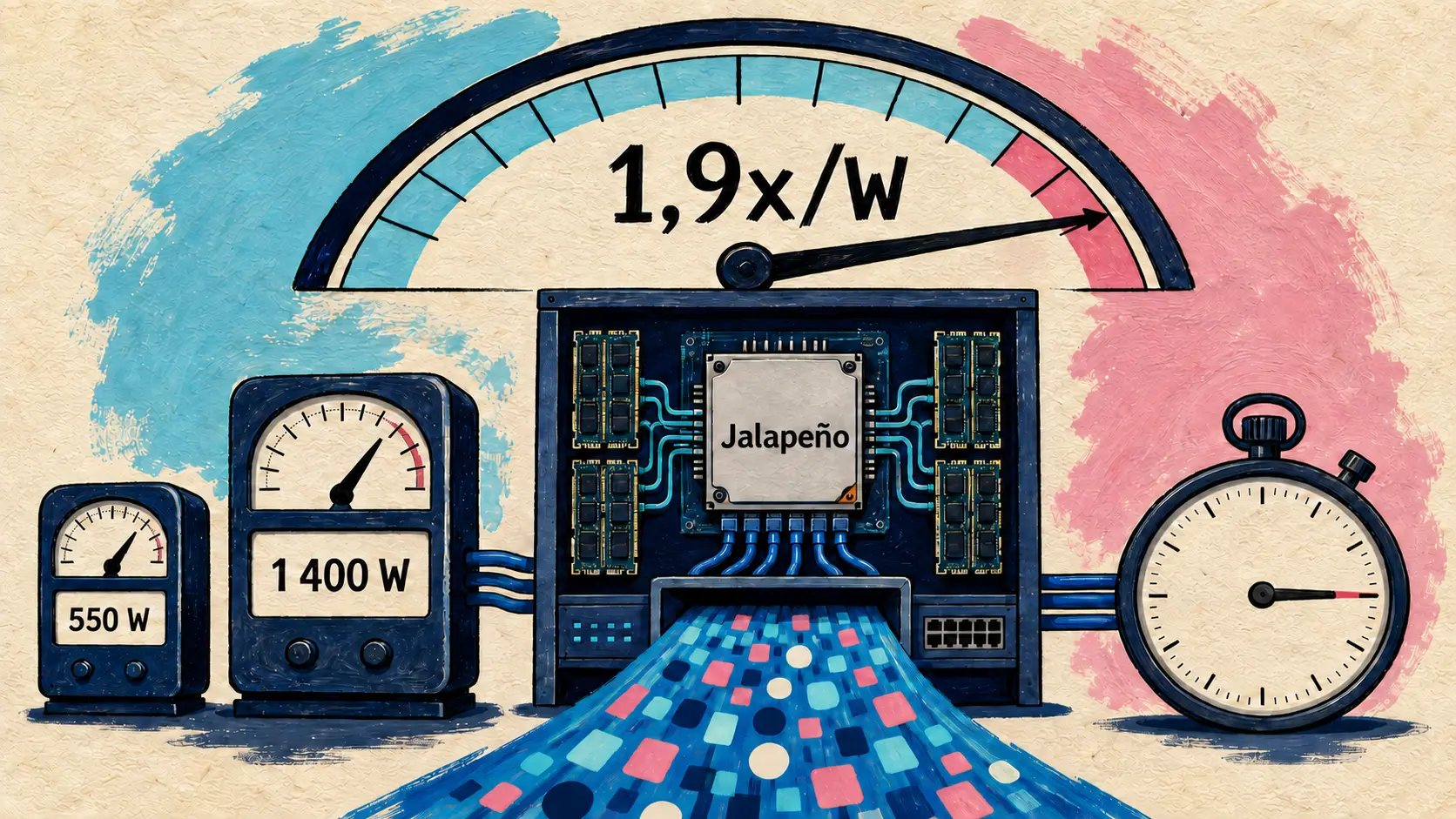
August 25 — OpenAI publishes the first measured results for Jalapeño, the first inference chip it designed itself. The significance of the announcement is not just the raw gains, but the tradeoff it claims to remove: existing inference systems generally have to choose between throughput and latency, whereas Jalapeño claims both in a single architecture.
The measurements are based on InferenceX, a public SemiAnalysis benchmark that simulates the full processing of a request. Three open models were tested — GPT-OSS 120B, DeepSeek R1 670B, and Kimi K2.5 1T — against commercial systems. The choice to normalize by watt rather than by chip is explicit, and convenient: Jalapeño consumes twice less than the systems it is compared against. Jalapeño is announced at 700 W, and sustained measured consumption stayed at 550 W or below on the tested workloads, versus 1,200 W for GB200 and 1,400 W for GB300.
| Evaluated model (comparison system) | Peak throughput per kW | End-to-end latency | Minimum TBT |
|---|---|---|---|
| GPT-OSS 120B (GB200, 1,200 W) | ≈1.9x (85,448 vs 44,960) | ≈1.7x (1.03 s vs 1.80 s) | ≈2.7x (0.69 vs 1.87 ms) |
| DeepSeek R1 670B (GB300, 1,400 W) | ≈1.7x (19,641 vs 11,781) | ≈3.6x (1.65 s vs 5.99 s) | ≈4.1x (1.43 vs 5.90 ms) |
| Kimi K2.5 1T (GB300, 1,400 W) | ≈1.5x (18,195 vs 11,862) | ≈3.4x (1.56 s vs 5.31 s) | ≈3.8x (1.44 vs 5.48 ms) |
Across the three models, OpenAI reports 1.5 to 1.9 times more AI work per watt at peak throughput and 1.7 to 3.6 times lower end-to-end latency than the comparison systems, and up to 2.1 to 4.1 times more performance on highly interactive workloads. Technically, the gains come from co-designing the chip, memory, network, software, and rack-scale system. Inference has two phases with different bottlenecks: prefill, which processes the prompt and saturates compute, and decode, which generates tokens one by one and depends mostly on memory bandwidth. Jalapeño aims to minimize data movement, with model state — including the KV cache — able to be placed explicitly and kept local while the system activates the right combination of compute, memory, and network depending on the phase.
The most interesting part for a developer is the role of AI in the chip’s own design. OpenAI says it went from initial design to tapeout in nine months by shortening design, measurement, and verification loops. The chip was designed as a predictable programming target for AI as much as for humans: work described through local tensors, explicit communication, predictable synchronization. With Codex and GPT-Astra, the team brought three open-weight models absent from the original production plan to completion in two months, and on selected attention and mixture-of-experts blocks from GPT-OSS, AI-generated kernels run 1.5 to 1.8 times faster than implementations written by human experts. The nuance matters: these figures apply to the selected blocks, not the full model. The schedule remains cautious — production qualification is underway, the software still needs maturing, deployment into OpenAI’s infrastructure is announced for the end of the year, Gen 2 is in advanced development, and Gen 3 is taking shape.
On the same day, Sarah Friar publishes the post that lays out the economic logic behind all this. She claims a broad compute portfolio — Microsoft and NVIDIA as the base, supplemented by AWS, AMD, Broadcom, Cerebras, CoreWeave, Oracle, SB Energy, and SoftBank — with an argument that is as commercial as it is technical: preserving credible choice among vendors makes it possible to route each workload to the best performance-price ratio and maintain pricing discipline. One concrete figure accompanies the point: on the Artificial Analysis Coding Agent Index, GPT-5.6 Sol at maximum reasoning reaches a new record while using 54% less output tokens than another leading model. The text also embraces Jevons’s paradox — making intelligence cheaper does not reduce its consumption, it expands the set of profitable uses. On the infrastructure side, Project Camellia in Georgia is presented with a closed-loop water system and commitments subject to an annual independent public audit. OpenAI says it will continue to deploy NVIDIA’s and its other partners’ accelerators broadly, for both training and inference.
🔗 Jalapeño — first results · The full stack behind abundant intelligence
Perplexity Portable Computer: everything runs on the machine, benchmarks to back it up
August 25 — Perplexity is launching Portable Computer, a version of its Computer agent that runs entirely on the user’s machine. The shift is architectural more than cosmetic: it is not just the model that runs locally, but the entire orchestration chain — orchestrator, planner, tool router, scheduler, persistent task queue, and local search index.
Today we’re launching Portable Computer on @NVIDIA DGX Spark.
Portable Computer is a fully local version of Perplexity Computer, where the entire runtime: orchestrator LLM, subagent LLM, agent harness all run on your local hardware. No cloud dependency.
The announcement is made jointly with NVIDIA and initially targets the DGX Spark — a Grace Blackwell GB10 platform, 20-core Arm CPU, NVIDIA GPU, 128 GB of unified memory — with an announced expansion to PCs equipped with RTX GPUs. Two models are offered as options, Qwen 3.8 27B or PPLX 27B, Perplexity’s post-trained version of the Qwen model, and NVIDIA Nemotron 3.5 Lightning, an open 30B model, is set to join the selector. Work handled locally consumes no credits. Escalation to the cloud remains possible — up-to-date information, browser, connected applications, or one of the 15 frontier models and beyond — but it is subject to explicit user approval. The Google Drive, Gmail, Slack, and GitHub connectors work from the device, dictation runs locally via the NVIDIA Nemotron 3.5 ASR Model without audio leaving the machine, and code execution takes place in an isolated sandbox. Portable Computer is reserved for Pro and Max subscribers with a DGX Spark, on Linux first and Windows later, with one-click installation from the app.
On the same day, the engineering team publishes the figures documenting this launch. The thesis is that the model and the harness must be designed together: generic harnesses assume a frontier model capable of absorbing long contexts and planning over an extended horizon, something local models handle poorly.
| Measured benchmark | Computer (Qwen 3.8 27B) | Pi | Hermes | Computer + PPLX 27B |
|---|---|---|---|---|
| Local Knowledge Work Bench (53 tasks) | 82.6% | 77.6% | 74.0% | 85.4% |
| BrowseComp (1,266 tasks) | 66.7% | 50.2% | 43.9% | — |
| ParseBench-100 (multimodal documents) | 65.1% | 13.9% | 34.6% | — |
On BrowseComp, Computer also uses 61% less time and 16% fewer tokens than Hermes, and 51% less time and 70% fewer tokens than Pi. Four design choices explain the gap: a minimal system prompt, capabilities modularized into skills loaded and unloaded as the trajectory progresses, heavily used connectors (Gmail, GitHub, Outlook, Google Calendar) converted into compact command-line tools rather than exposed as MCP servers whose definitions eat up context, and an always-active, non-configurable sandbox — if it is unavailable, the harness disables itself before any tool call instead of falling back to non-isolated execution. Perplexity also notes a useful practical observation: Qwen 3.8 27B advertises a 260K-token window, but empirically begins to struggle beyond 100K.
| Terminal Bench 2.1 (89 tasks) | Score | API cost per run |
|---|---|---|
| Qwen 3.8 27B, 100% local | 59.6% | around 0 |
| Qwen 3.8 27B + Claude Opus 5 advice | 73.0% | 0.415 USD |
| Claude Opus 5 alone | 82.4% | 0.65 USD |
The mechanism for escalating to an advisor model is the most interesting point in the report: it recovers about three-fifths of the gap to the frontier for roughly two-thirds of its cost, and the trade-off remains in the user’s hands. Before each call, the harness selects the relevant context, applies a personal-data classifier, and shows the user what would leave the device; the advisor model returns only text and has no direct access to files or tools. The post-training of PPLX 27B, finally, combines rejection fine-tuning and then reinforcement learning on synthetic environments executed in Docker containers, with no real user data at all. A technical report and the opening of the evaluation benchmark as open source are announced.
🔗 Local harness benchmarks · Portable Computer — Perplexity post
Claude: a single memory shared between chat and Cowork, readable file by file
August 25 — Anthropic removes the boundary between two memories that had coexisted until now. What Claude remembers from your conversations in chat is now exactly what it has in Claude Cowork, and the reverse is also true. Concretely, when Cowork executes a task in the cloud, it starts with the context accumulated over the months: the quarter’s priorities, the status of ongoing projects, a counterpart’s writing preferences. Anthropic gives deliberately down-to-earth examples — asking for a progress update for your manager without having to specify who that is or how that person likes to receive information.
The second change is more subtle but alters day-to-day behavior: memory updates as the conversation unfolds rather than through a summary produced afterward. Mentioning that a deadline is being pushed to September is enough for the next conversation to take that into account. The phrase “remember this” remains available to force the saving of a specific item, and memory can be paused or reset at any time.
On the transparency side, Anthropic has chosen a readable representation rather than a black box: everything Claude remembers appears as short files, organized by topic, in Settings then Memory. Each one can be read, corrected, or deleted. The practical benefit is immediate — correcting the old name of your company in a single file is enough for all subsequent conversations to use the right one.
Handling sensitive topics is the most interesting point from a product-design perspective. By default, Claude does not remember anything related to health, origin, ethnicity, religious beliefs, political opinions, or gender identity. Anthropic does acknowledge, however, that the boundary is personal and offers an optional setting to include those topics — enough to let Claude remember a gluten intolerance when suggesting recipes. This setting is not retroactive and can be disabled at any time. One category remains excluded regardless of the setting: identification numbers, criminal records, immigration status, and more broadly anything that violates the Acceptable Use Policy. Claude explicitly signals when it cannot save information of this kind, a design choice that favors visible refusal over silent filtering.
| Memory aspect | Described behavior |
|---|---|
| Scope | Single shared memory between chat and Claude Cowork |
| Update timing | During the conversation, instead of a summary after the fact |
| Storage format | Short files organized by topic, readable and editable one by one |
| Sensitive topics | Not remembered by default, can be enabled by setting, not retroactive |
| Permanent exclusions | Identification numbers, criminal records, immigration status |
| Free, Pro, and Max plans | Memory active by default on web, desktop, and mobile |
| Team and Enterprise plans | Opened by the administrator, disabled per user until activated |
🔗 Claude’s memory works everywhere · @claudeai announcement
IBM opens Granite 4.2, its first reasoning family, and two 470M ASR models
August 25 — IBM is releasing Granite 4.2, presented as its first family of dense, decoder-only language models explicitly designed for reasoning. Whereas earlier generations focused on efficiency and standard enterprise tasks, this version puts reasoning at the center and makes it configurable: each model exposes three modes — thinking, non-thinking, and low-effort — that the application chooses according to the latency and token budget it is willing to pay. The three sizes (3B, 8B, 30B) share the same architecture and pipeline, making switching from one to another painless on the integration side.
The architecture remains classic: GQA attention with 40 heads for 8 KV heads, RoPE with a θ of 10 million to handle the 131,072-token context, SwiGLU MLP, RMSNorm normalization, bfloat16 training on a NVIDIA GB200 NVL72 cluster hosted by CoreWeave. Pre-training starts from scratch on around 15 trillion tokens distributed across five phases. What really distinguishes Granite 4.2 is post-training: a pipeline of reinforcement in a chain of specialized stages rather than a single pass, in asynchronous GRPO with truncated importance sampling, so that the generation and training halves of the loop never block each other. The curriculum chains together three RLVR passes with verifiable rewards, targeted boosters for instruction-following and code, two software engineering stages in a 128K context, a terminal stage, a research stage, and then RLHF alignment. The agentic reinforcement block is applied only to the 8B and 30B models, which explains the performance gap in agentic coding between the 3B and its larger siblings.
| Benchmark published by IBM | 3B Dense | 8B Dense | 30B Dense |
|---|---|---|---|
| SWE-Bench Verified | — | 47.67 | 57.00 |
| SWE-Bench Multilingual | — | 30.78 | 41.89 |
| Terminal-Bench 2.1 | — | 20.56 | 29.24 |
| τ³-bench | 45.78 | 58.06 | 62.00 |
| AIME25 | 78.33 | 86.67 | 89.17 |
| GPQA | 54.80 | 64.14 | 66.41 |
| LiveCodeBench v6 | 69.71 | 73.24 | 75.77 |
| MMLU-Pro | 67.84 | 74.04 | 77.60 |
| RULER 128K | 55.30 | 71.41 | 81.38 |
The release is not limited to bfloat16 weights: four quantized variants accompany the launch for vLLM — dynamic per-channel FP8 without calibration, NVFP4 and MXFP4 via GPTQ calibrated on 2,000 SFT samples — as well as fourteen GGUF formats for llama.cpp, from Q2_K to Q8_0. Twelve languages are supported, including French, and three agentic coding harnesses are documented from day one: OpenCode, Pi, and OpenHands. On data quality, IBM details a pipeline in which GPT-OSS-120B and Gemma 4 serve as judges to score SFT samples, before local and global de-duplication by SHA-256 hash.
On the same day, IBM releases Granite Speech 5.0 Turbo CTC, two English speech recognition models with 470 million parameters that differ only in their training data and license — Apache 2.0 for the standard variant, CC-BY-NC-SA-4.0 for the variant trained on additional data. The architectural change is notable: previous Granite Speech models combined an acoustic encoder, a projector, and an LLM, whereas these are encoder-only. The stack layers 16 Conformer blocks, applies self-conditioning after the eighth block, replaces dot-product attention with chunkwise attention to avoid quadratic scaling, and directly optimizes the CTC loss. The real novelty is the token rate: downsampling operations take the stream from 100 frames per second at the output of the log-Mel spectrogram to 12.5 per second, which explains the “Turbo” in the name. Results are reported on the OpenASR Leaderboard and the FFASR Leaderboard for far-field speech, with speed/accuracy Pareto charts rather than isolated scores, and a continuous recognition demo run in the browser via WebGPU, limited to Chrome and Edge.
🔗 Granite 4.2 — technical walkthrough · Granite Speech 5.0 Turbo CTC
WeatherNext Cyclones, the first AI model used in real time by the National Hurricane Center
August 25 — Google AI details WeatherNext Cyclones, a tropical cyclone forecasting model from Google DeepMind and Google Research. The announcement is notable less for raw performance than for what it says about weather AI moving from the lab into operations.
The problem it tackles is structural. Until now, tracking a cyclone required a trade-off: physical models running on supercomputers do a good job capturing the large atmospheric structures sweeping across the planet, but understanding the local, intense physics that determines a storm’s strength meant switching to entirely different regional models. WeatherNext Cyclones removes that back-and-forth by predicting track, intensity, and size in a single pass.
The announced gain is a full day of extra lead time compared with previous systems. Google frames the comparison in striking terms: three-day forecasts now reach the accuracy of older two-day forecasts, a progress that historically took a decade of methodological advances. The second contribution is probabilistic: the model is fast enough to produce up to 1,000 simulations per storm, replacing the single “most likely” track with a range of scenarios. This makes rapid intensification easier to read, defined as an increase of at least 30 knots in sustained maximum winds over 24 hours. This year, 1,000 probabilistic predictions per storm are being provided to forecasters via WeatherLab.
The most significant element remains the real deployment. During the 2025 hurricane season, WeatherNext Cyclones was tested within the U.S. National Hurricane Center — the first time this institution has used AI models in real-time operations. Meteorologists used it to establish the forecast for Hurricane Melissa’s Category 5 landfall in Jamaica, giving local authorities extra time to prepare. An article has been published in Nature, and Google says it will release the model’s code and weights as open source on GitHub.
| Model aspect | WeatherNext Cyclones contribution |
|---|---|
| Predicted quantities | Track, intensity, and size in a single pass |
| Lead-time gain | One day; 3-day forecast = accuracy of the old 2-day forecast |
| Simulations per storm | Up to 1,000 |
| Operational deployment | U.S. National Hurricane Center, 2025 hurricane season |
| Documented use case | Category 5 landfall of Hurricane Melissa in Jamaica |
| Intensification threshold | More than 30 knots of sustained maximum winds in 24 hours |
| Availability | WeatherLab; code and weights open source on GitHub |
🔗 @GoogleAI announcement · Google DeepMind post
Stability AI closes a $76 million Series B with EA, Sony Music, Universal, and Warner
August 25 — Stability AI announces the closing of its Series B: $76 million in fresh capital, bringing total funding to $232 million since Prem Akkaraju took control of the company in June 2024, including two equity rounds and convertible notes. The amount remains modest by industry standards, but the composition of the round is the real story.
Four entertainment heavyweights are joining the cap table: Electronic Arts for video games, Sony Music Group, Universal Music Group, and Warner Music Group for music. The three major record labels are now shareholders in the same lab. AMD Ventures and Pacific Alliance Ventures are also joining. These investors are not coming out of nowhere: EA, Universal, and Warner were already strategic partners of Stability AI since fall 2025. The round therefore turns existing commercial agreements into equity stakes.
The other signal is the loyalty of financial investors. Coatue, Greycroft, Kadmos Capital, Sean Parker, and Eric Schmidt are putting money in again for the second consecutive round under the new leadership — which, after the troubled period Stability AI went through in 2023 and 2024, amounts to confirmation. Thomas Laffont, cofounder of Coatue, joins the board of directors, where James Cameron, Sean Parker, Dana Settle, and Prem Akkaraju already sit.
This unmatched group of investors is an affirmation of our vision where generative AI empowers every producer, musician, and storyteller. Stability is unique in the AI field because we are creative people making tools for creatives. — Prem Akkaraju, CEO of Stability AI, August 25 statement
The stated strategy is that of a niche lab: no general-purpose model, but tools for creative professionals, built with rights holders rather than against them. That is exactly the approach of Stable Audio 3.0, a family of open-weight models trained on fully licensed data, expanded on August 18 with a plugin for audio workstations. The money is meant to fund the product suite, applied research, and the professional services arm.
ChatGPT for business: Admin plugin, multi-browser extension, and $100 Premium seat
August 25 — Three OpenAI announcements converge on the same audience: organizations deploying ChatGPT and Codex at scale.
The most substantial is the Admin plugin for ChatGPT Work and Codex, which brings together in one conversation what previously required moving between analytics dashboards, settings screens, and reports. Its scope covers daily tasks: understanding adoption and credit consumption, spotting members or groups nearing their limits, managing joiners and leavers, reviewing effective permissions and diagnosing an access problem, adjusting usage limits, and arbitrating spending requests by comparing them with actual consumption. The most interesting part is automation without writing code: pending usage requests can be routed to Slack or Microsoft Teams for approval in the tool validators already use, and requests for access to a feature can be granted automatically when they meet predefined criteria, with exceptions sent back to a human. A key security point: the plugin operates within the user’s existing role and permissions and does not expand any access, with each instruction mapped to a supported read or write action with a structured result. OpenAI cites its own use — a ChatGPT Work agent in Slack handles internal IT requests, and the deployed workflows resolve about 45% of ticket volume, eliminating the backlog even as support volume had roughly doubled.
Second announcement: the ChatGPT browser extension leaves the Chrome-only scope and now supports Microsoft Edge, Brave, Opera, and Vivaldi. This matters for anyone working in an alternative browser for privacy reasons or due to enterprise constraints. Two uses are highlighted: bringing the context of open tabs into a task via the @ tab mention in ChatGPT Desktop, so Codex works from the already displayed documentation or ticket; and letting the agent control the browser to perform concrete web tasks, with subscription cancellation among the examples given.
Third announcement, more concise: a $100 Premium seat joins the ChatGPT Business offering, aimed at small businesses and startups with a plan presented as flexible and scalable depending on team size. The announcement was made on X without a detailed blog post, and the exact composition of the seat is not specified in the message.
🔗 Admin plugin · Multi-browser extension · ChatGPT Business Premium seat
NVIDIA: Gamescom for RTX Spark, and SANA cuts MiniMax H3 latency by 27x
August 25 — NVIDIA is using Gamescom, taking place this week in Cologne, to expand the catalog for RTX Spark, its Windows PC platform expected this fall. Electronic Arts, Embark Studios, and Ubisoft are joining KRAFTON, NetEase, Riot Games, and XBOX, which signed on at COMPUTEX in May. The named titles cover a range of technical requirements: EA SPORTS F1 25 and Apex Legends from EA, Anno 117: Pax Romana from Ubisoft, and ARC Raiders and THE FINALS from Embark Studios.
The most concrete point concerns anti-cheat. Running a game is not enough: major online titles depend on anti-cheat systems that must be ported to each platform, or the game remains unplayable in multiplayer. NVIDIA says it is working with EA to bring EA Javelin Anticheat natively to RTX Spark — the kind of infrastructure detail that determines whether a new PC platform is actually adopted. On the rendering side, DLSS 4.5 Ray Reconstruction is available immediately, with a second-generation transformer model replacing classic denoisers with a network trained on a supercomputer. Path tracing is coming to CONTROL Resonant and 007 First Light, Gears of War: E-Day integrates RTX Mega Geometry, and NVIDIA ACE technologies are announced in Aniimo for early 2027.
The other side of the same company, on August 24, is more technical. MiniMax relays results obtained by NVIDIA’s SANA team on Sol Engine applied to its H3 video model: ten seconds of 768p video generated on a single GB200 go from 414 seconds to 14.93 seconds, an acceleration factor of 27.7. The method does not rely on kernel optimization but on splitting generation into two passes — a low-resolution draft produced by H3 in 4 steps, then a refinement pass at target resolution handled by LTX in 3 steps with Sol-Attn. Seven steps in total. The second lever is replacing expensive VAE decodes with TAEH3 and TAEHV, lightweight decoders, while keeping latents stable for the refinement pass.
| Measurement on MiniMax H3 | Measured value |
|---|---|
| Measured load | 10 s of 768p video, one GB200 |
| Latency before | 414 s |
| Latency after | 14.93 s |
| Speedup factor | 27.7x |
| Generation steps | 4 (low-res H3 draft) + 3 (LTX) |
| Replaced decoders | TAEH3 and TAEHV replacing VAE decodes |
| Projected throughput per node | 378,000 videos per month, more than 97% GPU headroom |
The projected throughput is a MiniMax estimate, not a production measurement, and should be read as such. But the direction is clear: at fifteen seconds for ten seconds of video, high-fidelity video generation is moving out of asynchronous batch rendering and into near-interactive infrastructure.
🔗 NVIDIA at Gamescom · SANA and Sol Engine on H3
Chinese open models are becoming the research benchmark, and Qwen3.8-27B enters the Code Arena top 10
August 25 — Qwen relays two results on the same morning, and the second gives meaning to the first.
The first is a ranking. Qwen3.8-27B enters the Code Arena: WebDev ranking, which evaluates models on web interface generation, in 9th place overall with 1595 points. It is the only model in its size category in the top 10, and is only six ranks behind Qwen3.8-Max, which is much larger. Arena notes that it redraws the Pareto frontier of the ranking, and provides a striking benchmark: Gemma 4-31B, of comparable size but released in April, is in 80th place.
| Evaluated model | Code Arena: WebDev rank | Score | Ranking note |
|---|---|---|---|
| GLM-5.3 (Max) | 8th overall | 1597 | Snapshot from August 20, 2nd among open models |
| Qwen3.8-27B | 9th overall | 1595 | Only model of its size in the top 10 |
| Qwen3.8-Max | Six ranks ahead of 27B | n/a | Much larger model from the same family |
| Gemma 4-31B | 80th overall | n/a | Released in April 2026 |
The second result is a usage measure. Nathan Lambert, who co-led the Olmo project at Ai2, had Codex sift through 500,000 arXiv articles in AI and machine learning published since ChatGPT came out, to identify the open models actually used in research. The shift is captured in two figures: in 2024, about 30% of papers mentioned an American open model versus 10% a Chinese one; today, about 40% cite a Chinese open LLM and only 25 to 30% an American one.
| Model family | Share of papers citing an LLM |
|---|---|
| OpenAI (closed models) | about 37% |
| Qwen | about 33% |
| Gemini, Claude | 10 to 15% |
| Gemma, Mistral | 5 to 10% |
| Olmo | about 1% |
In detail, Qwen is mentioned in a third of papers that cite an LLM, whichever one it is. Llama peaked around April 2025 at 30%, at the very moment Llama 4 was released, and has declined since. Lambert himself notes an important caveat: publications lag behind model releases, because research takes time — these figures describe the state of ongoing work rather than current preferences. A broader trend emerges in parallel, distinct from the open-versus-closed duel: the share of AI papers mentioning an LLM has risen from 10.43% in January 2023 to more than 50% in 2026.
🔗 Qwen3.8-27B on Code Arena · Qwen relay of the arXiv analysis · @natolambert analysis
Claude Code moves to 2.1.245, and Claude’s web rendering becomes 4x smoother
Two versions of Claude Code were released within the window, and their content is clearly aimed at enterprise deployments. The CHANGELOG does not include dates, but Git history places them: 2.1.243 appears in the commit from August 24 at 23:40 UTC, and 2.1.245 in the one from August 25 at 05:13 UTC.
| Added setting | Affected version | Practical value |
|---|---|---|
modelPricing | 2.1.243 | Contract pricing in /cost, the status bar, and telemetry |
modelPicker | 2.1.243 | Ordered, labeled model list for /model |
promptCacheTtl / subagentPromptCacheTtl | 2.1.243 | One-hour prompt cache on the conversation, 5 min on subagents |
Loops breakdown in /usage | 2.1.243 | Spot /loop tasks that go off the rails |
| Passwordless connection via Console | 2.1.243 | Organizations that ban API keys |
| glibc 2.44 fix | 2.1.245 | Startup crash on Arch Linux, CachyOS, and Fedora Rawhide |
The most consequential setting is modelPricing : until now, displayed costs were based on public pricing; an organization can now inject its contractual per-model rates and discount coefficient, which makes the numbers directly usable for internal chargeback. The promptCacheTtl and subagentPromptCacheTtl pair addresses a concrete economic tradeoff for API-key users: keep a one-hour cache on the main conversation, where context remains stable, while letting subagents keep only five minutes, since their contexts are more volatile. On the fixes side, remote MCP servers in non-interactive mode no longer remain stuck after a disconnect, /resume is no longer limited to the fifty most recent sessions, and sessions silent for more than ten minutes now expire after about three minutes before a retry and an explicit error.
On August 24, Anthropic also announced that it had rewritten the engine that displays responses while they are being generated on Claude web and desktop. The principle is classic interface rendering: update only what is still changing, instead of redrawing the entire response for every new fragment. On a long response, the difference is structural — rendering cost no longer rises with the length of text already displayed. The reported gains are consistent: roughly 4x smoother, 9x fewer stalls on a low-power laptop, a worst-case interface freeze 4.5x shorter, and a sustained 120 frames per second from start to finish on a 120 Hz MacBook. The interesting detail is the intended audience: modest setups gain the most.
🔗 Claude Code CHANGELOG · 4x smoother rendering, @ClaudeDevs
Code agents go industrial: Warp publishes the format for its factories, Rohlik has agents write 90% of its code
August 24 late in the day — Warp reveals the internal mechanics of Warp Factories, its cloud agents platform announced on August 18: the chosen configuration format, and the opening of early access. The starting point is explicit — Warp moves its own agents off local machines for quality and cost reasons, and needed to describe environments, harnesses, and security permissions as versioned code.
| Configuration item | Chosen value |
|---|---|
| Definition file | factory.yaml, schemaVersion: v1alpha1 |
| Main keys | name, repositories (owner / name), agentDefaults.model |
| Agent definition | agents/<nom>/agent.md with agentType (FOREMAN, REVIEW…) and model |
| Triggers | automations/<nom>/automation.md : agent, triggers (provider, event) |
| Available interfaces | CLI (warp agent run-cloud), REST API, TypeScript SDK, MCP server |
| Early access | Up to USD 10,000 of free usage for qualified customers |
The separation is interesting: agents are not described in a single YAML file but in dedicated Markdown files, so an agent definition becomes a readable, diffable document. Warp applies the recipe to itself — its internal factory, codenamed “wilson,” covers repositories like warp-server and warp-terraform, declares its secrets and MCP servers, and organizes its agents by role (code-review, foreman, implementation, spec, triage) in 34 lines. The numbers on the access-request page are externally unverifiable commercial claims: 200,000 agent runs per day, more than 30% of pull requests merged without edits, 20% lower cost per pull request.
On August 25, Cognition published a case study that is much more documented than the previous one. Rohlik Group is an online grocery distributor founded in the Czech Republic, present in five countries, profitable, with more than $1.3 billion in revenue last year; it delivers a weekly basket of 17,000 products in under an hour or in fifteen-minute slots. The figure that structures the article: about 90% of the code there is now generated by agents, and the engineering organization describes itself as “agent-mostly.”
This was not achieved by just plugging in a tool. Rohlik says it started a year ago, with an early Devin experience that was considered buggy. What changed the game were the foundations laid on the client side: more than fifty internal and external MCP integrations, with the principle that any new tool must be accessible to agents from day one, a semantic layer above the Snowflake data warehouse, and a knowledge base giving agents the context one would pass to a new colleague. Work reaches Devin from where it is born: a Slack conversation about a bug or a Linear specification document all the way to the pull request. The claimed results — engineering throughput doubled since November, AutoStore robotics integration delivered in eight months where the industry takes two to three years, prototyping cut from one month to one day — remain those of a customer page published by the vendor. The more telling effect is elsewhere: the best engineers now spend 80% of their time reviewing code, and about 30% of Devin usage at Rohlik is data analysis by business users.
🔗 factory.yaml format, @warpdotdev · Rohlik case study, @cognition · Devin customer page
GitHub: four exercises on agentic workflows and the Customize tab reaches general availability
August 25 — GitHub puts four new exercises live on its GitHub Skills learning platform. The angle is explicit: instead of documenting the year’s agentic features, GitHub предлагает practicing them in a demo repository, with instructions delivered as pull requests come in.
| Published exercise | Exercise focus |
|---|---|
| Agent Orchestration Build Your AI Dream Team | Custom agents in Copilot CLI: plan, design, build, validate, hand off |
| Agentic Workflows that Read the Room | gh aw extension, agentic workflow in Markdown, changes submitted via pull requests |
| Idea to Merge with the Copilot App | From a session to a merged pull request, entirely in the GitHub Copilot app |
| Ship with Quality | Automated quality signals, test coverage, enforced checks on pull requests |
The most notable of the four is the first: it is the first time GitHub has offered a guided path on multi-agent orchestration in its CLI, a topic that until now had only been documented in prose. The second introduces the gh aw extension, with an important security point — changes proposed by the workflow go through pull requests rather than being applied directly, which preserves a human review point.
The same day, the GitHub Copilot app gains a Customize tab in general availability. Its role is to bring together in one surface the four extension mechanisms introduced separately over the past few months: MCP servers, plugins, skills, and canvases. A Featured view presents an editorial selection drawn from each category for the user who knows what they want to do but not what kind of extension answers it, and MCP servers benefit from dedicated navigation with highlighted options based on popularity and category browsing. The changelog illustrates the value of canvases with a concrete case: an Azure DevOps canvas for triaging issues, prioritizing a backlog, assigning follow-ups, then handing a task to Copilot so it can investigate, implement, or prepare the review.
🔗 Four GitHub Skills exercises · Customize tab in general availability
Google developer tooling: Gemini CLI 0.57.0 and Antigravity 2.10.0
August 25 — Google releases the stable 0.57.0 version of Gemini CLI, preceded a quarter of an hour earlier by preview 0.58.0. This version says less about new features than about how Google maintains its tool: out of the 24 changelog entries, 13 are prefixed with [SSR Agent] Issue Fix and point to issue numbers, often old, ranging from 19239 to 28518. These fixes address accumulated irritants in the backlog — an indefinite terminal UI hang now given timeouts, a misleading admin error message for personal accounts, missing spaces after autocomplete suggestions, terminal rendering that would not refresh when exiting an external editor. In other words, Google is running an agent over its own technical debt, and the result lands directly in the stable release.
| Released version | Date and time (UTC) | Release channel | Highlights |
|---|---|---|---|
| v0.57.0 | August 25, 18:37:14 | Stable | 13 [SSR Agent] fixes, eval validation, contextual retries |
| v0.58.0-preview.0 | August 25, 18:22:01 | Preview | Docker isolation in the macOS Seatbelt profile, safety checkers |
On the features side, the effort focuses on evaluation, with a validation command for evals and a tool-call formatter that includes failure summaries. Reliability also improves: capacity errors trigger silent retries that take context into account, and canceling a multi-turn request causes a full rollback rather than a partial state. For those looking for release notes, the repository’s docs/changelogs/index.md file has not been updated beyond v0.54.0 from August 6.
Four days after 2.9.1 and its Remote Control, Google Antigravity moves to 2.10.0 on August 24 and fills two gaps that previously forced users out of the tool: an integrated terminal and native Git version control, both located directly in the sidebar. The bundling fits the product’s trajectory — Antigravity positions itself as an environment where you steer agents rather than edit code line by line, but you still need to run a command and inspect a diff without changing windows. The rest of the release expands what can be submitted to an agent and what can be seen of its work: audio files join the accepted attachments, interactive image comments make it possible to annotate a visual to guide the agent, and enriched execution previews for MCP tools make it readable what a tool server actually did. Google counts the release as 13 improvements and 8 fixes, with a gradual rollout.
🔗 Gemini CLI v0.57.0 · Antigravity changelog
Anthropic funds $5 million in independent well-being evaluations
August 25 — Anthropic launches a $5 million grant program to fund independent research into the effect of AI on user well-being. Winners receive direct funding, model access, and technical support, but work independently: their evaluations are published open source and reusable across the industry. Applications are open until September 21, and candidates selected to submit a full proposal will be notified before October 5.
The technical rationale explains why this field resists standard evaluation methods. For most model behaviors, it is enough to inspect a single response to judge whether it is accurate and appropriate. Well-being requires context: a distressed user does not necessarily mention self-harm thoughts up front, and advice on balanced eating that is reasonable in one case can become potentially dangerous if the person has shown a history of eating disorders. In parallel, the Safeguards team publishes five rigor criteria: clearly state what is being measured, involve clinicians and subject-matter experts in the design, test both safeguards and harms — that is, assess the risk of excessive compliance as well as excessive refusal —, reflect real usage through multi-turn scenarios, and validate automatic evaluators against real experts. This third criterion, symmetry between over-compliance and over-refusal, is what distinguishes this approach from a simple hardening of guardrails.
Quantization-Aware Healing: a 4-bit model that outperforms its full-precision original
August 25 — The standard pipeline for making a large model deployable follows three steps: compress the architecture, quantize the result, then repair the quality loss. The dominant recipe for that last step is QAT (quantization-aware training), which inserts fake quantization operations and retrains; an alternative, QAD, distills from the compressed model in full precision. In both cases, the student can at best catch up to its compressed teacher, and thus inherits the ceiling set by compression.
Multiverse Computing proposes a one-line change: distill directly from the original model, the one before compression. Quantization then stops being a lossy post-processing step and becomes a full-fledged training stage. The result is counterintuitive — applied to GPT-OSS 120B compressed to 60B and then quantized to MXFP4, the method produces a 4-bit model that matches or exceeds its own bfloat16 source on seven out of nine benchmarks, with the largest gains where compression hurts most: +7.4 points on AA-LCR in long-context reasoning and +5.6 on AIME 2025. The only two drops, on MMLU-Pro and SciCode, remain under one and a half points.
The direct comparison with QAT on an identical pipeline may be the most practically useful result. On GPT-OSS 9B quantized to MXFP4, both methods reach a comparable peak, 54.9 versus 54.6, but not at the same cost: QAH gets there in about a hundred steps and stays there, while QAT takes about 700 steps to get there and then degrades. The concrete consequence is a different deployment risk — a QAT checkpoint requires careful early-stopping monitoring, a QAH checkpoint much less so.
Gradio integrates gr.Workflow, a graph-based AI pipeline builder
August 25 — Hugging Face publishes a guide introducing gr.Workflow, a primitive now integrated into Gradio. The starting point is simple: most interesting AI applications are not a single model call but a sequence — you generate an image, cut out its background, turn it into a voice-over, ask an LLM for a title. Until now, wiring that sequence together and exposing it cleanly required writing both the logic and the interface. gr.Workflow merges the two: you describe the steps as a graph of typed nodes, and the graph itself becomes the interface.
For developers, the value goes beyond the visual demo. Every graph output automatically gets its own REST endpoint: the media studio shown as an example, which chains a FLUX generation, background removal, speech synthesis, and an LLM, exposes three distinct routes (/sticker, /voiceover, /episode_title) callable from code without going through the interface. The nodes can speak to four worlds — models hosted via Hugging Face Inference Providers, other public Gradio Spaces reused as building blocks, a row from a Hub dataset, and arbitrary Python. That last point opens the most doors: an operator node decorated with @spaces.GPU reserves a ZeroGPU GPU for the duration of its execution, making it possible to run its own weights. Five actually deployed Spaces applications accompany the guide, including a dataset profiler and a demo that animates a still image with Lightricks/LTX-Video.
ElevenLabs launches Composer, a song editor section by section
August 25 — ElevenLabs announces Composer, a song editor that works section by section. The idea breaks with the dominant generation mode of music models: instead of producing a complete track in one pass and starting over when a passage does not fit, Composer lets you redo a verse, chorus, or bridge in isolation. Four starting points are offered — your own lyrics, an existing track you bring, a blank page, or a simple prompt — and the track is then built through successive edits.
This is ElevenLabs’ second move into music after Eleven Music, and it arrives in a busy week for the company, with CLI v1 having been released the day before. The positioning is consistent with the rest of the audio sector: Suno launched Studio 2.0 on August 13, Pika released its Pika Music lineup on August 18, and Stability AI delivered its plugin for audio workstations the same day. Fine-grained control over a track’s structure, rather than raw generation quality, has become the battleground. One caveat, though: no blog post accompanies the announcement, and nothing is available on the plans that grant access to Composer, export formats, or API access.
🔗 Composer announcement, @ElevenLabs
LiveAvatar removes all concurrency limits and drops to USD 0.01 per minute
August 25 — HeyGen announces the removal of concurrency limits on LiveAvatar, its real-time avatar product. The wording emphasizes the nature of the change: the limits are not raised, they disappear. One session or ten thousand run on the same API, with no prior quota negotiation. Two parameters accompany the announcement — output remains 1080p full-body, and pricing drops to as low as USD 0.01 per minute at scale.
That price point changes the nature of the possible use cases: at one cent a minute, a real-time avatar becomes viable for mass customer support, training, or interactive kiosks, cases where unit cost had until now decided feasibility. The removal of the concurrency cap is the technically interesting point. Real-time avatar platforms usually cap the number of simultaneous sessions because each session continuously consumes GPU; lifting that ceiling requires either substantial spare capacity or a model efficiency gain. HeyGen publishes an article explaining its approach, but the technical details were not accessible at the time of scanning.
🔗 Unlimited concurrency on LiveAvatar
Grok 4.6 arrives in OpenCode Go
August 25 — Grok 4.6 joins OpenCode Go, the subscription offering for the open-source code agent OpenCode. The announcement comes from OpenCode late in the day, and the @grok account relays it half an hour later. The concrete point for developers is the quota: 169 requests per 5-hour window for users of the Go tier. It is a rolling cap, not a monthly count, which suits the bursty usage typical of assisted coding sessions.
This integration is part of a series of openings of Grok 4.6 to third-party tools: the model arrived in GitHub Copilot on August 14, on Amazon Bedrock on August 19, and then on Google’s Gemini Enterprise Agent Platform on August 21. xAI had already connected OpenCode to its SuperGrok and X Premium subscriptions in May 2026 — so today’s addition is not access to OpenCode itself, but the presence of the 4.6 model in the Go tier, with an included quota rather than an xAI subscription you need to supply yourself.
🔗 @grok relay · @opencode announcement
Cohere publishes an IDC study on sovereign AI adoption in 2026
August 25 — Cohere publishes the results of an InfoBrief commissioned from IDC on sovereign AI adoption in regulated sectors. The study surveyed more than 500 senior decision-makers at companies generating over USD 1 billion in revenue in Canada, the United States, the United Kingdom, and Germany, between April and May 2026.
The most notable result concerns less adoption than conceptual confusion. One in three executives struggles to describe sovereign AI in their own words, and only 13% say they are very broadly aware of the topic. Among those who can define it, 52% frame it in terms of local or national control and 35% refer to digital independence. The gap also runs through the org chart: IT leaders report awareness twice as high as business leaders.
| Sector surveyed | Data leakage and compliance as the main concern | Competitive advantage as a driver |
|---|---|---|
| Financial services | 82% | 21% |
| Manufacturing | 77% | 32% |
| Telecommunications | 75% | 37% |
| Healthcare | 74% | 28% |
| Energy | 70% | 21% |
On motivations, the consensus is clear and cross-sector: data leakage, privacy, and compliance rank first in every sector surveyed. Competitive advantage appears as a secondary but growing driver, emphasized more in Canada (35%) and the United States (28%) than in Germany (23%) or the United Kingdom (18%). The study obviously serves Cohere’s positioning, whose agentic platform North runs in the infrastructure and jurisdiction chosen by the customer; still, the figures are attributed to an identified source. IDC also forecasts that by 2028, CIOs at multinational companies will increase their investments in modular sovereign cloud environments and data localization by 65%.
🔗 State of Sovereign AI Adoption 2026
Briefs
- Bain & Company joins the Claude Partner Network — The firm becomes a Global Premier partner, backed by a Claude rollout across its 19,000 employees; more than 7,000 active users already in the pilot phase, and more than two-thirds of participants adopted Claude for Excel. 🔗 Anthropic post
- Amp explains what orbs are — Thorsten Ball’s note in response to confusion over the name: an orb is a remote agent, controllable from the web, phone, or CLI. Two useful clarifications on cost: unlimited sleep is not billed, and the number of simultaneous orbs is not capped. 🔗 Amp note
- Together AI opens Qwen3.8 27B to fine-tuning and dedicated inference — The model becomes available both for tuning on your own data and for Dedicated Model Inference on reserved hardware. 🔗 @togethercompute tweet
- FINAL-Bench launches FINCHAL, a financial forecasting contest for agents — Funded with USD 2,000, it asks for positions rather than predictions and publishes a luck ceiling to separate skill from chance. 🔗 FINAL-Bench post
- Au-Zone publishes the EdgeFirst Model Zoo — Four YOLO families for detection and segmentation measured on real embedded silicon, with every published figure linked back to the validation session that produced it, in contrast to the opaque TOPS claimed by manufacturers. 🔗 EdgeFirst post
- Gemini’s smart dictation for macOS — Dictate into any desktop window, with automatic removal of hesitations and handling of mid-sentence corrections; voice can also be used to summarize files and rewrite text. 🔗 blog.google guide
- Push rules accept path exceptions — In public preview, the Restrict file paths and Restrict file size rules can exempt specific paths, for example blocking JARs everywhere except
**/gradle/wrapper/*.jar. 🔗 GitHub changelog - Blocking a user from a security advisory — The action is available from the three-dot menu on the description or a comment, in public repositories, without going back to settings; the advisory remains intact. 🔗 GitHub changelog
- Manus reports strong demand for data restoration — Restorations that fail must be retried later in the day; explicit instruction to keep backup bundles intact and unchanged. 🔗 @ManusAI tweet
- Kling publishes three guides on its MCP server — Connect Kling to an MCP-compatible assistant to replay a validated creative setup and generate variants in batch; two of the three tutorials cite Claude Code as the client. 🔗 Kling blog
- Wan 3.0 arrives on Runway and Replicate — Runway integrates it on August 24 with multiple reference inputs in image, video, and audio; Replicate follows on the 25th, highlighting native 30-second one-take output with synchronized audio. 🔗 @runwayml tweet
- Runway announces new speakers for its AI Summit — Expanded program covering robotics, autonomous vehicles, marketing, and infrastructure for the September event in San Francisco. 🔗 @runwayml tweet
- MiniMax publishes an index of H3 integrations — Awesome MiniMax H3 Integrations catalogs what is being built around the open video model, including setups running on 24 GB of VRAM. 🔗 @MiniMax_AI tweet
- Luma launches Dream Lab Weekly — First episode of a video series focused on Luma’s creative professionals and their weekly product work. 🔗 @LumaLabsAI tweet
- NVIDIA airs a Nemotron Labs session on open model routing — A 55-minute live stream titled Get Started with Open Model Routing, extending the work on Nemotron 3.5 Lightning and NeMo Switchyard. 🔗 @NVIDIAAI tweet
- One week left for the Grok Imagine Odyssey contest — Participants must compose a scene from the Odyssey that showcases the tool’s video and voice capabilities; prizes of USD 100,000, 50,000, and 25,000. 🔗 @grok tweet
- Limit reset bank for Plus and Pro subscribers — Rather than waiting for the reset window, the user consumes a banked reset; one free at launch and others via referrals, with shared workspace credits on Business. 🔗 ChatGPT and Codex changelog
What it means
Silicon is once again becoming a subject for model labs. On the same day, OpenAI publishes the first measured numbers for its own inference chip and the post laying out its compute strategy. That is no calendar coincidence: a model provider that designs its own silicon, measures it on a third-party public benchmark, and openly embraces a portfolio of ten partners changes the nature of the competition. The question stops being “which model is best” and becomes “at what cost per successful task,” and the answer is decided as much in the rack as in the weights. Perhaps the most telling detail is elsewhere: AI was used to design the chip and write its kernels, with tape-out achieved in nine months and generated implementations outperforming human experts on the selected blocks. The loop closes — models design the hardware that will run them.
AI is moving back onto the device, and the numbers are starting to follow. Three signals on the same day point in the same direction. Perplexity runs its entire agent locally on a DGX Spark, without spending credits, with cloud escalation remaining the user’s decision. Multiverse Computing publishes a method where a 4-bit model matches or exceeds its full-precision source, removing the usual argument against aggressive quantization. Au-Zone publishes measurements for embedded silicon vision, criticizing advertised TOPS for saying nothing about what a given model will actually do. None of these three works claims to match the frontier: Perplexity’s honest number is 59.6% local versus 82.4% for Claude Opus 5 alone on Terminal Bench 2.1. But escalation to an advisor model recovers three-fifths of the gap for two-thirds of the cost, and it is this tradeoff, more than parity, that makes local execution defensible.
Open weights are settling in as the default position. The analysis of 500,000 arXiv articles relayed by Qwen documents a shift that is already visible: Chinese open models have gone from 10% to about 40% of mentions, while U.S. open models have stagnated between 25% and 30%. Qwen3.8-27B entering the top 10 of Code Arena as the only model of its size, GLM-5.3 outperforming GPT-5.6 Sol and Claude Fable 5 on DeepSWE across multiple trials at a cost 2.1 to 5.4 times lower, IBM opening Granite 4.2 with four quantized variants and fourteen GGUF formats from day one — the same logic keeps repeating. Opening weights is no longer a catch-up move but a way to become the default infrastructure for others, with the nuance Nathan Lambert himself makes clear: publications lag behind releases, and these curves describe work in progress rather than current preferences.
And the web is getting ready to be read by agents rather than by eyes. The WebMCP Challenge is a contest with a $35,000 prize, which is small; what it reveals is worth more. Chrome, Cloudflare, Shopify, Vercel, Render, and Netlify are aligning with OpenAI around a standard that asks sites to expose structured tools rather than leaving agents to infer an interface. The same day, ChatGPT desktop can natively consume WebMCP, Codex can build and deploy a compatible application, and OpenAI documents its internal use of the protocol in a notebook tool. This convergence echoes what Rohlik describes on its side with more than fifty MCP integrations and the principle that every new tool must be accessible to agents from day one. The agent interface layer stops being a research topic and becomes an engineering requirement.
Sources
- OpenAI — WebMCP Challenge
- OpenAI — announcement of the WebMCP Challenge on X
- OpenAI — WebMCP in ChatGPT desktop and Sites
- OpenAI — automating repetitive work with Codex, Runme, and WebMCP
- OpenAI — Jalapeño, first results
- OpenAI — The full stack behind abundant intelligence
- OpenAI — Admin plugin for ChatGPT Work and Codex
- OpenAI — browser extension expanded to Edge, Brave, Opera, and Vivaldi
- OpenAI — premium ChatGPT Business seat
- ChatGPT and Codex — changelog
- Perplexity — Portable Computer launch
- Perplexity — Portable Computer post
- Perplexity — local harness benchmarks
- Anthropic — Claude memory works everywhere
- Anthropic — memory announcement on X
- Anthropic — Claude Code CHANGELOG
- Anthropic — 4x smoother streaming rendering
- Anthropic — research grants on well-being
- Anthropic — Bain & Company joins the Claude Partner Network
- IBM — Granite 4.2
- IBM — Granite Speech 5.0 Turbo CTC
- Multiverse Computing — Quantization-Aware Healing
- Hugging Face — gr.Workflow guide
- FINAL-Bench — FINCHAL contest
- Au-Zone — EdgeFirst Model Zoo
- Together AI — Qwen3.8 27B in fine-tuning and dedicated inference
- Google AI — WeatherNext Cyclones
- Google DeepMind — WeatherNext Cyclones
- Google — Gemini CLI v0.57.0
- Google — Antigravity changelog
- Google — Gemini smart dictation for macOS
- Stability AI — $76 million Series B
- Stability AI — announcement on X
- NVIDIA — Gamescom and RTX Spark
- MiniMax — SANA and Sol Engine on H3
- MiniMax — H3 integration index
- NVIDIA — Nemotron Labs session on routing open models
- Qwen — Qwen3.8-27B on Code Arena WebDev
- Qwen — relay of the arXiv analysis
- Nathan Lambert — 500,000 arXiv papers sifted through
- Warp — factory.yaml format and early access
- Cognition — Rohlik Group case study
- Devin — Rohlik Group customer page
- Amp — explained orbs
- GitHub — four new GitHub Skills exercises
- GitHub — Customize tab generally available
- GitHub — path exceptions in push rules
- GitHub — blocking from a security advisory
- Manus — update on data restoration
- ElevenLabs — Composer
- HeyGen — unlimited competition on LiveAvatar
- Kling — MCP server guides
- Runway — Wan 3.0 available on the platform
- Runway — new speakers at the AI Summit
- Luma — Dream Lab Weekly
- xAI — Grok 4.6 in OpenCode Go
- OpenCode — Grok 4.6 in the Go plan
- xAI — Grok Imagine contest on Odyssey
- Cohere — State of Sovereign AI Adoption 2026