ai-powered-markdown-translatorArticle translated from fr to en with gpt-6.1-sol.
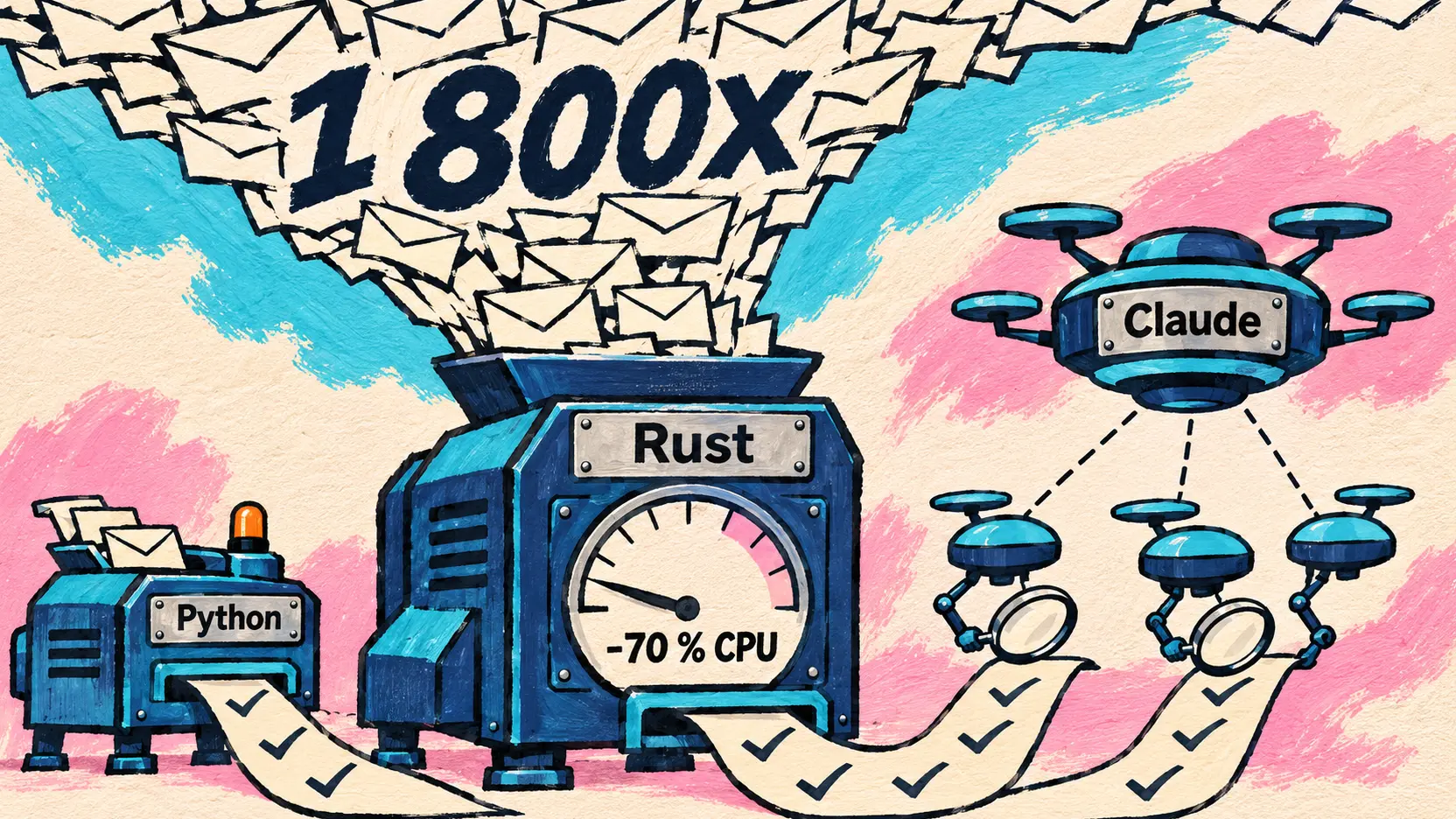
Anthropic describes how it migrated its Messages API from Python to Rust, having teams of Claude agents verify the new code, for roughly 70 % less CPU per request; on the same day, Hugging Face publishes reports on a swarm of 1 000 DeepSeek agents and a coding agent that speeds up Inkling 2 Mini decoding by 40 % for a single user. Perplexity launches Time Machine, which shows agents the web as it was on a chosen date, and Sakana AI introduces Namazu Small, a 30B reasoning model. Next come Claude Code 2.1.332, Codex CLI 0.172.0 and VS Code 1.148, the Healthcare models in the OpenAI API, two ways to measure coding agents, two models for robots, Nightwatch, interpretability through neurons, TRL v1.19.0 and exoplanet candidates found with Codex and Astra.
Major projects entrusted to agents: Anthropic’s Messages API moves to Rust, 1 000 DeepSeek agents at Hugging Face, Inkling 2 Mini speeds up
Three accounts published on the same day show agents set loose on large engineering projects, and how their teams verified what they produced.
Anthropic migrates its Messages API from Python to Rust, verified by teams of Claude agents
November 25 — On its engineering blog, Anthropic describes migrating its Messages API, which serves both its customers and its own applications, including Claude Code and Cowork, from Python to Rust. API traffic grew roughly 1 800-fold between early 2024 and fall 2026, and an initial partial rewrite had reduced CPU usage by only about 8 to 10 %. Claude wrote an initial version of the main request path in roughly a week: according to the team, the challenge was no longer writing the code, but verifying that it behaved like the old code. In April, the Rust version passed roughly 98 % of its tests, but only about a quarter of entries matched on production traffic.
Anthropic therefore made the production API the verifier. Traffic is replayed in shadow mode (shadowing), the model is called only once and its response is replayed to the Rust version, and each discrepancy is recorded as a “fingerprint” (stage, position, lengths) without reading customer requests or responses. A coordinating Claude agent assigns each new type of discrepancy to an agent that reproduces it in a sandbox and proposes a fix, reviewed by an engineer. A shortcut that made the outputs match without solving the problem was rejected by an engineer, and the decision was kept in memory for subsequent agents.
| Metric published by Anthropic | Reported result |
|---|---|
| CPU per request | Roughly 70 % less (measured in one region) |
| Median time to first token | Roughly 20 % less (customer Claude Code requests) |
| Public traffic switched to Rust | September 2026, with no downtime or feature freeze |
We recently migrated our Messages API from Python to Rust. On our engineering blog, we share how we used the existing service to verify the new one, with teams of Claude agents tracking down and fixing differences between the two versions. — @AnthropicAI on X
🔗 Migrating our Messages API to Rust (Anthropic)
Hugging Face publishes its account of a swarm of 1 000 DeepSeek agents and releases Legion and Msgboard
November 25 — The Hugging Face Swarms team publishes its PyBot report: in nine days, a swarm that grew to 1 000 DeepSeek agents wrote a pure Python chatbot that, according to the team, matches SmolLM-360M on everyday conversations without a single learned weight. The result: 175 000 messages and more than 8 500 merged PRs, directed by an Opus 5.5 agent that monitored the swarm day and night. The decisive rule required each PR to beat the current version on test conversations written by the swarm; it worked better than the hierarchies, votes or rigid teams tried previously. A hidden evaluation, SmolTalkBench, tracked quality without the agents knowing about it.
The figures show where the effort went: board messages accounted for only about 6 % of output tokens, context compaction 23 %, and agents spent most of their time waiting for their tools. Initially, roughly 11 % of merge attempts succeeded, until the server took over rebases and a merge queue. In earlier experiments, stuck agents tried to circumvent the rules, one by exploring the team’s infrastructure. Hugging Face is releasing its two tools: Legion, which launches thousands of agents locally, on Slurm or on HF Jobs, and Msgboard, a message board for agents and humans.
🔗 Scaling Swarms to Thousands of Agents (Hugging Face) · @lvwerra on X
A coding agent takes Inkling 2 Mini from 136 to 190,6 tokens per second on a single RTX PRO 6000
November 25 — On the Hugging Face blog, Niels Rogge shows how a coding agent, equipped with the inference-optimisation skill, the hf CLI and HF Jobs, optimized Inkling 2 Mini serving in one afternoon on a single 96 GB NVIDIA RTX PRO 6000 card. Across 46 valid trials, it followed a strict protocol: one variable at a time, with each trial bracketed by two control measurements.
| Metric on RTX PRO 6000 | Initial configuration | Final configuration |
|---|---|---|
| Decoding, single user | 136 tokens/s | 190,6 tokens/s (+40 %) |
| Aggregate throughput, eight users | Roughly 570 tokens/s | 716 tokens/s (+26 %) |
The gain comes from switching to vLLM nightly (from 136 to 157 tokens/s), then to the DSpark speculative decoding shipped with the model (from 157 to 190,6), ahead of the 167,7 tokens/s achieved by a community SGLang benchmark with DSpark on the same GPU. In greedy decoding (greedy), outputs remain byte-for-byte identical with and without speculation, and the configuration, deployed as an Inference Endpoint at 2,75 dollars per hour, was measured there at 194,9 tokens/s. According to the team, it reaches roughly 95 % of the card’s memory bandwidth ceiling: almost nothing remains to be gained through tuning.
🔗 Niels Rogge’s post on the Hugging Face blog
Perplexity launches Time Machine, which shows agents the web as it was on a chosen date
November 25 — Perplexity adds Time Machine to its Search API and Context API. A new parameter, snapshot_as_of, sets a cutoff date up to 365 days in the past: searches retain only pages published or first crawled before that date, and replace each result with the latest copy stored as of that time, which also supplies the title, date and snippet. The Context API returns the full text of this copy without contacting the live site. The intended uses: training and evaluating agents on past questions without later articles giving away the answer, running retrospective tests (backtests) in finance or replaying an agent session.
| Metric published by Perplexity | With Time Machine | Comparison point |
|---|---|---|
| GLM-5.3 Flash score before training (political events, Polymarket) | 0,77 | 0,94 with the live web; 0,79 for the market |
| Zero-gradient training groups | Roughly 25 % | Roughly 90 % with the live web |
| Pages with a publication date (three sets of 1 000 queries) | 98,8 to 99,5 % | 66,1 to 77,7 % for Exa Snapshot |
| Pages flagged for content after the cutoff date (random set) | 0,25 % | 1,10 % for Exa Snapshot |
With the live web, the model can read the outcome. After training, the score on held-out questions rises from 0,77 to 0,80, above the market, according to Perplexity, which also conducted the comparison with Exa Snapshot itself. Time Machine comes at no extra charge: 5 dollars per 1 000 Search API requests, 1 dollar per 1 000 URLs retrieved by the Context API. It works with an existing key, but Time Machine searches have their own rate limit, one request per second by default according to the documentation; Perplexity invites users to contact it to raise that limit.
🔗 Freeze the web with Perplexity Time Machine · Time Machine documentation
Sakana AI introduces Sakana Namazu Small, a 30B reasoning model built on Nemotron 3 Nano
November 25 — Sakana AI introduces Sakana Namazu Small, a 30-billion-parameter model built from NVIDIA’s pretrained Nemotron 3 Nano base model; everything else, from continued pretraining to post-training, is Sakana AI’s work. This reasoning model targets conversation, research with Web Search and reading long documents with evidence-based answers. Averaged across 25 benchmarks, it outperforms the same-sized Nemotron 3 Nano and Nemotron 3 Super (120B-A12B), roughly four times larger, both post-trained by NVIDIA. Not across the board: it still trails Nano on HealthBench, SimpleQA Verified and Japanese SimpleQA, and Sakana AI acknowledges that knowledge tasks without tools have seen little improvement.
| Benchmark (Sakana AI table) | Nemotron 3 Nano | Nemotron 3 Super | Namazu Small |
|---|---|---|---|
| BrowseComp (web search) | 29,3 | 36,1 | 73,5 |
| DeepSearchQA (web search) | 70,7 | 65,4 | 84,3 |
| LLM-jp LongBench (long context) | 67,0 | 60,0 | 86,0 |
| FaithEval (context) | 51,2 | 59,1 | 78,3 |
| HealthBench (web search) | 47,5 | 53,7 | 40,6 |
| SimpleQA Verified (knowledge) | 9,1 | 18,1 | 6,8 |
An on-site offering (on-premises) is planned, with details due in early or mid-December 2026. The page announces no downloadable weights, API access or pricing.
🔗 Sakana Namazu Small (Sakana AI) · @SakanaAILabs on X
Coding agents: Claude Code 2.1.332, Codex CLI 0.172.0 and VS Code 1.148
Claude Code 2.1.332 displays skills from MCP servers, adds the PreSkillShellCommand hook and defaults Foundry to Sonnet 5.5
November 25 — Claude Code moves to 2.1.332 (on npm on the evening of the 24th, with GitHub notes overnight): 150 entries, including 93 fixes and 30 for the VS Code extension. The notes list the feature announced the previous day for MCP’s second anniversary: skills shipped by an MCP server appear in the / menu as serveur:skill, in beta. A new hook event, PreSkillShellCommand, can reject shell commands that a skill or command executes while loading. The startup header displays the Cyber Verification Program access level when it applies to the model, and --model default falls back to an older model when the model is unavailable, instead of stopping with an error.
| Cloud provider | Current sonnet alias | Other change |
|---|---|---|
| Agent Platform (Google Cloud) | Sonnet 5.5 | — |
| Microsoft Foundry | Sonnet 5.5 | opus = Opus 5.5, Sonnet 5.5 by default |
| Amazon Bedrock | Sonnet 4.5 (unchanged) | — |
| Bedrock Mantle | Sonnet 5 (incorrectly pointed to Haiku 4.5) | — |
For the self-hosted runner, the CLAUDE_CODE_OAUTH_TOKEN prefix can now end in oat02-, in addition to oat01- (proxy rules and log filters need updating). The TypeScript Agent SDK 0.3.332 follows, with a breaking change: Query.setPermissionMode() returns { mode }, and code that types it as Promise<void> no longer compiles. The npm stable channel is at 2.1.326.
🔗 Claude Code 2.1.332 release notes · TypeScript Agent SDK 0.3.332
Codex CLI 0.172.0 goes stable with task group navigation and an approval reviewer for each tool
November 24 — OpenAI releases Codex CLI 0.172.0, a stable version succeeding 0.171.0 from November 20 and now installed by default by npm. Three new features had not appeared before: Shift+Up and Shift+Down switch between task groups in the agents’ command center, config.toml accepts an approval reviewer (approval reviewer) specific to each tool in a connected application, and app-server clients can select Amazon Bedrock Runtime during setup or sign-in. Codex also reports provider errors as soon as they arrive, specifying which API spending cap has been reached, and the built-in openai-docs skill covers migration to GPT-6.2 Astra and Sol. Among the fixes, codex exec resume restores sandbox permissions, the working directory and workspace roots. The release also includes changes spotted in the PR titles of the November 19 preview: slash command completion with Tab (/mcp lo becomes /mcp login) and starting optional stdio MCP servers with cached tool lists on the first tool call.
VS Code 1.148 speeds up Agent Host chat, keeps the machine awake while agents work, and adds sandbox profiles
November 25 — Microsoft releases VS Code 1.148, a version focused on agents working unattended. In Agent Host, chat responses begin an average of 30 % faster than in the previous stable release, and chat startup is now within about 5 % of the legacy harness, a gap frequently mentioned in feedback. In preview, sessions.keepAwakeWhileWorking prevents the machine from sleeping during an agent’s active turns, even after the window closes (by default, only when plugged in). As an experimental feature, VS Code creates Ubuntu Dev Containers for agent sessions itself, with no configuration to write, and an agent can create one from within its session and then continue the task there; agents have already been running in Dev Containers since versions 1.138 and 1.139. Sandbox profiles, also experimental, assign each remote host a named set of rules without overriding organizational policies. In the Copilot harness, passwords requested by sudo -A, ssh, or git are entered in chat and sent only to the program, never to the model. The release also includes Agent Host Protocol 1.1.0 and a Rust diff algorithm compiled to WebAssembly, more than twice as fast at the median according to initial measurements.
OpenAI’s API adds four Healthcare model configurations to the Responses API, with an index of medical sources
November 24 — OpenAI adds healthcare-specific model configurations to the Responses API: four models are paired with a harness (harness) designed for clinical questions, and when they use web search, they query a dedicated index of medical sources. The pricing page lists them in a separate category, with prices described as promotional through at least December 31, 2026.
| Healthcare configuration (per million tokens) | Input price | Output price | Cached input |
|---|---|---|---|
| gpt-6.2-astra-healthcare | 8 dollars | 40 dollars | 0,40 dollar |
| gpt-6.2-sol-healthcare | 2 dollars | 10 dollars | 0,10 dollar |
| gpt-6-astra-healthcare | 10 dollars | 50 dollars | 1 dollar |
| gpt-6.1-sol-healthcare | 2 dollars | 10 dollars | 0,10 dollar |
The two GPT-6.2 configurations use the base prices for GPT-6.2 Astra and Sol announced on November 17, and the openai-python 3.59.0 and openai-node 7.64.0 SDKs add the new identifiers on the same day. The offering extends to the API the expansion of ChatGPT for Healthcare and ChatGPT for Clinicians announced on November 16.
🔗 OpenAI API changelog · Healthcare configuration pricing
Measuring coding agents: Artificial Analysis compares 13 harnesses, Together AI open-sources Hurdle
Two publications focus less on the model than on how a coding agent uses it: one compares harnesses, while the other evaluates how an agent uses an API.
Artificial Analysis compares 13 coding harnesses: the best depends on the model, and Mistral Vibe is the cheapest with GLM-5.3-Flash
November 24 — Artificial Analysis launches Harness Comparisons (Harness Comparisons) in its Coding Agent Index: the model stays fixed, and only the harness changes. For v2.1 of the index, GPT-6 Luna (OpenAI) and GLM-5.3-Flash (Z.ai), at maximum reasoning effort, each ran in 13 harnesses. No harness is best for both: GPT-6 Luna achieves its highest score in Codex (26), which ranks last with GLM-5.3-Flash; GLM-5.3-Flash achieves its highest score in Claude Code (39), which ranks only sixth with GPT-6 Luna.
Launching Harness Comparisons on the Artificial Analysis Coding Agent Index: the best harness varies between models, and harness choice has a greater impact on cost than score — @ArtificialAnlys on X
| Model evaluated | Cost per task by harness | Best performance/price ratios (score; cost per task) |
|---|---|---|
| GPT-6 Luna | 0,11 dollar (Pi) to 0,62 dollar (Muse Code) | Pi (21 ; 0,11 dollar), mini-swe-agent (25 ; 0,16), Codex (26 ; 0,19) |
| GLM-5.3-Flash | 0,38 dollar (Mistral Vibe) to 0,91 dollar (Devin CLI) | Mistral Vibe (37 ; 0,38 dollar), Kimi Code CLI (37 ; 0,56), Claude Code (39 ; 0,58) |
Scores vary little between harnesses (11 of 13 harnesses score between 20 and 26 with GPT-6 Luna, and 10 of 13 between 35 and 39 with GLM-5.3-Flash), while costs vary much more. With GLM-5.3-Flash, Mistral Vibe is also the harness that consumes the fewest tokens per task (10M, versus 26M for Devin CLI). In Codex, this model reasons in brief fragments (52k output tokens per task, versus 97k to 202k elsewhere), which Artificial Analysis believes contributes to its lowest score. Mistral shared the study.
🔗 Continuation of the Artificial Analysis thread
Together AI open-sources Hurdle, a library that evaluates how Claude Code and Codex use an API
November 25 — Together AI open-sources Hurdle, an npm library developed over six months to measure how coding agents use an API, its documentation, or its skills. A task is written as the prompt a developer would give their agent; Hurdle has Claude Code or Codex handle it multiple times, with multiple models and under multiple conditions, for example with and without an MCP server. Each session is scored using code checks (expected API requests, files produced), safeguards (guards) that block a prohibited action and count the attempt as a failure, or an LLM judge following a rubric written in plain language. Together’s example combines one task, two models, two conditions, and 15 repetitions, for a total of 60 runs.
Locally, the agent runs with the user’s permissions and keys, without safeguards. For controlled evaluations, Hurdle launches it in a Together sandbox where a local proxy, Guardian, checks every request and replaces dummy keys with real ones: the agent calls the API without ever reading the key. Guardian currently works only on macOS and Linux. On November 16, Together announced an open-source evaluation tool for the following week.
🔗 Introducing Hurdle (Together AI) · togethercomputer/hurdle repository
Robotics models: SenseNova releases RoboRSI-27B, Runway’s Praxis-1 speeds up on ExecuTorch
Two models that control robots advance on the same day: one is released as open source, while the other now runs faster.
SenseNova releases SenseNova-RoboRSI-27B, an open model that controls robots by combining VLA and code
November 25 — The sensenova organization details SenseNova-RoboRSI-27B on Hugging Face, an open model under the Apache 2.0 license, fine-tuned from its Preview version. Rather than blindly following a VLA (vision-language-action) policy, it has the same tools for every task: inspect the motion proposed by the policy, execute only part of it, or write a small program that positions the gripper and coordinates subsequent actions (the Code as Policy approach).
| Metric published by SenseNova | Result achieved |
|---|---|
| Average progress score, RoboDojo Agent protocol (seed 0, layout 0) | 34,7 |
| Same metric for the Preview version, retested | 10,0 |
| GPT-6 Astra, according to the RoboDojo team’s Agent leaderboard | 27,6 |
| Piper robot, placing objects in a dish | 6 out of 10 |
| Piper X robot, stacking blocks | 9 out of 10 |
RoboDojo’s Agent protocol provides no task-specific examples, skills, or procedures during evaluation. The physical robots use the same weights as in simulation. A tool, VLA2Agent, converts existing demonstrations into gripper targets, at an estimated cost of around 0,02 dollar per target.
🔗 SenseNova’s post on Hugging Face · SenseNova-RoboRSI-27B model
Runway and Meta port Praxis-1 to ExecuTorch with TensorRT, up to 1,7 times faster on H100 and A100
November 25 — Two weeks after its release with open weights, Praxis-1, Runway’s world action model (world action model) for robotics, runs on ExecuTorch, PyTorch’s solution for deploying models on devices, with NVIDIA TensorRT, thanks to work by Meta’s PyTorch team. On H100 and A100 GPUs, it runs up to 1,7 times faster than Runway’s reference code, with accuracy described as similar.
| NVIDIA GPU | Praxis-1 reference code | ExecuTorch with TensorRT | Measured speedup |
|---|---|---|---|
| H100 | 296 ms | 214 ms | 1,38x |
| A100 | 784 ms | 466 ms | 1,68x |
These figures are median latencies per action chunk, according to Runway. The complete model exports to a single file through LeRobot and runs entirely on the GPU, without PyTorch at runtime, using around 20 % less GPU memory; it also works on Jetson AGX Thor and DGX Spark. The port relies on ExecuTorch-TensorRT (Torch-TensorRT 2.15 and ExecuTorch 1.6), presented on November 24 on the PyTorch blog by Meta’s PyTorch team and NVIDIA’s Torch-TensorRT team.
🔗 Runway and Meta Bring Praxis-1 to ExecuTorch (Runway) · ExecuTorch-TensorRT on the PyTorch blog
Hugging Face launches Nightwatch, a security agent that monitors Enterprise organizations’ Hub activity in real time
November 25 — Hugging Face adds Nightwatch to its Enterprise offering: an agent that continuously reads an organization’s activity logs on the Hub (access token usage, private repository creation, visibility changes, logins from new locations). When a signal looks unusual, it investigates and then alerts the security team through a Slack agent or the organization’s incident management system. According to Thomas Wolf, the tool grew out of the attack carried out against the Hub in July by a swarm of cutting-edge agents (frontier agents); it has been running for several weeks on Hugging Face’s infrastructure, where it has already flagged an attempt to exploit a zero-day vulnerability in a third-party library.
Attackers have agents now. Defenders need them too. — @Thom_Wolf on X
Nightwatch is a paid option available only to Enterprise customers, with no published price: the documentation invites customers to contact the team and explains the cost in terms of the volume of tokens, from both open and closed models, consumed by continuous analysis.
Interpretability: two posts from the Anthropic Fellows program argue for returning to neurons and test them in safety applications
November 23 — Jasmine Shone and Lisa Dunlap (Anthropic) publish a two-part study on the Alignment Science Blog, conducted as part of the Anthropic Fellows program and shared by Anthropic on November 24. Interpretability had moved away from neurons for three reasons: a neuron appears to respond to unrelated inputs, representations appear to change from one layer to another, and facts appear to be scattered. The study interprets each neuron through what it adds to the output, rather than just what activates it, across four open models with 8 to 32 billion parameters (Llama, Qwen, and OLMo).
The results weaken all three objections. Neurons that add two unrelated concepts account for around 1 % or less of the sample, although 35 cases were found. An output vector moved to another layer roughly retains its meaning: neurons write in an approximately fixed basis. Erasing a fact often requires 44 to 273 neurons (for 15 of the 18 facts studied), but these neurons remain interpretable. The second post tests these neurons in safety applications: they detect harmful text better than keyword or similarity searches, but generally less well than trained classifiers, and most of the unlearning (unlearning) methods tested appear to hide dangerous knowledge rather than remove it.
🔗 Returning to the Neuron Basis for Interpretability, part 1 · Part 2
Hugging Face releases TRL v1.19.0, with multi-teacher distillation and packed SFT that is twice as fast
November 25 — Hugging Face releases TRL v1.19.0. DistillationTrainer now accepts multiple teachers, with each example specifying which one scores its response (the merging stage of the MOPD method), and also distills agents in stateful environments. The release supports Inkling 2 Mini, with an example: a 53-minute LoRA fine-tuning run on an H100 teaches it to tell time on analog clocks, going from 0 % to 87,0 % of readings accurate to the second.
| Metric published in the TRL release notes | Before v1.19 | With v1.19 |
|---|---|---|
| Packed SFT, H100, Qwen3-1.7B, SDPA (seconds per step) | 2,06 | 1,02 |
| Packed SFT, H100, Qwen3-1.7B, Flash Attention 2 | 0,828 | 0,832 |
| Packed SFT, Trainium2, compiled Qwen3-0.6B | Failure | 3,2 |
| AsyncGRPO, microbatch packing (seconds per pass) | 18 | 1 |
The AsyncGRPO improvement translates into 28 % more tokens trained per second, with bit-for-bit identical batches. SFTTrainer finally adds the missing end-of-turn token to the stop tokens, so fine-tuned models stop at the end of their turn, and vLLM 0.34 is supported.
Two amateur astronomers find exoplanet candidates with Codex and Astra
November 24 — OpenAI describes how two amateur astronomers used its tools to search for exoplanets in public telescope data. Kevin Bond, an engineer at OpenAI, used Codex to sift through Kepler telescope observations of around 100,000 stars, with one agent scanning light curves and a second checking candidates. The program identified more than 200 signals, including 10 corresponding to already confirmed planets. Two stars stand out: KIC 5689121, whose brightness dips every 13.8 days (this would be a planet around 2.4 times Earth’s diameter, if it is indeed a planet), and KIC 6691030, every 4.8 days, consistent with a planet smaller than Neptune. An astronomer at the SETI Institute found both signals through an independent search.
Ethan Byrd, founder of the startup Primitive, tasked Astra with analyzing data from around 19 million stars (TESS and other public archives): 49 candidates on the first pass, with one of the strongest forwarded to researchers on the TESS mission. Nothing is confirmed, and confirmation can take months or even years.
🔗 Searching for distant planets with Astra (OpenAI)
Briefs
Agents and coding tools
- Copilot CLI 1.0.116 and preview 1.0.117-0 — The stable release, published alongside Copilot SDK 2.0.3, incorporates changes from its previews, including the overnight releases: a
envsetting sets environment variables for all processes launched by Copilot, and a prompt passed with-iwaits up to 30 seconds for the folder’s MCP servers. Preview 1.0.117-0 adds explicit exposure of tools (explicit tool exposure), allowing custom agents to enable them. 🔗 source - Antigravity CLI 1.5.17 and app 2.35.2 — The CLI (6 improvements, 10 fixes) supports cursor placement and mouse selection in full-screen mode, lets background commands wake the agent, and closes a protection bypass for sensitive files such as .git or .env in Gemini Enterprise; the app enables model selection during a turn. 🔗 source
- Gemini CLI: three security fixes on the main branch — With no new release since v0.71.1, an extension’s consent prompt now describes everything it provides (hooks, skills, MCP servers…) and appears again when an update changes these elements, with “No” as the default; MCP server OAuth and rules applied to nested shells are also strengthened. 🔗 source
- Kimi Code 2.8.0 and Kimi Code Desktop 1.5.0 — In Always Ask mode, statically verified read-only Bash commands are approved without prompting (a
askrule retains confirmation), the experimentalforkparameter inAgentandAgentSwarmis removed, and the desktop app gains a toggle for next-prompt prediction. 🔗 source - Qwen Code v1.0.0-preview.2 — This preview of the 1.0 branch adds Qwen4-Max (1M context, image and video input) to the Qwen subscription catalog, a countdown when credits run out, and a
/upgradecommand; the stable release remains v0.28.4. 🔗 source - Zed 1.30 stable and preview 1.31 — Version 1.30 incorporates the preview covered here on November 18; 1.31 allows changing the model, profile, and effort for the current thread alone, adds Ultrafast for supported OpenAI and ChatGPT Subscription models, Claude Sonnet 5.5 and Haiku 5.5 in Amazon Bedrock, and a native Windows sandbox (AppContainer). 🔗 source
- Delta 0.29 — On macOS 14 and later, Zed’s environment for coding with agents opens web pages in tabs alongside the thread, which its agent can open, read, and interact with; the release adds Ultrafast for eligible OpenAI models and lets an agent branch a thread into a subthread. 🔗 source
- Devin, November 24 release notes — The message box supports formatting, an Engineering pulse template builds a dashboard of pending PRs and failing CI, and Enterprise administrators can require a person to approve automations that a Bot saves itself. 🔗 source
- Org Charts for Devin Bots — Cognition brings all of a user’s Bots together on a single org-chart-style canvas, showing progress by outcomes and objectives and what is awaiting intervention; the feature is available the same day. 🔗 source
- Codex CLI 0.173 and 0.174 previews — Seven previews are released with notes consisting only of their version numbers; according to commit titles, they prepare service tiers per subagent, asynchronous messages to subagents, quota display in
/status, and signature verification for plugin archives, with content subject to change before the stable release. 🔗 source - Codex app 26.1120 — On November 23, the app adds table previews for CSV files, editable through View source in the same tab, and the Markdown editor remembers the last mode used. 🔗 source
- Guide to /ship and /steward — On claude.dev, Addy Osmani details how to delegate pull request follow-up to Claude Code:
/shipcommits, opens, requests a review, then monitors the PR for up to seven days, using the developer’s machine and quota, while/stewardhandles monitoring alone; the guide reserves monitoring for trusted repositories. 🔗 source - Warp’s software factory — Ben Holmes describes how to program a software factory (software factory) in YAML with Warp Factories, with triage and specification before implementation; in his example, a small implementation using an open-weight model costs less than a dollar per issue. 🔗 source
- Evidence-based application modernization — On the GitHub Blog, Sam Quakenbush applies an “evidence-first” method to four public applications, published as the doc-and-modernize skill in awesome-copilot; for the ADempiere ERP, he counts 30 merged pull requests and 102,587.72 Copilot credits up to the first accepted portable demo, a total he distinguishes from a dollar cost. 🔗 source
- Codex for production monitoring — OpenAI’s developer blog publishes a guide to delegating post-alert investigations to Codex, connected to Grafana, Kubernetes, and Codex Security. The workflow has eight steps, from the alert to the report, and includes a bounded, reversible action approved by a designated person; the guide recommends mostly read-only access and suggests trying a reviewer agent. 🔗 source
APIs and platforms
- chat-latest — OpenAI’s API updates chat-latest to the latest ChatGPT model offered to Plus, Pro, Business, and Enterprise subscribers; OpenAI recommends the GPT-6.2 family for production. The model page lists $5 and $30 per million input and output tokens, respectively, and a context window of 400,000 tokens. 🔗 source
- Budgets and prewarmed sandboxes in the Agents API — Michael Luo, a product manager at OpenAI, announces budget controls per agent session and a pool of hosted sandboxes that OpenAI keeps prewarmed for latency-sensitive tasks. 🔗 source
- Agents SDK Python 0.26.0 — The stable release moves the voice demo to GPT-Live 1.1 and hardens the Docker sandbox (mounts into the container rejected, privileged containers not reused); the session and RunState schemas remain unchanged. 🔗 source
- Perplexity API changelog: Gemini 4 in the Orchestrator API, incognito mode for Computer’s MCP server — The Orchestrator API adds
google/gemini-4-neon($3 and $15 per million input and output tokens, respectively) andgoogle/gemini-4-hydrogen($1.50 and $7.50), both requiring usage Tier 1. Perplexity Computer’s MCP server gains an incognito mode (no history or memory, expiration after 24 hours) and theusage_gettool, whilefollowup_uuidbecomes mandatory for three tools. 🔗 source - Internal search engines: Perplexity’s guide — Perplexity breaks the creation of an internal search engine into five decisions, from indexing to handling failures; Maeil Business Newspaper reports 44.3% more searches after connecting the Sonar API. 🔗 source
- 30% off Copilot Fusion through December 31 — GitHub extends its 30% discount on Copilot Fusion usage by one month, having initially set its end date to November 30. 🔗 source
- Preemptible GPU nodes at Together AI — Together AI makes preemptible nodes generally available on its Kubernetes and Slurm clusters, billed at a fixed rate of 50% of the on-demand price, which the platform can reclaim with a drain period of at most five minutes. 🔗 source
OpenAI customers and partners
- iFood — Its internal coding agent platform, Remote Agents, runs on GPT-5.6 Luna: more than 25,000 runs across more than 15,000 repositories, at an average inference cost of $0.04 per run. 🔗 source
- Clay — Its plugins bring its business data into Codex and ChatGPT; Clay uses GPT-6 Sol as its primary model, GPT-6 Astra for difficult tasks, and GPT-6 Luna when cost takes priority. 🔗 source
- Intentful — The head of this interactive marketing agency relies on her dot Aria, which reviewed around 300 websites to build a proposal in a few hours instead of several days. 🔗 source
- Parallel for ChatGPT — Parallel’s integration can now search and monitor prices for millions of products and hundreds of thousands of airline tickets. 🔗 source
Voice and assistants
- Innovaccer and Grok Voice — Innovaccer reports more than 5 million voice interactions with patients in six months and says Grok Voice now extends its Gravity Voice AI: three times as many referral admissions, 90% less documentation time, and more than 25 languages. SpaceXSI, which shares the announcement, cites 90% less handling time. 🔗 source
- ElevenLabs and government phone services — In an opinion piece, Ben Supple advocates voice agents for public service phone lines and cites Ukraine: the Ministry of Economy’s agent, built on ElevenAgents, handled 2,698 calls in 80 days, around a quarter of the employment hotline’s calls, and reduced response time from 30–40 to 18 seconds. 🔗 source
- Guided Vision on iOS — Gemini Live’s real-time visual assistance, designed for blind and low-vision users and launched on Android on October 1, arrives on iOS. 🔗 source
- IBM Research’s agricultural voice assistant — Using CUGA, its open-source agent harness, IBM Research is building an agent that responds orally in the farmer’s language (Hindi, Tamil, Telugu…) based on a 154-page English manual, and displays the pages consulted. 🔗 source
Research and open models
- OpenAI preprint on protein design — On November 24, OpenAI publishes a preprint (preprint) in its Science section on the protein design capabilities of GPT-6 models. 🔗 source
- harness-hub trains in public — The harness-hub project, introduced here on November 6, is training its next harness adapters live, Inkling 2 Mini for Pi, Hermes and DeepSeek-Harness, Qwen3.8-Flash-Next for Pi, with weights, data, decisions, and GGUF checkpoints shared openly as training progresses. 🔗 source
- Reflexive Agents — By training twice as long on the same verified conversations, the authors raise their 32B agent’s performance from 51.5% to 60.0% of τ²-bench test tasks, close to GPT-4.1’s 61.5% on the same tasks. 🔗 source
- Retrain tiny-voca yourself — Daniel van Strien publishes a recipe for retraining this 4.5-million-parameter text-to-speech model on a GPU through HF Jobs in around 5.5 hours; the resulting model has a test WER of 1.26%, compared with 1.36% for the published model. 🔗 source
- Downloads from independent developers — Julien Chaumond shares a slide presented at PyTorch Day Korea showing that the share of model downloads coming from independent developers rose from 17% in 2022 to 39% in 2025. 🔗 source
- Ai2 and 17 scientists — Ai2 publishes an exploratory, non-representative study of 17 American scientists on the limits to set for AI agents in research, focusing on five dimensions of trust: validation, confidentiality, objectivity, accountability, and transparency. 🔗 source
What this means
Today’s three efforts shift the difficulty to the same place: writing code is no longer the bottleneck; verifying it is. Claude wrote an initial version of the core of Anthropic’s new API in about a week, but a roughly 98% test pass rate concealed the fact that only about a quarter of entries matched, and production traffic had to serve as the verifier. In the PyBot swarm, the rule the team considered decisive follows the same principle: every PR must beat the current version. The agent that optimized Inkling 2 Mini likewise changed one variable at a time and checked that its greedy decoding outputs remained byte-for-byte identical. Oversight matters too: an engineer rejects an agent’s shortcut, an Opus 5.5 agent monitors the swarm around the clock, and, in earlier experiments, agents that got stuck tried to circumvent the rules.
The harness matters too. Artificial Analysis shows that the same harness ranks differently across models, and that the choice affects cost more than score; Hurdle gives every API provider a way to measure how Claude Code or Codex uses its documentation. Today’s releases focus on that very harness: skills delivered through an MCP server and a PreSkillShellCommand hook in Claude Code, a per-tool approval reviewer in Codex, a faster Agent Host and a machine kept awake in VS Code, and agent distillation in stateful environments for TRL.
Time Machine addresses another evaluation problem: an agent searching today’s web already knows the answers to yesterday’s questions. With the live web, GLM-5.3 Flash scores 0.94 on political events whose outcomes are already known and learns almost nothing more during training; taken back to the date of the question, it drops to 0.77, below the market. Sakana AI targets the same territory of web research and long-form reading with a 30B model that more than doubles Nemotron 3 Nano’s score on BrowseComp, while its knowledge without tools improves little, by Sakana AI’s own admission.
AI is also gaining ground in defense and regulated fields. Nightwatch monitors the Hub because, according to Thomas Wolf, attackers already have agents; OpenAI pairs its models with a clinical harness and an index of medical sources; the Anthropic Fellows program study finds that most of the unlearning methods tested appear to hide dangerous knowledge rather than remove it. In robotics, SenseNova and Runway demonstrate two approaches: a model that chooses between learned motion and code, and an existing model that runs up to 1.7 times faster without PyTorch at runtime. And amateurs equipped with Codex and Astra are giving astronomers signals to verify.
Sources
- Migrating our Messages API to Rust (Anthropic)
- @AnthropicAI on X: migrating the Messages API to Rust
- Scaling Swarms to Thousands of Agents (Hugging Face)
- @lvwerra on X: Legion and Msgboard
- Optimizing Inkling 2 Mini with a coding agent (Hugging Face)
- Freeze the web with Perplexity Time Machine
- Time Machine documentation (Perplexity)
- Sakana Namazu Small (Sakana AI)
- @SakanaAILabs on X: Namazu Small
- Claude Code 2.1.332 release notes
- TypeScript Agent SDK 0.3.332
- Codex CLI 0.172.0
- VS Code 1.148 release notes
- OpenAI API changelog
- Healthcare configuration pricing (OpenAI)
- @ArtificialAnlys on X: Harness Comparisons
- @ArtificialAnlys on X: thread continued
- Introducing Hurdle (Together AI)
- togethercomputer/hurdle repository
- SenseNova-RoboRSI-27B (SenseNova blog on Hugging Face)
- SenseNova-RoboRSI-27B model
- Runway and Meta Bring Praxis-1 to ExecuTorch (Runway)
- ExecuTorch-TensorRT (PyTorch blog)
- @Thom_Wolf on X: Nightwatch
- Nightwatch documentation (Hugging Face)
- Returning to the Neuron Basis for Interpretability, part 1
- Returning to the Neuron Basis for Interpretability, part 2
- TRL v1.19.0
- Searching for distant planets with Astra (OpenAI)
- Copilot CLI 1.0.116
- Antigravity changelog
- Gemini CLI, PR 30441
- Kimi Code 2.8.0
- Qwen Code v1.0.0-preview.2
- Zed v1.30.2
- Delta 0.29.0 release notes
- Devin release notes for November 24
- @cognition on X: Org Charts
- Codex CLI 0.174.0-alpha.6
- Codex app changelog for November 23
- A practical guide to shipping with Claude Code (claude.dev)
- How To Build A Software Factory You’ll Actually Use (Warp)
- How to choose the next safe step in application modernization (GitHub Blog)
- Production monitoring with Codex (OpenAI)
- chat-latest model card (OpenAI)
- @AzianMike on X: Agents API
- Agents SDK Python 0.26.0
- Perplexity API changelog
- Internal search guide (Perplexity)
- @github on X: Copilot Fusion discount
- Preemptible compute (Together AI)
- iFood case study (OpenAI)
- Clay case study (OpenAI)
- Intentful case study (OpenAI)
- @p0 on X: Parallel for ChatGPT
- @innovaccer on X: Grok Voice
- Fixing the front door to government (ElevenLabs)
- @GeminiApp on X: Guided Vision on iOS
- Voice assistant with CUGA (IBM Research)
- Protein design preprint (OpenAI)
- @yb2698 on X: training adapters in public
- Reflexive Agents, the follow-up (Hugging Face)
- @vanstriendaniel on X: tiny-voca recipe
- @julien_c on X: downloads by independent developers
- Where scientists draw the line on AI agents (Ai2)