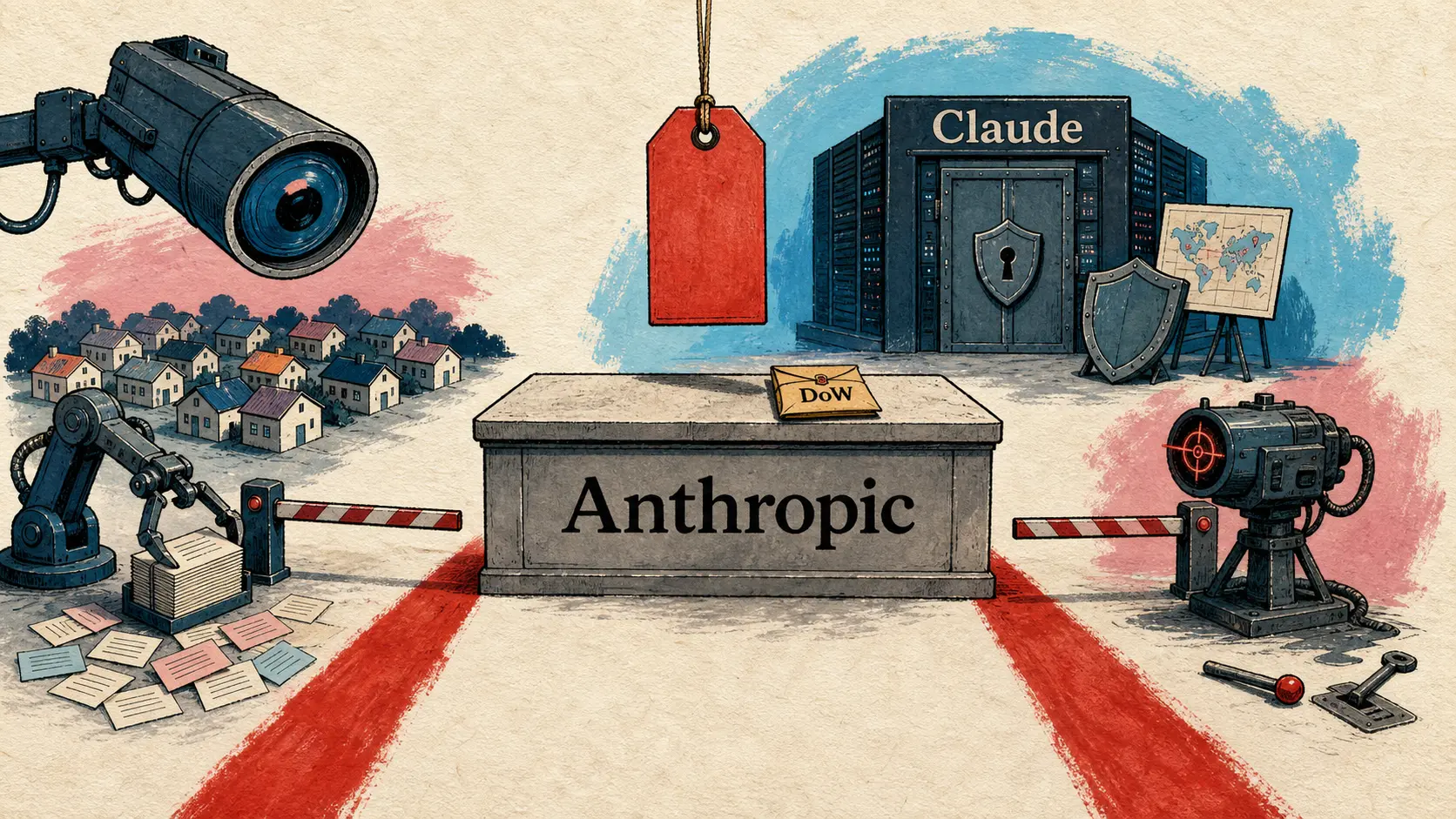
26 February 2026 marks a packed day: Dario Amodei publicly lays out the two red lines Anthropic refuses to cross with the U.S. Department of War, Perplexity secures OS-level access on 800 million Samsung devices, GitHub expands Claude and Codex to Copilot Business and Pro, and Eli Lilly inaugurates LillyPod, the most powerful pharmaceutical AI factory ever built.
Anthropic vs. the Department of War
26 February — Dario Amodei, CEO of Anthropic, publishes a public statement about ongoing discussions with the U.S. Department of War (DoW). The text sets out two red lines Anthropic refuses to cross, even under government pressure.
Anthropic is the first frontier-model provider to have deployed its models in classified U.S. government networks, national laboratories, and for national security customers. Claude is used for intelligence analysis, modeling, operational planning, and cyber operations.
The two refused use cases:
| Use case | Anthropic’s position |
|---|---|
| Mass domestic surveillance | Incompatible with democratic values. AI can assemble disparate data into a complete portrait of any person, at scale. |
| Fully autonomous weapons | Current models are not sufficiently reliable. No human oversight = unacceptable risks to soldiers and civilians. |
The DoW reportedly demanded that Anthropic accept “any lawful use” and remove these safeguards. If Anthropic refused, the DoW allegedly threatened to label Anthropic a “supply chain risk” — a designation never applied to an American company, usually reserved for adversaries. Amodei notes the irony: one threat brands them a security risk, the other treats them as essential to national security.
Anthropic says it remains available for a smooth transition if the DoW chooses another supplier.
🔗 Statement from Dario Amodei on our discussions with the Department of War
Perplexity integrated into the Samsung Galaxy S26
26 February — Perplexity announces its integration into the Samsung Galaxy S26 as a system AI, with the wake word “Hey Plex”. It is the first time Samsung has granted OS-level access to a third-party company that is not Google or Samsung.
What the integration enables:
| Feature | Detail |
|---|---|
| Wake word | ”Hey Plex” + side button (long press) |
| Native access | Notes, Calendar, Gallery, Clock, Reminders |
| Bixby | Uses Perplexity APIs for real-time search and reasoning |
| Samsung Internet | Integration of Perplexity APIs with browser agent capabilities |
| Search engine | Available as a default option in Samsung Browser |
Samsung built the S26 around a multi-agent model. Its internal data shows 8 out of 10 users already use more than two AI agents per day. Perplexity is preinstalled on all S26 devices, with no download or setup required. With 800 million active Samsung devices in 2026, the deal represents massive hardware access for Perplexity.
🔗 Perplexity Blog — Samsung Partnership
Claude and Codex GA for Copilot Business and Pro
26 February — GitHub expands access to the Claude (Anthropic) and OpenAI Codex agents to Copilot Business and Copilot Pro subscriptions. Previously reserved for Copilot Enterprise and Pro+, this access is now extended to a much larger user base.
The three agents (Claude, Codex, Copilot) run on a unified platform with centralized governance, shared context, and common memory. They are accessible from github.com, GitHub Mobile and VS Code, with no extra subscription required.
| Feature | Detail |
|---|---|
| Available agents | Claude (Anthropic), OpenAI Codex, GitHub Copilot |
| Surfaces | github.com, GitHub Mobile, VS Code |
| Governance | Agent Control Plane (GA) — audit logs, centralized policies |
| Subscription required | No additional subscription (included in Business/Pro) |
| Sessions | Asynchronous with detailed logs |
Activation for Copilot Business: an admin must enable the agents at the enterprise level (Enterprise AI Controls → Agents → Partner Agents) AND at the organization level (Settings → Copilot → Coding agent → Partner Agents).
Each agent session consumes a “premium request” during the public preview period. Sessions are started from a repository’s Agents tab by assigning an issue to @claude or @codex, or by mentioning them in PR comments.
🔗 Claude and Codex now available for Copilot Business & Pro users
NVIDIA + Eli Lilly — LillyPod DGX SuperPOD
26 February — Eli Lilly unveils LillyPod, the first NVIDIA DGX SuperPOD built with DGX B300 systems, constructed in four months. It is the most powerful AI factory fully owned and operated by a pharmaceutical company.
| Metric | Value |
|---|---|
| GPUs | 1,016 NVIDIA Blackwell Ultra (DGX B300) |
| Performance | >9,000 AI petaflops |
| Build time | 4 months |
| Network connections | ~5,000 |
LillyPod supports training protein diffusion models, graph neural networks for small molecules, and foundation models in genomics. The architecture is based on an NVIDIA DGX SuperPOD with Spectrum-X Ethernet networking and NVIDIA Mission Control for orchestration.
Codex CLI v0.106.0
26 February — OpenAI releases Codex CLI v0.106.0, a stable release with several notable additions.
| Feature | Detail |
|---|---|
| Direct install script | New script for macOS and Linux, distributed as a GitHub Release asset |
| App-server v2 Realtime API | Thread-scoped realtime endpoints and thread/unsubscribe flow |
| js_repl promoted to /experimental | Node compatibility checks (minimum 22.22.0) at startup |
| request_user_input in Default mode | No longer available only in Plan mode |
| gpt-5.3-codex visible in CLI | Model now shown in the list for API users |
| Diff-based memory | Forgetting based on diffs and selection by usage |
Bug fixes include a security fix on the zsh-fork execution path that could bypass sandbox wrappers, and a 1 million character cap on TUI/app-server inputs to avoid crashes on massive pastes.
Claude Code v2.1.59 + v2.1.61
26 February — Claude Code publishes versions v2.1.59 and v2.1.61 with notable features.
v2.1.59 — New features:
| Feature | Description |
|---|---|
| Auto-memory | Claude automatically saves useful context to persistent memory. Manageable via /memory |
Command /copy | Interactive picker when code blocks are present — allows selecting individual blocks or the full response |
| ”always allow” suggestions | Better suggestions for composite bash commands (e.g. cd /tmp && git fetch && git push) |
| Short task ordering | Improved scheduling in multi-agent sessions |
| Fix MCP OAuth | Race condition fix when running multiple Claude Code instances simultaneously |
v2.1.61: fix for concurrent writes corrupting the config file on Windows.
Anthropic news: Open Source and Connectors
26 February — Anthropic announces two complementary openings:
Claude for Open Source — Maintainers and top contributors of popular open source projects receive 6 months of free access to the Claude Max 20x plan. Boris Cherny (@bcherny), head of Claude Code, emphasizes that “much of what makes Claude Code great comes from OSS developer feedback.”
Connectors on the free plan — Claude Connectors are now available to users on the free plan. The catalog has more than 150 connectors across coding, data, design, finance, sales, and other categories.
🔗 Tweet Lydia Hallie — Claude for Open Source 🔗 claude.com/connectors
GitHub Enterprise: AI governance GA
26 February — GitHub announces the general availability (GA) of Enterprise AI Controls and the Agent Control Plane, the AI governance suite for GitHub Enterprise administrators.
GA features include: search and filtering of agent session activity (including third-party agents), removal of the 1,000-record limit for sessions in the last 24 hours, API to apply custom agent definitions at enterprise scale.
Still in public preview: enterprise-wide MCP allowlist management.
🔗 Enterprise AI Controls & agent control plane now generally available
GitHub Mobile: model selector for Copilot
26 February — GitHub Mobile ships a model selector for Copilot agent sessions. Users can now choose between Auto, Claude (Anthropic), OpenAI Codex and other models when starting a session.
Codex + Figma: code→design→code workflow
26 February — OpenAI Developers announces an integration between Codex and Figma enabling a bidirectional code→design→code workflow. The feature can generate design files directly from code, collaborate in Figma, then apply updates back into Codex without interrupting the workflow.
pplx-embed: Perplexity SOTA embeddings
26 February — Perplexity launches two families of text embedding models: pplx-embed-v1 and pplx-embed-context-v1, available in 0.6B and 4B parameter sizes. The models are accessible via the Perplexity API and on Hugging Face under an MIT license.
| Benchmark | Score | Reference |
|---|---|---|
| ConTEB (contextual retrieval) | 81.96% | New SOTA (vs voyage-context-3 79.45%) |
| MTEB Multilingual v2 (4B INT8) | 69.66% nDCG@10 | vs Gemini-embedding-001 67.71% |
| PPLXQuery2Query Recall@10 | 73.5% | vs Qwen3-Embedding-4B 67.9% (+5.6 pts) |
The models support INT8 quantization (4x less storage than FP32) and BINARY (32x less). No instruction prefix required.
Gemini CLI v0.30.0 and Qwen 3.5 FP8
25 February — Gemini CLI releases v0.30.0 with three axes of changes: introduction of an initial SDK (@google/gemini-cli-sdk), a new Policy Engine replacing --allowed-tools with a granular policy system, and UI improvements (Solarized themes, improved Vim support, Ctrl-Z suspension).
25 February — Alibaba releases FP8-quantized weights for the Qwen 3.5 series Medium (35B-A3B, 122B-A10B, 27B), available on Hugging Face and ModelScope with native vLLM and SGLang support from day one. FP8 quantization significantly reduces memory footprint while preserving performance.
In brief
-
Responses API field
phase(24 Feb) — OpenAI adds thephasefield to the Responses API, allowing assistant messages to be labeled ascommentaryorfinal_answerto distinguish intermediate reasoning steps from the final answer. 🔗 Changelog OpenAI API -
GPT-5.3-Codex GA in Copilot Chat (25 Feb) — Available on github.com, GitHub Mobile, VS Code and Visual Studio for all paid Copilot subscriptions. Business/Enterprise admins must enable the policy in settings. 🔗 Changelog GitHub
-
NVIDIA AI Cybersecurity OT/ICS (23 Feb) — Partnerships with Akamai, Forescout, Palo Alto Networks, Siemens and Xage Security to deploy AI in operational technology and industrial control systems cybersecurity. 🔗 NVIDIA Blog
What it means
Dario Amodei’s statement about the Department of War is unprecedented in the AI industry. It’s the first time a frontier lab CEO has publicly documented government pressure to remove ethical safeguards and has explicitly refused. The DoW’s potential application of the “supply chain risk” label—usually reserved for Chinese companies—to an American company would be an unprecedented escalation.
On the commercial front, 26 February illustrates consolidation around a few dominant platforms. GitHub unifies Claude, Codex and Copilot on a single surface with centralized governance — the “agent marketplace” model is taking concrete shape. Perplexity’s integration into Samsung follows the same logic: fewer new devices to conquer, more deep integrations into existing platforms.
LillyPod at Eli Lilly signals that pharma AI is moving to industrial scale: building its own AI factory in 4 months with 1,016 Blackwell Ultra GPUs shows that large companies no longer always rely on the cloud for their most sensitive workloads.
Sources - Statement Dario Amodei — Department of War
- Tweet @lydiahallie — Claude for Open Source
- Tweet @claudeai — Connectors free plan
- CHANGELOG Claude Code
- Claude and Codex GA — Copilot Business & Pro
- Enterprise AI Controls GA
- GitHub Mobile Model Picker
- Perplexity + Samsung Galaxy S26
- pplx-embed research article
- Codex CLI v0.106.0 Release
- Codex + Figma Tweet @OpenAIDevs
- NVIDIA LillyPod Blog
- NVIDIA AI Cybersecurity OT
- Gemini CLI Changelog
- Qwen3.5 FP8 Tweet @Alibaba_Qwen
- OpenAI Responses API Changelog
- GPT-5.3-Codex GA GitHub
This document was translated from the fr version into the en language using the gpt-5-mini model. For more information on the translation process, see https://gitlab.com/jls42/ai-powered-markdown-translator