ai-powered-markdown-translatorArticle translated from fr to en with gpt-5.4-mini.
Forty-seven announcements made the cut across nine areas for August 27. Three stand out. Anthropic opens the first phase of a research preview of the Model Hardware Standard, a specification that lets agents control laboratory instruments and cuts their integration from several weeks to a few hours. OpenAI publishes an op-ed calling for collective cyber defense, alongside organizations including Anthropic, AWS, Google, Microsoft and Oracle. And Ai2 deploys AutoDiscovery in an active oncology center, publishing the same day a laboratory-validated breast cancer discovery. The rest — GLM-5.3 Flash at Together AI and the announced opening of GLM-5.3 weights, Gemini Omni 1.1 Flash, Cohere Parse, the first Vera CPU delivered to AWS, and about twenty tooling updates — follows below.
Anthropic opens the Model Hardware Standard and 10,000 Claude seats for scientists
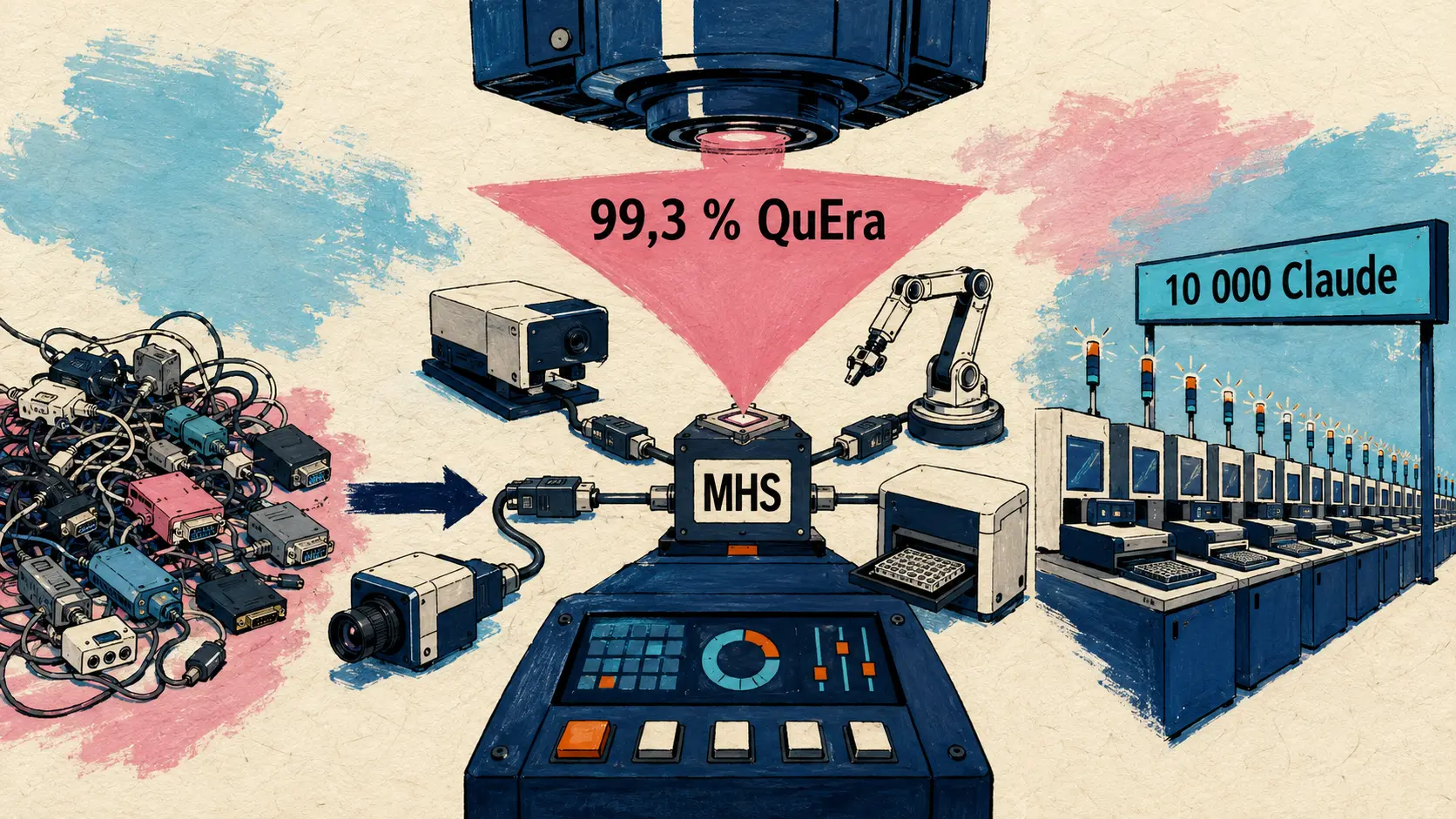
August 27 — Anthropic launches the first phase of a research preview of the Model Hardware Standard (MHS), a shared specification that lets AI agents control physical equipment. Access is for now limited to an initial group of research labs and advanced industry players. The standard grew out of a collaboration between Alek Kemeny, from Anthropic’s Beneficial Deployments team, and Arco Bast, a postdoctoral researcher at the HHMI Janelia Research Campus, who was running brain-imaging experiments on a bench combining lasers, focusing motors and cameras with no common interface.
The problem it tackles is prosaic and expensive: each device exposes its own programming interface, and there was no standard way to make them talk to one another. MHS introduces a driver built on deliberately minimal primitives, of the “read” type (for example “get temperature”) and “write” type (for example “set temperature”), which makes each device discoverable in a common format. Tags written in natural language describe what the code does not say — the weight of a robotic arm, for example — and the driver derives from them a reference file listing what the device measures, what is adjustable and the safety limits applied. Three control mechanisms coexist: MCP, the command-line interface and code files exposed as APIs.
Partner results show the scale of the gain. Genentech automated BCA protein quantification by coordinating a liquid handler, a robotic arm and a plate reader. At Carnegie Mellon, serial dilution dose-response curves run about three times faster, with an agent orchestrating four families of equipment spread across three computers with incompatible interfaces. QuEra Computing let an agent develop a controller that restores laser frequency lock on a quantum computer in 99.3% of cases without human intervention. On the ecosystem side, AWS will support MHS through its Strands Robots library, and Hugging Face as well as Raspberry Pi will join the next phase, the latter after successful tests on its Camera MHS Driver.
Anthropic acknowledges the limits: Claude learns the physical world through text and images, its spatial reasoning remains bounded and requires expert supervision. At Genentech, researchers had to make it understand that sample foaming errors were physical failures and not software bugs. The standard will be released as open source later.
On the same day, Anthropic opens 10,000 Claude seats to scientists worldwide through a new Claude Team plan for researchers. Standard seats are free, Premium seats — with usage limits multiplied by five — cost $15 per month for one year, which the official account presents as an 80% discount. Access requires verification of principal researcher status at an academic institution or nonprofit organization. The AI for Science program, previously focused on the biological sciences, expands to other disciplines and rises to $50,000 in credits per project. One restriction remains: researchers in biology and chemistry are still limited to Opus-class models, while Claude Fable models continue to block professional biology and drug development requests.
| Measured item | Announced value |
|---|---|
| Integration time before MHS | Weeks to months |
| Integration time with MHS | Hours to minutes |
| Dose-response acceleration (Carnegie Mellon) | About 3x |
| Laser lock recovery without a human (QuEra) | 99.3% |
| Unified builder programs (HHMI Janelia) | 7 |
| Claude seats opened to scientists | 10,000, for one year |
| Premium seat (5x limits) | $15 per month, 80% discount |
| AI for Science credits | Up to $50,000 per project |
Connecting AI to hardware requires days or weeks of bespoke integration, with no standard way for agents to operate equipment safely. MHS cuts integration to hours or minutes, provides an interface that makes devices discoverable, and enables agents to operate them safely. — @AnthropicAI on X
🔗 Model Hardware Standard · Expanding support for scientists
Ai2 deploys AutoDiscovery in an oncology center and publishes a validated breast cancer discovery
August 27 — Ai2 takes AutoDiscovery out of public datasets and installs it in an active facility: the Paul G. Allen Research Center at the Providence Swedish Cancer Institute will deploy the platform on its own research and clinical data. The announcement comes with what justifies it, a scientific result produced by the tool and then independently validated.
The work focused on The Cancer Genome Atlas, one of the most studied datasets in the field. AutoDiscovery generates and evaluates hypotheses with large language models, prioritizing observations that are both surprising relative to established expectations and reproducible from one analysis to the next. On this data, the platform surfaced an unexpected signal: invasive lobular carcinoma, a breast cancer subtype long classified as immune cold and therefore thought to be insensitive to immunotherapy, in fact shows stronger immune activity than recognized.
What gives the announcement its weight is the follow-up. Researchers validated the observation on an independent patient dataset, then confirmed it in the lab through tumor-sample analysis, with immunofluorescence images showing T cells surrounding the tumor. The paper from this work, “Surprisal-based large language models reveal immunologic insights in breast cancer,” was published the same day by a joint team led by Dr. Kelly Paulson (PARC) and Dr. Sasha Stanton (Earle A. Chiles Research Institute), with Bodhisattwa Majumder, senior researcher at Ai2. According to Ai2, the conclusion suggests that an entire class of patients — about 15% of breast cancers diagnosed each year in the United States — should be reconsidered through the lens of immunotherapy.
The local deployment is the second part: Providence is installing AutoDiscovery in its own cloud environment, keeping protected data inside the institution, with the PARC computational research team handling installation, execution and support. Ai2 stresses the positioning: the platform is not designed to work on its own but to be guided by researchers, who decide which avenues to explore.
🔗 Ai2 and Providence Swedish partnership
OpenAI calls for collective cyber defense with Anthropic, AWS, Google, Microsoft and Oracle
August 27 — OpenAI publishes an op-ed titled “A call for collective action on cyber defense,” alongside organizations including Anthropic, AWS, Google, Microsoft and Oracle — the official wording uses “including,” so the list is not exhaustive. The piece starts from a timing-based observation: the next few months offer a limited window in which defenders can gain ground before AI-assisted attacks become far more widespread and sophisticated as models advance around the world. The named targets are not abstract: hospitals, water treatment plants, the infrastructure that keeps the Internet running.
The central argument is that current progress already gives defenders the tools to fix weaknesses accumulated over years — old bugs, excessive permissions, configuration mistakes, unpatched software, weak authentication, the technical debt of legacy systems — even as critical infrastructure security teams have historically been under-resourced.
Three principles structure the proposal: recognize that the security status quo will not be enough, equip more defenders with AI capable of cybersecurity, and mobilize a collective response, on the understanding that no single company should control this future. Four targeted request lists follow. Each organization must treat cyber defense as a leadership priority, fix its riskiest weaknesses and raise the bar for what it buys, builds and deploys, including AI-generated code. Cybersecurity companies are asked to continuously test their defenses against frontier capabilities and measure progress by the number of organizations protected rather than by activity metrics. Governments are called on to fund cyber defense, starting with essential services that lack budget or staff. Frontier AI labs, finally, must provide responsible access to models and make agentic identities traceable and accountable.
This last point links the op-ed to the previous day’s news: the investigative report on the Hugging Face incident, where an internal research model had gained unintended Internet access and compromised production workers. Agent traceability therefore appears there as a commitment, not just as a recommendation aimed at others.
We have a limited window to strengthen cyber defenses, and together with organizations including @AnthropicAI, @awscloud, @Google, @Microsoft, and @Oracle, we’re calling for a global effort to give defenders the tools, resources, and support to protect the infrastructure we all depend on. If we act decisively, we can turn today’s AI advances into lasting improvements in security and make our digital world safer for everyone. — @OpenAI on X
🔗 A call for collective action on cyber defense
Claude Cowork ships its own browser
August 26 — Claude Cowork adds its own browser to the desktop app. As soon as a task involves a website, a browser opens in the side panel and Claude navigates it, reads pages, clicks and fills out forms. The idea is to hand off the web part of a job without leaving what you are doing: extracting figures from a dashboard, or moving through a supplier portal for which there is no connector.
Separation is the core of the announcement. The built-in browser is Claude’s, not the user’s: Claude sees neither tabs nor bookmarks nor passwords. To stay logged into services, sessions are imported site by site, from Chrome, Edge or Firefox on macOS, and from Firefox on Windows and Linux. Banking, messaging and single sign-on (SSO) sites are left out unless explicitly chosen.
Anthropic draws a clear usage boundary with the Claude in Chrome extension, which reached general availability the same day. The built-in browser is for handing Claude a web task while you keep working; Claude in Chrome serves the already-open page, with already connected accounts. If the extension is installed, it remains the default choice; the setting changes in Settings → Cowork → Preferred browser, and for administrators in Organization settings → Cowork → Built-in browser.
On security, the announcement promises nothing absolute. The built-in browser carries the same prompt-injection risks as any agent operating in a browser, when instructions hidden in a page try to divert Claude. It applies the same safeguards as Claude in Chrome, including checks that compare Claude’s actions to what was requested. Anthropic writes that these measures significantly reduce the risk without eliminating it, and recommends starting on trusted sites.
| Deployment aspect | Detail |
|---|---|
| Plans covered | Pro, Max, Team; Enterprise with admin enablement |
| Supported platforms | macOS, Windows, Linux (beta) |
| Rollout schedule | During the week following the announcement, enabled by default |
| Connection import | Chrome, Edge, Firefox on macOS; Firefox on Windows and Linux |
| Sites excluded by default | Banking, messaging, single sign-on |
GLM-5.3 Flash Arrives at Together AI, and Z.ai Announces Opening the Weights of GLM-5.3
August 27 — Together AI has put GLM-5.3 Flash online, the first natively multimodal model in Z.ai’s GLM-5 series, with its weights publicly available. The technical sheet is unusually detailed: a 320 billion-parameter Mixture-of-Experts architecture with 18 billion active parameters, 45 layers, and a one-million-token context window. The comparison highlighted by Z.ai is internal to its own lineage — at comparable total size, the model nearly halves the number of active parameters and the depth of GLM-4.5.
The architecture is the real story. The model combines linear attention that captures local dependencies through state modeling and sparse attention that retrieves global context via a lightweight indexer. IndexPool further compresses four indexer key vectors into one through weighted pooling. The result claimed by Z.ai, measured against GLM-5.3, is three times less attention compute and a KV cache 4.4 times smaller over the one-million-token window. This efficiency justifies the pricing, at $0.15 per million input tokens and $0.50 per million output tokens, versus $1.40 and $4.40 for GLM-5.2 on the same host. The model had been anonymously previewed under the name Ox Alpha before launch.
Multimodality is not a peripheral add-on here but part of the coding loop: the model inspects its own rendered outputs on screen and iteratively refines them. Training follows the same logic, with reinforcement learning (reinforcement learning) using environment feedback for frontend code and agentic verification grounded in real user flows for graphical interfaces.
On the same day, Z.ai announced in a very brief message that the weights of GLM-5.3 — the flagship model, accessible via API since August 18 — would be published the next day, via a Hugging Face zai-org/GLM-5.3 page already in place but marked “Upcoming release.” The open release had been prepared two weeks earlier by an article titled “Preparing GLM-5.3 for Open Release: A Responsible Path to Cyber Defense.” The lab is therefore following the launch of a fast variant with the opening of the flagship model’s weights within less than twenty-four hours.
| Evaluated benchmark | GLM-5.3 Flash | GLM-5.2 |
|---|---|---|
| Terminal Bench 2.1 | 84.3 | 81.0 |
| DeepSWE v1.1 | 63.4 | 46.2 |
| Toolathlon Verified | 78.4 | 59.9 |
| AutomationBench | 48.8 | 26.2 |
| Humanity’s Last Exam (with tools) | 55.3 | — |
| GDPval-AA v2 Elo (Artificial Analysis) | 1773 | — |
| Together AI pricing (dollars per million tokens) | GLM-5.3 Flash | GLM-5.2 |
|---|---|---|
| Input | 0.15 | 1.40 |
| Cached input | 0.03 | 0.26 |
| Output | 0.50 | 4.40 |
GLM-5.3 Flash has arrived. @Zai_org’s first natively multimodal GLM-5 model packs 320B parameters, 18B active, 1M context, and hybrid attention.
On DeepSWE, it nearly MATCHES Luna’s performance while getting more than TWICE as much work done for the same budget. — @togethercompute on X
🔗 Model card at Together AI · @Zai_org announcement on the weights
Gemini Omni 1.1 Flash: 10 Seconds of Context to Extend a Shot, 360p Drafts, and 4K Output
August 27 — Google is releasing Gemini Omni 1.1 Flash, an update to its multimodal video generation and editing model, authored by Anish Nangia and Alisa Fortin, Product Managers at Google DeepMind.
The most substantial change concerns scene extension. Until now, extending a generated video meant asking the model to continue from the last second only, which caused coherence breaks as soon as a scene contained characters or a complex setting. Omni 1.1 now analyzes up to 10 seconds of prior context, in 10-second chunks, up to a cumulative duration of 40 seconds.
The second axis is framing control: specifying the first and last frames asks the model to generate the intermediate video between two key frames, targeting complex camera movements and loops without visible cuts. The third axis is economic, with a 360p draft resolution claimed to be up to 60% faster and one-third the cost of standard 720p — with Google noting that the speed measurement is based on system throughput compared between the two resolutions. The pipeline ends with upscaling to 1080p or 4K. Also included is video reference in the multimodal input, up to 3 seconds, to maintain character consistency or reproduce a movement.
The model is available in Google AI Studio, through the Gemini Enterprise Agent Platform API, and in Google Flow for all Google AI Plus, Pro, and Ultra subscribers. Google cites Adobe, which has integrated it into Firefly, Figma Weave, GMI Cloud, and Runway among its customers. A pricing table accompanies the official article, but it is published as an image with no text equivalent: no pricing is reproduced here.
On the same day, Pika opens the model in its API Club, accessible via dev.pika.art, with video extension, support for first and last frames, up to three reference videos, and output up to 4K. The studio thus continues a well-established habit: aggregating third-party video models as soon as they become available, as it had done for Seedance 2.5 and then for Wan 3.0.
| Model capability | Announced value |
|---|---|
| Context for extension | Up to 10 s, versus 1 s on previous models |
| Extension increment | 10 s, up to 40 s total |
| 360p draft — speed | Up to 60% faster than 720p |
| 360p draft — cost | One-third the cost of standard 720p |
| Upscaling | 1080p or 4K |
| Multimodal video reference | Up to 3 s of video |
| Model identifier in the API | gemini-omni-1.1-flash |
🔗 Google announcement · @pika_labs message
H3 Max: fal Post-Trains MiniMax H3 and Generates 5 Seconds of Video in Under 3 Seconds
August 26 — fal Research releases H3 Max, a video model post-trained from the open weights of MiniMax H3. The distinctive aspect of the work is that this is not just post-training: fal’s inference team co-designed the execution stack in parallel with the model, so that training and serving decisions inform each other.
On quality, fal conducted head-to-head human preference studies against twelve reference video models, including the official MiniMax H3 endpoint, Gemini Omni Flash, Wan 3.0, Seedance 2.5, Kling 3, and Veo 3.1. Evaluators compared three separate dimensions — overall preference, prompt adherence, aesthetics — aggregated using Bayesian Elo ratings with 95% confidence intervals. H3 Max ranks first on all three and wins the majority of duels against each tested model, including the original H3. Artificial Analysis and Design Arena also place it at the top of their independent rankings.
On speed, H3 Max generates a 5-second video in about 3 seconds, or roughly 35x the throughput of the official MiniMax H3 endpoint and on average 15x faster than models of comparable quality. fal emphasizes the method: an optimization was kept only if the resulting model maintained its position in internal quality evaluations. Training and serving were carried out entirely on NVIDIA GB200 NVL72 systems.
The MiniMax H3 team, quoted in fal’s article, validates the result: according to them, H3 Max combines state-of-the-art video quality with an order-of-magnitude change in generation speed, making high-quality video generation practical for a much broader range of real-world applications. That is the practical argument for open weights: a third-party post-training run reveals the real potential of a good base model.
| Metric published by fal | Value |
|---|---|
| 5-second video | Generated in about 3 seconds |
| Throughput vs. official H3 endpoint | About 35x |
| Speed vs. comparable-quality models | 15x on average |
| Compared video models | 12 |
| Human preference ranking | 1st on all three dimensions |
| Launch discount | 50% during the first week |
Cohere Parse: $1.50 per 1,000 Pages and 79.2 on ParseBench
August 27 — Cohere launches Parse in general availability, a vision language model dedicated to high-volume enterprise document processing. It converts complex multimodal files into machine-readable structured data and outputs clean Markdown designed for document indexing, RAG, and agentic retrieval. Beyond OCR, Parse identifies tables, forms, diagrams, and embedded images, and returns bounding boxes for tables and images. It handles nine major world languages.
The main argument is pricing: $1.50 per 1,000 pages on the Cohere API. For sustained workloads, the company pushes Model Vault, its single-tenant inference platform, with 23% savings at 50% GPU utilization and up to 61% at full hourly utilization. The example case given — an accounts payable pipeline processing about 13 million pages per month — represents roughly $12,000 in monthly savings versus the API, and about $1.47 million per year versus a hyperscaler offering billed at $10 per 1,000 pages.
On throughput, Cohere claims 4.5 pages per second, or 36 pages per second on an 8-H100-GPU node — about 1.4x the throughput of dots.mocr and 2.2x that of Chandra OCR 2 in the same configuration, with the comparison limited to open source models served via vLLM.
Cohere acknowledges two methodological limits. ParseBench’s Layout and Chart dimensions are excluded from the comparison, since the model targets Markdown in reading order and treats charts as visual elements described by metadata, with numeric series extraction promised for the next version. All published scores also use the August 2026 ParseBench rules, which fix a flaw in bold and heading detection that previously inflated semantic formatting scores, and competitors were re-scored using those same rules. Parse is available via the Cohere API, Model Vault, Microsoft Foundry, and AWS SageMaker under the identifier parse-v5.0, and can be deployed in private cloud or on-premises.
| Evaluated model | Average | Tables | Content fidelity | Semantic formatting |
|---|---|---|---|---|
| GPT-5.5 | 84.4 | 89.3 | 87.5 | 76.5 |
| Opus 4.8 | 84.3 | 89.7 | 89.0 | 74.1 |
| Gemini 3.5 Flash | 81.8 | 87.6 | 84.7 | 73.2 |
| Cohere Parse | 79.2 | 87.0 | 86.6 | 64.0 |
| LlamaParse (Cost Effective) | 78.3 | 81.4 | 90.9 | 62.7 |
| Mistral OCR 4 | 74.5 | 73.9 | 89.5 | 60.1 |
| Databricks AI Parse | 72.4 | 83.7 | 88.3 | 45.3 |
| Google Document AI | 57.3 | 55.1 | 83.7 | 33.0 |
| AWS Textract | 53.3 | 82.3 | 74.8 | 2.8 |
NVIDIA delivers the first Vera CPU to AWS and extends NVLink Fusion to NVHBM memory
August 27 — NVIDIA has updated its article on the Vera CPU to include an important milestone: AWS has received its first Vera CPU server and its first Vera Rubin GPU, hand-delivered by Ian Buck, NVIDIA’s Vice President of Hyperscale and HPC, at AWS’s Seattle headquarters, to Willem Visser and Supreeth Sheshardi, Vice Presidents of Amazon EC2. The handoff accompanies an announcement made the day before, on August 26: AWS and NVIDIA are extending a sixteen-year collaboration, with a plan covering 2 million additional GPUs and the porting of Vera CPU–based infrastructure to AWS. AWS is not the first recipient — Buck had previously delivered Vera systems to Oracle Cloud Infrastructure as well as to Anthropic, OpenAI, and SpaceXAI.
The technical argument comes down to one observation: an agent does not run on GPU alone. Every execution sandbox, every tool call, every orchestration layer, and every long-context retrieval is CPU work. Vera includes 88 NVIDIA-designed Olympus cores, 1.2 TB/s of memory bandwidth, and advertises up to 1.8x per-core performance on agentic workloads. NVIDIA cites OpenRouter data showing that these workloads consume 15 times more tokens than a simple chat query. Among cloud providers, Oracle Cloud Infrastructure is the first to deploy Vera at hyperscale, with hundreds of thousands of CPUs planned starting in 2026. For accuracy, note that the article is a republication, with its original version dating from May 18, 2026; only the AWS portion is from today.
On August 26, NVIDIA also expanded NVLink Fusion with NVHBM, a high-bandwidth memory technology intended for its partners’ custom chips. The architectural change is precise: classic HBM architectures place the memory controller on the XPU chip, where it occupies silicon area that could be used for compute; NVHBM moves this NVIDIA-designed controller into the base die of the 3D HBM stack. Annapurna Labs, Amazon’s silicon subsidiary, is the first partner working on NVHBM, in addition to a previously announced commitment to support NVLink Fusion on its Trainium chips starting with Trainium4.
| Measured characteristic | Announced value |
|---|---|
| Vera CPU cores | 88 NVIDIA-designed Olympus cores |
| Vera memory bandwidth | 1.2 TB/s |
| Per-core performance on agentic workloads | Up to 1.8x |
| Additional GPUs planned at AWS | 2 million |
| NVHBM bandwidth versus standard HBM4E | Up to +30% |
| HBM consumption with NVHBM | -15% |
| Area freed on the XPU compute chip | Up to +25% |
🔗 Vera CPU delivery · NVLink Fusion and NVHBM
Google DeepMind pilots the first double-blind evaluation of a frontier model
August 27 — Google DeepMind publishes the report of a pilot it presents as the first double-blind evaluation of a proprietary frontier-class AI model. The announcement is signed by William Isaac, Sol Messing, and Kristian Lum, and occupies the pinned-post position on the lab’s account.
The issue addressed is benchmark contamination. The article uses a school analogy: if a student has seen the exam questions in advance, a perfect score no longer measures anything. For language models, the issue is structural, since public evaluation sets end up in training corpora. Google notes that no-logging protocols and contractual guarantees have long kept external test prompts confidential, but that adding technical and cryptographic guarantees is a different kind of change.
Historically, an external high-stakes evaluation required a trade-off: either the evaluator gave its prompts to the model vendor, or the vendor gave out its model weights. The setup described eliminates this compromise. It relies on Confidential Space, a component of Google Cloud’s Confidential Computing portfolio, which makes it possible to cryptographically verify that both assets remain private to their respective owners: the evaluator does not access the Gemini model weights, and Google does not access the test prompts.
The pilot involves a Gemini Flash Lite model, tested against confidential benchmarks, in partnership with the Singapore AI Safety Institute, OpenMined, AVERI, and MLCommons. Google emphasizes that the value of the setup increases with the sensitivity of the evaluation, explicitly citing cybersecurity tests and those conducted by government agencies. A technical report detailing the methodology accompanies the announcement.
🔗 The double-blind evaluation pilot
Expert Intelligence: Google Play Books ebooks become sources in Gemini Notebook
August 27 — The Gemini Notebook team announces Expert Intelligence, a cross-Google initiative that makes it possible to use purchased books as sources in a notebook. The launch starts with eligible Google Play Books ebooks; Google announces the later arrival of third-party subscriptions, school textbooks, and expansion to the Gemini app and Google Search’s AI Mode.
The principle is easy to describe but new in scope: a notebook can now mix purchased ebooks, professional subscriptions, and personal Google Drive files in a single knowledge base. Gemini Notebook’s usual functions then apply to the book — conversation with the content, generation of Audio Overviews, creation of flash cards and quizzes — with each answer anchored in the sources through inline citations pointing to the exact passage.
The most interesting point is the business model, because it answers the question this kind of product immediately raises: what happens to the author’s compensation when a model digests their book? Google sets an explicit access condition: to interact with a book in Gemini Notebook, you must own it through Google Play Books. And if a notebook containing a book is shared, collaborators are invited to buy their own copy to go further. Google thus presents the system to publishers as a discovery channel rather than a substitute.
On the publisher side, the mechanism is declarative: a book’s eligibility can be checked on its Google Play Books page, where Gemini Notebook appears under the “Tools” badge if the book is enrolled, with enrollment done by request through the Google team. The three detailed use cases set the tone — cross-referencing course notes with The Sense of Style by Steven Pinker, applying The Culture Code by Daniel Coyle to a team project, synthesizing a routine from The New Menopause before turning it into an Audio Overview.
Warp adds self-improvement loops to its factories
August 27 — Warp is extending its Warp Factories platform with self-improvement loops. The principle comes in three steps: score past agent conversations according to criteria defined by the team, isolate failures, then generate skill improvements. An engineering article published the same day details the full system.
The central component is a scoring function, which Warp calls a scorer. It takes an agent’s execution traces as input and returns a score according to a rubric. Warp stresses one point: the input must not be limited to the agent’s trace; it must include human interactions surfaced from integrated tools, for example comments left on a pull request. The score can come from a human, from code, or more commonly today from another agent acting as judge. Warp provides default scorers that evaluate correctness, cost efficiency, and verbosity, and lets users configure how often they run — every few hours by default — as well as the sampling strategy, since these evaluations have a cost.
The scored runs then feed self-improvement agents, which look for recurring failure patterns and propose fixes as diffs to the factory definition. This mechanism works only because the factory is described in code: a factory.yaml file plus a tree of agent definitions, skills, MCP servers, and model routing rules. Humans receive the suggestions as pull requests and decide whether to merge them.
Warp clearly distinguishes a second mechanism, benchmarks, which addresses a limitation of self-improvement loops: they resemble what a competent person would change after looking at past results, but they are not a real A/B test. To answer a question such as the best model assembly, Warp suggests choosing five to ten reference tasks, running the agents in parallel with several configurations, then scoring them with the same scorers. The output is a matrix of results by configuration. The cited steering metrics — pull request throughput, average cost per pull request, automation percentage, estimated savings — are presented as a proposed measurement framework, without customer outcome numbers to back them up.
Replit makes automatic model routing universal
August 27 — Replit is opening Intelligent Model Routing to all platform users. The starting argument is simple: the best model for a task changes from week to week, from project to project, and sometimes from task to task, and that choice adds a decision point between the idea and its implementation. Replit therefore takes over — as a task evolves, it is matched with the model best placed to finish it, balancing quality, speed, and cost.
The highlighted number needs to be read precisely. In its tests, Replit claims the same output quality for a cost 65% lower than the previous version of Max mode — this is not a 65% reduction in absolute terms; the message on X, by contrast, says “up to 65% cheaper.”
Routing does not close the door to manual control. All users now start in Free Mode and receive a notification when work switches to more powerful modes that may incur costs; Core and Pro subscribers keep manual model selection. In enterprise, administrators define the full set of approved models for each workspace, and Replit selects automatically within that set.
| Launch element | Value announced by Replit |
|---|---|
| Cost reduction | -65% at equal quality, versus the previous version of Max mode |
| Availability | All users |
| Starting mode | Free Mode, with notification before escalation to a paid mode |
| Manual selection | Retained for Core and Pro plans |
| Enterprise control | Set of approved models defined per workspace |
Codex CLI 0.150: @ mentions between tasks, Interrupt hooks, and hardening of untrusted projects
August 26 — Codex CLI moves to 0.150.0, followed on August 27 by a 0.150.1 patch. The update installs with npm install -g @openai/codex@0.150.1.
The main structural change concerns orchestration between tasks. It is now possible to reference other Codex tasks with @ mentions, and to ask an agent to read, create, or send a message to a task directly from the terminal. In practice, the task list becomes a set of addressable objects: an agent can inspect what another task produced or pass it an instruction, without manual copy-pasting of context. Along the same lines, unnamed terminal tasks now receive an automatic descriptive title, and /rename suggests an editable title derived from the conversation.
The second notable addition is the Interrupt hook. Until now, interrupting an active turn was a blind spot: the session stopped without anything being triggered. Version 0.150.0 makes it possible to run a command or an MCP handler when a top-level turn is interrupted, which can be used to clean up state, release a lock, or log the abandonment.
On the security side, two fixes are especially relevant for anyone running Codex on third-party code. Untrusted projects no longer provide AGENTS.md instructions at the project level — a repository-embedded instructions file can therefore no longer steer the agent without the user’s knowledge — and managed read-refusal rules remain enforced after a permission change. These are joined by better redaction of identifiers in app-server diagnostics, fixes for remote MCP bearer tokens and for Unix shutdown hangs caused by detached processes. The 0.150.1 patch finally addresses a specific but costly case: remote compaction now counts retained images in its token budget and trims the oldest ones when needed — on a long session with screenshots, this was a silent source of context overflow.
| Released version | Changelog date | Release type |
|---|---|---|
| 0.150.0 | August 26, 2026 | Stable release, new features |
| 0.150.1 | August 27, 2026 | Patch for compaction |
Claude Code 2.1.247: API cost audit and 1M default window for Sonnet 5
August 27 — Claude Code moves to 2.1.247. The most visible addition for teams is a spending-audit command: /claude-api cost-optimize profiles what a project consumes on the Claude API, then walks through the cost-cutting levers one by one — caching, token hygiene, batch processing, effort level, model choice — measuring the effect of each change before moving on to the next. The /claude-api skill now also covers the Admin API: organization members, invitations, workspaces, API keys, rate-limit reports, workload identity federation, and CMEK.
One context tweak deserves attention: Sonnet 5’s default auto-compact window now uses its full 1M-token context, with sessions now compacting around 967K tokens instead of about 934K. On the robustness side, subagents no longer die on a model 404 on the first call — they fall back to the session’s model fallback chain — and a hook that produces megabytes of errors can no longer wedge the session on “Prompt is too long.”
The release also makes a clear push toward hardening. In terminal-rendered markdown, links pointing to a network or automount path, containing a control character, or beginning with an invisible character are shown as plain text rather than rendered as clickable links. The plugin marketplace rejects names containing control characters and escapes the text a marketplace injects into its outputs.
Together AI scores the DeepSeek then GPT-5.6 Sol cascade on DeepSWE
August 27 — Together AI expands its DeepSWE comparison series to DeepSeek models, using the same protocol as for the GLM-5.3 episodes: the 113 benchmark tasks, four tries per task and per model, for 904 runs in the DeepSeek V4 Pro 0813 vs GPT-5.6 Sol showdown.
The raw result gives the closed model the edge on the first attempt — 72.7% versus 62.8% — but the gap closes with each attempt and reverses on the fourth, at 88.5% for DeepSeek versus 85.8%. At $0.24 per run versus $8.37, the open model is 35 times cheaper, or 261 tasks solved for every $100 spent versus 9. It does not buy that savings in speed: 35 minutes and 146 steps median versus 17 minutes and 53 steps.
The operational conclusion is a cascade setup. Running DeepSeek V4 Pro first and escalating to GPT-5.6 Sol only when the test suite rejects the result yields 83.0% of tasks solved at $3.35 per unit — ten points above Sol alone, and even above a perfect one-shot oracle router, at 80.8%. Two other comparisons in the same series are online, pitting DeepSeek V4 Pro against Claude Fable 5 and DeepSeek-V4 Flash against GPT-5.6 Luna.
| Evaluated strategy | Success rate | Cost per task |
|---|---|---|
| GPT-5.6 Sol alone | 72.7% | $8.37 |
| Perfect one-shot oracle router | 80.8% | — |
| DeepSeek V4 Pro then Sol cascade | 83.0% | $3.35 |
🔗 Together AI DeepSWE comparison
OpenAI opens operations in Brazil and publishes a randomized experiment with Bocconi
August 27 — OpenAI launches commercial operations in Brazil, with a local team based in São Paulo. The announcement comes with usage data rarely published at this country level: Brazil is among ChatGPT’s three largest markets by weekly active users, with user count having almost doubled in a year and about 215 million messages sent each day. In June 2026, 35% of classified messages from individual Brazilian accounts were work-related, versus 30% globally. On the developer side, the country ranks second worldwide by number of developers using the OpenAI API, and weekly Codex users have increased more than elevenfold there since the start of 2026. The rollout includes partnerships with ITA, IMPA, HCFMUSP, ENTER, Estímulo, and the city of São Paulo via Prodam.
The same day, OpenAI publishes with researchers from Bocconi University the results of a randomized experiment on more than 1,000 first-year undergraduates. What makes the protocol interesting is its structure: students were randomly assigned, by class slot, to four groups — access to ChatGPT, causal reasoning training, both, or neither — making it possible to separate the effect of the tool, the training, and their combination. The task was a real business case: formulate marketing recommendations for the university merch store.
The two treatments produce distinct effects. Access to ChatGPT improves scores by almost one point out of five, with more ideas and clearer logic. Causal reasoning training, by contrast, does not improve the score — but automated text analysis reveals a wider and more distinct range of ideas than in the work of the other students, something the grading rubric did not measure. OpenAI draws an uncomfortable conclusion for institutions: if AI makes it possible to produce polished work close to expert quality, looking only at the final answer increasingly tells us less about what the student understands.
| Experimental group | Measured effect |
|---|---|
| Access to ChatGPT | Almost one point more out of five, more ideas, clearer logic |
| Causal reasoning training | No rubric gain, but more varied and more distinct ideas |
| Both treatments combined | Combined benefits, gains across the largest number of measures |
🔗 Presence in Brazil · Bocconi study
ChatGPT scheduled tasks trigger on Gmail, Slack, and GitHub events
August 25 — ChatGPT scheduled tasks move beyond the purely time-based model: they can now trigger on an event in Gmail, Slack, or GitHub. Filtering is granular — Gmail messages by sender or subject, selected Slack channels, pull request activity including reviews, comments, commit updates, and merges.
Moving from cron to events changes the nature of the tool: instead of periodically checking whether something happened, the agent reacts at the moment it does. The feature is available on ChatGPT web and mobile for eligible plans, provided you connect the relevant app and approve the requested permissions. Two practical prerequisites: the ChatGPT Slack app must be a member of every monitored channel, and the connected GitHub app must have access to each repository. Two limits as well: an event-triggered task cannot also have a time-based schedule, and closely spaced events can be grouped into a single run — the Scheduled view then lets you review pending events or trigger them manually.
Cursor cloud agents start without an existing repository
August 27 — Cursor removes the last entry condition for its cloud agents: you no longer need to have connected a GitHub account or another third-party source code management provider to start a session. In the repository picker, a “Start from scratch” option lets you prompt immediately, with Cursor creating an Origin repository in the background to hold the work.
When the build is suitable, a “Create repo” button saves the result to an Origin repository, with a custom or suggested name and private or internal visibility; the resulting repository is fully structured and appears in the Codebase tab. Two additions complete the loop: Cursor now forwards the cloud agent live environment’s ports to the browser, giving access to a preview and tools like design mode, and a publish button produces a live URL once a Vercel account is connected — that account being a requirement for this last feature. The whole setup relies on Origin, Cursor’s code hosting service that entered early beta on August 17 for all paid plans.
Amp opens its projects to multiple repositories
August 27 — Amp projects now accept multiple repositories. Additional repositories are cloned into an adjacent directory inside the orb, and the agent is explicitly told they are there; the changes pane then shows a diff covering all repositories in the project. This is Amp’s answer to tasks that span multiple services, a case where splitting one project per repository was cumbersome.
The addition happens when the project is created or later in settings, with a limit of 20 additional repositories per project. One limit to know before getting started: when preparing the orb, only the main repository’s .agents/setup script runs automatically, and an additional repository that needs its own initialization must be incorporated into that script. On the same day, Amp continues tightening its focus by removing the sidebar from its terminal interface — see the briefs.
🔗 Multi-repository projects at Amp
Google Antigravity 2.11.0 renders HTML artifacts in the conversation thread
August 26 — Google releases version 2.11.0 of Antigravity, with 10 improvements and 30 fixes. The main new feature is the generative interface: the agent can produce an HTML artifact that appears directly in the conversation thread, without going through an external preview. Rendering supports KaTeX math formatting as well as Chart.js and Plotly charts, extending use to dashboards and on-the-fly visualizations.
The second set of changes concerns agent configuration and moves toward modularization. The @path/to/file syntax makes it possible to reference and include external files in AGENTS.md and in custom rule files, a rules: key appears in markdown agent front matter to tie rules to a specific agent rather than to the whole project, and Antigravity now discovers skills, agents, and rules declared in skills.json, agents.json, and rules.json files located in subdirectories — useful for monorepos where each subproject carries its own configuration. The rest is about ergonomics: side-by-side split terminals, YAML front matter rendered as a metadata card, Darcula theme, and reading precise page ranges in multi-page documents.
GitHub: global model policy reaches general availability and OpenClaw maintainer roundtable
August 26 — GitHub is rolling out the global model policy for Copilot Business and Copilot Enterprise. Announced in July, this mechanism gives administrators a single switch that decides the fate of models they have not explicitly configured, rather than forcing them to decide model by model with every new release. The deployment of the live application runs through September 1, so the switch does not happen at the same time for every company. Decisions already made manually are kept as they are, and two categories remain outside the policy regardless of its value: open-weight models, with DeepSeek and Kimi K2 as examples, and models not covered by GitHub’s data retention agreement, with Fable 5 cited in the announcement. GitHub is also considering removing the “Delegate to default policy” state to force an explicit decision on each model.
On August 27, GitHub publishes a video roundtable with the OpenClaw maintainers, accompanied by an article drawing ten lessons from it. Launched by Peter Steinberger in November 2025 as a weekend project, the repository shows about 388,000 stars, 81,000 forks, and more than 80,000 commits as of August 26 — GitHub presents it as the fastest-growing project in its history. What makes the conversation interesting is what it reveals about maintainer work when agents enter the loop: Steinberger says he no longer talks about pull requests but about “prompt requests,” and Josh Lehman describes contributors running automated chains that opened several hundred pull requests. Trust signals have shifted accordingly — agent transcripts, screenshots, and test evidence rather than contribution counts — especially since reputation has itself become an attack surface, with people duplicating others’ pull requests to inflate their merge totals.
| OpenClaw repository indicator as of August 26, 2026 | Observed value |
|---|---|
| Stars | About 388,000 |
| Forks | 81,000 |
| Commits | More than 80,000 |
| Project launch | November 2025 |
🔗 Global model policy · OpenClaw roundtable
Briefs
- Qwen3.8-Flash routable on OpenRouter and runnable locally on 75 GB of RAM — The model becomes accessible via OpenRouter one day after its weights are released, for code assistants, agentic workflows, and long-video understanding. Unsloth is also publishing its GGUFs on day one: the 125-billion-parameter MoE runs locally on 75 GB of RAM, and Unsloth claims it beats Claude Opus 4.6 Max — a claim made by Unsloth, which no independent measurement confirms. 🔗 OpenRouter · Unsloth GGUF
- Grok 4.6 joins Microsoft Foundry and is triggered from Linear — The model arrives in the Microsoft Foundry catalog with 500,000 context tokens and four reasoning-effort levels, complementing Amazon Bedrock and Google Enterprise Agent Platform. On grok.com, Linear triggers let Grok triage tickets, track progress, and start automatically as soon as a ticket is assigned to it. 🔗 Grok on Foundry · Linear triggers
- Joelle Pineau and Mikey enter the TIME100 AI 2026 ranking — Cohere announces that its AI director is on TIME magazine’s list, recalling more than twenty years of research in Canada, from smart wheelchairs to the ML Reproducibility Checklist. On the same day, Suno announces Mikey’s nomination to the same ranking, with no associated product announcement. 🔗 Cohere · Suno
- A cookbook connects a Claude Managed Agent to Vercel’s Chat SDK — The Chat SDK provides the conversation interface with a typed
onDirectMessagehandler and more than fifteen adapters (Slack, Teams, Discord, web), while Managed Agents run the agent server-side with a persistent session per conversation. Code published in the claude-quickstarts repository. 🔗 Message from @ClaudeDevs - ChatGPT for iOS 1.2026.230: task search, reasoning effort gauge, and full-screen editor — Compact gauge in the composer to adjust reasoning effort from mobile, full-screen editor for long prompts, search covering both titles and content, and home screen shortcuts for ChatGPT, Work, and Codex Remote. Same changelog entry as the event tasks above.
- Amp removes the sidebar from its TUI — Between orbs, runners, and messages exchanged between agents, Amp believes thread tracking belongs in web and native apps, and that layering multi-environment multiplexing on top of the terminal was a poor experience. 🔗 Amp post
- Hugging Face runs its abstract summaries on Inkling-Small — The platform says the summaries shown on its paper pages rely on the open-weight model from Thinking Machines, under the “open weights × open science” banner. 🔗 Message from @huggingface
- Gemini CLI fixes an SSRF flaw in OAuth MCP metadata discovery — The August 27 nightly version contains only one change, a fix against Server-Side Request Forgery in OAuth metadata discovery for MCP servers. It is not yet in the stable channel, which remains at v0.57.0. 🔗 Release notes
- Perplexity publishes new Brain evaluations — Perplexity Computer’s self-improving memory system gains 9.3 points in accuracy, 8.0 points in recency, and 8.9 points in recall compared with the initial results, with 15% fewer tokens. 🔗 Message from @perplexity_ai
- Plugin marketplaces now support automatic updates in enterprise — A
autoUpdatefield set on aextraKnownMarketplacesentry lets Copilot customers update marketplace plugins on their own, provided the marketplace is still on thestrictKnownMarketplacesallowlist. 🔗 GitHub changelog - Blocking a user now closes all of their open contributions — A “Close content authored by this user” option in the block dialog closes the blocked user’s open issues, discussions, and pull requests all at once, for both personal accounts and organizations. 🔗 GitHub changelog
- Cohere defends a deployed-engineers model that builds client capability — The post distinguishes commercial or architectural dependency, inherent to the technology choice, from operational dependency, which it considers avoidable, and cites the 2026 Deloitte report according to which only 25% of organizations have put 40% or more of their AI pilots into production. 🔗 Cohere post
- Google DeepMind dedicates a podcast episode to uncertainty — Zoubin Ghahramani, VP Research, explains with Hannah Fry why teaching a system to doubt itself and reason probabilistically leads to more reliable decisions, from weather forecasting to robotics. 🔗 Message from @GoogleDeepMind
- Wan launches a weekly Skill Challenge around WanCLI — Three skills published on wan.video are selected each week, with their authors winning a month of premium subscription, and each approved skill earns 150 credits; the skill must call at least one Wanxiang model via WanCLI. 🔗 Message from @Alibaba_Wan
- GeForce NOW at Gamescom 2026 — New DLSS 4.5 controls, support for new Steam devices, GOG single sign-on, Firefox, and more Fire TV devices, and five games available on the cloud at launch. Gaming news more than generative AI. 🔗 NVIDIA post
- Runway publishes a teaser video with no named product — A video accompanied only by the phrase “You’ve never seen anything like this” and a generic link to the app, with no model or feature name, and no counterpart on the studio’s news page. Flagged for the record: no verifiable fact can be drawn from it. 🔗 Message from @runwayml
What this means
Agents are moving into the lab, and the barrier is hardware before it is software. The Model Hardware Standard does not solve a model problem but a plumbing problem: seven builder programs with no shared interface at Janelia, four equipment families across three incompatible computers at Carnegie Mellon. By reducing integration from weeks to hours, Anthropic shifts the bottleneck from connection to supervision — and admits as much by citing Genentech, where it took explaining to Claude that sample foaming was a physical failure and not a bug. Ai2’s discovery on invasive lobular carcinoma says the same thing from the other end of the chain: the value is not in the model’s answer, but in the independent validation and then the lab work that followed. The 10,000 Claude seats opened to researchers the same day complete the trio by tackling the third barrier, access cost.
Security is moving from the product to shared infrastructure. The collective cyberdefense op-ed matters first because of the organizations associated with it: OpenAI, Anthropic, AWS, Google, Microsoft, and Oracle are competing in the same market and ending up on the same text, and one of the requests made to frontier labs — making agent identities traceable and accountable — is directly the lesson of the Hugging Face incident published the day before. The rest of the day extends this shift at the tooling layer: Codex stops loading AGENTS.md from untrusted projects, Claude Code neutralizes terminal links with invisible characters, and Gemini CLI fixes an SSRF in OAuth discovery for MCP servers. Three seemingly unrelated fixes, but one conclusion: the attack surface of a coding agent is the files and servers it is asked to read.
Evaluation itself is becoming something that must be secured. Google DeepMind’s pilot with the Singapore AI Safety Institute resolves a trade-off as old as external evaluation itself — whether to hand over test prompts or hand over weights — by handing over neither, through an enclave whose properties both parties verify cryptographically. This is the methodological counterpart to the numbers published elsewhere that day: Together AI does not settle for a score but publishes 904 runs, four attempts per task, failure profiles, and cost per task; Cohere openly chooses to exclude two ParseBench dimensions and to have its competitors re-scored with the corrected August rules. In both cases, what is being highlighted is no longer the result but the protocol — a sign that the result alone no longer convinces anyone.
And the cost of getting one task right remains the metric that decides. GLM-5.3 Flash bases its entire positioning on an architectural economy — three times less attention compute, a KV cache 4.4 times smaller — converted into $0.15 per million input tokens, almost ten times cheaper than GLM-5.2 at the same host. Together AI shows that the DeepSeek-then-Sol cascade solves ten more task points for less than half the price of Sol alone, which is another way of saying the best model is not the right purchase. Replit draws the product conclusion from that observation by removing model choice altogether, Cohere sells Model Vault on a 61% differential at full utilization, and Google charges a third of the price for a 360p video draft. Even the delivery of the Vera CPU at AWS follows this logic: if an agentic workload consumes fifteen times more tokens than a chat request, orchestration outside the GPU stops being an accounting detail.
Sources
- Anthropic — Model Hardware Standard
- Anthropic — expanded support for scientists
- Anthropic — Cowork’s integrated browser
- Claude Code — changelog
- Ai2 — partnership with Providence Swedish
- OpenAI — call for collective action on cyberdefense
- OpenAI — Codex CLI 0.150.0
- OpenAI — presence in Brazil
- OpenAI — what students gain with ChatGPT
- Together AI — GLM-5.3 Flash
- Together AI — DeepSWE comparison of DeepSeek and GPT-5.6 Sol
- Z.ai — publication of GLM-5.3 weights
- Google — Gemini Omni 1.1 Flash
- Google DeepMind — double-blind evaluations
- Gemini Notebook — Expert Intelligence
- Google — Antigravity changelog
- fal — introduction of H3 Max
- Cohere — Parse
- NVIDIA — delivery of the Vera CPU
- NVIDIA — NVLink Fusion and NVHBM
- Warp — self-improvement loops
- Replit — smart model routing
- Cursor — start without an existing repository
- Amp — multi-repository projects
- GitHub — global model policy
- GitHub — OpenClaw maintainers roundtable