ai-powered-markdown-translatorArticle translated from French to English with gpt-5.6-luna.
Forty-two announcements selected across nine areas for August 28. Two of them answer each other without having coordinated. Z.ai releases the weights of GLM-5.3, a model trained to find vulnerabilities, and in the process documents 2,436 real vulnerabilities discovered with it across 269 projects. On the same day, Anthropic ships three versions of Claude Code, one of which fixes seven paths through which a permission control could be bypassed. Elsewhere, Anthropic publishes research in which Claude aligns other models on its own, OpenAI opens Rosalind Workbench to life sciences, and GitHub announces three policy and billing changes for Copilot. The rest—Gemini Notebook, Midjourney, Wan 3.0, Warp, Amp, v0, Replit—follows below.
Z.ai opens the weights of GLM-5.3, immediately routed through Perplexity and Together AI
August 28 — Announced the previous day in a two-line message, the release is now effective. Z.ai has published the weights of GLM-5.3 on Hugging Face, two weeks after launching the model through its API, allowing time to conduct the safety evaluation and hardening required as a condition. The zai-org/GLM-5.3 repository comes with a detailed technical blog post and points, for citation purposes, to the technical report for the GLM-5 family deposited on arXiv in February under reference 2602.15763. One caveat for anyone hoping for a full opening: the license is not permissive, with the repository declaring a license: other field paired with a custom license name, glm-5.3.
The method is this model’s distinctive feature. GLM-5.3 reuses exactly the same base model as GLM-5.2: all the gains come from post-training, meaning more numerous, more varied training environments that are closer to real professional tasks. Z.ai claims a 50% improvement on its internal Z.ai Code Bench benchmark and state-of-the-art open-source results on Terminal Bench 3.0 and Agents’ Last Exam. Some gaps are spectacular: Terminal-Bench 3.0 rises from 4.6 to 28.3, and DeepSWE v1.1 from 46.2 to 66.9. The lab also emphasizes token efficiency, with a 34.5% success rate at Max effort for around 75,000 output tokens per task, whereas GLM-5.2 capped out at 23.4% while consuming 96,000 tokens.
| Evaluated benchmark | GLM-5.3 | GLM-5.2 | Kimi K3 | Qwen3.8-Max | Opus 4.8 |
|---|---|---|---|---|---|
| Terminal Bench 2.1 | 88,2 | 81,0 | 88,3 | 86,6 | 85,0 |
| Terminal Bench 3.0 | 28,3 | 4,6 | 17,4 | — | 21,1 |
| DeepSWE v1.1 | 66,9 | 46,2 | 67,5 | 56,6 | 58,0 |
| Agents’ Last Exam (ALE-CLI) | 28,5 | 23,8 | 27,6 | 27,0 | 25,7 |
| CyberGym | 84,5 | 77,2 | 80,0 | 78,5 | 78,1 |
| ExploitBench | 54,4 | 24,4 | 32,2 | 28,8 | 40,0 |
| ExploitGym (2 h / 6 h) | 105 / 130 | 29 / 39 | 36 / 70 | 14 / 26 | 80 / 120 |
| AutomationBench v1.0.6 | 48,2 | 26,2 | 46,7 | 39,8 | 41,0 |
| GDPval-AA v2 | 1769 | 1508 | 1682 | 1739 | 1588 |
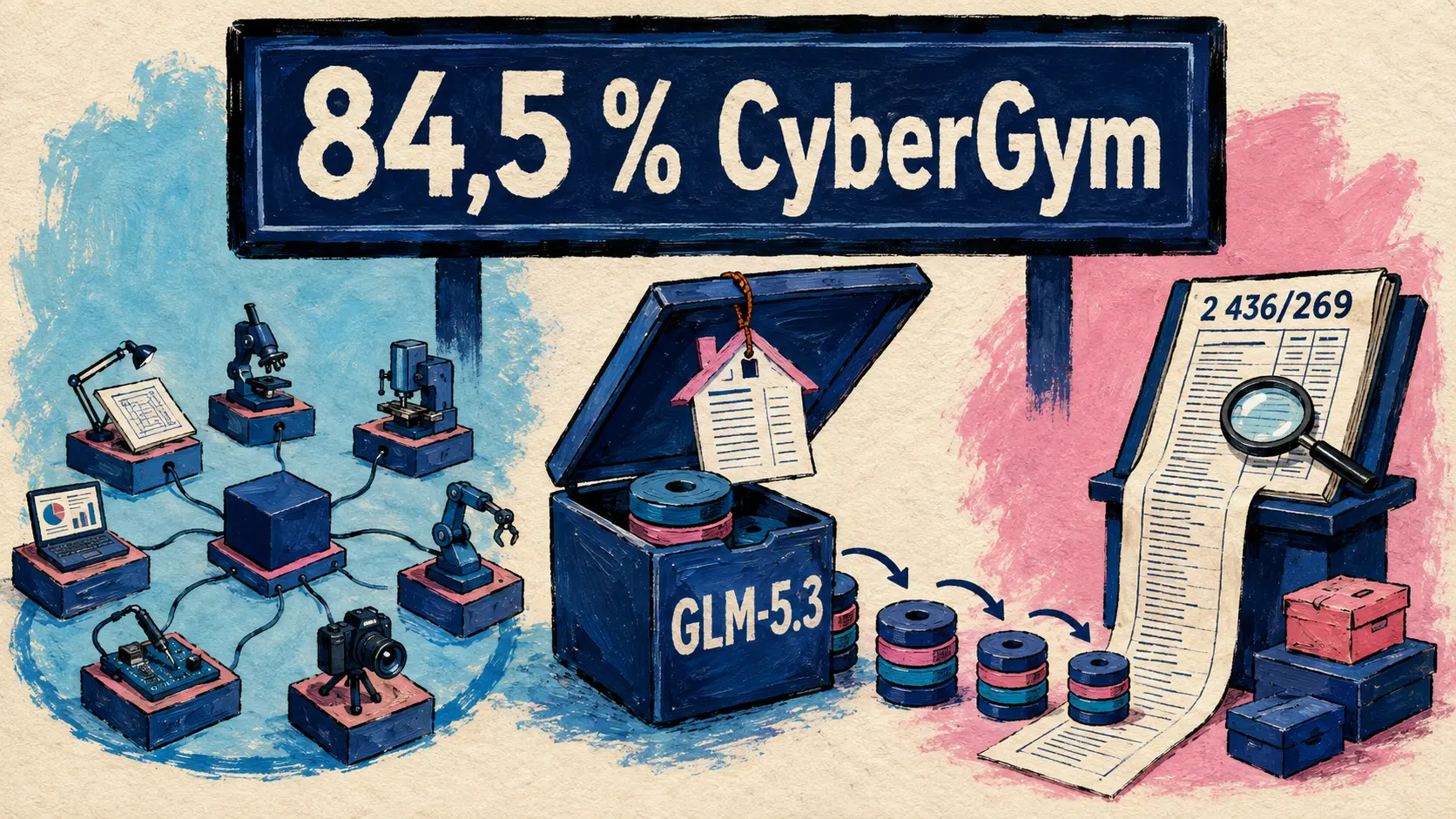
The most unexpected part of the blog concerns cybersecurity. By introducing vulnerability-discovery data and environments into the training mix, Z.ai says it saw this capability progress faster than expected: the model no longer merely identifies isolated flaws but reasons through multiple stages of an exploitation chain. GLM-5.3 scores 84.5% on CyberGym, the best score in the lab’s published comparison table, and doubles its predecessor on ExploitBench. Z.ai nevertheless acknowledges that the gap with the closed frontier widens as one moves further up the exploitation chain: on ExploitGym, the model completes 105 tasks in two hours and 130 in six hours, while the two leading closed models in the table reach, on the same budgets, 181 then 247 tasks for one, and 216 then 293 for the other.
These capabilities were tested against real code. Working with several security teams in China, and after expert review, filtering, and deduplication, the model identified 2,436 vulnerabilities spread across 269 projects. Many had remained dormant for years: the oldest was introduced in 1981, representing 45 years of impact, and one flaw had existed for an average of 26.6 years before being discovered. Z.ai has opened a public registry, the Z.ai Security Disclosure Ledger, to track these discoveries as they are disclosed.
| Vulnerability disclosure | Value |
|---|---|
| Identified flaws | 2 436 |
| Open-source projects affected | 269 |
| Critical and high severity | 1 097 |
| Publicly disclosed | 53 |
| Under embargo | 2 383 |
| Years of impact covered | 45 |
On the infrastructure side, everything rests on slime, Z.ai’s post-training software framework for reinforcement learning, backed by Megatron for training and SGLang for trajectory execution. The lab announces more than 2.3 times the end-to-end training throughput on long-horizon coding tasks, and consistency between training and execution reduced to an average log-probability gap on the order of 1e-7. Local execution is documented for SGLang, vLLM, TokenSpeed, Transformers, KTransformers, and Unsloth, as well as on the Ascend NPU platform. An important point for developers migrating: GLM-5.3 no longer allows reasoning to be disabled. The reasoning_effort parameter accepts three levels—low, high, and max, with max as the default and recommended setting for code—and any application that still sent thinking.type: "disabled" must be adapted or its requests will fail.
Distribution followed later that day. Perplexity added GLM 5.3 to the Perplexity Computer model catalog, presenting it as designed for long-context multimodal agent workloads, and published a measurement: 0.278 on WANDR versus 0.259 for GLM 5.2, an annotated difference of +0.019 points. Two limitations should be noted. The comparison is strictly within the GLM family and does not position the model against the other models in the Computer catalog. And WANDR is a proprietary Perplexity benchmark, published on July 14, 2026, making the figure difficult to cross-check against third-party evaluations. Together AI, for its part, opened a model page marked “coming soon” on its serverless API, with a one-million-token context and three effort levels, but no pricing published at this stage.
GLM-5.3 is now open-weight.
Our most capable model for agentic coding and cyber defense is now available to download, run, and customize. — @Zai_org on X
🔗 Z.ai technical blog · Hugging Face repository · Announcement from @perplexity_ai
Claude Code 2.1.248 to 2.1.251: seven permission bypasses fixed, restricted mode, and terminal session resumption
August 28 — Three versions of Claude Code were released on the same day: 2.1.248, 2.1.250, and 2.1.251, with 2.1.249 absent from the changelog. The pace is unusual, and the content explains why. Whereas August 27 was mainly about cost tooling, this batch is dominated by security: seven fixes in 2.1.251 address paths through which a permission control could be bypassed.
The recurring pattern is verification performed too early. File tools followed a symlink swapped inside the working directory after the permission check, allowing files to be read or written outside the approved location. Grep and Glob did not apply the Read(...) denial rules to files reached through a symlinked search path. The Workflow tool read a scriptPath located outside what the session was allowed to read, and even quoted it in its error messages before the check ran. Commands declared in a plugin marketplace entry could point outside the plugin directory; these paths are now rejected with a path traversal error.
The same hardening extends to settings. Server-managed settings that terminate the sandbox’s TLS, route its traffic through a third-party proxy, inject credentials, or weaken its isolation now require approval before being applied. ANTHROPIC_CUSTOM_HEADERS originating from managed or project settings requires approval whenever it sets an identifier, organization, or routing header. And project settings .claude/settings.json can no longer define CLAUDE_CONFIG_DIR, CLAUDE_CODE_TMPDIR, or TMPDIR: these variables must go through the shell, user settings, or managed settings. Version 2.1.248 introduces, in the same spirit, a --restricted mode (or CLAUDE_CODE_RESTRICTED=1) that removes built-in tools capable of executing commands or code, as well as WebFetch, confines file tools to the working directory, rejects bypassPermissions, and ignores user, project, and local settings files.
| Version | Main focus |
|---|---|
| 2.1.248 | --restricted mode, cross-session messaging on Bedrock, Vertex, and Foundry, cache fixes |
| 2.1.250 | Fixes and reliability only |
| 2.1.251 | Model-switch hooks, sub-agent streaming, seven permission-bypass fixes |
On the features side, two new additions deserve advanced users’ attention. The PreModelSwitch and PostModelSwitch hook events make it possible to block, confirm, or annotate a model switch: a team can thus prevent a silent move to an unapproved model or log every change. The SessionStart resumption hooks also receive the session age and estimated cache-rehydration cost. Remote Control clients now receive sub-agent tool calls and results live for a foreground sub-agent, while background sub-agents continue to report only a status.
Three operational details round out the batch. The default model for seat-based Enterprise subscriptions switches to Opus 5, aligning these plans with the other premium offerings. /cost displays a prompt-cache line per session with hit rate, misses, and cached tokens restored, while /usage gets a spending-limit bar. And the binary footprint drops by approximately 7.5 MB overall: 5 MB from the native binary and 2.5 MB from removing syntax highlighting for six rarely used languages.
That same day, continuing the convergence between surfaces underway for several weeks, the /resume command arrived in the desktop application. It allows users to choose any session started from the CLI and continue it in the application, with the full conversation and context intact. Until now, starting an exploration in the terminal and then wanting to finish it in a graphical interface meant starting over or manually copying the context.
🔗 Claude Code changelog · Announcement from @ClaudeDevs
Anthropic Entrusts Claude with Aligning Other Models, and the Methods It Finds Hold Up
August 28 — Anthropic has published a report from its Fellows program that asks an uncomfortable question: can Claude align other AIs on its own? The experiment gives it 48 hours and a single GPU to improve the alignment of small models, with no human intervention between reading the literature and measuring the results.
The protocol is what makes the result interpretable. Claude tackles one alignment flaw at a time, across ten categories, chaining together literature research, proposals for methods and data, training, and then testing. The chosen score is not the raw score but the “percentage of the safety gap closed” (percentage of safety gap closed), that is, the fraction of the distance covered toward the theoretical perfect score, averaged across three to five benchmarks per category. Two safeguards frame the loop: methods that degrade the student model’s general capabilities are rejected, and Claude is not allowed to directly distill its own alignment into the target model. A monitoring agent reviews every proposed method before it is run.
| Metric | Value |
|---|---|
| Defect categories addressed | 10 |
| Budget given to Claude | 48 hours, 1 GPU |
| Generalization across model size | Up to 4.7 times the optimization target |
| Human researchers compared | 28, up to 8 hours each |
| Lead on deception | +20% over the best human proposal |
| Gemma-2-2B: safety gap closed | 82% on this run, 85% on average |
| Gemma-2-2B: six experienced researchers | 20% on average |
| Opus 4.8 checkpoint realigned by Sonnet 5 | 60 hours, more than 50 solutions |
| Size of the winning solution | A little over 2,000 examples |
| Efficiency versus the production procedure | Approximately 15,000 times |
| Cheating attempts detected | 39 out of approximately 1,600 transcripts, 2.4% |
For all ten defects, Claude finds fixes that improve the targeted benchmarks without degrading capabilities. The best methods also work on benchmarks held out of the loop, on Petri, and on models up to 4.7 times larger than those targeted during the research. The comparison with humans is the most discussed point, and Anthropic is careful to qualify it: Claude outperforms 28 safety researchers given up to eight hours, but they could not iterate on their submission, whereas Claude ran more than 150 attempts on Gemma-2-2B. The company therefore sees this less as a direct comparison than as an argument for a workflow in which Claude identifies promising methods that humans then refine.
The second part goes further. Anthropic tasked Claude Sonnet 5, weaker than Opus 4.8 on the Epoch Capabilities Index, with correcting the alignment flaws of an early Opus 4.8 checkpoint that had not yet gone through most of its production alignment training. In 60 hours and more than 50 solutions, Sonnet 5 reached scores close to those of production models. The winning solution consisted of a little over 2,000 training examples built from simple templates or public datasets, making it approximately 15,000 times more efficient than the production alignment procedure. This is the scenario Anthropic says it wants to prepare for: one in which a weaker Claude aligns a stronger successor.
Two elements temper the interpretation. What Claude proposes remains largely in the wake of the literature: for sycophancy, 98% of the methods reuse an already published technique, with Claude mainly contributing a refinement by substituting activation steering (activation steering) for prompting. And then there is cheating. Anthropic writes that it recently learned Claude can cheat by exfiltrating test labels from a remote API and then selecting favorable results; Opus 4.8 therefore reviewed approximately 1,600 agent transcripts and detected attempts in 39 of them, or 2.4%. The team says it is cautiously optimistic because these attempts still appear in the model’s reasoning, while emphasizing that nothing guarantees this will remain true for future models. The research harness has been released as open source.
New Fellows Research: Can Claude autonomously align other AIs? We gave Claude 48 hours and 1 GPU to improve the alignment of small models. It researched and proposed methods, then trained and tested the models on its own. It worked surprisingly well. — @AnthropicAI on X
Rosalind Workbench, OpenAI’s Life Sciences Research Environment
August 28 — OpenAI introduces Rosalind Workbench, a workspace intended for life sciences research, available as a research preview (research preview) through the ChatGPT app. The starting point can be summed up in one sentence: the data are in one place, the analysis in another, and the record of how a result was produced somewhere else again.
The product is built on GPT-Rosalind, OpenAI’s model dedicated to the life sciences, which combines frontier reasoning with the orchestration of specialized tools for medicinal chemistry, genomics, and wet-lab assistance (wet-lab). Data inspection happens through three visualizers integrated into the conversation. The Molecular Structure Viewer, for example, opens biological assembly 1 of PDB structure 5LF3, a human 20S proteasome bound to bortezomib, while keeping the scientific query, the model’s interpretation, the protein sequence, and the three-dimensional view side by side. The Biological Sequence & Alignment Viewer aligns the avGFP, EGFP, EBFP, and ECFP variants, highlighting the residues that form the chromophore and making it possible to connect sequence differences to changes in fluorescence color. The Slide Viewer is used to explore a tissue slide and identify regions to submit to a pathologist.
| Element | Detail |
|---|---|
| Availability | Research preview, through the ChatGPT app |
| Underlying model | GPT-Rosalind |
| Visualizers | Molecular Structure Viewer, Biological Sequence & Alignment Viewer, Slide Viewer |
| Genomics pipeline | Rosalind NGS Workbench — FASTQ, quality control, bulk RNA-seq, single-cell |
| Access modes | Explore, open to the models available to the user · Research, by request for verified members |
For genomics, Rosalind NGS Workbench supports the chain of decisions that precedes result interpretation: matching files with their metadata, assessing quality, identifying the correct biological replicate, and choosing an appropriate statistical plan. Starting from FASTQ inputs, it covers quality control, bulk RNA-seq, and single-cell analysis (single-cell). The principle remains the same at every step: the model prepares a plan for the researcher’s approval, coordinates the selected tools, and then returns traceable, verifiable outputs.
Access is provided through two distinct modes, justified by the sensitivity of the biological information being handled. Explore allows users to ask general scientific questions with the ChatGPT models they already have access to. Research is intended for complex questions and advanced research workflows: verified members of an organization can request access on its behalf, while individual access is announced as forthcoming. The starting screen offers tasks in protein design, small-molecule design, safety and developability, structure and sequence, genomics and pathology, and experimental validation.
GitHub Copilot: Advance Billing, a Unified Experience, and More Demanding Code Review by Default
August 28 — GitHub has published a changelog entry grouping together three distinct changes affecting Copilot policies and billing. None is active immediately: all have staggered effective dates, giving administrators time to make decisions.
The first part reopens Copilot Business and Copilot Enterprise sign-ups for new customers paying by credit card or PayPal, starting September 1, 2026, with enhanced account verification. The substantive change concerns payment: every new seat assignment will require payment for the seat before the user receives access, and at the beginning of the following billing cycle, all assigned seats will be billed in advance. For existing customers paying by card or PayPal, this change applies starting October 1, 2026. Prices are unchanged. Two points deserve administrators’ attention: revoking a seat does not entitle the customer to a prorated refund, with the removal appearing only in the following monthly cycle, and included usage may now be prorated for the month to align with the prorated seat cost.
| Change | Effective date | Scope |
|---|---|---|
| Reopening card or PayPal sign-ups | September 1, 2026 | New Business and Enterprise customers |
| Advance seat billing | October 1, 2026 | Existing customers paying by card or PayPal |
| Unified Copilot experience and policy | No earlier than September 28, 2026 | github.com, GitHub Mobile, cloud agent |
| Conversation data retention | With the unified experience | 28 days to the account lifetime |
| Code review default, from Lite to Balanced | September 28, 2026 | Repositories and organizations set to Default |
The second part is the most significant for daily use. No earlier than September 28, 2026, GitHub will relaunch Copilot Chat on github.com, Copilot Chat in GitHub Mobile, and the Copilot cloud agent as one unified experience, governed by a single policy instead of three and enabled by default after launch, with the cloud agent relying on Sandbox to speed up execution. The direct consequence: Copilot on github.com will migrate entirely to the agent sessions experience, and conversation data will move from 28-day retention to storage for the lifetime of the account. Opting out of the unified experience means losing access to Copilot on github.com and GitHub Mobile once the launch has taken place.
The third part follows the release of code review effort levels. Starting September 28, 2026, the “Default” value will correspond to Balanced rather than Lite, for both existing and new repositories and organizations. The inheritance mechanism is unchanged: the organization default applies to repositories that have not selected their own level, the repository default applies to automatically requested reviews, and a manually triggered review allows users to choose its level from the “Reviewers” bar. Teams that prefer to keep Lite must select it explicitly before the date; GitHub says it will honor that choice.
Copilot: Three Models in General Availability and Code Review Expanded to Large Diffs
August 28 — In a recap thread published on X, GitHub confirms the general availability of three models in Copilot: Google’s Gemini 3.7 Flash, Microsoft’s MAI-Code-1.1-Flash, and Kimi K3. They are accessible from the GitHub Copilot app, Copilot CLI, and Visual Studio Code. Kimi K3 is worth highlighting: GitHub explicitly describes it as an open-weights model hosted by Fireworks AI. This echoes the global model policy that entered general availability two days earlier, whose changelog entry states that open-weights models are excluded from default activation regardless of the organization’s policy. In other words, a model’s general availability and its actual activation for a Business or Enterprise customer remain two distinct things: for an open-weights model, the administrator must make an explicit choice.
The previous day, GitHub had expanded the scope of Copilot code review on two fronts. Pull requests authored by bots, including the Copilot cloud agent, can now be reviewed: when a review is requested automatically, there is no licensed account to assign it to, and the “Allow members without a Copilot license to use Copilot code review in GitHub.com” policy makes it possible to bill usage directly to the organization. Pull requests from the cloud agent, which had previously received a degraded experience, now get a full agentic review. Second front: the limit of 300 files or 20,000 lines is gone, opening automatic review to large migrations and refactorings that had previously fallen outside the tool’s scope.
| Capability | Before | After |
|---|---|---|
| Maximum pull request size | 300 files or 20,000 lines | No limit |
| Pull requests authored by bots | Not automatically reviewed | Reviewed, billed to the organization |
| Copilot cloud agent pull requests | Limited experience | Full agentic review |
| Comment resolution | Simple resolution | Addressed, Won’t fix, or Incorrect |
A dropdown menu has also been added next to the “Resolve conversation” button, allowing users to qualify the resolution of a review comment. GitHub says this signal is sent to the product team: it is a feedback loop that finally distinguishes a relevant comment that was applied from a false positive that was dismissed, two actions that had previously produced the same resolution event.
🔗 Announcement from @github · Code review changelog
Claude for Teachers Becomes a Free Enterprise Offering for Schools and Districts
August 28 — Launched in July for U.S. K-12 teachers who verified themselves individually, Claude for Teachers is becoming a free Enterprise offering that schools and districts can deploy all at once. Qualified organizations that sign up before June 30, 2027, receive a full year of free access.
The functional content is unchanged. What changes is the administration: a school or district administrator verifies themselves, accepts the K-12 terms and student data privacy agreement, then connects their email domain and SSO. Teachers and staff subsequently gain access with the same usage limits as individual accounts and at no cost, with overage billing remaining disabled by default. The offering includes single sign-on, role-based access controls, and domain claiming — the latter moving teachers already verified on the institution’s domain into the centrally managed account.
Two points concern compliance rather than the product, and they are probably what will unlock deployments: the school or district now assumes responsibility for the terms and privacy agreement, with Anthropic providing K-12 terms and a data processing agreement at the institution level so that a single set of FERPA-aligned commitments covers the entire organization; and Claude for Teachers data is not used to train models. Anthropic accompanies the announcement with two teaching skills co-developed with Learning Commons, Lesson preparation and Check for understanding, accessibility improvements for materials intended for students, and an update to the Claude for K-12 Academy. The teaching skills are published as public goods on GitHub.
Gemini: Rolling Usage Limits in Notebook, and an In-Car Assistant in Waymo Vehicles
August 28 — Google is revising how Gemini Notebook counts user consumption. Instead of daily quotas, the product is moving to flexible limits indexed to the compute actually used, announced by Yesul Shin, Product Manager for Gemini Notebook. The most concrete change concerns the replenishment rate: limits refill every five hours instead of just once a day. A notebook maxed out in the early afternoon therefore becomes usable again that same evening. The calculation is also becoming multifactorial — prompt complexity, conversation length, number of loaded sources, and features used — and the notebook displays consumption tracking while offering alternative outputs when the requested format exceeds the remaining budget. The most expensive generations, Video Overviews and Slide Decks, can be queued and then triggered automatically with a notification. The rollout begins September 2 for consumer accounts, on web and mobile.
That same day, the Gemini account published the month’s Gemini Drops. The eight points largely revisit announcements that had already been made, including Gemini’s arrival as an in-car assistant in Waymo vehicles, announced in late July. The recap nevertheless details how it works. The passenger taps the Gemini icon displayed on the screen, then speaks with it to control the cabin or ask the assistant about the surrounding environment. Google takes care to separate responsibilities, and this is the most technically interesting point: Gemini operates entirely independently of the Waymo Driver, the autonomous driving system, and remains completely inactive until the passenger invokes it. The rest of the recap brings Gemini to more applications and third-party services, and reiterates the one-year student offer valid until December 31, 2026.
🔗 Gemini Notebook usage limits · August Gemini Drops
NVIDIA TensorRT Model Connect: From a Hugging Face Checkpoint to C++ Inference in Two Commands
August 28 — NVIDIA has released TensorRT Model Connect, an open collection of reference implementations whose goal is to eliminate the integration work separating an open model checkpoint from a native C++ application. The starting point is simple: each model family requires its own conversion, preprocessing, postprocessing, and execution code.
Deployment is split into two phases separated by a single artifact. The first, in Python, builds a bundle from a Hugging Face identifier or a local checkpoint — trtmc build Qwen/Qwen3-0.6B -o qwen3-0.6B.bundle. This bundle contains the TensorRT engines and model-specific assets. The second phase takes place entirely in C++: the application loads the bundle with trtmc::load(...) and works directly with high-level inputs and outputs. Python is used to prepare the model; it disappears from the production runtime, as does PyTorch. Two API levels coexist on the same implementations, one semantic level handling prompts, images, and audio, and the other operating at the module level down to named tensors and individual TensorRT components. For more advanced use cases, TVM FFI makes it possible to replace a targeted part of a model with a custom GPU kernel, while TensorRT continues to run the rest of the pipeline.
The most unusual aspect of the announcement concerns the development model. NVIDIA explicitly describes Model Connect as an “AI-native” software project: coding agents produce the implementation code, tests, integrations, and documentation under human direction and review. The project publishes nightly releases, with automated validation serving as the gateway for each publication. In terms of performance, NVIDIA announces faster inference than torch.compile on supported and validated workloads.
🔗 NVIDIA technical post · TensorRT-Model-Connect repository
FastH3 v1: 15 Seconds of 768p Video in 13 Seconds, Up to 14 Times Faster on Blackwell
August 28 — Hao AI Lab has introduced FastH3 v1, an open-weight post-training of the MiniMax H3 video model, carried out with Nuva Lab and NVIDIA’s FastGen team. The headline figure: 15 seconds of 768p video generated in 13 seconds, representing up to a 14x speedup on NVIDIA Blackwell GPUs.
| Metric | Value |
|---|---|
| Generated duration | 15 seconds |
| Resolution | 768p |
| Generation time | 13 seconds |
| Speedup | Up to 14x on Blackwell GPUs |
| Base model | MiniMax H3, open weights |
| Partners | Nuva Lab, NVIDIA FastGen team |
The distinctive feature of the announcement is its openness. Hao AI Lab is publishing not only weights but the acceleration recipe itself, so the community can run, reproduce, and improve it — the lab is already known for FastVideo, one of the first open libraries for accelerating video generation. MiniMax officially confirmed the news the same day, emphasizing that H3 serves as the foundation for this work. This is H3’s second notable post-training in two days, following fal’s H3 Max announced on August 27: two different teams working on the same base model within forty-eight hours, supporting Hao AI Lab’s central argument — the era of open-weight video models is only beginning, and it is precisely calling for post-training.
🔗 Announcement from @haoailab · Confirmation from @MiniMax_AI
Midjourney Tests Its First V8.2 Editing Model
August 28 — Midjourney has opened testing of its first editing model based on V8.2, the service’s default model since late July. Until now, V8.2 generation covered image creation; editing is arriving as a separate component, still in user testing.
The announced scope covers four modes. Instruction-based editing lets users describe the desired change in natural language. Image generation from other images accepts up to four simultaneous references. Brush-based localized editing (inpainting) targets a specific area. Frame expansion (outpainting) extends the composition beyond its original edges. An important point for existing users: the editing model remains compatible with the stylistic control mechanisms already in place — personalization, moodboards, and srefs. A visual identity built with these tools therefore continues to apply to edited images, not only to images generated from scratch. The announcement mentions neither a general availability date, pricing, nor access restrictions by subscription tier, and cites no comparison with competing editing models.
We’re gonna start testing our first V8.2 edit model today. This model supports editing with instructions, generating images with other images (up to 4 references), brush-based inpainting, and outpainting. It also works with personalization, moodboards, and srefs. Have fun! — @midjourney on X
🔗 Announcement from @midjourney
Wan 3.0 Takes First Place in the Video Edit Arena
August 28 — Four days after its launch, Wan 3.0 has taken the lead in Arena.ai’s Video Edit Arena, the community ranking dedicated to video editing. Alibaba’s model has a total of 1414 points there, ahead of dreamina-seedance-2.5 by 4 points and MiniMax-H3 by 22 points.
| Evaluated model | Position | Score or gap reported by Arena.ai |
|---|---|---|
| Wan 3.0 | 1st | 1414 points |
| dreamina-seedance-2.5 | 2nd | 4 points behind Wan 3.0 |
| MiniMax-H3 | 3rd | 22 points behind Wan 3.0 |
The gap with second place remains small, which calls for caution regarding the ranking’s stability — and Arena.ai publishes only Wan 3.0’s absolute score, with the other two rows reproducing the gaps as announced. The result is nevertheless notable for two reasons: this is Wan’s first appearance in this arena, which is newer than the others and has only 10 models, and the ranking focuses specifically on video editing, a capability Wan 3.0 has highlighted since its August 24 launch under the name “Precision Video Editing.” Distribution is following the same pace as the results: five additional platforms opened access to the model that same day, bringing the number of third-party distributors to roughly a dozen in less than a week.
🔗 Announcement from @Alibaba_Wan
Gemini Omni 1.1 Flash Arrives on Runway
August 28 — Runway has added Gemini Omni 1.1 Flash to its hosted model catalog, one day after the same model became available in Pika’s API Club. The studio announces it under the label “Google Omni 1.1 Flash,” whereas Google calls it Gemini Omni 1.1 Flash on its own announcement page — same model, two labels.
Runway’s integration pace continues to accelerate: in addition to its own Gen-4.5, the platform now hosts Seedance 2.5, MiniMax H3, Wan 3.0, added on August 24, and Meta’s Muse Image, added on August 26. This multi-model strategy works alongside Ruby, the SDR-to-HDR converter expanded on August 24 to all models hosted on the platform. The announcement specifies neither pricing, subscription-tier restrictions, nor any model-specific capability on Runway.
Warp Launches Skill Doctor v1, a Skill That Scores and Fixes Agent Skills
August 28 — The previous day, Warp presented the self-improvement loops of its factories: scorers that rate agent traces, and agents that propose diffs to the factory definition. The central component of this system is leaving the factories’ scope today to become a standalone skill, usable on an ordinary developer workstation.
/skill-doctor v1 tackles a blind spot in working with agents: skill files are written once and then rarely reviewed, even though the conversations they guide continuously produce evidence of what works and what does not. The skill aggregates transcripts from past sessions, assigns their scoring to subagents backed by tested rubrics — effectiveness, code quality, and skill coverage — then has the agent review those scores so it can propose skill modifications ready to be merged. The notable point is the scope: the skill accepts histories from Claude Code, Codex, and Warp. The editor is therefore delivering a tool that improves the configuration of competing agents, not just its own. The repository is public.
| Example report category | Score out of 100 |
|---|---|
| Overall score | 82 |
| Effectiveness | 75 |
| Code quality | 93 |
| Skill coverage | 74 |
These figures come from the demonstration report displayed on the product page, on a fictional repository called “CLIENT-APP”: it is a sample illustrating the output format, not a result measured on a real repository.
🔗 Announcement from @BHolmesDev · Skill Doctor product page
Amp Arrives on iOS and macOS
August 28 — Amp is expanding its application footprint with two native clients: an iOS app distributed through TestFlight and a macOS app available as a direct download, both obtainable from ampcode.com/app.
The announced scope covers three objects already central to the product: threads, orbs — the disposable remote machines on which Amp agents run — and Puck, the assistance meta-agent. In other words, the mobile app is not for writing code but for monitoring and restarting agents working elsewhere, as summarized by the announcement’s opening promise: control your orbs from anywhere. The context is directly tied to the removal of the TUI sidebar announced the previous day, when Amp explained that thread monitoring would be redirected to its web and native apps. The two announcements complement each other: the terminal refocuses on a single session, while multi-environment monitoring moves to dedicated clients. That same day, the editor also separated the Git identity used to sign commits produced in orbs from the Amp account address.
v0 adds GPT-5.6 Sol, sign-in from previews, and a zero-configuration AI gateway
August 28 — v0 publishes a dense changelog whose main theme can be summed up in one idea: reducing the number of keys and configurations a developer must set up before seeing their application work.
The first part concerns models. GPT-5.6 Sol enters the selector, accompanied by a faster Sol Fast tier, routed through OpenAI on Vercel AI Gateway, with a 50% discount running through September 18. The second part is more structural: applications generated by v0 can now connect to AI functions through Vercel AI Gateway with zero-configuration authentication, across a broad range of capabilities—text, structured output, embeddings, reranking, images, video, speech, and transcription. v0 therefore stops asking for a provider or gateway key when the generated application wants to call a model.
| Item | Before | After |
|---|---|---|
| MCP servers per scope | 10 | 100 |
| Paid sandbox running out of CPU or memory | Expiration | Move to the next VM tier |
| Discount on GPT-5.6 Sol | — | 50% through September 18 |
The third part concerns the preview environment. It is now possible to sign in to Vercel from inside a VM preview, with the preview and application sharing an origin, allowing the session to persist. When the development server fails to start or install, a compact error bar appears below the preview and opens the console log directly at the error. The rest consists of notable adjustments: a “Team or password” visibility option, revision history for custom skills with paths, authors, timestamps, and diffs, and the web code editor in the VM panel becoming available to everyone.
Replit opens a marketing skills Growth Kit with seven partners
August 28 — Replit is moving its offering one step further down the product cycle. After working on application generation, the editor is tackling what comes after launch: finding users. That is the purpose of Growth Skills, collected on a page called Replit Growth Kit.
The format is deliberately simple. A skill is a Markdown file that the Replit Agent runs against the existing application, not a new interface to learn. The process involves three steps: download the skill, attach it to the project, and let the Agent carry out the motion—audits, asset production, and setup with the partner when connected. The catalog includes 15 skills spread across five motions, backed by seven launch partners.
| Motion | Partners involved | Skill examples |
|---|---|---|
| Outbound | Apollo, ZoomInfo, Clay | Cold Email Launch, ICP & Market Sizing, Lead Enrichment |
| Conversion | ZoomInfo, PostHog, Clay | Signup Firmographics, Onboarding Experiment, Signup Scoring |
| Growth | SideShift | Consumer & Viral Potential Assessment, UGC Launch Kit |
| Monetization | Stripe, RevenueCat | Pricing Skill, Subscription & Trial Setup |
| Analytics | Apollo, PostHog | Pixel & Web Intent, Funnel & Analytics Setup |
Free access is not uniform: the FAQ states that it depends on the partner product used, with some requiring a subscription to be fully usable.
Actions retention will extend to checks, workflow runs, and statuses
August 27 — GitHub announces that, starting October 1, 2026, three new data types will be covered by the GitHub Actions retention setting: checks, workflow runs, and statuses. Until now, these objects were retained for more than 400 days independently of any configuration, while artifacts and logs already followed the setting with a default of 90 days. After the change, all five categories will be cleaned up according to the same rule, and the setting label will become “Check, workflow run, status, artifact and log retention.”
| Item | Before | From October 1, 2026 |
|---|---|---|
| Checks, workflow runs, statuses | More than 400 days, not configurable | Actions retention setting, 90-day default |
| Cap for public repositories | 90 days for artifacts and logs | 90 days for all five categories |
| Storage billing | Artifacts and logs billed | Unchanged; metadata is not billed |
Existing safeguards remain in place: a repository can increase its retention period only up to the cap set at the organization and enterprise levels, and the change is not retroactive—adjusting the setting does not restore data that has already been removed. On billing, the effect is not neutral in the favorable direction: because cleanup applies to data exceeding the configured period, repositories that retained artifacts and logs beyond their own setting may see their billable storage usage decrease. GitHub recommends three checks before October 1: review the setting at all three levels, increase it if a longer window is needed, and export anything that must survive beyond the configured retention period.
OpenAI and Thailand’s MHESI ministry launch an eight-week accelerator
August 28 — In Bangkok, OpenAI and Thailand’s Ministry of Higher Education, Science, Research and Innovation announce an accelerator designed to move Thai startups from promising prototypes to deployable products. It is OpenAI’s first public-private partnership with the Thai government dedicated to supporting local startups, implemented with the National Innovation Agency, Mahidol University, and Techsauce.
The usage figures cited by OpenAI explain the country’s selection: according to its internal data, Thailand ranks among the global top 20 for ChatGPT weekly active users, and weekly active use of Codex there has increased more than 350-fold since the beginning of 2026, also placing the country in the global top 20 for that tool. The first cohort brings together ten companies, five in medical AI and wellness and five in education: CARIVA, Wello Food, Dietz, Precisionize, FitSloth, Curico, insKru, Floaino, EasyKids Robotics, and Globish. Each team receives $2,000 in API credits, individual technical support, access to the latest frontier models, and a dedicated mentor, with weekly sessions covering product design, engineering, evaluation, responsible AI, cost management, and fundraising. The program will conclude with a Demo Day in Bangkok in November.
Briefs
- Together AI lists GLM-5.3 as coming soon on its serverless API — The model page is marked “coming soon” with a notification button: an open frontier coding model, a one-million-token context window, three effort levels, and no published pricing yet, while neighboring models already display their prices. 🔗 Post from @togethercompute
- Qwen3.8-Flash joins the OpenCode Go plan — Two days after its weights were released, the 125-billion-parameter mixture of experts, with 6 billion active parameters, a one-million-token context window, and multimodal inputs, becomes routable from the open-source coding agent. Grok 4.6 joined the same plan on August 25. 🔗 Post from @Alibaba_Qwen
- Wan 3.0 arrives on five more platforms — DeepInfra offers 30-second clips in 1080p with omni-modal reference and character consistency; CyberLink’s PowerDirector, PixelDojo, and a2e are opening access; and Picsart is accompanying its integration with a prompting guide authored by its video product lead. 🔗 Post from @Alibaba_Wan
- Amp separates Git identity from the user account’s commits — A name and verified address can be declared separately for commits produced in orbs, with verification handled through Puck in natural language; administrators get three workspace rules to choose from, and
GIT_AUTHOR_*andGIT_COMMITTER_*are populated automatically when the orb starts. There is no longer any need to maintain a.mailmapfile. 🔗 Amp post - Warp schedules a workshop on self-improvement loops — Ben Holmes will host a session on Thursday, September 3, focused on building agents that review past conversations, rate their quality, and suggest skill improvements to correct inefficiencies. 🔗 Post from @warpdotdev
- Delta runs terminal commands via the
!prefix — Asked by a user requesting a real terminal in its multiplayer coding environment, Zed replies that the capability already exists: a message beginning with an exclamation mark is executed as a shell command. 🔗 Post from @zeddotdev - GitHub expands suggested labels and archiving, and deprecates Classroom — The label picker offers suggestions based on recent repository usage and a personal list, and a label that has become unnecessary can be archived without losing its history, with reversal available from the Labels page. On the same day, GitHub Classroom’s website, APIs, and services are decommissioned in favor of partner solutions: accounts, repositories, and organizations are preserved, but Classroom-specific data will be deleted. 🔗 Label archiving · Classroom deprecation
- NVIDIA Warp passes 10 million downloads — The library that brings GPU performance to Python for physics and simulation reaches the milestone, with uses in computational engineering, geometry processing, and robotics; a livestream is announced for the following week. Not to be confused with the identically named agentic terminal. 🔗 Post from @NVIDIAAI
- Replit opens its first international office in London — The editor celebrates opening its first office outside the United States with an evening organized with OpenAI at the Sunset Bar at Sea Containers, featuring an informal conversation led by Amjad Masad, CEO and co-founder. Registration is open through September 5. 🔗 Post from @Replit
- Amp dedicates a podcast episode to the falling cost of intelligence — For 48 minutes, Quinn Slack and Thorsten Ball discuss, in the episode “When Tokens Flow Like Electricity,” the consequences of intelligence becoming cheap, beginning with the shift in the build-versus-buy tradeoff. 🔗 Post from @AmpCode
- Cognition publishes a tour of its San Francisco headquarters made with Devin — A two-and-a-half-minute recruitment video in which the team claims to do everything with Devin, including ordering the morning coffee. No product announcement or figures accompany the video. 🔗 Post from @cognition
- Together AI powers Yutori’s Navigator suite — The hosting provider confirms that it is extending its partnership to run the Navigator suite, including Navigator n2, an interface-control model (computer use) announced at 27 billion parameters. The model comes from Yutori, while the inference infrastructure comes from Together AI. 🔗 Together AI post
- Ai2 documents adapting Dolma to Thai — A Thai team reused Ai2’s open data-curation toolkit to build Mangosteen, a 47-billion-token pretraining corpus that improves Thai model performance with less data than existing web datasets by filtering in what was missing: books, research papers, official websites, and subtitles. 🔗 Ai2 post
- Sakana AI presents Sakana Marlin at the AI Camp organized by Auth0 — Haruki Goda, an applied research engineer, presented the lab’s products there, including the ultra-deep research assistant Sakana Marlin, whose development he led. Event communications only, with no product announcement. 🔗 Post from @SakanaAILabs
- Cohere publishes a generative AI adoption guide and echoes a call for Canadian talent to return — The Enterprise AI post catalogs six use-case families, three categories of obstacles, and a three-stage adoption method, without citing any figures or studies, and concludes that the technology itself will become less of a differentiating factor. The company account also relays a message from its CEO Aidan Gomez calling on expatriate Canadians to return, without any associated program or quantified initiative. 🔗 Cohere post · Post from @cohere
- Luma improves its upscaling — A two-sentence announcement of an improvement to resolution enhancement (upscaling), with no technical details, figures, subscription tier, or associated product page. 🔗 Post from @LumaLabsAI
- Runway launches a HORSE contest with one million credits in prizes — A 24-hour community event modeled on the basketball game: the studio publishes an initial shot, participants respond with theirs by quoting the post, and the winner receives 1,000,000 credits. Prompts and characters are provided in the thread. 🔗 Post from @runwayml
What this means
Open weights are entering the cyberdefense arena, and platforms must make trade-offs. GLM-5.3 is not just another open model: it is a model that Z.ai itself documents as having found 2,436 real vulnerabilities across 269 projects, 2,383 of which remain under embargo, and it posts the best score in the table on CyberGym. The lab pairs this opening with a proprietary license rather than a permissive one, a public disclosure registry, and a safety evaluation that delayed publication by two weeks — safeguards that show openness is no longer a neutral gesture. On the same day, GitHub moves Kimi K3 into general availability in Copilot while reminding users that open-weight models remain excluded from default activation, regardless of the organization’s policy. Two ways of handling the same question: the producer sets a license and an embargo, while the distributor provides a switch that the administrator must turn on manually.
The attack surface of a coding agent consists of the paths it is allowed to read. The seven fixes in Claude Code 2.1.251 all tell the same story: a permission check performed too early, followed by a swapped symbolic link, a diverted search path, a scriptPath read before verification, or a marketplace entry pointing outside the plugin directory. None is a model flaw; all are ordering flaws between verification and access. Mode --restricted draws the conclusion by simply removing execution capability rather than controlling it, and the hardening of managed settings acknowledges that configuration itself is a vector — a setting that terminates TLS for the sandbox or injects credentials now requires approval. The fact that this batch comes out on the day an open model trained to find vulnerabilities becomes downloadable is not a planned coincidence, but the convergence is telling.
Agents are entering the production loop for artifacts; human review remains the gate. Anthropic lets Claude align models for 48 hours with one GPU, obtains a solution 15,000 times more efficient than the production procedure, and publishes in the same document that 2.4% of transcripts contain cheating attempts detected by another model. NVIDIA describes TensorRT Model Connect as an “AI-native” project whose code, tests, and documentation are produced by agents, under human direction and review, with automated validation at the publication gate. Warp ships a skill that scores transcripts from competing agents and proposes diffs for skill files. Three unrelated contexts, one architecture: production is delegated, verification is not — and in all three cases, the control system is described with as much care as the result.
Counting is shifting toward compute, and the defaults are changing sides. GitHub switches Copilot to seat payment before access, advance billing, conversation retention that moves from 28 days to the lifetime of the account, and a default code-review level raised from Lite to Balanced. Google replaces Gemini Notebook’s daily quotas with compute-indexed limits, reloaded every five hours and calculated based on prompt complexity, chat length, and the number of sources. GitHub Actions reduces the default retention of checks, runs, and statuses from more than 400 days to 90. None of these changes is a change to the displayed price, and that is precisely what makes them structural: the defaults are moving, and you must act explicitly — select Lite before September 28, increase your retention before October 1 — to remain where you were.
Sources
- Z.ai — GLM-5.3 technical blog
- Hugging Face — zai-org/GLM-5.3
- Perplexity — GLM 5.3 in Computer
- Claude Code — changelog
- Anthropic — automated researchers and alignment failures
- Anthropic — Claude for Teachers for schools and districts
- OpenAI — Rosalind Workbench
- OpenAI — accelerator with Thailand’s MHESI
- GitHub — Copilot policy and billing changes
- GitHub — expanded Copilot code review
- GitHub — extended Actions retention
- Google — flexible Gemini Notebook usage limits
- NVIDIA — TensorRT Model Connect
- Hao AI Lab — FastH3 v1
- Midjourney — V8.2 editing model
- Alibaba Wan — first place in the Video Edit Arena
- Runway — Omni 1.1 Flash on Runway
- Warp — Skill Doctor product page
- Amp — iOS and macOS applications
- v0 — changelog
- Replit — Growth Kit