ai-powered-markdown-translatorArticle translated from fr to en with gpt-5.4-mini.
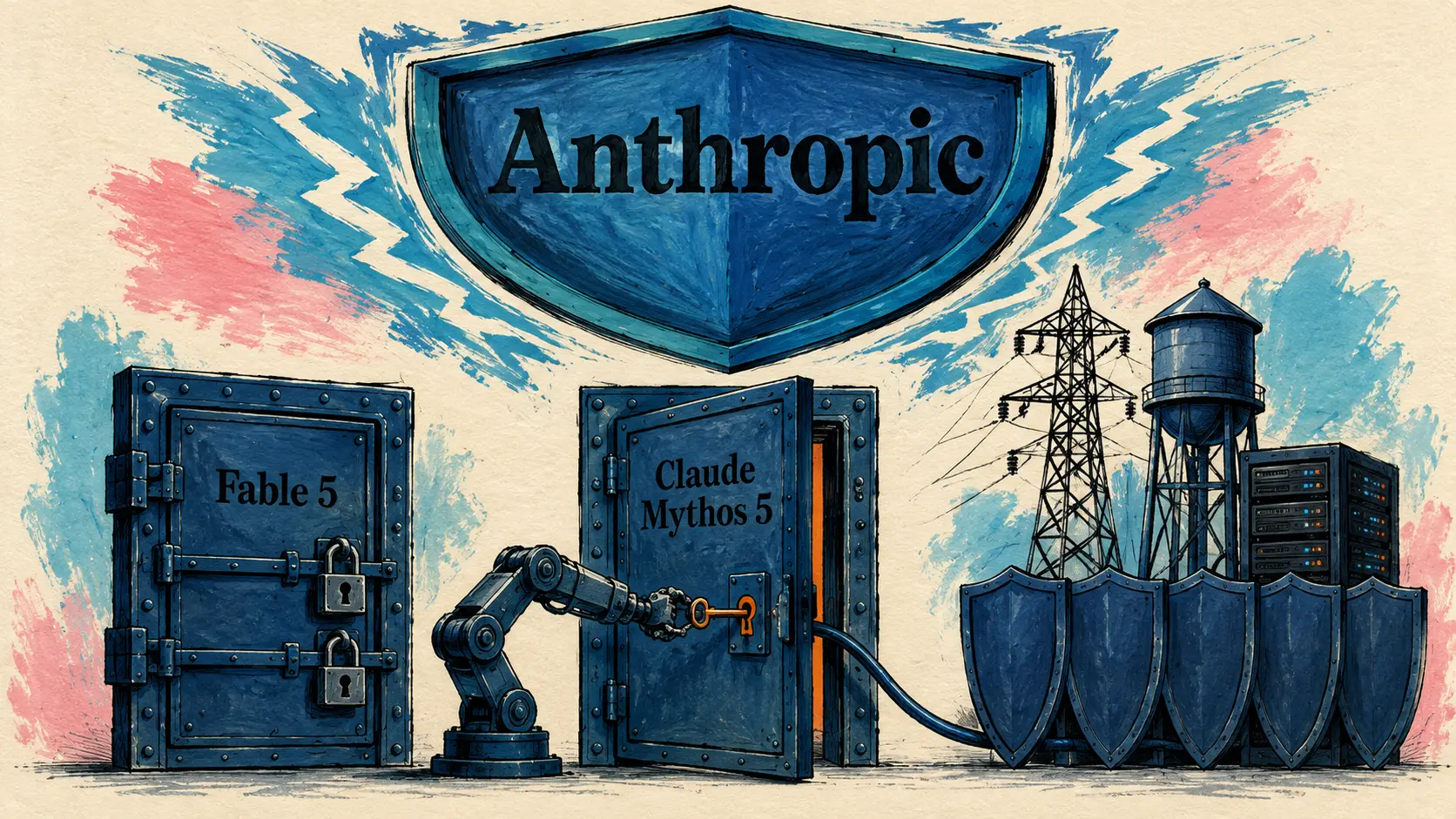
A quiet Sunday for AI: only one major announcement, but an important one — on June 27, Anthropic obtained authorization from the U.S. government to partially restore access to Claude Mythos 5, suspended since June 12, for organizations that operate and defend critical infrastructure in the United States. Fable 5 remains suspended, and negotiations continue. On the tooling side, GitHub Copilot App integrates the experimental skill /impeccable for interface redesign, and Codex gets several quality-of-life improvements.
Claude Mythos 5 restored for critical U.S. infrastructure
June 27 — On June 12, 2026, Anthropic suspended access to Claude Mythos 5 and Fable 5 following a decision by U.S. authorities. Fifteen days later, the government notifies Anthropic that a partial restoration is authorized: Mythos 5, Anthropic’s most powerful cybersecurity model, can be redeployed for a specific scope — U.S. organizations that operate and defend critical infrastructure.
Anthropic says it will restore access “rapidly” for these organizations, while continuing discussions to broaden the availability of Mythos 5 and make Fable 5 accessible to the general public again. The official tweet from @AnthropicAI, which generated 4.5 million views, 29,000 likes, and 4,000 retweets, sums up the situation:
We’re restoring access for these organizations quickly, and we’re continuing to work with the government to expand access to Mythos 5 and make Fable 5 available for general use again. — Since June 12, we’ve been working closely with the US government to restore access to Claude Mythos 5 and Fable 5. Today, the government notified us that Mythos 5, our strongest cybersecurity model, can be redeployed to a set of US organizations that operate and defend critical infrastructure.
Briefs
-
GitHub Copilot App — experimental
/impeccableskill (June 28) — The GitHub Copilot app integrates a new experimental skill/impeccablethat makes it possible to carry out a complete UI redesign in a single command. Demonstrated by a demo from @cassidoo on her PocketCal app. Enable it in Settings > Experimental. 🔗 Tweet @github -
Codex — quality-of-life updates (June 27) — @OpenAIDevs details several improvements to the Codex app: smoother scrolling in long threads, a navigation rail to jump from one turn to the next, expanded search in settings, and copy-paste Markdown from Codex to Slack without losing formatting. 🔗 Tweet @OpenAIDevs
What this means
Access to AI cybersecurity models is becoming a government-regulation issue. The partial restoration of Mythos 5 — reserved for critical infrastructure defenders — sets a precedent: U.S. authorities are now differentiating use cases based on the operator profile and the nature of the model. This is not unlike the restrictions announced the same week on other frontier models. Cybersecurity appears to be the first domain where the U.S. state imposes explicit access conditions, beyond the export controls already in place. Fable 5, meanwhile, remains suspended — a sign that public access to a model of this power is the subject of more complex negotiations.
National security is redefining competition among frontier providers. The ability to negotiate government authorizations for sensitive models is becoming a strategic advantage just as important as benchmark performance. Anthropic finds itself in an unprecedented position: simultaneously managing a conditionally accessible model (Mythos 5, critical infrastructure) and a model awaiting reinstatement (Fable 5, general public). This split between the open market and the sovereign market could become the norm for the most capable models of the next generation, raising the question of who, ultimately, decides access to the most powerful AI tools.