ai-powered-markdown-translatorArticle translated from fr to en with gpt-5.6-luna.
Twenty-two announcements across eight areas for August 29: a quiet Saturday, half as packed as the previous day. The dominant development is contractual rather than technical. OpenAI notified SpaceX of its intention to stop supplying its models to Cursor, with a proposed termination date of November 12, explicitly citing the past behavior of Elon Musk’s companies. Anthropic, for its part, announces a permanent 25% increase in Claude Code’s weekly limits which translates — by its own admission — into a 17% decrease compared with today. GitHub is moving Copilot CLI to a native Rust runtime, Together AI is putting GLM-5.3 online on the very day it becomes available, and an inference gateway is publishing production figures that finally establish the real position of open weights.
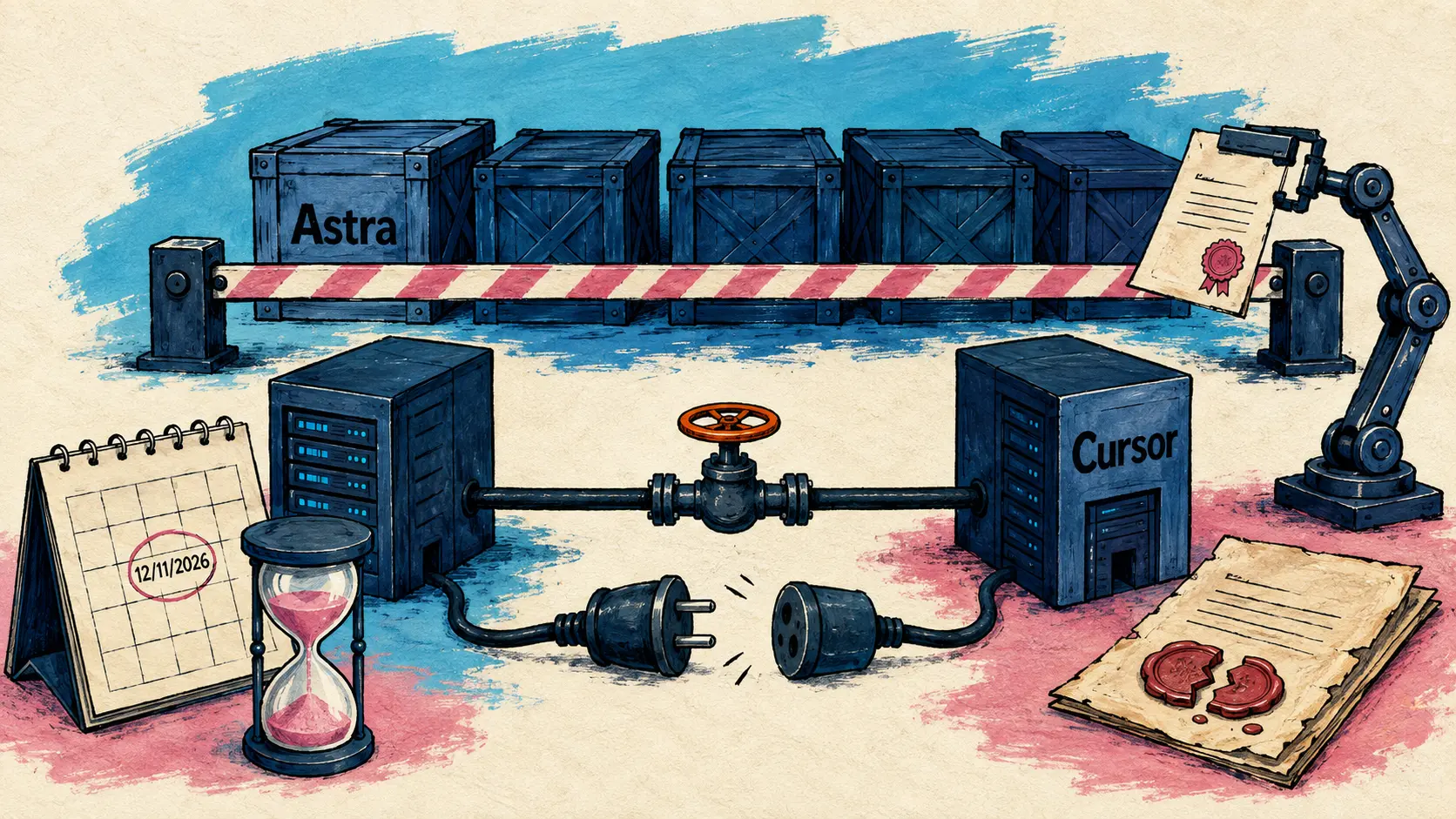
OpenAI ends its contract with Cursor after the SpaceX acquisition
August 28 — OpenAI notified SpaceX of its intention to terminate the contract giving Cursor direct access to its models. The proposed termination date is November 12, 2026: the company specifies that it chose the longest notice period allowed by the contract so developers can retain access to the models for as long as possible.
The reason is SpaceX’s acquisition of Cursor. OpenAI explains that it works with major partners through tailored contracts that guarantee compliance with the terms of use and the safety of large-scale integration, and says it cannot trust SpaceX to use its technology within that framework. Two precedents are cited by name: after Elon Musk’s acquisition of Twitter, a company now affiliated with SpaceX, the terms of the contract binding the two companies were broken; and, under oath earlier this year, Musk admitted that xAI, also brought under SpaceX, had violated OpenAI’s terms of use. The agreement signed with Cursor provided for a time-limited termination window following a change of control, which explains the schedule.
There is also a second, more unusual argument: OpenAI says it is taking on a new level of responsibility as capabilities advance, and cites its upcoming Astra model — the one it announced on August 7 could no longer be ruled out from reaching a level of cyber capabilities classified as Critical under its preparedness framework. The practical consequence: the contract runs until the latest possible date, but no future model will be supplied to Cursor.
| Item | Value |
|---|---|
| Date SpaceX was notified | August 28, 2026 |
| Proposed termination date | November 12, 2026 |
| Length of the OpenAI-Cursor partnership | nearly 4 years |
| Future models supplied to Cursor | none |
We’re ending our partnership with Cursor following its acquisition by SpaceX. Under our proposal, Cursor’s direct access to our models would end on November 12.
We know that the people most affected by this decision are the developers who rely on OpenAI models in Cursor. We care about their experience in this transition and we’re ready to go above and beyond to support them. — @OpenAI on X
Claude Code: weekly limits drop by 17% on September 14, CLI starts faster
August 29 — Anthropic announces that starting September 14, Claude Code’s standard weekly limits will permanently increase by 25% for Pro, Max, Team, and seat-based Enterprise plans. Until that date, the current 50% increase remains in place.
The wording called for clarification, and Anthropic provided it itself in the next post in its thread: compared with today’s situation, the change represents a 17% reduction in weekly limits. The arithmetic is simple — the current 50% increase is temporary, while the 25% increase replacing it is permanent, and moving from one to the other mechanically lowers the actual ceiling. This temporary increase was not recent: on July 18, 2026, the same account announced it would last “until August 19,” a deadline that passed without further communication. The August 29 announcement therefore sets an endpoint: a permanent ceiling, higher than the original standard regime but lower than the exceptional regime of recent weeks. The reception remained mixed, to the point that the main post — around 1.6 million views at the time of scanning — was accompanied by a context note written by X readers that repeated the reduction figure.
| Period | Claude Code weekly limits |
|---|---|
| Through September 13 | +50% (temporary increase, still in effect) |
| Starting September 14 | +25% permanent |
| Net effect announced by Anthropic | -17% compared with today |
Compared to today, this works out to a 17% reduction in weekly limits on Claude Code. We’re working on exciting changes that will make it feel like you’re getting more from Claude, while having more visibility and control of your usage. Can’t wait to share them. — @ClaudeDevs on X
Earlier in the day, the same account published its weekly Claude Code release roundup. Most of this six-post thread consists of updates already covered here across the various versions — the “Auto mode” tab in /permissions from 2.1.246, the prompt cache line in /cost and live tracking of foreground subagents in 2.1.251, and the breakdown of /loop tasks in /usage from 2.1.243. One area, however, had never been quantified: performance. The CLI no longer waits for the sandbox to start or for MCP servers to come online before allowing the first instruction to be entered, and the claude command skips initialization steps it does not need. On the distribution side, the Linux x64 download is 4.5 times smaller, at around 75 MB, and native builds use 40 to 70 MB less memory per session.
| Announced performance measure | Value |
|---|---|
| Linux x64 download | 4.5 times smaller, approximately 75 MB |
| Native build memory | 40 to 70 MB less per session |
🔗 Weekly limits announcement · Weekly roundup
Copilot CLI switches to a native Rust engine, Visual Studio gets custom organization agents
August 28 — GitHub published its weekly Copilot roundup late in the day. The entry is dated August 24 in its title — the week it covers — but was not posted until 20:13 UTC on the 28th, after the previous scan. Two of its sections repeat announcements already covered here, Copilot in Slack and Microsoft Teams and the general availability of the Customize tab; the rest is new.
The most structural development concerns the CLI: Copilot CLI now runs on a native Rust runtime, while its terminal interface remains written in TypeScript. GitHub announces “significantly better” performance without publishing any measurements, leaving readers to judge. Two settings, defaultMode and defaultPermissionMode, determine the execution mode and permission mode applied to each new session; the /plugin, /mcp, and /skills commands receive dedicated management interfaces; and the CLI can restore a session that did not end cleanly, including one interrupted in the middle of a turn.
| Affected surface | Announced updates |
|---|---|
| Copilot CLI | Native Rust engine, defaultMode and defaultPermissionMode, /plugin /mcp /skills interfaces, session resumption |
| Copilot application | Azure DevOps issues and pull requests converted into sessions, experimental WSL, split tabs, preview in the external browser |
| JetBrains extension | Enterprise controls for plugins, MCP servers, telemetry, and agent permission modes |
| VS Code 1.135 | Resumption of Copilot or Claude agent sessions launched elsewhere, second opinion from an additional model, single Agents pane, consumption by model and turn |
| Visual Studio 2026 | Custom organization agents, Low, Medium, and High reasoning effort, Manage models view, review by the Git agent |
Published the same day, a dedicated changelog entry details the August update to Copilot in Visual Studio 2026, available on all plans — Free, Student, Pro, Pro+, Max, Business, and Enterprise. The main change is the arrival of custom agents at the organization level: GitHub organization or enterprise owners publish agents usable across all their repositories, which Visual Studio detects automatically and displays in the selector along with their description and original organization. A GitHub organization is required, excluding personal accounts. The reasoning-effort setting is now controlled by the user with three levels, which GitHub explicitly presents as a trade-off between reasoning depth and token consumption. The Manage models view brings together capabilities, context-window size, cost information, and controls, while the Git agent reviews uncommitted changes or commits before a pull request is opened, across both GitHub and Azure DevOps repositories.
🔗 Copilot weekly roundup · Copilot in Visual Studio, August update
GLM-5.3 arrives at Together AI, which immediately measures the cost of its distilled version
August 29 — The third consecutive day for GLM-5.3. On August 27, Z.ai announced in two lines that it would publish the weights; on the 28th, access was live and Together AI opened a model page marked “coming soon,” without pricing. Since August 29 at 1:57 a.m. UTC, the page has been live and the host is describing the release as “Day 0” availability. The zai-org/GLM-5.3 endpoint is served in both serverless and dedicated infrastructure modes, and Together AI announces compatibility with Claude Code, OpenCode, and other coding-agent platforms. According to the host, the model is approaching Fable 5 across all benchmarks while costing a fraction of the price per task.
| Service characteristic | Value |
|---|---|
| Input / cached-input price | $1.40 / $0.26 per million tokens |
| Output price | $4.40 per million tokens |
| Context window | 1M tokens (IndexShare architecture) |
| Effort levels | low, high, max (max by default) |
| Announced SLA | 99.9% |
That same day, Together AI published the sixth comparison in its DeepSWE series, and for the first time it compares two models from the same family: GLM-5.3 and its distilled version, GLM-5.3 Flash. The protocol is unchanged—the 113 DeepSWE v1.1 tasks, four trials per configuration, both models at maximum effort—for a total of 900 complete executions (rollouts), 452 for the full model and 448 for Flash. At first glance, the gap seems substantial: 69.0% pass@1 versus 63.4%. But it falls to 2.6 points at pass@4, for one-seventeenth of the price. Distillation therefore did not remove capability; it removed consistency: none of the 48 tasks that the full model solves four times out of four becomes impossible for Flash, which retains 93 of the 99 tasks solved at least once. The mechanism is identified below, and it is the most interesting result: on unstable tasks, the longest trial is the winning trial in 61% of cases for GLM-5.3, but in only 46% for Flash—below the threshold of a coin toss. The distilled model can no longer turn additional effort into a solution.
| Measured metric | GLM-5.3 (max effort) | GLM-5.3 Flash (max effort) |
|---|---|---|
| pass@1 | 69.0% | 63.4% |
| pass@4 | 87.6% | 85.0% |
| Cost per execution | $3.99 | $0.24 |
| Tasks solved per $100 | 17 | 264 |
| End-to-end duration | 35 min | 26 min |
| Breaking an already-passing reference test | 4.4% | 6.9% |
| Effort paying off on unstable tasks | 61% | 46% |
Only one clear regression is noted, and it concerns caution: Flash breaks an already-passing reference test in 6.9% of executions versus 4.4% for the full model, leading Together AI to explicitly recommend a complete regression suite before accepting a diff produced by Flash without review. The operational conclusion is a cascade within the same family: launch Flash first, escalating to the full model only if a verifier rejects the response. This combination reaches an 80.9% success rate at $1.70 per task, twelve points higher than GLM-5.3 alone (69.0% at $3.99) for less than half the price. One discrepancy is worth flagging to readers: the DeepSWE score displayed on the model page (66.9) differs from the 69.0% measured by Together AI in its own campaign, which the host acknowledges by clarifying that its figures come from its own execution.
🔗 GLM-5.3 goes live at Together AI · GLM-5.3 versus GLM-5.3 Flash on DeepSWE
Open-weight models captured half the traffic, but only 13% of spending
August 29 — Thibault Jaigu, head of the Requesty inference gateway, published on the Hugging Face blog measurements collected from his own production traffic in 2026, excluding customer-provided keys and internal accounts. The central figure: open-weight models rose from less than 5% of tokens in January to half of all traffic during the week of August 3, but account for only about 13% of spending, with a frontier closed-model token costing approximately 6.4 times as much as an open-model token once caching is taken into account.
Two examples provide a sense of this market. After kimi-k3 was released, it took the original lab 11 days to lose the majority of tokens served on its own model, with four other hosts enabling inference on the same weights within 72 hours. And for glm-5.2, six hosts show a 5.7x difference in the price actually paid—not because of secret discounts, but because the cheapest caches 94% of input tokens while the most expensive caches none. These figures come from a provider describing its own product, which the author acknowledges by signing as Requesty’s head.
| Measurement recorded at the gateway | Value |
|---|---|
| Share of open weights in tokens (January 2026) | less than 5% |
| Share of open weights in tokens (week of August 3) | 50% |
| Share of open weights in spending | about 13% |
| Spending breakdown (Anthropic / OpenAI / Google) | 51% / 21% / 15% |
| Cache reads / fresh input / visible output | 78% / 19% / less than 2% |
| Input-to-output ratio (January then August) | 15x then 36x |
| Average context per request (January then August) | 9.6k then 28k tokens |
🔗 Requesty post on Hugging Face
Perplexity’s Search API takes the top three spots in the Artificial Analysis Search Index
August 29 — Perplexity shared a ranking published the previous day by Artificial Analysis: the three context settings of its Search API occupy the top three spots in the Artificial Analysis Search Index in their debut on the ranking. The medium setting scores 80 points, five more than the previous leaders Parallel (advanced) and Brave Search (LLM context), both at 75; the high and low variants follow with 79 and 77.
The protocol deliberately isolates the search component: Artificial Analysis runs the same model—GPT-5.6 Luna in medium reasoning mode—in Stirrup, its open-source agent harness, with web search and page-retrieval tools. From one test to the next, only the provider behind the search tool changes. Perplexity’s lead is concentrated on BrowseComp, while the AA-Omniscience and DeepSearchQA scores remain comparable to those of the other leading providers. The second advantage is economic: more compact payloads make the model read less, resulting in an inference cost per task of $0.028 to $0.034 depending on the variant, versus $0.036 for the next-cheapest provider—the lowest measured by Artificial Analysis to date.
| Search provider (variant) | AA Search Index score | Total cost per task |
|---|---|---|
| Perplexity Search (medium) | 80 | about 0.091 $ |
| Perplexity Search (high) | 79 | about 0.091 $ |
| Perplexity Search (low) | 77 | not disclosed |
| Parallel (advanced) | 75 | 0.084 $ |
| Brave Search (LLM context) | 75 | 0.13 $ |
Two usage caveats: the ranking comes from Artificial Analysis, not Perplexity, which merely highlights it, and no blog post duplicates the announcement, as the company’s blog has published nothing since August 25.
🔗 Post from @perplexity_ai · Numerical details from @ArtificialAnlys
Codex CLI 0.151.0: extensions intercept MCP results, remote sandbox is hardened
August 29 — Codex CLI moves to 0.151.0, published on GitHub at 11:55 GMT+2 and referenced the same day in the official ChatGPT and Codex changelog. The most significant new feature concerns extensions: they can now inspect or replace the results of an MCP tool before those results reach the model. An interception point is therefore inserted between the MCP server and the context, opening the door to filtering, rewriting, or truncating tool outputs without touching the server. Also included are a configurable grace period for discovering tools exposed by optional MCP servers, and plugin catalogs that combine configuration specific to each repository while flagging invalid project marketplaces without removing valid plugins.
The rest of the release is dominated by sandbox hardening. The /cd command can no longer weaken restrictions—a scenario in which changing directories implicitly loosened safeguards—and outdated Guardian classifications can no longer authorize an action after a permissions state change. Remote sandbox enforcement also aligns with the execution machine’s reality: the executor’s home directory, operating system, and path conventions are propagated into the context, including for read-denial rules. One final point for teams that delegate work to their agents: token usage by nested subagents is finally counted toward the root objective’s budget.
| Release item | Value |
|---|---|
| Version | 0.151.0 (stable) |
| GitHub publication | August 29, 2026, 11:55 GMT+2 |
| Installation | npm install -g @openai/codex@0.151.0 |
| New features / fixes / background work | 3 / 6 / 2 |
| Previous stable version | 0.150.1 (August 27) |
🔗 Codex CLI 0.151.0 release notes
Appshots: ChatGPT Work and Codex read the context of the displayed application
August 28 — OpenAI Developers introduced appshots, a context-capture mechanism for ChatGPT Work and Codex. The principle: rather than describing what is in front of you, transmit the full context of the application currently displayed to the assistant, so it can understand the screen and act on it. The trigger is deliberately minimal—two presses of the Command key (⌘ ⌘).
The thread details ten use cases that illustrate the intended scope, extending well beyond code: summarize a Slack thread, fill out a form, use an API reference displayed on screen to add a feature, extract themes from a batch of replies on X, identify private messages that call for a response, turn notes into a presentation, edit a video in iMovie, or transform an open recipe into a shopping list. As of the scan date, the announcement exists only on X: the ChatGPT and Codex changelog contains no entry between August 27 and 29 apart from CLI version 0.151.0. Access conditions—eligible plans, platforms, general or phased availability—are therefore undocumented.
Antigravity CLI 1.1.22: the /model command accepts an argument, eight stability fixes
August 27 — Catch-up on a channel that had never been scanned until now. The Google Antigravity changelog is divided into four tabs—Antigravity 2.0, Antigravity CLI, Antigravity SDK, and Antigravity IDE—of which only the first had been read during previous passes. In practice, the CLI tab publishes a release every one to three days; the latest, 1.1.22, brings three improvements and eight fixes.
On the usability side, the /model command now accepts an argument: instead of opening a selector, it switches directly to a model by specifying its name, slug, or label, and sets the default in the same step, with ghost-text autocomplete while typing. The /effort command, which sets reasoning effort, also completes the entered text instead of displaying a fixed example. The third addition is useful for long sessions: when an agent generates many files, bursts of file-system events are grouped into a single rescan.
The eight fixes target long-term stability. The most visible removes continuous interface redraws when the task panel or a subagent’s details remained open with no task in progress, which caused CPU usage to rise while idle. Transient HTTP 502 errors, which previously ended a run outright, are now retried after an increasing delay (backoff). The rest covers Windows, the headless daemon, and reasoning effort becoming selectable again for Gemini 3.1 Pro and Gemini 3.5 Flash when authenticating with a Gemini API key.
| Antigravity channel | Latest version | Date |
|---|---|---|
| Antigravity 2.0 | 2.11.0 | August 26, 2026 |
| Antigravity CLI | 1.1.22 | August 27, 2026 |
| Antigravity SDK | 0.1.15 | August 25, 2026 |
| Antigravity IDE | 2.5.5 | August 13, 2026 |
MiniMax takes stock of H3 Max and declares faster-than-real-time video generation achieved
August 29 — MiniMax publishes an unusually long statement about H3 Max, the video model that fal Research obtained by post-training the open weights of MiniMax H3. The model itself was announced on August 27; what is new here is the original lab’s position on what this external work means for it.
The message rests on two ideas. The first is strategic: MiniMax says that H3 Max has made the value of open weights tangible for its own teams, and says it is ready to support any team that reproduces fal’s approach. The second is technical, and goes further: the lab now considers faster-than-real-time video generation a solved problem, and draws from it a list of previously unreachable use cases — perpetual video streams, interactive worlds, real-time storytelling. Two hours earlier, MiniMax had shared a community test that neatly captures the shift: the question is no longer how long a generation takes, but whether the model generates faster than a Twitch stream can broadcast.
They made the value of open weights feel real to our team in a way it hadn’t before. Advancing technology together has always been a core belief at MiniMax. H3 Max made that belief tangible. It showed that the frontier no longer belongs to a few, it belongs to everyone willing to build, experiment, and share what they discover. — @MiniMax_AI on X
🔗 Community test shared by MiniMax
Briefs
- Grok 4.6 arrives on Grok.com and the iOS and Android apps — After a rollout focused on partner platforms — GitHub Copilot, Amazon Bedrock, Gemini Enterprise Agent Platform, then Microsoft Foundry on August 26 — xAI completes the series through its own consumer-facing surfaces. Three recommended uses: complex problems, agentic queries, and application creation. No figures, no benchmark, no pricing change. 🔗 Message from @grok
- Midjourney fixes the image quality of its V8.2 editing model — Less than twenty-four hours after testing opened, the studio released an image-quality fix and invited users who had encountered problems to rerun their generations. Further updates were announced without a timeline. 🔗 Message from @midjourney
- Gemini CLI locks workspace trust into default-deny mode — The nightly version (
v0.59.0-nightly.20260829.g0bd1d4397) includes a single change: a workspace whose trust cannot be established is treated as untrusted, and declared MCP servers are filtered in restricted mode. The stable channel remains on v0.57.0, and preview on v0.58.0-preview.0. The August 27 nightly had already patched an SSRF in the discovery of OAuth metadata for MCP servers. 🔗 Release notes - NVIDIA positions Dynamo alongside SGLang, vLLM, and TensorRT-LLM — A five-minute short answering a common confusion: Dynamo does not replace inference engines; it sits around them to distribute the load across multiple GPUs and nodes. Video presented by Vishakha Sadhwani. 🔗 Message from @NVIDIAAI
- QwenCloud publishes a recap of Qwen Conference Hong Kong 2026 — A review of the August 26 event held for more than 300 enterprise customers and developers, featuring a keynote that organized the platform around three entry points — the website, Skills, and the CLI — along with a demonstration of an agent chaining account creation, model selection, inference, deployment, payment, and billing. 🔗 Message from @qwen_cloud
- Luma organizes a creative evening in San Francisco — Creative Intelligent Machines Continuum, an on-demand creation evening scheduled for Tuesday, September 1, at tiat, with step-by-step demonstrations led by the studio’s senior creatives, a shared prompt, and on-site support. The initiative extends the Dream Lab Weekly series launched on August 25. 🔗 Message from @LumaLabsAI
- FAST, an attempt at a standard for agent-driven vulnerability reporting — The Framework for Autonomous Severity and Triage presents itself as a set of Markdown files to place in an agent’s context, with no SDK or API. It distinguishes an unproven lead from a vulnerability with reproducible proof of impact, provides a severity decision tree derived from what bug-bounty programs actually pay rather than from CVSS calculations, and requires a six-check gate before submission. CC-BY 4.0 license. 🔗 Post on Hugging Face
- Two AI sessions, one repository, two opposing verdicts on a self-healing agent — An engineering note on a personal project: a rejected autonomous self-healing design reappeared in the repository a few days later, written by another session using a different assistant, with no trace of the first decision. The file was never able to run, but only thanks to two accidental bugs — the author describes it as safety by accident, not by design. 🔗 Post on Hugging Face
- three.ws, an open-source stack for giving agents a body, a wallet, and a job — The project combines four building blocks: 3D generation and rigging with browser-based studios, an agent engine with a guardrail chain and skills system, an agent wallet backed by x402 (pay-per-call over HTTP), and distribution through a single tag that can be placed on any website or in augmented reality. 🔗 Post on Hugging Face
What it means
Access to frontier models is becoming a matter of counterparty, not just contract. OpenAI is not cutting off Cursor over a missed payment or a technical clause, but because it says it cannot trust how its new owner would use it, citing two named precedents — Twitter and xAI, both of which came under SpaceX. The more consequential argument is the second, however: OpenAI invokes its upcoming Astra model, for which it announced on August 7 that it could no longer rule out Critical-level cyber capabilities, to justify providing no future model. In other words, the more dangerous a generation of models is deemed, the narrower the list of those who can access it becomes — and the selection criterion is no longer the customer’s solvency, but its parent company’s compliance history. For teams that have built their production pipeline on a third-party provider, November 12 is a migration deadline.
What is changing in price is the ceiling, not the rates. Anthropic has changed no listed price: it is converting a temporary 50% increase into a permanent 25% increase, which means −17% compared with today, and says so itself in the following message. GitHub, for its part, exposes reasoning effort as an explicit trade-off with token consumption and now displays per-model usage on every conversation turn. Requesty’s figures explain why these ceilings have become the real price: cache reads account for 78% of all tokens processed, visible output for less than 2%, and the input-to-output ratio rose from 15x in January to 36x in August. An agent loop does not cost what it writes; it costs what it rereads at every step — and that is the quantity providers have begun rationing.
Open weights have gained volume and lost value. Half of traffic, 13% of spending, with 86% of that still concentrated among three providers: the open market has become a wholesale market, where the same model costs 5.7 times more from one host to another based solely on caching policy, and where a lab loses the majority of the tokens served on its own model in eleven days. GLM-5.3 illustrates the point today: weights published on the 28th, available from a third-party host on the 29th at $1.40 per million input tokens, followed immediately by an independent measurement that puts the cost of its distilled version precisely — 2.6 pass@4 points for one-seventeenth the price. When the model is the same everywhere, differentiation shifts to caching, routing, and measurement. It is an infrastructure business, not a laboratory one.
The command-line client is once again a field of technical competition. Copilot CLI switches to a native Rust execution engine while keeping its TypeScript interface, Claude Code cuts its Linux download by 4.5x and recovers 40 to 70 MB of memory per session, Antigravity CLI removes the redraws that drove up idle CPU usage, Codex CLI prevents /cd from weakening its sandbox, and Gemini CLI makes workspace trust default-deny. Five providers, the same week, on the same topics: startup time, memory footprint, and the precise scope of what the agent is allowed to touch. After a year spent comparing model capabilities, competition is also playing out in the program that runs them — and security now occupies as many changelog lines as features.
Sources
- OpenAI — decision on Cursor following its acquisition by SpaceX
- Anthropic — weekly Claude Code limits
- Anthropic — Claude Code weekly recap
- GitHub — Copilot weekly recap for August 24
- GitHub — Copilot in Visual Studio, August update
- Together AI — GLM-5.3 available the same day
- Together AI — GLM-5.3 versus GLM-5.3 Flash on DeepSWE
- Requesty — production figures for open weights
- Perplexity — Search API leads the Artificial Analysis Search Index
- OpenAI — Codex CLI 0.151.0 release notes
- OpenAI Developers — appshots
- Google — Antigravity changelog
- MiniMax — statement on H3 Max
- Google — Gemini CLI, August 29 nightly version
- xAI — Grok 4.6 on Grok.com, iOS, and Android
- Midjourney — V8.2 editing model fix
- NVIDIA — Dynamo alongside inference engines
- Luma — Creative Intelligent Machines Continuum evening
- QwenCloud — recap of Qwen Conference Hong Kong 2026