ai-powered-markdown-translatorArticle translated from fr to en with gpt-5.6-sol.
Just twelve announcements across five areas for the weekend of August 29 and 30—compared with twenty-two the previous day and forty-two on the 28th. Two factors combined, and neither should be glossed over. The 29th was a Saturday and the 30th a Sunday: almost none of the official blogs published anything. On top of that, X went down during collection, with the interface serving profile feeds no longer responding; twenty-three monitored accounts—those covering image and video generation, as well as development tools—remained inaccessible. An announcement shared only by tweet may therefore have escaped the scan.
What remains is a day split into two categories. On the product side, xAI connects Grok Bot to the X network, while GitHub details five improvements to Issues. On the research side, everything comes from the Hugging Face blog and individual contributors: a linear probe that transfers from one vision model to a competitor’s, a post-transformer model pretrained on a single MacBook, a Leech lattice that fits Qwen3-4B into 2.60 GB of VRAM, and a method for interrupting an agent mid-generation. These are research projects, not launches.
Grok Bot connects to X
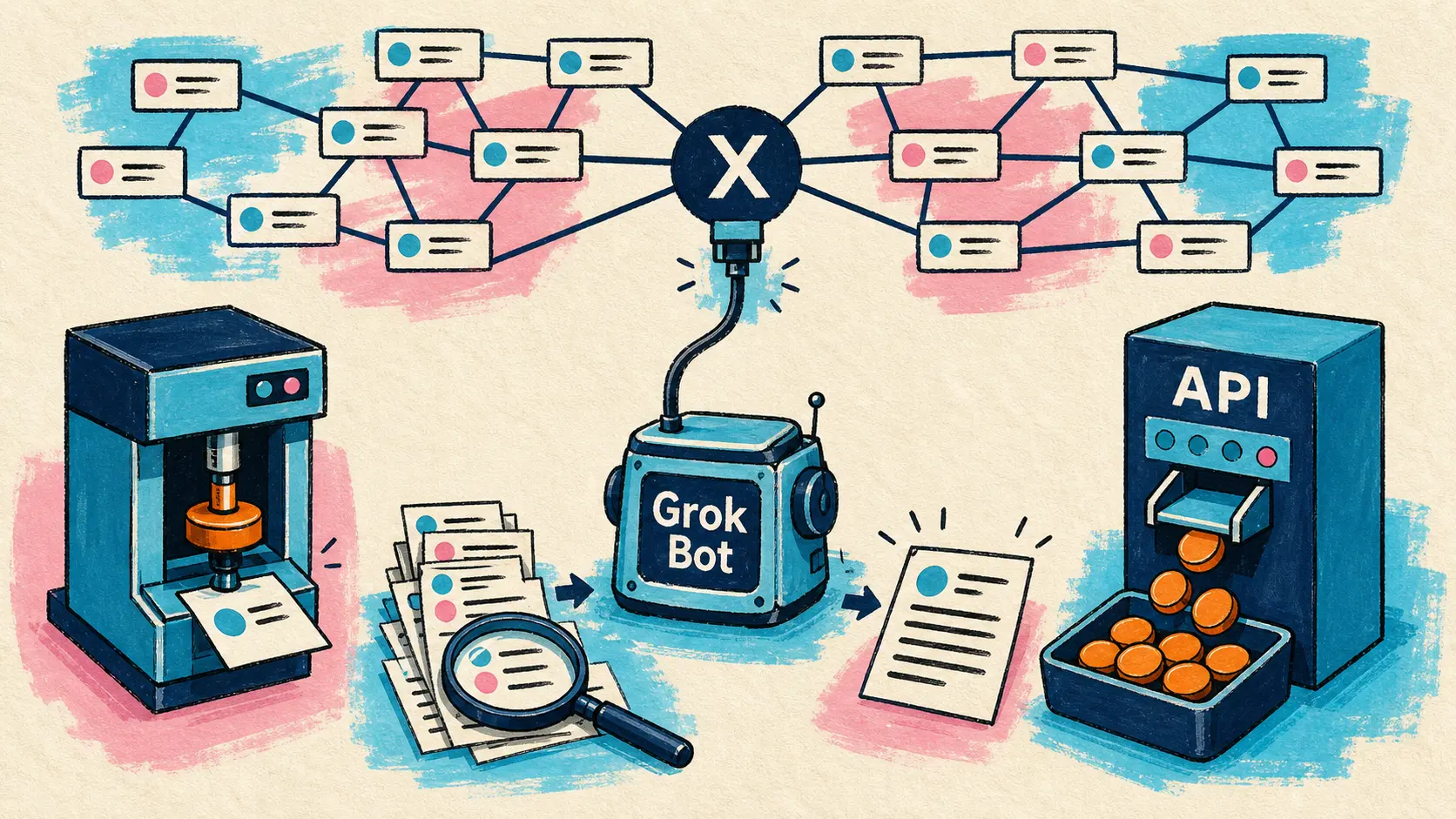
August 29 — xAI posted an update to Grok Bot, its autonomous-agent offering, on its news feed: the product now integrates more closely with X.
The mechanism involves connecting an account. The user links their X account from Grok Bot, and xAI automatically creates a developer account for them if they do not already have one—the step required for programmatic access to the network. Paying Grok Bot subscribers also receive free X API credits to get started, though xAI does not specify the amount or how long they remain valid.
Once the connector is enabled, a Bot can search posts, read its owner’s feed, check their mentions, and compile a summary of what is circulating on the network. Getting started simply involves opening Grok Bot and using the X connector.
xAI explicitly describes this release as the first version of the integration and says it intends to continue making it easier for Grok Bot to work on X.
GitHub Issues: five new features, including a scope-aware dependency REST API
August 29 — GitHub detailed five improvements to GitHub Issues, announced directly on X without an associated changelog entry: the post itself is the primary source.
Four of them focus on navigation convenience. Views can be pinned to the sidebar, avoiding the need to rebuild a filter during every session. Reactions now display profile avatars where only the count previously appeared. Dashboard density can now be adjusted, which is useful for repositories with many rows. Closed sub-issues can be hidden, reducing clutter in parent issues used to track ongoing work.
The fifth is the most consequential for automation: the issue dependency REST API is becoming scope-aware. Dependencies between issues, which describe the order in which tasks must be handled, can now be queried with scope taken into account—directly benefiting agents and scripts that build a work plan from a repository’s issue tracker. GitHub did not specify the availability status of these five changes.
| Announced feature | Scope of the change |
|---|---|
| Pinning views to the sidebar | Issues navigation |
| Profile avatars on reactions | Reaction display |
| Adjustable dashboard density | Dashboard |
| Hiding closed sub-issues | Parent issues and sub-issues |
| Scope-aware dependency REST API | REST API, dependencies between issues |
Gala, a post-transformer model pretrained on a single MacBook, reads 10 million tokens at constant speed
August 29 — A family of small language models, working name Gala, was pretrained from scratch in pure MLX on a single MacBook—M3 Max, 40-core GPU, 128 GB of unified memory—in five days.
The experiment begins with a reversal of perspective. The Transformer is designed for hardware where dense matrix products are abundant and high-bandwidth memory is scarce; a Mac is the opposite kind of machine. The chosen architecture therefore accumulates parameters and state while rationing FLOPs per token.
The final test consists of processing 10.5 million tokens of real FineWeb text, at batch size 1, on the laptop. Nothing grows: the recurrent state remains fixed at 3.07 MB throughout, and decoding speed does not deteriorate. Loss over the following 2,000 tokens does not increase either. The reference Transformer trained on the same data decodes at 134 tokens/s with just 32k of context and would require approximately 33 GB of KV cache at one million tokens.
| Context reached | Decoding speed | Loss over the following 2,000 tokens | Recurrent state |
|---|---|---|---|
| 32,768 | 382.3 tokens/s | 3.630 | 3.07 MB |
| 1,048,576 | 388.1 tokens/s | 3.534 | 3.07 MB |
| 5,242,880 | 386.2 tokens/s | 3.590 | 3.07 MB |
| 10,485,760 | 385.8 tokens/s | 3.296 | 3.07 MB |
Ingestion remains linear at approximately 28,000 tokens/s, or nearly six minutes for all ten million. The model is published with its execution logs, and the article devotes a section to what it cannot do.
A post-transformer language model, pretrained from scratch on one MacBook in pure MLX, that reads 10M tokens of context at constant speed. Five days, every number measured, everything released. — Arjun Reddy, on the Hugging Face blog
A Leech lattice in a CUDA kernel fits Qwen3-4B into 2.60 GB of VRAM
August 29 — The number of bits per weight is the only lever that changes the class of machine capable of hosting a model: at 2 bits, a 70-billion-parameter model drops from 140 GB to approximately 18 GB and fits on a 24 GB card. Quality still needs to hold up, however, and the best reported quality at this compression level comes from 24-dimensional block vector quantization on the Leech lattice, developed by Qualcomm AI Research.
The obstacle was software. For simplicity, the CUDA kernel published with that paper decodes only a single layer of the lattice and remains slower than competing methods. Yet the dictionary actually required at 2 bits is a union of layers: 301 equivalence classes and a 47-bit index identifying one point among 1.1 × 10¹⁴. The author could not find a decoder for this index anywhere.
So he wrote one. The mathematical core of the project—the lattice, exact nearest-neighbor search, bijective 48-bit indexing, and spherical GPTQ—is implemented in Rust without any external dependencies and comes with the missing fused CUDA decoder.
| Measured element | Recorded value |
|---|---|
| Quantized model | Qwen3-4B |
| VRAM footprint | 2.60 GB |
| Generation throughput | 87 tokens/s |
| Equivalence classes at 2 bits | 301 |
| Index size | 47 bits, among 1.1 × 10¹⁴ points |
| 70-billion-parameter model at 2 bits | From 140 GB to approximately 18 GB |
The quantized model produces the same tokens as the dense model under greedy decoding, aside from tie-breaking. Two caveats, both raised by the author: his decoder remains slower than the competing QTIP kernel, which reads 2.40 times fewer bytes and runs 2.27 times faster; and the preprint is self-published and has not been peer-reviewed. The code and data are public.
A linear probe trained on one vision model can be read on a competitor’s
August 30 — Four multimodal models from four different companies encode the same images. All are frozen, none are fine-tuned, and their hidden states do not even have the same width: 5,376, 5,120, 2,560, and 2,048 dimensions. Nothing should allow a probe learned on one to work on another. Yet it does.
The protocol is minimal. A linear probe—a single weight matrix—learns to predict image labels from one model’s states, then is read without retraining on another model’s states, using a mapping estimated through ridge regression on the training rows alone as a bridge between the two spaces.
| Evaluated domain | Native AUROC | Transferred AUROC | Transfer cost |
|---|---|---|---|
| Satellite imagery, 17-class land use | 0.9507 | 0.9484 | 0.0024 |
| ChestX-ray14 radiographs, 3 models out of 4 | 0.7440 | 0.7511 | negative |
For chest radiography—the official test list, comprising 25,596 images from patients never seen during training—the transferred score exceeds the native score, and four of the six cross-model directions outperform the target model’s own probe. The measurement discipline explains why the result deserves to be taken seriously: raw cosine similarity between unrelated items rises as high as 0.998 before correction, centering brings all four providers down to 0.005 or less, and every claim is published alongside its random baseline—0.5014 with shuffled labels on the satellite test set.
Together AI ranks GLM-5.3 ahead of two closed models on hallucination rate, without naming a benchmark
August 30 — Together AI presents GLM-5.3’s low hallucination rate as an underappreciated aspect of the model and compares it with two leading closed models.
| Compared model | Hallucination rate relative to GLM-5.3 |
|---|---|
| GLM-5.3 | baseline |
| Claude Fable 5 | more than 2 times higher |
| GPT-5.6 Luna | more than 3 times higher |
The measurement should be read for what it is. Together AI hosts GLM-5.3 and sells inference for it: the source is not neutral. The post cites neither the benchmark used, nor absolute values, nor the method for counting hallucinations—only ratios. A short video accompanies the post, but the published text contains no raw figures. It should therefore be treated as a relative ranking, not as an independent evaluation.
The angle remains noteworthy because it complements the picture drawn in previous days: the DeepSWE comparisons published on the 29th measured coding ability and cost, not factual reliability in production.
an underrated part of glm-5.3 is its low hallucination rate
claude fable 5 is over 2x higher, while gpt-5.6 luna is over 3x higher — @togethercompute on X
In brief
- Reflexive Role Routing, a method for interrupting an agent mid-generation — A single-linear-layer probe reads two values during generation—the drift between the prompt’s target and the current trajectory, and the estimated probability that the output will survive review—which a frozen controller uses to decide whether to interrupt. The process is formalized as a semi-Markov decision problem so that the context already produced is not discarded. Preprint submitted under DOI 10.5281/zenodo.22171581. 🔗 Post on Hugging Face
- A disposable risk evaluation generated by a frontier model — A single prompt has a powerful model create a fresh benchmark whose scoring rubric remains private within the conversation; the evaluated models take the test, their responses are returned there for scoring, and the benchmark is then discarded—the author does not see this as a solution to contamination, only as reducing dependence on the same public questions. Its main value lies in the required distinction between willingness, capability, and enablement in the results. 🔗 Post on Hugging Face
- CUDA’s default failure mode is silence — A first-week GPU programming learning note, written from the simplest possible program: adding two lists of one thousand numbers. What struck the author was not how the GPU works, but how quietly it fails. No announcement or model release. 🔗 Post on Hugging Face
- GitHub once again highlights grouped Dependabot updates — On GCToolkit, a Microsoft project, approximately one commit in six was a version bump for a single dependency; three changes to the
dependabot.ymlfile were enough to reduce the noise by grouping updates and slowing their cadence, without delaying security fixes. The referenced article dates from July 29, 2026: only the share occurred on August 30. 🔗 Post by @github - WebMCP Challenge: September 3 deadline and Q&A session on August 31 — OpenAI Developers reminds participants that WebMCP hackathon projects can be submitted until September 3 and announces in the same thread an office-hours Q&A session on Discord scheduled for Monday, August 31 at 11 am PT, with the competition partners: Chrome, Cloudflare, Shopify, Vercel, Render, and Netlify. The hackathon itself was introduced on August 25. 🔗 Post by @OpenAIDevs
- Cohere publishes three photos of Waterloo without an accompanying announcement — The official account reinforces the company’s Canadian positioning, with no launch, figures, or link. No factual substance: included for completeness within the monitoring window. 🔗 Post by @cohere
What This Means
Consumer hardware is becoming a design constraint again, not a limitation to endure. Two of the weekend’s projects start from the same premise: the available machine determines the architecture, not the other way around. Gala is designed for a Mac—abundant memory, scarce FLOPs—and therefore accumulates parameters and state rather than computation per token; the result is decoding that does not slow down between 32,768 and 10.5 million context tokens. Leech lattice quantization targets the other end of the pipeline: reducing a 70-billion-parameter model from 140 GB to around 18 GB means making it fit on a card that individuals own. Neither claims to compete with a frontier model, and that is not the point: both shift the question from model size to the class of machine capable of hosting it.
A probe trained on one model can be interpreted on its neighbor. The day’s most surprising result is also the most understated. If four frozen models from four companies encode images similarly enough for a single weight matrix to transfer from one to another at a cost of 0.0024 AUROC—or even at a negative cost—then the tooling built on top of these representations is no longer locked to the provider on which it was calibrated. The paper itself draws this practical conclusion, but immediately states the limitation preventing it from already being a method: the transport maps are fitted pairwise, and there is no evidence that any single one would hold up on a model excluded from that fitting. Measurement discipline never slips: anisotropy is corrected before any comparison, and the random baseline is published alongside every score.
Reliability claims are arriving without metrology. Together AI ranks GLM-5.3 ahead of two closed models on hallucination rate, but names no benchmark, publishes no absolute values, and does not describe its counting method—all while selling inference for the model it ranks first. The contrast with the research posts from the same weekend is stark: they publish their random baselines alongside their results and detail their protocols. A report without a reference framework is not a measurement; it is a marketing argument, and should be categorized accordingly.
On the product side, the weekend delivered nothing but plumbing—and that is where agents are won or lost. xAI is not releasing a model: it connects Grok Bot to X, creates the developer account on the user’s behalf, and distributes API credits to reduce onboarding friction. GitHub is not announcing a spectacular feature: it is making its issue-dependency REST API scope-aware. In both cases, what changes is the access permission and the queryable surface, not the model’s capability. It is the least visible and most decisive work for anyone building agents expected to read a social network or an issue tracker.
Sources
- xAI — Grok Bot now works with X
- GitHub — five new features for GitHub Issues
- Gala, a post-transformer model trained on a MacBook
- Leech lattice quantization and fused CUDA decoder
- Linear probes transported between frozen vision models
- Together AI — GLM-5.3 hallucination rate
- Reflexive Role Routing
- Disposable risk assessment generated by a frontier model
- Learning note on silent CUDA failure
- GitHub — grouping Dependabot updates
- OpenAI Developers — WebMCP Challenge and Q&A session
- Cohere — photos from Waterloo