ai-powered-markdown-translatorArticle translated from fr to en with gpt-5.4-mini.
July 30, 2026 is dominated by two research breakthroughs: Claude Mythos, Anthropic’s internal research model, discovers novel cryptographic flaws in a post-quantum NIST candidate and in a weakened version of AES, while Google DeepMind launches Gemini Robotics ER 2, capable of getting multiple robots to collaborate on the same task. Around these two topics orbit an OpenAI price cut for GPT-5.6, simultaneous adoption of stacked pull requests at GitHub and Devin, several open-model releases (Thinking Machines, Sakana AI, LightOn), and a wave of agent-side updates (Perplexity, Genspark, Gemini).
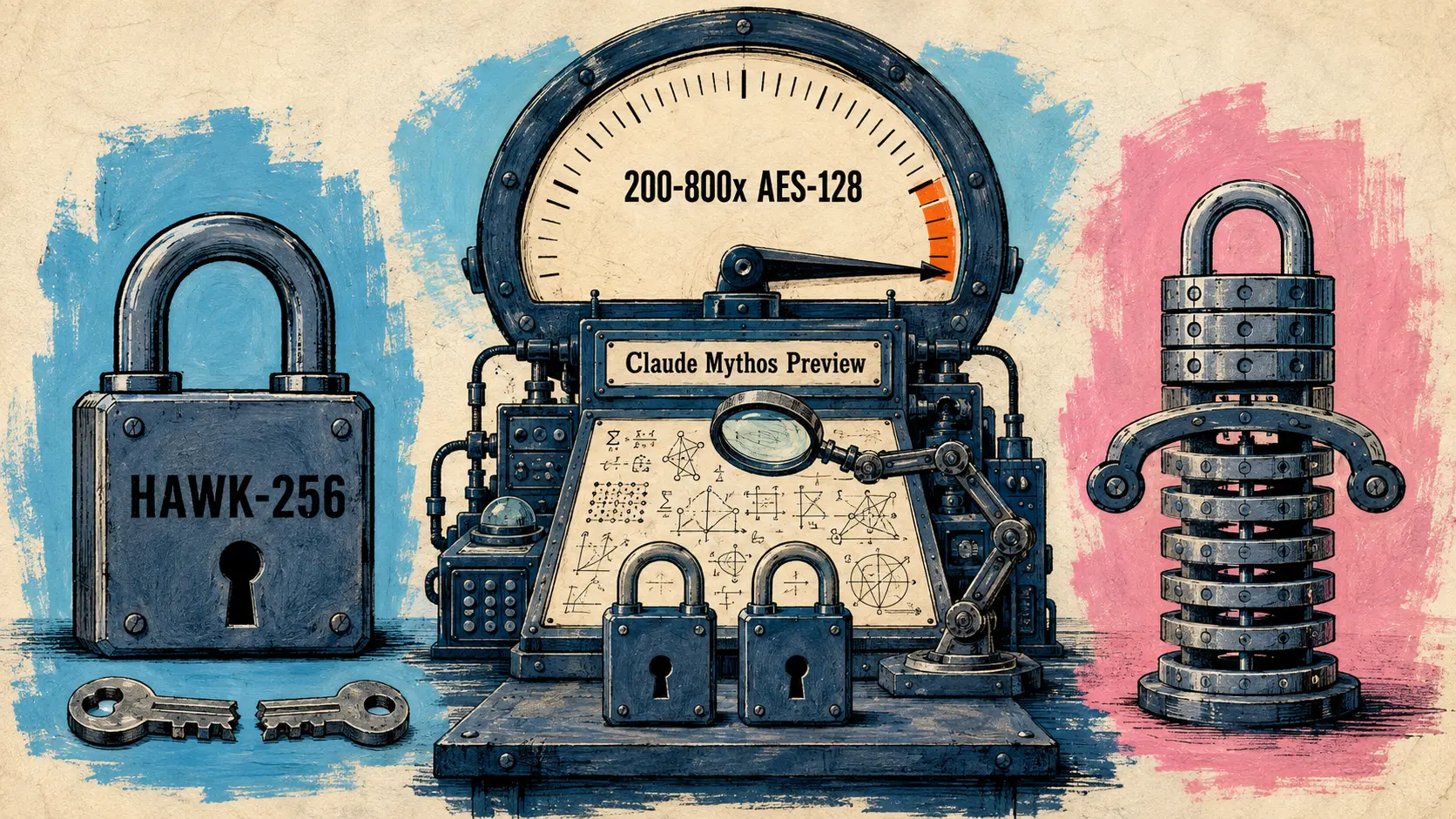
Claude Mythos discovers novel cryptographic flaws (HAWK, AES)
July 30 — Anthropic publishes research from its Frontier Red Team showing that Claude Mythos Preview, its most advanced and non-commercial internal research model, discovered novel mathematical flaws in two major cryptographic algorithms — beyond the simple implementation bugs Claude already knew how to spot in libraries like OpenSSL. The announcement was posted on July 28 on X, then expanded in a full blog post.
First result: an improved attack against HAWK, a third-round candidate in the NIST competition (the American standards body) for post-quantum digital signatures. In 60 hours of work, for an estimated cost of about $100,000 in API usage, the model found an attack that halves the effective key size of HAWK-256 — the estimated cost of a full attack drops from 2^64 to 2^38 operations. Second result: on a version of AES-128 reduced to 7 rounds out of 10, a new technique dubbed Möbius Bridge speeds up the best known attacks by 200 to 800 times, at a similar cost — the model initially judged the task impossible before persisting under the researchers’ guidance, who then spent several hundred hours validating the result.
Anthropic emphasizes that no production system is affected: HAWK is only an undeployed candidate, and the attack on AES applies only to a weakened version of the cipher — full 10-round AES is not broken. Preliminary results also affect LEA (key recovered in under an hour on 13 rounds), Serpent-128 (full 6-round attack), and more limited gains on Salsa20, Poseidon, and SHA-1.
To further this research, Anthropic is partnering with ETH Zurich, Tel Aviv University, and TU Berlin to build CryptanalysisBench, a benchmark designed to measure model cryptanalysis capabilities.
| Cryptographic target | Result achieved |
|---|---|
| HAWK-256 (post-quantum signature) | Effective key size halved (2^64 → 2^38), found in 60 hours |
| AES-128 reduced to 7 rounds out of 10 | Attack 200 to 800 times faster via the Möbius Bridge technique |
| LEA reduced to 13 rounds out of 24 | Key recovery in under an hour on a desktop computer |
| Serpent-128 reduced to 6 rounds out of 32 | New full key-recovery attack |
| Salsa20, Poseidon, SHA-1 | Gains below 10x over the best known attacks |
Google DeepMind launches Gemini Robotics ER 2
July 30 — Google DeepMind launches Gemini Robotics ER 2 (Embodied Reasoning), its most capable model for giving robots a high-level brain. It understands the physical world, converses with humans, plans multi-step tasks, then delegates motor execution to a lower-level vision-language-action model; it can also natively call tools such as Google Search or developer-defined functions.
Compared with the previous version (ER 1.6), the main advance is continuous video understanding: by observing a live video stream, a robot can track its own progress, adapt when something goes wrong, and know precisely when to move on to the next step. Google also introduces multi-robot collaboration: different machines (a wheeled robot and a humanoid, for example) communicate through shared semantic understanding to divide up complex tasks — demonstrated with Apptronik’s Apollo 2 and Franka F3 Duo robots, which tidy a garage together.
On performance, the model reaches 57.4% accuracy in task-progress classification and 91.3% in detecting the right moment to act (mean error of 0.96 seconds), with execution speed 4x higher than larger models at comparable accuracy. On safety, Google says this is its safest model to date: it correctly stops a humanoid robot when a person approaches, and resumes activity only once the area is clear.
The model is available starting today for developers via the Gemini API and Google AI Studio, with limited early access on the Gemini Enterprise Agent platform. A demonstration with a Boston Dynamics Spot robot fetching a snack on voice command is also documented, with code available on GitHub.
| Performance indicator | Measured result |
|---|---|
| Task-progress classification | 57.4% accuracy |
| Detecting the right moment to act | 91.3% accuracy, mean error of 0.96 seconds |
| Execution speed vs larger models | 4x faster |
🔗 Official announcement — Google DeepMind
Cursor: cloud agents complete 56% of merged pull requests
July 30 — Cursor shares an important internal metric on adoption of its cloud agents: in December, only 1 out of 10 merged pull requests came from a cloud agent; today that figure reaches 56%. The company credits this progress to giving agents their own cloud machine, with the ability to fix and improve their execution environment themselves — allowing them to carry out longer end-to-end engineering tasks.
In December, 1 in 10 of our merged PRs came from cloud agents. Today, it’s 56%, as we use cloud agents to complete longer engineering tasks from start to finish. We got here by giving agents their own cloud computers and letting them fix and improve their environments. — @cursor_ai on X
Stacked pull requests enter preview at GitHub, Devin adopts them the same day
July 30 — Two separate announcements, on the same day, around a single workflow: breaking a large change into a series of smaller, independently reviewable pull requests.
GitHub rolls out stacked pull requests
GitHub is moving stacked pull requests into public preview across all repositories. Instead of one giant pull request or several branches to rebase manually, the change is split into ordered layers, each reviewable through a “stack map” that places the layer under review within the whole, then mergeable in a single operation. Merging the top layer automatically lands everything beneath it; merging an intermediate layer automatically rebases and retargets the remaining open layers, without losing existing branch protections. The feature is available via github.com, the CLI (gh-stack extension), the mobile app, and directly from a coding agent like GitHub Copilot thanks to the dedicated gh-stack skill.
🔗 Stacked pull requests — GitHub
Devin (Cognition) adds native support
The same day, Devin, Cognition’s software engineering agent, announces native support for GitHub stacked PRs: breaking large changes into smaller diffs, processing and fixing review comments across the whole stack, and automatically rebasing downstream changes when a layer changes. The simultaneous adoption, on both the platform side and the agent side, shows that this new review model is taking hold directly in workflows driven by autonomous agents, not just human developers.
🔗 Devin — Cognition announcement
Amp Labs signs a partnership with Westpac
July 29 — Amp Labs, the services/consulting division of Amp (the independent spin-off from Sourcegraph), announces a partnership with Westpac, one of Australia’s oldest banks — a company more than two centuries old. The goal: transform how the bank builds and ships its technology, especially the migration and modernization of data systems used by millions of people. A dedicated team will work on-site in Sydney alongside Westpac engineers. The article introduces the project’s founding team — from Block, Ethereum Foundation, Google, and Canva — and opens local hiring in Sydney. This partnership illustrates the rise of service offerings around coding agents, beyond the software subscription alone: Amp Labs now sells an on-site human presence, backed by its agent.
🔗 Announcement — Amp Labs x Westpac
GPT-5.6 API price cuts, Fast mode for Sol
July 30 — Building on the efficiency gains achieved the day before (GPT-5.6 Sol optimized its own production kernels, already covered), OpenAI cuts API prices for GPT-5.6 Luna, its fastest and cheapest model, by 80%, and for GPT-5.6 Terra, its balanced model for everyday use, by 20%. These cuts are also reflected in credit consumption for Codex and ChatGPT Work subscriptions, with no changes to quotas or subscription prices.
OpenAI also introduces a Fast mode in the API, replacing the Priority Processing offering: for GPT-5.6 Sol, it provides up to 2.5x the speed of standard processing, at twice the price, with no change in intelligence. Existing requests tagged “priority” automatically switch to this new mode. Several enterprise customers are quoted as testimonials, including Replit, Notion, Ramp, Blitzy, Cognition, and Dust.
| Model and mode | Pricing starting July 30 |
|---|---|
| GPT-5.6 Terra (input / output) | $2 and $12 per million tokens |
| GPT-5.6 Luna (input / output) | $0.20 and $1.20 per million tokens |
| GPT-5.6 Sol, Fast mode | Up to 2.5x faster, at twice the price |
GPT‑5.6 Luna is the closest we’ve come to intelligence too cheap to meter. I’ve never seen a model this affordable be this powerful — it’s unlocking use cases for Replit we didn’t expect to build for a long time. — Michele Catasta, President and Head of AI, Replit — quoted by OpenAI
Two API tweaks triple GPT-5.6 Sol’s scores on ARC-AGI-3
July 29 — OpenAI publishes an analysis of the initially low scores of GPT-5.6 Sol (7.8%) and GPT-5.5 (0.4%) on the ARC-AGI-3 2D puzzle benchmark, even though Sol has also solved open math problems and beaten complex video games. The investigation shows that the benchmark’s official harness strips the model’s private reasoning after each action and truncates its history with a sliding window, preventing it from remembering previous thoughts and actions.
By rebuilding the harness with OpenAI’s Responses API (the one used in production in ChatGPT and Codex), enabling reasoning retention and compaction rather than truncation, GPT-5.6 Sol’s score on the public set rises from 13.3% to 38.3%, with 6x fewer output tokens — compared with an estimated human benchmark of 48%. OpenAI draws a general recommendation from this: use the Responses API rather than the older Chat Completions API to obtain evaluations that reflect real-world usage.
| Tested configuration | Score achieved (ARC-AGI-3) |
|---|---|
| Official benchmark harness | 13.3% |
| Retained reasoning and compaction | 38.3% (6x fewer output tokens) |
| Estimated human benchmark | 48% |
GitHub Copilot in Visual Studio: July recap
July 30 — GitHub publishes its monthly update on GitHub Copilot in Visual Studio 2026, with four new features. A new Agent (Preview) appears in the Copilot Chat selector, built on the same Copilot SDK that powers GitHub Copilot CLI — promising shorter answers and successful tasks with fewer back-and-forth exchanges. Built-in .NET and Azure skills, written by the relevant internal teams, appear automatically in the “Built-in” category of the tool selector as soon as the corresponding workloads are installed (disabled by default). A Review Selection feature lets you select code, right-click, and get actionable inline comments. Finally, organization-level custom instructions let organization owners define shared preferences automatically applied across all repositories — reserved for Business and Enterprise plans, while the other three new features are available on all plans.
🔗 July recap — GitHub Copilot in Visual Studio
Genspark unveils SecondBrain, persistent memory for AI Workspace 6.0
July 29 — Genspark is highlighting, via a media appearance by its COO Wen Sang, a feature called SecondBrain within AI Workspace 6.0 (already launched on July 20). The angle: the “memory problem” of AI agents, which forget project context from one session to the next. With the user’s explicit permission, SecondBrain connects to emails, calendar, chat history, meeting notes, and external tools (Gmail, Slack, Notion, HubSpot, Microsoft 365…) to build a personal context layer usable by Genspark’s Super Agent. Several concrete uses are documented: automatic weekly summaries, pre-meeting briefs with participant context, or cross-source search across all connected sources. Genspark distinguishes this software from the SecondBrain Note product, a separately sold physical recording device, which is only one optional input channel among others.
🔗 SecondBrain — Genspark announcement
Perplexity launches Projects, an evolution of Spaces in Computer
July 30 — Perplexity is replacing “Spaces” with Projects in Computer, its agent orchestration environment: persistent workspaces for long-running work, with a shared hierarchical file system that successive tasks can build on without starting from scratch. Projects connect to Brain, Computer’s self-improving memory system, which rereads the Project’s files and sessions between tasks so each new task starts with accumulated context. The collaborative aspect is emphasized: several team members can work on the same Project while keeping their personal memory and connectors siloed to their own account. Perplexity claims support for more than 400 tools (Google Drive, Notion, Linear, Snowflake, GitHub), as well as Slack and Microsoft Teams integration. Existing Spaces migrate automatically; available starting today to all Computer users.
🔗 Spaces becomes Projects — Perplexity
Gemini Spark integrates Chrome and expands to 160+ countries
July 30 — Google is expanding Gemini Spark, its web task automation assistant, with a direct integration into Chrome called Chrome auto browse. With the user’s permission, Spark can now rely on connected accounts and the browser’s saved passwords to carry out tedious tasks — scheduling visits to saved apartments, or searching for flights and starting a booking. Google says these actions are protected against prompt injection attempts, and that sensitive steps such as payments are systematically sent back to the user for confirmation. The feature is launching in the United States, with expansion planned to other regions. At the same time, access to Spark is being extended to Google AI Pro subscribers in more than 160 additional countries starting today — a much broader expansion than the one on July 23, which was limited to the United States.
🔗 Gemini Spark updates — Google
Nano Banana arrives in Google Earth
July 30 — Google Earth now integrates Nano Banana 2, Google’s image generation model, directly into its web interface. Simply zoom in on a location, click “create image,” and describe what you want to see: the model generates an image grounded in the site’s real imagery (satellite, aerial, and 3D views), rather than a generic scene. The article details five concrete uses: reconstructing a historical site (the ruins of Pompeii as they were in 78 AD), creating educational infographics about a place, producing plans for real estate or urban planning projects, visualizing a construction project before work begins, or simply reimagining a place in a whimsical way. The feature is available starting today, globally, for all Google Earth web users, with no geographic restriction or special subscription tier.
🔗 Nano Banana in Google Earth — Google
ElevenLabs launches Character Casting in ElevenCreative Audiobooks
July 30 — ElevenLabs is launching Character Casting within ElevenCreative Audiobooks, its AI audiobook production suite. The feature lets users import a complete manuscript, then preview different voices directly on real dialogues from the text, in order to assign a distinct voice to each character. The goal is to simplify voice casting, a step that until now has been manual and time-consuming in AI-generated audiobook production — the studio can now match the voice to lines actually spoken in the book rather than to generic demo text.
🔗 Character Casting — ElevenLabs
Inkling-Small: Thinking Machines publishes, NVIDIA follows the same day
July 30 — Thinking Machines (Mira Murati’s lab) is launching Inkling-Small, a compressed version of Inkling: 276 billion total parameters, 12 billion active, NVFP4 quantization, for performance comparable to Inkling — four times larger — with better code results according to Hugging Face. The full weights are being released openly, with fine-tuning possible via Tinker and trialing in the Tinker Playground (text, image, audio). Hugging Face is amplifying the launch the same day with a dedicated blog post on benchmarks and performance, and a model collection on the Hub.
NVIDIA is enriching the release the same day by announcing compatibility of Inkling-Small with NVIDIA NeMo on DGX Station for fine-tuning, as well as a dedicated NVFP4 checkpoint published directly on Hugging Face. This day-0 hardware support illustrates the speed at which the ecosystem is now coordinating around a third-party open model: the lab publishes the weights, Hugging Face documents the performance, and NVIDIA guarantees compatibility with its fine-tuning infrastructure — all in a single day.
| Technical characteristic | Measured value |
|---|---|
| Total / active parameters | 276 billion / 12 billion |
| Quantization | NVFP4 |
| Day-0 hardware compatibility | NVIDIA NeMo on DGX Station |
🔗 Launch — Thinking Machines on X
🔗 NeMo/DGX support — NVIDIA on X
Sakana AI and NYU publish Dream-Cubed, a dataset and models for Minecraft
July 29 — Sakana AI is publishing, together with New York University (NYU), Dream-Cubed: Controllable Generative Modeling in Minecraft by Training on Billions of Cubes. The contribution is twofold: a vast dataset of Minecraft worlds (tens of billions of “cubes” from procedural terrain and maps built by humans with their consent), and a family of transformers trained on these cubes as the tokenization unit, in the same spirit as words in language modeling. The models can generate and edit interactive 3D environments live at cube resolution, with targeted inpainting, large-scale outpainting, and user-conditioned generation, across worlds of arbitrary size. The dataset, training code, and paper are released openly.
🔗 Announcement — Sakana AI on X
Together AI and Y Combinator launch a dedicated GPU cluster for YC startups
July 30 — Together AI and Y Combinator are announcing a partnership delivering the first dedicated GPU cluster for the YC startup portfolio. The goal: remove the main bottleneck for young AI startups — access to compute — without forcing them to secure multi-year compute contracts that often exceed their total cash on hand. YC portfolio startups can reserve, provision, and manage their GPUs themselves through Together AI’s self-service portal, for one-off inference and training needs, without long-term commitment, while benefiting from pricing usually reserved for long-term contracts. The same day, Together AI is highlighting a first concrete use case: the startup Osmosis_AI, which is exploring whether an open source model can reach foundation-model level through reinforcement learning, trained on this cluster.
🔗 Dedicated YC GPU cluster — Together AI
LightOn publishes mDenseOn & mLateOn on the Hugging Face blog
July 30 — The French lab LightOn AI is publishing, on the Hugging Face blog, the mDenseOn & mLateOn collection: single-vector and multi-vector information retrieval models, as well as the associated datasets, specialized in multilingual search, long context, and code search — 18 items in total, released as open weights. This release follows the same pattern as LiquidAI’s publication (LFM2.5-Encoders) on July 28: a third-party lab uses the Hugging Face blog as an official launch channel, with the model card and collection hosted directly on the Hub.
🔗 mDenseOn & mLateOn — Hugging Face blog
Briefs
- Cognition updates FrontierCode 1.1 — with the new GPT-5.6 Terra and Luna price cuts (see above), the series is now positioned on the cost/performance Pareto curve. 🔗 source
- Hugging Face launches Trackio Logbooks — Trackio 0.34.0 automatically captures the code, agent traces, and artifacts of an AI experiment as a reproducible static HTML bundle. 🔗 source
- Antigravity CLI reaches version 1.1.8 — structured output formats (json, stream-json) for print mode, custom JSON schema validation, and improved permissions for composite commands. 🔗 source
- GitHub Models is officially retired — the playground, model catalog, inference API, and BYOK are no longer accessible to any customer; GitHub redirects to Microsoft Foundry or GitHub Copilot. 🔗 source
- GitHub restricts remote control to managed devices — new enterprise setting
remoteControl(requireSSO / disabled / enabled) for Copilot remote control sessions, deployable via private repository, MDM, or configuration file. 🔗 source - Kimi K3 (Max) takes the lead in the Fullstack Code Arena ranking — ahead of GPT-5.6 Sol (xHigh) and Claude Fable 5, another sign that open models are catching up with closed models on full development tasks (see Inkling-Small above). 🔗 source
What this means
Fundamental research is leaving the lab. Claude Mythos finds previously unknown flaws in a NIST post-quantum candidate and in a weakened version of AES — a research breakthrough, not a production-exploitable flaw, but one that illustrates how quickly an internal research model can push forward a field humans have studied for decades. On the same day, Gemini Robotics ER 2 takes embodied robotics from a single robot obeying instructions to multiple machines coordinating with one another for a shared task. Google Earth also grounds image generation in the real world: Nano Banana no longer draws a generic scene, but a reconstruction or projection based on satellite imagery of a specific place — while Gemini Spark, via Chrome, moves from text to concrete action on the user’s real web. Four distinct ways, on July 30, for AI to leave the purely conversational realm.
The economics of inference keep swinging in developers’ favor. OpenAI cuts GPT-5.6 Luna API prices by 80% and Terra by 20%, while introducing a Fast mode that is twice as expensive but 2.5 times faster — two opposite ways of matching price to real usage. The same day, an OpenAI analysis shows that a simple API configuration change (reasoning preserved, compaction) triples GPT-5.6 Sol’s score on ARC-AGI-3 while dividing its output token consumption by six — model performance depends as much on the harness running it as on the model itself. Cognition draws an immediate conclusion by updating its own FrontierCode benchmark: with the new discounts, GPT-5.6 ends up on the cost/performance Pareto curve.
Open models continue to catch up with closed models. Thinking Machines publishes Inkling-Small with day-0 NVIDIA hardware support; Sakana AI and NYU open a dataset and generative models for Minecraft; LightOn publishes its multilingual information retrieval model collection — three distinct labs choosing the same channel, the Hugging Face blog, to launch and document their work on the same day. Kimi K3 (Max), already leading the Agent Arena ranking, also takes first place in the Fullstack Code Arena ranking, ahead of GPT-5.6 Sol and Claude Fable 5. And Together AI, with Y Combinator, is tackling what remains the real bottleneck in this ecosystem: access to compute, by delivering a dedicated GPU cluster for YC portfolio AI startups without forcing them into multi-year commitments.
The industrialization of code agents is accelerating. At Cursor, the share of merged pull requests coming from cloud agents has risen from 10% in December to 56% today. GitHub is broadly rolling out stacked pull requests in public preview, and Devin (Cognition) natively supports them the same day — the same review workflow being adopted simultaneously on the platform side and the agent side. Amp Labs, for its part, now sells a human presence on the ground (an on-site team in Sydney for Westpac) in addition to its agent, while GitHub is expanding Copilot in Visual Studio with a new agent based on its SDK. Genspark and Perplexity are advancing on a related problem, memory: SecondBrain and Projects both give their agents persistent context between sessions, a prerequisite for carrying out long tasks without starting over each time.
Sources
- Anthropic — Announcement on X
- Anthropic — Full research on cryptanalysis
- Google DeepMind — Gemini Robotics ER 2
- Cursor — 56% of merged PRs
- GitHub — Stacked pull requests in preview
- Cognition — Devin adopts stacked PRs
- Amp Labs — Westpac partnership
- OpenAI — GPT-5.6 price cuts
- OpenAI — Two settings that triple ARC-AGI-3 scores
- GitHub — Copilot in Visual Studio, July recap
- Genspark — SecondBrain
- Perplexity — Spaces becomes Projects
- Google — Gemini Spark integrates Chrome
- Google — Nano Banana in Google Earth
- ElevenLabs — Character Casting
- Thinking Machines — Inkling-Small
- NVIDIA — NeMo/DGX support for Inkling-Small
- Sakana AI — Dream-Cubed
- Together AI — Dedicated YC GPU cluster
- LightOn — mDenseOn & mLateOn
- Cognition — FrontierCode 1.1
- Hugging Face — Trackio Logbooks
- Google — Antigravity CLI 1.1.8
- GitHub — GitHub Models retired
- GitHub — Restricted remote control
- Arena.ai — Fullstack Code Arena