ai-powered-markdown-translatorArticle translated from fr to en with gpt-5.4-mini.
June 30, 2026 marks a packed day for the AI ecosystem: Anthropic simultaneously launches Claude Sonnet 5 — its most agentic Sonnet model, now the default on Free and Pro plans with a native 1 million token window — and Claude Science, a specialized workspace for scientific researchers integrating NVIDIA’s BioNeMo Agent Toolkit. On the developer tooling side, Amp rolls out Orbs, cloud machines dedicated to running unsupervised agents, while Google makes Nano Banana 2 Lite and Gemini Omni Flash available to developers. OpenAI, for its part, publishes GeneBench-Pro, a research-grade benchmark in computational biology.
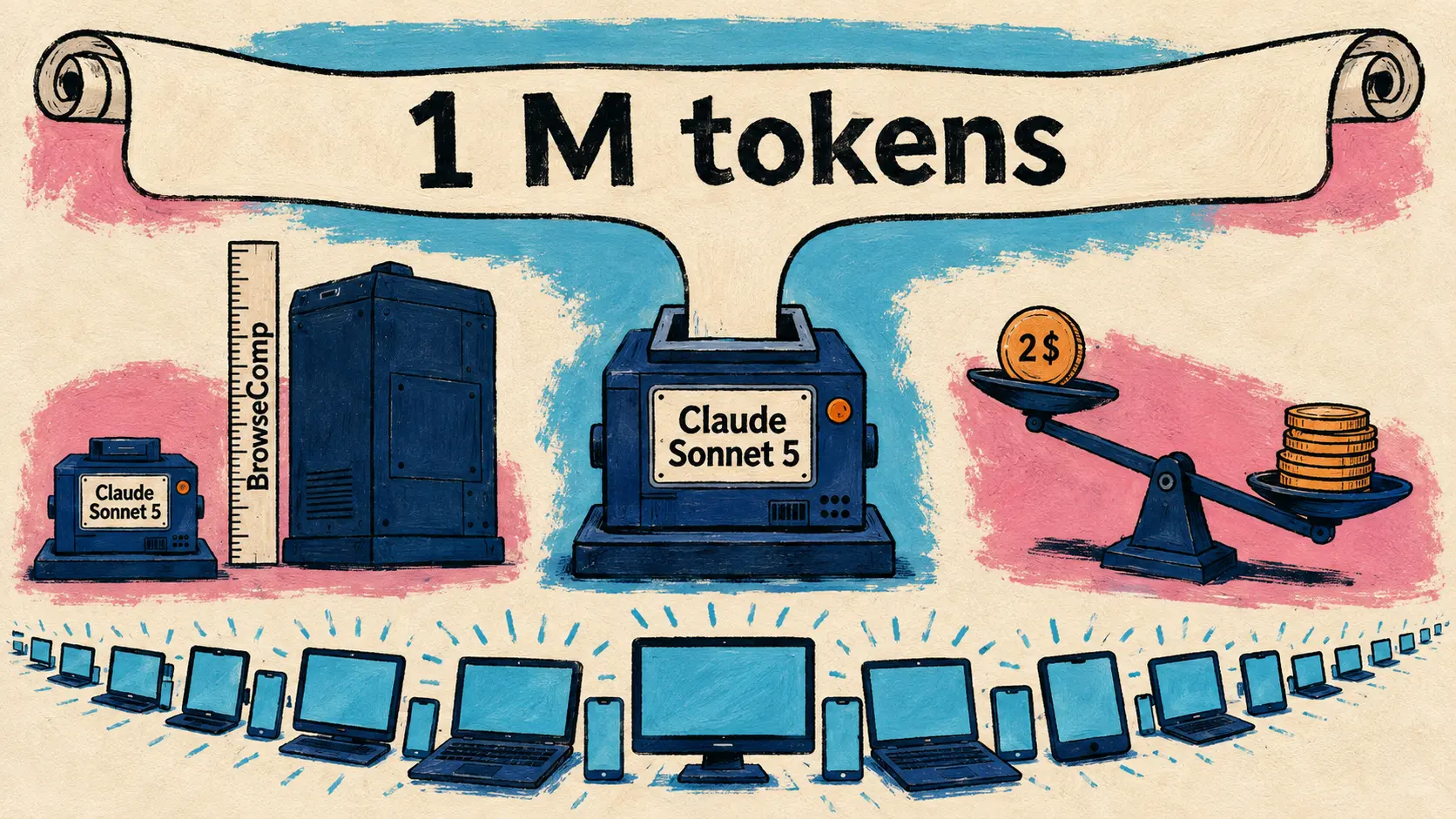
Claude Sonnet 5 — default model on Free and Pro, 1 million token context
June 30 — Anthropic launches Claude Sonnet 5, its new model in the Sonnet family, designed to be the most agentic yet. Sonnet 5 narrows the gap with Opus 4.8 on agentic benchmarks (BrowseComp, OSWorld-Verified) while maintaining lower pricing, and becomes the default model for Free and Pro plans from launch day.
| Feature | Value |
|---|---|
| API identifier | claude-sonnet-5 |
| Context window | 1 million tokens (native) |
| Input price (promo) | $2 per million tokens |
| Output price (promo) | $10 per million tokens |
| Default plans | Free, Pro |
| Availability | API, all Claude plans |
Highlighted capabilities include autonomous planning, multi-step tool use, execution of complex tasks on legacy code (brownfield code), and better adherence to code conventions. On the safety front, Sonnet 5 shows an overall lower rate of undesirable behavior than Sonnet 4.6, but exhibits slightly stronger capabilities on certain cybersecurity tasks without specific training; it is therefore launched with real-time protections via the Cyber Verification Program. The full System Card is available on anthropic.com.
Expanded availability: Sonnet 5 is also generally available in GitHub Copilot (Pro, Pro+, Max, Business, and Enterprise plans, with zero data retention for Business and Enterprise, selectable in VS Code, JetBrains, Xcode, CLI, github.com, iOS, and Android) and in Microsoft Foundry on NVIDIA GB300 NVL72 GPUs.
🔗 Anthropic announcement — Claude Sonnet 5
Claude Code v2.1.197 — Sonnet 5 as the default model
June 30 — Version 2.1.197 of Claude Code accompanies the launch of Sonnet 5 by making it the default model in the CLI tool. The native 1 million token context window is directly accessible in Claude Code sessions. Promotional pricing of $2/$10 per million tokens is valid until August 31, 2026. An update to version 2.1.197 is required to benefit from this default model.
🔗 Release v2.1.197 — Claude Code
Claude Science — scientific workbench in beta with NVIDIA BioNeMo
June 30 — Anthropic announces the beta availability of Claude Science, an AI workspace specifically designed for scientific researchers. The application brings together in a single space the tools that are usually fragmented: specialized databases, Jupyter, R, HPC cluster terminals, on-demand GPU execution.
| Feature | Description |
|---|---|
| Coordinating agent | +60 preconfigured skills and connectors (genomics, single-cell, proteomics, structural biology, cheminformatics) |
| Reproducible artifacts | Figures and manuscripts with exact code, environment, and complete history |
| Compute management | Laptop, HPC cluster via SSH, or on-demand GPU (Modal) — from 1 to hundreds of GPUs |
| Reviewer agent | Checks citations, validates calculations, corrects errors in real time |
| Session fork | Compares two approaches without losing the original thread |
| Native scientific render | 3D protein structures, genomic tracks, chemical structures |
Availability: open beta for Pro, Max, Team, and Enterprise plans on macOS and Linux (https://claude.com/science). A discounted Team plan is planned for academic labs and nonprofit organizations.
NVIDIA BioNeMo Agent Toolkit integration: Claude Science is the first environment to integrate the BioNeMo Agent Toolkit in production, allowing researchers to access NVIDIA’s GPU-accelerated tools through natural language:
| BioNeMo tool | Performance |
|---|---|
| NVIDIA Parabricks | Genomic analysis: hours → minutes |
| RAPIDS-singlecell | 1.3 million cells preprocessed in 25 seconds (vs. 52 min without GPU) |
| nvMolKit | Cheminformatics 3,000× faster (similarity, conformers) |
| BioNeMo open models | Evo 2, Boltz-2, OpenFold3 |
| BioNeMo NIM | Production-ready inference microservices |
Beta feedback: the Allen Institute (Jérôme Lecoq) writes scientific reviews of more than 100 pages with actor-critic agents, reducing the timeline from 2 years to a few weeks. The UCSF Brain Tumor Center (Stephen Francis) confirms a 10× speedup on epidemiological analyses of gliomas.
AI for Science grants program: up to 50 selected projects will each receive up to $30,000 in Claude credits, plus up to $2,000 in Modal compute for some projects. Applications are open until July 15, 2026, with award notifications before July 31.
🔗 Anthropic announcement — Claude Science
Amp: Agents in Orbs — cloud machines for running unsupervised agents
June 30 — Amp launches Orbs, dedicated cloud machines designed to run coding agents without supervision, even when the local machine is turned off.
| Feature | Value |
|---|---|
| RAM | 32 GB per orb |
| CPU | 16 cores per orb |
| Pricing | $1.66/h billed by the minute |
| Startup | Fast with automatic sleep mode |
An orb starts with a single command from the terminal or Amp TUI: amp -ox "<prompt>". Control remains the same as in a local run: code review, file navigation, integrated terminal. Changes are synchronized to the local machine with amp sync <thread-id>. It is possible to run multiple agents in parallel without local resource conflicts, and to access each agent’s state from the web, CLI, or mobile.
The per-minute billing model — with automatic sleep between active operations — is designed to minimize costs when the agent is waiting for input or performing I/O operations. This offering places Amp in the same territory as Anthropic’s Claude Code Remote, with one notable difference: a full dedicated machine per agent (32 GB, 16 cores) rather than a shared container.
From a workflow perspective, Orbs make it possible to launch an agent in the background at the end of the day and find pull requests ready to review the next morning, from any device.
🔗 Amp announcement — Agents in Orbs
Nano Banana 2 Lite and Gemini Omni Flash available in API
June 30 — Google DeepMind simultaneously launches two new models for developers: Nano Banana 2 Lite for high-velocity image generation and Gemini Omni Flash for conversational video.
Nano Banana 2 Lite (gemini-3.1-flash-lite-image)
| Dimension | Value |
|---|---|
| Latency | 4 seconds per image |
| Cost | $0.034 for 1,000 images |
| Availability | Gemini API, Google AI Studio, Gemini Enterprise Agent Platform |
Recommended replacement for the legacy model gemini-2.5-flash-image: better quality, higher speed, lower cost. The model maintains prompt fidelity, character consistency, and text rendering in the image despite prioritizing speed. It is also deployed in consumer-facing surfaces: AI Mode in Search, Gemini app, NotebookLM, Google Photos, Google Flow, and Google Ads.
Gemini Omni Flash (gemini-omni-flash-preview)
| Dimension | Value |
|---|---|
| Cost | $0.10 per second of video |
| Maximum duration | 10 seconds (longer durations announced) |
| Availability | Gemini API, Google AI Studio, Gemini Enterprise Agent Platform |
The model targets conversational video editing via natural language, with multimodal grounding (images + text + video as input), synchronized text/graphics, and integrated SynthID watermarking. Current limitations: duration limited to 10 seconds, audio references and scene extension not supported via the API, character consistency across scene changes still imperfect.
Image → video chaining: the Interactions API manages session history for sequential edits of up to 3 consecutive steps, making it possible to quickly generate an image with Nano Banana 2 Lite and then animate it with Gemini Omni Flash. Google demonstrates this chaining in three applications: Anywhere (transport into iconic places), Space Lift (interior design), and Omni Product Studio (e-commerce image→video).
🔗 Google DeepMind announcement — Nano Banana 2 Lite and Gemini Omni Flash
GeneBench-Pro — a research-grade computational biology benchmark
June 30 — OpenAI publishes GeneBench-Pro, a research-grade benchmark measuring the ability of AI agents to reason in computational biology. The central concept is research taste — the sequence of judgments that guides an analysis: which questions the data make it possible to explore, when an initial plan should be revised, how early diagnostics should change the approach.
Coverage: 129 questions across 10 domains — statistical genetics, population genomics, quantitative genetics, regulatory genomics, functional genomics, proteomics, clinical genomics, cancer genomics, microbial genomics, and forensic genetics.
Results:
| Model | Score (max reasoning level) | Score (Pro mode) |
|---|---|---|
| GPT-5.6 Sol | 28.7% | 31.5% |
| GPT-5 (construction-time baseline) | < 5% | — |
GPT-5.6 Sol solves nearly 6 times more questions than GPT-5.2 while using approximately two-thirds of the tokens. At this pace of progress, the benchmark could be saturated by the end of 2026. A human expert would estimate that a GeneBench-Pro problem takes 20 to 40 hours of work, i.e. thousands of dollars; AI inference costs a few dollars per problem.
Method: the problems are synthetically constructed (known causal structure, simulated data) to avoid evaluation bias (ground-truth leakage). Open source: 10 representative questions are published on Hugging Face; a subset of 50 questions will be provided to Artificial Analysis for an independent third-party benchmark.
🔗 OpenAI announcement — GeneBench-Pro
Together AI at ICML 2026: 8 open research papers
June 30 — Together AI publishes the recap of its 8 papers accepted at ICML 2026 (Seoul, July 6–11). The research covers the full stack: agents, training, algorithmic optimization, systems, and GPU kernels.
| Paper | Layer | Key result |
|---|---|---|
| ThunderAgent | Agents | Up to 3.6× agent throughput |
| TTT-Discover | Agents | Beats the best humans (open 120B model, ~$500) |
| Aurora | Algorithms | Additional 1.25× production speedup (MiniMax M2.1 229B) |
| Untied Ulysses | Systems | 5M tokens on a single 8×H100 node (−87.5% attention memory) |
| OEA | Systems | Up to 39% faster MoE decoding |
TTT-Discover applies RL at test time: each attempt becomes training data for the next, and beats best-of-N across 4 domains (mathematics, GPU kernels, competitive programming, cell biology) with an open 120B model for about $500 in simulation. Untied Ulysses reaches 5M tokens on a single 8×H100 node (−87.5% attention memory). Code and kernels are published open source.
🔗 Together AI blog — ICML 2026
ADK Go 2.0 — multi-agent workflow engine with human-in-the-loop
June 30 — Google releases version 2.0 of the Agent Development Kit (ADK) for Go, the official framework for building Gemini agents. This version introduces a graph-based workflow engine as a first-class primitive.
Main new features: composition of complex agents with graph primitives in native Go (without a separate DSL), built-in human-in-the-loop (HITL) for scenarios requiring human validation, dynamic orchestration with automated resilience (exponential backoff, error handling, retry), and a unified runtime shared between simple agents and complex graphs to simplify telemetry and state persistence. ADK for Go complements the existing Python SDK by bringing the language’s performance and type safety to the composition of multi-step agents.
🔗 Google Developers Blog — ADK Go 2.0
Copilot Agent in JetBrains AI Assistant
June 30 — JetBrains and GitHub announce the integration of GitHub Copilot as a first-class agent in the JetBrains AI Assistant agent picker, alongside the existing Copilot plugin.
The integration is based on the ACP (Agent Communication Protocol) and enables: selecting the Copilot model directly in the interface, adjusting reasoning depth, and complex multi-step programming tasks where Copilot reasons within the project, proposes changes, runs commands, and iterates. Announced next steps: support for NES (Next Edit Suggestions), invocation of reusable skills for common workflows, and deeper orchestration between tools in the IDE.
🔗 GitHub Changelog — Copilot Agent in JetBrains
Per-user AI budgets for Enterprise Copilot cost centers
June 30 — Enterprise administrators can now define a per-user AI budget on a cost center. The budget is automatically applied to all members of the cost center, including later additions via Enterprise teams. Precedence order: individual budget > cost center budget > global budget. The budget covers both included pool usage and additional usage, and can block a user before the pool is exhausted. Available since June 30 via the REST API only; the billing UI will follow.
🔗 GitHub Changelog — Per-user AI budgets
Claude on NVIDIA GB300 Blackwell Ultra in Azure — general availability
June 29-30 — Anthropic Claude models are now generally available in Microsoft Foundry, hosted on Azure and accelerated by NVIDIA GB300 Blackwell Ultra GPUs (NVL72 systems with Quantum-X800 InfiniBand networking).
The integration includes the NVIDIA Secure Agent Workspace Reference Design, which covers identity governance, networking, credentials, and infrastructure-level execution policy — a framework designed for enterprises subject to strict compliance requirements. Claude agents can access verified NVIDIA skills for domain-specific capabilities. This general availability follows the Microsoft × NVIDIA × Anthropic three-way partnership announced in November 2025.
🔗 NVIDIA Blog — Claude on GB300 Blackwell Ultra Azure
NVIDIA Omniverse + Metropolis: AI vision agents for industry
June 30 — NVIDIA publishes three complete workflows for building AI vision agents capable of running at the industrial edge, combining Omniverse (OpenUSD simulation), Metropolis (AI video deployment), and Cosmos (foundation models for the physical world).
1. Visual inspection (Roboflow + Corning): the Defect Image Generation skill paired with NVIDIA Cosmos generates synthetic defect data from real images. Result on Corning benchmark: 95% average accuracy with only 8 real images, and perfect recall on the hardest class. A project that used to take several quarters is reduced to a few days.
2. Smart cities (Linker Vision in Kaohsiung): −85% development effort, −80% incident response time. The pipeline uses Cosmos for video augmentation, TAO for fine-tuning, and VSS for search, summarization, and alerts.
3. Industrial operations at Foxconn (GB300 lines): via DeepHow — 99% accuracy on standard procedure verification, +3% first-pass yield.
🔗 NVIDIA Blog — Omniverse + Metropolis Vision AI
Briefs
-
Claude Code v2.1.196 — organization default models — Administrators can set the default model from the organization console; users see “Org default” (or “Role default”) in the
/modelcommand if they have not selected a model themselves. 🔗 Release v2.1.196 -
Hugging Face — Every Eval Ever (EEE) integrated into Community Evals — HF makes its Community Evals interoperable with the EEE schema (Every Eval Ever, EvalEval Coalition, February 2026): evaluation results appear on HF model pages with verified attribution, and a
community_evals_convertertool automates conversion from HF → EEE with human review before any push. 🔗 Hugging Face Blog — EEE -
OpenAI — 18-year-old bug in GNU libunwind fixed — Engineering post by Nathan Bronson: a single-instruction race condition in
_Ux86_64_setcontextof GNU libunwind (dating back to the first x86_64 implementation) caused crashes in Rockset. The three triggering conditions (high exception rate, high signal rate, signal handler consuming a lot of stack) were only present at OpenAI. Fix: migration to libgcc and an upstream patch to GNU libunwind. 🔗 OpenAI Engineering — Core dump epidemiology
What this means
The new generation of models and the 1 million-token context economy. Claude Sonnet 5 at $2/$10 per million tokens with a native 1 million-token window resets the economics of long-running agents: where entry-level pricing required truncating context, it is now possible to include entire codebases or extended work sessions without extra cost. The migration of Claude Code to this default model on launch day, and general availability in GitHub Copilot and Microsoft Foundry on GB300, signal a broad, simultaneous distribution strategy: Sonnet 5 is not a lab model, it is production infrastructure deployed from day one across the main enterprise channels.
AI as infrastructure for scientific research. Claude Science, GeneBench-Pro, BioNeMo integration, and Together AI’s 8 ICML papers converge on the same signal: AI is beginning to insert itself into the scientific process itself, not just into peripheral tools. Claude Science orchestrates HPC clusters and generates reproducible artifacts with full history. GeneBench-Pro measures research taste — the ability to chain judgments over 20- to 40-hour analyses — and sees a 6× improvement factor between GPT-5 and GPT-5.6 Sol. Together AI’s TTT-Discover goes further by showing that an open 120-billion-parameter model, learning on the fly for about $500 of simulation, can outperform the best human experts across 4 scientific domains. These simultaneous shifts sketch the outline of an AI-driven scientific infrastructure, with economies of scale that make analyses once reserved for large labs more accessible.
Cloud agents as the standard for asynchronous execution. Amp Orbs and Copilot Agent in JetBrains AI Assistant illustrate two versions of the same movement: taking agents out of the context of a synchronous session. Amp offers dedicated machines (32 GB, 16 cores, $1.66/h) for unattended coding agents that run while the developer sleeps. Copilot in JetBrains slots into the IDE’s native agent picker for multi-step tasks driven by reasoning. In both cases, the agent becomes an asynchronous collaborator capable of making decisions in a real work environment, not just an interactive assistant.
Generative media enters the developer pipeline economy. Nano Banana 2 Lite at $0.034 for 1,000 images and Gemini Omni Flash at $0.10/s of video with chaining via the Interactions API change the equation for e-commerce, gaming, and entertainment applications: generating 10,000 product images costs 34 cents, and each image can be animated for 40 cents. NVIDIA GB300 infrastructure and the Omniverse + Metropolis workflows complete the picture on the industrial side — AI vision at the edge with measured results (−85% development time in Kaohsiung, 99% accuracy on Foxconn lines) — and show that media generation is leaving the experimental realm to become an operational layer.
Sources
- Anthropic — Claude Sonnet 5
- Anthropic — Claude Sonnet 5 System Card
- Claude Platform — Model overview
- Anthropic — Claude Science
- Claude Science — Product page
- NVIDIA Blog — Claude Science + BioNeMo Agent Toolkit
- GitHub Changelog — Claude Sonnet 5 GA in Copilot
- Release v2.1.197 — Claude Code
- CHANGELOG Claude Code
- Amp — Agents in Orbs
- Google DeepMind — Nano Banana 2 Lite and Gemini Omni Flash
- OpenAI — GeneBench-Pro
- Together AI — ICML 2026
- Google Developers Blog — ADK Go 2.0
- GitHub Changelog — Copilot Agent in JetBrains
- GitHub Changelog — Per-user AI budgets
- NVIDIA Blog — Claude on GB300 Blackwell Ultra Azure
- NVIDIA Blog — Omniverse + Metropolis Vision AI
- Hugging Face Blog — EEE Community Evals
- OpenAI Engineering — Core dump epidemiology