ai-powered-markdown-translatorArticle translated from fr to en with gpt-5.6-sol.
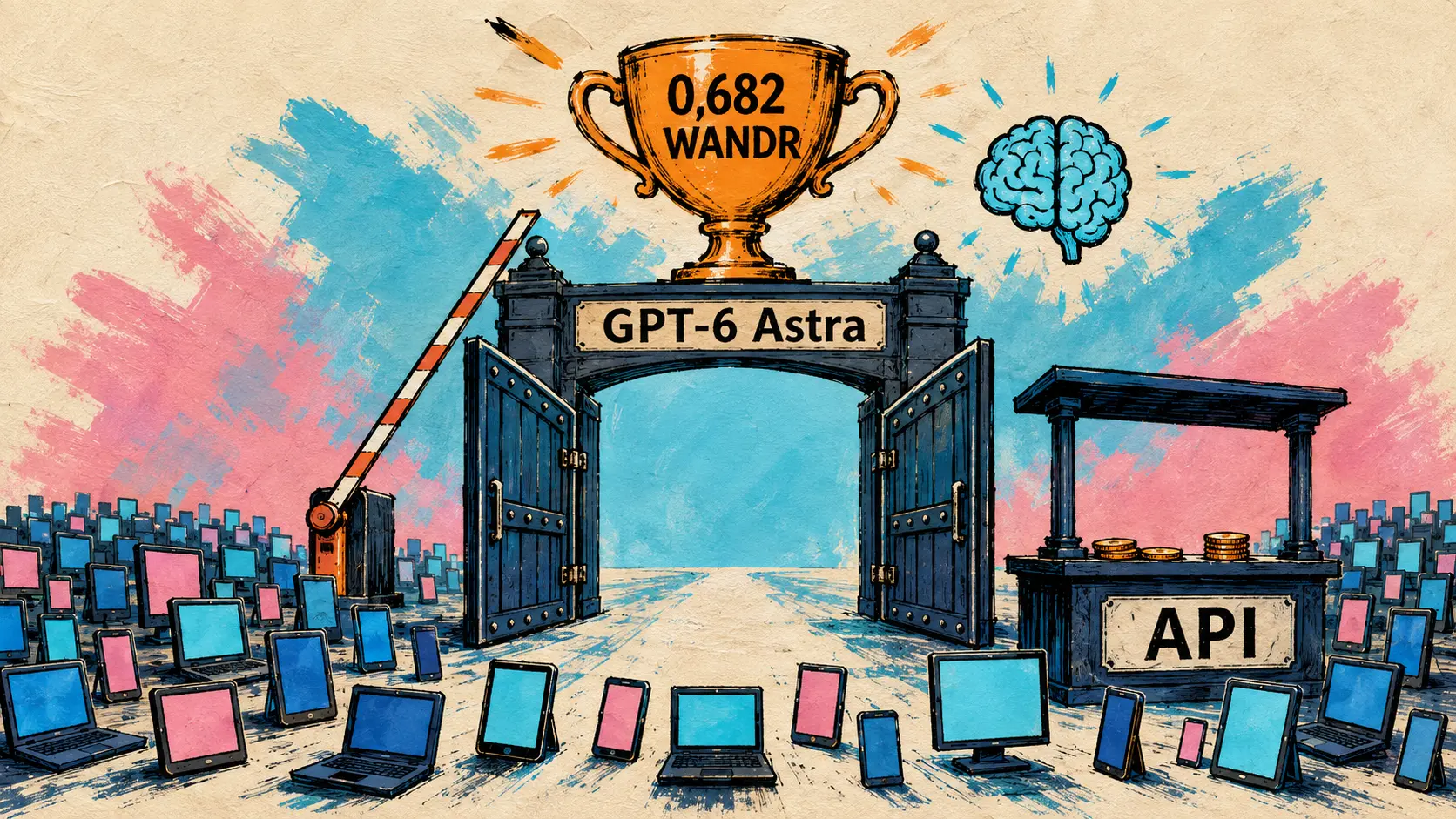
GPT-6 Astra leaves limited rollout twenty-four hours after its launch: the model becomes available to Pro, Enterprise, and Business Premium plans, enters general availability in GitHub Copilot, and earns the highest score Perplexity has ever measured on its deep-research benchmark. For its part, Anthropic publishes the first computer-verified proof of Fermat’s Last Theorem, written in eleven days by Claude. GitHub opens HydraFusion, a mode that selects the model and workflow for each task itself, Google releases Lyria 3.5 in the Gemini app, and SpaceXAI opens Grok Bot to businesses while documenting a procurement agent that found more than $100,000 in savings at its own employer.
GPT-6 Astra leaves limited rollout and enters general availability in Copilot
September 4 — OpenAI announces at 10:13 p.m. Paris time that GPT-6 Astra is leaving its limited rollout. The model is available to all Pro, Enterprise, and Business Premium users in ChatGPT Work and Codex, and the API now provides unrestricted access, whereas the September 3 announcement still made it subject to a gradual rollout. Plus subscribers and Business users will have to wait a few more days, according to the same message.
| Surface | Access as of September 4 |
|---|---|
| OpenAI API | Unrestricted availability |
| ChatGPT Work and Codex, Pro | Available |
| Enterprise and Business Premium | Available |
| Plus and other Business plans | A few days’ delay |
General availability in GitHub Copilot, at the public rate from day one
That same day, GPT-6 Astra enters general availability in GitHub Copilot. GitHub emphasizes the model’s working method rather than its scores: in its internal tests, Astra plans and validates throughout execution, combines diagnosis with verification, and confirms its own results before declaring a task complete, giving it better performance on long-running tasks with fewer steps than previous OpenAI models. No benchmark figures accompany the announcement.
The model appears across ten surfaces, from Visual Studio Code and JetBrains IDEs to Copilot CLI, GitHub Mobile, Xcode, and Eclipse, but remains limited to Pro+, Max, Business, and Enterprise plans. Copilot Pro is excluded. The billing detail is worth noting: Astra is billed at the provider’s public pay-as-you-go rate, with no promotional period, whereas Gemini 3.8 Flash, which arrived the previous day, benefits from introductory pricing until December 31, 2026.
Perplexity gives it its highest score on WANDR
On September 3 at 11:10 p.m., Perplexity published Astra’s result on WANDR, its in-house large-scale deep-research benchmark. The model scores 0.682 at $11.98 per task, the highest score of any model the company has tested.
| Model evaluated | WANDR score | Cost per task | Measurement published on |
|---|---|---|---|
| GPT-6 Astra | 0.682 | $11.98 | September 3, 2026 |
| Claude Fable 5.1 | 0.601 | $12.76 | September 1, 2026 |
Perplexity also provides two relative comparisons: a 13.5 percent higher score than Claude Fable 5.1 at a 6.1 percent lower cost, and 27.0 percent higher than Opus 5 at a 3.3 percent higher cost. Two caveats are necessary. WANDR is a proprietary benchmark whose detailed methodology has not been published, and Perplexity is also a customer of the models it ranks. No absolute value was disclosed for Opus 5.
Three Codex CLI patches complete the integration
On the command-line side, version 0.153.0, released overnight on September 3, was followed by three patches in less than two days, all dedicated to Astra. Version 0.153.1 makes it possible to configure the model through the API without changing the default model or making it appear in the selector. Version 0.153.2 corrects a label: the Fast tier is described as offering 2x the speed rather than 1.5x, with no change to how requests are processed. Version 0.153.3, released on September 4 at 9:01 p.m., adds Astra to the Amazon Bedrock model selector for Mantle and Runtime routes and corrects the instruction given to the model for asynchronous clarification questions.
OpenAI rounded out the day with three firsthand accounts: two posts on the developer blog, one about a procedural space exploration game built in Codex and the other about designing a house explored in Blender and Unreal Engine 5, plus an article by Dominik Kundel about five changes in how he uses Codex.
🔗 Codex CLI 0.153.3 release notes · 🔗 Building a game with Astra
Claude delivers the first formalized proof of Fermat’s Last Theorem
September 4 — Anthropic publishes the first fully computer-verified proof of Fermat’s Last Theorem. Claude worked for eleven days, largely autonomously, to write it in Lean. The company describes it as the largest Lean proof ever constructed.
| Metric measured | Recorded value |
|---|---|
| Duration of Claude’s work | 11 days |
| Lines of Lean written | 13 million |
| Intermediate theorems proved | 29,500 |
| First human proof, by Wiles | 1995, 129 pages |
| Gap between the conjecture and its proof | more than 350 years |
The theorem states that no triple of positive integers satisfies Fermat’s equation for an exponent greater than two. Pierre de Fermat scribbled it around 1637 in the margin of his copy of Diophantus’s Arithmetica. The first correct proof was produced by Sir Andrew Wiles in 1995: 129 pages, months of human verification, and an initial version presented in 1993 in which a reviewer uncovered a critical flaw two months later.
The first attempts failed, with agents achieving quick successes before losing track. The breakthrough came from Prove2Me, an open collaborative formalization platform, paired with a multi-agent harness based on Claude Code. The platform maintains a directed acyclic graph of statements that agents use to choose the next proof to attempt, separates statements and proofs into distinct files to speed up Lean compilation, and retains a natural-language description of each statement to enable search and reuse. The resulting proof follows Henri Darmon, Fred Diamond, and Richard Taylor’s simplified exposition of Wiles’s work.
This extraordinary autoformalization achievement, which Anthropic researchers say only took 11 days, proves Fermat’s Last Theorem with no assumptions other than the axioms of mathematics. — Kevin Buzzard, reviewer of the result, quoted on Anthropic’s research page
Anthropic frames the issue as one of verification rather than discovery, unlike recent AI work on the Riemann hypothesis, which produced new mathematics. As the volume of proofs grows, peer review becomes a bottleneck measured in years.
With Project HydraFusion, GitHub lets the tool choose the model instead of the developer
September 4 — GitHub opens Project HydraFusion as a research preview, a mode that no longer designates a model but a workflow. Whereas Copilot’s selector required users to choose among more than twenty models, HydraFusion decides for itself, for each request, which model handles the task and according to which execution pattern. It is selected like any other model but orchestrates several behind that single choice.
Three patterns are currently available. Single mode assigns the task to a single model. Cascade mode has an efficient model draft an initial solution, after which a quality gate decides whether to accept it or escalate to a more capable model. Critique mode has the draft reviewed by an independent, read-only critic from another model family.
| Benchmark evaluated | Cost difference vs. Opus 5 | Quality difference vs. Opus 5 |
|---|---|---|
| TerminalBench 2.1 | 67 percent lower | 4.9 points higher |
| DeepSWE | 36 percent lower | 1.5 points lower |
| CheckpointBench | 65 percent lower | 0.1 points lower |
Five engineering principles govern execution: aggregated accounting of the cost of each step, explicit timeouts and cancellation, review in an isolated context without tools, fail-safe application that applies no patch if the workflow fails, and routing validation before execution. GitHub accepts an interface tradeoff, showing the steps but withholding intermediate drafts until the final result, and acknowledges that waiting without sufficient visibility is a genuine drawback.
The development documentation is unusually candid: GitHub identifies TerminalBench 2.1 as the most complete sequence of runs, notes that progress was not linear, and acknowledges that two operational failures in the evaluation harness produced invalid runs between August 11 and 25. These runs were excluded from the trend and then corrected, and the company places the best operating points in the recorded series on August 25. Access is provided through Copilot CLI on all plans, at the standard rate based on the workflow’s total tokens, after /update followed by /experimental on.
Lyria 3.5 arrives in the Gemini app and the API
September 4 — Google releases Lyria 3.5, which it presents as its music-generation model with the best audio fidelity, featuring more expressive vocals and richer arrangements.
In the Gemini app, the update comes with three interface changes. Users can select or describe their musical genre and choose between vocal or instrumental output. New ready-made templates provide a starting point, whether for background music or a personalized birthday song. Track duration is now configurable, from short form to long form.
| Surface type | Access to Lyria 3.5 |
|---|---|
| General public | Gemini web and mobile app, worldwide |
| Professional creation | Google Flow Music |
| Developers | Gemini API, Google AI Studio, Google Vids |
Google positions the expected use cases around everyday needs rather than professional production: a backing track for a video, a brand jingle, or a personalized ringtone. Distribution is broad, with no subscription restriction mentioned. However, the post provides no audio-quality figures, no comparison with the previous version of Lyria, and no pricing for API access.
SpaceXAI puts Grok to work in the enterprise and publishes its procurement agent’s system prompt
September 3 and 4 — SpaceXAI opens Grok Bot to businesses. Launched on August 12, the product moves from an offering for individual subscribers and Cursor teams to a version equipped with access, network, and audit controls. Each user’s work runs in an isolated environment, and a Bot has no access by default: it can reach only the accounts to which it is explicitly connected. Grok Enterprise and Cursor Enterprise customers receive it free for two weeks and can invite their entire organization, including people without an existing seat. SpaceXAI cites Legora, Supermicro, and ServiceTitan, and says thousands of organizations have adopted the product since launch.
The most interesting point in the announcement is that the heaviest usage occurs outside engineering: overnight prospecting and evaluation rubrics in recruitment, email drafts and presentation updates in sales, and extracting questions and answers from webinars in marketing.
The following day, the company publishes a case study of a Bot unleashed on its own procurement operations. Named Haggle Bot and connected to Slack, Notion, Drive, Gmail, Hex, and Ramp, it reports more than $100,000 in direct savings.
| Agent finding | Amount identified |
|---|---|
| Total direct savings | more than $100,000 |
| Seats inactive for 90 days, first product | 43 seats, $14,220 |
| Unused references, monthly product | $85,662 per year |
The editorial value of the post goes beyond these figures: SpaceXAI publishes the agent’s system-prompt template, presented as a model to fill out for one’s own organization, with example values shown in angle brackets. Its permissions section distinguishes three permanent regimes. The first never requires approval, with examples including reading spending data and messaging colleagues. The second requires the operator’s explicit approval every time, with any communication sent to a vendor given as the example. The third remains prohibited under all circumstances, with the listed examples including signing, purchasing, subscribing, approving expenses, and making any binding commitment. The post explains in prose that the team allowed the agent to conduct internal research and coordination on its own but required explicit approval to spend money, accept terms, or write to a vendor.
🔗 Grok Bot for Enterprise · 🔗 Haggle Bot unleashed on procurement
Grok Connects to US Bank Accounts via Plaid
September 4 — Grok can now connect to its users’ financial accounts. The connection is handled through Plaid, the technical intermediary linking applications and banking institutions in the United States, and the feature is available immediately in that country only.
The three examples selected by SpaceXAI outline the intended scope: finding out where last month’s money went, tracking investment performance, and checking whether users can actually afford what is in their shopping cart. In other words, analyzing past spending, monitoring portfolios, and assisting with purchasing decisions when they arise. The announcement remains brief and says nothing about data processing or supported institutions beyond mentioning a secure connection.
It extends a series of financial integrations begun with the Interactive Brokers partnership on June 25, but its nature is different: whereas Interactive Brokers targeted active investors, Plaid opens the assistant to the general public’s checking accounts.
Claude Code 2.1.260 and 2.1.261: Diff Panel, Skills Audit, and Hardened Permissions
September 4 — Two versions of Claude Code were released on the same day, and they complement each other: the first provides visibility into work in progress, while the second shows what the session consumes.
| Released version | Release time | Key additions |
|---|---|---|
| 2.1.260 | September 4, 01:48 | /diff panel, cache diagnostics in /cost, permission fixes |
| 2.1.261 | September 4, 21:58 | /skill-doctor, outputs up to 128,000 characters, sub-agent prompt in a file |
Version 2.1.260 opens a diff panel beside the conversation in full-screen mode, displaying uncommitted changes as edits are made. Most importantly, it fixes several permission-evaluation flaws: Edit, Write, and Read rules whose paths contained parentheses were rejected as invalid or ignored by the Bash sandbox, leaving directories writable even though they were supposed to be read-only, while zsh commands concealing command substitution inside a REPORTTIME assignment were automatically approved.
Version 2.1.261 adds /skill-doctor, which lists loaded skills that remained unused and the context cost of each one. Its auto mode now treats a link that packages content into the URL of a public diagram generator as a submission to a third-party website.
🔗 2.1.260 release notes · 🔗 2.1.261 release notes
The ant apply Command Puts Managed Agents into Version-Controlled Files
September 4 — Anthropic is adding ant apply to its ant CLI. The command brings the declarative model familiar to infrastructure teams to Managed Agents: the desired state is described in repository files, and the command reconciles API resources with that description.
Five resource types are covered: Managed Agent environments, the agents themselves, skills, memory stores, and deployments. Until now, these objects were created through API calls or the console, leaving no trace in the repository. Describing them in files brings them into the scope of code review, version control, and continuous integration pipelines. The practical benefit is reproducibility: an agent environment described in a file can be recreated identically, compared across branches, or deployed from a pipeline without manual intervention.
NVIDIA’s Wave of Releases: Durable Agent Memory, Reasoning on Jetson, and Federated Identity
September 3 and 4 — Three posts appeared on NVIDIA’s technical blog on the same day, covering three different layers of the stack.
The first is an open recipe built on NemoClaw: a chief-of-staff agent that maintains durable memory of its user’s work. Its thesis can be summed up in one sentence: useful agent memory requires structure, selective retrieval, and governance, not just storage. The system relies on a self model, a human-readable knowledge layer written as structured Markdown pages, paired with a SQLite ledger that stores commitments, classifications, corrections, and audit events. Execution runs through NVIDIA OpenShell, which enforces filesystem, process, and network access policies in a sandbox, while credentials remain outside the sandbox.
| Measured metric | Agentic RAG baseline | Self model | Observed difference |
|---|---|---|---|
| Overall accuracy, across 186 questions | 82.8 percent | 90.9 percent | plus 8.1 points |
| Difficult questions, across 31 questions | 67.7 percent | 87.1 percent | plus 19.4 points |
| Tracking changing facts, across 5 | 60.0 percent | 100.0 percent | plus 40.0 points |
| Corpus fidelity, across 13 questions | 100.0 percent | 92.3 percent | minus 7.7 points |
Context can inform an action, but it cannot authorize one. — NVIDIA post on agent memory
The second publication is a deployment guide that marks a shift for edge AI: NVFP4 quantization combined with speculative decoding delivers up to 6.28 times the decoding throughput of BF16 on Jetson AGX Thor and Orin. The best configuration varies by model, and NVIDIA emphasizes this rather than naming a universal winner: Nemotron 3.5 Lightning performs best with DSpark, producing between 123 and 138 output tokens per second, while Qwen3.8-27B performs best with DFlash2, producing between 27.7 and 34.4 tokens per second. The final warning is methodological: throughput varies with workload, so the configuration should be validated using prompts representative of the intended application. The third, more modest publication describes propagating a user’s identity across federated Kubernetes and AI platforms.
🔗 Frontier reasoning on Jetson · 🔗 Identity across federated platforms
Google’s Command-Line Tools: Gemini CLI Moves to the 0.60.0 Series, Antigravity Opens Flash to Enterprises
September 3 and 4 — Gemini CLI’s nightly channel is moving from the 0.59.0 series to 0.60.0, with a release focused primarily on security. The most notable fix removes a hardcoded Google CrUX API key from the chrome-devtools-mcp component. Two other changes strengthen isolation: the macOS Seatbelt sandbox receives an isolated temporary directory, and the extension loader applies hardened path resolution with boundary validation. The fourth requires RFC 9207-compliant issuer identification in the MCP server OAuth flow, protecting against authorization-server mix-up attacks.
Antigravity 2.12.2, released the previous day, contains just one improvement and no fixes: enterprise users can access Gemini 3.8 Flash reasoning models by authenticating with Application Default Credentials. The practical benefit is connecting the model to the standard authentication method for Google Cloud deployments without requiring an individual API key.
🔗 Gemini CLI v0.60.0 nightly · 🔗 Antigravity changelog
AI for Science: A Coupled Climate Emulator and the Complete Connectome of a Male Fruit Fly
September 3 and 4 — Two publications apply machine learning to massive scientific objects in two unrelated disciplines.
Ai2 is releasing SamudrACE-E3SMv3 under the Apache 2.0 license on the Hugging Face Hub, a fully coupled atmosphere-ocean climate emulator. The aim is to reproduce the behavior of E3SM, the US Department of Energy’s reference climate model, at a much lower computational cost: screening hypotheses before running E3SM itself and producing large ensembles that sample climate variability inexpensively. The atmosphere (ACE) and ocean (Samudra) emulators are first pretrained separately before being coupled, then evaluated on 400 years of previously unseen E3SM data, over which the mean climate remains stable. Ai2 identifies an explicit limitation: the emulator captures daily precipitation up to the 99.99th percentile but underestimates it beyond that point.
The HHMI Janelia Research Campus, Google Research, and their collaborators are publishing the first complete map of the brain and central nervous system of an adult male fruit fly: more than 166,000 neurons, a record, divided into 11,691 cell types classified with the help of AI and validated by human experts. The method relies on imaging thin sections and then using computers to reassemble millions of two-dimensional images into three-dimensional neuronal shapes. Its significance lies in the comparison with the previously published female map: most neurons are identical in both sexes, a minority are sex-specific, and a third category, known as dimorphic, exists in both but connects to different neighbors. Three companion studies apply the map to vision, taste, and social behavior.
🔗 SamudrACE-E3SMv3 on X · 🔗 Map of the male fruit fly brain
Meta Opens Muse Spark 1.3’s Max Reasoning Tier to the Public
September 4 — Meta is making Muse Spark 1.3’s max reasoning tier publicly available, two days after announcing the model itself. The tier is available in Muse Code and through the Meta Model API.
What is changing, then, is not the model but actual access to its most compute-intensive reasoning level. Alexandr Wang, Meta’s chief AI officer, says the gains apply to coding and agentic tasks and recommends trying the model again even for those who have already tested the high and xhigh tiers. He adds that the launch follows the completion of safety testing. To activate it, users must select Muse Spark 1.3 and then set the reasoning level to max.
No benchmark figures accompany the release: the thread provides neither scores nor comparisons, only its author’s qualitative assessment.
Percept-Lens, Sakana AI’s Protocol for Evaluating Generated-Image Detection
September 3 — Sakana AI is introducing Percept-Lens, an out-of-distribution evaluation framework for detecting AI-generated images, accepted at ECCV 2026. The starting observation is that synthetic-image detectors fail as soon as several factors change simultaneously: the generator, the style or prompt, and the source domain. Percept-Lens unifies evaluation across 39 public datasets comprising 7.1 million images.
The representation study asks a direct question: does training a classification head still add anything beyond what modern encoders already separate? The authors construct a scale of prior-conditioned Gaussian discriminants—that is, closed-form heads built from first- and second-order feature statistics. The strongest rung on this scale often matches published detection heads and sometimes surpasses them, provided that comparisons use the same prior and encoder. The authors argue for reporting results at the level of the prior-encoder-head triplet.
🔗 Sakana AI post · 🔗 arXiv paper
TAOT, Topology-Aware Expert Replica Placement
September 4 — Baidu’s Baige team details TAOT, a method for placing expert replicas when training mixture-of-experts models, released as part of its open-source LoongForge framework.
The problem is concrete. When MoE training slows down, the cause is rarely GPU compute capacity but the inability to rebalance the workload in time: a few experts become hotspots while all the other ranks wait. The conventional remedy is to temporarily replicate a hot expert’s weights onto an idle rank, but once the parallelism domain extends beyond one node, not all idle GPUs are equal: intra-node traffic runs over NVLink, cross-node traffic over InfiniBand, and the cost can vary by an order of magnitude.
| Measured metric | Observed value |
|---|---|
| Time per iteration, before and after | 155.4 ms then 108.8 ms, or 1.43x |
| Speedup from EP4 to EP16 | up to 1.79x |
| Communication cost compared with LPLB | up to 74 percent lower at EP32 |
| Online scheduling overhead | less than 1 percent of forward-pass time |
TAOT is presented as the first method to incorporate both the benefit of clipping load peaks and the cost of moving weights between nodes into a single objective function. Whereas DeepSeek’s LPLB constrains paths using predefined graphs, TAOT uses a continuous communication-cost matrix with a soft topological preference: intra-node placement is favored, while cross-node placement remains permitted but more expensive. Switching from row-wise matching to column-wise matching reduces the residual imbalance from 7–10 percent to 1–2 percent.
Open Yap 1K, One Thousand Hours of Full-Duplex Conversation Free for Commercial Use
September 3 — The Agentic Data Company is releasing Open Yap 1K, an English-language conversational corpus with two separate channels, designed for full-duplex voice models.
| Corpus component | Public sample | Full corpus |
|---|---|---|
| Total duration | 8.9 hours | 1,000 hours |
| Conversations | 16 | 1,602 |
| License | CC BY 4.0 | Open Yap, free for commercial use |
| Access method | Hugging Face Hub | Available upon request |
The authors explicitly position the corpus as an alternative to existing speech corpora such as Fisher, Switchboard, and CANDOR, beginning with a technical argument: the post compares a Fisher English excerpt, sampled at 8 kHz over a telephone channel, with an Open Yap 1K excerpt to illustrate the difference in audio quality. The collection method, speaker demographics, quality assurance, consent, and privacy are documented.
Daily Brief Becomes Free for More US Gemini Users
September 4 — Google is expanding free access to Daily Brief to more users of the Gemini app in the United States. The feature was introduced on May 21.
Daily Brief works in the background and connects the user’s Google apps: emails, calendar, conversations, and interests are condensed into a single, browsable list of tasks and priorities, presented as a starting point for the day. The announcement remains limited to the United States and specifies neither the percentage of users affected nor a timeline for international expansion.
Runway Launches Team, a Self-Service Plan for Teams of Two to Nine Seats
September 4 — Runway is launching Team, filling the gap between individual plans and an Enterprise offering reserved for large accounts. The shift is significant for the product catalog: Standard, Pro, and Max are now explicitly individual plans, and every new member must now use Team, while existing workspaces retain their access and pricing.
| Plan feature | Announced value |
|---|---|
| Monthly price per seat | $69 |
| Annual price per seat | $55, a 20 percent discount |
| Number of seats allowed | 2 to 9 |
| Monthly credits per seat | 6,900, deposited into a shared pool |
| Shared projects and storage | up to 100 projects, 1 TB |
The plan is organized around shared projects containing assets, references, Brand Kits, sessions, and workflows. Runway makes the case in terms of output consistency: when the entire team generates from the same references, the tenth video looks like the first. Unused credits roll over for one month, a team can share up to 20 agent skills, and Agent Connectors link Figma, Dropbox, and Notion to the creative agent.
ElevenLabs Expands Its 1 Million Voices Initiative to Brazil
September 4 — ElevenLabs is bringing its impact program to Brazil and highlighting it with its first Brazilian story. Eliane lost her voice in childhood, while Alberto became blind at 46; the company gave Eliane a voice resembling those of her family members, allowing her for the first time to communicate with the man she loves in a voice that carries her identity.
The announcement comes with two local partnerships. The Associação Brasileira de Esclerose Lateral Amiotrófica, which serves up to 10,000 people with amyotrophic lateral sclerosis in the country, enables these patients to receive free access to clone their voices. The Sociedade Brasileira de Fonoaudiologia will train Brazilian speech therapists in voice cloning, with the company counting on practitioners’ proficiency to increase the number of patients who benefit. The 1 Million Voices initiative is a $1 billion in-kind commitment that has reached more than 11,000 people worldwide since its launch.
Kimi Code 0.41.0 Adds a Multi-Agent Mode and Removes a Two-Day-Old Safeguard
September 4 — Moonshot AI has released Kimi Code 0.41.0. The visible addition is tower, an experimental multi-agent collaboration mode in the web interface, triggered by the /tower command or the composer’s plus menu, which accepts a base branch as an argument. Context management receives two adjustments: the model is notified of its context budget before automatic compaction, then directed to the session event log to retrieve exact details. Turn-level file history is now permanent.
The most notable point is a reversal. Version 0.40.0, released on September 2, introduced blocking for destructive commands such as shutdown, reboot, or rm -rf in automatic permission mode. Version 0.41.0 reverses that decision and stops blocking dangerous commands, as well as commands that cannot be statically analyzed, in that same mode. The safeguard lasted two days. The reason is not explained in the notes, but static analysis of shell commands can easily produce false positives that block legitimate work.
🔗 Kimi Code 0.41.0 release notes
Perplexity Details Ivy, Tulip, and ROSE, the In-House Stack Serving Its Embeddings
September 4 — Perplexity has published an engineering post that lifts the hood on the infrastructure serving its embedding and ranking models. The company trains and serves its own models, including pplx-embed, and describes its search index as operating at exabyte scale.
| Stack component | Language used | Role in the service |
|---|---|---|
| Ivy | Rust | HTTP gateway, tokenization, chunking, and batching |
| Tulip | Rust, tokio, tonic | gRPC inference server, scheduling, and batching |
| ROSE | Python | Model execution, CUDA kernels, and graphs |
The guiding idea is to reuse LLM inference code. Perplexity notes that batch embedding resembles the compute-bound prefill phase, while online embedding of a short query resembles the memory-bound decode phase. The same kernels therefore serve pplx-embed and Qwen3.5 decoding, without a key-value cache instantiated for embeddings and with attention variants accepting ragged inputs that avoid unnecessary padding. For attention kernels, the team maintains FlashInfer 2, FlashInfer 3, and FlashAttention 4 in parallel rather than choosing only one, selecting among them case by case according to the number and dimension of the heads. The measurements are compared with vLLM v0.22.0, but their numerical results appear only in charts.
Zed and Replit Make Announcements on X, Without a Post or Release Notes
September 4 — Two announcements about third-party coding tools arrived on the same day, and both rely on a single X post, without a blog post or release notes to support them.
Zed says that Delta is now available to people enrolled in the Windows beta, in response to a September 2 user request. The distinction matters: Delta is the multiplayer agentic coding environment launched on August 12, allowing multiple team members to work with agents on a shared project. The Zed editor itself is already distributed for macOS, Linux, and Windows. The announcement therefore concerns Delta rather than the editor, whose Windows availability had remained pending since August. The exact scope of this beta and its enrollment process remain unknown.
For its part, Replit broadcast a one-hour-and-58-minute live session titled “Replit MCP: Steer Your Agent From Anywhere.” The title announces an MCP server that exposes the platform’s agent to protocol-compatible clients, with the intended use being to launch a task and track its progress from an editor, terminal, or third-party assistant without using the web interface. The message contains no text beyond that title, no link to a post, and no explicit launch wording.
🔗 Delta on Windows · 🔗 Replit MCP live stream
In Brief
- An API endpoint returns star history without exposing users — GitHub’s REST API returns timestamped star counts without identifying the accounts that awarded them, replacing listing endpoints restricted to administrators earlier in the year. 🔗 Changelog
- npm supports multiple trusted publishing configurations per package — three features are now generally available: multiple additive OIDC configurations per package, approval blocked while antimalware scanning is running, and preproduction history visible in the versions tab. 🔗 Changelog
- GitHub Actions adds a runner deprecation API — the REST API provides end-of-support dates for runner versions, a
vulnerability-alertspermission enables read-only access to Dependabot alerts, and fourjobcontext properties give reusable workflows their original identity. 🔗 Changelog - The Story of VS Code documentary premieres on September 4 — GitHub is promoting the release of the official Visual Studio Code documentary on the editor’s YouTube channel, following a trailer published on September 1. 🔗 Announcement
- Replit highlights an application built in one week — Pep AI, built on the platform by Cédric Roberge in about a week, reportedly generates around $130,000 per month according to Replit, in a promotional thread followed by pricing advice. 🔗 Replit thread
- Zed publishes a visual announcement whose content could not be verified — a four-word message accompanied by a single image, published on September 4 at 10:14 p.m. The image did not load during the scan, and no post or release notes accompany the publication: there is no way to establish what it announces. 🔗 Message
- A complete open LLM ecosystem for Armenian — a Hugging Face collection brings together the ArmWeb web corpus, the verified ArmSTEM scientific dataset, and the arm-gemma-e4b model, with a paper announced as forthcoming. 🔗 Post
- VLM Run Gateway brings open-weight OCR and vision models together behind a single API — the gateway exposes open-weight optical recognition, vision-language, and vision models through a single endpoint, including PaddleOCR-VL-1.6. 🔗 Post
- Sakana AI opens the doors of its engineering team on October 5 — the Engineer Open House will return on Monday, October 5, 2026, from 6 p.m. to 9 p.m., in Toranomon or online, with registration on connpass. 🔗 Announcement
- Google details the sprints in its Gemini Enterprise developer experience program — a methodology post without a launch: the sprint described focuses on enterprise AI governance and delivers updated documentation and standardized code examples for Agent Gateway and Semantic Governance. 🔗 Post
- Suno names its next generation of models, the v6 family — in a reply to a user, the official account describes it as its best work to date, without a date or technical details, one day after the new download limits took effect. 🔗 Reply
- MiniMax and Together AI host an evening on the economics of open models in London — the joint event Open by Design: The Economics of AI in Production will take place on September 16, MiniMax’s only post during the window. 🔗 Announcement
- Mistral brings the AI Engineer conference back to Paris on September 23 and 24 — the return to Station F brings together VP of Engineering Lélio Renard-Lavaud alongside Black Forest Labs, Cognition, and Hugging Face, following a sold-out previous edition. 🔗 Announcement
- The WebMCP Challenge closes submissions — the deadline comes after a twelve-hour extension caused by the September 3 outage; projects are under review, and the winners will be announced soon. 🔗 Announcement
What It Means
The speed at which the ecosystem absorbs a frontier model has become the real indicator. GPT-6 Astra was announced on September 3; by September 4, it was unconditionally available through the API, generally available across ten Copilot surfaces, benchmarked by a third party using it in production, and integrated through three successive Codex CLI patches. That twenty-four-hour turnaround did not exist a year ago. It shifts the question from launch to pricing: GitHub applies the provider’s public price to Astra without a promotional period, while Gemini 3.8 Flash benefits from introductory pricing through the end of the year. When every model arrives the day after its announcement, price once again becomes the only visible differentiator for the end user.
HydraFusion tackles the problem from the other end, and it is the day’s most consequential news for tooling. Choosing among twenty models is work that few developers do seriously, and GitHub proposes eliminating it altogether: users select a workflow, and the tool decides which model to use for each request. The figures—4.9 more quality points at 67 percent lower cost than Opus 5 on TerminalBench—matter mainly for what they suggest: the gain comes from orchestration, not from a superior model. If this result holds outside benchmark conditions, the model stops being the product and becomes an interchangeable component behind a quality gateway.
Enterprise agents are moving beyond engineering, and governance is following. SpaceXAI says so explicitly: the most intensive use of Grok Bot occurs outside coding, and the day’s most telling figure comes from a software seat audit—43 paid subscriptions with no activity for 90 days. But the real substance of these announcements lies in the permission mechanics. The system prompt template published by SpaceXAI distinguishes three regimes—always allowed, allowed case by case, and never allowed—and NVIDIA states the same principle in its post about agent memory: context can inform an action, but it cannot authorize it. Two unrelated players arrive on the same day at the conclusion that a useful agent is defined first by what it is forbidden to do.
For command-line tools, security is advancing in a zigzag rather than a straight line. Gemini CLI removes a hard-coded API key and strengthens its sandbox, Claude Code fixes permission rules that left supposedly read-only folders writable, and Kimi Code removes its block on destructive commands two days after adding it. The last case is the most instructive: static analysis of shell commands produces enough false positives that a safeguard that looks correct on paper becomes intolerable in practice. The security of these tools is determined not by the announcement of a protection, but by whether it survives contact with users.
That leaves the day’s developments in mathematics and science, the hardest to evaluate in the moment. The Fermat proof formalized in eleven days produces no new mathematics: it verifies a thirty-year-old result. That is precisely what makes it interesting, because peer review is the bottleneck measured in years, and Kevin Buzzard notes that these artifacts are now robust enough to serve as a foundation for further work. Ai2’s climate emulator and the fruit fly connectome follow the same logic: neither makes discoveries, but both make feasible work whose cost previously prevented it from scaling. This use is less spectacular than autonomous discovery and probably closer to what AI is actually changing in scientific practice.
Sources
- GPT-6 Astra available for Pro, Enterprise, and Business Premium
- GPT-6 Astra generally available in GitHub Copilot
- Perplexity benchmarks GPT-6 Astra on WANDR
- Codex CLI 0.153.3
- Building a game with Astra
- Formalizing Fermat’s Last Theorem
- Proof of Fermat’s Last Theorem on GitHub
- Project HydraFusion
- Lyria 3.5 in the Gemini app
- Grok Bot for Enterprise
- Haggle Bot, SpaceXAI’s purchasing agent
- Grok connects to financial accounts via Plaid
- Claude Code 2.1.260
- Claude Code 2.1.261
- The ant apply command
- A memory-driven agent with NVIDIA NemoClaw
- Frontier reasoning comes to Jetson
- Carrying user identity across federated Kubernetes platforms
- Gemini CLI v0.60.0 nightly
- Antigravity changelog
- SamudrACE-E3SMv3 by Ai2
- The complete connectome of a male fruit fly
- Muse Spark 1.3 max available publicly
- Percept-Lens by Sakana AI
- Percept-Lens paper on arXiv
- TAOT in LoongForge
- Open Yap 1K
- Daily Brief expanded across the United States
- Runway launches the Team plan
- 1 Million Voices comes to Brazil
- Kimi Code 0.41.0
- Fast GPU embeddings at Perplexity
- Delta available in beta on Windows
- Replit MCP live
- Privacy-safe endpoint for star history
- Multiple npm trusted publishing configurations
- Early September GitHub Actions updates
- The Story of VS Code
- Pep AI built on Replit
- Visual announcement published by Zed
- An open LLM ecosystem for Armenian
- VLM Run Gateway
- Sakana AI Engineer Open House
- Gemini Enterprise DevEx program sprints
- Suno discusses the v6 family
- Open by Design in London
- AI Engineer returns to Paris
- WebMCP Challenge concludes