ai-powered-markdown-translatorTranslated article from fr to en with gpt-5.4-mini.
The week of June 6 to 8, 2026 was dominated by the rise of autonomous agents: NotebookLM switches to agentic mode, Kimi simultaneously launches Work (a fleet of 300 local agents) and a major update to Code, and Perplexity publishes with Harvard the first major empirical study on agents in the enterprise — -87% time, -94% cost. In parallel, NVIDIA signs two Korean partnerships (LG Group and Doosan), Google lowers the price of its AI Plus subscription, and ElevenLabs expands into the United Kingdom with a government agreement.
NotebookLM becomes agentic — global rollout on the web
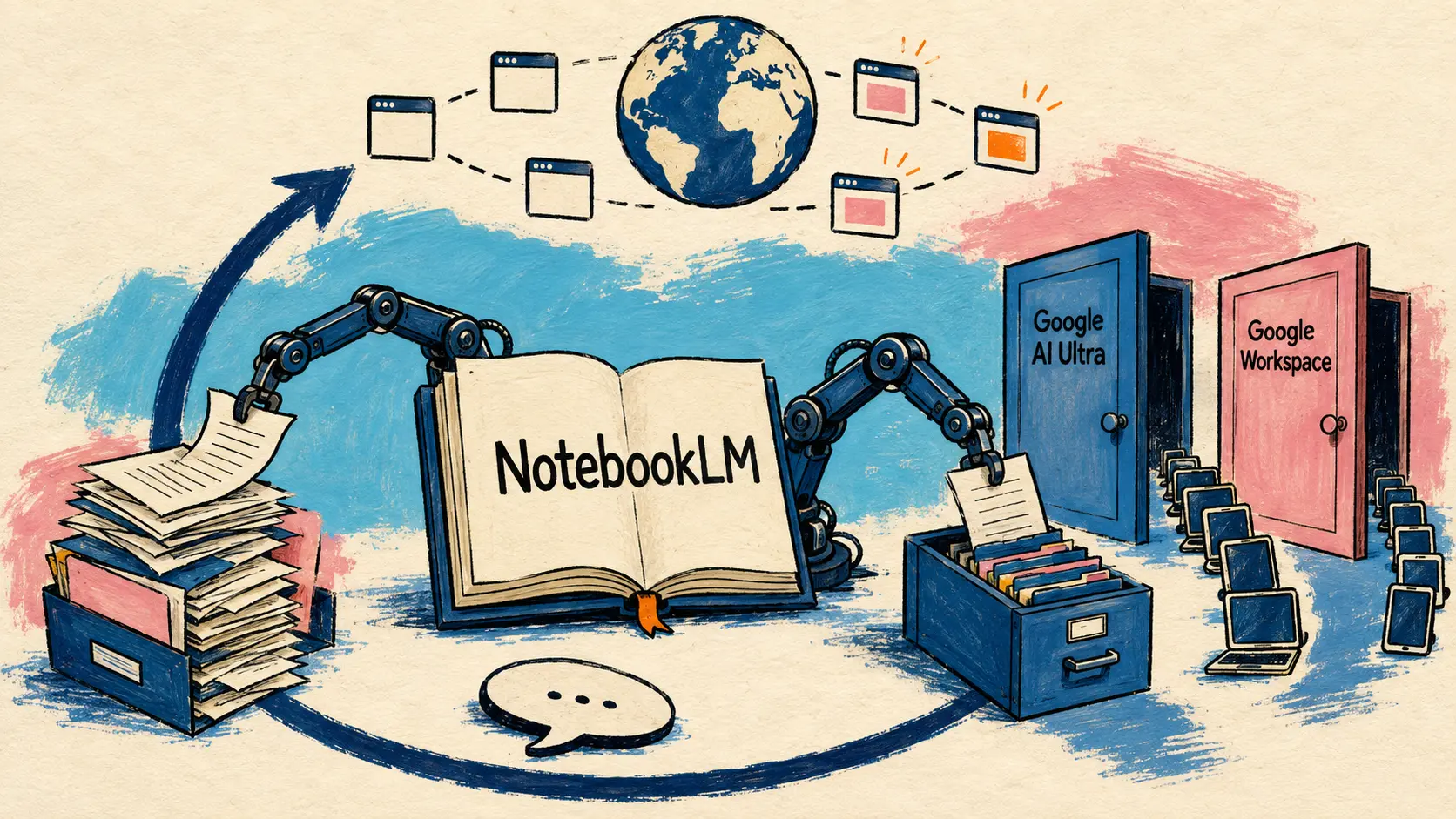
June 8 — Google launches a major update to NotebookLM, its AI-assisted note-taking and research tool. The application now benefits from agentic capabilities (agentic capabilities) in chat, more advanced reasoning (more advanced reasoning), and a series of new optimizations. Rollout is global on the web version starting June 8.
Introducing a more powerful NotebookLM 🚀 Massive upgrades deliver agentic capabilities in chat, more advanced reasoning, and a suite of new optimizations. — @NotebookLM on X
The announcement had been anticipated since the mysterious June 5 tweet — “Ok, it’s probably about time we changed the game. Stay tuned 👀” — which generated 415,000 views and 3,766 likes. Rollout begins for Google AI Ultra subscribers and Google Workspace customers, then gradually extends to other web users.
This evolution transforms NotebookLM from an intelligent note-taking tool into a true autonomous research agent, capable of carrying out tasks more independently within conversations. The direction is consistent with Google’s “agentic era” strategy announced at I/O 2026: Google apps now integrate autonomous action loops, not just conversational assistance.
| Aspect | Before | After |
|---|---|---|
| Operating mode | Conversational assistance | Agentic capabilities in chat |
| Reasoning | Standard | Advanced reasoning |
| Availability | Web (existing) | Global web rollout starting June 8 |
Kimi Work — local desktop agent with a fleet of 300 parallel agents
June 8 — Moonshot AI launches Kimi Work, a desktop-native AI agent running locally on macOS (Apple Silicon) and Windows. The most distinctive feature is an agent swarm architecture (agent swarm) that can run up to 300 agents in parallel on the local machine, without systematic reliance on the cloud.
Meet Kimi Work - a local AI agent on your desktop that does the work for you. Native agent swarm: Up to 300 AI agents running in parallel on your local machine. — @Kimi_Moonshot on X
Key features:
| Feature | Description |
|---|---|
| Native agent swarm | Up to 300 AI agents in parallel on the local machine |
| Browser use | WebBridge extension to browse, search, click, and complete web tasks |
| Integrated financial data | Native access to Yahoo Finance and World Bank without complex API setup |
| Persistent memory | History of preferences, past decisions, and user context |
| Platforms | macOS (Apple Silicon) and Windows |
Kimi Work is available now at kimi.com/products/kimi-work.
Perplexity × Harvard — AI agents reduce work time by 87%
June 8 — Perplexity publishes an empirical study conducted with researchers from Harvard Business School over three months (February–May 2026). This is the first major comparison between a conversational assistant (Search) and an autonomous productivity agent (Computer) in real-world conditions, across hundreds of thousands of active users.
The results are striking: Computer completes tasks in 87% less time and at 94% lower cost than Search alone. The amount of autonomous machine execution rises from 33 seconds to 26 minutes per session — a 48× factor.
| Indicator | Search + human | Computer + human | Gain |
|---|---|---|---|
| Average time per task | 269 minutes | 36 minutes | −87% |
| Estimated cost | (baseline) | −94% | |
| Machine execution per session | 33 seconds | 26 minutes | ×48 |
| “Create” level tasks (Bloom) | 26% | 50% | |
| Work outside main occupation | 50% | 59% | |
| Knowledge domains per query | 1.74 | 2.40 | +38% |
Computer’s advantage is observed across all 18 analyzed domains, with time savings of 79 to 92% and cost savings of 87 to 96%. The study shows that autonomous agents do not merely make existing tasks faster: they change the very nature of the work performed. Computer users delegate execution to the machine and tackle tasks that require skills outside their main domain.
🔗 Full study — research.perplexity.ai · 🔗 @perplexity_ai announcement
One year of Claude Code — video retrospective with Boris Cherny and Cat Wu
June 8 — Anthropic publishes a YouTube video for the first anniversary of Claude Code being generally available. Boris Cherny (@bcherny) and Cat Wu (@_catwu) look back on the project’s history: the first internal demo received only two Slack reactions. One year later, Anthropic engineers ship on average 8× more code per quarter than in 2021–2022.
The video covers four themes: choosing auto mode rather than plan mode, verification best practices (verification best practices), routines and loops (routines and loops) as an automation mechanism, and coding from the phone thanks to Claude Code in the cloud.
🔗 YouTube video — first Claude Code anniversary
Anthropic Science Blog — building the infrastructure for agents in biology
June 8 — Anthropic publishes a Science Blog post (“Paving the way for agents in biology”) asking a central question: why have AI agents progressed much faster in software development than in biology? The answer: biological databases were designed for humans, not for agents — they resemble “cities built before the automobile”.
The team developed gget virus, a deterministic layer for retrieving viral data, and the VirBench benchmark to evaluate agents on viral data. Key result: with gget virus, GPT-5.5 reaches 99.7% accuracy and Claude Sonnet 4 exceeds 90% — and model choice becomes secondary.
🔗 Anthropic Science Blog · 🔗 @AnthropicAI announcement
Google AI Plus — $7.99 → $4.99 per month and 200 GB → 400 GB of storage
June 8 — Google lowers the price of its AI Plus subscription from $7.99 to $4.99 per month (or local equivalent), a 37.5% decrease. In parallel, included storage is doubled from 200 GB to 400 GB. The announcement is made by Vikas Kansal, product lead for Gemini AI subscriptions, and officially reposted by @GeminiApp and @NewsFromGoogle.
| Aspect | Before | After |
|---|---|---|
| Monthly price | $7.99/month | $4.99/month |
| Included storage | 200 GB | 400 GB |
Gemini Live — real-time image creation and editing
June 5 — Google announces the availability of image creation and editing directly in Gemini Live, during a voice and visual conversation. This feature allows live visual iteration: room decor (room decor), creative visualization, or image retouching throughout the conversation without leaving the Live interface. The announcement generated 5.6 million views on X, 1,982 likes, and 295 reposts — one of the week’s most engaged tweets in the Gemini space.
🔗 Announcement @GeminiApp · 🔗 Gemini Live — feature overview
NVIDIA weaves its AI Factories in Korea
NVIDIA + LG Group — robotics, EXAONE, and datacenters
June 7 — NVIDIA and LG Group announce the construction of a shared AI Factory spanning four areas: robotics (CLoiD robots, Isaac Sim and Isaac Lab), autonomous driving (DRIVE Hyperion, DRIVE AGX), datacenter technologies (LG Energy Solution on 800V DC solutions, LG Uplus for a large NVIDIA DSX-aligned AI datacenter), and Korean sovereign AI. LG AI Research used NVIDIA Blackwell GPUs and the NeMo framework as well as Nemotron datasets to develop EXAONE, Korea’s sovereign AI model, deployed via the enterprise chatbot ChatEXAONE. LG CNS is also integrating NVIDIA technologies into its PhysicalWorks industrial platform.
NVIDIA + Doosan Group — physical AI and datacenter power supply
June 7 — NVIDIA and Doosan Group expand their collaboration to four entities: Doosan Robotics (Agentic Robot OS integrating Isaac Sim, Isaac Lab, Cosmos, the Newton physics engine, and NVIDIA Jetson Thor — aiming at palletizing, sanding, dual-arm robots, and humanoid use cases), Doosan Bobcat (autonomous construction and material-handling equipment), Doosan Enerbility (gas turbines, steam turbines, small modular reactors SMR, and hydrogen fuel cells for powering high-performance AI datacenters), and Doosan Corporation Electro-Materials (high-performance copper-clad laminates CCL for AI server printed circuit boards in the NVIDIA MGX ecosystem).
ElevenLabs signs an agreement with the British government and doubles its London headcount
June 8 — ElevenLabs signs a Memorandum of Understanding (Memorandum of Understanding) with the DSIT (Department for Science, Innovation and Technology of the United Kingdom) to deploy voice AI in British public services. Three pillars: accessibility (visually impaired people, people with low literacy, seniors, Welsh-speaking communities), AI safety (partnership with the UK AI Safety Institute), and talent development.
At the same time, ElevenLabs is doubling its UK headcount to 200 people this year and moving into a new London headquarters three times larger. The company already works with Revolut (voice agents for 4 million customers in 30 languages), Deliveroo, and Trainline.
Manus — multi-account Gmail and Google Calendar connection
June 8 — Manus (now integrated into Meta) announces support for multiple Gmail and Google Calendar accounts simultaneously. Users can connect their professional, personal, client, and team inboxes in a single workflow, then choose which account Manus acts from for each task involving emails or calendars. The agent can thus coordinate multiple schedules in parallel to find available time slots, send from the right account, and automate recurring multi-account tasks without complex setup — just specify in the prompt which accounts to use.
FLUX.2 [klein] locally on ASUS ProArt laptops
June 4 — Black Forest Labs announces that FLUX.2 [klein] (4 billion parameters), its fastest image generation model, is now preinstalled in ASUS’s MuseTree app on ProArt laptops equipped with an RTX GPU. Goal: generate an image in less than 5 seconds on 8 GB of VRAM, even with professional applications active. No Internet connection or API call is required — the model runs entirely locally.
Kimi Code — major update (CLI, video, plugins, ACP)
June 8 — Moonshot AI releases an important update to Kimi Code, its open-source coding agent powered by Kimi K2.6. The focus is on accessibility and extensibility: one-line CLI installation (zero setup, fast startup), importing videos as code context (reference-to-LUT, long-video-to-short, screen-recording-to-code), finance plugins (stock prices, reports) and academic plugins (research papers), the ACP protocol for inter-agent communication, JetBrains, Zed and other IDE support, and tool customization via hooks. Community contributions (issues, plugins, PRs) are encouraged.
🔗 Announcement @KimiDevs · 🔗 Kimi Code
Grok — #1 video on Design Arena and integration into Notion AI
Grok Imagine Video 1.5 Preview — #1 Image-to-Video ranking
June 8 — xAI’s Grok Imagine Video 1.5 Preview tops the Design Arena Image-to-Video ranking with an Elo score of 1357. The model establishes new performance frontiers (Pareto frontiers) combining speed and cost: average generation time of 41.2 seconds, pricing at $0.01 per image and $0.08 per second at 480p resolution. This ranking confirms the model’s competitive quality against rival solutions on an independent benchmark, building on the launch of Grok Imagine 1.5 Preview in API on June 3.
Grok 4.3 + Grok Build 0.1 in Notion AI
June 2 — xAI’s Grok 4.3 and Grok Build 0.1 models are now available in Notion AI, the AI layer integrated into Notion’s information management platform. This integration gives Notion users advanced search, writing assistance, and database management capabilities powered by Grok models. This is Grok’s second major integration into a productivity tool in less than a week, after the integration into Vapi announced on June 3 — a multi-platform distribution strategy characteristic of xAI in June 2026.
OpenAI Economic Research Exchange — open call for proposals
June 8 — OpenAI launches the OpenAI Economic Research Exchange, a structured program to fund external academic research on the economic effects of AI. Selected researchers will work in collaboration with the OpenAI Economic Research team, with access to OpenAI tools and data. Applications are open until July 5, 2026; selected applicants will be notified on July 31, 2026.
| Parameter | Detail |
|---|---|
| Application deadline | July 5, 2026 |
| Selected applicants notified | July 31, 2026 |
| Covered areas | Labor economics, productivity, education, inequality, entrepreneurship |
| Contact | econresearch@openai.com |
🔗 OpenAI Economic Research Exchange
Briefs
- Five tips from Boris Cherny for running Claude Opus autonomously — auto mode, dynamic workflows,
/loop, Claude Code in the cloud, and end-to-end verification (Chrome extension, iOS/Android simulator via MCP, full server startup). 🔗 Tweet @bcherny - Runway — automatic aspect-ratio reformatting with Aleph 2.0 — import an existing video, choose the target format (e.g. 16:9 → 9:16), and the Aleph 2.0 model completes the scene as if it had been shot in that format. Available on app.runwayml.com. 🔗 Tweet @runwayml
- Kling AI — 2nd anniversary: 100 million users — 100 million users and nearly 50,000 enterprise customers, 26 model iterations in one year. 🔗 Tweet @Kling_ai
- Alibaba Wan Character X — instant generation of unique faces, personalized avatars, and original visual identities, available in testing on create.wan.video/lab/playground/character. 🔗 Tweet @Alibaba_Wan
- Perplexity Billion Dollar Build — live finale on June 9 — 1,500 teams took part in 7 weeks of competition. The 8 finalists present live with Lewis Hamilton (F1 7× champion), Arav Srinivas (Perplexity CEO), and Rich Miner (Android co-founder) as judges. 🔗 Tweet @perplexity_ai
What it means
Autonomous agents are moving from concept to empirical measurement. The Perplexity × Harvard study is a methodological turning point: for the first time, it compares a general-purpose agent (Computer) with a conversational assistant (Search) across hundreds of thousands of real users over three months. The figures — -87% time, -94% cost, ×48 machine execution — are not lab-built benchmarks, but measurements under real usage conditions. Combined with NotebookLM’s results as it shifts into agentic mode and Kimi Work’s deployment of 300 agents in parallel locally, June 8, 2026 marks a week in which the agentic promise becomes observable at scale.
Industrial AI sovereignty is taking shape in Korea. The two NVIDIA partnerships — with LG Group and Doosan Group — are not just commercial agreements: they structure a complete physical AI supply chain, from power generation (Doosan Enerbility with SMR and hydrogen fuel cells) to materials for printed circuit boards (Doosan Electro-Materials), via industrial robots (Doosan Robotics) and consumer appliances (LG CLoiD). The EXAONE model, developed by LG AI Research on Blackwell, confirms that Korea is building sovereign AI indexed on NVIDIA infrastructure — a trajectory similar to France’s with Mistral, but on a larger industrial scale.
Voice AI is becoming institutionalized in the public sector. ElevenLabs’ agreement with the UK government (DSIT) is representative of a new phase: governments are no longer merely observing or regulating; they are signing memoranda of understanding (MOU) with private players to deploy voice AI in sensitive public services (accessibility, security, minority languages such as Welsh). This institutionalization, combined with programs already active in Ukraine, the Czech Republic, and Greece via ElevenLabs for Government, is shaping a public voice AI market that is moving out of pilot mode into deployment.
Multi-agent developer tooling is becoming standard. In a single day, Moonshot AI released both Kimi Work (300 local agents in parallel, WebBridge, persistent memory) and a redesign of Kimi Code (one-line CLI, videos as context, inter-agent ACP protocol, JetBrains/Zed). This coordinated dual launch — desktop agent + code agent — reflects a vertical coverage strategy: the same vendor offers desktop automation and development automation. It is a direct response to Claude Code and Codex CLI, but with the notable difference of local execution by default.
Sources
- NotebookLM — agentic capabilities announcement
- NotebookLM — global rollout
- Kimi Work — official announcement
- Kimi Work — product page
- Perplexity × Harvard — announcement
- Perplexity × Harvard — full study
- Claude Code — first anniversary (video)
- Claude Code — anniversary (@ClaudeDevs)
- Anthropic Science Blog — agents in biology
- Anthropic — Science Blog announcement
- Google AI Plus — new pricing
- Google AI Plus — @NewsFromGoogle
- Gemini Live — live image creation
- NVIDIA + LG Group — AI Factory
- NVIDIA + Doosan Group — Physical AI
- ElevenLabs — UK government MOU
- ElevenLabs — X announcement
- Manus — multiple Gmail and Calendar accounts
- Manus — X announcement
- FLUX.2 klein — on-device ASUS ProArt
- FLUX.2 klein — X announcement
- Kimi Code — major update
- Kimi Code — product page
- Grok Imagine Video 1.5 — #1 Design Arena
- Grok 4.3 + Build 0.1 in Notion AI
- OpenAI Economic Research Exchange
- Boris Cherny — 5 tips for Claude Opus autonomy
- Runway — Aleph 2.0 aspect-ratio reformatting
- Kling AI — 2nd anniversary 100M users
- Alibaba Wan Character X
- Perplexity Billion Dollar Build — June 9 finale