ai-powered-markdown-translatorArticle translated from fr to en with gpt-6.1-sol.
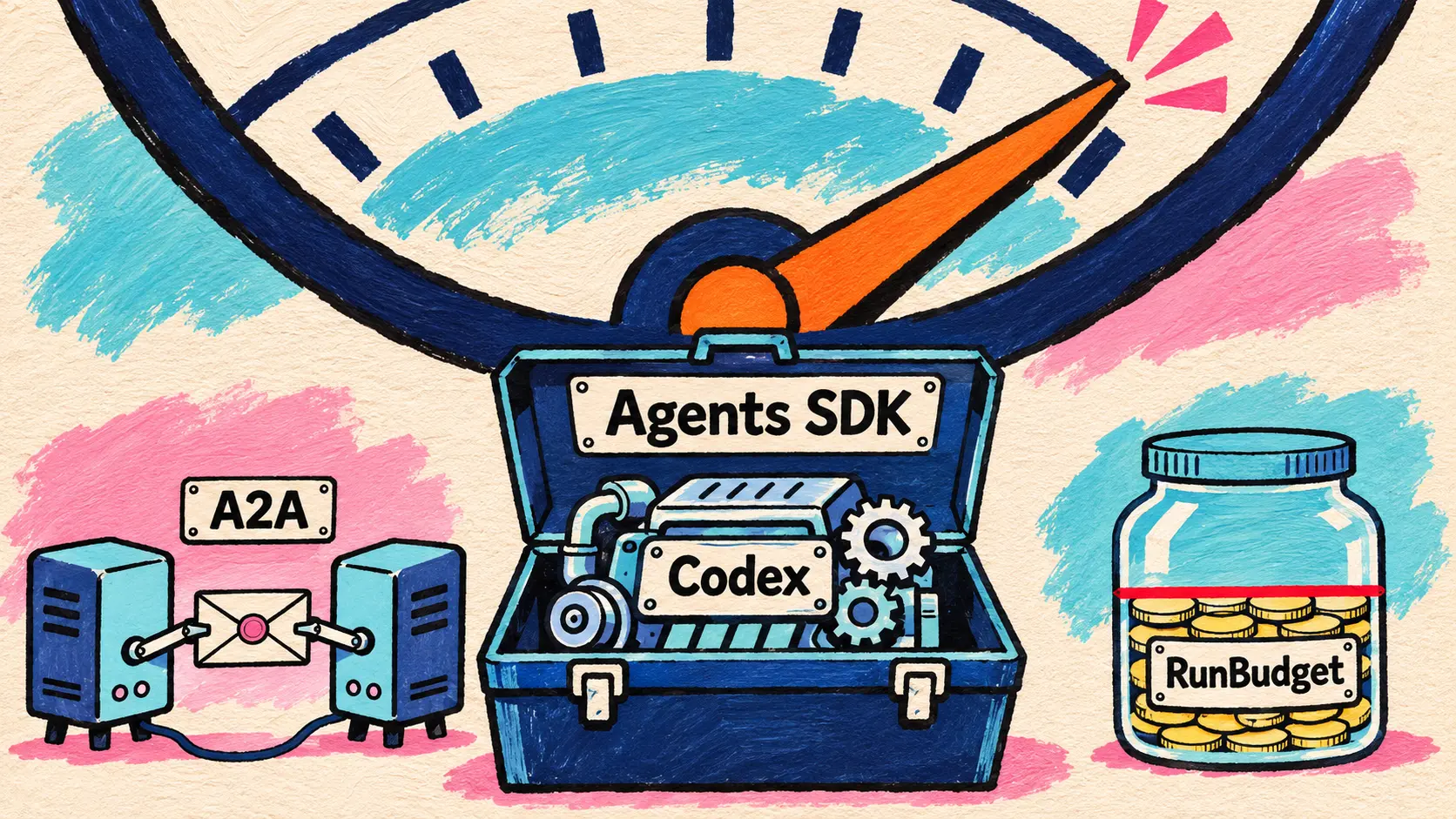
OpenAI releases two alpha previews of its Agents SDK, for Python and JavaScript, that incorporate the Codex harness as the native engine: conversation storage, usage limits, communication between agents via A2A and, on the Python side, a higher default reasoning effort. The rest of this Sunday’s news comes in briefs: Devin release notes, two previews of GitHub Agentic Workflows, fixes for Antigravity and Gemini CLI, the Qwen Code desktop application, then a series of community posts on Hugging Face, including open speech models for Taiwan and India’s 22 official languages, and a measurement of the additional cost of Turkish.
OpenAI integrates the Codex harness into its Agents SDK: two alpha previews with A2A, usage budgets and conversation storage
November 8 — OpenAI releases two alpha previews of its Agents SDK: v0.24.0-alpha.7 for Python and v0.22.0-alpha.2 for JavaScript. The series, launched on November 3, incorporates the Codex harness as the native engine; the previous engine remains available as “Classic.” The Python preview is distributed through GitHub Releases, not PyPI.
These versions add application-side conversation storage, the hosted FileSearch, CodeInterpreter and ImageGeneration tools, RunBudget usage limits (requests, tokens or estimated cost), which do not guarantee a spending cap, A2A adapters between agents and voice workflows. Changes to prepare for: strict write mode by default for new environments, plus, on the Python side, renamed MCP approval modes and a default reasoning effort raised from low to medium for GPT-6 Astra, GPT-6.1 Sol and GPT-5.6 Sol, unless explicitly configured.
🔗 Python preview · JavaScript preview
Briefs
Agents and coding tools
- Devin release notes for November 6 — Catch-up: administrators set the default visibility of new sessions and can restrict sharing to the organization, Gerrit connections synchronize groups and project access with Devin permissions (new connections require Gerrit 3.13 or later), and a button signs out all devices at once, from the web application to mobile applications. No pricing is announced. 🔗 source
- GitHub Agentic Workflows 1.2.0 and 1.2.1 — Two previews released on November 4 and 6, following general availability on October 28. A workflow triggered by
pull_request_targetfrom a fork now requires explicit opt-in for unrestricted use, a breaking change; additions include a pull request reviewer guided by the project specification, an experimental declarative engine, Atomic, and security reviews that default to blocking (fail closed) when unresolved. 🔗 source - Antigravity 2.29.1 — Catch-up from November 6: this application release fixes four issues in Gemini Live voice mode. Voice mode now asks users to sign in again when the account connection needs renewal, reads links and @ mentions in messages typed during a call, no longer attaches older remarks to the latest sentence, and no longer displays parts of responses that were never heard after a disconnection. 🔗 source
- Gemini CLI, PR 30183 — Merged into main on November 6 but not yet included in a release, it makes the 60-second timeout for initial response headers configurable. That timeout was interrupting requests involving lengthy reasoning and replaying them from the beginning, regardless of connection mode (via the
GEMINI_API_HEADERS_TIMEOUT_MSvariable ormodel.requestTimeoutMssetting). 🔗 source - Qwen Code Desktop v0.27.0 and TypeScript SDK v0.1.30 — Released on November 8, the day after the stable v0.27.0 CLI release, with nothing new: the application incorporates the 112 changes from CLI versions v0.26.9 and v0.27.0, and the SDK bundles CLI 0.27.0. Desktop ships for macOS, Windows x64 and Linux (AppImage, .deb, RPM for Fedora 44 and RHEL 10). 🔗 source
Open models for speech and regional languages
- HeliosLM — Chien-Hsin Lin releases an initial series of open models designed for Taiwan: a chat model and a safety classifier derived from Gemma 4 E4B-it, and two speech recognition models derived from Whisper large-v3. According to his measurements, the character error rate drops from 231.13 to 32.69% on Common Voice Taiwanese (Hokkien), and from 15.25 to 5.10% on Taiwanese Mandarin. 🔗 source
- Shruti — Udgam Labs, the creator of the small Laghu model, releases 22 speech recognition models under Apache-2.0, one for each language in the Eighth Schedule of the Indian Constitution. Each is approximately 30 MB, also transcribes English and runs offline, even on a phone from 2021; all 22 together total 653 MB, approximately one quarter the size of IndicConformer-600M. In real conversations, 22.9 to 56.8% of words remain incorrect, according to the team. 🔗 source
- The Turkish tax — Serkan Peker estimates that, using vLLM on an H200, producing the same text in Turkish requires 1.45 to 1.62 times the GPU time needed for English across four open models (Turkish-Gemma-9b-T1, Gemma 4 12B, Ministral 3 14B and Qwen3.8-27B), with 76 to 82% of that overhead explained by the additional tokens. Across seven tokenizers, only the one used by the Turkish model Kumru-2B consumes fewer tokens in Turkish than in English. 🔗 source
Community research and data
- Tiny Aya Global at the Lexsi Labs hackathon — Three teams from the Lexsi Labs safety and alignment hackathon publish their fine-tuned versions of this open model from Cohere Labs (3.35 billion parameters). According to their own measurements, SafeQuery raises an SQL agent’s success rate from 19.8 to 99.1% without succumbing to the tested injections, TaxOps completes 93.3% of synthetic tax returns correctly, and SafetyPulse reduces successful HarmBench attacks from 25.2 to 12.3%. 🔗 SafeQuery · 🔗 TaxOps · 🔗 SafetyPulse
- Erasing a style by modifying weights — Javad Taghia publishes an experiment in which GPT-6 Astra, given tool access to the weights of a small diffusion model (segmind/tiny-sd) but no gradients, must erase Van Gogh’s style from it. Under his preregistered protocol, the agent removes 11.5 more style points than the UCE method while damaging related painters’ styles just as much, and beats a random search given the same tools by 52 points. 🔗 source
- SEW Multimodal AMR in FiftyOne — On November 7, Harpreet Sahota publishes a FiftyOne conversion of this dataset of 3,151 annotated images across 55 MCAP episodes, captured by SEW-EURODRIVE’s autonomous mobile robot using six types of sensors (RGB and thermal cameras, depth, 4D radar, laser scanners, ultrasound), to compare what each perceives in the same scene. 🔗 source
GPU infrastructure
- NVIDIA DSX OS, November 5 post — Catch-up: NVIDIA details how the three open-source components of DSX OS, licensed under Apache 2.0, support a GPU cluster running on Kubernetes. AICR locks down the configuration in versioned recipes, NVCRE certifies it using real workloads (NCCL tests, level 4 DCGM diagnostics, NeMo pretraining), and NVSentinel only returns a repaired node to service after it passes the tests. 🔗 source
What this means
With these previews, the harness that powers Codex becomes the native engine of the Agents SDK, in both Python and JavaScript. Several of its features already existed in OpenAI’s hosted Agents API, such as the budget cap, available in beta on request since November 6, or compaction; the SDK brings them closer to the application code, which keeps its conversations in its own storage and communicates with other agents via A2A. The trade-off is an alpha phase: interfaces that change between versions, Python distribution outside PyPI and a higher default reasoning effort on the Python side, which changes the behavior of projects that do not configure it themselves.
Defaults are also becoming stricter in agent tools. OpenAI’s SDK switches new environments to strict write mode, GitHub Agentic Workflows requires explicit opt-in for unrestricted use of workflows triggered from a fork and fails unresolved security reviews, and Devin lets administrators set session visibility and restrict sharing. For both GitHub and OpenAI, updating requires a check: the change is breaking for gh-aw, and the Python SDK rejects the old names for MCP approval modes.
Several community posts target languages that large models serve poorly. HeliosLM reduces Whisper large-v3’s error rate on Taiwanese from 231.13 to 32.69%, Shruti fits speech recognition for 22 Indian languages into files of approximately 30 MB that run offline, and Serkan Peker quantifies the cost of a language poorly split into tokens: 1.45 to 1.62 times the GPU time needed for English when generating Turkish. Udgam Labs summarizes the obstacle: until now, building for these languages meant a per-minute cloud bill, a model weighing several gigabytes or permission from a large company. All these figures are measured by their authors, and Udgam Labs itself publishes Shruti’s limitations: in real conversations, up to 56.8% of words remain incorrect.
Sources
- Agents SDK for Python v0.24.0-alpha.7 (GitHub)
- Agents SDK for JavaScript v0.22.0-alpha.2 (GitHub)
- Agents SDK for JavaScript v0.22.0-alpha.1, introduction of the Codex harness (GitHub)
- Agents SDK for Python v0.24.0-alpha.6 (GitHub)
- Devin release notes for November 6
- GitHub Agentic Workflows v1.2.1
- GitHub Agentic Workflows v1.2.0
- Antigravity application changelog
- Gemini CLI, pull request 30183
- Qwen Code Desktop v0.27.0
- Qwen Code TypeScript SDK v0.1.30
- HeliosLM, Chien-Hsin Lin’s post on Hugging Face
- Shruti, Udgam Labs’ post on Hugging Face
- The Turkish tax, Serkan Peker’s post on Hugging Face
- SafeQuery, Lexsi Labs hackathon
- TaxOps, Lexsi Labs hackathon
- SafetyPulse, Lexsi Labs hackathon
- Javad Taghia’s post on erasing Van Gogh’s style
- SEW Multimodal AMR in FiftyOne, Harpreet Sahota’s post
- Configure, Certify, and Operate Kubernetes GPU Clusters with NVIDIA DSX OS (NVIDIA)