ai-powered-markdown-translatorArticle translated from fr to en with gpt-5.4-mini.
GitHub Copilot is taking another step in enterprise adoption with centralized CLI plugin management, while April updates for VS Code bring BYOK, semantic search across all workspaces, and a searchable chat history. Claude Code continues its intense pace with 60 additional fixes this week. In parallel, Luma AI opens the API for its Uni-1.1 model, which leads the Human Preference Elo ranking, and Qwen3.6-35B-A3B posts a +8.2-point gain on the ODinW benchmark.
GitHub Copilot CLI — Enterprise-managed plugins in public preview
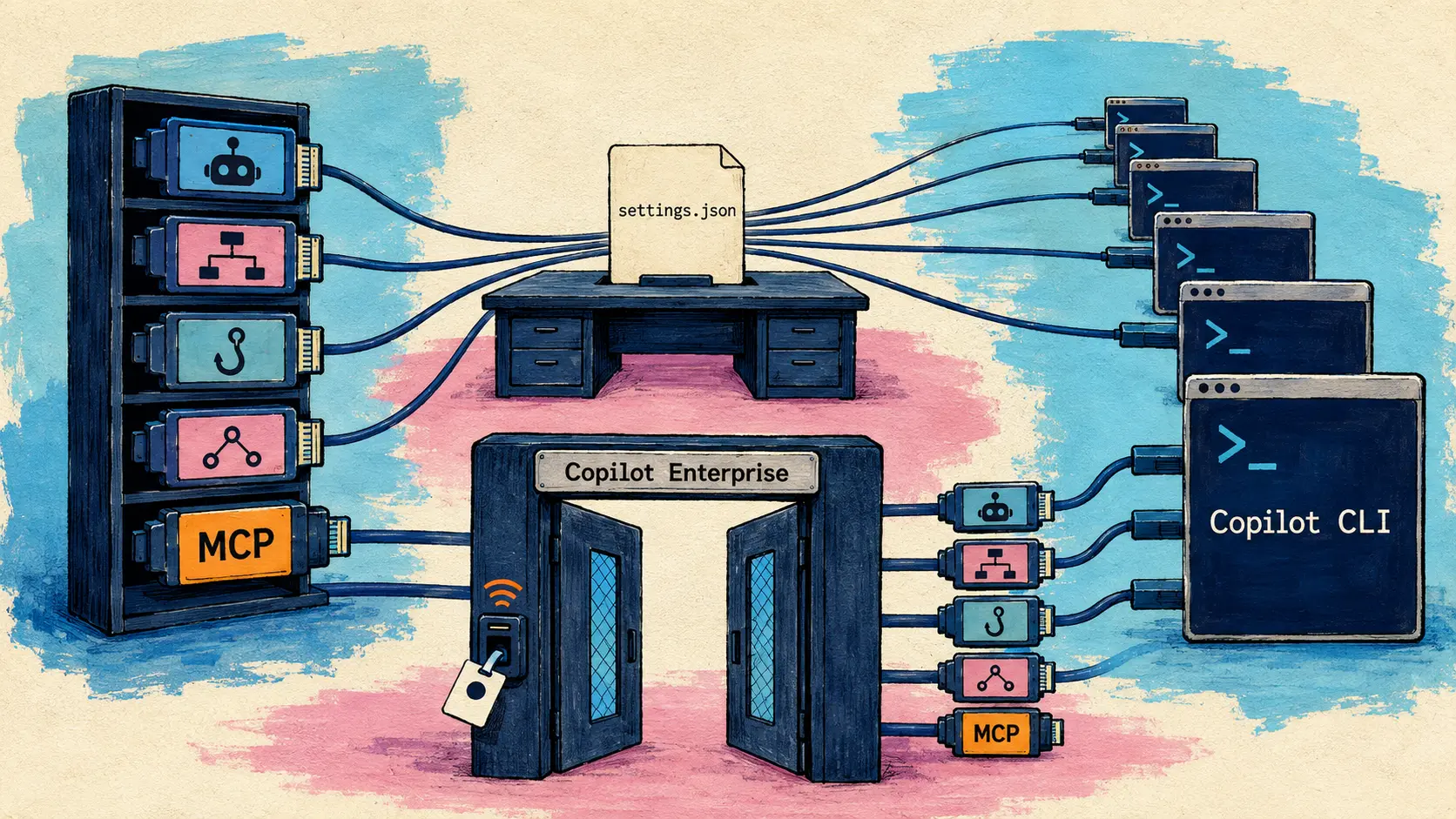
May 6 — GitHub is launching centralized management of Copilot CLI plugins for enterprises in public preview. Administrators can now define and distribute plugins (custom agents, skills, hooks, MCP configurations) to all users in their organization from a single settings.json file.
How it works in practice:
| Parameter | Value |
|---|---|
| Configuration file | .github-private/.github/copilot/settings.json |
| Required plans | Copilot Business, Copilot Enterprise |
| Status | Public Preview |
| Installation | Automatic on authentication |
Copilot CLI pulls and applies these settings for all licensed users. Plugins can include custom agents, workflow hooks, and organization-wide MCP configurations. If the company already configured a source for custom agents via .github-private, that same repository is reused. Administrators can verify the configuration from the Agents page in enterprise settings, under AI controls.
This feature fills an important gap between individual Copilot CLI adoption and organization-wide deployment: until now, each developer had to configure their plugins manually.
🔗 GitHub Changelog announcement
GitHub Copilot in VS Code — April 2026 updates (v1.116–v1.119)
May 6 — GitHub publishes the Copilot update roundup for VS Code covering v1.116 to v1.119 (April to early May 2026), following VS Code’s move to weekly stable releases.
Smarter context:
| Feature | Status |
|---|---|
| Semantic search (all workspaces) | Available |
githubTextSearch (grep across GitHub repos) | Available |
/chronicle (local chat history) | Experimental |
| Prompt cache + deferred tool loading | Available |
Semantic search is now active in all workspaces, no longer limited to indexed repositories. The githubTextSearch tool enables grep-style queries across entire GitHub repositories and organizations. The experimental /chronicle command creates a local database of chat history to retrieve past sessions, touched files, and referenced PRs.
Richer agent experience:
| Feature | Status |
|---|---|
| BYOK (Business + Enterprise) | Available |
| Integrated Browser | Available |
| Remote CLI monitoring | Experimental |
| Access to open terminals | Available |
BYOK (Bring Your Own Key) lets Copilot Business and Enterprise organizations connect their own API keys directly in VS Code: OpenRouter, Microsoft Foundry, Google, Anthropic, OpenAI, Ollama, and Foundry Local are supported. Agents can read and write in open terminals (REPLs, interactive scripts). The Integrated Browser feature lets users share browser tabs in real time as context for agents. Copilot CLI sessions can be controlled remotely from GitHub.com or the mobile app (experimental).
🔗 GitHub Changelog announcement
Claude Code — 60+ reliability fixes (week of May 8)
May 8 — The Claude Code team publishes a thread listing more than 60 fixes shipped this week, adding to the 50+ from the previous week.
“Last week we shipped 50+ Claude Code reliability fixes. This week it’s 60+ more. Smoother long-running sessions, a more efficient agent loop, auth that works in more environments, and terminal fixes.” — @ClaudeDevs on X
| Area | Notable fixes |
|---|---|
| Stability | claude -p accepts >10 MB via stdin, wake-from-sleep recovery |
| Agent loop | Prompt cache for sub-agents, opt-in 1h cache via ENABLE_PROMPT_CACHING_1H |
| Authentication | OAuth code pasted directly into the terminal (WSL, SSH, containers) |
| MCP | Automatic reconnection + clear status in /mcp, bounded memory fix |
| Terminal rendering | Cursor, VS Code, JetBrains scrolling fix; Japanese character fix |
To apply these fixes: claude update.
GitHub Copilot — Grok Code Fast 1 deprecation (May 15)
May 8 — GitHub announces the deprecation of Grok Code Fast 1 across all Copilot environments on May 15, 2026, one week after the announcement. The reason: the model itself is being deprecated by xAI.
| Model | Deprecation date | Suggested alternative |
|---|---|---|
| Grok Code Fast 1 | May 15, 2026 | GPT-5 mini, Claude Haiku 4.5 |
Copilot Enterprise administrators should verify that the alternative models are enabled in their model policies before that date. The transition after deprecation is automatic — no additional action is required to remove the model.
Google Health App — Fitbit becomes Google Health with Gemini coach
May 8 — The Fitbit app is evolving into the new Google Health app. This redesign keeps all existing Fitbit features and adds a personalized health coach powered by Gemini. The coach analyzes data from wearables, preferred health apps, and medical records to provide proactive health guidance tailored to each user.
The app is compatible with Fitbit and Pixel Watch devices, and integrates with hundreds of third-party apps and devices.
Gemini API — Multimodal File Search, Webhooks, Gemma 4 MTP 3x faster
May 8 — The weekly @GoogleAI roundup lists three developer releases from the week, 11 days before Google I/O:
| Feature | Date | Impact |
|---|---|---|
| Multimodal File Search | May 5 | Verifiable multimodal RAG with page citations |
| Gemini API Webhooks | May 4 | Replaces polling with push notifications |
| Gemma 4 MTP drafters | May 5 | Up to 3x faster inference |
The File Search tool now supports custom metadata and page citations, making it possible to build verifiable RAG (Retrieval-Augmented Generation) systems on multimodal sources. Webhooks remove the need for continuous polling on long-running tasks. MTP (Multi-Token Prediction) accelerators for Gemma 4 deliver up to 3x more inference speed in deployment workflows.
Luma AI Uni-1.1 API — Public launch
May 5 — Luma AI is opening its Uni-1.1 API, making its Unified Intelligence model accessible to developers through a REST interface. The model combines reasoning and image generation in a single architecture — unlike the standard approach that assembles multiple separate models at inference time.
| Metric | Value |
|---|---|
| Human Preference Elo | #1 (global generation, style, guided reference) |
| Image Arena | Top 3 (Text-to-Image + Image Edit) |
| RISEBench spatial reasoning | Top of the ranking |
| References per request | Up to 9 images |
| Generation time | ~31 seconds per image |
| Production partners | Envato, Comfy, Runware, Flora, Krea, Magnific, Fal, LovArt |
The API offers two main endpoints: Generate Image (text-to-image with up to 9 reference images to preserve identity, composition, or style) and Modify Image (natural-language editing). Python and JavaScript/TypeScript SDKs are available. Two pricing tiers: Build (usage-based billing) and Scale (higher rate limits, dedicated support).
NVIDIA + SakanaAI — ICML 2026 paper on TwELL sparse kernels
May 8 — NVIDIA AI and SakanaAI Labs jointly publish a research paper accepted at ICML 2026, focusing on sparse transformer kernels and data formats optimized for execution on modern NVIDIA GPUs. The project is called TwELL.
The core intuition: the human brain activates only the neurons needed for a given thought. Applied to language models, this means selectively computing active weights through structured sparsity, reducing compute load without sacrificing performance. This research aligns with NVIDIA’s direction toward more efficient inference, especially for Mixture-of-Experts (MoE) architectures. The tweet received 50,000 views and 66 reposts in the ML community.
Qwen3.6-35B-A3B — +8.2 points on the ODinW benchmark
May 9 — Tongyi Lab (Alibaba) announces a breakthrough in Instruction-Oriented Object Detection with the Qwen3.6-35B-A3B model. Unlike traditional detection, which simply localizes visual elements, this approach aims to semantically understand natural-language instructions to guide detection.
| Metric | Qwen3.5 | Qwen3.6-35B-A3B | Gain |
|---|---|---|---|
| ODinW score | 42.6 | 50.8 | +8.2 pts |
An interactive demo is available on ModelScope.
Tongyi Lab — 1,200+ languages for global inclusion
May 9 — Tongyi Lab (Alibaba) publishes a video titled “1,200+ Languages. One Vision for AI Inclusion”, raising the question of fair access to AI for underrepresented language communities. The initiative targets coverage of more than 1,200 languages — far beyond the 92 languages of Qwen-MT announced in July 2025 — in response to the gap between global technology and the communities it is meant to serve.
OpenAI Codex Switch — ChatGPT to Codex migration page
May 8 — OpenAI publishes a minimalist tweet pointing to chatgpt.com/codex/switch-to-codex/, with the only message being “Just gonna leave this here.” The tweet generates 517,000 views. This teaser fits into Codex’s positioning strategy as the central development assistant for the ChatGPT platform. The landing page was not accessible at the time of the scan.
Briefs
- OpenAI supply.openai.com — @OpenAIDevs posts a cryptic tweet: “Available until the goblins notice.” 🧌, linking to
supply.openai.com. The page was not accessible at the time of the scan (274,000 views). 🔗 Tweet
What this means
Enterprise is becoming the central Copilot battleground. GitHub is laying the foundations for an organization-wide managed Copilot rollout: centralized plugins via .github-private, BYOK to connect your own models, remote CLI monitoring, and Integrated Browser as live context for agents. These features answer a real demand from IT leaders who want to standardize AI tooling without forcing each developer to configure their own stack. The simultaneous deprecation of Grok Code Fast 1 (replaced by GPT-5 mini or Claude Haiku 4.5) also shows how quickly third-party models are added and then removed in this ecosystem.
Claude Code is betting on reliability. 110+ fixes in two consecutive weeks on specific topics — long sessions, OAuth auth in constrained environments, MCP, terminal rendering — indicate that the Anthropic team has identified reliability as the main blocker to production adoption. The fixes for WSL, SSH, and containers explicitly target enterprise environments where the browser cannot reach localhost. The one-hour prompt cache opt-in for sub-agents is also a signal: long-running multi-agent workflows are becoming a priority use case.
Luma AI and the unified API: an architectural bet. Where most image-generation pipelines stitch together several specialized models, Uni-1 combines reasoning and generation in a single architecture. The ability to use up to 9 reference images per request — and the #1 Human Preference Elo results — suggests that this unified approach offers style consistency that is hard to achieve with assembled pipelines. The 8 partners already in production validate that the API is ready for real workloads.
Alibaba/Qwen is targeting multimodality and multilinguality. The +8.2-point gain on ODinW for Qwen3.6-35B-A3B on language-guided object detection, combined with the ambition to cover 1,200+ languages, points to a Tongyi Lab strategy focused on high social-impact use cases: industrial vision made accessible through text instructions, and AI usable by language communities currently underserved. These two directions converge in a common logic of broad accessibility.
Sources
- GitHub Copilot CLI — Enterprise-managed plugins (Public Preview)
- GitHub Copilot VS Code — April 2026 Releases
- GitHub Copilot — Grok Code Fast 1 deprecation
- Claude Code — 60+ reliability fixes thread (@ClaudeDevs)
- Claude Code — Official changelog
- Google Health App — @GoogleAI announcement
- Gemini API — Google Developers Tools blog
- Luma AI Uni-1.1 API
- NVIDIA + SakanaAI — TwELL ICML26 paper
- Qwen3.6-35B-A3B — ODinW +8.2 pts (@Ali_TongyiLab)
- ModelScope — Qwen Object Detection demo
- Tongyi Lab — 1200+ Languages (@Ali_TongyiLab)
- OpenAI Codex Switch
- OpenAI supply.openai.com — teaser (@OpenAIDevs)