ai-powered-markdown-translatorArticle translated from fr to en with gpt-6.1-sol.
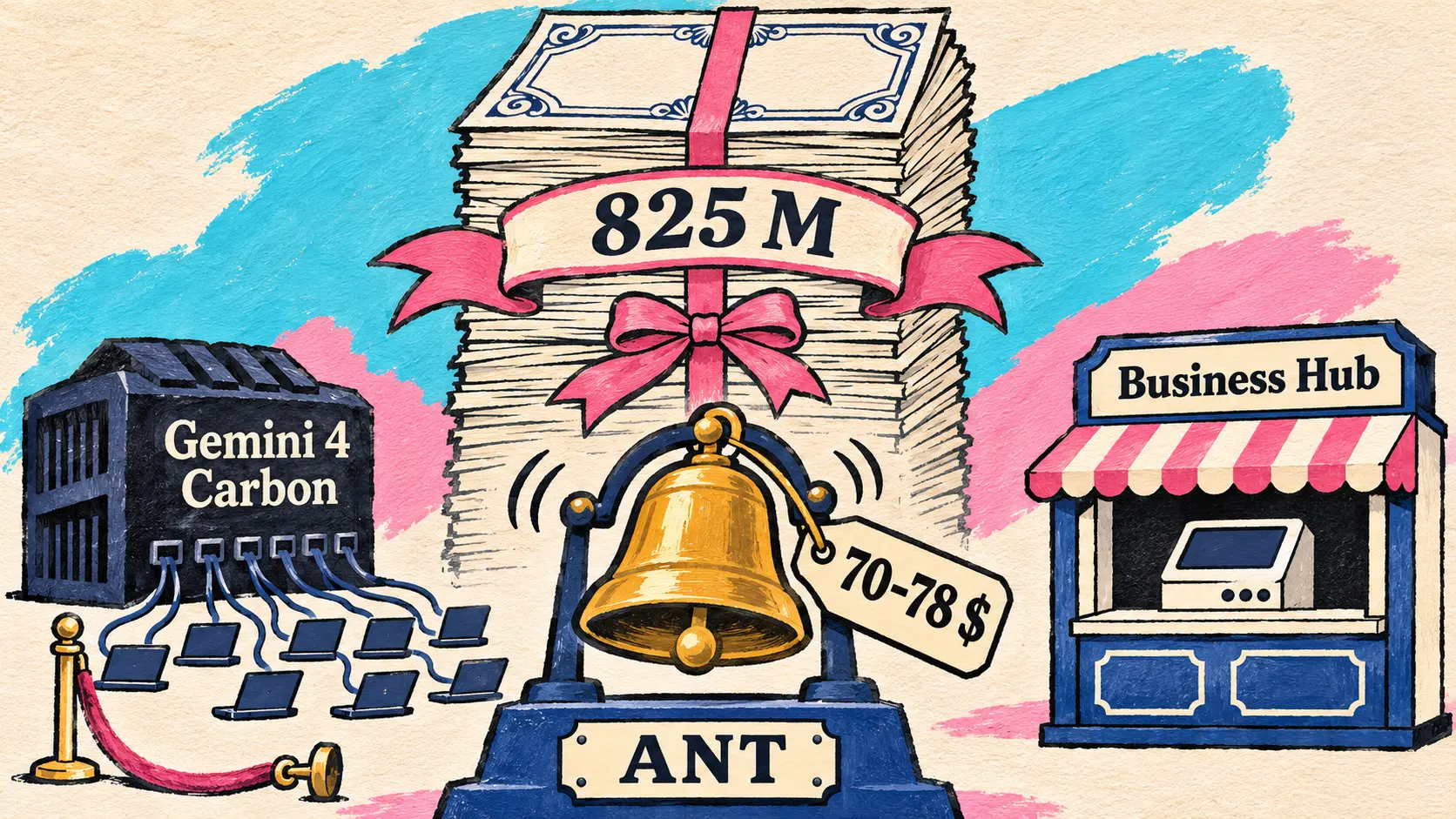
Anthropic launches its IPO roadshow: 825 million Class A shares offered at 70 to 78 dollars, on Nasdaq under the symbol “ANT”. Google opens Gemini 4 Carbon to developers, businesses and Ultra subscribers, at 2 and 10 dollars per million tokens until November 30, and Cursor, GitHub Copilot, Perplexity and Devin integrate it the same day, several with their own measurements. OpenAI launches Businesses in ChatGPT in beta, Anthropic adds Whiteboards, Sheets and Data to Claude, ByteDance and MiniMax release Seedream 5.5 and H3-Image, and the Élysée publishes a call for AI safety signed by 16 states, 10 companies and 7 organizations.
Anthropic launches its IPO roadshow: 825 million shares at 70 to 78 dollars
November 10 — Two weeks after publicly filing its S-1 with the SEC, Anthropic launches its IPO roadshow, the series of investor presentations that precedes pricing. The post on its Newsroom, shared by @AnthropicAI, covers an offering of 825 million shares of Class A common stock. Almost all of them, 801 351 354 shares, are being offered by Anthropic; the remaining 23 648 646 are being sold by certain existing shareholders, and the company will receive no proceeds from their sale.
The underwriting banks will also have a 30-day option to purchase up to 123 750 000 additional Class A shares. The expected price is between 70 and 78 dollars per share. Anthropic has applied to list its shares on the Nasdaq Global Select Market under the symbol “ANT”, and the preliminary prospectus is available from Goldman Sachs and Morgan Stanley.
| Offering item | Published value |
|---|---|
| Class A shares offered | 825 000 000 |
| Of which shares offered by Anthropic | 801 351 354 |
| Of which shares sold by shareholders | 23 648 646 |
| Banks’ option (30 days) | Up to 123 750 000 shares |
| Price range per share | 70,00 to 78,00 dollars |
| Market and symbol | Nasdaq Global Select, “ANT” |
The registration statement filed with the SEC has not yet become effective: no shares may be sold, and no offers to buy may be accepted, before then. The release provides no valuation, amount raised or first trading date. The S-1 was filed confidentially on June 1, then made public on October 26.
🔗 Anthropic launches roadshow (Anthropic Newsroom)
Gemini 4 Carbon becomes generally available, at 2 and 10 dollars per million tokens until November 30
November 10 — Two weeks after restricting it to cyber defenders in the Fairwind Program, Google makes Gemini 4 Carbon generally available. In a post by Koray Kavukcuoglu, SVP of Google DeepMind and Chief AI Architect, the model gemini-4-carbon becomes generally available in the Gemini API (paid tier), Google AI Studio, Android Studio and Gemini for business, as well as in Antigravity and CodeMender for enterprises. It is also rolling out to all Google AI Ultra subscribers in Antigravity, the Gemini app (desktop, mobile and web) and Search’s AI Mode. The cyber version remains available through applications to the Fairwind Program.
The introductory pricing now has an end date. According to the API release notes, Carbon costs 2 dollars per million input tokens and 10 dollars per million output tokens until November 30, 2026, then 4 and 20 dollars, amounts already announced on October 28 without a switchover date. Google specifies that this pricing applies to the Carbon model intended for public access.
| Pricing type (API, per million tokens) | Until November 30, 2026 | After November 30, 2026 |
|---|---|---|
| Input tokens | 2 dollars | 4 dollars |
| Output tokens | 10 dollars | 20 dollars |
Google presents Gemini 4 Argon as the right choice for most coding and document work, reserving Carbon for long, complex tasks that require more exploration and verification, at the cost of higher token consumption. The post ranks it first on CursorBench 4.0, Perplexity’s WANDR and Zapier’s AutomationBench, at less than half the cost per task of the next-best external model (Cursor’s and Perplexity’s figures are detailed in the next section). In finance, it matches the best model tested on Hebbia’s agentic evaluation and ranks first across 23 configurations in Balyasny Asset Management’s benchmark.
On safety, Google reports that 99 % of attack trajectories are blocked in simulated environments:
| Safety metric cited by Google | Gemini 4 Carbon | Gemini 4 Argon |
|---|---|---|
| Breach rate per attempt (simulated cyber) | 0,8 % | 3,1 % |
| Attack request success (Gray Swan tests) | 2,17 % | 9,86 % |
| Agentic honesty (375-task benchmark) | 92 % | 70 % |
The program offering Argon free for six months to 10 000 scientists is expanding to Carbon, and Google researchers used the model with AlphaProof Code to prove security properties of Signal’s protocol code in Lean.
🔗 Gemini 4 Carbon now available (blog.google) · Gemini API release notes
MKA: Google and Artificial Analysis launch a benchmark of 200 visual document tasks
November 10 — Google and Artificial Analysis release MKA (Multimodal Knowledge Agent), a benchmark measuring agents’ ability to work with visually complex files: architectural plans, technical diagrams, charts and tables. Its 200 private tasks were created with experts from 10 industries and 83 occupations; each represents 3 to 8 hours of work for an experienced professional. A rubric of around 70 yes-or-no checks scores each deliverable, with 75 % based on accuracy and 25 % on visual design.
All models use the same open-source harness, Stirrup, and scoring is handled by an agent built on a non-Google model, with 96 % agreement with human experts. The full dataset remains private at Artificial Analysis; 10 public tasks are on Hugging Face. The models tested average 30 to 130 turns per task. Gemini 4 Carbon ranks second in quality, at one-sixth the average cost per task of the top model, which the post does not name.
🔗 Multimodal Knowledge Agent benchmark (blog.google)
Gemini 4 Carbon arrives the same day in Cursor, GitHub Copilot, Perplexity and Devin, each with its own terms
Like Claude Fable 5.2 the day before, Carbon arrives in tools that integrate models within hours of its release. Cursor and Perplexity publish their own measurements, GitHub enables it by default in Copilot, and Cognition makes it available in Devin Desktop and Devin CLI, where even low effort exceeds Argon’s best result according to Cognition, which measures costs at public API rates, including public discounts (see Briefs).
Cursor: first on CursorBench 4.0 at 60,4 % on high effort, half price until November 30
November 10 — Cursor makes Gemini 4 Carbon available and places it at the top of CursorBench 4.0, its in-house benchmark: 60,4 % on high effort (High), for 9,22 dollars per task. Medium effort follows at 60,1 % for 8,49 dollars, ahead of Claude Fable 5.2 on maximum effort (60,0 %, 32,79 dollars). One curiosity on the leaderboard: low effort (58,6 %) is the most expensive of Carbon’s three levels, at 11,89 dollars per task, with 124 steps compared with 71 on High.
| Model and effort | CursorBench 4.0 score | Cost per task |
|---|---|---|
| Gemini 4 Carbon High | 60,4 % | 9,22 dollars |
| Gemini 4 Carbon Medium | 60,1 % | 8,49 dollars |
| Claude Fable 5.2 Max | 60,0 % | 32,79 dollars |
| Gemini 4 Carbon Low | 58,6 % | 11,89 dollars |
| Claude Opus 5.5 Max | 57,8 % | 13,43 dollars |
| Gemini 4 Argon High | 52,9 % | 4,57 dollars |
In Cursor, Carbon is half price until November 30, at 2 dollars per million input tokens and 10 per million output tokens, then moves to the full price of 4 and 20 dollars starting December 1. The page does not specify whether Carbon’s cost per task is calculated at the discounted or full rate, and no changelog accompanies the announcement.
🔗 Announcement from @cursor_ai · CursorBench 4.0 leaderboard
GitHub Copilot: Carbon generally available, enabled by default in organizations
November 10 — GitHub adds Gemini 4 Carbon to Copilot in general availability for Pro+, Max, Business and Enterprise plans. The model targets complex coding, agentic and reasoning tasks, with an emphasis on secure code generation and security work. It appears in the model picker across ten interfaces: VS Code, Visual Studio, Copilot CLI, the coding agent, the GitHub Copilot app, github.com, GitHub Mobile, JetBrains IDEs, Xcode and Eclipse; Gemini 4 Argon had eight on October 13. The rollout is gradual.
Unlike Claude Fable 5.2 (next section), Carbon requires no action in Business and Enterprise organizations: since new models are enabled by default, it appears automatically unless the administrator has turned off that setting or disables this model. It is billed based on usage at the provider’s list price, with no amount or promotional rate given in the changelog, whereas Argon received discounted pricing at launch.
🔗 Gemini 4 Carbon in GitHub Copilot (GitHub Changelog)
Perplexity: 0,857 on WANDR for 5,86 dollars per task, in Computer and Search
November 10 — Less than two hours after general availability, Perplexity makes Carbon available in Computer, its agent, for Pro and Max subscribers, and in Search for Max subscribers only, as with Claude Fable 5.2 the day before.
Gemini 4 Carbon is now available in Perplexity Computer for Pro and Max subscribers, and in Search for Max subscribers. It scores 0.857 on our WANDR benchmark at $5.86 per task, matching Claude Fable 5.2 at 40% of the cost. — @perplexity_ai on X
| Model evaluated on WANDR | WANDR score | Cost per task |
|---|---|---|
| Gemini 4 Carbon | 0,857 | 5,86 dollars |
| Claude Fable 5.2 | 0,851 | 14,51 dollars |
| Gemini 4 Argon | 0,802 | 7,88 dollars |
The tie with Fable 5.2 is Perplexity’s interpretation: the gap between the two is 0,006 points, and Perplexity’s chart, the source of these figures, places Carbon on the Pareto frontier. This per-model score cannot be compared with the 85,9 % reported on November 5 for the Agent API’s ultra tier, a multi-agent configuration. The API changelog adds google/gemini-4-carbon to the Agent API at the introductory rate valid until November 30, 2026 (2 dollars per million input tokens, 0,10 dollars for cached input, 10 dollars for output), along with anthropic/claude-fable-5-2. Neither the effort level used for WANDR nor the credit cost in Computer is specified.
Claude Fable 5.2 and Mythos 5.2 in GitHub Copilot, Devin Security, Warp and Genspark
The day after their launch, Fable 5.2 and Mythos 5.2 continue to arrive in third-party tools. Following Cursor, Devin, Perplexity and v0 on November 9, Warp makes Fable 5.2 available in Warp Factories and its terminal, and Genspark in its Code Agent (see Briefs). Two integrations come with specific conditions: data retention in GitHub Copilot, and restricted access to Mythos 5.2 in Devin Security.
GitHub Copilot: Fable 5.2 generally available, with data retention by default
November 9 — On the day of its launch by Anthropic, Claude Fable 5.2 becomes generally available in GitHub Copilot for Pro+, Max, Business and Enterprise, across the same ten interfaces as Carbon. According to GitHub’s initial tests, it solves more tasks than Fable 5.1 with fewer steps and tool calls, with no figures published. It is billed based on usage at the provider’s list price, and Copilot CLI has included it in its model picker since version 1.0.109.
As with Fable 5 and 5.1, Anthropic retains prompts and outputs by default to run its safety classifiers, without using them for training. For Business and Enterprise, the Claude Fable 5.2 policy is therefore disabled by default, and enabling it constitutes acceptance of this retention; Copilot’s other Claude models retain no data (zero data retention). Eligible enterprises receive an exemption allowing zero data retention for Fable 5.2, 5.1 and 5 until the end of the calendar year. After that, these models will require Enterprise Frontier Safeguards (EFS), which adds automated security monitoring and retention options, including customer-controlled encryption keys.
🔗 Claude Fable 5.2 in GitHub Copilot (GitHub Changelog)
Devin Security: Mythos 5.2 scores 73.5 on Cognition’s internal cyber benchmark, versus 56.9 for Mythos 5.1
November 10 — Cognition is integrating Claude Mythos 5.2 into Devin Security’s managed security scans for eligible enterprise customers who have access to frontier cyber models through Devin; others can request access. Devin runs the scans itself: the customer’s security team does not need separate access to the model, which Anthropic reserves for its verification programs.
Cognition is publishing a new internal vulnerability discovery benchmark: 25 repositories in C, Python, Go, PHP and TypeScript, frozen at a commit where 1,781 publicly reported vulnerabilities remain. The F2 score, out of 100, combines recall and precision while prioritizing recall, and is averaged over three runs per repository.
| Model evaluated by Cognition | Average F2 score (internal benchmark) |
|---|---|
| Claude Mythos 5.2 | 73,5 |
| Claude Mythos 5.1 | 56,9 |
| Claude Opus 5.5 | 32,7 |
The “more than $100 million” in credits announced with Mythos 5.2 extends the commitment of hundreds of millions of dollars in Devin credits already presented on October 26; the new element is their explicit association with Mythos 5.2. No pricing has been disclosed.
🔗 Announcement from @cognition · Claude Mythos 5.2 in Devin Security (Cognition)
ChatGPT for businesses: Businesses in ChatGPT in beta, and the Business plan in third-party tools
November 10 — OpenAI is launching Businesses in ChatGPT in beta, allowing businesses to manage their presence in the assistant. OpenAI presents it as a new way to reach the 1.2 billion people who use ChatGPT every week.
Now in beta: Businesses in ChatGPT. Claim your business, manage your information, and get insights on how people engage with you. Eligible businesses can also build a Business Agent to answer customers’ questions and help them explore what you offer. — @OpenAI on X
The entry point is Business Hub, accessible from the ChatGPT sidebar on the web. A business claims its listing there; once verified, it updates its information and adds product feeds with pricing and availability. According to the release notes, identity verification through Persona is required before anything can be published. Any eligible business located where ChatGPT is available can do this; Enterprise customers and advertisers go through their OpenAI representative, and Shopify merchants connect through Business Hub or the Shopify admin. Business Hub also displays aggregated statistics: mentions, clicks to the website and discovery topics, meaning recurring subjects in conversations where the website is cited. Neither users’ conversations nor exchanges with a Business Agent are shared, and these statistics only appear once certain thresholds are met.
The second component is the Business Agent: the business builds, tests and publishes an agent that answers customers using the information it provides. Users open it from the business’s profile when it appears in a response, in a labeled conversation separate from the original conversation. A business can also sponsor its agent and make it the destination for its ChatGPT Ads campaigns, with labeled placements.
| Component offered | What it enables | Announced availability |
|---|---|---|
| Business Hub | Claim a listing, update information, add product feeds | Eligible businesses where ChatGPT is available (beta) |
| Statistics | Mentions, clicks to the website, discovery topics (aggregated, with thresholds) | With Business Hub |
| Business Agent | Agent that answers customers using the business’s information | Eligible online commerce and service businesses, United States only |
| Sponsorship | Business Agent as a destination for ChatGPT Ads | Businesses with a Business Agent |
No pricing is listed. OpenAI plans to expand the offering to other markets and categories, and add tools for organizations with more complex needs, with no timeline given.
🔗 Introducing Businesses in ChatGPT (OpenAI)
The ChatGPT Business plan expands to third-party tools, including v0 and Warp, with Sign in with ChatGPT
November 10 — The ChatGPT Business plan joins Go, Plus and Pro in Sign in with ChatGPT (Sign in with ChatGPT): a team can use its subscription in tools such as Notion, v0, Amp, Kilo Code, Warp, Hermes from Nous Research, OpenClaw or OpenCode. Usage counts against the plan’s Codex and ChatGPT Work allowance, with no additional allowance, and the connected application cannot access conversations or memories.
The new element is the administrative controls. On admin.openai.com, the administrator authorizes each application to use the plan, then sets the percentage of each Standard or Premium member’s allowance that these services can use; beyond that, authorized members can draw on workspace credits. Devin does not support using the Business plan.
v0 details the integration in its changelog: eligible responses from OpenAI models count against the plan rather than v0 credits, and when the limit set by the administrator is reached, v0 pauses generation while preserving the work, with the choice of requesting an increase or continuing with v0 credits. Warp confirms support for Business plans, without further details.
🔗 Announcement from @OpenAIDevs · Sign in with ChatGPT documentation · v0 changelog
Claude Whiteboards and Claude Sheets in beta, Claude Dashboards becomes Claude Data in general availability
November 10 — Anthropic is adding two types of collaborative artifacts to Claude and bringing a third out of beta. Claude Whiteboards is a shared whiteboard: you describe a plan aloud, Claude lays it out with a timeline, owners and dates, and the team edits it in real time. You can select an area to ask Claude about it, then turn the whiteboard into a document or presentation, or export it to Lucid, Miro or Vani by Zoho. Claude Sheets creates spreadsheets with tabs, formulas, formatting and dropdown lists, often from a single prompt, and highlights every change it makes. Anthropic acknowledges that Sheets remains basic for now and points users toward .xlsx or CSV exports, Claude for Excel, or Airtable, Asana, monday.com and Smartsheet.
Claude Dashboards, launched in beta on October 8, is moving to general availability under the name Claude Data.
Claude Data (formerly Dashboards) is now generally available on paid plans. Along with dashboards, Claude can draft data stories and narrated videos from your metrics, for you to review before sharing. Certified queries and live sharing are in beta. — @claudeai on X
Claude Data gains metric definitions certified by the data team, indicated by a badge on charts, live sharing where viewers see the results of approved queries without being able to run other queries using your credentials, support for design systems, a configurable cache for each dashboard and a change history with the ability to revert to an earlier version. It requires a data connector (warehouse or CRM); Amplitude, Mixpanel, Omni, PostHog and Sigma are partners.
| Claude product | Status as of November 10 | Enablement on Enterprise |
|---|---|---|
| Claude Whiteboards | Beta, paid plans | Disabled by default |
| Claude Sheets | Beta, paid plans | Disabled by default |
| Claude Data | General availability (certified queries and live sharing in beta) | Enabled by default on November 19, 2026 |
| Claude Meetings | Announced, no date | Not specified |
All three products are available on all paid plans, on the web, desktop and mobile, through a gradual rollout; on Team, they are enabled by default. In an overview article published the same day, Anthropic also announces Claude Meetings, with no date: Claude will join a call to take notes and update documents during the conversation. Other additions include Salesforce (beta), NetSuite and Workday (beta) plugins that come with skills, and a Claude Marketplace with more than 9,000 connectors and plugins, according to Anthropic.
🔗 Sheets, Whiteboards and Data (claude.com) · More ways to work with Claude (claude.com)
Interactive connectors open in full within Claude, and MCP Apps gains app tools and embedded sites
November 10 — Interactive connectors, which have displayed a compact view of a tool within the conversation since January, now open in full, alongside the conversation or in full screen: for example, the full Confluence or Notion editor, connected to the user’s account. Claude can edit the open page, row or file, subject to the same approval as connector actions, with a live view; a tool can also be opened without a prompt and pinned to the sidebar. The rollout covers the web and Claude Desktop, on all plans, in the new experience that brings together chat and Cowork. Initial tools: Asana, Canva, Carta, Dropbox, monday.com, Smartsheet, Vercel and Webflow; Figma, Harvey and Shopify are preparing their integrations.
For developers, Claude supports more of the MCP Apps extension, including app tools and embedded sites (embedded sites), in public preview: according to @ClaudeDevs, implementation details may still change. The documentation specifies that they require a remote server and, for the directory, a verified listing.
🔗 Interactive connectors (claude.com) · Thread from @ClaudeDevs
Seedream 5.5 edits an image over 100 turns and generates natively transparent images
November 9 — ByteDance’s Seed team is launching Seedream 5.5, its new image creation model, aiming for reliable results in professional production workflows. First improvement: stable editing across up to 100 turns, preserving unedited areas pixel for pixel, without color drift. Second: native generation of transparent or semitransparent RGBA images, ready for compositing without background removal. Third: more natural rendering of light, materials and skin, with less shine and overexposure, and better rendering of small, dense text.
According to ByteDance’s evaluations on its MagicArena platform, conducted across six use cases (e-commerce, marketing, film and television, gaming, office work, fashion), Seedream 5.5 improves quality scores and usability rates in all six compared with Seedream 5.0 Pro. In pairwise comparisons, it outperforms GPT Image 2.5 Sunburst and Nano Banana 2.1 on text structure, again according to ByteDance.
| Seedream 5.5 evaluation (according to ByteDance) | Published result |
|---|---|
| Usability compared with 5.0 Pro (film and television, office work) | More than double |
| GSB preference for image-to-image realism compared with the previous version | +55,62 % |
| Severely corrupted text | 0,4 % |
| Slightly corrupted text | 1,7 % |
The model is coming to Dreamina, CapCut and BytePlus. On November 10, Pika added it to Image Studio at no extra cost for its Creator and Fancy subscribers, with separation into more than 100 layers and transparent PNG export, and Genspark is opening early access (see the Briefs). A Pro version of the series will follow, with no date given; no open weights or pricing have been announced.
🔗 Introducing Seedream 5.5 (ByteDance Seed)
MiniMax H3-Image generates and edits 16-megapixel images, with open weights under a community license
November 10 — MiniMax is releasing H3-Image, an image generation and editing model with open weights from its H3 family, whose first model, announced on July 31, has had open weights since August 3. Generation and editing are combined in a single checkpoint. The model directly produces images of around 16 megapixels across all aspect ratios, from 4096x4096 square images to 6272x2688 in 21:9, without upscaling, and accepts up to 16 reference images. MiniMax claims a 4K image in 10 seconds, without specifying the hardware used.
| H3-Image feature | Published value |
|---|---|
| Native resolution | Around 16 megapixels, from 4096x4096 (1:1) to 6272x2688 (21:9) |
| Architecture | Dense diffusion transformer (DiT) with 33,1 billion parameters, 50 layers |
| Sampling | Distilled to 6 steps, without CFG guidance |
| Published weights | BF16, 66,28 Go for the transformer, 2,34 Go VAE |
| Reference images | Up to 16 |
| License | MiniMax-H3-Image Community License Agreement |
The transformer uses the MiniMax H3 architecture without the audio layers, with its text encoder unchanged. MiniMax also provides a prompt enhancement model, MiniMax-H3-Image-PE, and a vLLM-Omni deployment recipe; the model card does not publish any benchmarks. Hugging Face shared the announcement.
The weights are on Hugging Face under MiniMax’s own license: the separate written authorization provided for in Section IV can be requested through a form. The model is also offered through MiniMax’s API, with a Highspeed variant and outputs of up to 20 million pixels, as well as in MiniMax Code and Hailuo AI, with a 50% discount on images of 16 megapixels and above during launch week.
🔗 Announcement from @MiniMax_AI · MiniMax-H3-Image model card on Hugging Face
Gemini Robotics 2.5 completes 30 to 100 % more tasks, and achieves 96 % kitting success at Mercedes-Benz
November 10 — Google DeepMind introduces Gemini Robotics 2.5, its most advanced vision-language-action (VLA) model, in a post by Carolina Parada. Evaluated on more than 200 distinct tasks, from serving with tongs to pipetting a liquid and tying a ribbon around a package, it completes 30 % to 100 % more tasks than previous baselines depending on the task type, and executes them 20 % to 30 % faster. It runs on Apptronik’s Apollo 2 humanoid, equipped with a five-finger SharpaWave hand with 22 degrees of freedom, and on the Franka Duo platform with parallel grippers. The model is being deployed at Google DeepMind’s robotics partners; no public access has been announced.
The most concrete test takes place at Mercedes-Benz, with Apptronik, on production lines in Kecskemét (Hungary) and Sindelfingen (Germany). In this proof of concept, Apollo 2 prepares kits of automotive parts (kitting) with a 96 % success rate: the Gemini Robotics ER reasoning model tracks the workflow, while Gemini Robotics 2.5 controls the hands and arms.
| Metric cited by Google DeepMind | Published value |
|---|---|
| Tasks evaluated | More than 200 |
| Success improvement by task type | 30 % to 100 % |
| Execution speed improvement | 20 % to 30 % |
| Kitting at Mercedes-Benz (Apollo 2) | 96 % success |
| Safe tasks around obstacles / people | +33 % / +43 % |
| ASIMOV-Jailbreak: Gemini 4 Argon / Robotics ER 2 | 99,5 % / 82 % |
On safety, reasoning guidance at inference time increases tasks completed safely around obstacles by 33 %, and those near people by 43 %. Google DeepMind is also releasing ASIMOV-Jailbreak, an open source jailbreak benchmark specific to robotics, comprising hundreds of prompts that disguise dangerous requests across dozens of scenes: Gemini 4 Argon resists them 99,5 % of the time, compared with 82 % for Gemini Robotics ER 2. Argon also accelerated development by generating thousands of simulations from a filmed scene.
🔗 Gemini Robotics 2.5 (Google DeepMind)
NVIDIA contributes OpenShell to the CNCF and launches NVKE, NVKR and Snapshot for AI factories running Kubernetes
November 10 — At KubeCon + CloudNativeCon North America in Salt Lake City, NVIDIA contributes OpenShell to the Cloud Native Computing Foundation (CNCF), part of the Linux Foundation. This open source runtime secures and governs autonomous agents: it controls their files, network, credentials and the model endpoints they call. It becomes a CNCF Sandbox project; according to NVIDIA, hundreds of organizations use it, and it has received tens of thousands of contributions in less than a year.
NVIDIA is also contributing to Agent Substrate, a project originating at Google and accepted into the same Sandbox, which suspends idle agent environments and then resumes them on a shared pool of Pods. NVIDIA’s technical post reports 10 times the density of standard containers and targets millions of agents; NVIDIA and Google are working to integrate OpenShell and Agent Substrate.
For AI factories, NVKE (NVIDIA Kubernetes Engine) and NVKR (NVIDIA Kubernetes Recipes) are entering public preview, as open source under the Apache 2.0 license, as components of the NVIDIA DSX AI Factory platform. NVKE provides the software for a managed Kubernetes service deployed at the AI factory (cluster provisioning and management); NVKR builds system images, container images and packages from validated, signed recipes with pinned versions. Mirantis, Netris, OpenNebula Systems, Rafay, Spectro Cloud, vCluster, Firmus and SK Telecom have integration plans.
NVIDIA Snapshot addresses inference cold starts: this open source component captures an already initialized GPU workload (CPU and GPU memory) and restores it on a node with the same GPU and driver, with examples for vLLM, SGLang and TensorRT LLM.
| Snapshot metric and GPU used | Without Snapshot | With Snapshot |
|---|---|---|
| Crusoe, GLM-5.3 ready to serve (HGX B300) | About 8 minutes | 31 seconds |
| Saturn Cloud, vLLM startup (HGX B300) | 2 to 8,5 minutes | 6 to 34 seconds |
| All tested configurations (technical post, B200) | Cold start | Under 45 seconds, 8 to 36 times faster |
No pricing: these are open source projects.
🔗 OpenShell and open source infrastructure (NVIDIA blog) · CNCF announcement
Voice and avatars: Scribe v3 and Scribe v3 Live from ElevenLabs, interactive clones from Synthesia
November 10 — ElevenLabs launches two speech recognition models designed for real-world audio, where people interrupt one another and switch languages: Scribe v3 for recorded audio, and Scribe v3 Live for real time, in a low-latency variant. Across 102 languages (an internal version of the FLEURS benchmark), Scribe v3 makes 27 % fewer word errors than Scribe v2, with improvements in every language tested: -42 % in German, -35 % in Spanish, -23 % in English. It also does a better job of attributing speech to each speaker: 12 % fewer diarization errors overall, and 17 % fewer with three or more speakers.
Scribe v3 Live reduces the semantic error rate by 43 % compared with Scribe v2 Realtime, and the word error rate by 31 %. It introduces real-time diarization for the first time, with 39 % fewer errors than the best other real-time model tested, according to ElevenLabs. For voice agents, end-of-turn detection draws on the conversation’s context, and a multilingual mode follows language switches mid-sentence. At Eneco, an energy supplier serving more than 2 million households and businesses in the Netherlands, the agent recognizes postal codes on the first attempt 40 % more often, and house numbers 15 % more often.
| Comparison published by ElevenLabs | Reported improvement |
|---|---|
| Scribe v3 versus v2, word errors across 102 languages | -27 % |
| Scribe v3 versus v2, diarization with 3 or more speakers | -17 % |
| Scribe v3 Live versus v2 Realtime, semantic error | -43 % |
| Scribe v3 Live versus v2 Realtime, word errors | -31 % |
| Scribe v3 Live, diarization versus the 2nd real-time model | -39 % |
Scribe v3 Live is available in ElevenAgents, with a version optimized for medical conversations, and both models are available in ElevenAPI (scribe_v3, scribe_v3_live) and by default in the ElevenLabs application. Processing takes place in the United States by default, with isolated environments in the EU, India and Singapore and a zero-retention mode. No pricing has been disclosed.
Synthesia launches free interactive AI clones you can speak to aloud
November 10 — Synthesia lets users create an interactive AI clone of themselves for free. Users record a short clip, the clone is ready in about two minutes, and they can then speak to it aloud and receive real-time responses, with the user’s appearance and voice. Creation requires a name and an email address.
The clone can be shared through a link, and each recipient can talk to it and then create their own. Three tones are offered: standard, enthusiastic (hype) or mocking (roast). Synthesia does not specify the model used, conversation duration or the limits of this free offer, and has not published a post.
🔗 Announcement from @synthesiaIO · Interactive clones page (Synthesia)
AI safety: the Paris Call signed by 16 states, 10 companies and 7 organizations, and Control Room at OpenAI
November 9 — The Élysée publishes the “Paris Call for AI safety and security,” a declaration signed on November 9 following a meeting on AI and security held in Paris at Emmanuel Macron’s invitation. It brings together 16 states, 10 companies and 7 civil society organizations, and remains open to new supporters. The signatories at the time of publication:
| Signatory category | Number of signatories | List of signatories |
|---|---|---|
| States and governments | 16 | Austria, Bahrain, Canada, Croatia, Cyprus, Estonia, Finland, France, Ireland, Kenya, Latvia, Liechtenstein, Luxembourg, Netherlands, Norway, Portugal |
| Companies | 10 | Anthropic, Black Forest Labs, Cohere, Domyn, Hugging Face, Microsoft, Mistral AI, OpenAI, Sakana AI, Synthesia |
| Civil society | 7 | LawZero, SaferAI, AI Safety Connect, Ifri, Geopolitical Center for the Datasphere, GPAI Policy Lab, CeSIA |
Google, Meta and SpaceXSI do not appear on the list of companies, nor do the United States, the United Kingdom and Japan on the list of states.
The text is organized around three commitments. The first aims to establish a common framework for evaluating and managing frontier model risks, supported by shared standards and evaluation tools, focused on dangerous uses (cyber, nuclear, radiological, biological, chemical) and risks associated with increasing autonomy or misalignment, including loss of control; non-sensitive evaluation results will be published in a standardized format in a shared, publicly accessible repository. The second concerns responsibility: frontier model developers commit to disclosing capabilities, limitations and known risks, supporting independent evaluation when proportionate to the risk, and maintaining safety mechanisms (fail-safe mechanisms) capable of stopping their models, including training and internal use. The text recognizes the risk of removing safeguards while preserving the benefits of open-weight development. The third concerns information sharing: early warning systems, a common classification of cyber and AI control incidents, and confidential channels for whistleblowers, which policymakers commit to establishing.
Sakana AI announced its signature on X on November 10, after participating in the meeting.
🔗 Paris Call for AI safety and security (Élysée) · Sakana AI announcement
Control Room: OpenAI can stop any workload in its research infrastructure within 35 seconds
November 9 — On the same day, OpenAI details Control Room, the central system that tracks model workloads across its research infrastructure: agentic sampling for training and evaluation, and data processing. Each job requests an identifier (job_id) at startup, and each inference engine requests authorization from Control Room before serving a request; a stopped job has all its requests denied across all engines. The maximum delay between the decision to stop and generation actually stopping is 35 seconds, due to an authorization caching layer that OpenAI wants to reduce to zero.
Control sits in the centralized inference layer, rather than in experiment code. Control Room denies requests by default: if it goes down, is disabled or is tampered with, all inference requests are denied. This principle already applies to research workloads on frontier models and will be extended to the others in the coming days; every agentic research workload must also have an approved safety justification (safety case).
Coding agents: multiplayer Cursor Projects, Amp Boxes, Delta, Antigravity’s /swarm, Gemini CLI and Qwen Code
For coding agents, the day is primarily about collaboration: Cursor brings together agents from multiple teammates, Antigravity coordinates swarms of agents, Amp hosts the applications its agents build, and Delta welcomes Conductor users. Shorter updates (Claude Code, Codex CLI, Copilot CLI, Vibe CLI, Kimi Code…) are in the Briefs.
Cursor makes Projects multiplayer: teammates’ agents share context, plans and tasks
November 10 — Two months after launching Projects, where a coordinator agent directs a fleet of agents across an entire project, Cursor makes it multiplayer. Users invite teammates into a Project: everyone keeps their own chat with their coordinator and worker agents, but all share a common context layer (requirements, diagrams, specifications, mockups) and a task board showing who is doing what, what everyone’s agents are working on and which PR corresponds to each task. A decision made in one chat becomes accessible to all agents in the Project.
Agents also communicate across teammates: according to Cursor, they share plans before starting, flag conflicts during work and unblock one another’s tasks. At Cursor, teams already handle their on-call duties in a shared Project. The company presents Projects as the first workspace where software teams work alongside all their agents; the feature is rolling out in beta to all users starting November 10, with no pricing announced.
🔗 Projects, now multiplayer (Cursor) · Thread from @cursor_ai
Amp launches Boxes, always-on machines to host what its agents build
November 10 — After orbs for development and portals for sharing work in progress, Amp adds boxes to provide lasting hosting for what users have built. A box is a persistent virtual machine, with no container or other abstraction, on which the agent deploys one or more applications, each with its own URL. Deployments can be private or protected by Sign In With Amp, and a box shared with the workspace lets every member deploy new versions. Each box also has its own runner, for running agents that modify the state of live applications, such as cleaning up a team wiki’s database.
Boxes are billed by the minute and can be turned on and off on a schedule. The post lists four sizes without specifying which plan the table applies to; it only states that the prices shown in the video are for the Enterprise plan and that Personal and Team boxes cost less.
| Box size | Machine configuration | Hourly price | 30 days continuously |
|---|---|---|---|
| b1.tiny | 0,5 vCPU (bursts to 2), 2 Go | 0,025 dollars | 18 dollars |
| b1.small (default) | 1 vCPU (bursts to 2), 4 Go | 0,042 dollars | 30 dollars |
| b1.medium | 2 vCPU, 8 Go | 0,069 dollars | 50 dollars |
| b1.large | 4 vCPU, 16 Go | 0,139 dollars | 100 dollars |
Delta imports conversations from Conductor, which is shutting down, and announces its Cloud Runners for November 11
November 10 — The Zed team is inviting Conductor users to switch to Delta, its multiplayer coding environment with agents. According to Delta’s post, the Conductor team announced the previous week that it was joining Meta and shutting down its product; also according to Delta, Conductor Cloud will stop accepting new messages on November 13 and shut down on November 20, when data deletion begins.
Delta therefore imports Conductor conversations, either from the menu or from the sidebar when it detects them on the machine; they become private threads labeled Conductor. The import only includes conversations: files and attachments must be saved from Conductor, and Cloud workspaces must be transferred locally before November 20. Delta also announces its Cloud Runners for the following day, November 11, before their launch: a thread set to Cloud will run its agent on a hosted runner, synchronized across desktop, web, and phone. Claude Code sessions already synchronize there through Delta’s CLI; Pi and Codex are set to follow, and support for the Agent Client Protocol (ACP) is being added.
🔗 Import your Conductor chats (Delta) · Thread by @zeddotdev
Antigravity launches /swarm in preview, and versions 2.30.0 and 2.31.0 add a Knowledge Work interface
November 9 and 10 — Antigravity accompanies the arrival of Gemini 4 Carbon with /swarm, in preview in the application and CLI: a coordinator agent distributes work among parallel worker agents, each in its own git worktree, while adversarial verifiers run tests and challenge diffs. They all communicate on a shared, append-only message board, and an idle agent consumes no tokens. Each role can have its own model, with Carbon coordinating and auditing, and Argon or a lighter model executing, but Google warns that a swarm consumes quota much faster than a regular conversation.
Version 2.31.0 of the application, dated November 9, brings /swarm, a font size setting, and mandatory approval before the browser agent downloads a file. Version 2.30.0, from the same day, adds a Knowledge Work layout that hides code changes and developer tools for research, writing, and everyday tasks; it completes the rollout of voice mode (except for business and enterprise accounts) and remote agents (paying Ultra and Pro subscribers), and imports Claude Code, Codex, or Cursor configuration into a plugin (MCP servers, skills, commands, subagents, instructions).
🔗 Gemini 4 Carbon and /swarm (Antigravity blog)
Gemini CLI releases stable v0.68.0 and preview v0.69.0 after six days without a release
November 10 — After six days without a release because of missing nightly builds (the workflow has failed every night since November 5), Gemini CLI publishes a stable release and a preview twelve minutes apart. Stable v0.68.0 simply promotes v0.68.0-preview.0 from November 4: extension validation, a countdown for 429 errors, and the model retained after a fallback.
Preview v0.69.0-preview.0 finally releases changes that had remained on the main branch: /stats heatmap for daily token usage, themes in a standalone theme.json file, /model validating the model name and accepting a direct argument, and a now-configurable 60-second timeout before the first headers. It adds around twenty previously unreleased fixes: in headless mode, an interruption kills child processes and preserves the signal’s exit code; shell mode no longer opens one gemini session inside another; on macOS, folder trust is resolved before the Seatbelt sandbox; several PDF-related memory leaks are fixed.
🔗 Gemini CLI v0.69.0-preview.0 · Gemini CLI v0.68.0
Qwen Code v0.27.2 connects WeChat, QQ, and email to Web Shell and opens three APIs to Mods
November 10 — Qwen Code v0.27.2 becomes stable the day after v0.27.1, with 55 entries, including 20 features and 20 fixes. Web Shell now configures WeChat, QQ, and email channels, with QR code login for the first two, and displays the number of turns, output speed, tokens consumed, and cache hit rate below the input area.
Mods, the tool’s extensions, gain three APIs: $.model.complete for a one-off completion without tools or history, the ui.render hook for rewriting a response’s displayed text without touching the stored text, and $.store for retaining values across sessions. Pending approvals trigger a bell or desktop notification when the terminal is in the background, and Managed Agent offers session summaries, with an option to generate them automatically. The only change marked as breaking is a dependency upgrade for the SDK and Web Shell.
Grok Bot joins private Tailscale networks to reach internal MCP servers
November 10 — Grok Bot, SpaceXSI’s agent, can now join an individual’s or company’s private Tailscale network (tailnet) to reach private MCP servers, internal tools, and applications that remain off the Internet. It is enabled through the Tailscale plugin in the Grok Bot desktop application.
The integration relies on Tailscale’s OAuth apps, which became generally available the previous day according to Tailscale. Instead of using a shared service identity, Grok Bot joins the tailnet as a device linked to the identity of the user who authorizes it, with no key or secret to paste: access rules, audit logs, and device quotas apply just as they do to the user’s other machines. On Tailscale’s Premium and Enterprise plans, Grok Bot carries a dedicated posture attribute (custom:grokbot) that allows access to specific MCP servers without granting it its owner’s full network access; on other plans, a tag applied after authentication serves this purpose. Other agent developers can reproduce the integration using the OAuth apps documentation.
Grok Bot had already been using MCP servers since October; the new feature is access to private servers. The previous day, its account had also reset weekly limits for all its users.
🔗 Announcement by @bot · Tailscale post
Gemini in devices and software: Pixel 10, motorola signature 27, and an Adobe partnership
Google is expanding Gemini into phones and a partner’s software, without a new model.
Gemini Intelligence comes to Pixel 10 and motorola signature 27, with Create My Widget and Device Assistance
November 10 — Gemini Intelligence, Android’s proactive AI layer announced in May, is expanding to new devices. Motorola introduces motorola signature 27, its first Gemini Intelligence device, available for preorder in the United States starting November 19, and the November Pixel Drop brings the latest features to Pixel 10, Pixel 10 Pro XL, and Pixel 10 Pro Fold. Rambler, which turns dictation into clean text, is coming to these devices, and task automation in applications (ordering a meal or a ride, making reservations) is expanding to the United Kingdom, India, and Japan.
Create My Widget creates a home screen widget from a description, drawing on Gmail, Calendar, and Search; it rolls out over the coming weeks, including on Pixel Watch. Device Assistance lets users ask Gemini to free up space, check location access, or block distractions while letting important calls through. Proactive suggestions in Android Auto are coming soon, with no date specified.
🔗 Gemini Intelligence: November updates (blog.google)
Google and Adobe: Acrobat in Drive and Gmail, and a Google DeepMind image model being explored for Photoshop
November 10 — At Adobe MAX, Google announces an expansion of its partnership with Adobe, all still to come and with no date specified. Acrobat will be accessible directly from Google Drive and Gmail (as a suggested application and an “Edit with” entry in file previews), Gemini and Gemini Enterprise’s Adobe connectors will expand to Acrobat and other creative tools, and these tools will come to Search’s AI Mode. Businesses will be able to use Adobe’s CX Enterprise Coworker agent in Gemini Enterprise to create visuals, work on PDFs, and launch marketing campaigns.
In the other direction, Google’s frontier models will enter Adobe’s applications, with no model specified. Adobe and Google DeepMind will also explore new editing capabilities, starting with an image model for Photoshop that could enable near-instant edits: an avenue under investigation, not an announced product.
🔗 Adobe and Google expand their partnership (blog.google)
Work and AI: OpenAI and Upwork show that AI reshapes freelance work rather than replacing it
November 10 — A new installment in OpenAI’s Work at the Frontier series: together with Upwork, its economists compare ChatGPT usage and freelance job postings in the report “The Rebundling of Freelance Work in the AI Age.” Their first finding is that the two look quite different: writing accounts for a much larger share of ChatGPT usage, while video and animation account for more of Upwork’s postings.
Of 63 matched subcategories, 43 follow the same pattern: activities that are relatively common in ChatGPT lose share on Upwork. The other 20 show the opposite, and the authors conclude that ChatGPT usage alone does not explain these changes.
| Upwork job category | Share of postings, H1 2025 to H1 2026 |
|---|---|
| Mobile development | +2,27 points |
| Video and animation | +1,38 point |
| QA testing | +0,58 point |
| Content writing | -0,57 point |
| Web and mobile design | -0,68 point |
| Web development | -1,98 point |
AI-related projects are reshaping occupations: between early 2023 and late 2025, the tasks requested in their postings became 45 % more varied, increasing from 14,6 to 21,2 equally common tasks. Their advertised hourly rates remain close to those of other projects, but their fixed-price budgets and volume of hours are higher.
🔗 AI’s effect on freelance work (OpenAI) · Full OpenAI and Upwork report (PDF)
Open data and research: decision models in Transformers, MotionGraphicsBench, grafted experts, and Dory1.0-4B
Four open publications, ranging from a library to a model, with a benchmark and a training method in between.
DecisionPipeline and AutoModelForDecision come to Transformers, merged but absent from published releases
November 10 — Hugging Face publishes a reference guide to decision models, which do not generate text but assign probabilities to predefined responses (a service, an urgency level, yes or no). Written by Aritra Roy Gosthipaty, Lysandre, Pedro Cuenca, and Tom Aarsen, it announces the arrival in Transformers of the DecisionPipeline, AutoModelForDecision, and DecisionConfig classes, which allow pipeline("decision", ...) to be called as a classification pipeline.
This code comes from PR 50054, merged into the main branch on November 9, and is not yet included in any published release: the latest, v5.22.2, dates from November 6. The post also demonstrates fine-tuning a decision model with the Trainer API, using JEV-9B. The rest of the guide brings together components that are already available (the /v1/systemone endpoint in transformers serve, serving through llama.cpp, a Hub tag). No performance figures are published.
🔗 Decision Models in Hugging Face · Transformers PR 50054
MotionGraphicsBench: GPT-6 Astra leads at 67,7 %, and only four models exceed 50 %
November 10 — Jiaju Ma (Stanford and Figma) and three coauthors from Figma publish MotionGraphicsBench, a benchmark that measures models’ ability to animate an existing vector graphic. Each of the 100 tasks, written by experts based on real Lottie animations, provides a static SVG and an animation instruction; a deterministic verification program checks the result. These verifiers agree with human judgments 93,3 % of the time, compared with 83,3 % for a visual judge based on GPT-6 Astra.
Of 32 models from 12 providers, only four exceed a 50 % first-attempt success rate at their maximum effort, and GPT-6 Astra leads with 67,7 %. The best open models remain far behind.
| Model evaluated (effort) | pass@1 |
|---|---|
| GPT-6 Astra (max) | 67,7 % |
| GLM 5.3 (max) | 39,8 % |
| Qwen 3.8 (xhigh) | 39,4 % |
| Qwen 3.8 Flash-Next (xhigh) | 34,0 % |
| Average of the 16 proprietary models | 38,8 % |
| Average of the 16 open models | 21,8 % |
🔗 MotionGraphicsBench (Hugging Face blog, Figma) · arXiv paper
TNG adds Rust and Haskell experts to Qwen3.5-35B-A3B, combinable without retraining
November 10 — TNG Technology Consulting adds new experts to a mixture-of-experts (MoE) model without touching the existing ones: they occupy a separate parameter space, and the router learns when to call them. On Qwen3.5-35B-A3B-Base, a Rust expert raises Rust code generation from 0.62 to 0.73 in pass@1, and a Haskell expert raises Haskell from 0.32 to 0.51, with general capability scores of 0.78 and 0.80, compared with 0.80 for the base model.
Two separately trained experts combine in a single checkpoint while retaining most of their gains (0.70 and 0.50). The best LoRA adapters perform roughly as well individually (0.74 and 0.48), but averaging them brings the scores back down to 0.67 and 0.36. The experts were added only during continued pretraining, and the post links to no published weights.
| Evaluated configuration | Rust | Haskell |
|---|---|---|
| Base model | 0,62 | 0,32 |
| Rust expert added | 0,73 | — |
| Haskell expert added | — | 0,51 |
| Two experts combined | 0,70 | 0,50 |
| Average of two LoRAs | 0,67 | 0,36 |
🔗 Bring Your Own Expert! (Hugging Face blog, TNG)
Dory1.0-4B: NVIDIA releases a small looped model that adjusts its compute at inference time
October 16, highlighted again on November 10 — NVIDIA has published Dory1.0-4B on Hugging Face, an open language model from Nemotron Labs that had not yet been covered in this roundup. Rather than stacking layers, it repeatedly applies the same block of 20 layers, placed between an input block and an output block of 8 layers each, with the input fed back in at every loop. The number of loops can be adjusted at inference time, without retraining, to trade compute for accuracy; only the final loop’s KV cache is retained.
Pretrained natively in NVFP4 and then continued in BF16, Dory comes in BF16, MXFP8, NVFP4 and Q5_K_M variants, with a context of 256K tokens, in English, under the OpenMDW-1.1 license, which permits commercial use. vLLM support is under review, and the BF16 version was downloaded 13,488 times last month. NVIDIA dedicated an “Ask the Experts” broadcast to it on November 10.
Briefs
Coding agents
- Claude Code 2.1.322 — A release with a single entry: fast mode comes to Vertex in the global, us and eu regions, falling back to standard speed if Vertex rejects it. According to the documentation, this is Fable 5.2 fast mode on Google Cloud’s Agent Platform, enabled through /fast or launch options. 🔗 source
- Codex CLI 0.167.1 — A patch with no release notes: according to its two pull requests, an option disabled by default,
incremental_tools_legacy, declares tools as the conversation progresses and remains restricted to Amazon Bedrock providers. On the same day, openai-python 3.49.0 and openai-node 7.55.0 add typing for asynchronous functions. 🔗 source - Copilot CLI 1.0.109 and 1.0.110-0 — Stable release 1.0.109 includes 158 entries: Fable 5.2 in the selector, sandbox host rules in CIDR, and confirmation before /share follows a symbolic link. Preview release 1.0.110-0 removes the old remote control mechanism in favor of an AHP environment and offers to top up AI credits once usage reaches 90%. 🔗 source
- Copilot CLI C++ Language Server — The server now includes its own MSBuild compilation command extractor and calls it automatically when the project opens, without a configuration skill or a manual compile_commands.json; CMake projects still use a skill. Copilot subscription required. 🔗 source
- GitHub Agentic Workflows 1.2.2 — First stable release in the 1.2 series: more workflows use economical model routing instead of fixed models, ten more Copilot workflows receive gates that prevent unnecessary runs, and
cancel-work --obsoletecancels obsolete tasks. Agent network egress hardened. 🔗 source - Antigravity CLI 1.5.3 — November 7 release: each subagent’s model and effort are displayed, plugin hooks receive
PLUGIN_ROOTandPLUGIN_DATA, and a terminal sandbox vulnerability is fixed (a command could modify the environment subsequently loaded outside the sandbox). 🔗 source - Vibe CLI 3.1.2 — Mistral’s command-line agent lets users disable a plugin without uninstalling it, revamps /skills (search, toggling, shared registry skills with pinned versions) and enforces
--max-tokensand--max-pricebefore every completion in headless mode. 🔗 source - mistral CLI 0.18.0 — Mistral’s application and agent deployment tool renews an expired session instead of failing with a 401 error, adds
mistral context show --jsonand grants the required role to agents running in a Mistral sandbox. 🔗 source - Kimi Code 2.5.3 — A steering message now interrupts the current model request, and execution resumes within the same turn, with a dedicated
steerendpoint; MCP servers launched through npx restart on Windows. 🔗 source - v0 security review — On request, v0 reviews changes from a conversation (or the project’s riskiest code) for missing authentication, injections or SSRF, checks each finding across the entire project and proposes a fix, applied only with approval. Available on paid plans, using v0 credits. 🔗 source
- Replit Performance Scanner — Replit highlights a tool that identifies potential application slowdowns and gives the Agent a starting point for fixing them; the tweet specifies no availability date, plans or pricing, and the feature had not yet appeared in the documentation. 🔗 source
- Gemini 4 Carbon in Devin — Cognition makes Carbon available in Devin Desktop and Devin CLI; according to its post, even at low effort it exceeds Gemini 4 Argon’s best result, and its best score costs less than two-thirds of Argon’s cost per task. Its 40.0% on FrontierCode 2.0 had already been published on October 30. 🔗 source
- Fable 5.2 in Warp — On the evening of November 9, Warp makes Claude Fable 5.2 available in Warp Factories and its terminal, and recommends asking it to identify an application’s implicit state machines to make it more readable by agents; no pricing or benchmark. 🔗 source
- Fable 5.2 in Genspark’s Code Agent — Genspark adds Claude Fable 5.2 to its Code Agent and repeats the claim of the best score on FrontierCode 2.0, ahead of Opus 5.5, without a figure, plan or credit cost. 🔗 source
Enterprise
- JPMorganChase — The bank expands Claude beyond engineers: pull request reviews, self-healing agents, incident analysis, product backlogs and risk assessments. Claude Code runs in Devspace, its containerized platform, without direct agent access to credentials, and automated gates prevent Claude from approving its own work; no figures published. 🔗 source
- Curative — The US health insurer signs 2,000 to 2,400 provider contracts per week with Gwen, its Claude-based agent (mostly Opus, with Sonnet as reviewer and Haiku as judge), compared with 2,100 throughout 2025, using about 20 million tokens per contract; reimbursement disputes drop from about 90 days to under 30 minutes. 🔗 source
- CodeRabbit — In an OpenAI case study dated November 9, CodeRabbit says it has shipped about 20 times more software over six months with Codex; its free Deep Scan offering has identified more than 43,000 vulnerabilities across 13,000 in-depth scans, and GPT-6 Astra detects 50% of issues in its internal benchmark. 🔗 source
- Gemini for healthcare — Google Cloud launches a preview solution that connects patient records, billing, clinical guidelines and Medicare data for multistep tasks (record summaries, prior authorization reviews) under human supervision, with HCA Healthcare, Highmark Health and Northwell Health. 🔗 source
Education and society
- AI in schools in EMEA — OpenAI draws lessons from its education partnerships in Estonia, Slovakia, Greece and Italy, citing a ThinkYoung study: 79% of students surveyed use AI for homework, but only 47% say they have been shown how to use it. 🔗 source
- Workshops for caregivers — OpenAI Academy is holding free ChatGPT workshops for family caregivers on November 10 in Oakland, Tampa, Pittsburgh, Atlanta and Detroit, with three nonprofit organizations; according to OpenAI, more than 40 million weekly health-related messages in the United States concern a loved one. 🔗 source
Voice
- Voice agents powered by GPT-Live — OpenAI’s developer blog features Juno, Treater, Picsart and Weekend. At Juno, a small background model reduces handoffs to the text agent by 40% and cuts the longest silence in a test call from 9.3 to 3.2 seconds; at Treater, median conversation duration increases by 26 to 30%. 🔗 source
Images
- Seedream 5.5 at Genspark — Genspark opens early access to BytePlus’s Seedream 5.5 in Genspark Design and AI Media Studio, with a 40% discount for one month for all users. 🔗 source
- Ideogram 4.5 — Ideogram claims first place among 20 models in Rapidata’s benchmark, which uses human judges to measure whether a face remains recognizable after five successive edits, ahead of FLUX 3 Image, Muse Image and MAI-Image-2.6; no score is published. 🔗 source
- Pika H3 Flex on AMD GPUs — A contributor has ported inference for Pika’s open-weight video model to AMD GPUs, in a branch dedicated to Instinct MI350X; Pika calls on AMD developers to contribute, without performance measurements. 🔗 source
Hugging Face and open labs
- Hugging Face on the Google Cloud bill — An organization can now pay for Team and Enterprise subscriptions, Jobs, Inference Endpoints, Inference Providers, GPU Spaces, ZeroGPU and storage through Google Cloud Marketplace, at Hugging Face’s public prices, after Hugging Face approves each subscription. 🔗 source
- Muse on Google Cloud — On the evening of November 9, Meta announces that Muse Ember and Muse Wonder are coming to Google Cloud, where Muse Spark 1.3 has been in preview since September; no service, status or pricing specified. 🔗 source
- 20 million creators on Hugging Face — According to Clément Delangue, Hugging Face has 20 million AI creators and hosts 300 PB of models, datasets, agent traces and RL environments, including 9 PB added in one week; October was its best month for active users and revenue, with no amount disclosed. 🔗 source
- GLM-5 on Trainium3 — David Corvoysier runs GLM-5 (754 billion parameters) on a single trn3.48xlarge instance with the published Transformers code: 43 minutes to load, first token in 4.1 seconds, 6.9 tokens per second at a batch size of 1, an initial measurement without optimization according to the author. 🔗 source
- Disease detection at OpenMed — Maziyar Panahi publishes three open models with 194M to 576M parameters under Apache-2.0 that identify diseases in English medical texts on CPU; fine-tuned on NCBI Disease, they gain about 14 F1 points on BC5CDR. 🔗 source
- Agents that ship without testing — In a post in Turkish, Serkan Peker shows that 39.4% of 47,293 SWE-agent submissions arrive without testing after the final change, with roughly one-third lower odds of resolution (odds ratio of 0.68); a preregistered hypothesis, replicated with Claude Code and gpt-oss-120b. 🔗 source
- Borrowed reasoning — Timofey Klyubin inserts Qwen3.8-27B’s reasoning traces into Qwen3-8B, which rises from 51.1% to 80.9% on 300 LiveCodeBench problems; two 8B models trained to produce these traces do not help. 🔗 source
- EgoDex in FiftyOne — Harpreet Sahota converts the EgoDex test set released by Apple: 3,243 episodes of 111 manipulation tasks, totaling 7 hours, with poses for 68 joints recorded by an Apple Vision Pro. 🔗 source
What it means
Like Fable 5.2 the day before, Gemini 4 Carbon is measured on release day by those integrating it, each on its own benchmark: 60.4% on CursorBench 4.0 at Cursor, 0.857 on WANDR at Perplexity, and at Devin a result that exceeds Argon’s best even at low effort. Google also cites these external rankings in its own post. These figures need to be read alongside their costs: at Cursor, Carbon’s low effort costs more per task than high effort, and Perplexity describes a tie with Fable 5.2 with a 0.006-point gap and 40% of the cost. GitHub, meanwhile, provides no figures but enables Carbon by default, while Fable 5.2 remains disabled until the administrator accepts Anthropic’s data retention.
November 30 becomes a reference date. Google sets it as the end of Carbon’s introductory pricing (2 and 10 dollars per million tokens, then 4 and 20), Cursor applies full pricing from December 1, and Perplexity adopts this introductory price in its Agent API. Introductory discounts are also multiplying for images: 50% off MiniMax H3-Image’s 16-megapixel images for one week, 40% off Seedream 5.5 at Genspark for one month. The costs per task published that day therefore need to be read in light of their pricing basis: Devin specifies that it measures at public API prices, including public discounts, while Cursor’s page does not say whether its costs account for the discount.
Assistants are becoming places for work and commerce. OpenAI opens ChatGPT to businesses that want to manage their listing, track their mentions and install an agent eligible for sponsorship through ChatGPT Ads, and lets Business teams spend their plan allowance in v0, Warp or Notion. Anthropic turns Claude into a space where users can draw a plan, maintain a spreadsheet, share certified metrics and open Confluence or Notion in full. On the same day, Anthropic launches its IPO roadshow, disclosing only two figures, 825 million Class A shares and a range of 70 to 78 dollars, with no valuation, amount raised or listing date.
The ability to stop a model moves from principle to engineering. The Paris Call commits signatory developers, including OpenAI, Anthropic and Mistral AI, to having mechanisms capable of stopping their models, including training and internal use; on the same day, OpenAI describes its own, Control Room, with a maximum delay of 35 seconds and default denial if the system goes down. NVIDIA, for its part, entrusts the CNCF with OpenShell, which controls agents’ files, network and credentials, and Tailscale brings Grok Bot into private networks under the user’s identity, with permissions that the administrator can restrict.
Sources
- Anthropic launches roadshow (Anthropic Newsroom)
- Roadshow announcement (@AnthropicAI)
- Gemini 4 Carbon now available (blog.google)
- Gemini API release notes
- Gemini 4 Carbon for developers (blog.google)
- Gemini 4 Carbon in the Gemini app (@GeminiApp)
- Gemini 4 Carbon (@GoogleAI)
- Gemini 4 Carbon model card (PDF)
- Multimodal Knowledge Agent benchmark (blog.google)
- Gemini 4 Carbon in Cursor (@cursor_ai)
- Gemini 4 Carbon pricing in Cursor (@cursor_ai)
- CursorBench 4.0 leaderboard (Cursor)
- Gemini 4 Carbon in GitHub Copilot (GitHub Changelog)
- Gemini 4 Carbon in Perplexity (@perplexity_ai)
- Perplexity API changelog
- Claude Fable 5.2 in GitHub Copilot (GitHub Changelog)
- Mythos 5.2 in Devin Security (@cognition)
- Claude Mythos 5.2 in Devin Security (Cognition)
- Introducing Businesses in ChatGPT (OpenAI)
- Businesses in ChatGPT (@OpenAI)
- ChatGPT release notes
- ChatGPT Business in third-party tools (@OpenAIDevs)
- Sign in with ChatGPT documentation
- v0 changelog: ChatGPT Business plan
- Business plans in Warp (@warpdotdev)
- Sheets, Whiteboards and Data (claude.com)
- More ways to work with Claude (claude.com)
- Claude Data (@claudeai)
- Interactive connectors (claude.com)
- MCP Apps in Claude (@ClaudeDevs)
- Get started with MCP Apps (Claude documentation)
- Introducing Seedream 5.5 (ByteDance Seed)
- Seedream 5.5 (@ByteDanceSeed_)
- Seedream 5.5 in Pika Image Studio (@pika_labs)
- MiniMax H3-Image (@MiniMax_AI)
- MiniMax-H3-Image Hugging Face model card
- Image generation in the MiniMax API
- Gemini Robotics 2.5 (Google DeepMind)
- Gemini Robotics 2.5 (@GoogleDeepMind)
- OpenShell and open source infrastructure (NVIDIA blog)
- CNCF press release
- NVIDIA Kubernetes Engine (NVIDIA technical blog)
- NVIDIA Snapshot (NVIDIA technical blog)
- Agent Substrate (NVIDIA technical blog)
- Scribe v3 (ElevenLabs)
- Scribe v3 (@ElevenLabs)
- Interactive clones (@synthesiaIO)
- Interactive clones page (Synthesia)
- Paris Call for AI safety and security (Élysée)
- Sakana AI signs the call (@SakanaAILabs)
- Control Room (OpenAI)
- Control Room (@OpenAI)
- Projects, now multiplayer (Cursor)
- Team Projects (@cursor_ai)
- Boxes (Amp)
- Boxes (@thorstenball)
- Import your Conductor chats (Delta)
- Importing Conductor chats (@zeddotdev)
- Gemini 4 Carbon and /swarm (Antigravity blog)
- Antigravity changelog
- Gemini CLI v0.69.0-preview.0
- Gemini CLI v0.68.0
- Qwen Code v0.27.2
- Grok Bot and Tailscale (@bot)
- OAuth apps generally available (Tailscale)
- Gemini Intelligence: what’s new in November (blog.google)
- Adobe and Google expand their partnership (blog.google)
- AI’s effect on freelance work (OpenAI)
- Full OpenAI and Upwork report (PDF)
- Decision Models in Hugging Face
- Transformers PR 50054
- MotionGraphicsBench (Hugging Face blog, Figma)
- MotionGraphicsBench (arXiv)
- Bring Your Own Expert! (Hugging Face blog, TNG)
- Dory1.0-4B (Hugging Face)
- Claude Code 2.1.322
- Codex CLI 0.167.1
- Copilot CLI 1.0.109
- Copilot CLI 1.0.110-0
- C++ language server now auto-configures MSBuild builds (GitHub Changelog)
- GitHub Agentic Workflows v1.2.2
- Vibe CLI 3.1.2
- mistral CLI 0.18.0
- Kimi Code 2.5.3
- v0 security review (v0 changelog)
- Performance Scanner (@Replit)
- Gemini 4 Carbon in Devin (Cognition)
- Fable 5.2 in Warp (@warpdotdev)
- Fable 5.2 in Genspark (@genspark_ai)
- JPMorganChase expands Claude Code use (claude.com)
- Curative and its Claude agents (claude.com)
- CodeRabbit, Codex and Daybreak (OpenAI)
- Gemini for healthcare (blog.google)
- Closing the AI guidance gap in education (OpenAI)
- Helping caregivers use AI in everyday life (OpenAI)
- Pushing voice agents further (OpenAI Developers)
- Seedream 5.5 in Genspark (@genspark_ai)
- Ideogram 4.5 and identity drift (@ideogram_ai)
- Pika H3 Flex on AMD GPUs (@pika_labs)
- Pay for Hugging Face Hub with your Google Cloud Account (Hugging Face)
- Muse on Google Cloud (@AIatMeta)
- 20 million creators (@ClementDelangue)
- GLM-5 on AWS Trainium3 (Hugging Face blog)
- Nitrofurantoin is not a disease (Hugging Face blog, OpenMed)
- No more unsubstantiated claims (Hugging Face blog)
- Borrowed Thoughts (Hugging Face blog)
- EgoDex in FiftyOne (Hugging Face blog)