ai-powered-markdown-translatorTranslated article from fr to en with gpt-5.4-mini.
June 12, 2026 marks the open-source release of Kimi K2.7-Code, a Mixture-of-Experts code model (mixture of experts) with 1,000 billion parameters from Moonshot AI. Anthropic simultaneously publishes the results of its first major national survey on American attitudes toward AI — 51,993 people surveyed — and announces a partnership with Tata Consultancy Services for 50,000 employees in 56 countries. GitHub expands Copilot code review to agent skills and MCP servers, OpenAI improves Codex with reset banking and CDP browser access, and MiniMax M3 becomes available in open-weight with a free NVIDIA GPU endpoint.
Kimi K2.7-Code: Moonshot AI open-sources a code model with one trillion parameters
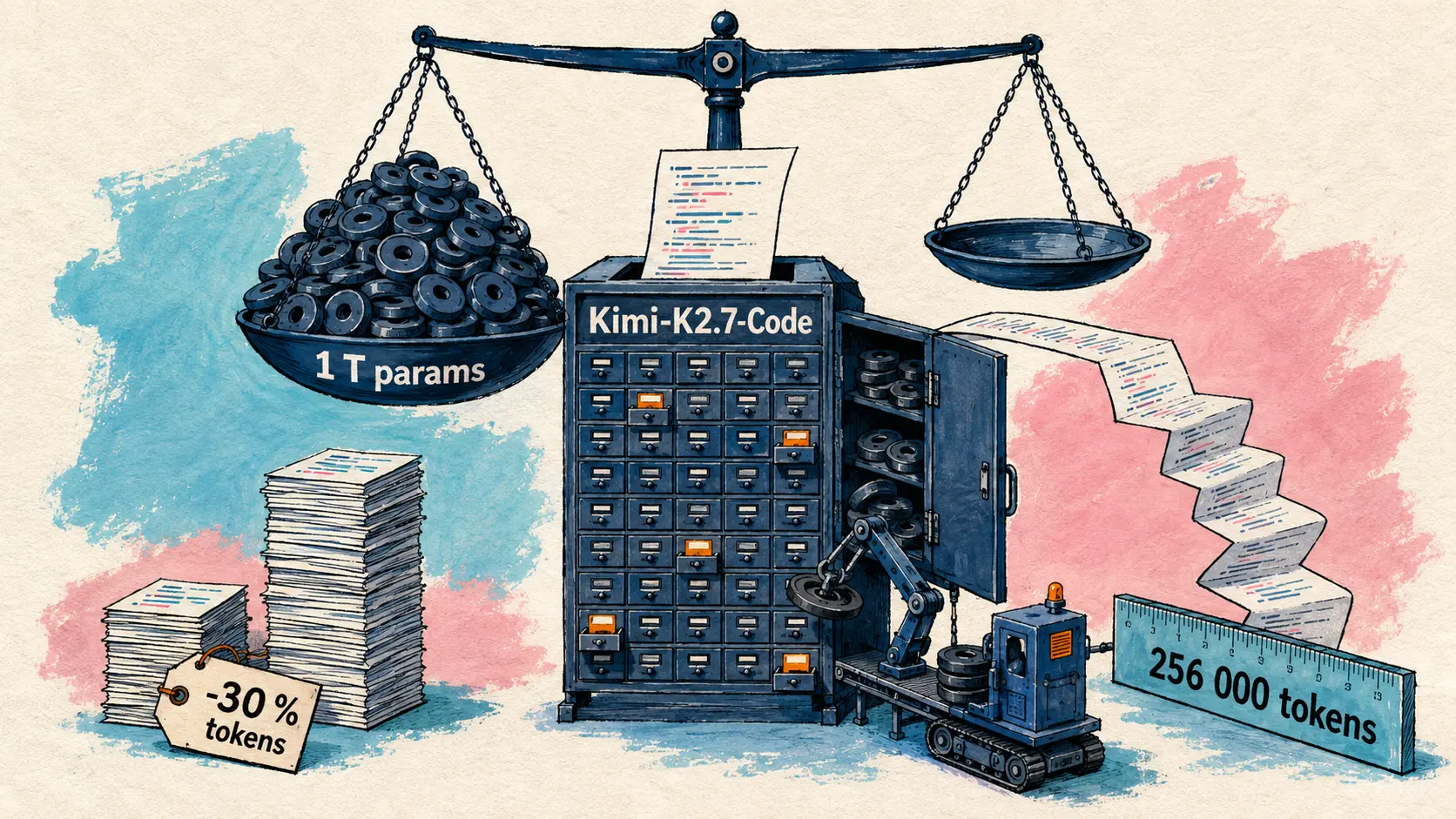
June 12 — Moonshot AI releases Kimi-K2.7-Code, an agent-oriented code model open source from launch. The direct successor to K2.6, it uses a Mixture-of-Experts architecture with 1,000 billion total parameters, with 32 billion active parameters per token. The context window reaches 256,000 tokens thanks to MLA attention (Multi-head Latent Attention).
K2.7-Code vs K2.6 comparison:
| Benchmark | Gain vs K2.6 |
|---|---|
| Kimi Code Bench v2 | +21.8% |
| Program Bench | +11.0% |
| MLS Bench Lite | +31.5% |
| Reasoning tokens | -30% |
The gain on reasoning tokens is notable: K2.7-Code reduces token usage by 30% during reflection steps, limiting the overthinking phenomenon common in long-reasoning models. In practice, this translates into more direct responses and lower inference cost.
The model is available today via the Kimi API on platform.moonshot.ai and the Kimi Code interface on kimi.com/code. A beta program is open to developers (kimi.com/code/beta). A 6× high-speed mode is announced soon.
“Kimi-K2.7-Code, our latest coding model, is now released and open-sourced!” — @Kimi_Moonshot on X
The weights are available on HuggingFace.
🔗 moonshotai/Kimi-K2.7-Code on HuggingFace
Anthropic Public Record — 51,993 Americans surveyed about AI
June 12 — Anthropic publishes the results of the first edition of the Anthropic Public Record, a series of representative surveys designed to regularly measure the attitudes of the American public toward AI. The survey was conducted in November-December 2025 among 51,993 Americans (16 years and older) via YouGov, weighted according to U.S. census data.
| Topic | Result |
|---|---|
| Hope #1 | Cure diseases (cancer, Alzheimer’s) — 48% |
| Hope #2 | Help people with disabilities — 36% |
| Fear #1 | Job loss — 64% (in every state) |
| Fear #2 | Cognitive dependence — 56% |
| Fear #3 | Misinformation — 52% |
| Support for government regulation | 71% (79% Democrats, 68% Republicans) |
| Trust in AI companies | Only 15% |
A paradox emerges around jobs: people who use AI daily at work are less worried about their job (54%) than those who never use it (70%). Trust in AI companies (15%) is the lowest of all institutions tested, below the federal government (20%). The survey will be repeated regularly and expanded beyond the United States.
TCS and Anthropic — Claude for 50,000 employees in 56 countries
June 12 — Anthropic announces a strategic partnership with Tata Consultancy Services (TCS), one of the world’s largest technology services providers (around 600,000 employees). TCS joins the Claude Partner Network alongside DXC Technology, announced the day before.
| Area | Detail |
|---|---|
| TCS employees | 50,000 internal users in 56 countries |
| Client sectors | Financial services, healthcare, public sector, aviation, telecoms |
| TCS role | ”Customer zero” + dedicated Claude practice |
| Sector offerings | Claims processing (insurance), loan advisory (banks) |
Deployments already underway: Diligenta (TCS UK subsidiary, life and retirement) is improving the customer experience for 22 million policyholders; TCS Banking & Financial Services uses Claude Code for software engineering productivity; TCS iON integrates Claude for 75 million annual assessments across 1,500 cities in India.
“Enterprise AI value comes from understanding business context, orchestrating complex systems, and applying deep AI engineering talent.” — K. Krithivasan, CEO of TCS
GitHub Copilot code review: agent skills and MCP servers in public preview
June 12 — GitHub expands Copilot’s automated code review capabilities with support for custom “agent skills” and connections to MCP (Model Context Protocol) servers. The feature is available in public preview for all existing Copilot Pro, Pro+, Business, and Enterprise users.
Until now, Copilot code review relied only on the immediate diff context. With agent skills and MCP, teams can connect their own MCP servers to inject style rules, internal conventions, or organizational data directly into the review, and create custom agent skills tailored to each project’s standards. In GitHub’s official wording: “Bring your org’s context and standards right into the diff.”
ElevenLabs Avatars in ElevenCreative
June 11 — ElevenLabs launches Avatars in its ElevenCreative creative suite, making it possible to create studio-quality talking-head videos from a script, a voice, and a digital avatar — no filming required.
The library offers ready-to-use or customizable human and non-human avatars. The workflow is fully integrated: avatar selection, style choice, script input, and assignment of an ElevenLabs voice. For teams producing at scale, an Avatar node in Flows enables batch generation from a single pipeline. Created avatars are stored in Assets and remain accessible from any workspace.
“Introducing Avatars in @ElevenCreative. The best AI voices, now with a face. Create studio-grade talking videos from a script, a voice, and an avatar - all in one place.” — @ElevenLabs on X
MiniMax M3 open-weight on HuggingFace + free NVIDIA GPU endpoint
June 12 — MiniMax makes the weights of its M3 model public on HuggingFace, while NVIDIA simultaneously opens a free GPU endpoint on build.nvidia.com. The model, initially announced on June 1, thus becomes frictionless for developers to access.
| Spec | Value |
|---|---|
| Total parameters | ~428 billion (sparse MoE) |
| Active parameters | ~23 billion per token |
| Context | 512,000 tokens |
| Modalities | Text, image, video (native) |
| Prefill | 9× faster (MiniMax Sparse Attention) |
| Decode | 15× faster |
| Free endpoint | build.nvidia.com (day-0) |
| Availability | Fireworks AI (M2.7 parity pricing) |
🔗 NVIDIA Tweet · 🔗 HuggingFace weights
OpenAI Codex: reset banking and CDP developer mode
June 12 — OpenAI rolls out two updates for Codex.
Usage limit reset banking: users can now keep unused limit resets to carry them over later, instead of losing them every day. At launch, all Go, Plus, Pro, and Business users receive one free reset. A temporary referral program (2 weeks) is also included: Plus and Pro users can invite up to 3 friends to try Codex; when a friend sends their first message, both sides get an additional banked reset.
| Plan | Free reset included | Referral |
|---|---|---|
| Go | 1 | No |
| Plus | 1 | Yes (3 invites) |
| Pro | 1 | Yes (3 invites) |
| Business | 1 | Yes (workspace members) |
Developer mode for browser usage: a new mode gives Codex access to the Chrome DevTools Protocol (CDP) in Chrome and in the app’s built-in browser, enabling performance profiling, network traffic debugging, console inspection, runtime error analysis, and page state observation. The changelog notes a performance improvement: browser usage is up to 2× faster thanks to CDP optimizations and DOM snapshots that reduce back-and-forth.
🔗 @OpenAI — reset banking · 🔗 @OpenAIDevs — CDP developer mode
Briefs
- Claude Code v2.1.173-175 — Three releases in two days: fix for
[1m]suffixes on Fable 5 (v2.1.173), numerous/modelselector fixes and usage attribution in VSCode (v2.1.174), newenforceAvailableModelsparameter to prevent users from expanding the allowed model list (v2.1.175). 🔗 GitHub releases - Gemini Neural Expressive — Google Gemini presents “Neural Expressive,” its new design language, at a community Discord event hosted by Product Marketing Manager Megan C. On the agenda: dynamic visual responses and smooth transitions between interface modes. 🔗 @GeminiApp on X
- OpenAI API platform: ⌘K search bar + documentation agent — The
platform.openai.complatform now has a search bar and quick commands (⌘K) for navigating pages, settings, and documentation. A documentation agent ondevelopers.openai.comcan generate custom guides opened directly in Codex or copied in Markdown. 🔗 @haydenbleasel on X
What this means
Moonshot AI’s open sourcing of Kimi K2.7-Code illustrates a persistent trend: specialized code models are reaching massive MoE scales (1T parameters) while remaining practically deployable thanks to partial activation (32B active). The 30% reduction in reasoning tokens is an important signal — the industry is starting to optimize not only performance benchmarks but also the internal efficiency of thought chains, which directly affects operating costs for large-scale deployments.
Anthropic’s enterprise partnerships with TCS (50,000 employees, 56 countries) and DXC Technology (announced the day before) outline an industrial deployment model: large systems integrators become both internal users (“customer zero”) and resellers of Claude sector solutions. This distribution model through established players in regulated sectors (finance, healthcare, public sector) accelerates adoption without requiring Anthropic to build sector sales teams from scratch.
The Anthropic Public Record results deserve attention: 71% of Americans want bipartisan government regulation of AI, but only 15% trust AI companies — a score below the federal government (20%). This gap between growing AI usage and distrust of its producers defines the regulatory environment in which all of today’s announcements unfold. Anthropic’s decision to make this survey public and recurring is itself a deliberate transparency posture in this context.
The expansion of Copilot code review to agent skills and MCP servers, combined with Codex’s new CDP capabilities, confirms that developer tooling is shifting toward an extensible agentic paradigm. Code review is no longer read only in the diff — it can now query organizational context via MCP, just as Codex can inspect a browser’s network and console via CDP. These two announcements continue the Agentic Workflows launched by GitHub the day before.
Sources
- @Kimi_Moonshot — Kimi K2.7-Code open source
- HuggingFace — moonshotai/Kimi-K2.7-Code
- Anthropic — Anthropic Public Record
- Anthropic — TCS Partnership
- @github — Copilot code review agent skills + MCP
- @ElevenLabs — Avatars in ElevenCreative
- @NVIDIAAI — Free GPU endpoint for MiniMax M3
- HuggingFace — MiniMaxAI/MiniMax-M3
- @OpenAI — Codex rate limit reset banking
- @OpenAIDevs — Codex CDP developer mode
- Anthropic — Claude Code releases
- @GeminiApp — Neural Expressive design language
- @haydenbleasel — API Platform search bar ⌘K