ai-powered-markdown-translatorArticle translated from fr to en with gpt-5.6-sol.
This Tuesday, Google is launching Gemini 3.8 Live and Gemini 3.8 Live Extended Thinking, two real-time voice dialogue models capable of calling tools in the background without interrupting the conversation. Anthropic is releasing three versions of Claude Code and bringing Salesforce into Claude, while OpenAI has set October 14 as the date when GPT-5.5 will be removed from ChatGPT and Codex. Agents are also moving into existing distribution channels, from HP preinstalling Perplexity to Devin being sold on AWS Marketplace, while NVIDIA details two building blocks of its Vera Rubin platform.
Gemini 3.8 Live and 3.8 Live Extended Thinking, two voice models that act while speaking
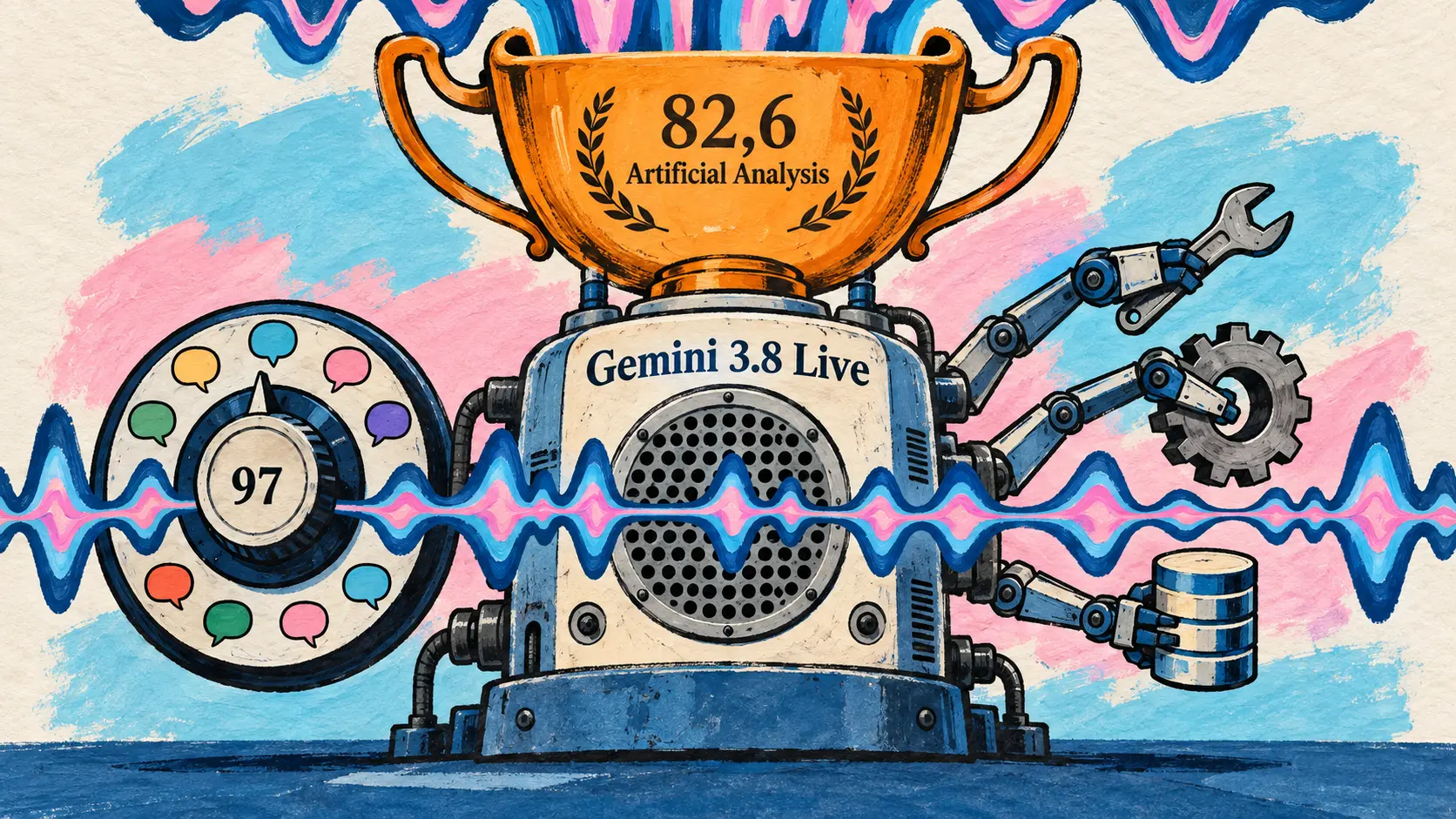
September 15 — Google is launching two real-time voice dialogue models, introduced by the Gemini Audio team. Gemini 3.8 Live targets scale, speed, and cost: it accepts near-real-time visual inputs and automatically switches between 97 languages throughout a conversation. Gemini 3.8 Live Extended Thinking is designed for tasks requiring multi-step reasoning: it reasons and speaks at the same time, acknowledges requests with brief verbal cues, and comments on the progress of its background tasks; its reasoning level can be configured in the API. Both models perform tool and API calls in the background (asynchronous function calling) while the audio response continues.
The models talk, think, and handle tasks in the background without breaking your flow. — @GoogleDeepMind on X
Google also highlights accuracy on dictated alphanumeric data, such as confirmation codes or case numbers, and presents these models as a simpler alternative to cascade architectures, which chain together transcription, text processing, and speech synthesis. According to the Gemini 3.8 Audio model card, they are based on Gemini 3 Pro, accept audio, images, video, and text within a 128K-token context, produce up to 64K output tokens, and rely on knowledge with a January 2025 cutoff.
| Ranking or benchmark | Model evaluated | Score published by Google |
|---|---|---|
| Speech to Speech Quality Index (Artificial Analysis) | 3.8 Live Extended Thinking | 82.6 (1st place) |
| τ-Voice | 3.8 Live Extended Thinking | 68.6% |
| τ-Voice-banking (Sierra) | 3.8 Live Extended Thinking | 35.1% |
| Big Bench Audio | 3.8 Live Extended Thinking | 97.7% |
| Speech Agent Arena (Artificial Analysis) | 3.8 Live | 2nd place |
These rankings are maintained by third parties, but the cited scores are those published by Google. In the Live API, Google estimates the cost of both models at $0.005 per minute of input audio and $0.018 per minute of output audio, based on $3 per million input tokens and $12 per million output tokens; Agora, Fishjam, LangChain, LiveKit, Pipecat, Vercel, and Vision Agents are named as integrators.
| Distribution channel | Gemini 3.8 Live | Gemini 3.8 Live Extended Thinking |
|---|---|---|
| Gemini API and Google AI Studio | From September 15 | From September 15 |
| Gemini Enterprise | Private preview | Private preview |
| Consumer | Search Live | Gemini Live, Docs Live (Google AI Pro and Ultra subscribers), Gmail Live and Keep Live (all Google AI subscribers) |
In Search Live, the model provides step-by-step guidance for real-time troubleshooting. All generated audio carries the invisible SynthID watermark.
🔗 Introducing Gemini 3.8 Live and 3.8 Live Extended Thinking 🔗 Developer post about the Live API 🔗 Gemini 3.8 Audio model card
Claude Code 2.1.271 to 2.1.273: fast mode in Remote, per-command networking, and tighter permissions
September 15 — Anthropic is releasing three versions of Claude Code in just over 22 hours, the first shortly after midnight Paris time.
| Released version | Date and time (UTC) | Release notes |
|---|---|---|
| 2.1.271 | September 14, 10:12 p.m. | 96 lines: fast mode in Remote, per-command allowed_domains, omitClaudeMd, --accept-command |
| 2.1.272 | September 15, 12:42 a.m. | One line: bug fixes and reliability improvements |
| 2.1.273 | September 15, 8:23 p.m. | 64 lines: headers for LLM gateways, Remote Control session duplication, local classifier on Bedrock, Vertex, and Foundry |
Version 2.1.271 brings fast mode to Claude Code Remote sessions, both in the cloud and on self-hosted runners, where permitted by the organization. In auto mode with sandboxing, Bash, PowerShell, and Monitor accept a per-command allowed_domains list: required hosts are reviewed alongside the command and opened only for that command, while all others are denied. The omitClaudeMd field in agent frontmatter launches a sub-agent without the user, project, and local CLAUDE.md files, while managed policy files remain loaded, and claude plugin install --accept-command <sha256> accepts only the exact command displayed during a previous switch to --json, instead of a -y. Version 2.1.273 makes it possible to duplicate (fork) from the Claude app a session launched with claude --remote-control, with the duplicated session then running in the background on the computer. It also issues a warning when an MCP server disconnects and automatic reconnection gives up, and adds request headers for LLM gateways, enabled by CLAUDE_CODE_GATEWAY_HINT_HEADERS=1.
| Modified element | New behavior |
|---|---|
| Sub-agent return in auto mode | Dedicated hand-back call reviewed by the safety classifier, instead of an after-the-fact check of its last message |
Skill ! commands and slash commands in auto mode | Default-mode permission rules instead of the classifier |
| Monitor watches | Mandatory timeout of no more than 30 minutes (10 when running -p), with Claude notified so it can rearm them |
| Dynamic workflows | Pause at the usage limit and resume automatically when it resets, instead of abandoning agents |
| Auto mode on Bedrock, Vertex, and Foundry (2.1.273) | Local classifier by default for now, CLAUDE_CODE_AUTO_MODE_SERVER=1 for the platform classifier |
The two versions also fix several permission checks. Commands containing a subshell, two directory changes, or a cd + git chain skipped the prompt under permissions.blockReadsOutsideWorkingDirectories, and a subshell could hide a dangerous rm in permission bypass mode. MCP settings enforced through MDM or managed-settings.json were ignored whenever server-managed settings existed. /resume and /teleport retained tracking of files read in the previous conversation, allowing Claude to modify files that the resumed conversation had never read. Finally, the context meter counted advisor tool turns at roughly twice their size, triggering automatic compaction at around half the window.
None of the three release notes mentions the Claude Mods announced on September 14; however, on issue #91870, community testers believe version 2.1.272 has already affected their behavior.
🔗 Claude Code 2.1.271 release notes 🔗 Claude Code 2.1.273 release notes
Salesforce in Claude, a beta sales plugin for approved organizations
September 15 — Anthropic is launching Salesforce in Claude in beta, bringing a salesperson’s accounts, opportunities, and pipeline into Claude. The post introduces a plugin designed with Salesforce, while the help center credits Salesforce with building its 37 sales skills: account research, call preparation, pipeline review, and CRM updates. It is accompanied by two connectors: Salesforce with read and write access, and Slack for deal channels and team threads.
Salesforce remains the system of record: each salesperson signs in with their own credentials, Claude reads only what their Salesforce permissions allow, and every write must be approved by default. The plugin works in chat and in Claude Cowork (web and desktop). The beta is available on paid plans, but only to organizations accepted by Salesforce through its beta registration and using the latest enterprise edition of Sales Cloud; their Salesforce administrators request access through AgentExchange. GitLab, Siemens, and Legora have deployed it, and 7,000 Salesforce salespeople use it.
🔗 Bringing Salesforce into Claude 🔗 Set up Salesforce in Claude for your organization
GPT-5.5 will leave ChatGPT, ChatGPT Work, and Codex on October 14, but remain in the API
September 15 — OpenAI has announced on X the end of GPT-5.5 in its applications, already listed in the ChatGPT and Codex changelog dated September 14. On October 14, the model will leave ChatGPT, ChatGPT Work, and Codex across all plans: consumer, Business, Enterprise, and Edu.
| Affected surface | Status on October 14 |
|---|---|
| ChatGPT and ChatGPT Work | GPT-5.5 removed from all plans |
| Codex with ChatGPT sign-in | GPT-5.5 removed, switch to gpt-5.6-sol required |
| Codex with API key | GPT-5.5 still available |
| OpenAI API | GPT-5.5 still available |
For Codex with ChatGPT sign-in, the documentation instructs users to replace gpt-5.5 everywhere it is explicitly selected: workspace defaults, saved settings, managed configurations, custom agents, scheduled tasks, and scripts. The @ChatGPT account’s post also names GPT-6 Astra as its replacement in Codex. The administrator guide warns that changing the default model does not grant access to that model: administrators must verify, client by client, that the replacement is available to the affected users. OpenAI is following the same one-month notice period used for GPT-5.4 and GPT-5.4 mini, which were removed from Codex on August 31 for users signed in with ChatGPT, following an announcement on July 31.
🔗 ChatGPT and Codex changelog 🔗 Post from @ChatGPT on X
HP preinstalls Perplexity on its Windows PCs, with an Autodesk Revit connection
September 15 — Perplexity and HP have announced that the Perplexity app for Windows will be preinstalled on the taskbar of the manufacturer’s PCs, beginning with the ZBook Ultra G3a mobile workstation, equipped with AMD Ryzen AI Max PRO 400 series processors; other models will follow in the coming months, with no list, pricing, or date provided. According to the post, the ZBook Ultra G3a’s local AI capabilities allow routine tasks to be performed with Portable Computer, the local version of the agent that works without cloud credits and offline, but its availability depends on the device configuration: the post does not list compatible configurations, while the Windows version released the day before required an NVIDIA RTX GPU with at least 24 GB of video memory.
Portable Computer also connects to Autodesk Revit, the Building Information Modeling software, through the Revit 2027 MCP server, offered in Technical Preview as a separate module. Access is read-only: the agent answers questions about the model, such as the number of doors on a floor or their fire rating, and exports views, PDFs, and schedules without modifying it. Personal Computer for Windows is available to Pro, Max, and Enterprise subscribers on Windows 10 and 11.
🔗 Perplexity comes to more Windows PCs with HP
Cognition signs with AWS and launches macOS in Devin Cloud
September 15 — Cognition published two announcements on the same day, linked by infrastructure: the Macs on which Devin now builds Apple applications are AWS EC2 Mac hosts.
A Strategic Collaboration Agreement with AWS
Cognition and Amazon Web Services have entered into a multi-year Strategic Collaboration Agreement, though the post specifies neither its value nor its exact duration. Two components are already in place: Devin can be purchased through AWS Marketplace, and the Agent Toolkit for AWS can be used directly in Devin. Deeper integrations into customers’ AWS environments are being explored, with no timeline provided. Devin is deployed in a single-tenant environment, in the AWS region selected by the customer, with data stored in a dedicated VPC and one virtual machine per session, deleted when the work is complete.
| Customer cited by Cognition | Reported result |
|---|---|
| Mercedes-Benz | More than 200,000 lines of COBOL analyzed, with a project estimated at eight months reduced to eight days |
| Unnamed automotive manufacturer | 25,000-line COBOL workflow migrated from a mainframe to AWS Lambda, with an estimated cost reduction of 73% |
🔗 Cognition’s post on the agreement with AWS
macOS Comes to Devin Cloud
On July 31, Cognition had already demonstrated Devin cloud agents running macOS, with Xcode and the iOS Simulator. The September 15 launch in Devin Cloud, for building and verifying iPhone, iPad, and Mac applications, adds several new features: Devin sends screen recordings of its tests to Slack, provides a TestFlight link for installing the application, and a new iOS Simulator panel displays the running application. The agent also controls applications through their accessibility tree, exposed to its computer-use tool: it queries a control by its role and name, acts on it, and then rereads the tree, while screenshots are still used to assess the rendering. This layer relies on Dioxus’s open-source accessibility-cli, whose team joined Cognition on September 10.
The macOS VMs run on Apple’s Virtualization.framework on physical AWS EC2 Mac machines, with a Network Block Device (NBD) interface added to the snapshot system so a session can be resumed without keeping the machine powered on. A user-space Ethernet gateway replaces Apple’s managed NAT to enforce each session’s network policy. Neither pricing nor the applicable plan is specified.
NVIDIA Details Two Building Blocks of Vera Rubin, Groq 3 LPX and NVLink 6
September 15 — Two posts on NVIDIA’s technical blog explain how the Vera Rubin platform saves energy during inference and withstands network failures. The figures below are NVIDIA’s.
Groq 3 LPX, Deterministic Execution to Reduce the Voltage Margin
Groq 3 LPX’s production launch was covered here on August 24; this post explains the mechanism. Before execution, the LPU chip compiler schedules, down to the clock cycle, every computation and data transfer across the rack’s 256 chips, allowing it to predict current draw. Two technologies take advantage of this: Preemptive Power (PEP) asks the power delivery network to raise the voltage just before a demand spike, while Clock Period Synthesis (CPS) lengthens the clock cycles in which current rises most rapidly. The aim is to reduce the voltage guardband maintained by every circuit, which is costly because power increases with the square of voltage: 10% more voltage means 21% more power.
In internal testing, the voltage drop decreased by more than 60%. NVIDIA estimates that, for the same workload, the required power could fall by a low-double-digit percentage compared with a comparable nondeterministic system. These controls are coming to Vera Rubin in the second half of 2026.
🔗 NVIDIA’s post on Groq 3 LPX deterministic execution
NVLink 6, a Resilience Stack from Silicon to Software
NVLink 6 connects the 72 Rubin GPUs in a Vera Rubin NVL72 rack into a single domain; its packet throughput, which NVIDIA claims is 10 times higher than generic Ethernet alternatives, was already cited here on July 21. This time, the post details fault tolerance layer by layer.
| Stack level | Mechanism described by NVIDIA |
|---|---|
| Physical layer | Lightweight error correction, paired with Physical Layer Retry |
| Link layer | Credit-based flow control, with packet loss prevented by design |
| Link management | Software recovery in approximately 1.5 seconds through the NMX Controller |
| Inference service | Shadow Engine Recovery (NVIDIA Dynamo): interruption reduced from 283 to 7.3 seconds on B200 GPUs |
| Multi-node checkpoints | cuda-checkpoint supported by NCCL in prototype form, with general availability expected by the end of the year |
Credit-based flow control sends a packet only if the next hop has room to receive it, whereas Ethernet relies on PFC and ECN. Shadow Engine Recovery keeps a replica of the inference engine already initialized with its own NCCL communicators.
🔗 NVIDIA’s post on NVLink 6 resilience
Gemini Notebook Announces Voice Conversations with Notebooks and an Audio Recorder
September 15 — For the start of the academic year, Gemini Notebook is getting a new look and announcing a series of study tools, most of which are still forthcoming.
| Announced study tool | Stated availability |
|---|---|
| Real-time voice conversations with notebooks on mobile, in nearly 100 languages | This week for adult Google AI Ultra subscribers, soon for Google AI Pro subscribers and others |
| Audio recorder in the mobile application | Starting next week |
| Interactive learning overviews in Reports | In the coming weeks, for all users |
| Short-answer, multiple-choice, or fill-in-the-blank quizzes | In the coming weeks, for all users |
| Shareable Short Video Overviews in more than 80 languages | Now, up from more than 70 languages on September 1 |
Voice conversations will answer based on the notebook’s sources and can be interrupted by voice, while the recorder will capture a lecture or reflection directly in the notebook alongside the sources. Learning overviews will combine summaries, infographics, quizzes, and flashcards. Regarding the student plans already introduced in August, Google specifies that the free year of Google AI Pro for US students quadruples the limits in Gemini Notebook, while the year of Google AI Plus offered in more than 140 other markets doubles them.
🔗 Sharpen your study routine with new Gemini Notebook tools
Antigravity 2.14.0 Opens the Integrated Terminal and Git to Enterprise and Business Accounts
September 15 — Antigravity 2.14.0, which includes 10 improvements and 18 fixes, gives Enterprise and Business accounts access to the integrated terminal and Git version control in the sidebar, introduced for other accounts with version 2.10.0 on August 24. Conversations with very long histories load faster and use less memory, and a redundant scan of skills, rules, and customization files that previously reran with every message has been eliminated.
Among the fixes, a transient service error no longer ends the session: it is retried with increasing delays for approximately twelve minutes. Completed subagents no longer remain displayed as active, blocking subsequent messages until a restart, and a memory leak related to terminal command output has been fixed. The release title mentions a new permissions system, but on this point the notes only rename the general settings section to “Global Permissions” and the project settings inheritance option to “Inherit Global.”
🔗 Google Antigravity changelog
IBM Research Halves an Agent’s Consistency Gap with ALTK-Evolve
September 15 — On the Hugging Face blog, IBM Research has published the third installment of its ALTK-Evolve series, this time focusing on agents’ execution consistency. Across 168 AppWorld tasks, a ReAct agent using GPT-4.1 at temperature 0 succeeds in an average of 77.4% of its runs over five trials (Mean@5), but succeeds in all five for only 53.0% of tasks (Pass^5). IBM calls this 24.4-point difference the consistency gap.
The Consistency Analyzer identifies unstable decisions from a single recorded trajectory: it replays each step offline by requesting five completions, without ground truth, without rerunning the task, and without access to logits. Fragile steps become consistency guidelines, injected at inference time.
| Agent configuration | Mean@5 score | Pass^5 score | Consistency gap |
|---|---|---|---|
| ReAct GPT-4.1 without guidelines | 77.4% | 53.0% | 24.4 points |
| ReAct GPT-4.1 with consistency guidelines | 81.0% | 69.0% | 12.0 points |
On gpt-oss-120b, Pass^5 rises from 10.1% to 16.1%. The Analyzer and guideline generation are integrated into the open-source ALTK-Evolve repository.
🔗 IBM Research’s post on the Hugging Face blog
Aillis Adopts Sakana Namazu for Evidence Finder, Scores 96.4% on Japan’s National Medical Examination
September 14 — Aillis, a Japanese company that develops medical devices based on machine learning, has adopted Sakana Namazu, the Japanese-specialized LLM launched by Sakana AI in early August, for Evidence Finder, its evidence-research tool for physicians. The announcement, published at 11 a.m. Tokyo time, was shared by Sakana AI on X the same day at 3:30 p.m. Pacific time, after our September 14 review. Evidence Finder uses medical literature to draft answers that cite their references, whose existence is checked by its Verify feature; the two companies are also beginning joint work on medical use cases.
The version of Evidence Finder powered by Sakana Namazu scored 96.4% (482 points out of 500) on the 120th Japanese National Medical Examination in February 2026. According to Aillis’s assessment as of September 1, this is the highest score among domestic foundation models designated by the Japanese Ministry of Economy’s GENIAC program. The announcement includes two caveats: the product’s restrictions, including its refusal to answer image-based questions, were lifted for this test, whereas the commercial service handles only text-based questions, and Evidence Finder is not a medical device.
🔗 Aillis announcement on PR Times 🔗 Sakana AI’s post on X
Google Quantifies AI Usage and Its Social Impact
September 15 — On the same day, Google published two series of posts devoted to real-world AI usage and its social effects.
AI & Economy ATLAS Opens to the Public, with a Study on Scientists
AI & Economy ATLAS, the research program from Google’s Office of the Chief Economist that produced the figures on administrative procedures cited here on September 9, is becoming a freely accessible interactive experience: users can compare AI usage by occupation, at home, and across countries.
| Highlighted ATLAS indicator | Value published by Google |
|---|---|
| India: share of arts, design, and media occupations in professional AI usage | 19%, or 1.6 times the global average |
| United States: share of computing and mathematics | 30%, double the rest of the world |
| Brazil and Germany: share of manual tasks, such as equipment diagnostics | 7%, compared with 4% in Japan |
A study by Google, Google DeepMind, and MIT FutureTech, based on an analysis of 2,600 specialized AI models and a survey of more than 600 US and UK scientists, indicates that nearly half use AI every day and report saving just under 7 hours per week. The authors also note the downsides: time spent validating AI outputs and a growing queue of untested hypotheses awaiting physical experiments and clinical validation.
🔗 New insights from Google’s AI & Economy ATLAS
AI for Societal Impact: Languages, Google.org Winners, and FireSat
According to Google, the group’s technologies work across more than 300 languages spoken by over 7 billion people, and several datasets were built with local partners. Google also presents Language Explorer, an interactive tool that visualizes the open LinguaMeta database.
| Initiative cited by Google | Announced figure |
|---|---|
| WAXAL, open speech corpus | 27 sub-Saharan African languages |
| Project Vaani | More than 30,000 hours of speech across 109 languages |
| Google.org Impact Challenge: AI for Government Innovation | 15 winners, $30 million, more than 2,600 applications |
| FireSat | First batch of operational satellites in orbit, with around 50 targeted by 2030 to produce an image every 20 minutes |
| Planetary Prediction Engine, presented in late August | 83% of emerging Ebola hotspots in the Democratic Republic of the Congo identified in advance, according to Google |
The Google.org winners, including Code for America for tax filing and Johns Hopkins University for road safety, receive volunteer support from Google engineers and are designing their projects as reusable open-source models.
🔗 AI for everyone in every language 🔗 15 organizations transforming public service with AI 🔗 Building AI to accelerate science and improve lives 🔗 Detecting wildfires with AI
Briefs
- Anthropic publishes a guide to deploying Claude across sales teams — released on the same day as Salesforce in Claude, Building an AI-native revenue organization is introduced in a post citing two customers: Cox Communications says it achieved a sevenfold return on investment in the first year and reduced the cost of validating and enriching its leads by 86%, with accuracy rising from 18% to 97%, while 88% of Cyera’s roughly 1,500 employees use Claude every week. 🔗 source
- Perplexity publishes a guide to shadow AI — the post provides no original data and compiles third-party surveys: about half of employees say they have violated their organization’s rules by using AI (KPMG), while 82% of respondents to a Cloud Security Alliance survey report unknown agents on their organization’s systems. It concludes with a pitch for Perplexity Enterprise and Comet for Enterprise, without any new functionality. 🔗 source
- v0 becomes model-agnostic — according to a single tweet, Vercel’s application-building tool offers frontier, inexpensive, open, and fast models served through Vercel AI Gateway, including Claude, GPT, Kimi, GLM, Grok, and DeepSeek; neither the full list, pricing, nor the eligible plans are specified. 🔗 source
- Warp quantifies its internal software factory — in a post outlining a three-step method (crawl, walk, run) for adopting the software factory, Warp CEO Zach Lloyd says the company’s factory automates about 75% of changes to warp.dev, its marketing website; Warp Factories remains in early access, with $10,000 in usage offered to qualifying companies. 🔗 source
- Kimi Code 0.43.1 fixes its subagent swarms — less than 19 hours after 0.43.0, Moonshot AI releases seven fixes, including freeing memory when a subagent finishes, lighter rendering and event-loop processing in large swarms, and a change ensuring Ctrl+C now interrupts only subagents instead of closing the entire CLI. 🔗 source
- Gemini CLI v0.60.0 reaches stable — the release carries over unchanged the September 8 preview and its eleven hardening changes, while v0.61.0-preview.0 opens the next series with three fixes already published in nightly builds and one agent-loop fix. 🔗 source
- Copilot suggests allowed values for repository custom properties — when creating an enterprise or organization custom property, Copilot suggests values that can be accepted with one click; the feature is in public preview for Copilot Business and Enterprise, under the control of the “Repository custom property suggestions” policy. 🔗 source
- Grok Imagine edits text in images, in beta — SpaceXAI’s image- and video-generation tool can alter text appearing in any image, such as an invitation, poster, or advertisement; the announcement specifies neither the plans, platforms, nor model used. 🔗 source
- MiniMax H3 exceeds twice real-time speed during denoising — in a tweet published on September 14 at 4:34 p.m. Pacific Time, after our report from earlier that day, MiniMax says that with SGLang-Diffusion and VDN-H3, H3 generates 14.4 seconds of 768p video in 9.0 seconds on 8 B200 GPUs, with no measured quality regression, extending the H3 ecosystem covered on September 14. 🔗 source
- Retrieve-for-Train distills reinforcement learning into a small diffusion model — based on an ICML 2026 paper, this Google Research work trains a 4B-parameter model once, offline, through Reinforcement Learning to produce diverse subqueries, then distills that behavior into a 53.9-million-parameter diffusion model that generates the entire set in a single pass, delivering a 12- to 20-fold speedup. 🔗 source
- NVIDIA quantifies the choice between a dense model and a Mixture-of-Experts model (MoE) — this educational post compares Gemma 4 31B, Qwen3.8-27B, Nemotron 3.5 Lightning, and Mistral Small 4 using Artificial Analysis data collected on August 31: Lightning, with 30B parameters of which 3B are active, runs four to five times faster than Qwen3.8-27B at one-fourteenth the price, with less than half its capability score. 🔗 source
- NVIDIA FLARE 2.9 adds Slurm — the federated learning framework, which has supported Docker and Kubernetes since version 2.8, can now combine all three environments within a single federation and introduces a portable per-job resource description. 🔗 source
- Sakana Marlin adds Interactive Reading and PowerPoint export — with Interactive Reading, Sakana AI’s autonomous research assistant lets users question the agent about its report and open a cited source within the relevant passage that supports the claim; it also exports editable PowerPoint presentations containing the URLs of their sources. 🔗 source
- ShadowPEFT enters the PEFT library — community post: the method, which attaches a small detachable “shadow” network to the frozen model, has been merged into PEFT’s main branch and will ship in its next release; on Llama-3.2-3B, its authors measure 48.1% on GSM8K versus 46.9% for LoRA, but with peak memory usage of 28.2 GB versus 22.3 GB. 🔗 source
- RiverRider measures file localization against chance — individual contribution: on SWE-bench Verified, a local 33-million-parameter encoder ranks the correct file first in 45.8% of cases, but a baseline using shuffled queries already finds it among the top 50 results 24.4% of the time, reducing the signal-to-chance ratio from 45.8 to 3.9. 🔗 source
- EcoHash doubles concurrency on an RTX PRO 6000 running Qwen3.8-27B — a post by an inference provider, previously cited on September 14 on another topic, based on measurements from its own service: enabling the model’s multi-token prediction (MTP) head in vLLM 0.27.1 reduces time per token from 22 to 13 ms and increases sustained concurrency from 32 to 64 requests, a ceiling reached in two out of four runs, at the cost of 23% of KV cache capacity. 🔗 source
- DINO-X releases a research model for hepatic vessels, along with its failures — a community model restricted to research: this 86-million-parameter ViT-Base achieves an external AUROC of 0.9413 across 17,639 CT slices, and its author also publishes negative results, including a colon specialist scoring 0.6529 that remained unreleased. 🔗 source
What It Means
Voice is becoming a fully fledged agent interface. Gemini 3.8 Live and its Extended Thinking variant call tools in the background while the response continues and improve accuracy for dictated codes and numbers, with a cost estimated per minute of audio. Google is immediately placing the Extended Thinking variant, which provides progress updates on its background tasks, into its productivity tools through Docs Live, Gmail Live, and Keep Live, while Gemini Notebook is announcing a voice conversation grounded in each notebook’s sources. The focus is shifting from voice quality to what the model accomplishes while it speaks.
The second thread is distribution: agents are entering business tools through channels that already exist. Salesforce in Claude arrives with sales skills, connectors to the CRM and Slack, and approval for every write operation; HP preinstalls Perplexity in the taskbar of its PCs and connects it to Revit models in read-only mode; Devin can be purchased through AWS Marketplace and deployed in a dedicated VPC. In every case, the agent comes to the tool the company already uses, with its safeguards: the salesperson’s Salesforce permissions, read-only access to Revit, and a dedicated VPC on AWS.
The third thread concerns reliability and control. Claude Code versions 2.1.271 and 2.1.273 have the classifier review subagent output, open network access on a command-by-command basis, and fix permission bypasses involving subshells or ignored MDM settings. IBM Research shows that an agent set to temperature 0 can succeed in an average of 77.4% of its runs yet complete all five successfully on only 53.0% of tasks, and recommends publishing Pass^k alongside the average. NVIDIA applies the same standard to hardware: NVLink 6 recovers a link in about 1.5 seconds, while Shadow Engine Recovery reduces an inference interruption from 283 to 7.3 seconds. The question is no longer merely whether an agent succeeds, but whether it succeeds every time, within verifiable limits.
The final thread concerns pace. OpenAI will retire GPT-5.5 from its applications one month after the announcement, as it did with GPT-5.4 before it, and is asking users to replace the identifier wherever it is explicitly selected, including in scheduled tasks and scripts. On the tooling side, Claude Code releases three versions in 22 hours, Kimi Code issues a fix less than 19 hours after its previous release, and Gemini CLI promotes the September 8 preview to stable one week later. Meanwhile, v0, which until now added models to its selector one by one, declares itself model-agnostic and relies on Vercel AI Gateway: the model becomes an interchangeable component.
Sources
- Google, Gemini 3.8 Live and 3.8 Live Extended Thinking
- Google, developer post about the Live API
- Google DeepMind, Gemini 3.8 Audio model card
- Google DeepMind on X, Gemini 3.8 Live announcement
- Claude Code, version 2.1.271 release notes
- Claude Code, version 2.1.273 release notes
- Claude, Bringing Salesforce into Claude
- Claude Help Center, configuring Salesforce in Claude
- OpenAI, ChatGPT and Codex changelog on the retirement of GPT-5.5
- ChatGPT on X, end of GPT-5.5 in ChatGPT, ChatGPT Work, and Codex
- Perplexity, Perplexity comes to more Windows PCs with HP
- Cognition, agreement with AWS
- Devin, Bringing macOS to Devin
- NVIDIA, deterministic execution of Groq 3 LPX
- NVIDIA, NVLink 6 resilience
- Google, new Gemini Notebook study tools
- Google Antigravity, changelog
- Hugging Face, IBM Research and agent consistency with ALTK-Evolve
- PR Times, Aillis press release
- Sakana AI on X, sharing the Aillis press release
- Google, AI & Economy ATLAS
- Google, AI for everyone in every language
- Google.org, AI for Government Innovation winners
- Google, Building AI to accelerate science and improve lives
- Google, detecting wildfires with AI
- Claude, Building an AI-native revenue organization
- Perplexity, Shadow AI
- v0 on X, selectable models through Vercel AI Gateway
- Warp, Adopting The Software Factory Model
- Kimi Code, version 0.43.1 release notes
- Gemini CLI, v0.60.0 release notes
- GitHub Changelog, Copilot custom property suggestions
- Grok Imagine on X, editing text in images
- MiniMax on X, H3 with SGLang-Diffusion and VDN-H3
- Google Research, Retrieve-for-Train
- NVIDIA, dense models or MoE
- NVIDIA, FLARE with Docker, Kubernetes, and Slurm
- Sakana AI, Marlin update
- Hugging Face, ShadowPEFT in PEFT
- Hugging Face, RiverRider and file localization
- Hugging Face, EcoHash and speculative decoding
- Hugging Face, DINO-X