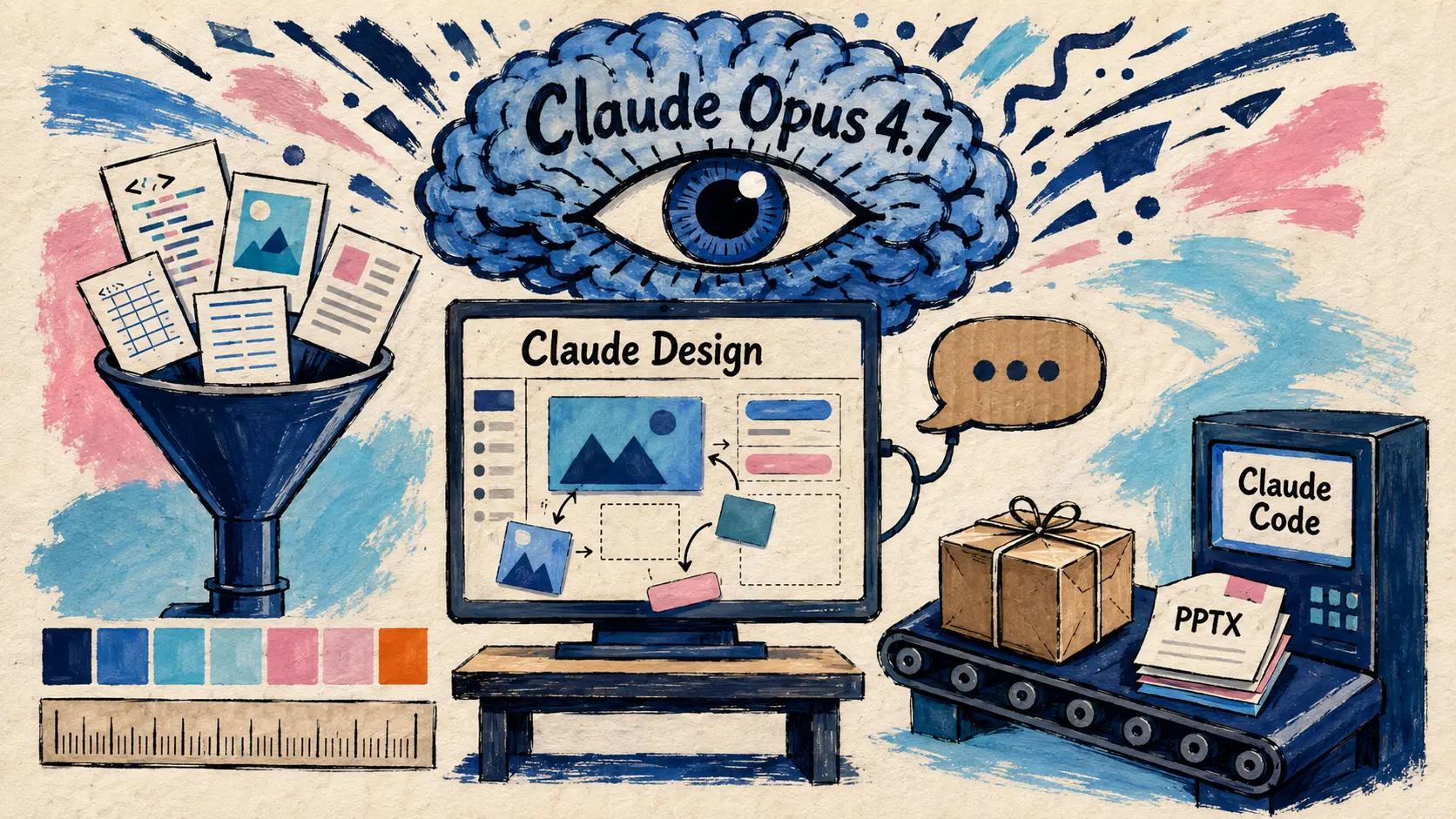
On April 17, Anthropic Labs launches Claude Design, a conversational prototyping tool that extends Claude Opus 4.7’s capabilities to interface design. On the command-line agent side, Claude Code moves to a native binary per platform, Codex CLI v0.121 opens a plugin marketplace, and Copilot CLI reaches general availability for automatic model selection. Google expands NotebookLM to Free users in Gemini App, NVIDIA publishes a NemoClaw tutorial for local agents, and Runway rolls out Seedance 2.0 on iOS.
Claude Design — conversational prototyping
April 17 — Anthropic Labs launches Claude Design, a product that lets users create interactive prototypes (interactive prototypes), slides, and one-pagers through simple conversation with Claude. The product is powered by Claude Opus 4.7, Anthropic’s most advanced vision model, and is available in research preview (research preview) on Pro, Max, Team, and Enterprise plans.
How it works
Claude Design’s workflow is built around an integrated design system: during onboarding, Claude reads the team’s source code and design files to automatically build the in-house design system. Imports can come from any format — text, images, DOCX, PPTX, XLSX documents — or a URL.
Editing remains granular: inline comments on specific elements, direct text edits, adjustment dials for spacing, colors, and typography. Creations can include voice, video, shaders, 3D content, and built-in AI.
| Target audience | Use case |
|---|---|
| Designers | Interactive prototypes, direction exploration |
| Product managers | Functional wireframes, handoff to Claude Code |
| Founders / sales teams | Full presentations in minutes |
| Marketers | Landing pages, campaign visuals |
Export and collaboration
Sharing happens at the organization level (private, internal, or public). When a design is ready to be built, Claude generates a handoff bundle that can be passed directly to Claude Code. Export is available to Canva, PDF, and PPTX. Additional integrations are announced for the coming weeks.
The Canva partnership is built in from launch. Melanie Perkins, co-founder and CEO of Canva, says:
“We’ve loved collaborating with Anthropic over the past couple of years and share a deep focus on making creativity more accessible. Claude Design is a perfect complement to Canva’s mission.”
— Melanie Perkins, Co-founder and CEO of Canva
🔗 Anthropic announcement 🔗 @claudeai post
Claude Code v2.1.113 — native binary and CLI improvements
April 17 — Claude Code v2.1.113 brings a notable architectural change: the CLI now uses a native binary per platform rather than bundled JavaScript. This transition improves startup performance and interface reliability.
| Feature | Description |
|---|---|
| Native binary | Platform-compiled CLI, no more bundled JavaScript |
sandbox.network.deniedDomains | Blocking specific domains even if a wildcard would allow them |
| Fullscreen Shift+↑/↓ | Viewport scrolling during an extended selection out of view |
| Ctrl+A / Ctrl+E | Start/end of logical line in multiline inputs (readline behavior) |
| Windows Ctrl+Backspace | Delete previous word |
| Long URLs (OSC 8) | Stay clickable even across multiple lines |
/loop improved | Esc cancels pending wakeups |
/extra-usage | Works from Remote Control clients (mobile/web) |
Autocomplete @-file | Available from Remote Control clients |
/ultrareview improved | Faster launch thanks to parallelized checks |
Codex CLI v0.121.0 — plugin marketplace, memory, and enhanced MCP
April 15 — OpenAI released version 0.121.0 of Codex CLI, its command-line coding agent. This update adds several features focused on extensibility, memory management, and MCP support.
Plugin marketplace
The codex marketplace add command lets users install plugin marketplaces directly from GitHub, git URLs, local directories, or marketplace.json files. Codex CLI’s plugin ecosystem thus opens up without going through a centralized store.
Improved TUI interface
The command-line interface (TUI) gains reverse history search via Ctrl+R, with local recall of accepted slash commands. Memory management arrives: dedicated menu, reset, entry deletion, and memory extension cleanup. The phase 2 memory model is updated to gpt-5.4.
MCP and Realtime API
MCP support expands with MCP Apps tool calls (part 3), MCP tool registration with namespace, opt-in parallel calls, and passing sandbox metadata to MCP servers. The Realtime API integrates output modality and transcription events.
| Aspect | Detail |
|---|---|
| Marketplace | codex marketplace add — GitHub, git URLs, local, marketplace.json |
| TUI search | Ctrl+R — prompt history with local recall |
| Memory | Dedicated menu, reset, cleanup, model updated to gpt-5.4 |
| MCP Apps | Tool calls part 3, namespace, parallel-call opt-in |
| Devcontainer | Secure bubblewrap profile for Docker + Unix socket allowlists macOS |
🔗 v0.121.0 release notes 🔗 Codex changelog
Copilot CLI — automatic model selection in general availability
April 17 — GitHub launches automatic model selection in GitHub Copilot CLI for all Copilot plans in generally available (generally available) status. In auto mode, Copilot dynamically chooses the most effective model for each request.
Routing is based on plan and admin policies to: GPT-5.4, GPT-5.3-Codex, Sonnet 4.6, and Haiku 4.5. The model in use is shown directly in the CLI, with the option to switch at any time between auto and a specific model.
| Aspect | Detail |
|---|---|
| Models | GPT-5.4, GPT-5.3-Codex, Sonnet 4.6, Haiku 4.5 (depending on plan and policies) |
| Discount | 10% off the premium request multiplier when auto selects a model |
| Transparency | Model in use visible in the CLI |
| Control | Switch auto ↔ specific model at any time |
| Billing | Based on the selected model (multipliers 0x–1x currently) |
🔗 GitHub Copilot CLI changelog
NotebookLM — expansion to Free users in Gemini App
April 17 — Google expands access to NotebookLM in Gemini App to Free users on the web. The feature had been available since April 8 only to paying subscribers.
Users can now access their personal, unshared notebooks directly in Gemini App, and use their Gemini conversations as sources in new notebooks or existing notebooks.
NVIDIA NemoClaw + OpenClaw — local agents without cloud
April 17 — NVIDIA publishes a technical tutorial for building a local, always-on, secure AI agent using the NemoClaw and OpenClaw stack on DGX Spark. The approach targets organizations that want autonomous agents without third-party cloud infrastructure — addressing privacy and data control concerns.
| Component | Role |
|---|---|
| NVIDIA NemoClaw | Open-source stack orchestrating OpenShell to run OpenClaw; onboarding, lifecycle, image hardening |
| OpenClaw | Self-hosted gateway connecting messaging platforms to code agents |
| NVIDIA Nemotron | Open-source language model powering the agent |
| NVIDIA DGX Spark | Local hardware for inference |
| Telegram | Remote communication interface with the agent |
The tutorial covers runtime setup, local model deployment, NemoClaw installation, and Telegram connection.
🔗 NVIDIA Developer Blog 🔗 @NVIDIAAI post
Media: Runway Seedance 2.0 iOS and Built with 4.7 hackathon
April 17 — Runway launches Seedance 2.0 on the iOS app. The video model developed in partnership with ByteDance, available on the web since April 9 and in 1080p rendering since April 16, is now accessible from iPhone. New subscribers get 50% off for 3 months on any plan purchased via the iOS app.
Runway also launches the Big Pitch Contest: a 2-week creative contest inviting creators to pitch an imaginary TV show using Runway tools. Prize: $100,000 in cash. No real production budget constraints.
Anthropic and Cerebral Valley are also launching the Built with 4.7 hackathon: a one-week event open to developers worldwide to build with Claude Code and Opus 4.7.
🔗 Runway Seedance 2.0 iOS 🔗 Runway Big Pitch Contest 🔗 Built with 4.7 hackathon
What it means
Claude Design marks Anthropic’s entry into the AI-assisted design segment — a space until now dominated by tools like Figma AI or Canva AI, but without Claude’s conversational depth. The design → handoff to Claude Code loop is especially significant: it connects two Anthropic tools into a continuous workflow, from idea to deployment.
The convergence of CLI updates — Claude Code v2.1.113 in native binary, Codex CLI v0.121 with marketplace, Copilot CLI Auto Model GA — confirms that command-line agents have become the main innovation ground in developer environments. Each vendor is building its own plugin or extension ecosystem, and competition is now playing out as much on extensibility as on the underlying model’s capabilities.
NVIDIA NemoClaw illustrates a parallel trend: in response to the centralization of cloud agents, a “local-first” offering is emerging for organizations sensitive to data privacy. DGX Spark as a local inference platform is beginning to shape an alternative market beyond public APIs.
Sources
- Anthropic — Claude Design by Anthropic Labs
- @claudeai post — Claude Design
- Claude Code CHANGELOG — v2.1.113
- GitHub openai/codex — Release v0.121.0
- Codex CLI changelog
- GitHub Changelog — Copilot CLI Auto Model Selection GA
- @NotebookLM post — Free notebooks in Gemini App
- NVIDIA Developer Blog — NemoClaw + OpenClaw
- @NVIDIAAI post — NemoClaw
- @runwayml post — Seedance 2.0 iOS
- @runwayml post — Big Pitch Contest
- @claudeai post — Built with 4.7 hackathon
This document was translated from the fr version into the en language using the gpt-5.4-mini model. For more information about the translation process, see https://gitlab.com/jls42/ai-powered-markdown-translator