ai-powered-markdown-translatorArticle translated from French to English with gpt-6.1-sol.
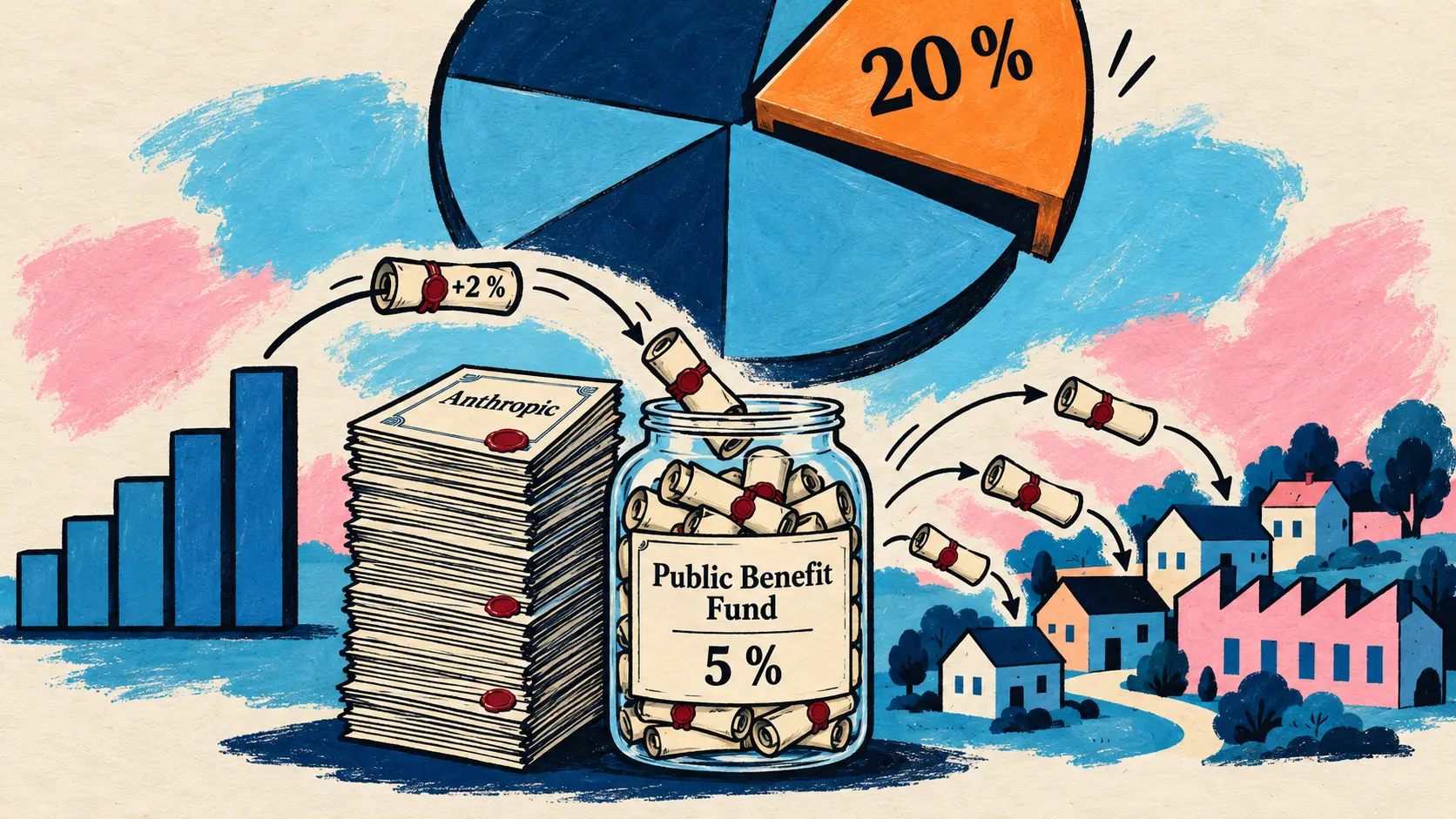
Anthropic is creating a Public Benefit Fund and, subject to shareholder approval, committing 5 % of its shares to it, with further increments tied to increases in its value: including its cofounders’ pledge and employee stock donations, which it matches, around 20 % of its equity is now dedicated to the public good. In OpenAI’s Agents API, GPT-6 Astra Ultrafast is arriving and idle environments are no longer billed, according to a weekly recap from an API team member. Thomas Wolf of Hugging Face estimates the training compute that labs have shared for free on the Hub at nearly a billion dollars, up from less than 40 million at the end of 2023.
Anthropic commits 5 % of its shares to a Public Benefit Fund that could grow with its value
October 18 — Anthropic is creating the Anthropic Public Benefit Fund, a wholly owned LLC dedicated entirely to the public good. Subject to shareholder approval, it is committing 5 % of its shares to the fund; its board of directors could then add up to 2 % for each 50 % increase in its value above an undisclosed baseline. The company presents this mechanism as the reverse of the growing stock compensation that tech companies usually award their executives.
| Stock commitment | Scale of the commitment |
|---|---|
| Initial Public Benefit Fund, subject to shareholder approval | 5 % of Anthropic’s shares |
| Increment for each 50 % increase in value above the baseline | up to 2 % more, at the board’s discretion |
| Cofounders’ pledge, made at the company’s founding | 80 % of their holdings |
| Employee stock donations, matched by Anthropic | around half of employees participate |
| Total dedicated to the public good, including the fund | around 20 % of shares, excluding future increments |
The fund’s shares will not be used for lobbying or political donations, in the United States or elsewhere. Work that combines public interest and commercial value (safety and interpretability, applied biomedical research, discounts on Claude for nonprofits and scientific institutions) remains within the company, a mission-driven corporation (public benefit corporation). The fund could make large donations to nonprofits or direct payments to targeted populations; the post develops the example of employment, toward which Anthropic says it has already committed 200 million dollars. Its structure, governance and increments will be detailed in the coming months, alongside a public benefit report (public benefit report) on progress toward its mission.
🔗 Investing in the public benefit (Anthropic) · The announcement on X (@AnthropicAI)
OpenAI’s Agents API: GPT-6 Astra Ultrafast, sandbox snapshots and an end to billing for idle environments
October 17 — Steve (@stevendcoffey), from OpenAI’s API team, posts his weekly recap of the Agents API on X, the Codex harness opened to developers in public beta on September 10; the OpenAI Developers account reposted it. He lists seven updates, without pricing or figures. Only the first is announced as available: GPT-6 Astra Ultrafast, the premium speed mode launched on September 29 in the API and in Codex.
| Agents API update | Scope stated in the recap |
|---|---|
| GPT-6 Astra Ultrafast | Available in the Agents API |
| Sandbox snapshots (sandbox snapshots) | OpenAI-hosted environments are restored after inactivity, with files intact |
| Revised billing (better billing) | Idle environments are no longer billed |
| Environment keys | Created programmatically, no longer just from the dashboard |
| Artifact SDK | Spreadsheets, presentations and Word documents created or edited in OpenAI’s sandboxes |
| History by turn | Items from a specific turn of the root agent, including sub-agent interactions |
| Vault filtering (vaults) | Vaults can be filtered by their metadata |
None of this was in the documentation yet when we checked on the evening of October 18: the API changelog had no entries after October 16, and the page for OpenAI-hosted sandboxes still listed standard container rates (standard container rates), with model usage billed separately.
Hub Dollars: Thomas Wolf estimates training compute shared on the Hub at nearly a billion dollars
October 18 — Thomas Wolf of Hugging Face publishes a back-of-the-envelope calculation (napkin math), reposted by @huggingface: what it would have cost to rent the GPUs used for the final training runs of the Hub’s main families of open-weight models, available to download for free. His Hub Dollars Space estimates the amount at 991 million dollars, within a range of 816 million to 1.35 billion (from the 10th to the 90th percentile), covering 75 families and 35 organizations. At the end of 2023, this total was still below 40 million dollars.
Fun and crazy napkin math: Meta, NVIDIA, Alibaba, DeepSeek, Moonshot, Mistral and ~30 other labs have shared close to $1B worth of training compute on the Hugging Face Hub — @Thom_Wolf on X
| Organization on the Hub | Central estimate, in millions of dollars |
|---|---|
| Meta | 156 |
| Alibaba | 149 |
| NVIDIA | 114 |
| Moonshot | 55 |
| Mistral AI | 49 |
| DeepSeek | 47 |
| Total for 35 organizations | 991 (816 to 1 345) |
Wolf himself considers this total a lower bound. A base of around 502 million dollars, roughly half, rests on compute figures published by developers, with the remainder based on assumptions, and neither the long tail nor the Hub’s roughly 900,000 community fine-tunes are counted.
Briefs
Products, platforms and awards
- OpenAI’s dots on iOS — Catching up on October 16 news, Dominik Kundel from OpenAI’s DevX team announces iOS widgets for dots, the persistent agents launched on September 29, and support for the iPhone’s Action button; his video also shows a Shortcuts tip for calling his dot with the Camera button. 🔗 source
- Decider V1.2 on Vercel’s AI Gateway — Catching up on October 16, the day they arrived on OpenRouter, covered on the 17th, Perplexity’s Decider V1.2 27B and Decider Flash V1.2 4B decision models join Vercel’s AI Gateway at Perplexity’s prices with no markup or platform fees, including when using your own keys (BYOK), through the AI SDK or Decisions API. 🔗 source
- SynthID among the inventions of the year — Catching up on October 15 news, and like Meta’s Omnilingual ASR and NVIDIA’s NemoClaw covered on the 16th, Google DeepMind’s invisible watermark is among TIME magazine’s best inventions of 2026. Its profile notes that it also marks content from OpenAI, NVIDIA, Kakao and soon Apple, which anyone can verify on synthid.com. 🔗 source · 🔗 TIME
- Gemini CLI, October 18 nightly — No changes: it uses the same commit as the October 17 build, and only the release bot updated the version numbers. Nothing has been merged into the main branch since the evening of October 16, and the community PR adding Gemini 4 Argon to the model selector remains open. 🔗 source · 🔗 PR
Community posts on the Hugging Face Hub
- OpenYap Turn — The Agentic Data Company presents an audio turn-taking model with 72.4 million parameters, trained on 1,984 hours of conversations between friends and family. Ranked first out of 24 for end-of-turn detection on Sesame’s TurnBench, it reports a median latency of 298 ms, compared with 595 and 548 ms for the next two. Its weights are not on the Hub. 🔗 source
- RetryBench — You Liu presents a benchmark that separately evaluates the decision to retry a timed-out tool call and the outcome of the retry. When offered a modified key, the GPT endpoints named Sol, Terra and Luna retry without justification 1, 55 and 60 times out of 80. The code is released under a non-commercial license. 🔗 source
- Detecting an evaluation in activations — On Qwen3, PLLuM and Gemma 3, Mateusz Piesiak (Project Inkblot) shows that eight evaluation cues yield distinct directions: the usual direction mainly detects explicit mention of a test (cosine similarity from 0.81 to 0.89), and a direction learned from seven cues barely detects the eighth, the artificiality of the scenario (AUROC from 0.49 to 0.62). 🔗 source
- Nemotron 3.5 Super VL in 4 bits — The last of three Thoughtworks reports, the first of which, on CharXiv, was covered on October 16: at an equal token count, Gustavo A. Lujan detects no difference between GPTQ calibration on legal or generic text. The weights shrink from 231.8 to 68.1 Gio, with cross-entropy increasing by 0.32 to 0.61 % on legal texts, measured on a preview of the model. 🔗 source
What this means
Anthropic’s fund commits equity stakes, not a cash amount: the post provides neither a valuation baseline nor a dollar figure, and its impact will depend on the shareholder vote, followed by the governance and increments promised for the coming months. Its structure matters too. Wholly owned by Anthropic, as an LLC rather than a charitable organization (501(c)(3)), the fund remains under its control and can switch between forms of giving, with two prohibitions set in advance: lobbying and political donations. Finally, employment, the example developed in the post, is also the subject of reports published on October 16 about its own teams, where the share of junior staff among technical hires fell from 27 % to 9 %.
The Agents API updates target the time when an agent is doing nothing. No longer billing for an idle environment, and being able to restore it with its files, reduces the cost of agents that work intermittently. That time accounts for a large share: Anthropic’s reports on its own teams found that interactive sessions were idle around 80 % of the time, waiting for a response. The source remains a recap posted on X: on the evening of October 18, neither the API changelog nor the hosted sandboxes page, still listing standard container rates, mentioned these changes.
Thomas Wolf’s figure, finally, gives a sense of the scale of the shared resource formed by open models: nearly a billion dollars in compute, compared with less than 40 million at the end of 2023, and it only counts the final training runs of the main families. By Wolf’s own admission, this is a back-of-the-envelope calculation, only half of which rests on published figures. The tally also shows who bore the cost: Meta, Alibaba and NVIDIA lead, ahead of Moonshot, Mistral AI and DeepSeek. Wolf compares it to Wikipedia, written in volunteer hours, while this shared resource is written in GPU hours and data.
Sources
- Investing in the public benefit (Anthropic)
- The Public Benefit Fund announcement (@AnthropicAI)
- The weekly Agents API recap (@stevendcoffey)
- API changelog (OpenAI)
- OpenAI-hosted sandboxes (Agents API documentation)
- Thomas Wolf’s back-of-the-envelope calculation (@Thom_Wolf)
- Hub Dollars (Hugging Face Space)
- Dot widgets and the Action button on iOS (@dkundel)
- Decider V1.2 on AI Gateway (Vercel changelog)
- SynthID among TIME’s inventions (@GoogleDeepMind)
- The SynthID profile (TIME)
- Gemini CLI v0.66.0-nightly.20261018 (GitHub)
- Gemini CLI’s Gemini 4 Argon PR (GitHub)
- OpenYap Turn (Hugging Face blog)
- RetryBench (Hugging Face blog)
- RetryBench on arXiv
- Is evaluation awareness one direction or eight? (Hugging Face blog)
- Calibration and 4-bit quantization of Nemotron 3.5 Super VL (Hugging Face blog)