ai-powered-markdown-translatorArticle translated from French to English with gpt-5.4-mini.
On August 19, 2026, Anthropic published a research study in which Claude autonomously designs proteins that bind specific biological targets, experimentally validated by Adaptyv Bio and Twist Bioscience. Google is launching a back-to-school offer for students with one free year of Google AI and a new student hub in the Gemini app, while Replit is opening Free Mode, unlimited access to software creation powered by OpenAI’s GPT-5.6 Luna. Around these major announcements, Cursor is beefing up its cloud agents, ElevenLabs is rolling out its real-time voice model more broadly, and seventeen other updates cover development, open research, and media platforms.
Claude speeds up protein design, validated by Adaptyv Bio and Twist Bioscience
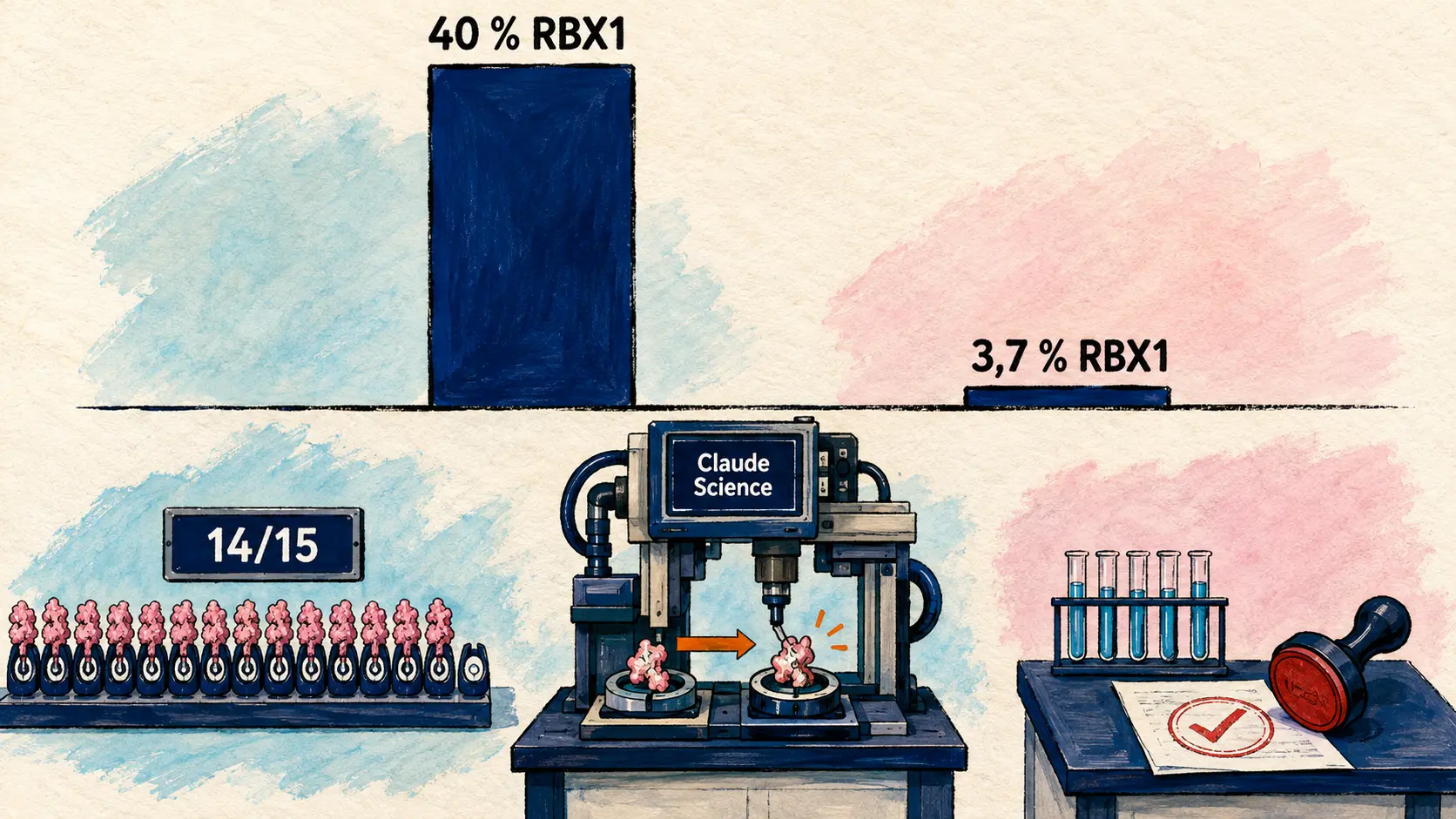
August 19 — Anthropic publishes the results of a research experiment testing Claude’s ability to autonomously design “minibinders” — small proteins capable of binding tightly to a biological target, a key step in drug development that normally requires weeks to months of expert work per target.
Via Claude Science, with access to specialized design models (Opus 4.8 and Mythos Preview), Claude successfully designed binders against 14 of the 15 protein targets tested, starting from a simple prompt written by a human expert. Success rates ranged from 22.6% to 26.7% depending on the model in multi-target mode, and reached 35.1% in single-target mode — compared with a typical rate of 10% to 15% in current design campaigns. On target RBX1, Claude reached a 40% success rate versus 3.7% for human participants in a benchmark competition.
Separately, Claude Opus 5 processed raw NMR and LC-MS spectroscopy files without proprietary software: 23 minutes for a table of 18 NMR peaks accurate to ±0.08 units, and 19 minutes for an LC-MS chromatogram with a purity calculation of 96.4% versus 96.33% in the lab.
Anthropic notes that a high-affinity binder is only a first step toward a drug, and that these capabilities remain dual-use: protein design is not available in open access on Claude Fable 5. The full technical report is published open source on Hugging Face.
With a protein design prompt written by a human expert, Claude autonomously designed protein binders against 14 out of 15 targets. We then worked with Adaptyv Bio and Twist Bioscience, who independently built and tested the proteins Claude designed. — @AnthropicAI on X
Gemini for back to school: student hub, study notebooks, and a year of Google AI free
August 19 — Google is launching a global student offer for back to school 2026, paired with a new student hub in the Gemini app.
| Region | Offer | Plan content |
|---|---|---|
| United States | 1 year of Google AI Pro free (value $19.99/month) | 4x usage limits, Gemini Spark, Gmail/Docs integration, 5 TB of storage |
| 140+ countries | 1 year of Google AI Plus free | Gemini Omni, doubled limits, 400 GB of storage |
The offer is reserved for eligible students, requires a valid payment card (auto-renewal after the free period), and the claim window runs until December 31, 2026.
The student hub introduces several new features: study notebooks, an adaptive learning environment with diagnostic quizzes, lessons built from the student’s course materials, and a progress dashboard; interactive visualizations — 3D simulations and dynamic charts generated in chat by prefixing the prompt with “Show me…”; and Deep Research in Gemini Live, which lets users start a multi-step research report by voice, lock their phone while the research runs in the background, then discuss the results orally.
Talk through research with Gemini Live. You can now kick off multi-step research reports with your voice: 1) Ask Gemini Live to Deep Research a complex topic 2) Lock your phone or switch tasks while it works in the background 3) Get notified when it’s done, then seamlessly talk through the findings hands-free. — @GeminiApp on X
Replit launches Free Mode, powered by OpenAI’s GPT-5.6 Luna
August 18-19 — Replit launches Free Mode, free and unlimited access to everyday software creation tasks, powered by OpenAI’s GPT-5.6 Luna. The announcement was presented exclusively to Fortune as the result of a strengthened partnership between the two companies, with more joint products to come.
| Mode | Usage |
|---|---|
| Free Mode | Unlimited daily tasks, no credits consumed (GPT-5.6 Luna) |
| Power Mode | Cost/speed-optimized models for regular use |
| Max Mode | High-performance models for complex builds |
According to Replit, Free Mode lets users “create up to 30 times more” with the same subscription, with up to 30 hours of chat included per month and limits resetting every 5 hours. When a task requires more reasoning, Replit can route to GPT-5.6 Sol and then return to Free Mode while preserving project context. Free Mode is included in Core ($20/month) and Pro plans, made possible according to Amjad Masad (CEO of Replit) by OpenAI’s recent price cuts on the GPT-5.6 series.
For Replit, this is a direct response to a known pain point in “vibe coding”: the unpredictable cost of usage credits, which slows experimentation. For OpenAI, it is a new showcase for GPT-5.6 Luna, positioned as an economical large-scale model rather than a frontier model.
If we can get to a world where anyone with access to the internet can build a product, build a startup, and just kind of get started and get going, I think we’re going to see another renaissance-level entrepreneurial boom like we’ve never seen before. — Sam Altman, OpenAI CEO, quoted by OpenAI
Cursor beefs up its cloud agents with /goal, isolated subagents, and Custom Modes
August 19 — Cursor is rolling out a wave of features that push its cloud agents toward greater autonomy, with the stated goal of making them work “like a system” rather than tools that must be relaunched at every iteration.
/goal: gives the agent a persistent goal to work toward until full completion (e.g./goal fix all flaky tests and make CI green), without stopping at the first attempt.- Automatic subscriptions: cloud agents now monitor pull requests, Slack threads, and scheduled tasks, and automatically subscribe to the PRs they create in order to drive them to completion (CI fixes, bot feedback handling).
- Subagents on isolated machines: each subagent can now run on its own virtual machine with an isolated copy of the project, useful for testing changes in a fresh environment or parallelizing fixes without conflicts.
- Custom Modes: any skill can be pinned as an always-on mode in chat, accessible via ⌥⏎ (Mac) or Alt+Enter (Windows).
- Improved steering: a message sent while an agent is working no longer interrupts its current action — it is queued and handled at the next tool call.
This update continues Cursor’s strategy (Origin, cloud agents) of turning the editor into an orchestration platform for autonomous agents rather than a simple interactive assistant.
ElevenLabs launches Eleven v3 Conversational in general availability
August 19 — ElevenLabs announces general availability for Eleven v3 Conversational, its most expressive model for real-time voice, now available on ElevenAgents and ElevenAPI.
| Feature | Detail |
|---|---|
| Voice library | more than 11,000 voices |
| Supported languages | more than 70 languages |
| Starting price | $0.05 for 1,000 characters (degressive) |
The model has been specifically optimized for real-time use, with consistent quality across streaming generations. It introduces audio tags that provide fine-grained control over emotion and tone: voices can be directed to laugh, whisper, adopt a sarcastic tone, or express curiosity. Performance is highlighted especially in German, Spanish, French, Portuguese, and Hindi.
This launch strengthens ElevenLabs’ position in real-time conversational voice, a segment where latency and expressiveness are the differentiating criteria against competing models. A full walkthrough was published by the ElevenLabs Devs team to help developers integrate the model.
Claude can now send Gmail emails and manage Google Drive
August 18 — Claude can now act directly in Gmail and Google Drive: draft and send a reply in a thread, or manage files in Drive, without the user having to manually copy and paste content. The feature goes through the connectors menu, where users only need to connect their Gmail or Google Drive account to enable it.
Anthropic highlights user control: the user decides when manual approval is required before Claude sends an email or modifies a file. The feature is available now on all paid plans, a notable expansion of Claude.ai’s agentic scope beyond simple chat, continuing the connectors already offered (Slack, GitHub).
Code tools: remote MCP in Amp, Zed 1.16, and Devin at GE Aerospace
Three code editors and agents are shipping notable updates on August 19.
Amp connects remote MCP servers to orbs, the TUI, and Puck
August 19 — Amp (Sourcegraph) adds support for remote MCP servers across all of its interfaces: orbs (cloud machines for agents), the local TUI, and the Puck voice assistant. Configuration is done from ampcode.com/settings/mcp-servers, with OAuth or Bearer token authentication, in personal or workspace-wide setup. MCP Apps, Resources, and Prompts are not yet supported — only classic MCP tools are supported for now. This feature completes Amp’s “orbs” strategy begun in mid-August.
Amp lets you invite your team to collaborate in an orb
August 19 — Amp adds the ability to invite colleagues into an orb by mentioning them with @. Once tagged, the person can view the thread, take over (“drive”), and exchange messages directly in the conversation with the agent. The announcement illustrates several concrete use cases: requesting a design asset, asking for a code review on a diff, or making a production-deployment decision. It is a logical evolution of Amp’s “orbs” model: these cloud machines dedicated to an agent become a shared workspace rather than a tool isolated on one developer’s machine.
Zed v1.16: collapsible Git Panel, named stashes, and Gemini 3.6 Flash
August 19 — Zed releases version 1.16 of its editor. The Git Panel gets collapsible change sections, the git: stash all command lets users name a stash, and the gutter.git_gutter_width setting adjusts the width of diff indicators. In Markdown Preview and the Agent Panel, Mermaid diagrams now support zoom and horizontal scrolling. On the model side, Gemini 3.6 Flash joins the Google AI models available in Zed, alongside new OpenCode Zen and OpenCode Go models. A routine maintenance update, while Zed continues to roll out its major feature still in private beta, Delta.
Cognition highlights GE Aerospace as a Devin customer
August 17 — Cognition (Devin) publishes a customer testimonial highlighting GE Aerospace, which uses Devin to speed up the development of embedded software tied to its aircraft engines. According to Cognition, one team nearly doubled its engineering output thanks to the tool; the software involved optimizes flight routes, reduces fuel consumption, and monitors engine anomalies. No detailed article accompanies this announcement (no blog post or full case study): it is a one-off communication on X, and should be taken as such — a marketing figure not publicly detailed at this stage.
Liquid AI publishes LFM2.5 Q4_0 checkpoints via quantization-aware distillation (QAD)
August 19 — Liquid AI publishes GGUF checkpoints quantized in Q4_0 on Hugging Face for four LFM2.5 sizes (230M, 350M, 1.2B-Instruct, and 2.6B), obtained via quantization-aware distillation (QAD): a high-precision teacher model is distilled directly into a quantized student model, rather than quantization being applied after the fact.
Announced result: the checkpoints recover 97% of the average accuracy lost by classic quantization, on benchmarks including GPQA Diamond, MMLU-Pro, and IFEval. Tested on MacBook Pro, NucBox EVO-X2, Samsung Galaxy S26 Ultra, and Raspberry Pi 5, the 230M/350M variants match the quality of a Q5_K_M with throughput 4 to 33% higher. All four variants are available now and can be deployed via llama.cpp.
Gemini: Chrome on Android in the United States, Waymo brings along the assistant
Google is extending Gemini to two new touchpoints outside the main app.
Gemini in Chrome now available on Android in the United States
August 18 — Gemini in Chrome, the AI assistant built into the browser, is opening to Android users in the United States. Core features (long-page summaries, connection to Google apps, image generation in the browser) are available to all US Android users. Google AI Pro and Ultra subscribers additionally get auto browse, capable of handling repetitive tasks such as reserving a parking spot or updating an online order.
Waymo integrates Gemini into its Ojai vehicles
August 19 — Waymo integrates Gemini as an onboard AI assistant in its autonomous Ojai vehicles. Passengers can use voice commands to interact with the cabin (adjust the air conditioning, for example), discover nearby places, or get contextual information about their trip. The integration works independently of the Waymo Driver driving system: Gemini remains inactive until the passenger deliberately activates it via a dedicated icon, preserving the separation between the conversational assistant and the autonomous driving stack. The announcement does not specify a rollout date or the cities involved.
GitHub: code quality trends and Copilot session steering
Two updates focus on governance and tracking team work.
The organizational Code Quality dashboard adds a Trends tab
August 19 — GitHub’s organizational Code Quality dashboard is gaining a Trends tab. Previously limited to a fixed snapshot of findings across an organization’s repositories, it now adds a 7-, 14-, or 30-day trend graph, grouped by health score or severity. Two tables complement the graph by ranking repositories by the change in the number of open findings. The feature is generally available on GitHub Enterprise Cloud and GitHub Team with Code Quality enabled, but not on GitHub Enterprise Server.
The GitHub Copilot app details the My work panel for steering sessions
August 19 — GitHub publishes a guide detailing the My work panel in the GitHub Copilot app, a central hub for tracking pull requests and issues related to Copilot sessions. It offers four default views (All, Active, Review requests, Done) and custom views using GitHub filter syntax or a UI builder. Two display modes are available — a card-style list or a table with customizable columns — and it is possible to start a new Copilot session directly from a selected issue or PR, including in bulk.
Media generation: SkillEvaluator, video distillation, and unlimited access on Runway
Three new items affect agent evaluation, video generation research, and model access respectively.
NVIDIA releases SkillEvaluator, an open source tool to measure the impact of agent skills
August 19 — NVIDIA releases SkillEvaluator, an open source tool that measures the real impact of AI agent skills. The team evaluated more than 300 verified NVIDIA skills across 30+ products, comparing the performance of the same agent on the same task with and without the skill installed. Results measured across five dimensions: correctness +41 points (46→87), discoverability +40, efficiency +39, productivity +35, safety +1 — an average gain of +31 points across all dimensions combined. NVIDIA notes that the skill domain matters far more than the choice of agent harness (variation of +2 to +46 points depending on the product, versus about 5 points depending on the harness).
Context-Matched Distillation (CMD): fast, controllable autoregressive video generation
August 14 — A researcher (Hmrishav Bandyopadhyay), relayed by NVIDIA AI, presents Context-Matched Distillation (CMD), a framework for fast, controllable autoregressive video generation. The method aligns the teacher model’s evaluation with the student model’s generation context through Prefix Scoring: a causal teacher evaluates each target without access to future frames, unlike classic bidirectional approaches. CMD enables frame-by-frame or block-by-block generation, with interactive control of the camera trajectory at each frame and efficient inference in few steps, suitable for real time.
MiniMax H3 switches to unlimited generation on Runway (limited offer)
August 19 — Runway announces that the MiniMax H3 video model is moving to unlimited generation for Max plan users, for a limited time: no cap or counting on generations with this model. MiniMax_AI relayed the same announcement on its side, confirming the cross-platform offer between the two platforms. No new model is being launched: this is a temporary change to the terms of use on an already available model, intended to drive adoption of MiniMax H3 on Runway.
GLM-5.3: online API and benchmark overview
August 18 — The GLM-5.3 API (Z.ai) is online, available through the official API and partner gateways, at the same price as GLM-5.2. Artificial Analysis publishes a detailed numerical overview:
| Metric | GLM-5.2 | GLM-5.3 |
|---|---|---|
| AA Intelligence Index | 53 | 60 |
| GDPval-AA v2 (Elo, agentic) | 1524 | 1770 |
| Cost per task | 0.44 $ | 0.68 $ |
The model keeps the same architecture (753 billion parameters, 40 billion active in MoE), a 1 million-token context window, a MIT license, and pricing of 1.40 $/million input tokens and 4.40 $/million output tokens. At 0.68 $ per task, GLM-5.3 remains 19% cheaper than Kimi K3 and 45% cheaper than GPT-5.6 Sol. On Terminal-Bench 3.0, the model jumps from 4.6% to 32.4%. Open weights are expected “within the week,” according to Z.ai.
OpenAI: stronger API privacy and ad expansion in Europe
Two OpenAI announcements on August 19 affect enterprise data privacy and the expansion of the advertising program respectively.
OpenAI relaunches Zero Data Retention and previews Private Safety Processing
August 19 — OpenAI reaffirms its Zero Data Retention (ZDR) commitment for eligible API customers: prompts and model responses are not retained after processing, and the content is not accessible to OpenAI staff. The company is also previewing Private Safety Processing, designed to detect abuse patterns across multiple linked interactions (malicious intent, repeated probing of guardrails) without giving OpenAI staff access to the underlying content — whether that content stays on the customer’s infrastructure or is stored encrypted with customer-controlled keys. Automated systems identify potential abuse and return limited safety signals.
ChatGPT Ads expands to 31 European markets
August 19 — OpenAI announces the expansion of ChatGPT Ads to 31 European countries the following week (Germany, France, Spain, Italy, Sweden, Norway, Denmark, the Netherlands, Austria, among others) — the largest expansion to date of the advertising program, launched in pilot in the United States in February. Ads will be shown only to users on the Free and Go plans — Plus, Pro, and Enterprise subscriptions remain ad-free. OpenAI has expanded targeting beyond CPM/CPC toward conversion optimization, with geo-targeting, custom audiences, and measurement via the OpenAI Pixel.
DeepSeek V4 Pro available in Perplexity Computer, hosted in the United States
August 18 — Perplexity adds DeepSeek V4 Pro to Perplexity Computer, with hosting localized in the United States — a detail that matters for customers concerned about data residency, rather than hosting at DeepSeek in China. The team says it evaluated the model on its internal WANDR benchmark, where it scores 0.359 at a cost of 0.75 $ per task, 62% cheaper than the next model on the cost-performance frontier. This announcement follows the broader rollout of DeepSeek V4 Pro seen at other providers (Together AI, Novita), with a Perplexity-specific numerical datapoint here.
Briefs
- Claude Desktop starts about twice as fast — a background throttling fix corrects a startup slowdown identified a month ago. 🔗 Tweet
- GPT-5.6 Sol at -70% in Devin Desktop and Devin CLI until October 3 — Cognition promotion on a model deemed strong on the FrontierCode 1.1 benchmark. 🔗 Tweet
- Replit prepares new enterprise governance tools — full audit logs, enterprise workspace settings, and administration API at scale, with no availability date specified. 🔗 Tweet
- DeepSeek V4 Flash summarizes 1,000 research papers for 4 USD — a third-party developer summarized and visualized the year’s top papers for a total cost of 4 $. 🔗 Tweet
- Higgsfield AI becomes a Together AI customer for video inference — the platform behind Cinema Studio, fresh off a $400M funding round, runs its video models on Dedicated Container Inference. 🔗 Tweet
- Four BTS interactive experiences in the Gemini app — music quiz, tour tracking, and Korean learning, accessible via code 7777. 🔗 Google announcement
- Managed enterprise settings for GitHub Copilot in JetBrains — plugin governance, MCP server allowlist, OpenTelemetry configuration, and permission mode control. 🔗 Changelog
- Revocation and deauthorization of credentials by token type — GitHub now lets you target PATs, SSH keys, OAuth tokens, or GitHub App during a security incident. 🔗 Changelog
- HeyGen launches 4K upscaling for real estate listing videos — turn a blurry video into 4K without reshooting. 🔗 Tweet
- HeyGen automatically translates real estate news videos — more than 175 languages to reach non-English-speaking buyers. 🔗 Tweet
- Synthesia promotes the creation of personal lookalikes — a digital avatar generated from your own face, accessible to any user in minutes. 🔗 Tweet
- Suno improves playlist management on web and mobile — shuffle, track reordering, and playlist filtering, mobile coming soon. 🔗 Tweet
- Kimi K3 available via Ollama Cloud, integrated with Claude Code and OpenCode — deployable directly with
ollama launch claude --model kimi-k3:cloud. 🔗 Tweet - Technical issue with Advanced Account Security causes some users to lose access to Daybreak Blue — affected accounts must re-verify before the September 1 deadline. 🔗 Tweet
- How NVIDIA upskills its teams with ChatGPT Work — GTM and solutions architecture teams save up to 16 hours per week on automated workflows. 🔗 OpenAI case study
What this means
Large models are beginning to produce results measured in the lab rather than in benchmarks alone. Anthropic’s protein design experiment is changing in nature: Claude no longer just generates plausible text, its protein binders have been independently built and tested by Adaptyv Bio and Twist Bioscience, with a success rate that exceeds industry standards. In a different vein, NVIDIA’s SkillEvaluator applies the same controlled testing logic to coding-agent skills — same task, same model, only the installed skill changes — and quantifies gains of up to +41 points. These two announcements share a common principle: measure the real contribution of an AI capability rather than assuming its value.
The agentic infrastructure for software development is becoming denser around extended autonomy. Cursor introduces a persistent objective (/goal) and sub-agents on isolated machines, Amp opens its orbs to remote MCP servers and team collaboration, and Zed keeps moving forward while its major Delta feature remains in private beta. Devin, meanwhile, is establishing itself in aerospace with GE Aerospace. These updates converge on the same goal: making agents run as a continuous system rather than as a tool restarted on every iteration. Replit pushes this logic all the way to access: Free Mode, powered by GPT-5.6 Luna, makes software creation free for everyday tasks, a decision made possible by the ongoing drop in frontier model inference costs.
Data and access governance are becoming a selling point in their own right. OpenAI is previewing Private Safety Processing to detect abuse without exposing customer content, in addition to its Zero Data Retention commitment. GitHub, for its part, now lets users revoke credentials by token type during an incident, adds managed enterprise settings for Copilot in JetBrains, and enriches its organizational Code Quality dashboard with a Trends view over several weeks. In all three cases, the issue goes beyond the isolated feature: it is about giving security and compliance teams fine-grained control tools, an increasingly common requirement for enterprise AI adoption.
The cost-performance ratio continues to shape competition among models. Z.ai’s GLM-5.3 is close to Kimi K3 on Artificial Analysis’s Intelligence Index while remaining cheaper per task than GPT-5.6 Sol, pending publication of its open weights. DeepSeek V4 Pro lands at Perplexity with U.S. hosting and a cost-performance score 62% lower than the next model on the frontier. Liquid AI, by contrast, is optimizing the low end: its LFM2.5 checkpoints, quantized by distillation quantization-aware training, recover 97% of the accuracy lost by classic quantization, making them suitable for running on a Raspberry Pi 5. And Kimi K3 joins Ollama’s cloud, directly usable from Claude Code — a sign that portability between tools now matters as much as the model itself.
Sources
- Anthropic — Claude accelerates protein design
- Tweet @AnthropicAI
- Tweet @claudeai — Gmail and Google Drive
- Tweet @ClaudeDevs — 2x startup
- Cursor — August 19 changelog
- Replit — Free Mode
- OpenAI — Replit
- Amp — MCP in orbs
- Amp — collaborate in an orb
- Tweet @zeddotdev — Zed v1.16
- Tweet @cognition — GE Aerospace
- Tweet @devindesktop — GPT-5.6 Sol promotion
- Tweet @Replit — enterprise governance
- Hugging Face — LFM2.5 QAD
- Tweet @nutlope — DeepSeek V4 Flash
- Tweet @togethercompute — Higgsfield AI
- Google — Gemini student offer
- Tweet @GeminiApp — Deep Research in Gemini Live
- Tweet @googlechrome — Gemini in Chrome Android
- Google — Gemini at Waymo
- Google — BTS interactive experiences
- GitHub Changelog — Code Quality Trends
- GitHub Blog — My work panel
- GitHub Changelog — managed JetBrains settings
- GitHub Changelog — credential revocation
- Tweet @ElevenLabs — Eleven v3 Conversational
- Tweet @NVIDIAAI — SkillEvaluator
- Tweet @hmrishavbandy — Context-Matched Distillation
- Tweet @runwayml — unlimited MiniMax H3
- Tweet @HeyGen — 4K upscaling
- Tweet @HeyGen — real estate video translation
- Tweet @synthesiaIO — lookalikes
- Tweet @suno — playlists
- Tweet @ArtificialAnlys — GLM-5.3 review
- Tweet @ollama — Kimi K3 on Ollama Cloud
- OpenAI — Zero Data Retention and Private Safety Processing
- OpenAI — ChatGPT Ads in Europe
- Tweet @OpenAIDevs — Daybreak Blue
- OpenAI — NVIDIA ChatGPT Work case study
- Tweet @perplexity_ai — DeepSeek V4 Pro